ACoAs: Getting to our EMOTIONS (Under)

feelings hurtFEELING BITE!
I won’t let anyone get to me

PREVIOUS: Feelings Aren’t Facts – #2

POSTs:  Emotional Maturity


ISSUE
ACoAs were trained to ignore our Es, often with tragic consequences. It prevents us from being able to identify what is:
• suitable or not for us          • mentally sane & logical
• psychologically healthy       • genuinely pleasurable
STYLE
• At its simplest: The Right brain governs our emotions & the Left brain our thinking (among many other things).
Connecting the 2 sides is a thick mass of nerves, the Corpus Callosum, allowing the halves to communicate, like being able to verbalize (T)<—> feelings (E).  (see posts re. M & F Brains)

• Everyone is born with a unique personality which then interacts with their  environment & training.  Growing up in constant stress, for protection the 2 sides can stop communicating. Then some people function too much from the L & others too much from the R. We can see this in the way we react to physical or mental hurt.

1. UNDER-FEELING – L brain
Under-Feelers (U-F) “live in their head” to avoid painful Es, cut off from a vital part of our being, & need ways to re-connect the ‘wiring’.
a. GOAL – TO:all Es
• feel all our emotions without judgment
• learn names of a wide range of emotion & be able to associate them with sensations the body generated in the limbic system
• learn how to manage painful emotions when they surface
• regularly use available tools to get in touch with repressed emotions
• nurture the Inner Child so our Abandonment pain diminishes – making us less afraid of Es!

TOOLS
• The exact order & stages (process) needed break thru layers of emotional denial is different for every person & can’t be predicted. Each of us starts at a different mile marker on the road to Recovery. So the effectiveness & timing of these activities will vary

• Any one, or a combination, of the following methods can bring up Es we had to push into the unconscious.  It takes patience & perseverance. Try as many as you can & never give up

BODY WORK — ANY available in your area, like:
acupuncture, to re-align meridians so energy can flow freely (Es are energy)
Brain Gym (re-patterning), to reconnect the 2 brain halves
• core energetics, a safe way to clean rage out
• craneo-sacral therapy, to get trapped cerebro-spinal fluid moving
massage, to release holding Es in muscles
◉  If none of these are available, go to a gym, find a place to run, get a punching bag, hit pillows, get a plastic bat & use it on the bed or couch
READING
• 12-step literature          • Personal-growth articles & books
• Spiritual works         • any other writing that ‘touches’ you
SEEING / LISTENINGspiritural practice
• movies, plays, classical & modern music, choirs
• old family photos, diaries, letters….
SPIRITUAL
• religious services, spiritual gatherings
• meditation, prayer….

TALKING
• 12-Step Meetings – Al-Anon,  ACoA, SIA (Survivors of Incest)….
• any form of therapy – individual, group, experiential, primal….sharing
• loving friends, getting family info from anyone willing to talk
VISUALIZING
• Inner Child visualizations & guided imagery
• ‘hypnosis’ – with a trained therapist or self-administered (fully awake but with focused concentration on a topic)
WRITING
Dreams – write them out using the Gestalt Method
Evening Inventory – Brief Journaling OR a positive 10th Step
4th-Step inventory: list of character defects, childhood traumas & losses – but NOT used for self-abuse!
2-handed IC dialogues – learning to listen to the Inner Child AND how to respond lovingly

 Lists of positive qualities – 5 or 6 categories (PMES, Natural abilities, Learned Skills, Talents, Interests, Personality traits… ). Use POST: “Our Timeline inventory”
–> Add to each category as often as you think of : things you do automatically, what you’ve learned in school or on your own, natural tendencies, tastes, interests…, whatever you’re good at, AND anything positive that other people say about youjournaling
Morning pages – stream of consciousness – first thing in the a.m. we’re less ‘defended’ against our inner truth (POSTs “Writing for Personal Growth

• keep a separate list of self-hating beliefs every day to ’hear’ how ugly & untrue they are.  ASK: “Would I say these things to someone I love?” If not, then why let the Pig Parent say them or let the kid agree with them? You can change that!

NEXT: ‘Getting to our Feelings’ – OVER – #1

“FEELINGS AREN’T FACTS” (Part 2)

heart talkWHEN THE HEART TALKS….
… I should listen

PREVIOUS
: “Feelings aren’t facts” (#1)

SITEs: • How to listen to the heart
• Diff between feel, think, believe

POSTs : Use THINK instead of Feel


1. FEELINGS (Part 1)
2. ‘FACTS’:  The other problem with this platitude is that these 2 words don’t really belong together (feelings & facts).
a. Facts – are only actions, quantifiable, with measurable results. Simplified – facts come from the head.
b. Feelings – as pointed out in Part 1, has 3 different uses, 2 legit, 1 not.

For people who use this term – ‘feelings’ means Emotions (Es) and Es are never ‘facts’ – they are internal experiences – from the gut.  Yes, it’s a fact that we have emotions. Even Vulcans have those pesky things, underneath. For humans, to be cut off from them turn us into narcissists or worse – sociopaths!

• Eventually someone in Al-Anon added what they thought was a clarification: “Feelings aren’t facts, but it’s a fact that I’m having these feelings”.  OK – this does refer to Emotions. This was encouraging for many of us to hear, because as CoAs we were taught to repress some or all Es – to deny them as irrelevant or unacceptable.  So this version gave permission to FEEL emotions.
But this is not what the phrase “Feelings aren’t facts” actually means.
circular

c. Thoughts (Ts) are not technically facts either, but rather ‘constructs’ of the mind – not tangible in themselves. They are:
• the cause of emotions (in the present) :
EXP : T ⏩ “I can’t believe she never called me back. What a b— I’m so angry!” ⏪ E
Unrealistic expectations, cruel toxic rules, scary projections, unfounded assumptions & S-H … lead to distorted thinking & obsessions, which cause us great suffering, & often lead to unfair or harmful actions toward others!
OR
• the cause of actions, healthy or unhealthy, depending on the type (may not be conscious, but the real reason for behavior)
✒︎ NOTE : Watch out for people who ONLY talk about what they or other people are doing, where they’ve been, who they know, what they’ve accomplished…. Facts, facts, facts!  That tells us they’re NOT in touch with their emotions, which makes them unsafe in relationships, for anything other than giving information – if that!

CONCLUSION: Based of these distinctions, what does “Feelings are facts” really mean?
ANS: In this case ‘Feelings’ are obsessions, circular repetitive thinking built on negative, distorted beliefs, and NOT emotions at all! which are not telling us the truth (facts) about a situation.”
✒︎ In other words : “What my obsession is telling me is most likely a lie.”

And what do most ACoAs endlessly obsess about ? :
bad thoughts☁︎ EITHER Self-Hate
”I don’t know why he won’t talk to me – why is she ignoring me – was it something I said? Maybe I should have been nicer to her.  I probably sat in the wrong chair… I know he doesn’t like me… what can I do to change their mind… “  –  bla, bla, bla….
OR
👺 Rageful thoughts towards others
“How dare she treat me like that… Why didn’t he call me…. I never did anything to her… I’m going to give her a piece of my mind… I hate her, she’s a witch…. no I’d better not… what should I say… I don’t want to get fired…”  grrrrr , grrrrr

❖ Healthy THINKING is imperative for us to function well in the world & in personal relationships. This requires :
• accurate, reasonable & present-day information about how everything really work   • what our needs, goals & dreams are
• what is positive about oneself (character & abilities)
• what it means to be human (determined, imperfect) images-4
• universal spiritual truths about Higher Power.

EXRESS  thoughts
, opinions & beliefs, directly:
• “I think that the government should…”
• “That’s not my opinion”   •   “I wouldn’t say that…”
• “I suspect he’s not going to honor his agreement”
• “I’m convinced there’s a better way to do this project”

❖ Healthy EMOTIONS are NEVER good or bad, but rather range from the very painful <———–0————> to the very joyful.  ‘0’ is neutral.
✒︎ We’re most successful & comfortable when we live within a range of +5 to -5 on either side of center, most of the time, although not exclusively. Times of great stress OR great joy will push the range much higher or lower, but not get stuck at either extreme.
☆ This medium state can only happen when healing diminishes accumulated anxiety so we don’t have to alternate between the ‘outer limits’ of misery or fantasy/illusion!
(REVIEW all posts on Emotions)

NEXT: Getting to Our EMOTIONS – Under

“FEELINGS AREN’T FACTS” (Part 1)

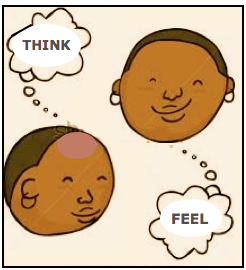
think or feelTHOUGHTS vs EMOTIONS
I’m confused! What are you talking about?

PREVIOUS: Recovery Thoughts


This is a familiar phrase used in 12-Step Programs, but not exclusively. It contains an intrinsic truth and an intrinsic lie.  We have to examine both words – ‘feelings’ and ‘facts’ – to understand.
1. FEELINGS
a. CONFUSION:
• In our language, the word feelings is used in almost every context to mean either thoughts, emotions or sensations, without distinction.
• The main problem is that most of the time people use ‘Feel’ to mean Thoughts, not emotions. This causes confusion for both speaker & listener.

confused• This triple usage may be a clever ploy in our culture – likely unconscious – to suppress Emotions! We’re taught to live in our head & only focus on actions (“Just do it”), which we gladly embrace as a defense against facing our deepest pain.
So, along with many other sources (family, media, male culture, war, sport…) our language encourages cutting us off from an essential part of ourself

b. CLARITY:  We’re not going to change how we talk, but we can understand the 3 uses of the word FEEL, so we can be accurate.
i. Sensations – ‘Feel’ as a Physical experience : I feel hungry, tired, thirsty, sexual…
ii. Emotions: If ‘feel’ as indicating Emotions –  followed only by a single words : “I feel…… sad, glad, mad, anxious, pleased…..”.
AND we can have more than one E at the same time, even contradictory ones.
“I’m happy to see you, but disappointed that Ted’s not here too.” (Posts: Use THINK, not feel)
iii. Thoughts :
 The word “Feel” should never be used to mean Thoughts / Opinions / Beliefs.  Thoughts are always in sentence form, always more than one word. 
When “Feel” is misused, it usually leads with ‘that‘ or ‘like’:
•  “I feel like he wants to talk about something”
•  “It feels like you’re not supporting me”
• “I feel that we should leave soon”
• “I don’t feel that we’re communicating”
•  “I feel like going to the movies”

Stated as such, none of these are about emotions, only ideas – ** even though emotions are implied but not acknowledged. It’s subtle & at best unintentionally, at worst it’s manipulative & dishonest

c. INDIRECTness : Another mix-up occurs when thoughts are expressed in a round-about way. Such statements are clearly sentences, but couched in terms of feeling, which makes the speaker sound unsure of themself. They’re not actually expressing confusion, but rather insecurity by asking for permission to have a voice.

ACoAs are ‘notorious’ for talking around an important point, leaving out crucial info, adding too many qualifiers, justifications & apologies! This misuse comes from not being allowed to own our personal power.
We say:
• “ I hope you don’t mind if I tell you…”
instead of
  “I’d like to tell you something / I need to talk to you about___”

• “Is it alright if I___ , Will you be upset if___ …”
instead of (with a smile, perhaps) “I won’t be able to____ , I need to____ , I’d like to___ , I’m not available for___”

• “I feel like I’m doing better”  instead of “I’m doing better”
• “I feel like I can’t trust them”  instead of “I know they’re not trustworthy”

☑️ Unfortunately, for many ACoAs, being direct is not just considered impolite but actually aggressive! which it is not IF statement are accurate & made without anger.
Sadly, women are more likely to be indirect as a way to not be pushy, which makes staying connected easier, but at a personal price. (BOOK : “He & She” by Chris Evatt)

YES, there is a time & place for careful wording, being respectful of others’ time & space, or for apologizing.
HOWEVER, the above examples of waffling have to do with ACoA shame, S-H, fear of being seen, of punishment or being cut off.

The BEST, clearest way to communicate combines emotions + thoughts in the same sentence : be clear
• “I’m scared you won’t stay with me”
• “I’m so happy that you got the promotion”
• “I feel sad that she’s ignoring me”
• “I’m worried that he won’t like this gift”
• “I’m excited for you & curious about what you’re going to be doing”
• “I’m concerned that you’re going there alone”
This of course implies that we know what we’re feeling (emotions) and have permissions to own & express them.
🔴 Practice verbalizing your thoughts & emotions using declarative sentences, so they come out of your mouth more easily. And repeat, daily: “I know what I know”!

NEXT: “Feelings aren’t facts”, Part 2

RECOVERY Thoughts for ACoAs

lion & lamb
MAKE FRIENDS WITH YOUR INNER JUDGE
– just don’t obey it!

PREVIOUS: My Rights Qs (25-48)

SITE: 5 Major Benefits of Recovery


This is a open-ended review
– which can be used as a set of goals to work toward & to see our progress. Add your own to each category.

♥ Be absolutely sure that you:
• are damaged, not defective. Damage can be healed, & you’re OK
• can be of service to others without being co-dependent
• can say & believe – “I Know what I Know, & I can’t know everything”
• have a right to be alive, and be exactly who & what you are
• have a right to & can achieve a measure of healing & happiness

♥ Be Accepting of:
• all your emotions, no matter how unpleasant or socially unpopular
• other people’s differences. You don’t need them to be carbon copies
• your childhood damage, without constantly repeating it
• the time it takes to work on your issues
OF
• your own reactions to what others do & say to us
• your Inner Sadist (I.S.). The more they hurt us as kids, the angrier we are. If we make friends with the I.S. we don’t have to act it out on anyone
• other people’s kindness, compliments, validation
• our humanity, with it’s beauty & it’s imperfections

outer child♥ Be Aware :
• of your talents, gift, accumulated knowledge & experience
• of the options you have in most situations
• of your effect on others, positive or negative
• of how other people can trigger your old pain (the buttons)
AND
• that you’re not your own Higher Power
• that God is not an alcoholic parent
• that your emotions cannot harm others – only your words & actions
• that others’ reactions to you are about them & are their responsibility

♥ Be healed enough to:
• be able to take care of yourself, reasonably well
• hear what other people are actually telling you about themselves
• not try to fix others, no matter how much pain or trouble they’re in
• no longer be sexually attracted to emotionally or physically inappropriate or dangerous people (rage-aholics, alcoholics, gamblers drug addicts, & other narcissists)
TO:
• stay at a respectful distance from ‘nice people’ who are passive-aggressive, needy, or so shut down that you can’t connect with them
• act appropriately in most social situations – neither from perfectionism nor from rebellion, not from co-dependence nor from terror
• not have to obey your Toxic Rules
• to listen to good advice, but ultimately follow your gut & experience

♥ Be willing to:
• be as emotionally honest with others as you’re capable of, without hurting yourself or them (live in your truth)
• be the Good Parent & Healthy Adult, taking care of the Healthy kid
• express all your talents (skilled or imperfectly)
• follow your dreams, no matter who objects
• keep looking for answers to your difficulties. Don’t be ashamed to ask for help before you collapse!
• listen to the needs, thoughts & emotions of the WIC
• never give up, no matter how hard things are, but it’s good to take breaks
• not let the WIC run your live, nor let the kid do self-harming things

MAJOR RECOVERY TRUTH: A sure sign of mental health & emotional maturity is to know in your very bones that:
Most things being done to us or around us have NOTHING to do with US!
Being convinced that it does – comes from the PP or WIC.

self-love treeTo repeat: Most the time, “It’s not about us = ie – our True Self”!
That includes all the stuff our parents did to us, at us, on us, around us, BUT not about who we are fundamentally!
Even when people react to something we did or said, their behavior is their responsibility. As a reminder, see post on ‘Personal Responsibility’.

NEXT: “Feelings aren’t facts” #1

REQUEST of my READERS

 CELEBRATING A  YEAR & A HALF of posts

Thank you all for your continued interest in following this blog.

• For 30 years people have been saying I should be writing down all my material because it has been so helpful & they wanted to see it spread around.

• My answer always was “I’ll do it when I’m old”.  Well, this year I turned 65!  I started writing these posts at the end of March 2010 on my website (www.acoarecovery.com),  and began publishing them on WordPress in July.

• So I’m pleased to share this marker with everyone. AND, my Flag Counter  app shows that it’s being read in over 100 countries!

MY REQUEST: Please write comments on posts whenever they touch you and let me know what you’re getting out of this work.

Tell me if I’m on the right track, if I’m leaving out anything, & what you’d like me to write about in the future.

My best wishes for your growth & peace of heart!

NEXT: Recovery Thoughts

RECOVERY – What IT IS & IS NOT (Part 2)

Screen Shot 2015-07-10 at 9.30.12 AMLEARNING HOW TO BUILD A LIFE
on the experience of those who know

PREVIOUS: RECOVERY – IS & is NOT (#1)

SITE: “25 Things you do as an Adult when you’ve experienced Childhood Emotional Abuse
(like the Laundry List)


RECOVERY
IS NOT….
❖…eliminating ALL pain from our life
IS...
❧…a combination of gains & losses, fulfillment & disappointment, joy & pain – part of being human, not superhuman.  Only addicts – of any kind – want ‘no pain’ & think that’s an appropriate goal
🦋

IS NOT…❖…trying to get from our family all the things we never got as kids, nor assume we can have a ‘great’ relationship with them – if only we were well enough

IS…❧…accepting there’s no ‘if only’ about our family & our childhood (SORRY!)
no more blame• It was their damage that prevented them from being all we needed.  It was never because of who we are/ were! Yes, it was done to us, at us, with us – but it was never ABOUT us  ie. our essence
and, unless family members have been growing too, or changing enough, we may take more radical steps

We can choose how to deal with them – by :
a. having rare or no contact, to protect ourself from abuse & mind games
b. no contact for a long time, until we are more healed, so our buttons (which they installed) get much smaller :)! Then re-connect & see….

c.
limited contact, to see who they really are, for clarification & validation of how they treated us – which will diminish our self-hate, & allow us to gain some emotional distance from the family drama
d. regular contact, spaced out AND only as friendly Adults.  Don’t expect them to be parental if they can’t. Interact superficially or only in ways that suites everyone. Don’t push for the impossible!

➼ Other people often disappoint, which can make us sad & angry. That’s normal. It just doesn’t have to devastate. NOW it’s truly up to us to become Kind Parent & Wise Adult for ourself, with the help of therapy, H.P., Program & other support systems.
🦋
IS NOT...❖…saying we have forgiven our family, as if it were an intellectual decision, made once & forever, hoping that will wipe out all of the damage they inflicted, & all of our pain

IS…❧…knowing that forgiveness is a gift from H.P. – a ‘letting go’ – as a result of our willingness to do Recovery work to clean out old emotional wounds.
Forgiveness is the end product of that work, rather than a prerequisite for growth, as many tell us. Forgiveness isn’t genuine without healing our rage & sorrow. (9 posts = 4 types)

PROOF : when we try to ‘will’ forgiveness & think it’s all behind us – eventually some life-event will stir up that unresolved pain & bite us in the butt. Besides, some abuses are un-forgivable! But we still have to let go of being a victim of our own rage by feeling the sadness that’s underneath (“Forgiveness Is an Inside Job“)
🦋

IS NOT…❖…getting over our rage, so we don’t have to feel it any more OR not having any more terror, worry, sadness… if/when we get ‘really healthy’Screen Shot 2015-07-10 at 9.38.11 AM

IS... ❧…knowing & accepting that we’ll always have some vestiges of the old pain, fear, rage, shame & abandonment hurt, BUT that those Es doesn’t have to control us
…. being willing to separate internally, from the bad voice & externally, from harmful people. It’s absolutely necessary to get away from damaging situations & negative thoughts. After all, if you kept scraping away at a sore on your skin, it wouldn’t heal, would it?

• At first this ‘letting go’ can bring up fear & depression, but with time, it will allow us to heal old wounds, making us less fearful & angry.
We can find & use new ways to deal with those painful Es – by: learning to accept & comfort ourself & letting them out in safe places & ways. Then we’ll experience pleasant & joyful emotions as well.

NEXT: RECOVERY – IS & is NOT (#3) 

RECOVERY – What it IS & IS NOT (Part 1)

in with the new
OUT WITH THE OLD, IN WITH THE NEW
Dismantling the old patterns

PREVIOUS: What Self-esteem IS

SITEBenefits of a Gratitude List

RECOVERY
IS NOT…❖…expecting to get unconditional love and perfect sanity from any human. It’s unrealistic, but the Wounded Inner Child demands it anyway. Now – when we don’t get it, we accuse others of abandoning us!

IS…❧…understanding that in adult relationships –  each person has their own needs.  Since our parents couldn’t give us unconditional love, when it would have been ‘normal’ & needed, we can only look for it now from ourself, our pets & our Higher Power.  As we interact with healthier people we will receive more appropriate companionship – be mirrored, understood, respected, considered, loved…but never perfectly!
🦋

IS NOT…❖…being free of emotions (Es) that were unacceptable in our family, controlling our Es or trying to have ‘appropriate’ Es. Those are signs of damaged thinking – (CDs) – NOT the same as being in control of our behavior!

IS…❧…accepting all emotions as legitimate. Humans are built with the capacity AND the need to feel. Es are the natural indicators of our reaction to any experience – to let us know whether something is good or bad for us. Re.T.E.A. —
Actions may, or may not, be good, & can be corrected, over time
• Unhealthy Thoughts can be reframed & replaced, when harmful or incorrect
Es just are. They can go from very joyful <–to–> very painful, but are never good or bad! We need to have access to a wide range of Es, with many shades. It gives us a sense of vibrancy & allows us to connect with others.

Only seeing everything in B & W = tv, paintings, walls, clothes….. can become quite boring. Suppressing or narrowing down Es (to 1 or 2, like rage or fear) will make us one-dimensional, possibly cold, hard, distant & ultimately limited.
The intensity & depth of our emotional reservoir of old childhood pain is so great that it will never be completely empty.  Accept this & learn how to manage Es rather than trying to spiritualize them away!
(review “Feelings Aren’t Facts” posts) (MORE re. hand-emotions)
🦋

IS NOT…❖…trying to permanently ‘fix’ our childhood damage, eliminating all character defects, doing is easily it & quickly.  Any effort to fix ourself means we think we’re bad, & that our badness is our own fault, SO we’re responsible for doing anything we can to eradicate it. (BTW, this is one of the reasons why many ACoAs are suicidal & want to be dead)

IS…❧…accepting that alcoholism & co-dependence have left deep scars & emotional hangovers. (Good / bad parenting @ ACoA site). These will take our life-time to gradually heal. Being human means we’ll never be perfect – but Recovery IS truly possible!  Many have proven it.

Humility (not humiliation) is acknowledging our human limitations, with a consistent willingness to evaluate ourself with compassion, in honesty & reality, modifying our thoughts & action when needed to reach our own goals
🦋

IS NOT…❖…being ‘serene’ all the time.
• To always be pleasant, kind, honest, thoughtful…is a disguise for a wide range of emotions we don’t find acceptable (anger, envy, greed….)
• To still be the good boy / girl, in the present, is the symbiotic need for our family’s approval, rather than becoming our own person
• Forever trying to be ‘so good’ is a negation of our legitimate rage & pain of childhood abandonment

IS...❧…gaining genuine serenity, based on a solid emotional, mental & spiritual foundation – from the inside.  This creates the unshakable knowledge that we are ok even when we’re in pain, under pressure, not understood or supported.
We can have upheaval, express intense pain / anger… and still be at peace, deep down.  Serenity is the by-product of knowing & accepting ourself in the moment, trusting our gut, having a great support system & a loving H. P.

NEXT: RECOVERY IS / IS NOT #2

ACoAs & SELF-ESTEEM – what it IS

self-evealuationI KNOW WHO I AM
– & I approve!

PREVIOUS: What Self-Esteem is NOT


SELF-ESTEEM IS:
1. Knowing Ourself well (with + & – characteristics), accepting & genuinely enjoying who we are, without denial or arrogance
** Some years after both her parents had died, one woman Recovery said about herself: “It’s sad that they missed out on experiencing the wonderful person their child has matured into, & always was  from the start.”

2. Knowing that all our Emotions (Es) are legitimate, valid & a part of the complete personality.  There are NO negative Es – when referring to painful or “unacceptable” ones – because anything that is considered a negative should be gotten rid of. Reality : ALL emotions are part of being human and are valuable, because they tell us what’s right or wrong for US! So the term does not apply to Es.

3. Knowing that all our Needs are normal & acceptable, but understanding that not all of them will be met, all of the time. That some will take longer than others to achieve, & that some which we didn’t get in childhood may never be fully realized.  But the more we reach for them, the more we’ll get. mistakes

4. Being OK with being Human – realistically knowing what our limits & limitations are. That to be human will always mean making mistakes, not knowing some things, being imperfect, having weaknesses – as well as having the gifts of abilities & talents, which we can hone & enjoy

5. Accepting that no matter how ‘Good or Spiritual’ we are, life can still be unfair, bad things can happen to us, other people will sometimes mess us up… but that does not mean it’s personal or that we’re not trying hard enough.  Having S.E. means we have a right to be here – on the planet – & that our H.P. wants the best for us

6. Being willing & able to take Responsibility for ourself (all our T.E.A.s) without guilt, shame, fear of punishment or of being abandoned (FoA). We’re able to be our own motivator, rather that using others to give us permission to be or act.  We can protect ourself from other people’s damage, but also own all our reactions, especially to upsetting eventsbalance Es

7. Being able to live in Balance between extremes, most of the time (minimizing drama / trauma). Part of S.E. is knowing how to think clearly & accurately, which lowers anxiety
✏︎ Being peaceful does not mean standing still
✏︎ Being calm is not the same as being bored
Living between +25 & -25 is the best option, rather than -100 hopeless or +100 fantasy high.

8. Accepting that Process is part of all accomplishments & personal growth. Delays do not mean failure or being abandoned (never reaching a goal). Process takes time & with S.E. we know we can do a great deal.  When we fail, we have the ability to learn from mistakes, improve ourself & keep reaching for our dreams

9. Always looking for new things to Learn & explore, curious about ourself, other people, including all the newest developments & difficulties in world.
We can take time to research topics we don’t know about, especially relating to problems that come up with ourself or family. As we age – our brain stays functional longer IF we include something new & different every so often

relax10. Being able to freely Express ourself artistically, using all our talents, knowledge & special gifts. S.E. allows us to pursue our dreams, no matter where they lead us. Knowing that we can’t be perfect, we’re not afraid to share those talents with others

11. Being able to Relax, Enjoy, have fun, take time off, rest, ‘veg’ – regularly.  These experiences are necessary to increase ‘good’ chemicals in the brain, which elevate mood. It also give us time to process our daily experiences on internal conscious & sub-conscious levels & to heal from past wounds. We have a right to healthy pleasure!

NEXT: RECOVERY – Is & is NOT (Part 1)

ACoAs & SELF-ESTEEM – what it IS NOT

ACTING ALL SUPERIOR?  Not me-e-e

PREVIOUS: Recovery – IS & is NOT (#2)

SITE: Want more self-esteem? (links)

REMINDER: See ACRONYM page for abbrev.


IN IT’S SIMPLEST FORM
, the opposite of self-hate is self-esteem. Since our Western culture is based a great deal on outer appearance, most people think that if you look & sound good, you must:
• have come from a nice, happy family background
• be happy, healthy & have good self-esteem (S.E.)

ACoAs believe that in spades, but neither one is proof that we’re ok. We assume that anyone who has OR seems to have personal qualities & a life style that we don’t (a variety of relationships, making $$, an education, travel…) – must have a positive sense of identity. Actually, there’s a big difference between true self-esteem & the facade of it.
☛ Various defense mechanisms can mimic it, especially narcissism.

Self Esteem is NOT….
1. …. acting entitled, superior, arrogant, pushy
superior• anyone who acts this way is covering feeling scared & insecure, even though they may not be consciously aware of it.  Acting entitled is narcissistic – they believe only they have rights!

2. …. always being right – having all the answers, needing to prove what we know
• ‘know-it-alls’ use their info as a battering ram or as a shield – either way it comes from insecurity. It’s a defense – they have to keep the facade of being better than they feel inside.  It’s also a way to keep emotions at bay – focusing on facts rather than emotions

3.. based solely on activities or accomplishments
• there are people who are famous, rich, powerful – but we know from their bios that many are active addicts, spouse abusers & sometimes murderers, have relationships full of drama or can’t commit at all

attitude 24. …. being ‘cool’ – repressing emotions, being in control, not needing others, being mysterious, above it all
• it is actually being cut off from most or all their emotions, numb, hard, angry – keeping them disconnected from others. AND scared underneath : fear of failure, of abandonment, of being trapped & suffocated emotionally….

5. …. being perfect – the ‘good’ one, the Hero, Ms or Mr Popular
• while there is social acceptability in this persona, it is usually based in the co-dependent need to be approved of, to be mirrored by the admiration of others, rather than having a clear internal sense of self. Without this constant reinforcement, the person is depressed & at sea.

6. …. being powerful – lording it over others, being controlling
• the need to use personal or social power to make others submissive or compliant is both narcissistic & cruel – whether done by a CEO or a mother. All forms of controlling is based in fear, which the person is usually not aware of, or knows but is not willing to acknowledge

7. …. being a super-helper – rescuer, martyr, people-pleaser
super doer• being ‘wonderful’ to everyone, long-suffering, over-tolerant, over-doing… comes from LOW S.E. & FoA. Without Recovery, sooner or later, they may have some type of physical collapse &/or live with chronic depression

8. …. being superhuman – highly accomplished, chasing the impossible, being the best of the
best

• achieving big things may or may not benefit humanity. What’s important here is MOTIVATION. If the desire to succeed is compulsive, then it’s driven by anxiety, not S.E. – from fear of failure, fear of being found out as a fraud, fear of poverty, fear of being powerless, fear of being controlled….

 9. …. doing whatever we want – needing instant ‘grat’, having transient relationships, running away, ignoring others
• this is immaturity, run by the WIC – by fear, weak boundaries, narcissism, & irresponsibility

10. …. having lots of relationships, but superficially, with people who are:
• needy & insecure or narcissistic, are users, have the same social interests, like being paid attention to or rescued, want to be around fame & power…
NOTE : having ‘friends’ by itself does not automatically imply S.E. It depends on the quality, depth & mental health of the relationships

Part 2: What Self-Esteem IS

ACoAs – Deserving vs Rights (Part 4)

PREVIOUS: Deserving vs Rights #3

SITE : “Rights & Needs


2. ACoA DAMAGE

3. HAVING RIGHTS (cont.)
Some rights are stated in our constitution – “that all men are created equal, endowed by their Creator with certain unalienable rights, that among these are life, liberty & the pursuit of happiness”

What is Inalienable ?
➼ The state of a thing, or a right not capable of being alienated – sold, surrendered or transferred – without the consent of the one possessing such rights, such as the natural right to be alive & be free

• This concept generally refers to the way a government is supposed to treat ‘the people’, although much of the world is run by regimes that don’t function that way.
It’s primarily a Western idea, but Anthropology, Archeology & Sociology, even Mythology, suggest that some ancient cultures also valued personal freedom, especially the matriarchal ones

• We may then make a comparison between the family unit & government – one group in the role of the authority over another group needing sustenance, guidance & support. Clearly, there are few governments & few families that respect these ideals

• The focus here, for ACoAs, is not about political rights, which are important, but being clear about personal rights, starting in childhood, which sets the tone for the rest of life. If we believe that human beings are born with certain fundamental rights, that also extends to how the family should treat their children. Again – one cannot earn basic human rights.

THINGS we did NOT EARN:
• being born with certain abilities & genetic predispositions, such as musical talent, a great immune system, a head for business, being extrovert or introvert, physical stamina, a quick & clever mind ….
• lucky accidents – being in the right place at the right time – but – we would need to take advantage of the opportunity to receive the benefits
• outright gifts from anyone who values us (or needs a tax break, lol)

PERSONAL RIGHTS
a. ‘Positives’ (recognized by law)feel safe
Most countries—though not the USA—have ratified the UN Convention on the Rights of the Child, which accords children a wide range of rights. These include, most centrally, the RIGHT :
• to have their ‘best interests’ be ‘a primary consideration’ in all actions concerning them (Article 3)
• to the ‘inherent right to life’ (Article 6), and
• of a child “who is capable of forming his or her own views … to express these views freely in all matters affecting the child” (Article 12). United Nations 1989.

b. Moral (children’s rights, everywhere)  FOR:
• age-appropriate guidance, including acceptance of our human limitations such as mistakes, inabilities, developmental stages of skill….
• all our opinions & emotions to be heard
• being treated with respect, no matter what age
• care, nurturing & unconditional acceptance (love)
• encouragement, validation, praise
• opportunities for positive social contact : play, education, creativity, relaxation, hanging out ….
TO:
• be paid healthy attention to, with boundaries
• be helped with & allowed to develop a spiritual basis for our life
• feel as safe as parents can possibly make us
• know & develop our personality to its full potential
• not be exploited for parents’ or other adults’ benefit

Right to Pursue Happiness (from philosophy)
This is freedom of action.
To live, we must be able to choose our values & act on them.
To achieve values, we must be free to think & do whatever it takes to develop ourselves, (sometimes including self-defeating actions) as long as it doesn’t conflict with the rights of others.
To appreciate the freedom of developing our values, we need to be of service to our community / wnew ideasorld, passing on our Rights

FOR ACoAs – Freedom means never being forced to devote our life to pleasing others – at our expense.
ASK: What qualities & activities are legitimate for you? especially those denied us when we were children.
ANS: S & I (separation & individuation) means we choose the best way to honor our True Self, no matter how much it conflicts with toxic family traditions & rules, while still keeping the best parts of our genetic inheritance!

NEXT: ACoAs & Self-esteem -What it is NOT #1