Relationship FORM B. (Part 1)

  Screen Shot 2016-06-18 at 6.03.46 AM
WE  SEE THINGS VERY DIFFERENTLY.
Can we understand each other better?

PREVIOUS: Relationship Form A. (#2)

See ACRONYM page for abbrev.

‘KtFoY’ = “Keep the focus on yourself!” 


“WHEN YOU….”
Form in Part 2 & 3
• We hear from many sources that to be mentally & emotionally mature, we need to take responsibility** for our own TEAs (thoughts, emotions, actions). Yet ACoAs were taught by our family & religion NOT to think about our own needs, tastes, ideas, values… only other people’s – which means we’re not allowed to KtFoY. It’s considered:
☀︎ selfish, because it takes attention away from them
☀︎ arrogant, because we feel so worthless that we have no rights
☀︎ disobedient, because we’re not allowed to think for ourselves – only what they said was acceptable – no matter how contradictory or crazy

Can you hear the PP’s poisonous voice whispering: “Who do you think you are?”
And no matter how intelligent or accomplished, without correct info, many ACoAs don’t actually know what KtFoY means or how to do it.

REMINDER: ** Taking Responsibility is different from Self-Hate, which tells us everything bad / painful that happens to us and others – is our fault.
☼Responsibility is not about fault, but rather ownership. It acknowledges what we have or have not thought, felt or done (T.E.A.) – period.
☼ S-H adds to that :”Yes I’ve done/ not done —- and therefore I’m bad!”
This is not KtFoY.

•  Taking responsibility without S-H allows us to determine who did what – if anything – & if there is anything we can learn or correct for next time – without shame or recrimination.

NEGATIVE USE:Screen Shot 2016-06-18 at 6.16.44 AM
• Some ACoAs will use KtFoY to justify being selfish, thoughtless & inconsiderate – coming from their narcissism. Like : promising to do something important for another person, & then flaking. When confronted, they may say “Oh, I just needed to take care of myself” – without considering the consequences to anyone else.

• Other ACoAs think they’re being righteous when they use their version of KtFoY – but only to point a finger. Like: “I feel that you…. should be more… are being stupid for staying with… don’t know what you’re talking about… ought to do…”

POSITIVE USE:
•  Identify the thoughts & emotions YOU are having about a situation, leaving out as much reference to others as possible. That may take some soul-searching, but a good way to find out what’s going on inside is to ask what the the Inner Child or the PP is going on a about.
Either one is having some old emotional reaction – the direct result of our thoughts – wrapped in a cognitive distortion & Toxic Rule “If it’s hysterical it’s historical”.

•  Then, if appropriate, write or state what you’re thinking & feeling. Of course you’re reaction is in response to something or someone else, but it’s YOUR response, regardless of that they do or say. focus on self
Such as:

☼ re. Es: ‘When you talk like that it hurts my heart!’ or  ‘It’s very painful for me to watch you harm yourself’  or ‘I get so angry when you disappoint me, over & over!’
☼ re. Ts:  “I simply don’t agree with your assessment of the situation” or “I don’t understand why you keep …” or “I know I didn’t do that, even if you don’t believe me”….

✒︎ Notice that these are all “I”  statements. It’s the best way to communicate, because it eliminates blaming or trying to control.
It also stops most people in their track – it doesn’t give them much they can use to escalate. They can of course divert your attention by changing he subject, or just make fun of what you said.
Hopefully it greatly cuts down on defensive, angry & resentful responses

REMINDER: Don’t wait endlessly before saying something appropriate about an annoyance or a serious problem. Otherwise you’ll just be in a rage & any communication will be short-circuited.

SO, back to these forms – regarding something another person has done over & over that bothers you a lot. Notice:
☆ Form A. was about a future event that worries / angers you
★ Form B. is about recent but ongoing past actions, you wish would stop. Examples in Part 2 & 3.

NEXT: FORM B. (Part 2)

Relationship FORM A. (Part 2)

couple troubleSOMETIMES IT SEEMS THAT
relationships are more trouble than their worth!

PREVIOUS: Form A. (re. forms: Who, What, When –#1


FORM A: “IF I WERE TO LET YOU

1. WHO / 2. WHAT / 3. THEN

4. WHY: It’s important to know what your motives are in sharing these forms with another. The 3 main possibilities are:
a. as another manipulation, so you can change the other person, to get them to do what you wan. Ask, don’t demand or assume.
b. to open lines of communication, & be able to talk about the topic /situation – if you’re both willing, & possibly lead to a better outcome (Actions) or at least a resolution of conflict (Emotions & Thoughts) – Ts, Es or As.
c. to get as clear as you can about your own thoughts & feelings, regardless of the other person’s ability to hear you

~~~~~~~~~~~~~~~~~~~~~~~~~~~~~~~~~~~~~~~~~~~~~~~~~~~~~~~~~~~~~~~
IF I WERE TO LET YOU  (As)  ______________________________
I WOULD FEEL (Es) ____________________________________
& I’M AFRAID of THAT, BECAUSE I BELIEVE (Ts) _______________
__________________________________________________
SO I PREVENT YOU FROM________________________________
BY (As & words (Ts) _______________________________________
even tho’ I’ll still end up angry & resentful (Es),  that’s
LESS SCARY than having to experience :_____________________
a. FEEL (Es) _________________________________________
b. & DEAL WITH (As & Ts) _______________________________
~~~~~~~~~~~~~~~~~~~~~~~~~~~~~~~~~~~~~~~~~~~~~~~~~~~~~~~~~~~~~~~

EXP 2:
IF I WERE TO LET YOU – go back to school
I WOULD FEEL – envious & scared
I’M AFRAID OF THAT, BECAUSE I BELIEVE – that it will take up all your time, so you won’t have any time for me, & I’ll be the dumb one, won’t be able to keep up, you’ll lose interest in me…..
SO I PREVENT YOU FROM – registering for classes
BY – trying to convince you it’s too expensive, too hard, you don’t really want to go, you don’t need it because you’re smart enough….
…. even though I’ll end up feeling guilty, that’s
LESS SCARY than having to FEEL – alone, frustrated, helpless, vulnerable, hopeless
or DEALING WITH – paying for things by myself &/or for you, not having any company  evenings & weekends, not being able to do some of the things I want to do because I have to help you…

NOTE that most of what you write on these forms isScreen Shot 2016-06-18 at 5.44.30 AM your WIC’s reaction to a situation (or copying your PP) – no matter what the current reality is.
✐ If it’s the PP, ask it to step back, get out-of-the-way, leave you alone. Say “You’re not helping!”
✐ If it’s the WIC (more likely), give the kid a hug, repeat: “You’ll be OK, I’m here, you’re never alone. I can handle it. We have other options….” Then use any positive tool to support your Adult self.

WAYS to COPE no matter the outcome
Who the other person is will have some bearing on how you deal with this. Could be a sibling or your own child, even an order parent, but most likely a mate.
Your evaluation of the situation may be quite accurate – you will not have much time with this person if they’re in school – depending on their class load. So, instead of just panicking, ask yourself:

Re. YOU
• what buttons from my background is this pushing in me?
• what tasks (if you live together) can I stop doing, so I don’t feel so used?
Even if that makes you uncomfortable, in the long run it’s better than being resentfulScreen Shot 2016-06-18 at 5.46.33 AM.png & a victim
• If this happens, will there be things I can do to help ease the situation for both of you? Ask the other person for suggestions

• Where can I connect with a support system, so I’m not so alone?
• is there something I can be studying on my own, that doesn’t cost a lot? even if I don’t get credentials right away

TOGETHER
• Will having him/her go to school be beneficial to us both, in the long-run? Better job or career, more money… will I feel proud of them?
• am I willing to wait (1, 2, 4 years)?
• if no, am I really prepared to leave? If not, then own that decision & don’t sulk or punish the other person because you choose to stay
• if yes, what can I do with my empty time? Things I always wanted to do, but haven’t yet?
You can be growing on your own or with friends so you’re not left behind….

➼ These (Part 1 & 2) suggestions are just 2 possible ways to use this form & some healthy ways of dealing with a situation. Start by looking at your own buttons (sore spots) & negative thinking. Always remember “keep the focus on yourself.”

NEXT: Form B. “WHEN YOU…”

Relationship FORM A. (Part 1)

discussing 

RELATIONSHIPS ARE SUCH A PAIN!
I’m always dealing with some c—-p!

PREVIOUS:
Healthy Adult / Loving Parent – #3

See ACRONYM page for abbrev.


FORM A: “IF I WERE TO LET YOU

ABOUT:
ACoAs did not have good role models for communicate clearly, directly & honestly.
• We became afraid & ashamed to say what we really mean, how we feel emotionally & what we want or need. So it takes courage TO:
— practice listening to what we’re thinking (usually negative), & writing down our inner mental reactions to every aspect of our life
— have the courage to recognize, admit & verbalize our emotions – not just a few, like anxiety or annoyance, but the whole range
— hear the difference between thoughts (always sentences) & emotions (always one word for each)

~~~~~~~~~~~~~~~~~~~~~~~~~~~~~~~~~~~~~~~~~~~~~~~~~~~~~~~~~~~~
IF I WERE TO LET YOU  (As)  ___________________________
I WOULD FEEL (Es) _________________________________
& I’M AFRAID of THAT, BECAUSE I BELIEVE (Ts) ____________
_______________________________________________
SO I PREVENT YOU FROM (A)_____________________________
BY (As & words (Ts) ____________________________________
even thought I’ll still end up angry & resentful (Es),  that’s
LESS SCARY than having to experience or:
a. FEEL (Es) _______________________________________
b. & DEAL WITH my (As & Ts) _____________________________
~~~~~~~~~~~~~~~~~~~~~~~~~~~~~~~~~~~~~~~~~~~~~~~~~~~~~~~~~~~

1. WHO
• You’ll need to know about T.E.A. ( thoughts, emotions, actions), to fill it in accurately. This is NOT about blame!Screen Shot 2016-06-18 at 4.10.17 AM
• For it to be most helpful, both people need be able & willing to be emotionally & mentally honest – which is not always possible

• IF YOU are dealing with someone who is shut down, hostile, defensive &/or uninterested – you may still choose to show them the filled-out form, but be clear that you will NOT get what you want

2. WHAT: This is a standard form for 2 people in any kind of personal relationship – friends, lovers, mates, siblings… A starting point, only!
It’s specifically about a possible/ probable future action of the person you’re dealing with – and your reaction to that possibility
• It does not offer a correction or shift in perspective, or a Recovery way of responding. That has to be added by you
• Part 1 & 2 give examples of how to use it.  Keep several blank copies handy, for when one of you is bugged about something

EXP 1:
IF I WERE TO LET YOU – go to the party without me
I WOULD FEEL – lost & alone
I’M AFRAID OF THAT, BECAUSE I BELIEVE – you’ll find someone else who’ll be more interesting & attractive to you
SO I PREVENT YOU FROM – going
BY – making you feel guilty / starting a fight / whining / getting sick ….
EVEN THO’ I END UP FEELING guilty & selfish, that would be LESS SCARY than having to FEEL – unwanted
& DEAL WITH –  the possibility of loosing you, which feels unbearable

3. THEN: Once you’ve filled it out, you will want the other person to read & respond. However, that may not always happen. If you’re with someone who is unwilling to cooperate, that’s a clear signal for you to evaluate the relationship.

However, if the other person has read it, wait patiently for the response. It may not be a new problem between you.
Re. this EXP, DO THEY? :
✐ try to placate you by people-pleasing
✐ respond thoughtfully, kindly, without being defensive
✐ insult, belittle, yell, justify, or divert attention from the issue
✐ decide to stay home so you won’t be mad at them? …..

WAYS to COPE, no matter the outcome
Re. YOU:
• Take a moment for yourself –  Give the WIC a hug & say: “You’ll be OK, I’m here, you’re never alone.”
• Consider if your assumptions are valid or not.  Are you ‘awful-izing’, or basing it on experience & intuition?  If it’s only your WIC reacting again, take time to deal with it lovingly
• If you need help, call someone else (appropriate) to share your distress with, rather than creating drama. Go to a Al-Anon ACA or SLA Meeting. Read some comforting or spiritual material to help with the FoA. Go to a movie or to a friend’s place.

Re THEM:
• If you can, admit your FoA to the other person (fear of abandonment) & simply state that you will feel sad & alone if they go without you. They may not be able or willing to take you along, no matter how you feel. That’s their right.

• If you are invited – but NOT out of co-dependence or guilt, then go & enjoy. If not, make an alternate plan, for something you’ll like, on your own or with friends. Always have plan B

• IF you know you’re not just being jealous, & your concern is based on ;
✐ past experience or things the other person has said (threaten to leave, insensitive to your feelings…)
✐ you’ve had a nagging feeling or the ‘icK’ factor about them for a while, but you’ve been in denial….

…. then your FoA (that they’ll find someone else) may be realistic. Consider this minor event as a signal that something deeper is wrong – they may not BE safe or suitable for you, at all! You could start looking around – yourself.
Remember: “I know what I know”!

NEXT: Form A. (Part 2) Another example

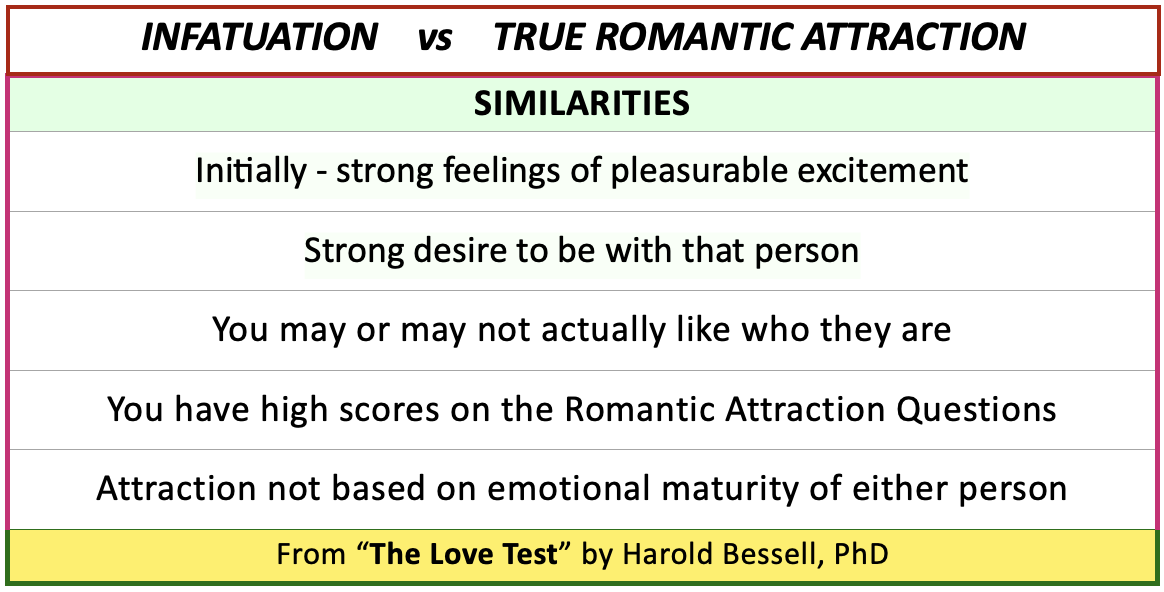
Infatuation, Sexual or Romantic Chemistry

HE LOVES ME, HE LOVES ME NOT
But how do I feel?

Review: Relationship Continuum & following posts


NOTE to Readers: If you’re interested in these topics & the other charts from the book “The Love Test”,  you can also do additional book & internet searches to read variations about these issues.  The lists below are only one version – to get you thinking & to give you a place to start from.


You may notice some similar characteristics from the previous 2 posts.

NEXT : Relationship Form A, (Part 1)


ROMANTIC ATTRACTION – Qs (Part 2)

dancing 

I WANT TO BUILD MY LIFE AROUND YOU –
I hope you feel the same way!

Part 1: R.A.Qs, 1-30

POST: FRIENDS Inventory

INVENTORY (cont)
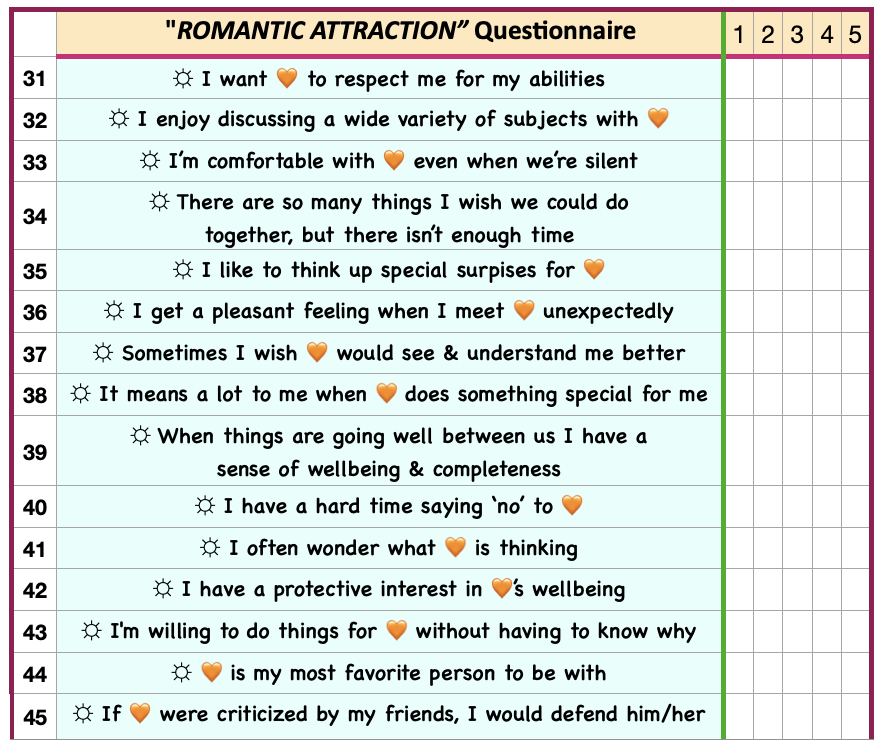
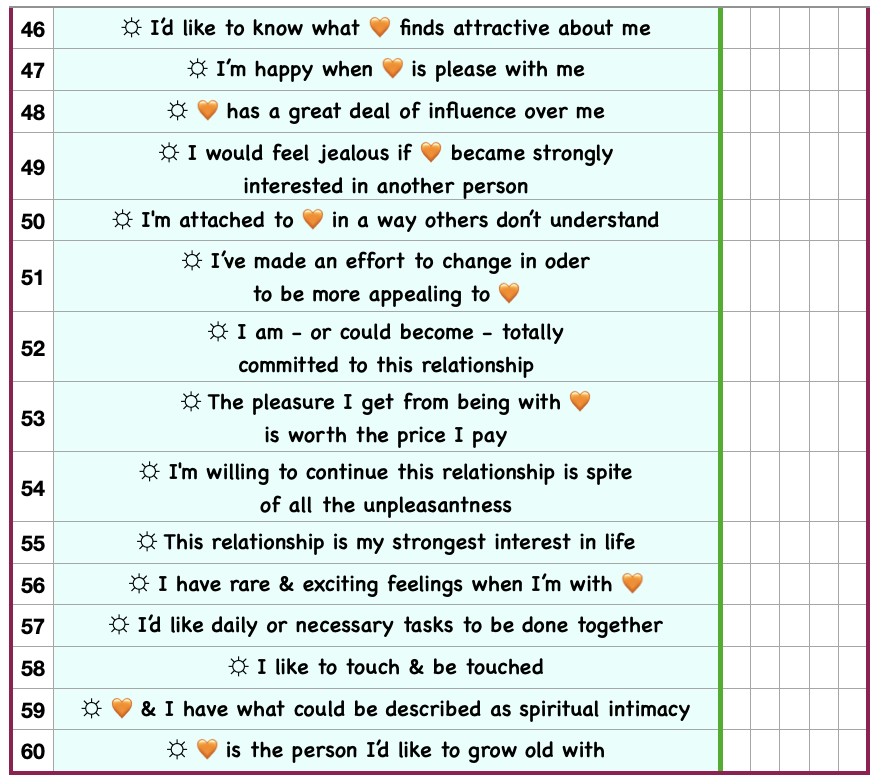
➼  Print out Part 1 & 2.  Put a check mark in the column which best fits your responses about a specific person: _____________ (🧡)

Use #1 as the weakest to #5 as the strongest feeling you have about each statement. Do NOT consider #5 as ‘perfect’, only as intensity
• If you don’t know or are confused, mark #3.  You can always go back later & fill the ‘blanks’ or reevaluate your answers

• Take your time considering the Qs – think about your own experience with each person AND what you know about them
• If possible, have your partner take the same test
• Total up each column & then add them all together.

👁 See below – to interpret your scores

EVALUATION
Add up each column (1-5) – for both Parts 1 & 2. Combine all columns , to get one number for your Romantic Attraction (R.A.)
• 180 -200 = Little or no romantic interest, so it’s not likely to work out, no matter how much one of you may wants it
• 200 – 220 = Weak R.A., indicating borderline interest
• 220 – 260 = Strong R.A., enough for a relationship to be satisfying if both of you fall in this range
260 – 300 = Very high R.A., indicating a strong compatibility, if both have similar scores

• If one of you scores below 200 & the other is over 220 – especially after several tries – expect the relationship to just run its course.  Enjoy what you can & then move on
• If both of you score below 200, you’re not suited for romance, unsatisfied
BUT it makes it easier to have a satisfying & long-lasting friendship, if you want to & there are enough compatible interests

REVIEW – ACoAs (& unrecovered addicts in general) usually have relationships:
• based on interlocking damage with another person
• driven by our WIC & PP, rather than the True Self
• just to keep from feeling alone & abandoned, no matter how unsatisfying or harmful
• trying to get the good parenting we never got in childhood – from someone else, instead of from Ourself & H.P.
• that act out our deepest fears & greatest wounds
rejectionWe’re afraid:
• to stand up for ourselves – say what we want or don’t want
• that we won’t ever be able to choose better friends & lovers
• our family will disapprove of / not accept our choices
• to risk ‘everything’ on our Inner Truth

A secondary GOAL of this kind of QUIZ is to get us thinking about the positive qualities we can own in ourself, as well as those we need to be looking for in partners & friends. Then we can grow into being comfortable & happy in any relationship
• Romantic excitement can not be manufactured or forced if it doesn’t already exist, but all good relationships require a level of emotional maturity, which can be improved on with continuing effort & the right tools.

NEXT: Infatuation…

ROMANTIC ATTRACTION – Qs (Part 1)

old fahionedHOW DO I FEEL ABOUT YOU?
I’m thinking, I’m thinking!

PREVIOUS: Infatuation, Sexual…..

See ACRONYM page for abbrev.

POST: FRIENDS Inventory

TO LIKE OR NOT TO LIKE, that is the question   🙂
ACoAs are often confused about their thoughts & emotions regarding others.
We  :
• were DIScouraged from knowing needs, preferences, dislikes
• & now are not allowed to have them even if we do know
• are more worried about how others feel about us – if they’ll approve or be angry at us, which leave us….
• in conflict between the damaged (WIC) & our developing Recovery (UNIT) voices

BESIDES being given distorted thinking, ACoAs grow up with little or no information about what ‘normal’ is, to help us figure out what’s going on in our head & with others.
These 2 posts list 60 questions to find out about your thoughts & emotions:
happy couple• regarding a new romance or marriage partner – OR
• review how you feel now about someone you’ve been in relationship with for a while (even yrs) but may be wondering how to evaluate it

Taken from “The Love Test” book by Harold Bessell, PhD, 1984
• The quiz is measures the degree of excitement about a specific person, & your desire for a permanent intimate relationship – sexual, mental, emotional & spiritual – with them. The focus is on the person-to-person factor, not sexual interest

• Research suggests that 6 out of 7x, a strong romantic attraction can dissipate within 3-4 months. If the desires remains after that rime, with enough contact it will likely continue for many years

• The 4 month rule doesn’t apply if there is physical distance, a fantasy connection (letters, email…) or an attraction to someone who’s not truly available. An interest in this type of lover will usually dissipate in a few days if you  spend face-to-face time with the real person

• Also, when someone has a ‘fear of intimacy’, living together or getting married may actually trigger withdrawing affection & sexual closeness. This disruption of the bond with a loved one is not from lack of compatibility but rather a person’s unresolved ifear of intimacy

• When taking the test, you will get the best results if you are NOT too tired, depressed, angry, sad, frightened or overwhelmed. If any of these emotions persist, take the test several times & see if there is a combined average
• There are no wrong answers – only your honest evaluation.
💋
INVENTORY info in Part 2  (Qs, 31-60)
➼  Print out Part 1 & 2.  Put a check mark in the column which best fits your responses about a specific person: _____________ (🧡)

NOTE: Evaluate previous partners & compare. Look for a pattern of qualities missing in any of them. Is that a coincidence?
👀 You may be able to use some of these Qs to evaluate a family member, friends, a mentor…. leaving out the romance / sex part.
🌹 Be gentle on yourself at all times, but especially if you’re a “survivor”.

NEXT : Questionnaire 31-60

‘TRYING TO LEAVE YOU’ Stages (Part 3)

stay sadPREVIOUS: “Trying to leave you” (#2)


STYLES of  ‘Leaving’

1. ACoA AVOIDERS
(see Part 1)
COMMENTS
Re. ACoAs: It’s hard to make notes for each stage separately because we are so extreme – not going thru the steps at all, going thru them all in the first few weeks, or staying for years even when we know better….  We too experience endings (leaving or being left), but suffer more that people who are less wounded. So these are general observations of ACoA patterns

LEAVING:  Regardless of our style, personality type, previous experiences…. when we can’t bear it anymore – we leave, but rarely in a healthy way:
a. Even though weither ore know a friendship or relationship is dead & hopeless, we desperately try to hang on, begging, chasing, manipulating, threatening to kill ourselves….
OR
b. We cut someone off – cold turkey, without explanation – & refuse any opportunity for closure.  If the partner or friend is the Clinging type, they will be unprepared & dumbfounded.
We are angry or fed up. We don’t want to deal with their abandonment issues, their tantrums, their sulking & self hate. We don’t want to get sucked back in. Our boundaries are not strong enough & it’s just not healthy

c. One or both create such drama, fighting, emotional upheaval – that the only possible outcome is an explosion & then the big split.  We don’t want to feel our abandonment pain either – anger is a cheap, fast & sometimes cruel or physically dangerous way to get out

d. For some, no matter how bad the situation, there’s no leaving at all – only an ending when one partner dies
e. Some ACoAs are capable of more appropriate exits, but it’s rare

STYLES
1. ACoA AVOIDERS: Some ACoAs are so afraid of commitment, being trapped, being abused & then left, that they don’t have avoidersany love relationships, don’t make long-term connection, or only have short serial relationships, friends, jobs…

• If they try, they’ll go thru the 5 Stages very quickly – or stop at #2 – over & over,
♝ always finding fault with any hint of imperfection, OR
♝ always picking people & situations that reproduce the original abuse & abandonment, OR
♝ not giving healthy people a chance to develop connections that would be beneficial & uplifting

2. ACoA CLINGERS
a. Fantasy
• ACoAs often start relationships in a fantasy fog of symbiosis, all hopeful & excited. There may be very little thought, just a whirlwind of emotions (Es).
Or the thought is: ‘This time it will be different’

• Then the dis-illusionment. The other person says or does something so unacceptable – to us- that it breaks the trance of togetherness.  It may be :
✐ something TOO healthy (setting a boundary, not rescuing),disillusioned OR
✐ something truly hurtful / abusive / disappointing, OR
✐ it’s just that they triggered an old wound of ours.

• We may object, complain, attack…. but we stay rather than start over. We don’t investigate the actual source of our own reaction, & accept the unacceptable, spending all our effort covering up the problems. And then feel depressed.

b. Denial
• We convince ourselves the situation isn’t really that bad – that the mate / job / parent / sponsor / friend … has some ‘superior’ qualities we can’t live without. They may have, but it’s just crumbs, compared to the problems!

• Some of us even KNEW before we got married that this was not the right person – while walking down the aisle, but went thru with it anyway. (like Princess Diana….)

c. Shame (see posts) is caused by currently having any need some up that was regularly abused or neglected in childhood. Many ACoAs consider the Need for Love as a character defect. But needs never goe away. SO we keep picking people whose damage guarantees our continued abandonment!

c. Control
tug_of_war• We make a huge effort to change the other person so we don’t have to leave, instead of changing ourselves. We badger, cajole, lecture, push, punish, bribe, manipulate. We get back only more resistance – of course!
• We spend a lot time punishing the other person for not being who & what we want, instead of moving on or letting go of our demands & expectations of another.

NEXT: Part 4 (Clingers d. – j.)

‘TRYING TO LEAVE YOU’ Stages (Part 2)

cutting strings

I GUESS THIS IS GOODBYE : (How could this happen to me!?)


PREVIOUS: Leaving
 (#1)

ACTS OF DISTANCING ▼  (cont)
5. DIFFERENTIATING
4. LIMITING

3. STAGNATING
Normal: They’re still together, but with a feeling of being stuck & not knowing how to make it better or how to get out. There’s not enough meaning or nourishment to keep it alive, but being in a long-term or committed relationship makes it harder to consider leaving.

They feel disconnected & depressed/ but stay together to avoid the pain of separation
Some form of talk is needed, but if either hints at starting an unpleasant conversation, they’ll find a way to prevent it so they don’t have to invest any feelings

stagnating• They have little to say to each other, are bored with the same old stories, don’t want any confrontation, & won’t talk about the relationship because it feels pointless

“Do you want to watch that program?” <> “No, but you go ahead” , “I don’t want to hear that again” <> “I know, you’re not interested in what I have to say!”

• One or both may be experiencing personal problems & possibly blame the other, rather than facing their own issues. But when people are no longer getting their needs met from their partner, they shut down the lines of communication & turn elsewhere

• People can start punishing each other for their own disappointment & loneliness: Well, she/he hasn’t helped me in a long time, so I’m not doing this for her/him”
– may be the kind of thinking behind further withdrawal.
💔

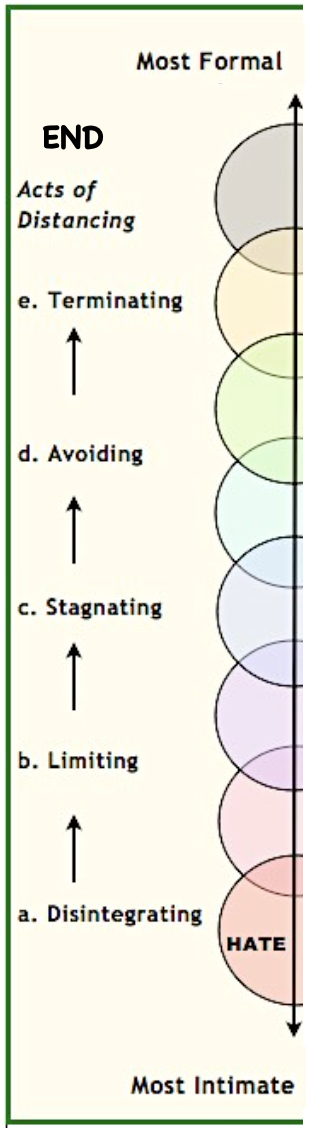
2.  AVOIDING

Normal: Now these 2 people who have been in a committed relationship, no longer see themselves in the dyad. They’ve withdrawn their emotions & are ‘spending‘ them elsewhere. Deep emotional distance is an indicator that the union is no longer salvageable. Each person knows in their mind  & heart they’ve detached, & need to protect themself

• They reorganize their lives to avoid being together & may even verbalize it: “I don’t want to talk to ____”.
It can also show up by sleeping in separate beds or rooms, & one or both looking for a new place to live

• People not living together will avoid calls, emails & texts.
“Leave me a message & I’ll get back to you” , “I’m really busy, so I’m sure you’ll understand if we don’t get together this week”

Usually there’s less fighting, but what’s left may be sniping, sarcasm, put-downs. Otherwise, communication is only about practical necessities, if at all
💔

1. TERMINATING (Final)
Normal: This stage can be done rather quickly or be dragged out for years.
• It’s the actual physical leaving of the relationship, with a little or a lot of psychological finality. If both parties can accept this, it makes it much easier to move on.

I can’t do this any more. This is the end for me.” <> “Yeah, sure, whatever separationyou say.”

• When one partner has come to their ending point, it’s important & respectful (be ‘clean‘) to actually tell the other person.  This is more likely with a longer-term connection.  Often with less developed ties, one person just stops taking calls, emails…..

• Verbal messages are used to prepare for the end by only using ‘I’ or ‘me’ statements, & meant to create finality & permanent distance “This relationship isn’t working for me anymore” , “Please don’t call me again” .

• It’s not uncommon for one or both people to have another relationship, job, even a new city… waiting in the wings, even if the new ‘love’ is temporary, to get them thru the transition.
✶ Leaving may actually be a benefit to both, even if it hurts. They may need the relationship to end so they can continue their career, their personal growth or to start a more suitable lifestyle.
♥               ♥                ♥

NEXT: “Trying to Leave you” (Part 2) – Clingers

‘TRYING TO LEAVE YOU’ Stages (Part 1)

 WE’RE NOT the SAME ANYMORE –
What’s happening to ‘us’?

PREVIOUS: “Getting to know you” (Part 5)

REVIEW: Relationship Continuum

BOOK :“Communication Patterns & Couple (Dis)satisfaction”.

Communication Indicators of DISSOLUTION
These 5 breaking-up stages are the ‘normal’ process of separating. The amount of time varies based on individual personalities, the length of the association & the type of relationship.
• The stages are listed ‘backwards’, from most intimate to most distant: #5 = Differentiation,  4 = Limiting,  3 = Stagnating, 2 = Avoiding, 1 = Terminating. The process applies to all types of relationships, not just romantic.

ENDINGS can be made by one or both parties:
When it’s mutual ….
a. …but not openly acknowledged:
both people become less & less interested & there’s a gradual fading of interactions.  There may be several attempt to -sort of- talk about it, & maybe one who is trying to fix it.
It can take a long time to actually end (this approach is more likely to be used by people with anxiety)

b. …and more direct: the couple is likely to have arguments or fights, each blaming the other, OR separation is negotiated & agreed on (less likely to try repairing)

When it’s one-sided ….
a. …if the end is in sight, & the ‘leaving’ person’s reaction is indirect – they’ll withdraw, avoid contact or get more annoying to be around, drop hints, try to be friends, manipulate
b. …if it’s more direct – the person will talk about what has gone wrong in the relationship, & is able to clearly say “It’s over”,  accepting reality

FOR ACoAs: Most of the time the ending of any relationship is painful & traumatic – from a job, an old friend, family member, sponsor, therapist… & even if it was with someone we met recently or with someone we barely like!

OVERALL COMMENTS will be in Part 3 & 4.

                              ▼   ACTS OF DISTANCING  
5. DIFFERENTIATING
Normal: Two people begin to notice a gap in their togetherness, less ‘we’, more ‘me’ statements. “Working together’ is gradually replaced by separate activities.

“I don’t see how you can like that group!”  <> “Well, I guess we’re not on the same page about that!” ,  “Why don’t we go dancing any more?” <> “You know I’m too busy”

Temporary separation is sometimes tried. The situation is uncomfortable & can lead to subtle disagreements or open fights, then more time apart….
This stage can occur when:annoying
• the relationship is still new-ish but the first idealized ‘bloom’ has worn off
• they’ve been together longer & one or both are disappointed in who the other turned out to be
OR
• something they first found macho, adorable, attractive… in the other person, now drives them crazy
• for longer-term couples, their personal interests may have caused them to grow apart
• with too much one-ness, togetherness – one person misses a sense of individuality, feels resentful, held down, maybe suffocated
💔

4. LIMITING (Circumscribing)
Normal: This stage has been called the ‘slow fade’, & is more likely to occurs in committed relationships, but not exclusively.
There’s a shift in the focus from each others’ differences to constricting & limiting communication, which decreases in amount & topics they talk about. It’s superficial, kept to ‘safe topics’ they know they can agree on, avoiding controversial subjects, iScreen Shot 2015-08-01 at 7.27.57 AMn order to prevent fights

This inevitably leads to less & less real sharing.
“Who was that on the phone?” , “What are we having for dinner?”  , “Do you like the food?” <> “It’s OK.”

• There’s a definite sense of not understanding each other any more, & their concern is with protecting themselves emotionally
• While still projecting a good public face as a couple, they’ve mostly stopped telling each other anything personal
 • Sexual intimacy disappears, & if there is fighting, it’s about not being heard.
💔

NEXT: Part 2: Terminating; ACoAs Leaving

‘GETTING TO KNOW YOU’ Stages (Part 3)


I’M INTERESTED

what he’s saying

PREVIOUS: Part 2 – Experiment


♥ ACTS OF AFFILIATION ♥
(cont) indicated by Types of Communication 

3. INTENSIFYING (Exploratory)
a. Normal: ‘Partners’ start opening up, sharing deeper personal info, taking more risks.  Much more emotionally intense &/or passionate stage, using intimate language

“I love you” <> “Me too” ✥  “I think you’re the best” <> “ I’m glad we found each other”  ✥   “It’s great to be with someone with the same tastes” <> “Yeah, we have a lot in common. Makes me feel at home”

• Begin to use ‘we’, develop favorite palaces, nicknames, share / swap possessions, understand non-verbal cues, give gifts, idealize each other, even finding their flaws endearing.  People can be so excited with each other at this stage, they’ll spend hours talking – time passes quickly. There’s a feeling of exhilaration, & depending on the type of relationship, a strong sexual pull

This is the pivotal stage. Depending on whether or not both feel a chemistry (comfort, mutual value & excitement), and if the revealed info, attitudes & activities are sufficiently shared – people either continue to #4 & #5, or fall apart.

The connection at this point may be intense but short-lived, which is a shock to some who mistakenly assumed it would last because of the surface siminfatuationilarities & the emotional / sexual intensity.

➼  In some cases, there’s an intermediate stage called “Revising Communications” – when the euphoria has worn off.
The partners are able to review the strengths & weaknesses of the relationship from a more rational place, to see if they want to go on to the next phase. If they do, they begin working thru any problems or obstacles to further intimacy

b. ACoAs: we usually rush into this stage soon after meeting! Spoken or not, the communications is something like:
“Hi, my name is Sara, let’s be together forever!” <> “”OK, I’ll keep my eyes closed, as long as you make me feel good!”

✶✶✶ WARNING: ACoAs often misinterpret the ‘euphoria’ of this stage to mean there’s real intimacy happening! Spending every day for a week deeply immersed with a new friend or lover can end abruptly when they disappear on us!
Whatever their reason – they got scared, they feel suffocated… we feel conned, betrayed, angry… & are left with an acute sense of longing!

REALITY: We went too deep too soon, & now we’re alone – again!
• TYPICAL ACoA reaction: beside feeling rage, we obsessively ruminate on what we did wrong (S-H) without knowing what the real issues are! We either withdraw into a depressed ball or use all our energy to chase after them. We want the pain to stop & get back the HIGH. heart illusion

REALITY: WE got it wrong. Yes, the other person is also responsible for their part, but we can only deal with ourselves.  This is supposed to be stage 3, NOT instant love! It was not intimacy.

• HINT: if a ‘relationship’ develops too close, too fast – it’s likely NOT going to be healthy or real, but coming from both WICs!  ACoAs are addicted to fantasy & magic, as powerful as any chemical narcotic.
We have to work at going slowly or we’ll keep getting abandoned.

NEXT: Part 4 (Ingratiating)