MBTI – STACKS Basics (Part 4)


PREVIOUS: Stacks Basics #3

SITES:  How to use Stacks for Growth

Personal Growth using MBTI


ORDER OF PREFERENCE (cont.)

Primary Cognitive Engine: Combined Dominant + Auxiliary, sometimes called the  function pair,  comes from the 2 middle letters of our personality type (INTP, ESFJ.….), which produce most of our communicating, decision-making & processing skills.
✯ Together Dom & Aux are about 90% of our personality – on a good day 😉
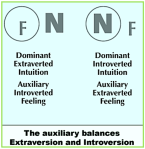
It can help to balance: 
• Extrovert & Introvert, so Es can turn to their inner world at times & Is to the outer
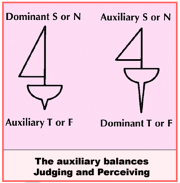
• the J functions, so we can take in new info (T), & make decisions about that info or have closure (F)
• the P functions, so we can pay attention to the outer world & take actions (S), as well as pause for reflection to notice the inner one (N)

AGES
Jung believed that all the functions are largely unconscious & undeveloped in infants.
DOMINANT (Dom)
0 – 6 years = use all 4 functions indiscriminately, trying each of them on for size, to decide which ones work best
6 – 12 years = The Dom begins to develop & assert itself. There will be glimpses of the AUX as well, but underdeveloped & unbalanced
AUXILIARY (2nd) 13 – 21 years
A powerful support to the Dom – this is an important time of “self-identification”. A weak AUX can cause real problems. For Introverts, it will be the function most visible to others, while the Dom is more in the background.

TERTIARY (3rd) tends to develop in ones 30s & 40s
21 – 35 years – Begin using this function more often & with better success. Not as strong as Dom & Aux, but helps to balance them, if developed properly. Tertiary kinds of activities are recreational or very relaxing

INFERIOR (4th) At midlife or later
35 – 50 years There’s a pull to develop & use it more effectively, which is very possible
50 onward – All 4 are accessible. The basic Type continues to assert itself, & functions are used in a more disciplined, differentiated way.

5th – 8th = Shadow Functions (INFJ as EXP ➡️)
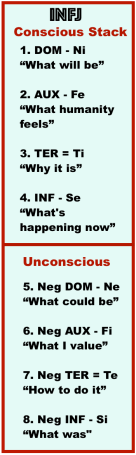
• There are 4 additional levels, the exact E/I unconscious reverse opposites of our 4 conscious ones, called ‘shadow’ functions. Regardless of their order, they’re not well-suited for the light of day because they’re unpredictable.

• For most people, our conscious level 1 & 2 preferences develop with very little effort. They simply work, & work well.  90% of the time we use them to tackle just about everything. Our TER characteristic contributes about 5% to our style, & the other five positions (conscious ‘Inferior’ + 4 unconscious) have to fight over the last 5%.

• But if ones conscious Dom & Aux aren’t ‘on’ – suppressed for some reason – one or more of these lower 4 will take over, being playful, mischievous or harmful.
Eruptions from one or more of them can last seconds (blood sugar crash, over-reacting to some annoyance) to decades (wrong career, toxic marriage, addictions….). (MORE….)

• To develop one of the lesser functions, we can focus on the third one. We’ll get the most out of it, because, unlike the rest (4-8), it’s still usable & somewhat competent, like a teen driver with a learner’s permit, while the rest of the functions are more like toddlers & young children. (1-4 detailed in Part 2)

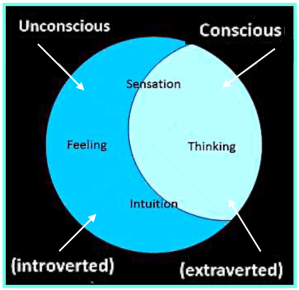
⬇️ DIAGRAM (by QuickTwist) of the relationship between the 4 conscious & 4 unconscious functions.
The “Greater Personality” is when a person has found a way to combat their Shadow, & can use both levels simultaneously.

In the healthy person, the Unconscious Function (UF) is filtered through its corresponding Conscious Function (CF), because they’re less out of balance.
Their CF gets its energy from the corresponding UF, which combines in the Shadow & is then expressed consciously as an act of WILL, in behavior.

In an unhealthy person, the Dom & Aux (conscious) have been overused, so their UFs are over-accentuated = rather hysterically in Es, & neurotically in Is.

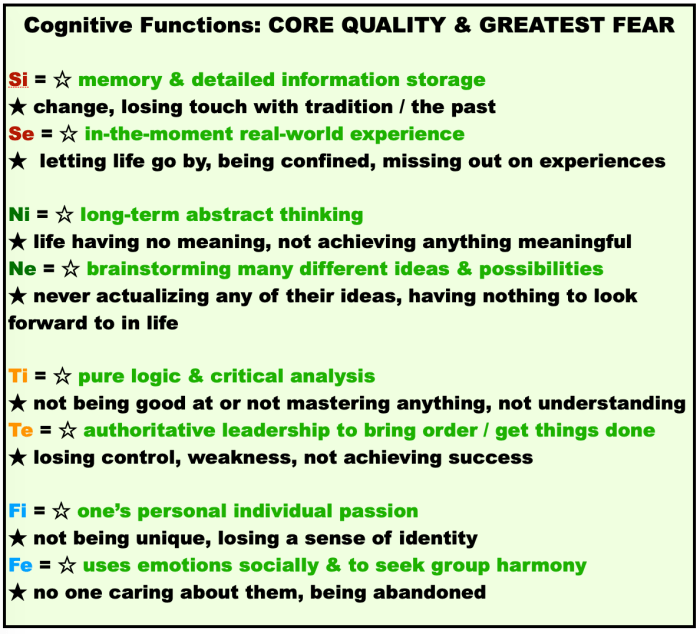
 LISTs ⬇️ from PICK LUCK mbti.info and ODYSSEY
NEXT: Stack basics #5
MBTI – STACKS Basics (Part 3)

 PREVIOUS: MBTI Basics #2

SITE: How each MBTI type Processes Their Own & Others’ Emotions

Complete description of each type’s stack – see sidebar


ORDER OF PREFERENCE (cont.)
NOTES re. Stacks
• As stated in Part 2, each preference is either Introverted or ExtrovertedIs are directed inward & generally private, while Es are directed outward & interact with the world.   EXP:
💗 Judging Extroverts (EnfJ, EstJ…..) always lead with a dominant J function (T or F), so may seem the most ‘J’ of any type   (CHART —->)

💚 Judging Introverts (IstJ, InfJ….) always lead with a dominant P (S or N), so will seem less ‘J-like’, making them more likely to be mis-typed as Ps by the casual observer

• Functions always alternate, based on which side of the center line the first one falls on (E or I)
• The Dominant & Inferior positions will always be opposites (#1 & #4)
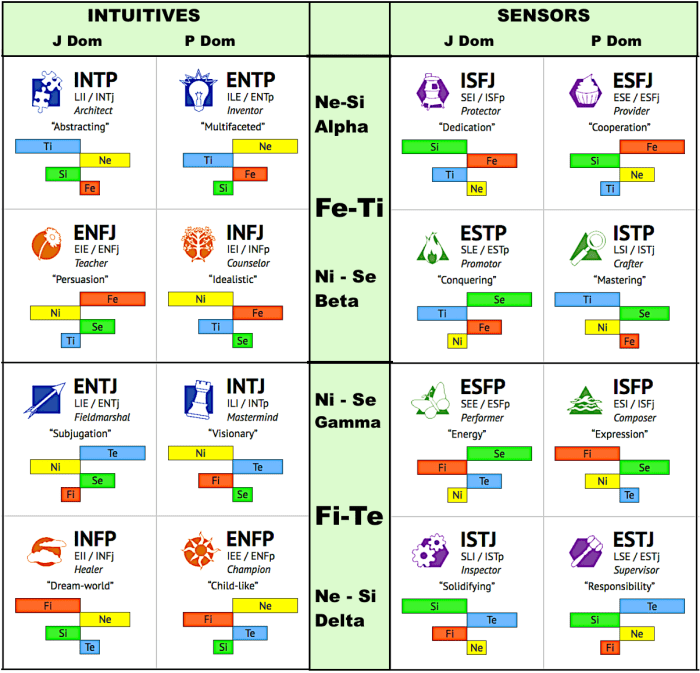
• Stacks are always formed into JPPJ or PJJP, so the middle 2 are either both components of J or both of P (ISFJ = Si —- Ne / Fe – Ti )

• Types that share the same first & last functions (DOM /INF) are called “Brain or Dom buddies,” because they think quite alike. (INTP’s dom-buddy is ISTP, sharing Ti & Fe, but not their 2 middle functions)

HOW to figure the order of the stack
Always start with the person’s MBTI Type to see whether their Dominant (Dom) function is going to be E or I. Each stack includes all 4 options (S, N, T, F), in a specific order. (More….)

Reminder: Dominant & Auxiliary are always our MBTI Type’s 2 center letters.
IMP :
🚦 all Js use T or F as their top 2 choices
Judgers
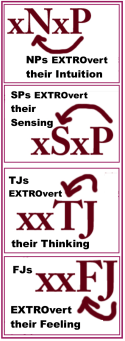
 extrovert J functions (T or F) & introvert P functions (N or S) 

🚥 all Ps use S or N as their top 2 (Dom or Aux)
Perceivers extrovert P functions (N or S) & introvert J functions (T or F)

Another way of saying the same thing is:
▶︎ Introverts hide their DOM from immediate view, & show Aux:
• I–Js conceal Si or Ni (as DOM), & reveal Te or Fe (as AUX)
• I–Ps conceal Ti or Fi (as DOM), & reveal Se or Ne (as AUX)

▶︎ Extroverts reveal their DOM & hide Aux:
• E–Js reveal Te or Fe, & conceal Si or Ni (as AUX)
• E–Ps reveal Se or Ne, & conceal Fi or Ti (as AUX)

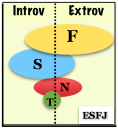
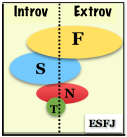
EXP: ESF
• As an E, the biggest oval has to be on the right side of the line
• As an E–J, the dominant (DOM) preference has to be a J function = F or T
• Since ESFJ has a preference for F rather than T, the only possible #1 position is Fe = extrovert Feeling. (Same for ENFJs)
• The bottom circle (“Inferior” preference) for this person has to be T on the I side – Ti = introverted Thinking, because #4 is always opposite the Dominant

NOW we can to fill in the 2 middle ovals – also alternating. We’ve used up the F & T (top & bottom) so we need to place S & N.
• Being an E, its Auxiliary position must be on the I side
• We see that ESFJ refers S rather than N, so it’s #2 preference is Si = introverted SensingThis is so because if it were in 3rd position, it wouldn’t be a preference.  (For ENFJ – #2 has to be Ni).
• The 3rd oval is left (Tertiary), & can only be Ne – extroverted iNtuition.
🎬
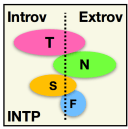
EXP: INTP 
here the Dominant preference is on the I side
• As an I–P, this person’s Dom has to be Ti, hidden from immediate view (since xNxP extroverts its N function)
• Automatically we know the Inferior (#4 oval) is Fe 
• Having placed the T & F, the Auxiliary (#2) will be either S or N, & for the INTP, it can only be Ne
• So Tertiary (#3) is left with Si = introverted Sensing(MORE…. /ALSO…)

The 16 STACKS

NEXT: Stacks #4

MBTI – STACKS Basics (Part 2)

PREVIOUS: MBTI Basics (3b)

SITE: Guide to becoming awesome : MBTI edition

ORDER OF PREFERENCE (cont.)

STACK levels
❤️ Dominant (DOM) = largest oval – the ego’s strongest orientation, which is in the driver’s seat of our personality (function & attitude). It’s what we rely on & use regularly, the most trusted part of our Self. When engrossed in any activity which fully uses our Dominant, we feel alert, alive – what we were “born to do”

• For Is, it will be hidden, while Auxiliary is what others see first until better acquainted – so they may be mis-typed
• For Es, it’s reversed – their DOM is immediately visible, while the Auxiliary is hidden – at first
(Dominant P & Dominant Js)

💛 Auxiliary (AUX) = #2 position – tends to show up once Dominant is clear, developing in the teens & early 20s. We rely on these 2 functions to grow skills & learn who we are – if allowed!  To fully use our MBTI type we need a well-developed Auxiliary that can support Dominant.

NOTE: Since each stack level alternates on the E or I side, then if the DOM is a P function, the AUX will be a J – or vice-versa, & the opposite attitude of the dominant.  This is for the sake of cognitive balance – to provide data for or “informing” the Dom’s J choice, or organizing the Dom’s P choice with rational assessments, keeping us in touch with both inner & outer experience

Auxiliary is in the ‘passenger seat’ of our personality, needed to determine how we use the DOM, serving as support & equalizer. At its best it can be fully available to us & therefore easy to use, such as only having to learn something once

💚  Tertiary (TER) = 3rd, the Helper Function, a somewhat reliable resource to be called on, ‘though each of us will vary on how often we use it. In some stacks it will work hand in hand with Auxiliary, while in others 2 & 3 will bicker, wanting different things. Auxiliary usually wins, since it carries more weight.

Tertiary doesn’t control or lead, but can offer strength & support to the 2 above it. It’s like having a teenager in the back of the vehicle, who’s growing up but not there yet, so sometimes it’ll rise to the occasion, but not dependably
Tertiary:
• can serve as brakes, reminding us of past stressors & warning of similar problems in future
• can provide relief from mistakes, to let us psychologically off the hook, or suggest a ‘way out’, encouraging new ways of living
• isn’t that easy to access unless it’s deliberately developed – which can happen for some people, but usually not until middle age

💜 Inferior (INF) = the 4th is often called a “weakness”, which is a misinterpretation of what MBTI describes. It should be identified as a lower conscious function.
SO: the Dom is always on, 2nd is the creative (can be switched on), 3rd is the relief function (used for feeling better) AND the inferior is your subconscious driving force. (CHART of preference order by Type)

• Normally our brain will actively avoid it, but when forced to be engaged, it’ll feel unpleasant, stressful & very draining. For most of us – like the baby in the back of the vehicle – it’s what we’re weakest at, because it’s (usually) the least developed

• It can emerge as part of a developmental stage but undeveloped, so Dom tends to think Inferior gets in the way, shoving it aside as often as possible.

• It’s also called the ‘Danger’ Function, because under pressure it can pop up at the wrong time & misbehave, with negative consequences. It can start ‘crying’ when we’re stressed & tired, seen as childish, so we tend to shy away from using it.
If we spend too much time in the Danger zone (in a Loop), our Primary & Helper functions will step aside or burn out, leaving us at the mercy of the lesser ones

• However, Inferior is an under-estimated powerful Personality Factor. It can indeed be cultivated – usually in middle age – making us better off. Discovering Inferior’s gifts can provide positive opportunities & adventures (More in future posts)

NEXT: MBTI Stack Basics #3

MBTI – STACKS Basics (Part 1)

PREVIOUS: PYRAMID USES –  MISC.

SITEs: • MBTI links  // MBTI’s 4 dichotomies explained 
How each MBTI type Processes Their Own & Others’ Emotions


STACKS
: our ORDERS of PREFERENCE
Once we identify & appreciate our personal Type, we can go deeper into understanding our personality. 
The MBTI is not about knowledge, skills or abilities. Neither does knowing our type (ISFJ, ENTP….) force us to rigidly limit our options. We all have the ability to be flexible to choose & change behavior patterns that are immature or self-defeating, even while our underlying preferences remain the same.

To increase our self-awareness & flexibility, & to better appreciate how others are similar or different from ourselves, the MBTI provides a way to specify the mental faculties which help us make sense of the world.
They’re based on our type, but use only the 2 middle dichotomies, also called Cognitive Functions, which are the ‘heart’ of this typing system.

These show how we gather info (S=Sensing <—-> N-Intuition) & make decisions (F-feeling <—–> T-thinking), becoming 8 possibilities:
Extroverted functions (e) : Se, Ne, Te, Fe and
✥ Introverted functions (i) : Si, Ni, Ti, Fi
– combining into 16 STACKS –
 the 4 dichotomies in specific order for each of the 16 MBTI types.  EXP: Small chart ↗️ shows the Stack for all INTJ people

✳ Our strongest preference is called Primary or Dominant, the next is Auxiliary, then Tertiary & lastly Inferior (weakest). Each Personality Type is referred to by its top two choices. Introverted functions are the ones we use internally, & the extroverted ones are used to interact with the world around us. (Formula for creating stacks and chart of all stacks – in #3c)

PURPOSE: Even though we only have 2 of the 4 choices in our Type (2 center letters), every stack will include all 4, indicating our thought process – NOT our behavior. It tells us the order of our mind’s/ brain’s thinking-steps: how we think, what we think of first, how we solve problems…. The same functions will show up differently in each Type, even the same Type, depending on their orientation (e/i, and j/p)

The order of their importance to us (our stack) comes from our genetic makeup, so it won’t change what it is throughout our life. But how it’s used & to what extent – can be modified or improved if necessary, by ironing out any inherent kinks.
Over the course of our life, different preferences may rise to the top & be used more often, as well as more easily – called Type Development.
EXP: Sometimes a Primary Thinker may decide things using their feelings, a Primary Feeler may make decisions logically, Ps can be very structured, & Js might go with the flow…..

✥ The 2 functions for gathering information (2nd dichotomy) – used to Perceive / see (p) things – are EITHER:
• Sensing (pS), looking for details & current realities
-OR-
• Intuition (pN), seeing patterns, underlying meaning & future possibilities

✥ The 2 for organizing info & making decisions (3rd dichotomy) – used to Judge (j) / evaluate things – are EITHER:
• Thinking (jT), deciding based on principles, systems & logical consequences -OR-
• Feeling (jF), deciding based on harmony, values & consequences to people (MORE re J vs P).

This table shows the distribution of cognitive functions between the genders in a theoretical population of 1 million….. it shows that the most common Perceiving functions are Si & Se, and the most common Js are Fe, Fi & Te.
This jibes with official statistics which identify SPs (Sensing Perceivers) SJs (Sensing Judgers) as the most common types. (in the USA ?)

Knowing our Cognitive Stack can help us TO:
• Explore ways to better develop our career, create or enhance our leadership style, & improve our communicate skills
• Appreciate diversity in working styles, & to understand organizational & team culture – which can improve working relationships
• Develop strategies to solve problems & resolve conflict
• Manage difficult or stressful changes, & understand stress reactions

NEXT: MBTI Stacks basics #2

ACoA DEFINITIONS – Review

PREVIOUS: Perfectionism Review

🎇 REMINDER: There are severely debilitating effects of growing up in an alcoholic / dysfunctional home & community BECAUSE we:

▪︎ weren’t allowed to think for ourselves
▪︎ didn’t learn how to think clearly, logically
▪︎ often got very limited or distorted information – about ourselves, our family members, & how the world works.

This has nothing to do with our native intelligence nor with our to ability to learn!  The clearer & more accurately we can think – the more empowered we are. So we need the right info – & then practice what we learn.

👄 👁 👂🏾 🧠
Human NEEDS – 3 baskets
UNIVERSAL : All normal needs, common to everyone (respect, info, love, safety….). These are our rights.UNIVERSAL : All normal needs, common to everyone (respect, info, love, safety….). These are our rights.
PERSONAL : A unique combination of needs specific to your personality, similar to others like you, but still different from everyone else
ACoA / WOUNDED : Needs caused by childhood abuse & neglect, some of which may go away with Recovery, & many can diminish enough to no longer be a constant irritant or block

‘FEELINGS – 3 uses
PHYSICAL : anything to do with the body (tired, thirsty, horny, achy….)
EMOTIONAL : a visceral (gut) response to an internal state (thoughts) or external events
MENTAL : what one is thinking (opinion, belief, assumption, conclusion….)
EXP: “I feel that we should…. I feel like she doesn’t like me”
This is the only category that is NOT about feelings!!

THINK vs FEEL (amount)
FEELINGS
– emotions are always ONE word things (happy, sad, pleased, annoyed….). We can have more than one at a time, even contradictory ones!
THOUGHTS – always a sentence, whether short or long (“I don’t think I’ll hear from him again”, NOT “I feel like I won’t….”)

REACTING (Triggered)
DENIED – when someone’s comments or behavior annoys/ angers you, which is a character defect of your own you can’t or won’t admit to (accusing others of dishonesty / over-disclosing (TMI) / being judgmental….)

BUTTONS – hating or fearing something in others – that causes you pain – which you repeatedly experienced growing up, (done TO or around you), but which you do not do (be consistently late / undependable, not listen, rage / fight / tease….)

DAMAGE – reacting badly to behavior or patterns in PPT (people, places, things) caused by long-term trauma, physical illness or emotional pain – aggravating your nerves (loud sounds, fluttering paper or leg swinging, crowds, pile-up of problems, waiting in line ….)

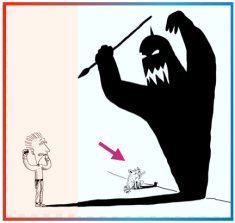
NOTICE: Cat’s shadow is normal proportion

The 3 As
AWARENESS – become conscious of something you didn’t know before, OR that you’d unconsciously hidden from yourself
ACCEPTANCE – a deep & absolute acknowledgement of what is real / true, no matter how unpleasant. Usually done in increments, over time
ACTION – any behavior, especially as a pattern throughout life, and which has an effect on oneself &/or others

T.E.ATHOUGHTS, EMOTIONS, ACTIONS
When talking about something, be clear which of these categories you’re referring to. If asked how you feel, you’re more likely say what you’re thinking, or even sometimes what you did – rather than emotion.
What kind of info was the person actually asking you for?
T: “That’s very interesting. I’d like to hear more about it”
E: “Are you relieved or upset about your breakup?
A: “They went to the footfall  game yesterday”

ANGER 3 Causes
FEAR – Anything that scares us in the present, usually tapping into something old (if it’s hysterical, it’s historical),
HURT – when our feelings are injured by a statement or reaction by others, regardless of why they did it, or why we’re bothered
FRUSTRATION – when we want or need something badly which is out of our reach, or which is not possible – from a particular person or situation (connection with a narcissist, institutions to be fair, a person who has died – to still be alive….)

ANGER vs RAGE
ANGER – Rational, cool, for connection, creates true intimacy
RAGE – Hot, irrational (without thought), from real or assumed danger, to push way – to feel safer

SHAME vs. GUILT
SHAME
– an emotion caused by any NEED which was abused or neglected as a child
GUILT – an emotion caused by breaking a law or rule we deeply believe in, especially TOXIC family rules we grew up with

NEXT: MBTI functions

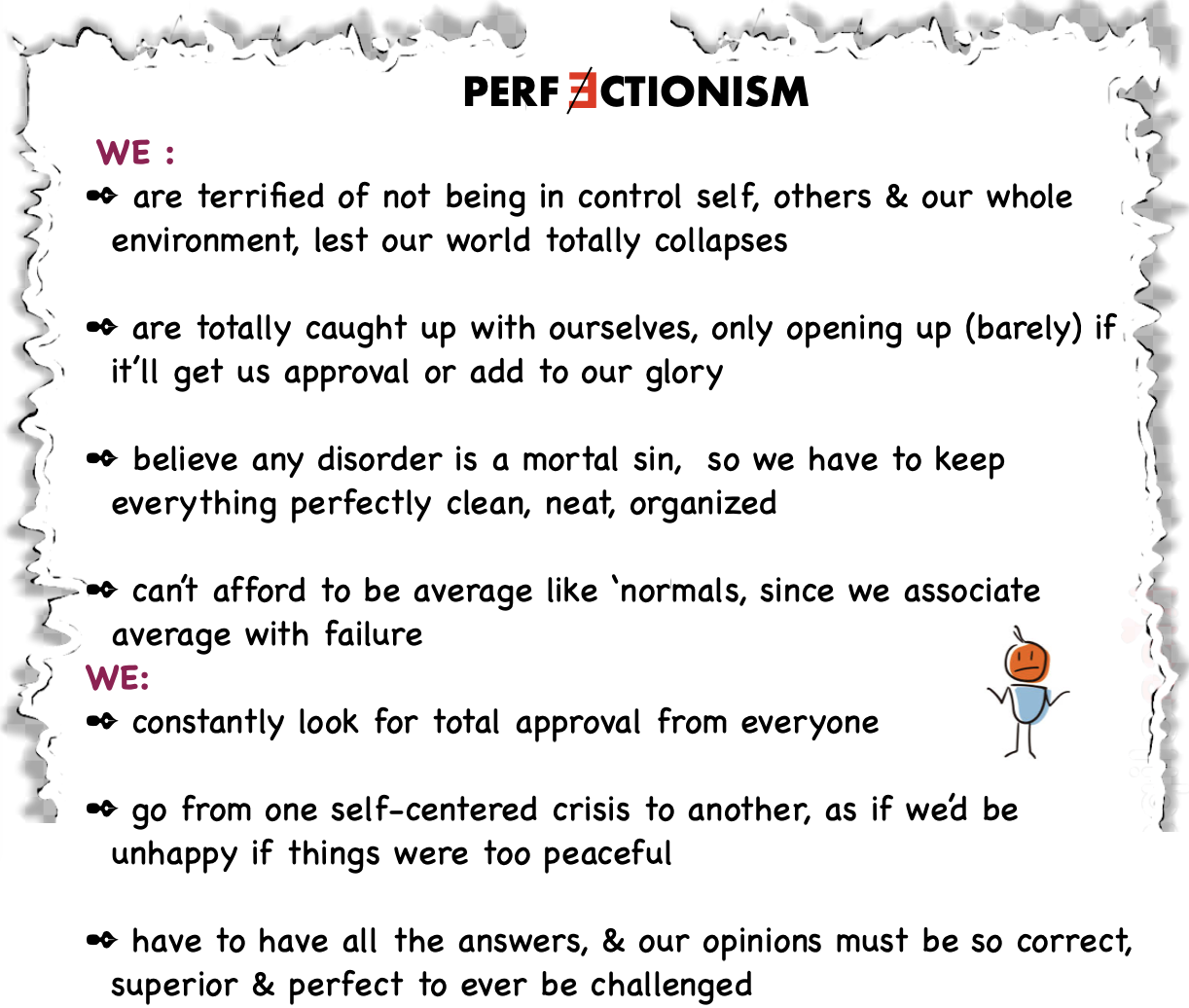
PERFECTIONISM Overview

PREVIOUS: Misc. Pyramids

SITEs: • The many faces of perfectionism

Profound Shift that Frees from Perfectionism

“How To Overcome Perfectionism: 4 Secrets From Research

DEF: “Psychologically, it’s a maladaptive personality trait expressed as striving for flawlessness & setting high performance standards, accompanied by critical self-evaluations & concerns regarding others’ evaluations…. which drives perfectionists to try achieving unattainable ideals or unrealistic goals… inevitably setting the person up for disappointment”

Normal ‘idealists’ are more inclined to pursue high standards without compromising their self-esteem, and derive pleasure from their efforts.
Neurotic ‘idealists’ are prone to strive for impossible outcomes, and feel dissatisfied when they can’t reach them. (D. E. Hamachek, 1978)

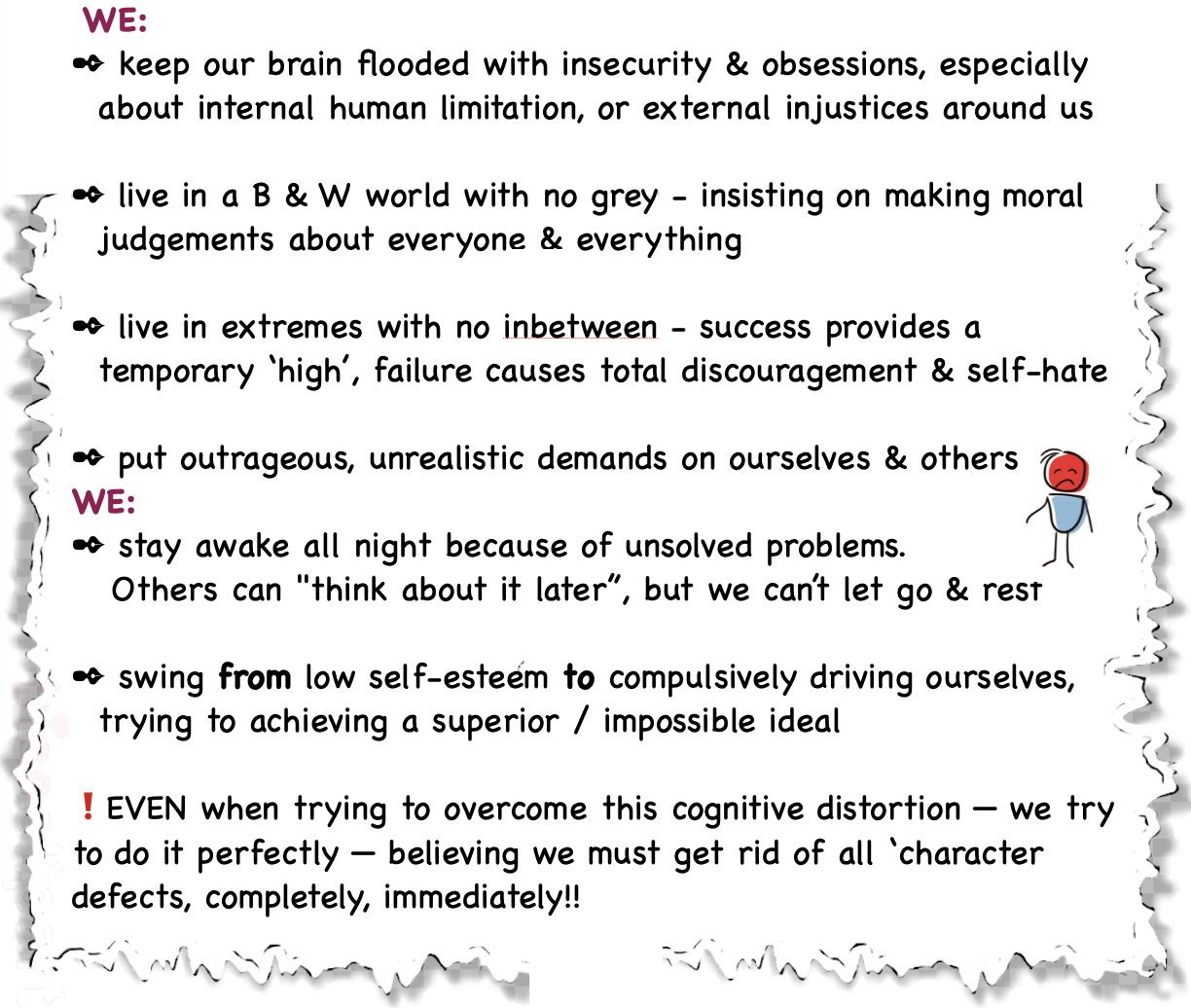
ACoA / co-dependent PERFECTIONISM is a Cognitive Distortion (CD) – an expression of hidden self-hate (S-H), the reaction of any child growing up in an unhealthy family, in reaction to constant, overwhelming abandonment in all 4 PMES forms.

Children who experience feeling unwanted & unloved believe it’s their fault. So if they can be perfect, they will receive the nurturing, care & love everyone needs & has a right to.  Such children (ACoAs) grow up believing they are failures (a Toxic family Rule), since no matter how hard they try, wounded parents cannot provide the kind of care that is needed for a healthy upbringing.

NOTE: A mistaken saying in Recovery is: “I don’t have to be perfect” – as if we had a choice. NOT SO.
It assumes we actually can be perfect (more than human, god-like) IF we wanted to. W-r-r-rong!!
This is the Serenity Prayer backwards.
(3 Posts : “Emotional Immaturity“)

REALITY: NO human being can be perfect. Therefore we cannot BE a failure!
We can fail in our ACTIONS, but that doesn’t represent our identity, our True core Self. (3 Posts: “Emotional Maturity“)

MORE SIGNS of Perfectionism
▪︎ Avoid activities & situations we think we can’t excel at. Often set initial goals out of human reach (unrealistic)
▪︎ Can only see achieving the goal / end result – nothing else matters
▪︎ Can’t trust others to do things right, so rarely delegate

▪︎ Decision-making & efficiency is decreases, procrastination increases
▪︎ Fear, frustration, disappointment, depression Increases

▪︎ Have all-or-nothing thinking (another CD). Constantly use ‘I should / shouldn’t ….’
▪︎ Have trouble completing projects – there’s always more that has to be done
▪︎ Look for tiny imperfections & fixate / obsess about an irrelevant ‘flaw’ or actual mistake 

▪︎ Not able to focus on process or enjoy accomplishments – stress level is raised thru the roof
▪︎ Pushed toward goals by anxiety over not reaching them – & see anything less than a perfectly met goal as being weak or incompetent
▪︎ React defensively to any constructive suggestions or requests – since any imperfection is experiences as terrifyingly shameful

REMINDER
Al-anon saying:
PROGRESS, NOT PERFECTION!

NEXT: MBTI Preferences

Pyramid Uses – MISC

PREVIOUS: Reversed #2

SITE: NEEDS – MET vs UNMET


FOOD
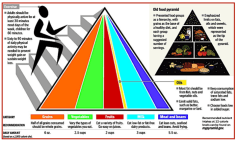
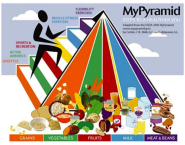
In 2005 the U.S. Department of Agriculture released a new food pyramid, which breaks food categories, into a spectrum to emphasize variety. It’s more flexible and accurate, understanding that one version can’t apply to everyone. What works will depend on a person’s overall lifestyle, how much exercise they get during a week, or if they’re trying to lose or gain weight.  Exercise was introduced as a component of the food pyramid, & 12 individualized intake profiles were added.

10 Most Pervasive Food Pyramid  MYTHS
The new Pyramid clarifies many of the old confusing Qs about nutrition, expanding health education by debunking some of the most pervasive Food Pyramid myths that still exist.
EXP of MYTHs
 ‘”Our diet should consist mostly of bread and pasta”
“What you eat and how you exercise aren’t related” ……

PROCESS
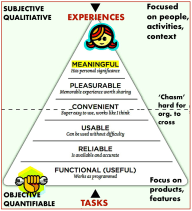
How to tasks provide satisfaction? Stephen P. Anderson’s book Seductive Interaction Design:….  provides several ideas from psychology:
Sequencing: tasks are broken down into smaller tasks
Appropriate challenges: a balance between overwhelming & boring
Status: constantly assessing how interactions add to or diminish our standing relative to others & our personal best.
Achievements: we’re more likely to keep going when meaningful achievements are recognized

And, what make us want to continue the process:
Feedback loops: need to see our actions modify subsequent results
Curiosity: given a bit of interesting information, we want to know more
Visual imagery: vision trumps all other senses
Recognition over recall: It’s easier to recognize things we’ve personally experienced, than from just hearing or reading them. (More….)

====================================================

FRAGRANCES
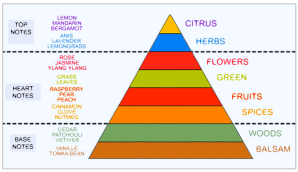
The “fragrance pyramid concept embodies the classic three-tiered French structure, where the denouement reveals distinct phases resembling a 3-D presentation.  The tightest traditional perfume structures, the “chypre” is the harmonious blend, like a musical sonata, with a clear progression of themes, from elegantly sour to resinous/sweet, down to mossy/earthy, becoming more than the sum of their parts. (More….)

========================================================

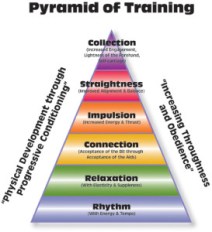
Training HORSE RIDERS
For beginners START with teaching —
1) the balanced seat on the lunge line, until the rider can separate their limbs, then teach them the aids and set them free.
2) the aids for controlling your horse – with kids it’s usually on a lead line, with adults they usually ride independently – and teach the balanced seat as they go, typically just riding around the arena…
(More….)

==========================================================

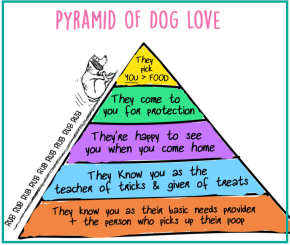
DOG’s ⬅️ LOVE for their owner

===========================

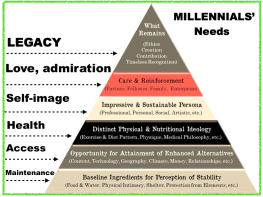
N. American MILLENNIALS
Level 1 Base: “Given the context of the generation’s upbringing  –  the cultures, standards, attitudes & industries with which they’ve been surrounded  –  there’s usually a layer that represents the largely subconscious question of, “On a daily basis, do I feel like my surroundings, & I are stable enough for me to accomplish something more than ‘barely squeaking by’?” (MORE….)

========================================================

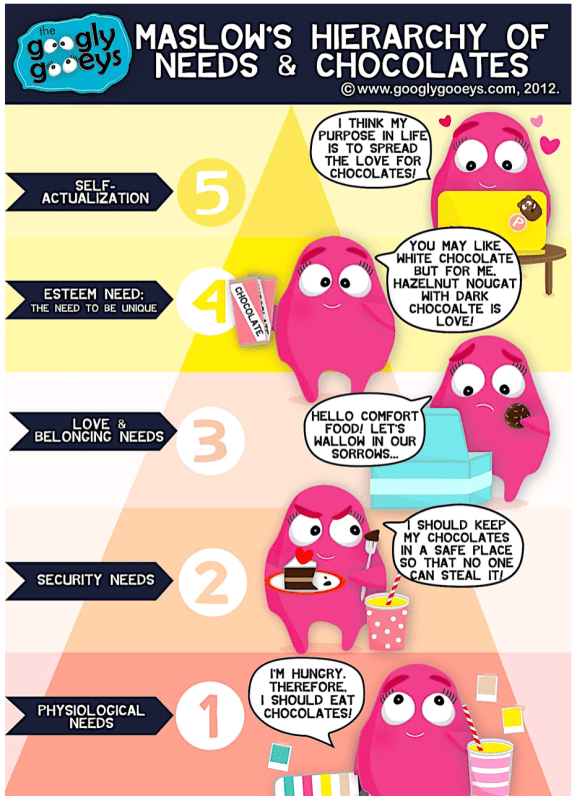
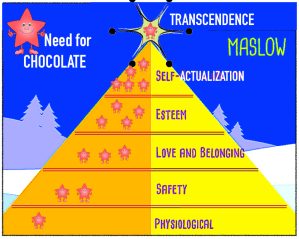
NEED for CHOCOLATE

⬆️ Cartoon by pongo    Nuf’ said!

➡️ Sister Alma Rose: thinks that perhaps the greatest flaw in Maslow’s theory is its failure to account for the importance of chocolate at every level of human experience. She’s taken the liberty of modifying his pyramid to indicate that the more spiritualized one’s existence, the greater one’s need for chocolate!

NEXT: TRAUMA