Enneagram: Triad EMOTIONS – Intro

triad emotions 

UNDERSTANDING MY EMOTIONS
helps me deal with life better

PREVIOUS: Ennea Triad Basics – #2c

SITE: “Personality tool: Understanding the Enneagram. Scroll down for info on each type’s way of expressing emotions

CORE EMOTIONAL responses of the 3 Basic Centers
An important way of using the Enneagram is to identify & properly deal with the emotional essences of each triad – developed out of biological responses to survival threats. They can be seen across ALL mammalian behavior, via modern Affective Neuroscience. The same distress-emotions are triggered when the organism’s 3 BASIC NEEDS are not met.

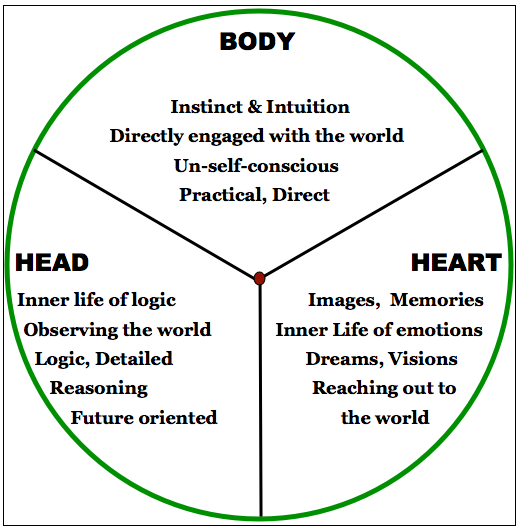
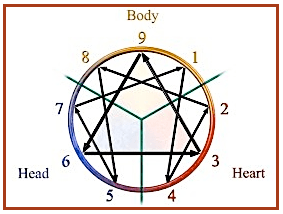
CENTERS: Feeling = Heart (234), Thinking = Head (567) and Gut (891) which includes = Instinctive (digestion, breathing, heartbeat) & Sensory aspects (running…).
Interesting: Gut acts 30,000 times faster than Heart, itself 30,000 times faster than Head. (“The Fourth Way)

◆ EVERY type is capable of experiencing ALL emotions, but each Center is driven by a main one. When things get tough, frustrating, won’t go our way….Screen Shot 2014-09-28 at 10.38.50 AM there’s an inner ‘default’ setting that gets triggered

234s = Grief, Shame
567s = Fear, Anxiety
891s = Anger, Rage
Each Type handles it’s primary emotion differently:
❖ The first # is overt “externalizes” :
2 its shame, 5 its fear, 8 its anger
◆ The second # “represses /covert” :
3 its shame, 6 its fear, 9 its anger
✦ The third # “internalizes /neutral” :
4 its shame, 7 its fear, 1 its anger

Basic FEARS – Triad emotion are our automatic ‘natural’ way of responding to the world, but most people don’t realize it’s what fuels their daily reactions.
When these emotions are cut off from our Core Self, they generate the Type’s defense mechanism, which underpin all dysfunction. While each Center has it’s preferred emotion, Riso & Hudson explained that each TYPE also has an underlying fear OF being: 
enn - Triand INFO1s – corrupt, defective, unbalanced
2s – unwanted, unworthy of love
3s – worthless
4s – without identity or personal significance
5s – helpless, incapable, useless
6s – unable to survive on their own
7s – in pain and deprivation
8s – harmed or controlled by others
9s – lost or separated from self & others

◆ Beatrice Chestnut, psychologist & teacher, condensed a human child’s early needs into 3 challenges – emotional ‘disturbances’ when not properly fulfilled:

A. Need to feel mirrored – when their caregiver makes direct, loving, face-to-face, eye-to-eye contact, so the young child feels ‘seen’ for who they are.

MISSING: Distress/Panic, from the loss of connection & bonding.
Heart types innately pursue this need, but do it incorrectly by creating a False Persona. This makes it hard to be curious about oneself, others & life.
They’re too busy watching what they do, so it will fit their created IMAGE of being:
2s – thoughtful & considerate – so others will respond favorably to ‘such a selfless person’ who only thinks of others
3s – a confident, successful person (so others will respond with respect to such a competent, achieving individual)
4s – a unique person, different from everyone else (so others will at least think they are special rather than lost or deficient).

B. Need to not feel fear – being protected from real danger, or whatever is imagined to be dangerous

MISSING: Fear/Anxiety, when experiencing ta threat, challenge, or danger to our very security
Head
types figure out what makes life certain for themselves. Some fear is necessary & useful if it’s not all-pervasive & overwhelming. When fear overwhelms, it’s very hard to be open to & curious about all the good things available to us.
It’s also imperative to separate fear that’s real from what’s self-created (S-H)

5s – move away from anything that scares them, retreating into a solitary, private world where they only rely on themselves
6s obsessively imagine future danger, &/OR act fearless, as a way of coping with their ever-present fear of life
7s try to avoid fear entirely with constant distractions, sticking to a positive attitude, always considering new possibilities, & planning escapes

C. Need to feel held & supported – seen in very young children who want to be securely wrapped & held, to not feel the threat of being dropped (injured or dead)

MISSING: Anger/Rage, when we experience not being able to depend on our caretakers to ‘back us up’ – neglected, violated & repeatedly deprived
Body Types can sense what’s wrong in their world, know what actions are needed to correct it & how to provide their needs. They want to control their experience & environment to deal with anxiety :
8s try to ‘hold’ everything & everyone by taking charge
9s ‘hold’ by repetitive activities that soothe them (narcotizing)
1s ‘hold’ by being self-controlled, trying to control or structure every aspect of life

LAYERS of the SELF enn -LAYERS of the SELF
Outer = COMPULSIVE : Behavior is automatic
Next = OBSERVING : Beginning of awareness, ability to notice & detach from compulsions
Semi-Inner = HIGHER : Increasing awareness & autonomy, the ability to access higher functions of the Centers
Inner/Center = ESSENTIAL :
Unified consciousness, not trapped in or identified with any one triad
(Chart: ‘Nine Paths’ 12/26/12)

Moving from the outer circle of Stress & Security points – towards our center – requires consistent self-observation.

NEXT: Triad Emotions (Heart)

Ennea TRIAD Basics (Part 4a)


I HAVE ALL I NEED
to understand my environment

PREVIOUS: Ennea Triads, Part 2b

SITE: Discover your Enneagram TRI-Type


3rd Triad (891) : INSTINCT (Gut), Body-based character structure

#8 = Leader — Energy: Larger than life, Dominating.
#9 = Mediator Energy: Diffuse extension, Comfortable
#1= Reformer Energy: Rigid containment, Righteous

At a party: If you go right in, engaging in hearty, jovial, back-slapping greetings that may put some people off, you’re likely in the Gut triad. Or, you might offer the host a ‘helpful’ criticism about how to improve some aspect of the party.

Flow: Gut-centered people act first – think & feel later. They’re very connected to concrete reality, with a very “nuts & bolts” approach to life. Their driving ‘sin’ is anger, as their first reaction to unsafe people & physical circumstances

POSITIVE 891s : At their best, they’re grounded, with a common-sense approach to taking care of basic needs, so not much thought is required for the simple tasks of life. Their motto could be: “Just do it”, being active in the physical world, & connected to nature
When healthy, they relate to their environment & to others exceptionally well, with a deep wisdom from within. Struggling to stay in the moment, they can always call on their gut reactions to bring them back to the present.

Purpose: “We all use personal position & personal power to make life be the way we believe it “should be.” We devise strategies to assure our place in the world & to minimize discomfort.~ David Daniels, M.D

Physical Center: The Gut / Instinct is the physical link to the conscious ego & the unconscious soul. 891s value action, living life at full volume & maximum speed, doing whatever it takes to best handle physical needs.

All types depend upon the Body Center of Intelligence to be in touch with their higher qualities, including: • the right amount of energy needed for action
• how much power to use (or not use) in each situation
• the capacity to be being grounded in themselves & the world.

Priority: Instinctual needs & rhythms in daily life; issues of fairness or rightness, getting practical results.
Direction: 891 Types move in & against, are direct & straight forward, & can easily be confrontational
Key Mode: Screening & buffering (principled inattention)
Key Words: Belonging, Comfort, Congruence, Harmony, Personal power, Protection, Respect, Worth

gut reactions.pngBasic defense: A concentration of energy in the belly center enables repeated patterns to form layers of “insulation” in the mind & body.

This insulation is used to “screen out” unwanted feelings or information from the inside or outside. Personal wants and needs are controlled by super-ego “shoulds

Neurotic style
: Obsessive process – using repeating patterns of thinking and doing to capture and stabilize attention in daily life.

NEGATIVEFearing neglect or being overlooked, they seek acceptance & be respected for who they are. Acting impulsively, they resist being influenced by current reality, & try to impose their will on the environment without being affected by it – to prevent being controlled by anyone or anything. When they don’t have the experience of their positive Key Words, they react with anger / rage – the more controlled version showing up as irritation, resentment, impatience….
Main emotion :
8s
externalize & act out their anger
9s feel conflicted & disconnect with their anger
1s internalize & repress their anger

Life challenge: Struggle with being asleep to their True Self. They need to “Wake up” through self-awareness instead of falling into excessive materialism (8), low-level comfort (9) or habits (1).
Their childhood experience is of not being allowed their space, so there’s a deep hunger to carve this out for themselves in the world, with a push to distinguish between who they are vs everyone else.

INEXT: Triad EMOTIONS (Part 1)

Ennea TRIAD Basics (Part 3a)

triad flowers
I NEED TO UNDERSTAND
so I can control my environment

PREVIOUS: Basic Triads, Part 2b


SECOND Triad (567) : HEAD, Mental-based character structure
#5 = Observer – – Energy: ‘Invisible’ Detachment, Hoarding
#6 = Questioner Energy: Fight 6 – Jabbing Confrontation
Agreement seeking – – – –  Flight 6 – Poised-for-flight Scanning
#7 = Adventurer Energy: Airy Excitement, Re-framing

At a party: If you stand at the door, looking around to see who’s there & what’s happening, you’re likely in the Head triad. You want to have a good idea of what to expect before going in to a new situation, approaching others cautiously.

Flow: Head-centered people think first – act and feel later. They tend to view life as outsiders looking in. Their driving ‘sin’** is fear, feeling separate from people and their environment

**”SIN” – the Enneagram comes out of a spiritual-direction tradition, so it teaches that each type has a definite sin disrupting their journey toward psychological & spiritual wholeness. In Greek it means “to miss the mark,” so it’s what makes us miss the ‘target’ in our life, which must be confronted & integrated

POSITIVE 567s notice more than other people, but don’t realize that most can’t see the same things they do, or don’t see things the same way! At their best they’re knowledgeable, intellectual & brilliant & visionary. (Bill Gates…). But caught up in the world of ideas, they can forget about the rest of the body (Shertriad 567lock Homes).

Purpose: “The goals of this center are to help us all minimize anxiety, manage potentially painful situations They want to gain a sense of certainty through the mental processes of analyzing, figuring out, envisioning, imagining & planning.

In addition, all of us depend on the HEAD Center of Intelligence to develop the higher qualities of wisdom, inner knowing & thoughtfulness.” ~ David Daniels, M.D

Physical center: Their main activity takes place in the Head, where they make decisions based either on logic on & mental processes (thinking things thru).
Also – they’re acutely aware of the environment, living very much in the present, & instinctively take everything in by physical senses (touch, taste, smell is the way to their “holy idea”) – because it gets them out of being stuck in mental loops

Priority: They want to create security by making sense of the world & other people – using ideas, concepts & rational thinking. Their most important quest is for Truth – for what’s real & what’s not.

Their implied Q is: “What does it all mean?” as they constantly try to figure out how each piece of information they’ve gathered fits in with everything else they’ve picked up. Controlling all the pieces by ‘understanding’ things makes them feel safer

Direction: 567 Types initially move away or withdraw from relationship
Key Mode: Detachment & upward displacement (away from gut)
Key Words: Assurance, Certainty, Opportunity, Predictability, Safety, Security

Basic defense: A concentration of mental energy makes it possible to detach from emotions & the body, to live in the mind. Fear of life (& death) is countered by thinking, explaining, rationalizing. Personal wants & needs are explained away or simply not felt.
Neurotic Style: Paranoid/schizoid process – distrust leads to withdrawing from contact with the world, to figure things out & feel protected.  Re. Emotion:
5s externalize their fear
6s
repress their fear, as a primary strategy
7s in
ternalize their fear inwardly

Life challenge: To integrate mind & body. They have trouble combining their inner world with the outer environment. For them – being ‘seen’ is a two-sided dilemma:
— if they get noticed, they lose their valued privacy
— if they don’t get seen they get too isolated, & feel unappreciated for all their knowledge

Much of the time they have lots of ideas & plans that never go anywhere, which tend be forgotten or go unnoticed. In business, being rigid & dogmatic in their thinking (they’re always right!) can create resentment & conflict, but they don’t know why, since they’re just being ‘reasonable’.
📌 The primary attraction / avoidance dance is trust vs. non-trust.

NEXT: Triad basics – Part 2c

Ennea TRIAD Basics (Part 2a)


ALL OF MY ENERGY
goes to looking good to others

PREVIOUS:
 Basic Triads, Part 1


FIRST Triad (234) : HEART,
Emotion-based character structure
#2 = Sentimentalist Energy: Aggressive Affection, Helpful
#3 = Enthusiast – – – Energy: Charismatic Producer, Successful
#4 = Romanticist – – Energy: Dramatic pull, Authentic

At a party: When you get to the door, what do you do?
If you walk right in, say hello & start chatting – you might belong in the Heart triad

Flow: Heart-centered people feel first – act & think later. They are very conscious of the community around them & how they’re being received.
Their driving ‘sin’ is pride – constantly engaged in image management, so they’ll be well received by others

POSITIVE 234s have flexibility & skill in relationships, achieving success by empathy – being attuned to & meeting social expectations, & sensitive to the vast potential of the human heart

Purpose: “Every Type depends on emotional intelligence to develop the higher qualities of the Heart Center, including empathy, understanding, compassion and loving-kindness.
The HEART center energy tunes us into the mood & feeling state of ourselves & others, so we can meet the vital needs for contact & approval. We can get recognition from others to help support our self-esteem, & fulfill our need for love & connection.” ~ David Daniels, M.D

Physical center is the spinal column, which allows free & comftoward othersortable movement around the outer world, to accomplish all the tasks they set for themselves. They use their energy to ‘feel’ what others want from them, so they can adapt themselves

Priority: Their relationship-needs are for recognition & approval, establishing personal identity through connecting & being seen. 234s tend to rate themselves by how others rate them – to the point of ignoring their own wishes. Their attention is so outwardly focused that it’s hard for them to access their Inner Space

CONFUSING: Actually – they’re only concerned with how they appear to themselves – keeping h image of being “good”- but it has to be through the eyes of others

Direction: 234 Types move towards others, to engage in relationship
Key Mode: Substitution of worth
Key Words: Affection, Approval, Assurance, Bonding, Certainly, Connection, Image, Love, Opportunity, Predictability

Basic defense: Their Emotional intelligence is used to form an “image self” to get recognition & approval, which helps overcome an internal sense of deficiency or emptiness. Trying to meet the expectations of others is a substitute for personal needs & wants
Neurotic Style: ‘Hysteric’ process – unconsciously building up emotional energy & then discharging it willy-nilly into the environment (over-reacting, clowning….)

Life challenge: To find the balance between Self and Other, autonomy & dependence, alots of activitycknowledging & expressing their authentic Inner state.
They tend to resist this inward turn, using many rationalizations to ‘explain’ why they can’t or don’t have time to be introspective.
Each of the 3 types will have their specific excuse, based on lack of self-esteem & emotionally hooked to the past.
Their two major themes are: Identity: “Who am I?” and
Hostility : “I hate you for not loving me in the way I want!”.

Re. Emotion 
2s externalize their shame, & create an image of good person
3s feel conflicted between feeling shame & creating an image of success
4s internalize their shame, & create an image of unique identity
“SHAME eats away at the very core of who you are, wondering if you have enough value to meet all the demands of life & love.  Without a clear answer to this question, you set out to get evidence – to prove your worth, in many unproductive & unhealthy ways. All that effort – to get something you already have.” (MORE…..)

Their Primary Instinct “To DO something” means they have a need to respond to other people or circumstances in order to stay connected.
This is true even if they’re not feeling something themselves, or don’t actually like the person or group. P.D .Ouspensky called them ‘Natural Imitators”, sometimes generating emotions they think suitable to a given situation. They create a facade for others to relate to – of like-ability (2s), success (3s) & uniqueness (4), & then become dependent on the reactions of others for their sense of value & worth.

NEXT: Heart Triad (2b)

Ennea TRIAD Basics (Part 1)

triad proportions<—- DIAGRAM – Each Type’s proportion
of the triune brain, combining: (scroll down)
Intellect (green)
Emotions (blue)
Instinct (red)

PREVIOUS: Type Strengths (#4c)

SITEs: Ennea Triads – Centers of Intelligence


BASIC TRIADS
 As mentioned in ‘Enneagram Basics – Part 3’, there are many different ways to sub-divide the Enneagram, usually in groups of 3. Others will be addressed as well, but we start with the fundamentals, always enn triadsbeginning with TYPE 2.
The Triad that our Type falls into dictates the general way we approach life’s challenges. This gets combined with our specific VICE (character weakness) to form our Driving Need. These create all our traits & desires, fueling an automatic way of responding in the world, often cleverly disguised as defense mechanisms (Enn. Defects, Part 3a…..).

NOTE: Main approaches to categorizing the trios
a. From Helen Palmer – the most popular approach :
234= Heart-based Emotion  // 567= Head-based, Reason  // 891=Gut-based, Instinct

b. From Don Riso:  Feel / Do / Relate to environment

c. From Dick Wright, PhD, who believes his approach is truer to Gurdjieff’s original teachings:  234 = Doers // 567 = Perceivers // 891 = Feelers/ Sensers**.

◆ Each grouping is named by the function they do best, & what’s most important to each type in the sub group: (see below).
The Primary style is what is most Instinctual, the 2nd is an Auxiliary & the 3rd is Buried —->  EXP: Quality that’s buried for Type 7 is ‘Doing’ = to motivate

**In the Enneagram, Feeling or SENSING refers to basic, primitive instincts which come from deep inside & can’t be faked (891s). It does not mean Emotion or Sentiment – like the ‘show’ of 234s, which is more surface – a reaction to external ideas & events – picked up from others.

DOERS Triad (HEART #s 234) – They Motivate
Unconscious Types that deal with life experiences. Focus: emotive center
POSITIVE purpose : To achieve healthy, perfect union with others, the universe & with Spirit, to understand the stages of human development that create maturity and wholeness.
NEGATIVE use : To manipulate one’s own & others’ way of feeling, including the emotional climate within relationships

PERCEIVERS Triad (HEAD #s 567) – They Communicate
Conscious Types that define & justify emotions. Focus: theoretical center
POSITIVE Purpose: To develop creative vision & open people up to the real meaning of life, to be fully conscious of the true nature of self and others.
NEGATIVE Use: To think, plot & make intellectual decisions limited by a narrowly defined universe.

SENSERS Triad (GUT / Body #s 891) – They Translate
Subconscious Types that deal with sensations. Focus: effective center
POSITIVE Purpose: To energize & motivate people to actively live as we were intended, according to our true purpose & vision, to actively create & complete the work we are meant to do.
NEGATIVE Use: To protect & preserve our physical body & fulfill our basic needs, no matter the cost to others.
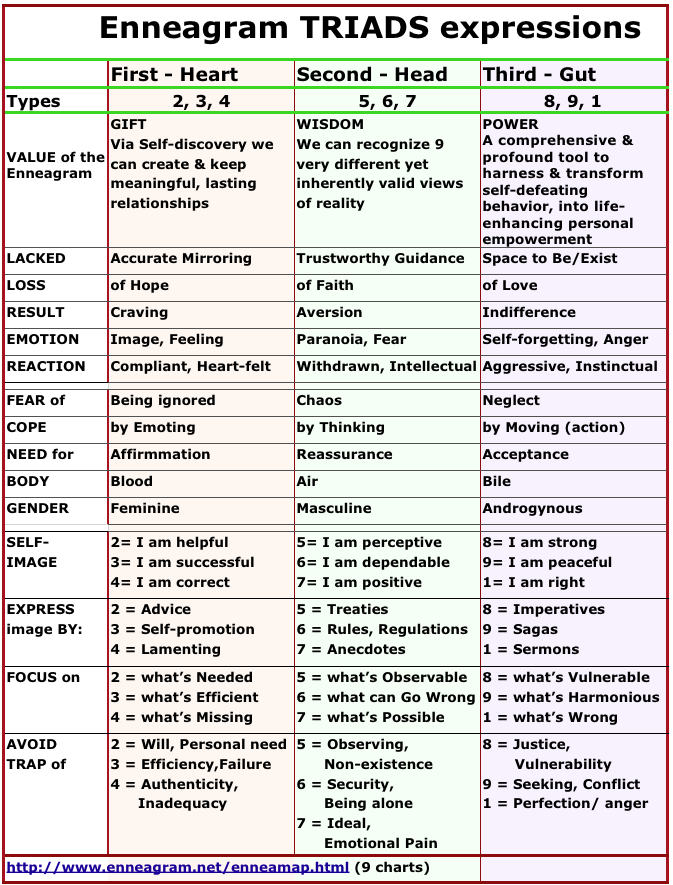
«enn TRIAD expressions

«
NEXT: Triads (Part 2a)


Enneagram – Type STRENGTHS (Part 4a)

k5941299THERE ARE MANY MORE
pieces to this puzzle

PREVIOUS: Type Strengths (Part 3)

SITE: Ennea Happiness & Strengths (fun)


STRUCTURE of PERSONALITY
Claudio Naranjo has united several theories, contrasting Essence to Personality (the conditional Self/lesser mind TO the Real Being/Higher Mind). This chart shows his variation of Ichazo & Gurdjieff’s view of the human psyche, made up of five centers, with the addition of two higher centers of the ‘awakened’ individual.

● It’s based on the current view of optimal mental health that the outer expressions of Personality do not represent the True Self within, but are motivated by a sense of deficiency – the passions/drives repressing, contaminating & replacing core instincts. The Bound (lower) parts include the Enneagram’s Triad of Instincts:
— Self-Preservation, for personal survival
— Sexual, for intimate one-to-one connection
— Social, for connection to the larger world. More in future posts. (MORE…..Chart—>.)

ESSENCE:  Higher Mind drives the automatic orientation toward our specific qualities of awareness – not mediated by every-day thinking.
The Virtues are automatic bodily responses – not directed by personal likes or dislikes.

Although higher mental awareness is different from its counterparts in the Personality, it’s easy to mistakenly assume we are in our Essence when we – think humble thoughts (4s), force ourselves to be brave (6s), feel we’ve been of ‘great service’ (2s)….. These reactions are only indirectly related to being open, undefended & attuned to the environment & other people. Fortunately, each type has the unconscious drive to identify AND the conscious ability to outgrow ‘the trance of type’.

LIBERATION & Presence* (being fully awake)
2 = Humility. By Disinterestedness we can express Altruism
3 = Integrity. By Self-acceptance we gain Genuineness
4 = Equanimity. By Self-renewal we achieve Creativity

5 = Generosity. By Understanding we experience Discovery
6 = Courage. By Self-Affirmation we gain Courage
7 = Sobriety. By Assimilation we experience Gratitude

8 = Subtlety. By Self-restraint we can express Magnanimity
9 = Engagement. By Self-possession we find Fulfillment
1 = Serenity. By Discernment we gain Tolerance

*Presence – the opposite of being trapped in our Enneagram style – when we’re controlled by a younger part of ourselves, habitually acting out of the past as a reflex. When we’re not truly awake to current experiences, our judgments are flawed & our actions inappropriate. Being Present is a spiritual process, & while it’s not easy, it is a crucial requirement for a full life.

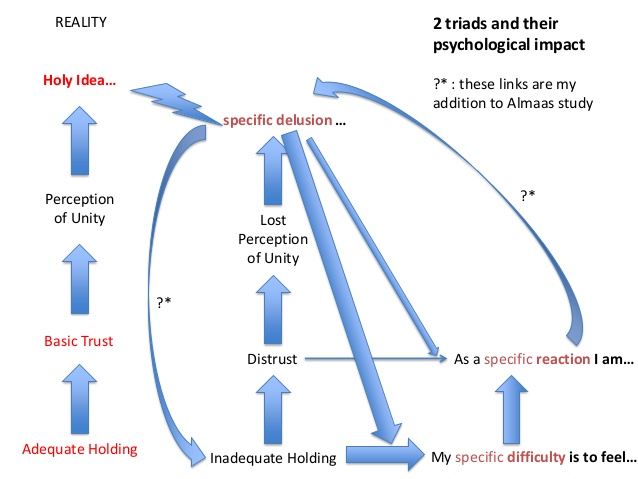
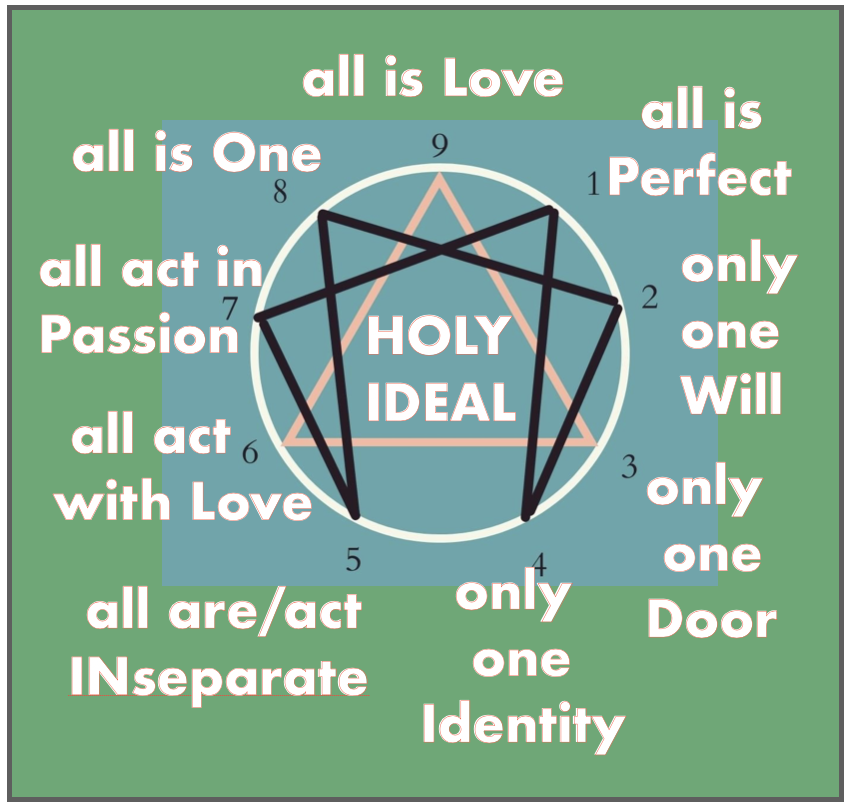
Overviews – Holy Ideas are the essential qualities of Reality.
The left-hand chart shows Universal Reality coordinated with the Enneagram’s Heart, Head, Body.  enn - holy-ideas 2 TRIADS
Use the right-hand chart as the model for the #1-9  diagrams that follow. (All created by P.Ferrieux)

HOLY IDEAS & VIRTUE (STRENGTHS)
#1 VIRTUE: Serenity is the recognition that Reality is inherently perfect. As part of that reality, we are already ‘perfect’ so we can be open & accept the conditions that we are working with, trusting that whatever wisdom we may need will be available in the moment

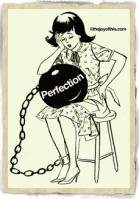
PERFECTIONISTS are fair, honest, honorable, improvement-oriented, noble, responsible, want equality with a shared purpose and values, can be morally heroic
— They really want to be good people & make the world a better place, to realize all their potentials & help others actualize theirs
— They value/are attracted to Goodness & right-ness

Holy PERFECTION points to the more universal sense of perfection , which we can only uncover in small doses. I see that my purpose is not to achieve some transcendental level but to deal with the imperfect world with acceptance. Everything is already as it should be, so when I’m in “here and now” the moment is always perfect. I can trust the process & bring my support to every situation with compassion.

HIGHER MIND: True Perfection isenn - holy-ideas 1
a balance of positive & negative elements blending together at every moment. Any perfect relationship, event or product has to go through stages, including occasional bad risks or bad timing. So – 1s can benefit by accepting that what can seem like terrible mistakes are connected to an ultimately correct outcome. Their only responsibility is doing the best job they can at any given time

NEXT: Type VIRTUES (Part 4b)

Enneagram – Type STRENGTHS (Part 3)

enn water over rocks AS WATER FLOWS OVER ROCKS
so do my Gifts from out of me

PREVIOUS: STRENGTHS (#2)

SITE: Popular Enneagram books

REMINDER:  In this context – EGO = FALSE SELF,  NOT the same as a HEALTHY EGO, and read “EGO”)

OVERVIEWFall from Higher Essence Qualities to Ego Distortions
Oscar Ichazo made a connection between the 10 spheres of Kabbala’s Tree of Life, & the Enneagram symbol. The Tree’s first sphere, Keter, is reserved for the Messiah, leaving 9 others for humans, suggesting 9 kinds of souls as emanations or facets of the Divine Unity.  (MORE...)
● While everyone has the capacity to embody all of the Holy Ideas and Virtues, one pair of them is central to the soul’s identity, so their loss is felt acutely, & the person’s ego (conscious False Self) become totally preoccupied with recreating it, although in futile, self-defeating ways

● Based part on this, Ichazo created a hierarchy of expressions:
9 HOLY IDEAS (Part 1) the objective, experiential understanding of higher Truth. Their loss or absence generates specific delusions /fixations, the underlying Toxic Rules of our ego-driven lives. Each delusion forms the center of a psychological complex, which the core of that particular fixation.

VIRTUES
Based on the Holy Ideas, the Virtues are the natural expression of the awakened heart – the unified, expansive qualities humans experience when we are abiding in Essence, our True Self. AND they can not be ‘practiced’ or claimed as personal achievements. While our ego-self is most preoccupied with recreating it, doing so would only be a narcissistic self-aggrandizement for the ego – the very opposite of a Virtuous state.
They are each type’s antidote to its Passion – pointing to our STRENGTHS – so as we “Let-go-&-let-God”, accepting what is already waiting in us to emerge, our specific Virtue begins to express itself in our daily life. They are not simply ‘their own reward’ but expressions of Grace & a method of transformation*.

*Transformation can be understood as a conversion of energy: shifting from the narrowness & futility of our Vice to our Virtue. It is not easy to do, since out Type is hardwired & a life-time of doing things a certain way are hard to soften & dissolve. Shifting this energy takes time, along with great desire & determination, persistent effort & a willingness to look deep inside ourselves. Repetition of new habits & patterns create new neural pathways that, over time, allow us to catch our automatic responses before they get going. This makes it possible to choose a new way of responding to PPT (people-places-things).

EGO-FIXATIONS
As a person loses Awareness & Presence of the Holy Idea, we fall away from Essence into the trance of the outer personality – an ego delusion about self or reality. But once the True Nature is restored  we can see through the particular delusions of our type. Again, our underlying Truth is antidote to the ego-fixation when we want to restore the balance & freedom of our personal Holy Idea

PASSIONS

They represent the underlying characteristic emotional response (Basic Fear column) to reality which was created by the loss of contact with our Essential nature – the Virtue. The underlying hurt, shame & grief this loss entails are enormous, so our ego (defended Self) is compelled to come up with its particular way of emotionally coping with the loss, altho misguided & ineffective.
— It can also be thought of as our untamed animal nature before it’s transformed by contact from higher influences—an awareness and Grace. Together with the ego-fixation, these represent the ways that spiritual qualities become contracted into ego states

INSTINCTS
Our Instinctual Self is a primal aspect of personality, & our dominant one insures our fundamental survival in the physical world, but in so doing can block the way to growth. The Enneagram’s 3 instincts are an anchoring counter balance to the higher spiritual Essential Self, rooting us in the dualistic (good-bad) defended self, which ‘forces’ us to distort & habitually overuse our survival strategies.
● They are considered the way we forget our connection to the Divine. Losing our Essence-center distorts our Thinking, Feeling & Doing (TEA). Spiritual / emotional growth comes from being able to balance, release & transform our instinctual nature into its higher opposite.

NOTE that the strengths and weaknesses of each type are two sides of the one coin. There is NO point in wanting to change to another type, since that would just mean swapping one set of problems for another.

NEXT: Type VIRTUES (Part 4a)

DEFENSE MECHANISMS (Part 1)

defense typesI USE WHATEVER I CAN
to escape my fears

PREVIOUS: Enneagram Humor #4

REVIEW posts: Abandonment Pain

SITE: Defense Mechanisms Quiz

BOOK:In sheep’s Clothing (re. manipulative people) go to slide 50 ++

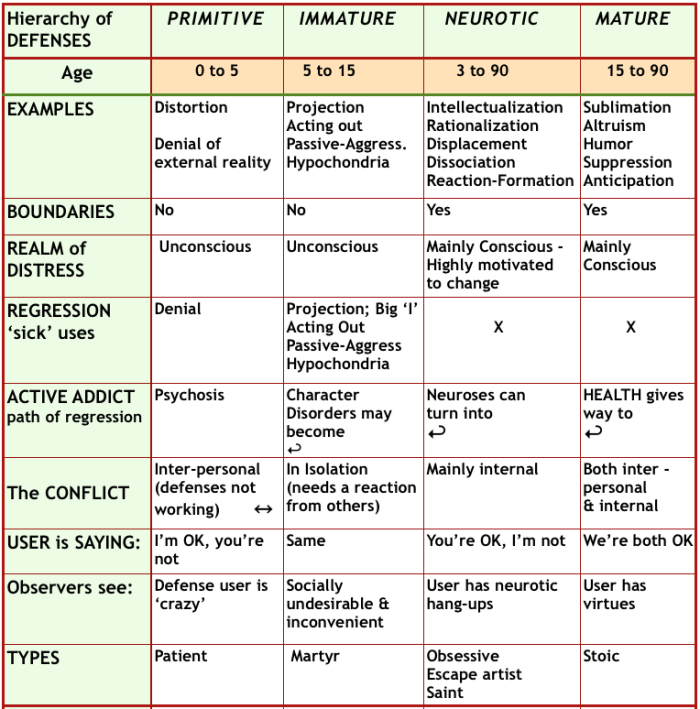
DEF: Unconscious & conscious processes to defend against or escape from conflicts, frustration & depression, so that the person can make useful adjustments to be able to live in their society.

REMINDER – as such, defenses are NOT bad. They’re needed to cope with life’s difficulties, as when we use humor to lighten our mood or altruism to lighten someone else’s load.
At best – most are delaying tactics, giving us breathing room to take a break & re-group.
The problem comes when any one of them become ‘land-locked’, so deeply ingrained that it can’t be given up easily, so rigid that it’s used like a hammer on every problem, regardless of size or importance.
tree of defenses
• In that case they become Negative Benefits” – used to avoid childhood or other trauma which the person does not want to deal face. To better understand what these are, we need to know about Defense Mechanisms, which were first identified by Freud, & then added to over the years by others.
He noted that people have wishes, desired & impulses that are either unacceptable to their society, religion or family – or their own sense of self  (CHART)

• The fact that the impulses don’t go away, but are usually hidden in our unconscious, leaves a residue (like at the bottom of a bottle) of anxiety*.
Keeping the impulses pushed out of awareness takes a lot of energy – which is exhausting, but considered by the ‘user’ to be safer than admitting them
(EXP: wanting to kill one’s parents or oneself). We do this by using Defenses. Which ones we pick will depend on our upbringing & our native personality.

*ANXIETY types, according to Freud
1. Neurotic – the unconscious worry that we’ll lose control of the id‘s urges, resulting in punishment for inappropriate behavior
2. Moral – the fear of violating our own principles
3. Reality – the fear of real-world events, usually easy to identify.
EXP: Fear of being bitten when near a menacing, snarling, barking dog is appropriate – so it’s best to avoid genuinely dangerous situations (PPT) if at all possible.

Defense Mechanisms distort reality
In proper proportion & with limited use they can also be adaptive, allowing us to function normally in very difficult situations, where there are no better options

The big problem comes from over-use, as a way of life, especially when they’re no longer needed. What was once a way to cope then becomes the problem. A goal in Recovery is to make the extreme / harmful use of defenses conscious so the we can develop healthier ways of handling anxiety & stress – without eliminating defenses altogether.

Sdefenses hierarchy


NEXT: 27 Defenses

BOOK Suggestions

images-1


PREVIOUS : Enneagram Defects, #3c


The TOOLS – to help & inspire you to live life in forward motion”
~ Phil Stutz & Barry Michaels   / thetoolbook.com

COMPLEX PTSD”  –  Recovering from Childhood Trauma
~ Pete Walker

TRAPPED in the MIRROR” – Adult Children of Narcissists In their Struggle for Self
~ Elan Golomb, PhD

PSYCHO-CYBERNETICS” ~ Maxwell Maltz, M.D.
Cybernetics is a network of constant feedback loops in the brain, correcting its course & receives further feedback on the success of the transmission. This allows us to travel to places we don’t have the instructions for beforehand, & build on the history of our actions.

NO-DRAMA DISCIPLINE: The Whole-Brain Way to Calm the Chaos and Nurture Your Child’s Developing Mind” ~ Daniel J. Siegel & Tina Payne Bryson
COMMENT: They talk about what works & what doesn’t – in disciplining your “outer” kids – but can apply to dealing with the Inner Child as well.

“30 COVERT EMOTIONAL MANIPULATION TACTICS” ~ Adelyn Birch
How manipulators take control of personal relationships – re mates, but is also clearly about our family’s ‘games’.

“ADULT-CHILDREN of EMOTIONALLY IMMATURE PARENTS” ~ Lindsay C. Gibson PsyD. How to Heal from Distant, Rejecting, or Self-Involved Parents who create a sense of neglect, & discover ways to heal from the pain and confusion caused by your childhood.

Pls let me know if these are helpful.

Thanks, DMT

Enneagram – Type ‘DEFECTS’ (Part 3a)

defect part 3
I HATE TAKING MY INVENTORY
it makes me feel hopeless

PREVIOUS: Enneagram ‘Defects’ (Part 2)

QUOTE: “ People are wonderful; people are difficult. The Enneagram helps us make sense of both” ~ Peter O’Hanrahan


EACH TYPE develops their 
own way of coping with life’s stressors, but not always helpful.  'defects' Part 3This chart shows how how each type’s WIC reacts to the lack of positive nurturing.
w = each Type has 2 wings – additional modifying characteristics – one number on either side, with one as a preference


TYPE 1 – The REFORMER  (also 9w1 & 2w1, somewhat)
FEAR: of being corrupt & “not good,” so they refuse to recognize their mistakes, & take even mild suggestions as criticism
INTERNAL Story: “I must always be perfect”

WEAKNESS : Get frustrated & angry when things or others don’t meet their high standards. Insist on being correct at the expense of connecting with others. Al-Anon asks: “Do you want to be right, or be happy?”

DEFENSIVE PATTERN: ‘Reaction Formation’ – an opposite or unrelated reaction to an authentic feeling – to avoid direct anger, & maintain the self-image of always being right

HIDE from others that  “I’m not as perfect as I appear to be.”
Anger & frustration in part comes from 1s being resentful for having flaws. They’re convinced that if they’re seen as less than perfect they’ll lose their position of the moral authority & arbiter of logicperfectionism

PROJECTION: Since 1s avoid their own anger & flaws, they project those onto others – who they see as critical & angry towards themselves.  In general, the world is considered careless, flawed, frivolous, imperfect, messy & wrong. They must clean it up, straighten everyone out to get them back on the road to perfection (to feel ‘safe’)

MANIPULATE by: constantly correct others, playing on others’ sense of guilt & inadequacy, insist others share their standards
Create CONFLICT by: being opinionated, critical /self-critical, impatient, irritable, judgmental, rigid, perfectionistic, sarcastic


TYPE 2  – The HELPER  (also 1w2 & 3w2, somewhat)
FEAR: of being unloved & unappreciated, so they play favorites, judging some people more worthy of their attention than others
INTERNAL Story: “I must always be connected”

WEAKNESS : Poor boundaries, helping others instead of self-care. Insist on exclusivity & ever more nearness

DEFENSIVE PATTERN: ‘Repression’ of personal needs & feelings to avoid looking needy (which they are), to maintain a self-image of being all-loving, & gain approval 

HIDE from others: “I’m not as caring as I appear to be.”
Pride prevents 2s from showing their needs, so they try to get them met indirectly, secretly. Believe that by being constantly helpful, others will automatically reciprocate – as if their good deeds are vouchers to be cashed in later. But others don’t know that’s the deal & so keep disappointing the 2helper

PROJECTION: Since 2s avoid their own needs, they project that out onto others, who are seen as cold, critical, heartless, indifferent, mean, prickly, selfish, withholding AND needing help.
So 2s think it’s their job to identify & empathize with the needs of others, then fit them, to make themselves indispensable

MANIPULATE by: mind-read what they think others need or want, & then provide it, un-asked
Create CONFLICT by: being clingy, flattering, ingratiating, insincere, people-pleasing, possessive, seductive, self-important, self-deceptive, worried


TYPE 3  – The ACHIEVER  (also 2w3 & 4w3, somewhat)
FEAR: of being worthless & unappreciated, so they create a too-good-to-be-true image & push to achieve, at any cost
INTERNAL Story: “I must always be outstanding”

WEAKNESS : Believe they must present an image of success, rather than express who they really are. Insist on career & social status over people

DEFENSIVE PATTERN: ‘Identification’ – to avoid failure & keep a self-image of flourishing, ignoring their True Self 

HIDE from others: “I’m not as together as I appear to be.”
Self-deception causes 3s wear a ‘I have it all together’ mask, as anything less would not meet their need to shine. They can’t face the possibility that others might seachievere them as a failure or incompetent

PROJECTION: 3s avoid failure & inefficiency, which are projected onto others, who are seen as being aimless, the source of all failures-inefficiency-ineptness, in danger of entropy, limited, losers, wall flowers, AND in need of assistance & guidance from the 3

MANIPULATE by: charming others, taking on / adapting to whatever image will work to keep up appearances
Create CONFLICT by: being “appropriate” instead of sincere, boastful, competitive, grandiose, overly-driven, self-promoting, taking advantage

NEXT: Type Defects (Part 3b)