SAYINGS that MISREPRESENT (Part 3)

I’M NOT SURE –
what to ask for!

PREVIOUS: SAYINGS…  (#3)


REVIEW Intro in Part 1 

7. “Be careful what you ask for – you may get it”
❤️ YES – said as a warning
if you’re superstitious, self-destructive, have a habit of choosing badly….

GROWTH : There’s a different YES – not as a negative – but can be stressful at first. This is when we determine to make a positive change in our life, & perhaps ask HP for help – to be released from a bad relationship & find a good one, be provided with a new job/career, to live in a bigger, safer, more suitable location …..

And then it comes our way, not magically but because we did the foot-work and were in the right place at the right time.
BUT – if we’re not fully prepared to receive these blessings, we can feel uncomfortable, scared, unworthy….
That’s OK. If we ride it out & get validation from the right people, eventually we’ll be able to relax into it.

💜 NO – As ACoAs, we don’t want to be so ‘careful’ that we don’t ask, since many of us have a poverty/deprivation approach to life. It’s imperative we give ourselves permission to ask for what we NEED, first & foremost. This requires knowing who we are + knowing what our human rights are + being able to deal with the risk of not getting.

Also it requires that we never go to people who have already proven – a hundred times over – that they’re not capable or willing.
THEN we can begin, slowly, to ask for bigger & better things, healthy things, fun things….. and when we get them – take them in, be happy, be grateful. Enjoy!

8. “A good beginning makes a good ending”

💜 NO –
in most instances for ACoAs before Recovery. If we start by marrying an alcoholic &/or other addict, it’s for-sure going to cause years, even decades of great pain. It’s not uncommon for these to end with a bang.
OR – if we enthusiastically start an unsuitable job, try to do too many things at once, idealize a new partner, be great caretaker….. it’s likely to end in disappointment, frustration, exhaustion & rage

OR – if we start a good thing, such as exercising, a diet, an advanced degree, a recovery book, a 12-Step program or therapy…. all with the best of intentions, but it goes against our Toxic Rules, it’ll peeter out with a whimper. (“Anxiety & T.E.A.” ).

❤️ YES – if we pick the right kind of job/careers, or healthy & suited-to-us friends, mates, therapist, doctors….. then it’s likely that a good beginning would predict at least a neutral if not a good ending – when appropriate or necessary.

9. “Forgive yourself
❤️YES for harmful things you did as a result of your damage
💜 NO for being damaged in the first place!
POST: “Outgrowing Co-Dependent Niceness #6a

10. “Everything that has happened to me is OK because it’s made me the person I am today”.
There are a couple of ways this is wrong. Yes the things that happened in childhood naturally molded us, & for some people that was beneficial.

BUT for ACoAs, saying that what happened to us was OK – is cruel. Was it OK that you were beaten all the time? That you had to take care of everyone but not yourself? That you were mind-f–ed, punished for having emotions? That you were molested, raped, neglected, starved???? 💜NO!
If some or all of these were part of your early years, then all they accomplished was to form a False Self, which we mistakenly believe is who we are. (Our Wounded Inner Child

All the horrifying things that happened to us made us who are today – all right!  – into frightened, self-hating, over-working, ego-less wrecks.
But anyone in FoO Recovery knows that our healing work is to strip away the layers of defenses (self-destructive messages) to get to the person we actually are inside & would have been a long time ago – without the abuse!! (POST: “They did the best they could”)

NEXT: Sayings #4

SAYINGS that MISREPRESENT (Part 2)


WE KEEP PASSING ON – half correct ‘helpfulness’

PREVIOUS: SAYINGS… (#1)

REVIEW Intro in Part 1
3. “I don’t have to be perfect.
What’s wrong with this statement?
💜 NO – Unfortunately, people in Recovery who say this actually consider it a sign of growth, but is in fact one of those sneaky ways our ‘damage’ keeps us hooked. Why? Because:
It implies we COULD be perfect, we just don’t have to be. NOT true!

No one can be perfect except God. So, what is true & accurate is that “Humans are not perfect, & I am human, so I can’t be perfect!” That’s normal. To think otherwise is arrogant. We can only do the very best of our ability given where we are in our life-progress right now.
It means that “To err is human”,  so we must accept the reality of having limitations. This does not minimize our accomplishments or gifts! We can say: ‘There’s nothing wrong with being imperfect, because it’s a universal Truth”

4. “Feelings aren’t facts” is 💜 not about our emotions, as most people assume. The confusion comes from the reality that we use the word ‘feeling’ in 3 completely different ways: As physical sensations, as emotions AND as thoughts.  See POST

5. “The way you do one thing is the way you do everything.”
💜 NO – It’s the word “EVERYTHING” that’s the problem. Taken literally, this is a blatant inaccuracy. Always keeping PMES in mind, how we do the various parts of our life depends on many factors.
It will depend on your fundamental personality, such as indicated by their MBTI or EnneaType – whether you’re more left or right-brained, (scientific vs artistic) Introvert vs Extrovert, AND above all what areas of childhood experiences were allowed & praised or ignored & punished.

So, I can be meticulous about how I dress & do my makeup, but sloppy about keeping my house orderly.  I can be a brilliant scholar & writer, but neglect my family. I can be very talented & dedicated to my native art form but irresponsible if I have to do office work…. .READ article – a Lesson
▶︎ None of us do everything the same way!

(❤️YES) However, if we take this phrase more psychologically, we can use this woman’s experience to indicate where we’re stuck. Each of us can have the same kind of ‘aha’ connections – between everyday ways of doing (or not doing) things & how they’re a reflection of our fears & resistance to change. Such discoveries help us remove blocks which will improve our life.

6. “If you hate a flaw in someone else it means you have that flaw yourself, otherwise you wouldn’t be upset by it”
💜 NO – the things that bother us the most in the present, that push our buttons or ‘trigger us’ are actually the abusive / neglectful things that were done to us by our family (& other perpetrators) over & over throughout our childhood.
They are wounds we need to clean out, but they are not our character defects.
EXP: I’m almost never late anywhere, but I will definitely be angry at anyone who’s consistently late to dates / appointments, because of all the times as a kid I was left waiting to be picked up by my drunk parent….

❤️ YES – Al-Anon says that when we point a finger at someone else, 3 fingers point back at us. So the statement is true to the degree that our denied ‘character defects’ get projected out onto others, & we don’t like what we see of ourselves in them. These flaws are the emotions, beliefs & behaviors (TEAs) we internalized from our family & society, rolled into our Negative Introject’s voice (PP).

BUT that is not who we are. It’s the False Self we developed in reaction to our unhealthy upbringing.
Even so, our True Self sneaks thru in spite of early brainwashing – sometimes indirectly, sometimes obviously.
EXP: a secret interest, types of addictions we chose, our career path, the way we dress, places we love to go….. So the goal is to find out who we really are & live it!

NEXT: Sayings #3

SAYINGS that MISREPRESENT (Part 1)

I WANT TO BE CLEAR
about what I’m saying

PREVIOUS: Growth for the Scapegoat #3

SITE:Use of Language (Many links re. the meaning of words & phrases)

INTRO
CONFUSING
: We all use short-cuts in daily conversation, which is understandable, but sometimes this can do us a disservice.
There are truisms we take for granted, phrases & sayings we repeat without considering what they really mean. We assume they are correct, & that they apply across the board  (the latter is B & W thinking – a CD).

It is said that the unconscious has no sense of humor & is completely literal. It’s the reason affirmations need to be said in the positive: “I have a right to be happy…. rather than “I don’t want to suffer any more”, and stated as if our goal had already happened; “I am making / have made $100,000 in sales this year”, rather than “I wish I could make….”.

Language is so important, not just to connect well with other people, but mainly to connect with ourselves in the healthiest possible way. The Inner Child is always listening to everything we say to others, & at the same time is listening to the Bad Parent voice shouting or whispering in the background.
It’s up to the UNIT (healthy adult & loving parent) to make sure our language is kind as well as accurate.

In terms of having good mental boundaries, “Accuracy is more important than agreement”. Just because everyone else believes or does something – doesn’t mean we have to. Don’t let others confuse you. Don’t follow the crowd!

☁︎ NOTE: How we use Language is as important in the quest for ‘sanity’ as other factors. The words & phrases we choose either help or hinder our progress.

1. “I deserve to / You deserve it…..”
The problem is the word ‘deserve’. Sounds OK? Well, in terms of actual meaning, ‘deserve’ refers to something given as a reward for acceptable, special or difficult behavior (as in: “Here is your A+ / medal / Oscar / gold watch…..you deserve it”). It’s something earned, which is OK, since it’s good to be recognized & honored for accomplishments.

So it’s a ❤️ YES if you’re rewarded for earning a living, getting a good grade, winning at a sport or climbing a mountain….

BUT it’s a definite 💜 NO when speaking of our rights as a person. We’re not supposed to deserve them. They’re ours no matter what. Using ‘deserve’ in the context of personal growth is misguided, because it implies that our worth is based on how much & how well we DO things.

This reinforces our difficult childhood, when we were only acceptable (if at all) based on the condition of how well we conformed to dysfunctional rules, instead of being loved unconditionally for just being here.

So, connecting “I deserve …..” with self-worth is a subtle distortion, disguised as Recovery, which ignores our BE-ing. The implied message is: “Produce or lose!” It sneakily tells us that we have to keep on earning validation & permission to have things which are in fact universal Human needs (love, freedom, respect, identity, guidance, dependability….), & therefore should not have to be struggled for.
This deep-rooted negative assumption is why we keep trying to be perfect & please everyone.

2. “Well, at least you’re alive, You’ll be just fine, You’re strong”
❤️YES – of course. We want to affirm life & let people know we care about their existence.
❤︎ However, without making this a NO, there is a way in which these phrases are a kind of insensitive throw-away. With many people it’s just a polite standard.

But if you just had a devastating loss & may even be injured – like a serious accident with a death, a full-scale house fire, a near drowning, a severe physical assault, a major illness…. You’re in pain, in mourning, in shock! so those comments are not comforting or uplifting.
Without looking for pity or to be rescued, some indication of empathy or sympathy would be welcome, rather than a glib pat on the head.

NEXT: Phrases #2

ACoAs being Scapegoated – GOWTH (Part 2)


PREVIOUS : Scapegoat #7a

See ACRONYM page for abbrev.


TO WORK ON (cont)
a.
BOUNDARIES  / b. PRESENTATION / c. RELATIONSHIPS

d. COMMUNICATION: ASK, ASK, ASK – never assume you know what others are thinking! Be clear about what you want & then speak up using declarative statements – not circling around a topic or issue. To be effective it has to some from the Adult ego state – not the scared or angry kid

• Ask for things you want or need – no matter how small (even if you can get it yourself) especially when you’re overwhelmed. It’s practice for getting help.
• Ask people to explain themselves, don’t assume you already know: “What do you mean, why did you say that…?”

• Ask for information: “How do you do that, where can I find one, how do I get there…?”
• Ask for respect: “Please don’t talk to me that way, thadirect communicationt’s unacceptable, I don’t like it when you_______ ”
• Ask for clarity: “You misunderstood me, can you rephrase, why did you….?”

e. RESCUING: Growing up a frustrated ‘truth-teller’, it’s time to curb your impulse to focus on other people’s ‘bad’ behavior – especially when it has nothing to do with your life.
Being a scapegoat (SC) is a horribly painful situation to fall into for an Empath. To avoid that, empathic SCs must learn to distinguish between your emotions & that of others‘ you may be absorbing. Stay inside your boundaries!

Two ways :
1. Only speak your own truth, when someone’s upset:
Some people will come to the SC to vent or rant about another person or situation, subconsciously trying to lure the SC into picking up sword-&-shield on their behalf.

If you get riled up when listening to them, check with yourself: “Whose emotions am I experiencing?” Your sensitivity will absorb what others feel, & then want to fix it.
You can choose to listen or not – but do not take on their fear, anger or disapproval. Don’t try to rescue or protect other adults. It tends to backfire!

2. Choose the truths you tell, when something bothers you:
Some things are none of our business. Being naturally intuitive & observant, we’re forever on guard for potential danger – to ourselves.
So when we see someone misbehaving (coming to work drunk, stealing, making a mistake….) we get revved up, our anxiety hitting the RED ZONE.
The WIC is desperate to tell the boss, the teacher, a leader….. DON’T.
When it does not affect your well-being in any practical way – stay out of it!

NEW RULE: If the other person’s actions do not impinge on your rights or freedom, it’s best to not say anything. It’s not your job to be a snitch – anymore. Besides, others probably know about it already.
Instead, keep the focus on yourself. Learning to love our Inner Child helps us legitimately believe & accept our value – being gifted, loving, intelligent, sensitive, & for many – highly accomplished.

STOP being a SC at WORK (& everywhere else)
As we recover, we can stay awake for things we still say & do, often subconsciously, that attract negative attitudes from other damaged people, leaving us wide open to their disdain & disrespect.
Almost everyone else also has unresolved issues – not just us. If we push their buttons, or run into an actual personality disorder (which isn’t always obvious at first), we can easily be victimized.

The ‘Golden Child’ at work (see Part 2)stolen wriitng
If you grew up as the SC, you’re likely to be particularly enraged & hurt by the office favorite, who can do no wrong – just like that sibling!

You may have experienced:
• working your butt off only to have some brown-nose narcissist steal all the credit (or your actual work)
• doing the best job possible & watched others be rewarded

• blamed for something that went wrong when you either didn’t do it or were told to do it by the person blaming you.

SCs have a hard time recovering from the early loss, betrayal & disrespect that can get re-triggered at workthe rage making it hard to focus on the bigger picture. (MORE, re.work favorites…..)
ALSO: many book re. Managing Difficult People

NEXT: Scapegoated Growth #3

ACoAs being Scapegoated – GOWTH (Part 1)

empowerment

I CAN & AM OUTGROWING
this toxic victim role!

PREVIOUS: Scapegoating #6


FOR ALL ACoAs
Emotional damage: Scapegoats (SCs) are forced undeservedly to carry the family’s burden of disowned defects. They drown in the pain of those closest to them, & later in the collective pain of the society – with no one to comfort or understand them

In the process SCs are robbed of experiencing their own pain, denied the opportunity to learn how to contain, endure & grieve the suffering they’ve had to ignore & bury. (What is Scapegoat child abuse?)

No matter what our toxic family role was as kids, many of us tried to bring attention to the family’s dirty laundry,
so it would get corrected, but in most cases that never happened. (This is true even if parents or siblings eventually get into 12-step Programs, but still have not done their own FoO work).
We assumed that if we could make the adults own their emotional baggage, our torment would stop & life would be great.
And so we pushed & pushed – but it only got us more abuse.

• ACoAs desperately want justice / fairness! Failing at this childhood goal, some continue trying to ‘fight injustice’ as adults, especially those of us who were scapegoated. We may become ‘expose´journalist, prosecuting attorneys, ‘church ladies’, public service advocates or whistle blowers….

However, most of us live more conventional lives, with little social or political clout. Even so, we compulsively insist that dishonest & hypocritical friends, relative, mates, bosses (& elderly parents)…. admit their flaws. It didn’t work at home, & rarely works in the adult world either. It still brings negative feedback & so another layer of abuse

TO HEAL
Ask: “Am I willing to do whatever it takes to give up my Scapegoat role?” That’s not always an easy Yes, but do-able. Remember, if you continue to be :
😠 belligerent,  demanding, controlling
-OR-
😔compliant, over-agreeable, too silent, submissive or unclear
THEN
👎🏽 it’s easier for others to end up avoiding, making fun of, manipulate or attacking you
That’s even true coming from people who are not usually scapegoaters!  It’s a normal human reacpull out toxic roletion toward someone acting out their WIC’s damage.
BUT – as you heal the inside, you’ll get better reactions from others! Who knew??

• Once you acknowledge this toxic role that was forced on you, & truly believe it was not your fault (Al-Anon‘s 3 As), you can observe how you perpetuate the syndrome, & slowly change the pattern

❇We can bear to re-feel our old pain IF & when we’re comforted, understood & treated with respect by one or more safe & caring people. Then apply that treatment to ourselves.

TO WORK ON 
a. BOUNDARIES: • Don’t expect others to respect your boundaries. You have to set the standard that’s right for you. “This ____ works for me, this ____ doesn’t, I want to do this, I don’t want to do that…..”

• Practice saying NO – at first in your head – a lot! Then try it out on small things you don’t like or don’t want to do – with people or situations that don’t feel TOO ‘dangerous’ if it doesn’t work out the way you hoped.

• Don’t over-give. Offer a little, & then see what & how much the other person can reciprocate. If the can only give 10%, you give only 10-15%, etc. It’s up to you to not get taken advantage of

b. PRESENTATION: ✦ Walk into every room with head held straight, look at people directly, don’t slouch, walk ‘confidently’ – as if you believe you have a right to be here – even if you don’t feekind peoplel like it.
✦ Dress appropriately for the situation you’re in
✦ Look around & notice what’s going on, notice who’s NOT safe (using your inner radar) ….

c. RELATIONSHIPS: Whenever possible, stay away from the people who originally set you up, or who still treat you as the black sheep in any situation.
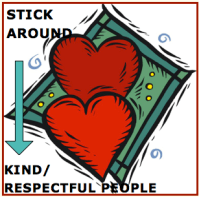
Look for people who are already kind, or at least respectful.
If you aren’t getting any of your needs met or are treated shabbily, you can walk away.
We MUST keep the focus on ourselves – owning & correcting our own character defects, AND appreciate & cherish our talents & skills.

NEXT: Scapegoated GROWTH #2

ACoAs being SCAPEGOATED (Part 3)

 PREVIOUS : Being Scapegoated #2

SITE: “Thru the Looking Glass
(anti-bullying blog)

1. ORIGIN
2. Scapegoat-ing FAMILY

3. Scapegoat-ed CHILD
Scapegoatees (Sc) are the non-entities of the family, held to an impossible standard not required of other members, accused unjustly, treated cruelly, & then ostracized.
The Sc is usually the most sensitive & intuitive child. Having no one to teach it the correct way to use empathy (with boundaries & discretion) this kind of child can easily be used by wounded parents, deliberately or not, to carry the ‘sins’ they refuse to deal with themselves (‘never wrong’, hypocrites, selfish, self-hating….)

◆ All children need to be mirrored – to know who they are – by looking into the faces, hearts & minds of loving adults. And all children need a degree of connection to family members – some more, some less – to feel safe.

😢 Sadly, too many children only get back warped reflections from parental & teacher mirrors, who provide their own distorted versions of reality.
What sensitive Scapegoats ‘see’ tells them they’re the ‘guilty party’, the one responsible for everyone else’s pain.

With no choice but to believe it, they’re pounded down by this message, forcing them to the bottom of the totem pole, where they stay in school or at work. No matter how well or poorly they do in life – on the outside, they build their life on an unstable foundation of anxiety, guilt & insecurity.

WHY is the Sc child CHOSEN?
🔎 A family’s scapegoating leader will choose a particular child, with ‘assistants’ who follow their lead (sibs, relatives….), because the child MAY –
• be too radically different in personality from the parents -OR-
• have similar characteristics to a parent, who hates those in themselves

• remind a parent of a hated relative, such as their own parent, sibling….
• be seen as a hindrance to a parent’s new marriage or relationship, OR be a child from a previous one
• be hated for being an unwanted ‘accident’, the a product of rape or incest, their birth ‘caused’ the mother’s death or the father leaving….
• be viewed as yet another mouth to feed, a burden to be gotten rid of…….

MAIN Sc “REQUIREMENTS”
1. SCs must actually be the strongest – because they have to psychologically / spiritually & sometimes physically carry the defects of the entire family. Their strength is needed to survive, alone, in the family ‘desert’ without the comfort or support of their tribe. (Part 1)

2. SCs must be the most loving – by their nature willing to sacrifice themselves for the benefit of the tribe. Again, this may be partly unconscious, but as a child the Sc has no choice. On some level they know they’re ‘willing’, so the family can appear to be OK

ALSO – SCs may be
• vulnerable in some physical or psychological way (ADD, obsessive…)
• hyperactive, non-compliant, overtly acting out
• young, or viewed as too weak to defend itself
• not the gender the parents wanted
OR
• too independent, smart & clever, with it’s own mind
• opposite in personality to the designated ‘golden child’ who can do no wrong = like Ivanka.
The favorite can be the eldest, sometimes the youngest, or even a child who died before the Sc was born & is now idealized (More….)

⚡️ In some very dysfunctional families, a parent will goad the other children into also picking on the disfavored one. Or siblings may copy the habit of taunting & blaming the Sc on their own, by watching adults get away with the cruelty. They will do this, at least in part, out of fear that if they side with the victim they’ll be tortured as well

Also, only children raised by severely damaged parents are likely to be alternately treated as Scapegoat & Golden Child, creating great confusion for the child (MORE…..)

⚡️ Once the scapegoating pattern is woven into the fabric of the family system, it’s inevitable that the Sc will gradually empathize with–> then carry–> then identify with all of the unresolved adult character defects that suffocated love in that home.

NEXT: ACoAs being Scapegoated (Part 4)

Enneagram Type 9 – Flaws in us ALL

type 9


PREVIOUS: All flaws – Type 8

IMPORTANT
Review explanation for each category in the INTRO post 
Associated Type is inside the ( )


Type 9 COWARDICE because of CDs (#6)
• re. self-assertion: believe it’s not OK to assert yourself in most situations. Instead, assume it’s best to not “make waves” or create controversy
• re. opinions: believe that either they don’t matter or that it is not worth the effort to express them
• re. conflict: think that it creates disharmony in relationships, & worry when someone is upset with you or when you’re upset with others

Type 9 FLATTERY (#2)
• Get into conversations with people you don’t like or are not interesting to you. Stay far longer than you’d like, while wondering how to continue so you won’t be considered rude
• Think of a way to draw out opinions from others, even when they’re boring, not knowledgeable or not very bright
• Think about how to offer time, energy & resources to someone you don’t think highly of or care about, just to be “nice” & avoid conflict

Type 9 LAZINESS (of mind or action) (#9)
• see only the positive side of your beliefs about people, situations, world events – as a way of maintaining harmony
• forget what matters to you, or what you truly think – as a way of not making waves or calling attention to yourself
• ignore or forget what you’re supposed to be doing (priorities) as a way to de-stress & not cause conflict – though it often creates more conflict later

Type 9 MOODINESS / melancholy (#4)
• believe that you don’t really matter
• see yourself as notable to stand up for yourself the way others can
• think you’re going to lose everything & everyone if you express your anger

Type 9 PLANNING – as compulsion (#7)
• about how not to plan
• how to not allow others to make demands or put pressure on you because of their plansambition

Type 9 RESENTMENT (#1)
• slow-burning angry thoughts when your opinions have not been taken seriously, & which has been building for a while
• think that others should be more open-minded & less judgmental when you’re in the middle of highly unbalanced thinking & actions
• ‘ugly’ thoughts that come up after you feel taken advantage of for being so nice & accommodating

Type 9 STINGINESS (#5)
• with expressing your ideas, believing what you have to say doesn’t matter as much as what others think
• with acknowledging your ambitions, seeing yourself as someone who’s humble & not competitive (even though it’s not always the case)
• with expressing anger, thinking that expressing your anger will damage or sever all relationships

Type 9 VANITY (#3)
• believe you’re above being ambitious
• see yourself above mere mortals who get reactive & angry
• think that when you muster the energy to state an honest opinion, it’s absolutely correct

Type 9 VENGEANCE (#8)
What sets you off is thinking someone has –
• chronically disrupted your peace & harmony
• been rude to you or others, particularly more than once
• ignored you, especially in a disrespectful way
• pressured, demanded or tried to control you
.

REACTIONS: try to keep others at a distance & from trying to control you, because of their plans
GROWTH: Ask “Am I taking a clear stand on issues, by expressing my thoughts & feelings directly, especially anger?”

ALSO
Type 9 DISTORTED LENS
Too loose lens (Type 9). Looking at things too openly & loosely means we miss the granulated nature of things (details). OR think that everything in our lens is equally important without enough distinctions
Lesson: When we observe in too broadly, we may see everything that’s there, but completely miss what’s most important.

Type 9 HANGING ON
Hang on to:
• being in positive resonance with others around you, at any cost
• not asserting or expressing yourself directly, & believe you don’t really matter as much as others

Why
: to keep a sense of ‘self as someone who’ can bring reconciliation / harmony to disruption, rapport to discord, & agreement where there’s disrespect &/or misunderstanding
Let go of: the belief that the way you matter is to not matter

Type 9 get OFF-BALANCE by:
• feeling angry but not being willing to express it
• being pressured or have a demand to do something, especially something you don’t want to dohelping?
• being put in the middle of an unresolvable conflict between others for an extended period

Type 9 MAYA (illusion)
Think you’re so consistently kind & nice, without recognizing that your under-experienced & unexpressed anger has painful consequences for self & others

Type 9 WORRY
“What do I really think? Why was I ignored? How can I get rid of the external tension? Where is my passion? Why didn’t I say what I really thought?”

NEXT: Ennea Humor #5

Enneagram Type 7 – Flaws in us ALL

type 7


PREVIOUS: Type 6 flaws

IMPORTANT
Review explanation for each category in the INTRO post 
Associated Type is inside the ( )


Type 7 COWARDICE
because of CDs (#6)
• re. pain: you think that all ‘pain’ is a waste of time, unnecessary & something you’re not equipped to deal with
• re. restraint: believe that freedom is the absence of any limits, & that no one has the right to restract you
• re. standing (sitting) still: see it as worthless or as an opening for a flood of despair, which you’re terrified of

Type 7 FLATTERY (#2)
• Think about a possible activity someone suggested merely because it keeps you all doing something, not because it’s a very good idea at all
• Re-frame a put-down by someone, making it seem kind & generous
• Think (often unconsciously) how to befriend authority figures with flattering attention, as a way to neutralize their potential ability to limit your freedom in any way

Type 7 LAZINESS / Indolence (#9)
You almost always seem to be energetic, but a person can be highly energetic & still be indolent
• Think about pleasure but rarely about pain, if ever
• Not notice what you physical sensations are telling you
• Re-frame potential negative information into a positive, as a way of not paying attention to what’s actually happening

patienceType 7 MOODINESS (melancholy & resulting separation) (#4)
• Wonder why, with all you joy, you don’t feel full inside
• Feel an emptiness inside you don’t know what to do about
• Think that even your mild feeling of pain or suffering are catastrophic (mainly because you’re so unused to them)

Type 7 PLANNING – as compulsion (#7)
• About positive possibilities: reacting immediately to stimuli (positive or negative), so your mind goes into a “hyper-gear” of associations, where one idea follows another in rapid-fire succession

Type 7 RESENTMENT (#1)
• If you feel restricted, think that no one has the right to do that to you
• Think negative thoughts about another when they cause you pain
• Rationalize away when having actually done something wrong, or something others may see as unacceptable or below standard

Type 7 STINGINESS (#5)
• with slowing down: Believe “down time” is boring & a waste
• with patience: Think that others are terribly slow because they can’t follow your line of thinking or mental pace
• with introspection: Don’t consider your interior world as fascinating or enjoyable as external experiences

Type 7 VANITY (#3)
• Think you’re not only quicker minded than others, but that you also catch on to new ideas better than most
• Believe that most of your ideas have merit
• See yourself as capable of enjoying life more than others do

Type 7 VENGEANCE (#8)
What sets you off is thinking someone has –
• tried to limit you
• not listened to or taken your ideas seriously
• been insincere and, therefore, can’t be trusted
• acted abusively (or is considering it) and needs to be stopped

REACTION: think about how to keep yourself & others safe from this person, which may include disarming them
GROWTH: Ask “Am I willing to deal with & stay focused on painful or difficult issues?”

ALSO
Type 7 DISTORTED LENS
Tainted color (Rosy) – looking through colored lenses makes everything seem brighter than it really is
Lesson: Everything is not nearly as rosy as we might want it to be, & just thinking / wishing doesn’t make it so!

Type 7 HANGING ON
Hold on to: being fun-loving, completely free, pleasure-oriented, & your unalterable right to avoid restrictions or painful experiences
Why: to maintain your ‘sense of self as a person who’ lives in a world where anything is possible, & there are no limits unless you create them
Let go of: the belief that freedom means having no limits

Type 7 get OFF-BALANCE by:
• anyone or anything bursting your bubble of enthusiasm
• feeling trapped or cornered in any way
• someone treating you as if you shouldn’t be taken seriouslyhole-in-soul

Type 7 MAYA (delusion)
Think that you’re forced to live forever with a deep hole inside, when in fact all you need to do is go inside – because you are there!

Type 7 WORRY
“Why do they want to bring me down? Why am I not taken as seriously as I desire? Are they trying to trap me? How can I fill that empty hole inside me? Why don’t I seem to feel as deeply as others when I do feel deeply about some things?”

NEXT: All flaws – Type 8

Enneagram HUMOR (Part 1)

school kids laughing
IT’S ALWAYS GOOD
to laugh at ourselves! 

PREVIOUS: Humor

SITEs: Type Comics 
Ennea DOGS

BOOK: “Enneagram Pop! – Fictional Characters” Damian Hospital & Tony Vahl

Enneagram animalsDINNER PARTY, by Elizabeth Wagele
enneaAnimals

Enneagram TYPE JOKES – gathered from the 4 corners of the earth!
GROAN ALL YOU WANT! Some are better than others!
NOTE: The ‘w’ between numbers means ‘wing’, so 6w7 is a Type 6 with some of the 7’s style. This is an additional feature – the number on either side of your Type – & is more likely to be one rather than the other – 4w3 vs. 4w5….. (Explained in other posts).

TYPE 1
❥ How many 1s does it take to change a light bulb?
Only 1, because no one else can do it right!

TYPE 2
❥ How many 2s does it take to screw in a light bulb? None.
“That’s all right, I’m fine in the dark. But I’ll do it for you if you need it?”
❥ Why did NASA send a 2 into space?
Because you have to pay a dish-washer

TYPE 3
❥ What do you call a 3 who hasn’t moved in 10 minutes? Dead.
❥ How many 3s does it take to screw in a light bulb? Just one. They hold the light bulb & the universe revolves around them
❥ How many 3s does it take to change a light bulb?
Two – one 3w4 to buy the best & brightest one, and one 3w2 to screw it in & then take all the credit for brightening up the room.

TYPE 4
❥ Why do 4s dress in all black? 
Because any other color makes them look fat and they are very self-conscious about it to the point of crying for hours about how fat they are.
❥ Why did the 4 cross the road?
To write an ode to the roadkill on the other side

TYPE 5
❥ What did the male 5 say to the female 5 on their first date?
“ I had so much fun. I’d like to meet you in person.”
❥ Why did the 5 cross the road?
To retrieve the emotions she left on the other side
❥ How many 5s does it take to change a light bulb?
Five: one to change the lightbulb, the other four to stand around pondering the meaning of light, & arguing whether they’re taking the right approach.

TYPE 6
❥ How many 6s does it take to change a light bulb?
5! 1 stands on the chair while the other 4 turn it
❥ Why is 6 afraid of 7? Because 78(ate) 9
❥ Hey, did you hear about that Six who was afraid of the germs on her counter? She was Counter Phobic!

TYPE 7
❥ How many 7s does it take to screw in a light bulb?
None… 7s don’t screw in light bulbs, they screw in hot tubs.
❥ Why are there so many 7w8s on TV?
 Because the murders they commit are big news.

TYPE 8
❥ How many 8s does it take to change a light bulb?
None, 8s aren’t afraid of the dark
❥ What did the 8 say to the 1?
“Why are we doing all the hangin’ while 9 does all the sittin’?”
(8s have the power to make someone happy… by staying single) lol

TYPE 9
❥ How many 9s does it take to change a light bulb?
None, because they forget about it until someone else does it
❥ What did the 9 say to the light bulb?
Nothing, just threw it out because it wasn’t working.

NEXT: HUMOR #2

PARENTS BLAMING US (Part 1) 

being blamedWHY IS IT ALWAYS MY FAULT?
No matter what I do, it’s wrong!

PREVIOUS: Rebellion vs Compliance #2

SEE posts : What is Guilt?
What is Shame?
• ACoAs’ Need for Revenge


INTRO

There is a lot of talk in the ‘spiritual’ community about forgiveness, ie – that we should not be blamers.
Not blaming ourself (S-H) or others (attacks) is a good rule for us in the present – now that we’re adults. And that’s a discussion for another post.

However, those same teachers & preachers never talk about what was done to us as kids – that among many other types of harm, our parents unfairly, inappropriately blamed us for all kinds of things – and what that did to our tender & vulnerable developing sense of identity!

This post is about what happened TO US as children. A hallmark of alcoholic & other emotionally unhealthy families is the mistreatment of their children in all 4 of life’s aspects: Spiritual, Emotional, Mental, Physical (PMES).

😿 Parents blaming their children for ANYTHING is ABUSIVE. Blaming us is the same as holding us responsible for their deficiencies & unhappiness.

Remember – abuse is not just Physical, in its various forms. Abuse encompasses all the ways people harm others – especially their children – by injuring another’s rights, self-esteem, mental clarity, sense of safety, emotional equilibrium & boundaries. So Blame fits into the other 3 categories – M, E & S..

👥 A variation on parental Blame is a constant and negative COMPARISON of a living child to a dead or other living sibling, another relative, a famous person….  “Why can’t you be more like ____”

1. IN OUR CHILDHOOD
✅ Damaged parents blamed YOU for things WHICH :
a. were NOT your fault
• your difficulties because of a learning disability, like dyslexia or ADD
• the illness or death of a parent; a parent being left by a lover or spouse..

b. was a projection
of what the parents were guilty of being (fearful, irresponsible, lazy, feeling unlovable, risk-averse….)

c. you were not doing
what you were accused of
• being a ‘whore’ when you were too young to have had sex at all OR
• of seducing a parent’s lover/ spouse, when that adult was actually sexually abusing the child
• of using drugs when you never did – at least not at the point…) Screen Shot 2016-06-12 at 5.07.37 AM

d. you could not do, especially without any instruction, & then accused of being stupid
• when you legitimately couldn’t know something (fixing a car or other machinery, shopping by yourself, def. of a big word…)
• ‘getting’ a hard school subject
• expected to know how to fix a parent’s personal, sexual & financial problems
• forced to take care of a drunk or crazy parent, alone…
WHICH
e. were truly no one’s fault. EXP :  • an act of God
• being born with a physical or mental limitation
•  getting severely ill or having an accident…

f. you were held responsible for –
 something one of your siblings or other child did, especially if you were the Hero or Scapegoat (start a fight; steal or break something; get into trouble at school…)

g. your parents were jealous of, because they couldn’t do something you could, even as a youngster (a natural skill or gift), so they made that ability stupid or a bad thing

h. was mostly not true
always lying (“Kids always lie so we can’t believe anything they say”)
always being stubborn, selfish, too sensitive, difficult, disobedient, stupid….

➼ This last category are a group of normal childhood characteristics which:
√ sick parent cannot tolerate because of their own issues
√ occur sometimes as a defense in the child because of family abuse & neglect…
√ happens occasionally because kids are human ie. imperfect.
Those behaviors & attitudes then get demonized – which make them a ‘sin’ and more likely to continue, causing the child to TRY becoming perfect’. We CAN’T WIN in a sick environment.

NEXT: ACoAs’ need for revenge