ACoAs MANIPULATING Self & Others (Part 3c)

in your head PREVIOUS: Manipulation #3b

SITE: 8 Ways to spot Manipulators

See ACRONYM page for abbrev.


Manipulative TACTICS (cont.)
Foot-in-Door
Start by asking someone for a small favor they don’t mind doing, then when they’re in the middle of it, add on other things or ask for the big thing you really wanted – making it hard for them to say nofoot in door

Guilting
Telling a conscientious victim they don’t care enough, are too selfish or have it easy, to keep them in a self-doubting, anxious, submissive position. OR make someone feel bad that you don’t have qualities, people or things the way they do (you’re jealous /envious), so they’ll feel sorry & volunteer to help you

Judgmental – the (T) form of T.E.A.
— all the time about everything, which is narcissistic
— occasionally, when old abandonment terror is triggered by a person or situation, but you don’t recognize it’s a reminder of childhood neglect & abuse

Mirroring (negative)
Physically &/or verbally copying someone you want to influence, by using their same body language, intonation pattern, language, preferences… making them feel ‘seen’ – so then they’ll copy you (symbiosis)

Over-promising
Saying yes to anything asked of you even when you’re not interested or it doesn’t suit you, & you don’t have time anyway – just so you’ll be liked. You over-book & then forget or cancel at the last-minute

One up-One Down
a. Feel superior – morally better with more value as a person, rather than being better at certain things (not just having a higher IQ), in order one upto keep everyone away, & not acknowledge your need for connection, help, comfort….

b. Feel inferior, believing you’re worse than everyone else (weaker, dumber, less capable….)
— to stave off assumed inevitable abandonment, disappointment AND
— obeying Toxic Rules “I am unlovable” / “I’m too much trouble” / “Don’t have needs”….
— living in deprivation, trying to get others to meet your needs

c. Fake humility – hiding the compulsion to dominate – by being the servant, helper, assistant, perhaps to serve a ‘higher cause’…. while controlling things from the wings

People-Pleasing / Perfectionism
Constantly trying to be or do whatever others want, or what you think they need/want, going above & beyond what’s called for or expected. Make yourself indispensable so they’ll approve of you & never ‘go way‘

Victim
Put a burden on others to be the ‘good parents’ you never had, BY:
• dismissing your own ‘voice’ & not taking up enough spacevictim
• going along, suffering in silence – but others can feel it
• give up what you want to avoid conflict, but are quietly resentful
• don’t ask questions, but always trying to explain or defend yourself
• talk in indirect or convoluted ways, instead of declarative statements
• withholding, as a form of silent disapproval
• believing you have nothing worthwhile to contribute……

COMBINED Manipulation of Self & Others
Taking on the Scapegoat Role as a child (NOT the same as being scapegoated by the family). It’s the child’s attempt to spare the obvious narcissist / addict their pain, by taking it on & acting it out for them – assuming this will alleviate the heaviness it can feel in others.
It’s a way the child denies admitting that the abandoning adults are as sick as they are & not willing to change

This manipulative tactic (usually unconscious) continues into adulthood – the ACoAs continuing to sacrifice their own needs, good name & protect familystanding in life – if it will make others ‘feel better’ by avoiding responsibility for their own damage

On one level this Role is genuinely taken on in the name of love, but at a deeper level it’s about the fear of losing connection, the ultimate childhood terror.
Unfortunately, the sacrifice is never successful or unappreciated, only being disrespected & dismissed. So when the Scapegoat is treated badly or ignored, this ACoA gets very angry at anyone they’ve been trying to ‘save’.

Adult Scapegoats only focus on being rejected or & invisible, left outfeeling unloved, excluded, attacked – BUT not seeing that they
— allow themselves to be used & toyed with by unscrupulous types
— experience real or imagined slights as a direct rejection, as if others are focus on them, or hell-bent on hurting them
— perpetuate childhood environment of fear, loneliness & abandonment BY not having a strong core identity based on self-esteem & self-respect.

NEXT: Manipulation #4a
ACoAs MANIPULATING Self & Others (Part 3b)

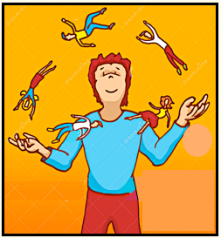
juggling peoplePREVIOUS: Manipulation #3a

SITEs:☀︎ 20 Subtle Signs of Workplace Bullying
☀︎ “Workplace Danger – Manipulative People”

BOOK: 30 COVERT ways of M. ~ Adelyn Birch


FORMS of Manipulation (cont.)
1. Direct / Overt (Part 3a)

2. Indirect / Covert
A more subtle form, tactics (Evasion, Diversion, Blame….) are effective because they carefully hide aggressive & exploitative intentions, while putting the other person unconsciously on the defensive.
— Sometimes all it takes is a particular facial expression, non-verbal gesture, glance, glare, stare, or shrug
— Sometimes the manipulator will send a carefully veiled “Now there’ll be some hell to pay!” message without making any kind of direct threat

ACoAs
As stated in Part 1, M is an attempt at getting our needs met, but only indirectly, because we’re not allowed to HAVE them (shame is what we feel about each need never provided by our family). Back then, trying to get anything we needed always ended in being made fun of, punished or completely ignored.
BUT since needs are NORMAL & therefore don’t go away, we look for alternative ways of meeting them, while still obeying the toxic rules – putting ourselves in a double bind.

Manipulative TACTICS
Avoid Asking
Expecting others to guess what you need & then provide it. When they don’t – not being mind-readers – you feel very angry, get depressed & assume the ‘universe’ doesn’t want you to have the needs

Bribery
First you reward someone by identifying what they want/need & give it to them, acting like a ‘genuinely’ nice person. Then later pleasantly suggest you’d like something in return. They’ll usually feel compelled to return the favor

Bugging / Pushypushy
At the other extreme, always nagging to get what you want, repeating the question, requesting or demanding, insisting…. to wear others down until they finally give in. Can’t tolerate NO as an answer, & constantly over-step boundaries

Charm / Good Looks
Use your best assets to encourage people to favor you over others (work, dating, purchasing…) by being positive, cheerful, self-confident, well-groomed, with approachable body language – to make them feel special for having your full attention

Conditional Approval & ‘love’
You’re kind, pleasant, helpful – but only if they’re just like you. Want what they can do for you, let you control them…. But get angry or withholding if they disagree, set limits on you, stand up for themselves, won’t go along with your agenda….

Dishonest watching & listening
Pay close attention to what people tell you about themselves & their body language, figuring out their psychological/emotional makeup, in order to identify weakness or strength you can exploit

Distorting Facts
Manipulate info & reality by making it seem better than it is. OR leave out crucial info in an explanation, use info against the person, overwhelm with facts & statistic, lie, make excuses, exaggerate, act like you know everything…. to avoid responsibility & feel more powerful

double-BDouble-Binding
Keep someone who wants to please you in bondage (paralyzed) by subtly giving opposing messages they must obey or accept without question, to keep them confused & off balance (EXP: smile while insulting)

Exploiting
Use other people’s time, energy, money, talents – only for your benefit – by convincing them it’s for a good cause, will make them feel good, will provide ‘spiritual benefits/rewards…. or by promising some big reward while ignoring their rights & interests

Fake Emotions
Use contrived emotions to get what you want & have the upper hand, by acting angry to scare someone, solicitous to soften them, caring to keep their attention, weak & needy to get taken care of, insulted to create guilt…..fear & relief

Fear-&-Relief
To get someone to do what you want but is resisting, you artificially create sudden mood swings, by first working on their fear (disapproval, threats to leave, withhold money….). When when they’re weakened & disarmed, ready to give in – you stop the pressure, tell them it’s OK…. which makes them so relieved they’ll do whatever you want

Flattering / Kissing up
Making others feel good by complementing them, acting totally interested in their lives…. so they’ll want to please you. It makes it hard for them to say NO, even against their better judgement, so you won’t be disappointed or think badly of them

NEXT: Manipulation #3c

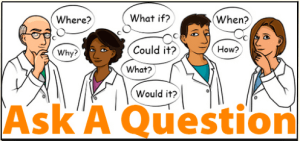
ACoAs & ASKING QUESTIONS (Part 1)

asking QsIT NEVER DAWNS ON ME
to ask about the other person

PREVIOUS: Reverse Laundry List


PROBLEM
Another indicator of ACoA damage is the fear of asking questions or worse – not even realizing it is necessary, appropriate, even imperative.
At the core of this issue is the unconscious but ingrained perspective that we should not hold other people responsible for their words & actions. As emotionally immature adults, we are still going on the assumption that everything is our fault (narcissistic S-H), & therefore it’s all up to us to correct misunderstandings & fix whatever is causing us pain (narcissistic grandiosity).

In CHILDHOOD
Most ACoAs stopped asking Qs because of the messages & reactions we got from our dysfunctional family as well as from outside sources such as school & religious institutions. “Children should be seen & not heard”. They :
• didn’t want their authority questioned
• didn’t want their bad behavior pointed out or abuse objected to
• didn’t want their hypocrisy & neglect uncovered….not allowed to ask
AND they
• couldn’t be bothered to listen or explain things
• didn’t have the patience to show us what they knew how to do
• made it sound like we’re dumb for not knowing things they knew
• told us we were disrespectful for questioning their authority
• punished us with a smack or with guilt for wanting to know what’s going on around us • made fun of us for exploring & being curious ……

NOTE: Curious & clever children may seem to be ‘challenging’ the adults “WHY … WHY…” But if we got a bad reaction (“you’re arrogant, you’re being difficult, you’re disrespectful”) it’s almost always because the person did NOT know the answer & was ashamed to admit it

No matter what Toxic family Role were fell in to as kids (Hero, Scapegoat, Lost Child, Mascot), ultimately we were on our own, because our wounded parents we unable to connect with us in healthy loving ways. We got the message that we were a burden to them – or worse – hated (“You’ll be the death of me yet!”). We understood that if we were to figure things out it would have to be from other sources, like school & our peers, but mainly by just watching other people & events. Quietly, secretly observing the world around us helped, but it didn’t encourage asking questions.

As ADULTS
Our early trauma, distorted mirroring & lack of good role models has left holes in our ability to think of what to say. This is because of missing information, rather thanbeing mute stupidity. It literally means not having the vocabulary for legitimate questioning – what words to use, what point of view we need to come from, or what to expect.
BUT this can be learned from books such as “The Gentle Art of Verbal Self-Defense”, & from others who have already know how.

Many of us believe that any form of Qs is impertinent, boundary invasive, & just plain rude – which is not true when Qs come from our Adult ES.
And when someone says or does something unkind, inappropriate, narcissistic or flat-out mean – we justify, over-explain, excuse ourselves (Sorry, Sorry), instead of lobbing the ball back at the other person by saying something like:“What did you mean? // Why did you say it that way? // Is that what you would do – want?… (See “Useful Responses”).

ACoAs were not allowed to defend, protect or stand up for ourselves, to not have the right to object to abuse, & to never know what our true needs are. So we continue to live in a quasi-world of not really belonging, not having rights, not being heard, not having access to our personal power, & most of all – never truly feeling safe.  Others of us will bite back when we feel neglected, dismissed or accused, a version of the PP &/or WIC trying to protect ourselves, but this is simply ineffective & can serve to escalate a bad situation.

NEXT: ACoAs & Asking Qs – Part 2

OUR SENSES & LEARNING – Vision (#2a)

visual learning
I GET MOST OF MY INFO
through my eyes

PREVIOUS: Sensory Learning #3

SITE: MANY links re learning
• “5 things to know about how the brain learns”

QUOTE: “To develop a complete mind, study the science of art and the art of science. Learn to see. Realize that everything connects to everything else.“ ~ Leonardo DaVinci

VISUAL Learning Style
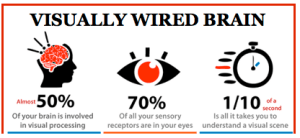
According to Dr. David Sousa, 45% or more student in most American classrooms prefer to receive information visually. This includes pictures, video tapes & charts, as well as reading, because the interpretation of symbols translate into mental pictures (“How the Brain Learns”)

Our brains give preference to processing vision, compared to our other senses.
EXP: Imagine being in an open field. How far can you see? About 50 miles. How far can you hear? Maybe a mile or two. How about smell? 10-20 yards, assuming that the wind is not blowing. How about touch? Just an arm’s length. Taste? A couple of inches.

The Visual Cortex, in the Occipital Lobes, is the largest system in the human brain, responsible for higher-level processing or visual images. It’s at the back of the brain, above the cerebellum. It interprets info from visible light to build model of the world around the body. As the eyes gather information, the brain interprets & makes sense of what we take in. Both occipital & parietal lobes manage spatial orientation.

The eyes & the Visual Cortex form a massive parallel processor that provides the highest band-width channel into human cognitive centers. At the higher level of processing, perception & cognition are closely interrelated, which is the reason why the words “understanding & seeing’ are synonymous.” ~ Colin Ware (slide 17) attention span

The average human attention span is 8 seconds, & our brain processes visual images 60,000 times faster than a text, in roughly 1/10 of a second.

Hubel and Weisel showed that the primary visual cortex consists of cells responsive to both the simple & the complex features of whatever we’re seeing. Interestingly, most of these cells have a preference for one edges of an angle over another, called ‘orientation preference’, & to inputs from one eye over the other, called ‘ocular dominance’.
These 2 patterns (preference & dominance) are not fixed genetically, but develop from visual experience, mostly soon after birth.

80-90% of children use their eyes to learn about their world. They’re used to gathering information nearby (what can be touched) & at a distance (beyond arm’s reach). Visual stimulation helps to shape children’s minds in powerful ways.eye preference & dominance

Science tells us the neurons that handle visual processing make up about 30% of the brain’s cortex – more than double that of hearing & touch combined. Via this method we store both negative & positive impressions in the brain (images of AK-47s & beautiful waterfalls), at conscious & subconscious levels. All imprints have a deep & lasting effect on the way we learn & think.

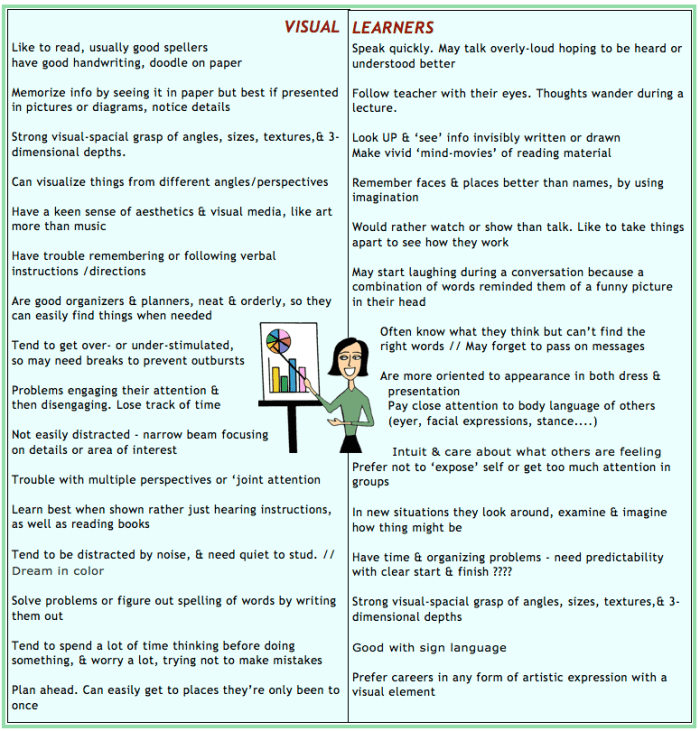
Most of our activities involve ‘seeing’, so the importance of this sense can easily be taken for granted, yet sight is crucial to learning. Visual learners take what is spoken or heard & make it into something they can see in their mind’s eye. They get the most out of visual aids, & put a lot of effort into observing / listening so they can turn info into notes, charts, graphs, pictures….

Re. INTUITION (Clear Seeing) Being able to visualize possible scenarios in the mind’s eye, as if recalling a memory or imagining an actual picture.

SOME general VISUAL Characteristics
KEEP IN MIND that whichever style is your preference you’re not going to identify with every single characteristic listed. That will depend on other factors, such as mixing in other learning styles with your primary one, your educational background and your native personality.visual Lern - charact
NEXT: Auditory Learners (Part 4b)

OUR SENSES &LEARNING – Intro #1c

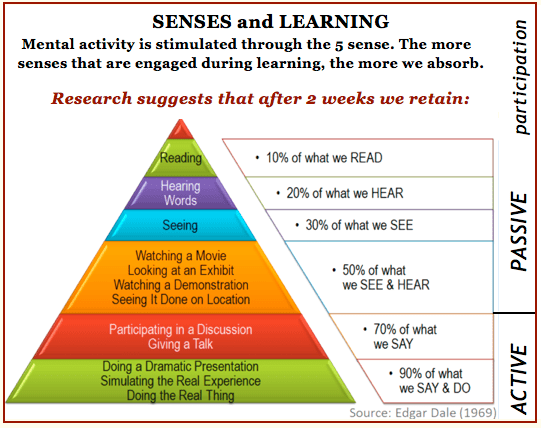
sense learning %


PREVIOUS: Sensory Learning (Part 2)


SITE: Sight, Scent & Sound: The Role of Senses in Retail Marketing

QUOTE: “Live as if you were to die tomorrow. Learn as if you were to live forever.” ~ Mahatma Gandhi

OLD CHINESE PROVERB: “When I hear, I forget. When I see, I remember. When I do, I understand.”

🌺      🕺🏼     🧤     🕶    👂🏾
MAIN SENSORY INPUTS

We express ourselves internally & externally from VAKOG forms of gathering knowledge & understanding:
1. Visual = SEEING 🌀 2. Auditory = HEARING
3a/b. Kinesthetic/Tactile = SENSING/TOUCHING
4. Olfactory = SMELLING 🌀 5. Gustatory = TASTING

Only the first 3 are widely used as major input channels for collecting data about our surroundings. 1, 2, 4 & 5 are obvious. #3a refers to whole body experiences involving sensations, emotions & motion itself. #b refers to learning by touch – such as the blind reading in Braille.

Summary of stimulus-to-response pathwayssensory process


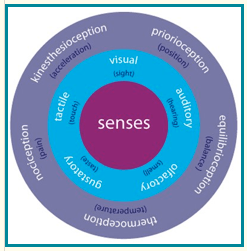
OTHER sensory sources (equally important sources of internal/external info) : senses circle
1. Chemo-receptors:  These trigger an area of the medulla which detect blood-born hormones & drugs. Also involved in the vomiting reflex

2. Equilibrio-ception
: This helps to keep our balance & a sense of physical movements, such as acceleration, directional changes, & a sense of gravity.
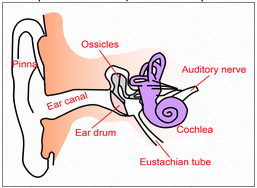
It’s the Vestibular Labyrinthine system. located in the inner ear. When malfunctioning, we can’t tell up from down, so moving from place to place without help is nearly impossible

3. Hunger
: This system allows the body to detect when we need to eat
4. Itch:  A distinct sensor system, part of other touch-related senses

5. Magneto-ception
: This gives us the ability to detect magnetic fields, providing a sense of direction, based on Earth’s magnetic field. It’s not strong (like in birds), but experiments show that we do have some

The mechanism is not clear, but may have to do with deposits of ferric iron in our nose. It could be, since humans given magnetic implants have a much stronger magneto-ception than those without (MORE…. )

6. Noci-ception:  i.e Pain – once thought to simply come from overloading other senses such as Touch. Actually, it is its own unique sensory system.  with 3 types of pain receptors: cutaneous (skin), somatic (bones and joints) & visceral (body organs)
7. Pressure: Identifying shapes, softness, textures, vibrations….

8. Proprio-ception
: Gives the ability to tell where our body parts are, relative to each other. Police test this when checking for a potential DUI driving drunk, by asking: “Close your eyes & touch your nose”.
This sense is used regularly in small ways, such as scratching an itch without having to see where the hand needs to goear structure

9. Sound: Detecting vibrations along some medium in contact with the ear drum, such as air or water
10. Stretch Receptors: These are found in the lungs, bladder, stomach & the gastro-intestinal tract. One type, which senses dilation of blood vessels, is often involved in headaches
11. Tension Sensors: These are found in places like muscles, allowing the brain to monitor muscle tension
12. Thirst: This system allows the body to monitor its hydration level so the body knows when we need to drink

13. Thermo-ception: a specific brain system, plus a combo of senses, for monitoring internal body temperature. This includes the ability to notice heat & cold, using the 2 hot/cold receptors

14. Time:  This one is debated, since no single mechanism has been found that allows people to perceive time. However, experiments have definitely show that humans have a startlingly accurate sense of time, particularly when younger.

This seems to come from some combination of the cerebral cortex, cerebellum & basal ganglia.
— Long-term time-keeping seems to be monitored by the supra-chiasmatic nuclei, responsible for the circadian rhythm
— Short term time-keeping is handled by other cell systems

15. Touch: Rather than located in one or more specific areas, this sense is our whole body – made up of a very fine network of receptors in our skin, forming our largest sensory system. (More….)

HIDDEN Senses automatically, unconsciously help to:
• control bodily functions, such as temperature & bladder fullness
• control timing & movement of food through the body (digestion)
• measure the amount of sugar & salt in the blood
• regulate the amount of oxygen that’s taken in, for breathing…..synesthesia

SYNESTHESIA – when 2 or more senses combine / overlap, such as seeing numbers in color, tasting words….
It’s hereditary, estimated to occurs in 1 out of 1000 individuals, in various forms & intensity.
(MORE…) // (Science of Synesthesia chart)

NEXT: Visual Learning (Part 2a)

Procrastinators Anon TOOLS

putting it off 

PREVIOUS: RE-ORGANIZED pages


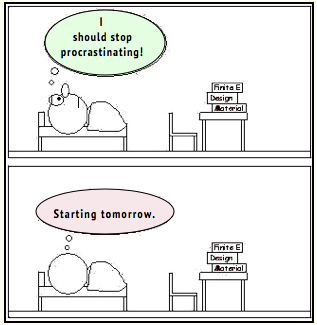
THESE TOOLS ARE GREAT.
I’ll try them later!

PREVIOUS: ACoAS & Procrastination (#5)

POSTS“ACoAs & Procrastination” / / “Weak Decision Styles

Procrastinators-Anonymous.org – “a fellowship of men and women who share their experience, strength and hope with each other that they may solve their common problem and help others to recover from chronic procrastination.”
TOOLS for RECOVERY
1. Break It Down: Break down projects into specific action steps; include preparation tasks in the breakdown.

2. Visualize: Plan what to do, then imagine yourself doing it. The more specific and vivid your visualization, the better. See yourself doing the task, and doing it well.

3. Ask Yourself Why: While you are visualizing doing the task, see if you can detect what it is about the task that feels odious to you, what uncomfortable emotions you are avoiding. Knowing what’s behind the avoidance can help you get past it – for example, address real problems or ignore irrational fears.

4. Focus on Long-Term Consequences: Procrastinators have a tendency to focus on short-term pleasure, and shut out awareness of long-term consequences. Remind yourself how panicked and awful you’ll feel if the task isn’t done, then imagine how good it will feel when the task is finished.

5. Avoid Time Binging: One reason procrastinators dread starting is that once they start they don’t let themselves stop. Plan to work on a task for a defined period of time, then set a timer. When the timer goes off, you’re done.

6. Use Small Blocks of Time: Procrastinators often have trouble doing tasks in incremental steps, and wait for big blocks of time that never come. When you have small blocks of time, use them to work on the task at hand.

7. Avoid Perfectionism: Procrastinators have a tendency to spend more time on a task than it warrants, so tasks that should be quick to do take an agonizingly long time. Notice this tendency and stop yourself. Some things require completion, not perfection.

8. Keep a Time Log: Increase your awareness of time by logging what you are doing throughout the day. This is a great diagnostic tool for discovering where your time went, and an excellent way to become better at estimating how long tasks take.

9. Develop Routines: To help structure your day and make a habit of things you always need to do, develop routines for what you do when you wake up, regular tasks of your workday, and what you need to do before going to bed.

10. Bookend Tasks and Time: Use the Bookending board on the P.A. Web site to check in throughout the day, or at the beginning or end of specific tasks you are dreading.

Please visit Procrastinators-Anonymous.org for more info.  Details are at the top of the Bookending board.  AS A REMINDER:

putting off cartoon
NEXT: WEAK Decision Styles, #1

ACoAs & PROCRASTINATION (Part 5)

make notes I CAN GET THINGS DONE –
& feel good about it!

PREVIOUS: Putting things off #4


SITE: Overcoming Procrastination

BOOK: “Willpower: Rediscovering the Greatest Human Strength” by John Tierney, New York Times science writer, & psychologist Roy F. Baumeister.
An unconventional “self-help” book that, much like Timothy Wilson’s ‘Redirect’, grounds its insights & advice in 30 yrs of serious academic research into willfulness & self-control. While the book is fascinating in general, its 3rd chapter “A Brief History of the To-Do List, From God to Drew Carey,” is particularly interesting.

5. BOTTOM LINE
“WHY BOTHER?” underlies all our indecision & procrastination. We don’t take genuine care of ourselves, no matter how busy or cocky we seem to others. On a deep level we’re paralyzed by:
a. Not knowing or having access to our healthy True Self, so we believe we don’t know what we want or like, nor what our rights are!

b. Not being allowed to be our own internal motivator – so our only reason to take actions has to come from outside. We have to use family, a boss, teacher, a cause, religion, a career, friends & lover relationships, AND ultimately our terror of abandonment & punishment to push ourselves. Left to our own devices, we just collapse inward

c.
Our Internal Conflicts:conflict
• losing someone, being hurt or punished vs. feeling ‘safe’ (even if that safety is an illusion or self-destructive)
• WIC & PP vs. the Healthy UNIT
• obeying vs. disobeying the Toxic Rules
• old patterns vs. new ways of doing things
• what we want vs. what we’re ‘supposed’ to be, do, think, feel

d. Double messages, originally forced on us by one or more adults, we had no choice but to internalize the resulting Double Binds* (simultaneous but opposing demands, with a penalty for whichever one we can’t fulfill).
EXP:
• As kids they expected us to do for them (which may still be going on with an elderly parent), taking advantage of us to be their parent substitute – using hints, guilt, shaming, manipulation, demands, threats…. AND were angry / abusive if we did nothing (the penalty)

• BUT THEN were totally dissatisfied with & critical of (the penalty) whatever we did do for them, no matter how much effort we put in, what it cost us, what we had to sacrifice, how clever we were at it….

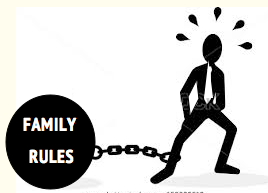
*EITHER WAY we were/are punished. If they’re still live we compulsively keep trying – to please them,chained to rules over & over. If they’re not around anymore we often find some other needy, critical person to satisfy – always with the same impossible, painful results!
YES, we’re addicted to the rejection, while maintaining the illusion that we have the power to change them, if only we try hard enough, long enough!

Ultimately, we stopped trying – but only for ourselves, because:
• we’re still waiting for them to approve of us, & give us permission to have a life of our own life (free us of their bondage because we don’t believe we can do it ourselves!)
• we’re convinced that if we failed with them (the family, also school, religion), it’s inevitably that we’ll fail with everything & everyone else, so there’s no point in trying
• we’re waiting for someone – anyone – to come & rescue us so we don’t ever have to be our own parent!

6. FACING our INNER REACTIONS
• Unfortunately, delaying inevitable responsibilities (as well as ones we’ve taken on voluntarily) creates endless obsession & self-recrimination. “”I’m just lazy by nature”, “I can’t do anything right” , “I’ll just mess it up – again” ….procratination

So why would we rather worry ourselves sick than ‘just do it’?
• we SAY it’s just a habit – but it’s really our self-hate
• we’re used to longing for things, rather than having them
• we’re waiting to be taken care of
• we think we don’t know how, even tho we actually do
• staying loyal to the family by copying how those adults ‘handled’ daily actions & problems
• we’re not allowed to do things easily because suffering is the norm (if it’s too easy it doesn’t count)

NEXT: Procrastination #6

ACoAs & PROCRASTINATION (Part 4)

self-motivationTHERE REALLY ARE THINGS
I can do to get going

PREVIOUS: Putting things off, #3

See ACRONYM page for abbrev.

SITE: ‘Beating Procrastination


2. NOW we put things off because of…. (in Part 3)
3. WHAT makes it HARD to act
a. Internal FEAR of // b. External FEAR of….

Internal & external fears can show up as: (cont.)
Putting off tasks. Many of us find that our whole life is permeated with the ‘habit’ of waiting to the last-minute to do things. It doesn’t seem to matter whether the ‘thing’ is something we would like to do or something we dread. We just put it off & off & off.

— Then comes crunch time – the deadline has caught up to us. We’re in a panic, scrambling to do the task, but now it’s going to be half-baked. We don’t have enough time to do a thorough job, don’t read the instruction correctly (or at all), leave out or miss something. And by leaving it tot he lat minute it can never be done right
— OR the deadline has past & we don’t get the benefit of a discount, miss a class or a needed product, a reunion, a party….

▶ Of course we’re painfully aware of all this, but as long as we’re stuck: worried
— we’re full of anxiety & S-H for not doing it Perfectly
— we scare ourselves with dire projections & predictions about how we’re going to get judged, punished, fired….
— hate ourselves for letting a desired or favorable opportunity pass by

But, like any good addict, we’ll do it the same way all over again, & again! WHAT? How can this be an addiction? WELL…. in this case it’s the addiction to: Fear + Adrenalin + S-H = Drama. This formula has become so much a part of our lives since childhood that we keep doing things (or not) to re-enforce the chemical surges it creates.

Yet under this self-inflicted ‘excitement’, the WIC is just trying to protect itself the only way it knows how – by NOT doing anything. Yet it’s not enough to just label it as part of our ACoA damage, which it is. We need to know how it all got started (Past) & how we perpetuate it (Present).

4. GOOD Stuff can deter us too – we often sabotage when things get too good!
• fear of success, as that would disobey basic Toxic Rules, and we’d have a lot of responsibility which the WIC believes it can not handle – even tho our adult can/could

• not allowed to be happy, based on the belief that life is hard, exclusively, AND that we aren’t worthy of having good things anyway
• stay loyal to the family by not out-doing them – we must also be a failure, don’t show them up, stay in the family mobile, don’t rock the boat…

• can’t be decisive: sometimes there are places we thinks we should go to, but really didn’t like, or we don’t feel well, or want to do something else, or do nothing at all…. even when it’s potentially pleasurable or valuable.

But we aren’t allowed to say NO to the inner Pressure-er (“what will they think if I don’t show up? / what if I miss out on something / maybe this will have the perfect answer to all my problems?….”). So instead of firmly deciding Yes or No, we dither & obsess, do nothing & then hate ourselvesindecisive

• are never supposed to say NO to what someone else suggests, offers, wants – especially if it’s good for us. Besides “Why do they want to be with me? Why are they being so nice?” So for those times we don’t rush to people-please, we make promises we eventually flake out on, make excuses or just lie, until people get angry &/or give up on us.
— That comes both as a relief – of pressure, and a big pain – of yet again feeling ‘abandoned’! Trapped in our own no-win game, we blame others AND are filled with self-abuse

NEXT: ACoAs & Procrastination #5

ACoAs & PROCRASTINATION (Part 3)

mananaMAÑANA, MAÑANA
I want to, but just can’t get going!

PREVIOUS: “Putting things off” Part 2

POST:Why are you Stuck?”


2. NOW we put things off because of: ❓Feelings  // ❓ Knowledge
✳️ ULTIMATELY – we put things off :
a. so we won’t feel so alone – that inner loneliness of not having nurturing parents growing up! Being our own caretaker, being competent – even in small things – is an emotional reminder of how terribly alone we always felt as kids – no one to guide (only bully), no one to comfort (only control), no one to encourage (only shame)…. inner aloneness

• Instead of doing something positive, all that wasted time spent worrying, obsessing about things we’re not getting done actually serves a purpose for the WIC : it fills up the emptiness inside – where a good parent should be – the Inner Supporters we never had (early abandonment).

EXP: Pre-Recovery, Tina needed to replace a knob for her radio that had fallen off & was lost. She knew she had the manufacturer’s purchase list in her files, but felt a general lethargy about taking the action = all of 5 minutes to find, make the call & order the tiny part. It was several months before she did this simple task.

• In the mean time Tina had to turn the radio on & off by awkwardly using 2 fingers on the sound stub. When the part arrived, in a little pouch, it sat on her night table several more weeks. Eventually she ‘faced’ the great task of taking the knob out of the package & clicking it into place = all of 1 minute!

b. because we have a deep (usually unacknowledged) feeling of hopelessness. After all – the WIC believes that our actions are supposed to get us the love & attention we’re always craved, specifically from our parents (dead or alive!). The Child’s logic says – “since they hurt me & hated me, it has to be my fault, so I have to find a way to fix it.”

But no matter how hard we work at being the perfect son or daughter, we rarely achieve this wish. So eventually drowningtaking actions gets harder & harder. Scapegoat & Lost Child ACoAs give up trying a lot sooner than Heroes & Mascots, but they never give up wanting to be loved & accepted! They just pretend they don’t care!

c. we feel powerless to have any effect on our environment (being efficacious). We could never get our parents (& sometimes siblings) to notice us, listen to us, take us seriously, consider or feelings & needs. So why would we be able to influence anyone else in the world? If we have no ability to influence, then why even try to DO anything?

3. WHAT makes it HARD to act
a. Internal FEAR of —
• not doing everything Perfectly (a form of S-H)
• not knowing how to do something (even tho we’re actually very
smart, clever, creative, knowledgeable)
• not knowing what to say when challenged or attacked
• looking weak, needy, incompetent, lazy, stupid…..
• having to stand up for ourselvesstandup
• making the ‘wrong’ choice, when having several options, or many demands on us at the same time
• having to feel the loneliness & pain of our original abandonment

b. External FEAR of —
• getting disappointing, hurting or angering someone
• being judged harshly (the way we do to ourselves)
• asking for help when we really need it
• having to deal with difficult people
• being interrupted & lose our train of thought /activity
• having to make everyone else happy (not be in pain) but resenting it

These can show up as:
• Not being able to decide what to do first, when we have several options, or what to do at all (like with free time)
Starting things (refinishing a pc. of furniture, art work, a book, even relationships…) but never / rarely finishing anything – IF for ourselves
• Can’t motivate ourselves – to have a life of our own, as in following our dreams, leaving bad relationships, moving to a better location….!

NEXT: Procrastination  Part 4

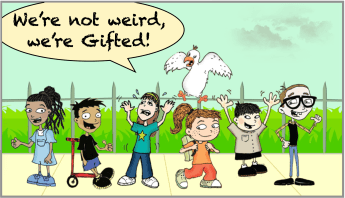
Gifted Children – Types (Part 1)

WE WANT TO UNDERSTAND
our child & help her/him blossom

PREVIOUS:
 Multiple Intellig. #3e

SITEs: “Characteristics & Behaviors of the Gifted (excellent)

12 Lessons about GIFTED KIDS from MATILDA

BOOK: “The Drama of the Gifted Child”~ Alice Miller (Comments)

UNIQUENESS
Parents know that their children are different from each other – but not all are aware of it consciously. We can tell this by how differently they treat each child – because of birth order, gender, inborn characteristics, & the Type most like each parent.

Healthy
:
In reasonably functional homes parents notice & respond appropriately of the variations in their children’s personalities. While trying to be fair & balances, they form their relationships & type of guidance based on what’s best suited to each child’s style.

Unhealthy: Damaged parents don’t even try to be fair or balanced with their various children. Instead they ONLY use those existing differences in the service of the family dis-ease & their own sick personal needs – especially the very smart & perceptive children, who are either:

a
. scapegoated in order to dis-empower them because their sensitivity & intelligence is a threat to maintaining the abusive structure, & so are systematically destroyed, OR
b. their strength & cleverness is used to take care of everyone else, while the child’s needs are neglected & negated. OR both.

ACoAs: Even though we are in fact quite smart – to have figured out how to survive so much chaos & cruelty – we don’t know who we are inside. So it’s not surprising that we seem oblivious to fundamental differences in the personalities of people we meet or live with. We act as if they are all the same – but more specifically – the same as us (symbiosis).

This is the crux of our emotional & psychological blindness: Our WIC narcissistically wants everyone to be a carbon copy of ourselves, as if that would validate us & give us permission to be ourselves. It’s the only way it thinks it can be safe.

▶︎ Studying the various Styles of children & adults allows us to distinguish ourselves from others, & be better able to interact with them based on who they are.

RECOVERY: But first we need to find our who we truly are (via our inventories, plus mirroring & validation from others) to get comfortable with ourselves, so that it’s OK to see who other people are, without it threatening us. Another irony – the more we can do that the safer we actually feel!

REVIEW
: As listed in many other posts – there are a number of ways to find out who we are, such as: Al-anon, Dream Interpretation, Enneagram, Journaling,  Myers-Briggs Inventory, MMPI, Multiple Intelligences,  Personality tests, Prayer & Meditation, Psychotherapy, Numerology & Astrology, 2-handed Inner Child dialogues, Trauma Release body work…..

For ACoAs – all these tools are needed in various combinations in oder to form a rounded picture of our Inner Self, since we are complex beings and because our upbringing gave us a very distorted view of ourselves.

Re. very bright children – the next 2 posts list the categories drawn from many year of observation by George Betts & Maureen Neihart (Davidson Institute for Talent Development), based on Howard Gadner’s 1983 proposed Multiple Intelligences.

Re. this List (Part 2 & 3) : As with other kinds of descriptions, a child may be a combination of 2 or more, & their Type will develop with time as they grow. Healthy parents will want to stay aware of their gifted child’s progress, to keep up with changes needed to give practical help & emotional support.

NOTE: Some Gifted Children have hidden learning disabilities that often go undiscovered, fearing ridicule & the ignorance of others. Their cleverness allows G&Ts to compensate for problems in their early years. Untreated, eventually it becomes harder & harder for them to excel, which can lead to behavior problems, depression & giving up.

NEXT: Gifted Children (Part 2)