ACoAs – What about ANGER? (Part 1)

frustrationI’M SO FRUSTRATED
I don’t know what to do with myself

PREVIOUS: New Year Celebration

BOOK: Metaphor & Emotion, seeing the body as container for emotions: “She unleashed her anger, his anger is smoldering, you make by blood boil…..”

BASICs the more we know about something, the easier it is to understand, deal with & be in charge of it. So it is with anger.

1. Anger is a perfectly normal emotion – created by the physiology of our brain & body. It’s not only universal, but absolutely necessary, and NOT something to be cured as if it were a disease.

Anger is a healthy reaction to a grievance, so one of its positive intentions is to focus our attention – so we can modify or eliminate an aggravation or abuse, wherever possible. The benefits of appropriately expressing it include overcoming our fears, & building confidence to respond to threats, danger & mistreatment.

T.E.A.
The problem is not in having (feeling) the emotion (E),
►but rather in what we’re saying (T) to ourselves about a situation which greatly upsets us,
▶︎and the kind of behavior (A) we use to express it, based on what we learned as kids.
We need to FEEL our anger, but we do not always need to outwardly E. HEAT mapACT it out on others!
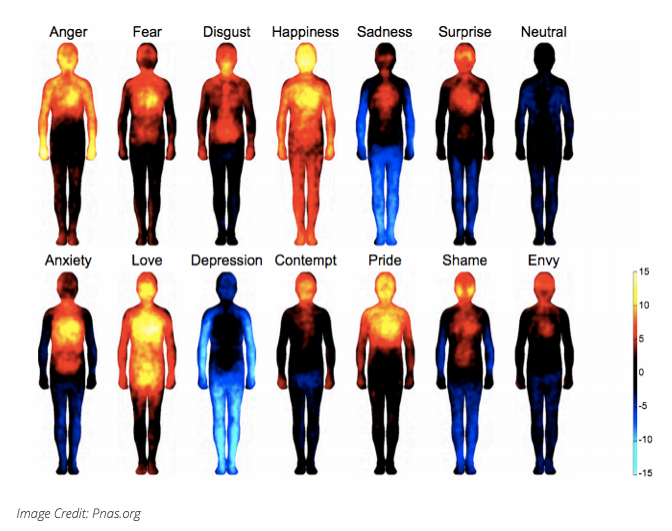
2. Like all emotions, anger is actual energy – no matter how intense – scientifically proven, as seen on these scans.
Heat maps of emotions —->

3. Anger is considered one of the secondary emotions – a response to primary Es such as intense FEAR (from being abandoned, attacked, disrespected, forced, offended, pressured, trapped…..). This does not mean it’s unimportant or to be ignored.
It’s secondary because it’s a composite of other more fundamental ones (Plutchik’s 8 Primary Es), AND because it can’t tell us directly what the underlying unmet NEED is, only that something is wrong.

🔹  However, it is a very useful starting point. Instead of being afraid of it, we can successfully use anger, guilt, anxiety…. as helpful indicators of what’s going on in the background (unconscious), giving us the opportunity & choice to ‘fix’ the real lack, which would then make us feel better.
The problem for ACoAs with solving this Q. (‘What’s missing?’) is that we’re not allowed to know what we really feel NOR what we actually need.
So these 2 aspects have to become part of our understanding & daily vocabulary before anger can be a useful tool.
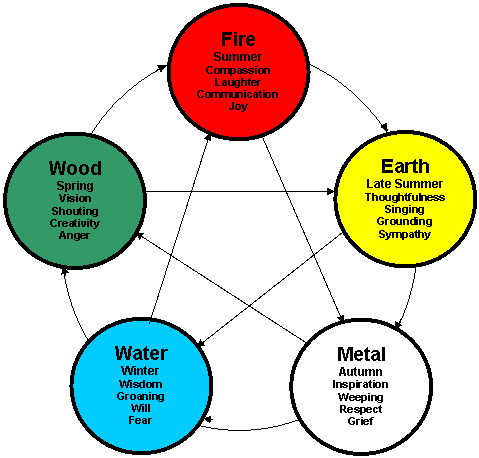
FiveChart24. Anger is part of the Wood Element – which governs the eyes, gallbladder, liver, & tendons. In the short-term, & by itself (without action), the emotion itself is not harmful.
But because it is energy, generated by chemicals in the brain, we can damage ourselves in PMES ways when we suppress the anger / rage, especially for a long time. The chemicals can ‘fester’ inside & cause a variety of problems (headaches, high BP, auto-immune illness…. ).

Denied anger results in lowered quality of life, causing mental & emotional numbness, which can then draw us toward violent situations as a release. It will also negatively effect many parts of the body, such as the:
√ Muscular (tightness) & Immune (over-worked) systems
√ Liver – causing our decision-making abilities to be diminished
√ Gall bladder – causing gallstones (condensed anger) & migraines

✤ At the other extreme is acting out the anger in ways that directly injure ourselves & others – especially when aimed at children.

5. How each person reacts (emotional intensity + behavior patterns) is formed by a combination of : genetic predispositions, cognitive problem solving skills, family / culturally-learned behaviors & past experiences

6. We hear even ‘respected ‘speakers’ talking about “negative emotion”. Wrong!
Es are either degrees of 🔺pleasurable OR degrees of 🔻painful.

NEVER think or talk about anger & other uncomfortable / ‘unacceptable’ / painful emotions AS negatives!
Anything designated as a negative is automatically considered bad – which in this case means we should not be angry, under any circumstances.

NOT so. Without feeling & owning legitimate anger – we are easily abused, frightened & manipulated – & so become or stay victims.

NEXT
: What about anger? – Part 2
To All my READERS – 2015

images-5images-4

HAPPY NEW YEAR from Times Square in NYC!

Thank you to all my faithful readers & a big welcome to all who have joined me this year.

These are some of the figures posted by WordPress that all of you made possible:
“The concert hall at the Sydney Opera House holds 2,700 people.
This blog was viewed about 60,000 times in 2014.
If it were a concert at Sydney Opera House, it would take about 22 sold-out performances for that many people to see it.

The busiest day of the year was March 15th with 559 views. The most popular post that day was ‘List of HEALTHY Boundaries (Part 1)’.

WORLD-WIDE readership: 146 countries in all! Most visitors came from USA. Canada & U.K. were not far behind.”

images-3I wish for each of you : growth, safety & enjoyment on your path to Recovery, in the coming year.
Donna Marie

Fireworks over the Hudson River, NYC

Enneagram – 9 LEVELS for TYPE 9

k13563304I JUST WANT 
everyone to get along!

PREVIOUS: Type 8 levels

SITE: Type 9 overview


LEVELS by TYPE (cont.)
TYPE 9 – Peacemakers/Mediators
Healthy Levels – Self-remembering: Indomitable. Able to bring people together and heal conflicts.
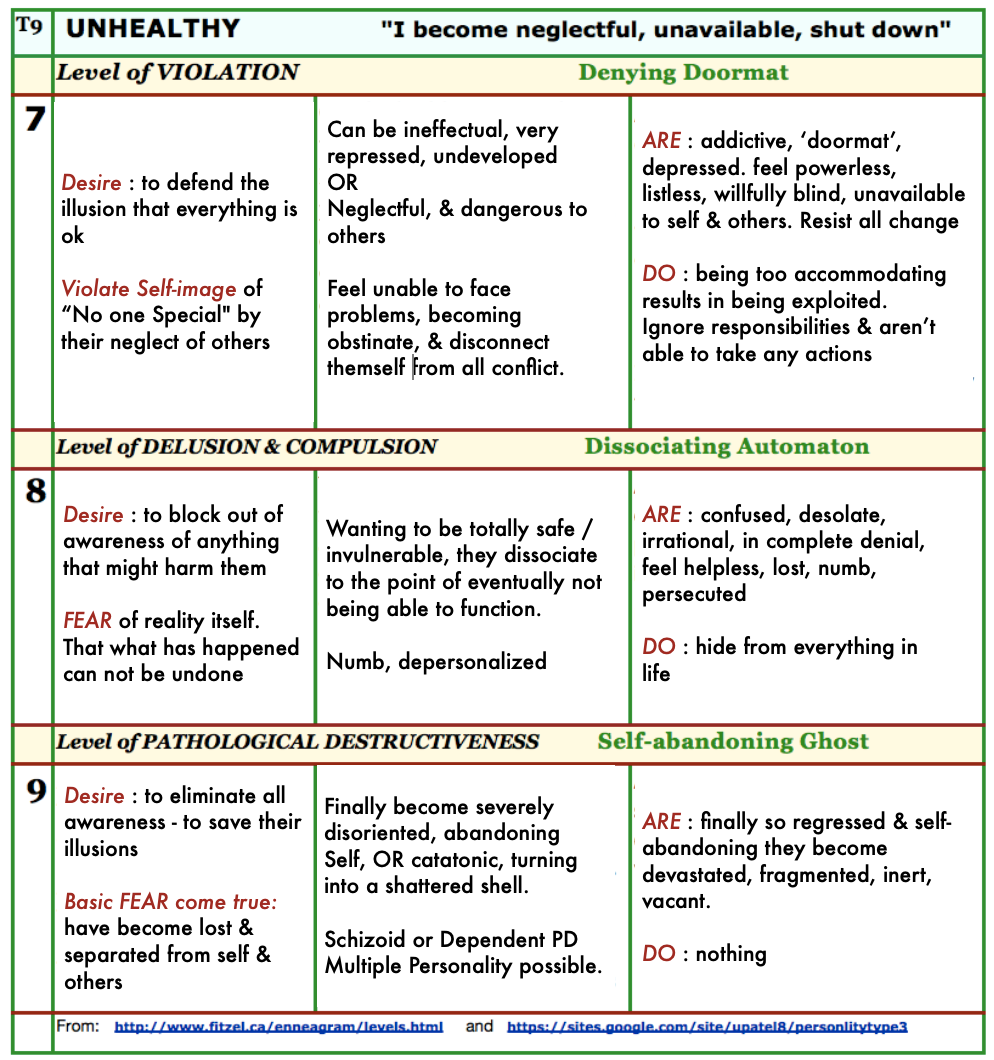
Unhealthy Levels – Self-abandonment: De-personalized behavior. Held back by passivity and stubbornness.

HEALTHY 9s: I have a calming effect on others
The Stoic: Unshakable, self-possessed, they’re quietly strong, a skilled mediator, wise, unpretentious & put others at ease.
Serenity overcomes the vice of indifference, allowing 9s to become more in tune with their inner desires and thoughts. Pleasant & modest, at High Performance they’re accepting, calming, harmonizing, patient, steady & supportive. They build consensus, & can masterfully blend divergent points of view.

AVERAGE 9s: I like to go through life unhurriedly, in a relaxed manner.
The Monk: agreeable, easy-going, grounded, nice, peaceful, placid
● Life corrupts the ideal of love (appreciating self, others) into believing they should focus their appreciation on the external world.
This leads to the idea that the 9’s inner world is dull, because the exterior world is so complex. They rely on indifference to maintain the illusion that their inner concerns aren’t really a problem. Their desire for harmony takes the form of conflict-avoidance, & they can sacrifice their own position for the sake of keeping the peace.

UNHEALTHY 9s: I am lazy, overly relaxed
The Slacker: They’re irresponsible, lazy, lost, overly compliant, passive, spacey, undeveloped
● They become apathetic, disengaged, procrastinating, passive-aggressive, resistant & stubborn

INTEGRATION
Type 9 LEVELSHealthy loop: Run by the Basic Desire of ‘Needing to find union’ makes 9s genuinely open up to others & accept them as they are. This acceptance is welcome & builds strong bonds with others. Thus the 9s’ need is satisfied and balance is reached.
Average state: when Nines’ are less accepting of others or the world, union begin to weaken. This causes the need to increase, which can help 9s make the effort to be more accepting & so create balance.
Unhealthy loop: Run by the Basic Fear ‘of separation’, 9s delude themselves with fantasy unions, sustained by ignoring reality and blindly accommodate others or the world. This insures not achieving true union, which further increases 9s’ basic fear & prevents balance.

LENS you see the world thru: “How can I stay comfortable? Where can I find a sense of harmony?”
GROWTH: To break control of the basic fear 9s must stop indulging in made-up connections, and start to really accept others as they are.
~~~~~~~~~~~~~~~~~~~~~~~~~~
LEVEL 5 in BIZ (Mid-Average)
AS LEADERS
THEY:
— are inspirational, friendly & non-directive, preferring to operate by consensus
— cannot bear conflict & try their best to avoid it
— can get torn between opposing views, examining alternative at great length, causing them to miss opportunities
— like to have a thorough picture of a situation or project, & then fill others in on the details later
— are process oriented, rather than being controlling
— will want recommendations from every division or shareholder before making a final decision'average' levels

SUPERVISING Type 9 WORKERS
Look for & recognize the 9’s contributions, & ask them for feedback. Don’t misunderstand 9’s silence for agreement. Put your requirements clearly & in writing, focusing on breaks & deadlines. Don’t be controlling or domineering, rather work toward cooperation & collaboration
THEY:
— flourish with positive support, energized by productive routine & other people’s enthusiasm for projects
— want recognition but will not ask for it, avoiding self-promotion
— have a natural desire to be responsive rather than pro-active
— prefer to rely on schedules & consistent guidelines to work toward so that they don’t have to make lots of decisions
— will slow down or neglect aspects of their work to show dissatisfaction or unhappiness, rather than speak up

NEXT:

Enneagram – 9 LEVELS for TYPE 8

k13563299
I’M ALWAYS IN CHARGE,

& I want to protect the ‘weak’

PREVIOUS: Levels for Type 7

SITE: Type 8 overview


LEVELS by TYPE (cont.)
TYPE 8 – Leaders/Challengers
Healthy Levels – Self-surrender: Magnanimity. Able to be a powerful magnanimous leader.
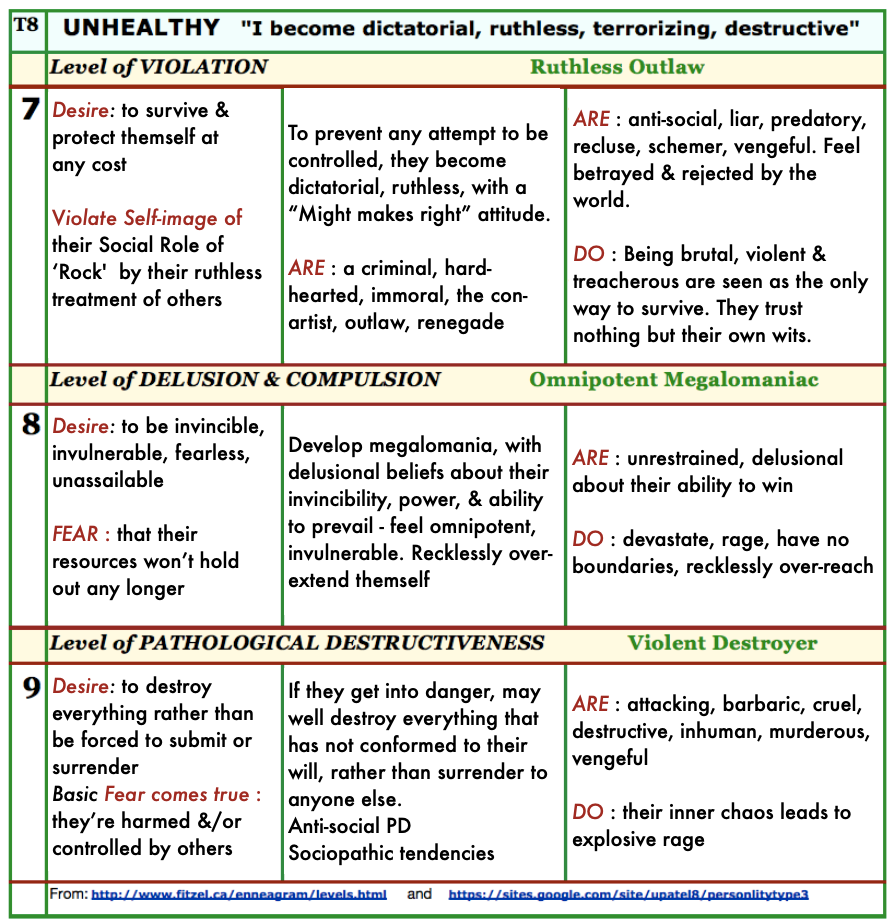
Unhealthy Levels – Antisocial behavior. Tries to control and intimidate others.

HEALTHY 8s: I am a powerful leader.
The Leader: Heroic, self-surrendering, they’re assertive, dominant, fearless, powerful
Magnanimity = nobility, willingness to face danger, are beyond petty anger, —> overcomes the vice of lust (to taste/ indulge in everything), having required the 8 to develop as a person, & bring True strength.

They make sure they’re empowered, as well as empowering those around them. Champions of the underdog, they protect those in their care, are courageous, magnanimous, pragmatic & self-assertive.
They take charge, can stand the heat, & make sure they can make a difference.

AVERAGE 8s: If someone angers me, they will hear about it.
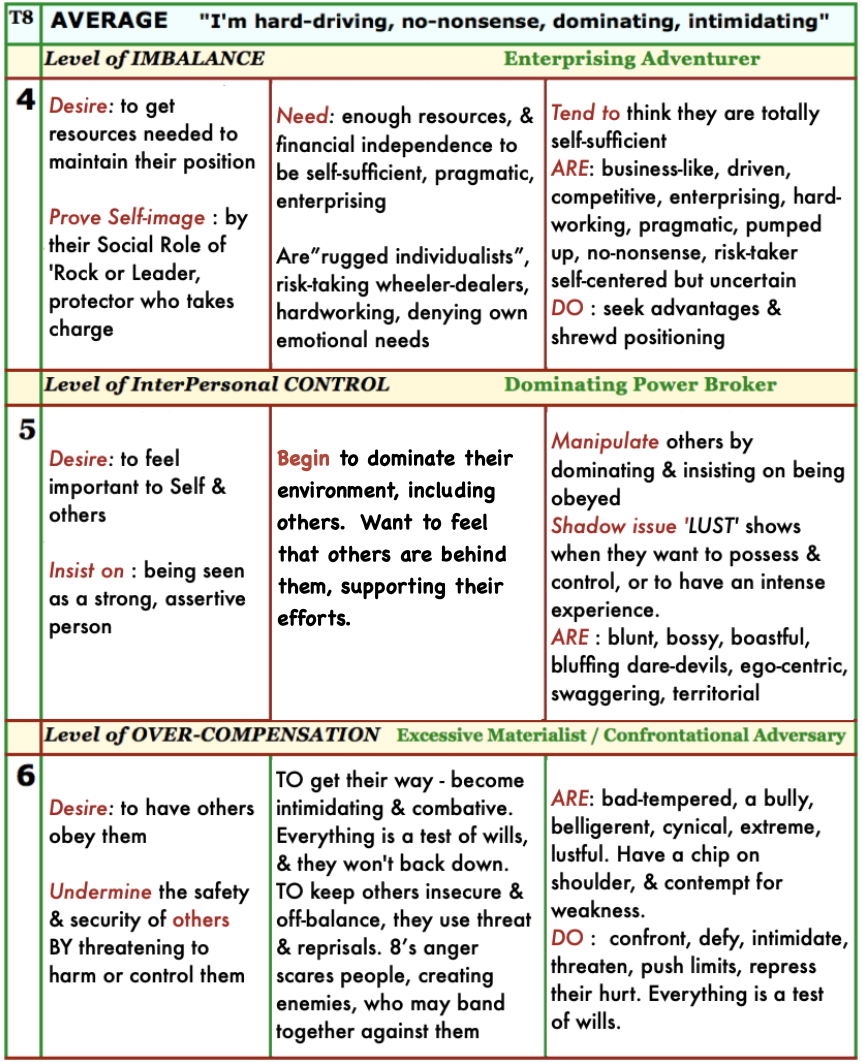
The Challenger: They’re intimidating, prone to anger, provocative, sarcastic, will not back down
● Life corrupts the ideal of Truth into the delusion that no one is innocent, so they rely on lust to give the illusion of survival.
Conflict is seen as natural & acceptable, because everyone must understand conflict on some level.
They can become blaming, boastful, excessive, have black-&-white thinking, & can throw others off balance
«

UNHEALTHY 8s: I’m a rage-aholic.
The Bully: abusive controlling, raging, violent
● They use their considerable strength to protect themselves by being combative, intimidating, a bully

INTEGRATION
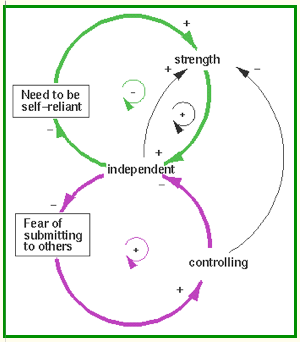
Type 8 LEVELSHealthy loop: Run by the Basic Desire of ‘Needing to be self-reliant’ makes 8s become stronger & more able to defend others. When 8s are independent, their need is satisfied& balance is reached.

Average state: when 8s aren’t building their strength enough, they get more dependent on others for certain needs. This increases the impulse toward self-reliance, encouraging 8s to work harder to get strong, creating balance.

Unhealthy loop: Run by Basic Fear of ‘Submitting to others’ which can cause 8s to lash out and try to control others, as a defense. Unfortunately – & ironically – this make them more dependent on others, increasing the basic fear & prevents balance.

LENS you see the world thru: “Who has the power? Who might be trying to influence me? How can I make an impact?
GROWTH: To break control of the basic fear 8s have to stop controlling others, & start to strengthen themselves instead.
~~~~~~~~~~~~~~~~~~~~~~~~~~
LEVEL 5 in BIZ (Mid-Average)
AS LEADERS – Are direct & assertive – what you see is what you get.
THEY:
— prefer to be the one in charge instead of delegating, wanting full control
— keep a close eye on everyone under their supervision
— don’t usually give compliments, so ‘no news is good news’ from them
— hate being blindsided by incorrect or incomplete information
— react best to honesty & transparency from co-workers. The don’t demand agreement, only truth & clarity'average' levels

SUPERVISING Type 8 WORKERS
Show that you’re in charge – right from the beginning. 8’s become aggressive or go on the offensive when they feel insecure because things are out of control, or are unjust. If they confront you, make sure you stand up to them. Don’t ever tell an 8 what they can’t do – unless that’s exactly what you want them to do!
THEY:
— assume their own opinions & approaches are the correct ones. It’s “My way or the highway”
— expect their boss to take command & be self-assured
— expect competency in a leader, & don’t respect wimps
— will take over leadership if they think no one’s in charge
— react badly to being controlled or treated unfairly
— prefer to be told bluntly when they’re messing up or making you mad
— don’t automatically follow the rules, which they will bend to suit themselves, or in order to improve the system – based on their own evaluation
— need clear boundaries from management, & will confront a boss any time they overstep the mark
(From: Global Leadership Foundation)

NEXT: Type 9 LEVELS

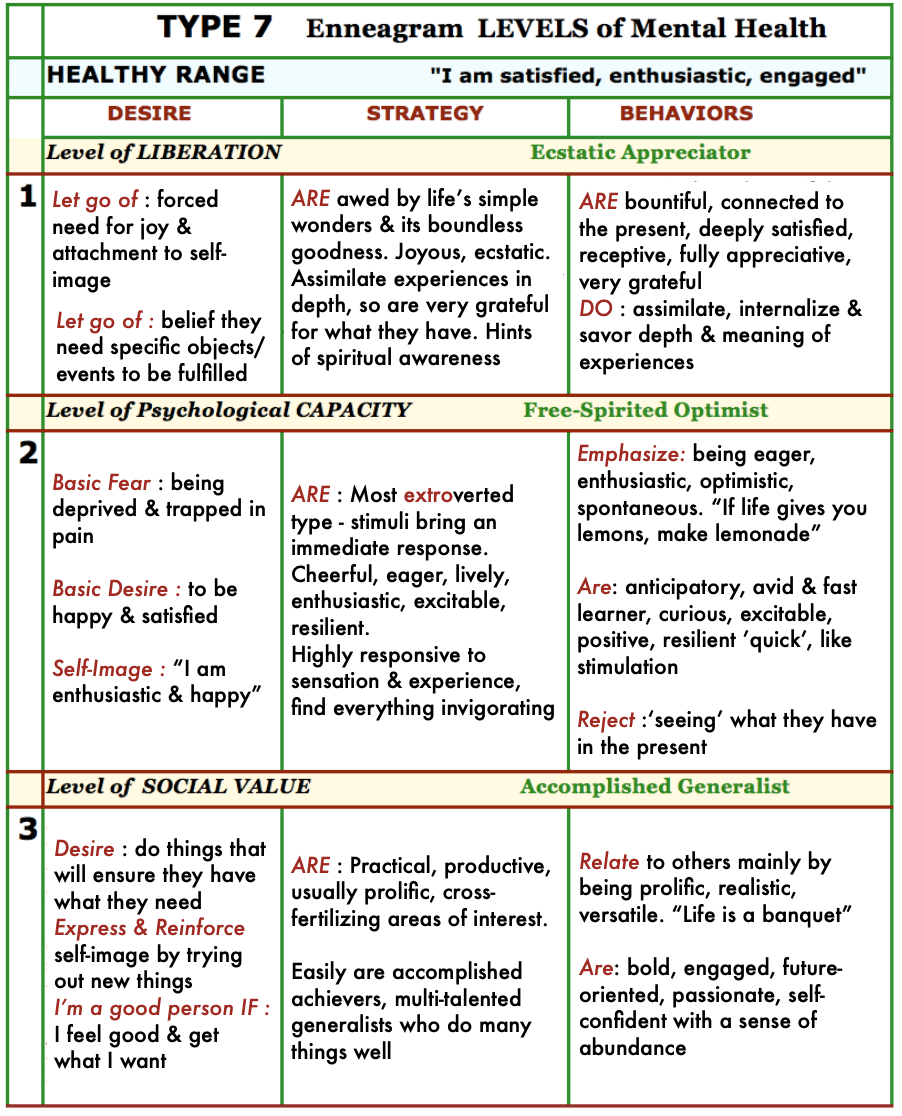
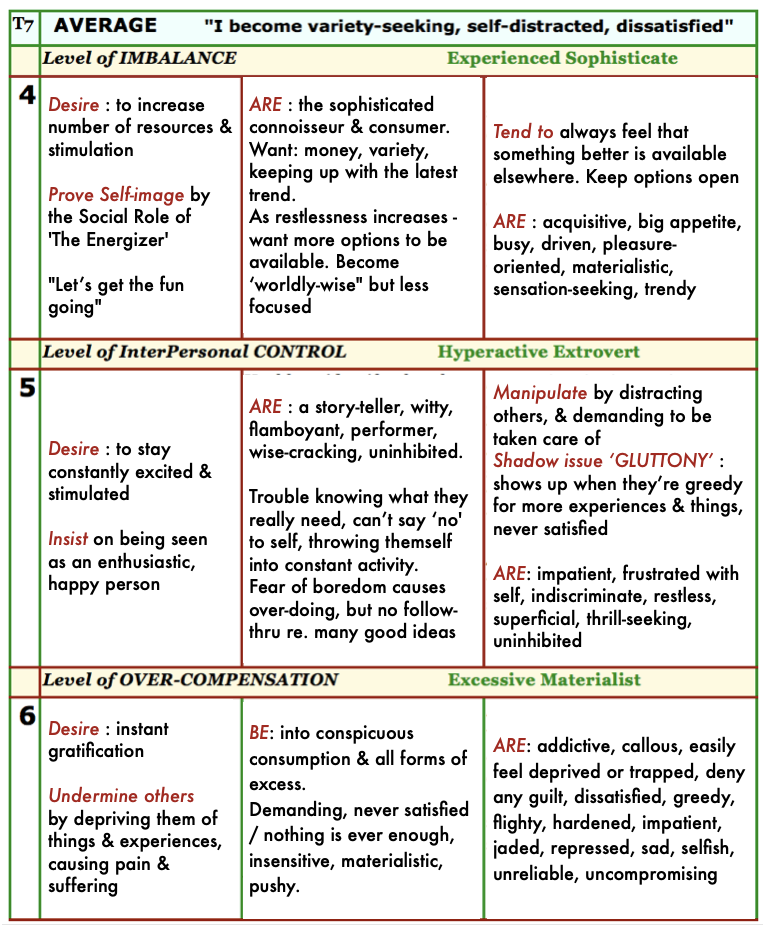
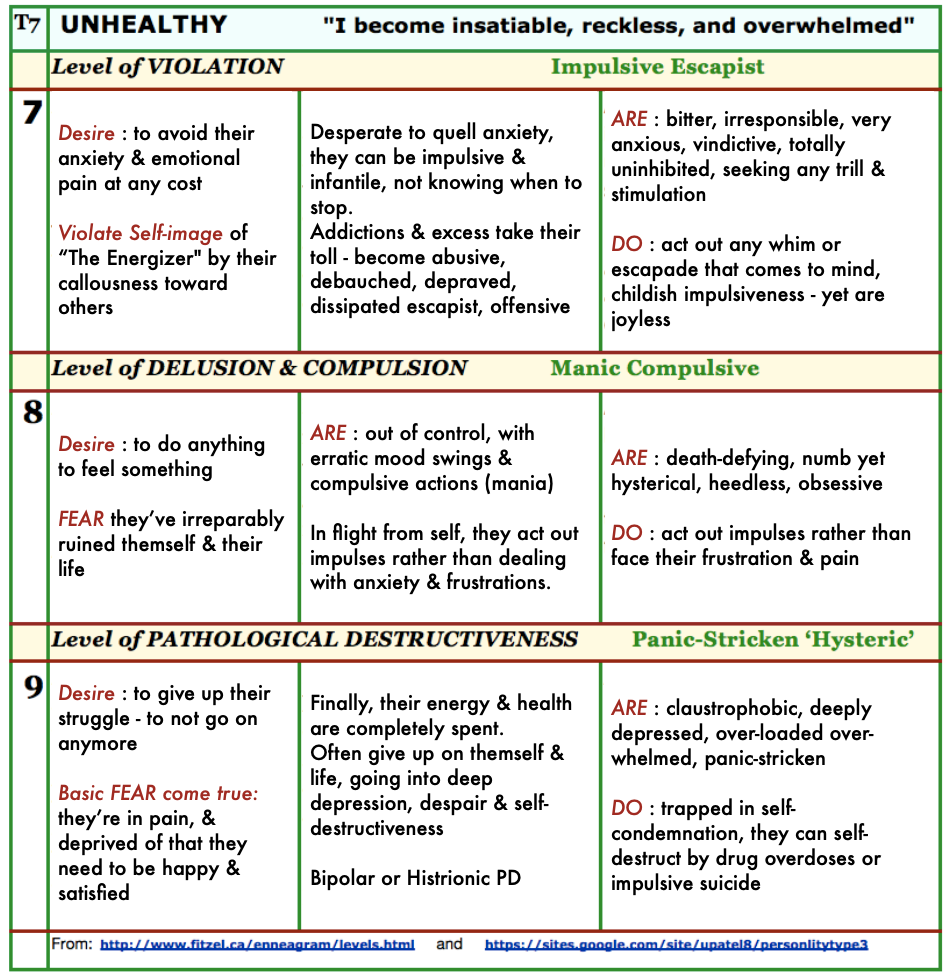
Enneagram – 9 LEVELS for TYPE 7

k13563302
I’M ALWAYS LOOKING
for the next thrill!

PREVIOUS: Type 6 Levels

SITE: Type 7 Overview


LEVELS by TYPE (cont.)
TYPE 7 – Enthusiasts
Healthy Levels – Assimilation: Gratitude. Able to become highly accomplished & spirited
Unhealthy levels – Hysteria: Panicked behavior. Misled by impulsiveness and impatience

HEALTHY 7s: I live fully in the moment.
The Adventurer: Satisfied, appreciative, they’re curious, endlessly optimistic, fearless, full of energy, improvisational, lives fully in the moment, with excellent fine-motor skills
Sobriety (in all forms) overcomes the vice of gluttony (for every experience), returning to the original awareness of the ‘holy plan’ (the path to tranquility), creating inner peace. Busy & fun-loving, they can take any situation as it comes & find a way to make the best of it. They’re buoyant, charming, enthusiastic, joyous, multi-talented, optimistic, playful, resilient, spontaneous.

AVERAGE 7s: Fun is the most important thing in life
The Thrill Seeker: They’re exciting, exploratory, fun, life of the party, spontaneous, very talkative
● Life perverts the ideal of the Holy Path, which is corrupted into sampling everything in life. They rely on gluttony for the illusion that they’re satisfied with the world, hoping to find a substitute for inner tranquility. Instead – they become chronically unsatisfied, scattered, & have trouble following through on commitments

UNHEALTHY 7s: I seek pleasure and avoid responsibility
The Hedonist: They avoid responsibility, are escapist, prioritize pleasure-seeking above all else, substance abuse & have health problems as a result of lifestyle
● They tend to be impatient, impulsive, with a short attention span

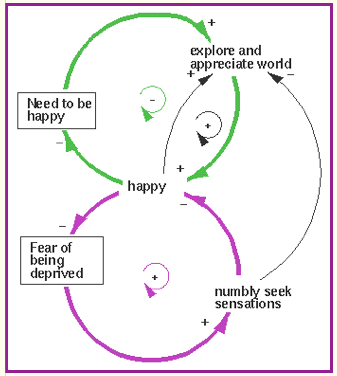
INTEGRATION
Type 7 LEVELSHealthy loop: run by the Basic Desire of ‘Needing to be happy’, making Type 7s explore the world & genuinely appreciate what they find. Their great happiness satisfies the need & balance is reached.
Average state: when 7s aren’t exploring & appreciating everything, they become restless and unhappy. The the need to be happy increases, which can make them want to reach out & find things to appreciate, creating a balance.

Unhealthy loop: Run by the Basic Fear of ‘being deprived’ they can compulsively, numbly seek new sensations and adventures without truly appreciating the experiences.They get little happiness from all the highs, increasing 7s’ feeling of emptiness and basic fear, preventing balance.

LENS you see the world thru: What’s the next interesting, stimulating, fun thing to do? What can I plan next?
GROWTH: To break control of the basic fear 7s cannot keep jumping into one activity after another, but rather appreciate deeply what they do experience.
~~~~~~~~~~~~~~~~~~~~~~~~~~
LEVEL 5 in BIZ (Mid-Average)
AS LEADERS
At this level visionary 7s tend to lead by wandering around, communicating with charisma. Their strength comes from being able to correlate a variety of info into a coherent pattern.
'average' levelsTHEY:
— are at their best in a fast-changing, fast-paced environment that depends on planning & data-synthesis
— are usually good at empowering others, helped by being friendly & fun
— like to have several projects going at one time, or involved with several parts of one large assignment

SUPERVISING Type 7 WORKERS
Share your business concerns with a 7 because they like to be a part of things. What you see as a problem they may see as an interesting opportunity, so let them share their vision & enthusiasm. You’ll get the best out of them by encouraging their social skills or inventiveness, so don’t judge them or focus on pesky details. Be sure to put them in a non-boring position & don’t expect a commitment to ‘closure’.
THEY:
— prefer ideas & theories rather than do-ing/implementing them
— will create new ways of doing something out of boredom with routine
— feel supported when others make use of the 7’s individuality, creativity & experimentation
— need reasonable & clear deadlines since follow-thru is not their forté
— are hard-working as long as their tasks are stimulating & varied
— need supervision to ensure a project gets finished, since they can easily get distracted & go off in another direction
— can easily get enraged when getting a negative review. They react better if given an opportunity for a ‘fresh start’  (From: Global Leadership Foundation)

NEXT: Levels for Type 8

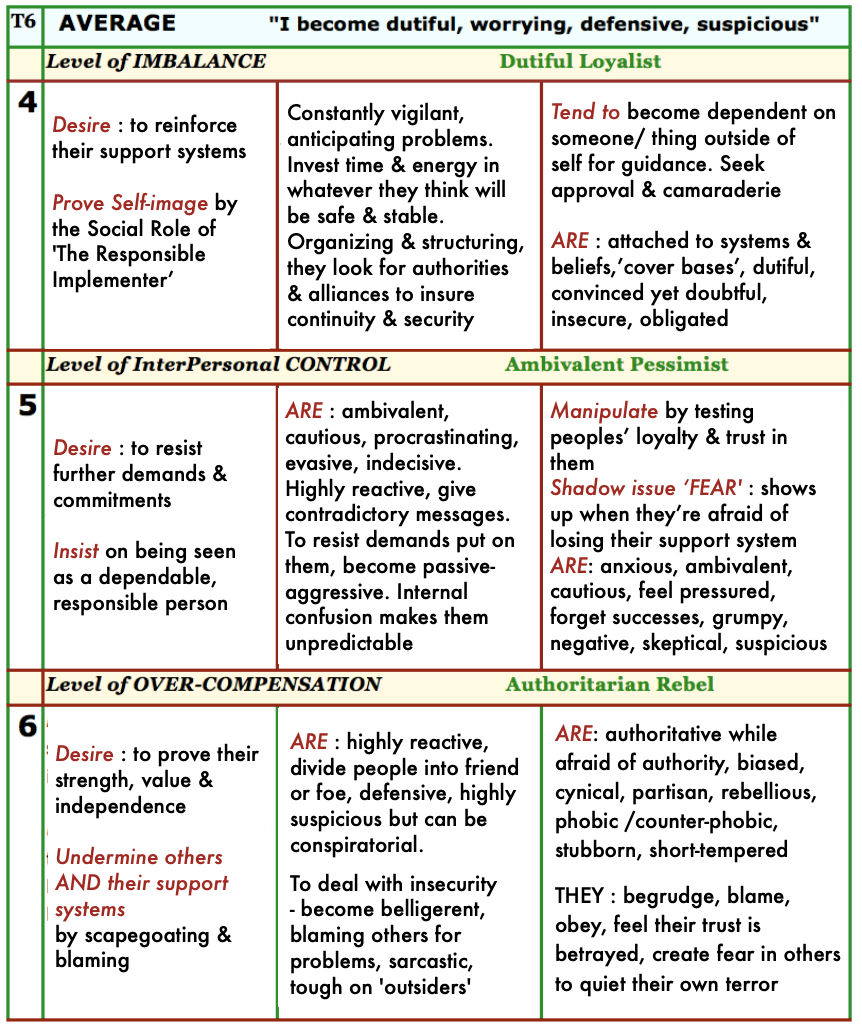
Enneagram – 9 LEVELS for TYPE 6

k13563303
I WANT EVERYONE
to make me feel safe

PREVIOUS: Type 5 Levels

SITE: Type 6 overview


LEVELS by TYPE (cont.)

TYPE 6 – Troubleshooters
Healthy Levels – Inner guidance: Courage. Able to exemplify courage and commitment.
Unhealthy Levels – Self-abasement: Self-destructive behavior. Struggles with anxiety and rebelliousness.

HEALTHY 6s: I am skilled at seeing & averting danger.
The Security Expert: Courageous, self-reliant, they’re capable of bravery, seeing dangers before others do & skilled at averting it
● Courage overcomes the vice of Fear & Doubt, having realized that fear is conquerable. Committed & security-oriented, at High Performance they’re trustworthy, dedicated, dutiful & warm. They constructively point out potential problems before they become major issues. They value teamwork, are cooperative, supportive, loyal team players. They often have a quirky, dry sense of humor.

AVERAGE 6s: Safety and security are more important to me than to most
The Cautioneer: They’re too ‘careful’, predictable, reliable, safe, secure, stable
● Life corrupts the ideal of complete confidence into the delusion that faith is too risky, & instead should be replaced by doubt. This gives the appearance that they are winning the survival war. They become nay-sayers, consistently focusing their attention on what might go wrong.

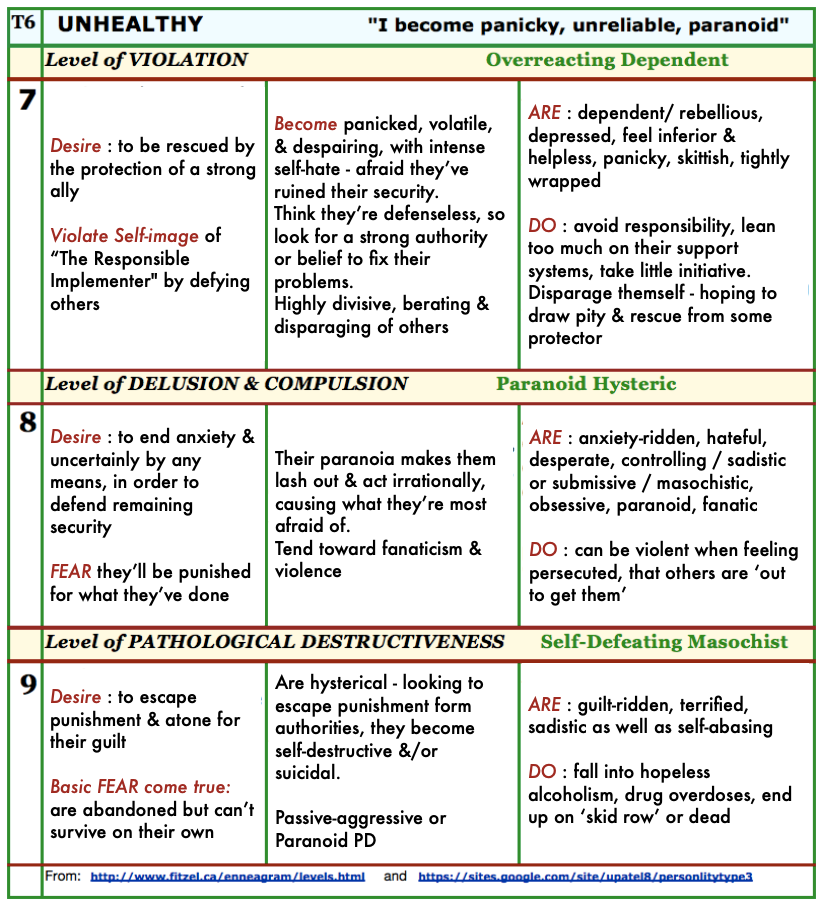
UNHEALTHY 6s: I am suspicious, paranoid.
The Paranoid: They’re erratic, fearful into conspiracy theories, jealous, unsure, suspicious
● Disliking unpredictability & rapid change, they can become anxious,
blaming, doubting, reactive, suspicious, volatile & worrying.

 INTEGRATION
Type 6 LEVELSHealthy loop: Run by the Basic Desire of ‘Needing to be secure’ which makes 6s loyal to others, especially authority. This increases their sense of safety, which satisfies their need & balance is formed.
Average state: when 6s are not so loyal to others, feel insecure with others, increasing their need & may spur them to seek out authority and
become loyal to it, or more loyal to their peers. That will balance the loop so 6s can recover.
Unhealthy loop: Run by the Basic Fear of ‘being abandoned’ which makes 6s suspicious & distrustful of others. This reduces their sense of security, which further increases the basic fear & prevents balance.

LENS you see the world thru: “Where is the danger? What might be the worst-case scenario? How can I/we prepare for it? What are peoples’ underlying motives?”
GROWTH: We can see from the diagram that a way to help break the control of the basic fear is to weaken the unhealthy loop. Sixes can refrain from distrusting others, and begin to be more loyal to others.
~~~~~~~~~~~~~~~~~~~~~~~~~~
LEVEL 5 in BIZ (Mid-Average)
AS LEADERS
6s can come alive under adversity, as they can be clear & strong against a known problem. If/ when 6s over come their self-doubt they can be courageous, & determined leaders.
'average' levelsTHEY:
— are masters at ‘circling the wagons’ to defend against a common enemy
— can become passive & procrastinators when not challenged or opposed
— have a tendency to focus on flaws & talk in “Yes buts… What ifs…..”
— keep refining & improving their work, with great endurance & bravery, over long periods of time
— like to express all their negative expectations before considering positive alternatives, so that any potential threats are accounted for

SUPERVISING Type 6 WORKERS
Keep your word with 6s – it greatly helps the relationship if you have integrity. Their trusted is not given easily – it needs to be earned.
They’re unsettled by too much positive feedback, so mix in some negative comments to prove you’ve considered all angels. To get the best from Average 6s, let them know your reasons for wanting something done, and never order them around.
THEY:
— have strong analytical powers. They understand trouble & will want to help, especially if the boss is the underdog in a situation
— tend to play devil’s advocate, listing all the things that could go wrong
— are very loyal to those who ‘deserve’ it. Once the boss is on their team they’ll help fight her/his battles as their own
— don’t like surprises, needing security & predictability.
— need clear plans with fallback positions, & want backup data with contingencies (From: Global Leadership Foundation)

NEXT: Type 7 Levels

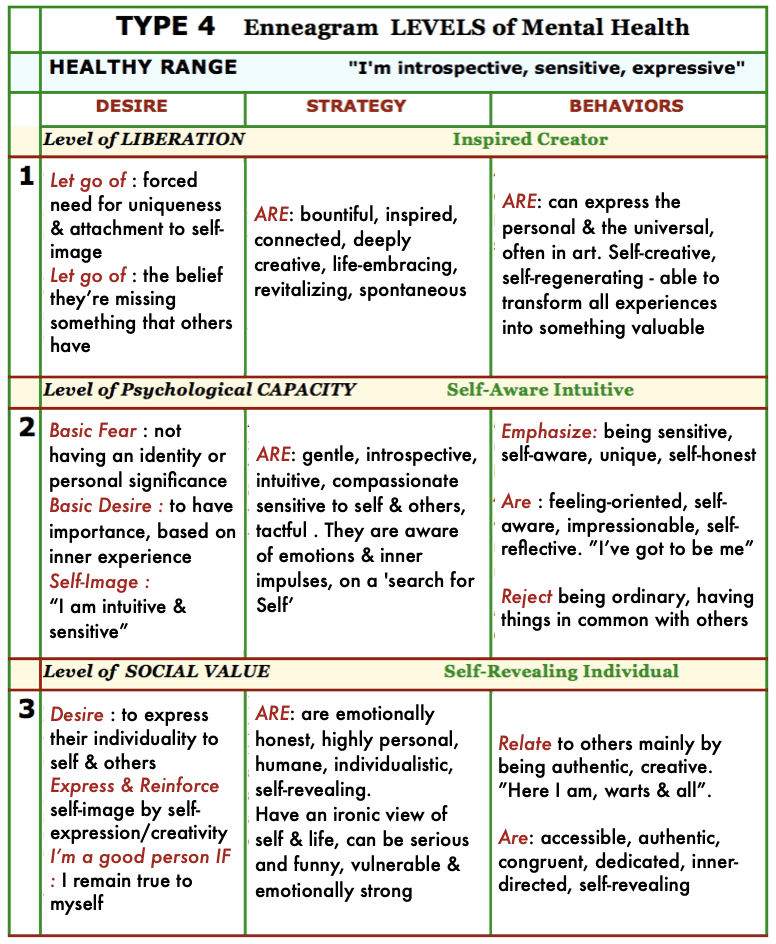
Enneagram – 9 LEVELS for TYPE 4

k13563296I HAVE TO BE DIFFERENT 
or I’ll be boring (& bored)!

PREVIOUS: Type 3 levels

SITE: Type 4 overview


LEVELS by TYPE (cont.)
TYPE 4 – INDIVIDUALISTS / Designers
Healthy Levels – Are Self-Renewing & Inspirational. Able to model creativity and intuitive power for others
Unhealthy Levels – Are Clinical depressed & Suicidal. Held back by moodiness and self-consciousness.

HEALTHY 4s: It’s important to go beyond the limits of convention.
The Revolutionary: They’re artistic, aesthetically oriented, creative, edgy, expressive, individualistic, inspired, intuitive, self-aware & sensitive.
Equanimity overcomes envy, giving calmness & composure.  They return to the knowledge of “Origin”, that everything in the universe came from the same origin point, so beings are fundamentally connected to each other. Embracing & enhancing life, they encourage others to be everything they can be. They break new ground & bring depth to their work life, push the envelope & find ways to put a unique stamp on whatever they do.

AVERAGE 4s: Being told “You’re odd / weird” is welcome proof I’m staying true to myself.
The Unconventionalist: different, experimental, idiosyncratic, open, unique
• Life’s difficulties corrupts the ideal of Unity into the delusion that everyone is fundamentally fragmented & separated. 4s notice what’s wrong in their life, & so envy what others have. They rely on that envy to give themselves the illusion of unity, as a way to connect to others in a counter-productive fashion, becoming self-indulgent & alienated.

UNHEALTHY 4s: I’ve lost touch with reality (but may not know it)
The Stranger: Become progressively more moody, hypersensitive &
withdrawn. Can be bizarre /schizotypal/ schizophrenic, cut off from everyday current reality, delusional, irrational, masochistic

INTEGRATION (Loops)
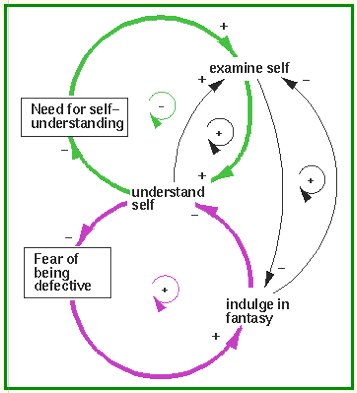
Type 4 LEVELSHealthy loop: Run by the Basic Desire of ‘Needing self-understanding’, they allow emotions to surface & examine them in order to understand them-selves. Then the need is satisfied & balance is achieved.

Average state: when 4s’ don’t closely examine their emotions, they can’t understand themselves, increases the need to figure out who they are. This can push 4s into willingness to face their feelings,
establishing a balance.

Unhealthy loop is run by the Basic Fear of ‘being defective, which can cause 4s to ignore their true selves, allow their emotions to overwhelm them, & indulge in wild fantasy about themselves. This leads to understanding themselves even less, further increases the basic fear & prevents balance.

LENS you see the world thru: “How can I express my creativity and uniqueness in this situation?”
GROWTH: Breaking control of the basic fear comes from not indulging in fantasy and start examining oneself realistically.
~~~~~~~~~~~~~~~~~~~~~~~~~~
LEVEL 5 in BIZ (Mid-Average)
AS LEADERS
At this level Type 4’s authority comes from what they know. Their main strength & weakness as leaders come from the same place – an unwillingness to compromise their vision'average' levels
THEY:
• are usually a romantic, passionate star
• hold a strong personal vision & inspire with the force of personality
• are fervently pursue an elusive goal, so achieving them is a problem
• want to stay emotionally engaged & are attracted to ‘drama’
• achieve goals in order to be distinctive – different & unusual
• excel with a business approach where unique presentations count

SUPERVISING Type 4 WORKERS
Honor the 4’s unique way of seeing & doing things. If you want them to work hard, let them know how a project needs their personal touch. The more enthusiastic they are the harder they’ll try. Be emphatic rather than helpful – instead of giving a 4 the answers, give them the opportunity to express themselves.
THEY:
• want distinctive work, preferring jobs which call for creativity, even genius
• need to feel respected for their personal vision & ideas
• their efficiency is tied to their mood. When their emotional life is disrupted their attention to work suffers
• like to be connected to ‘special authority’ – people in their field who stand for quality instead of popularity
• feel demeaned by having to perform what they consider ‘common’, but which is defined by each #4 differently
• want to feel that their creative ides have been received, understood & appreciated
(From: Global Leadership Foundation)

NEXT: Type 5 Level

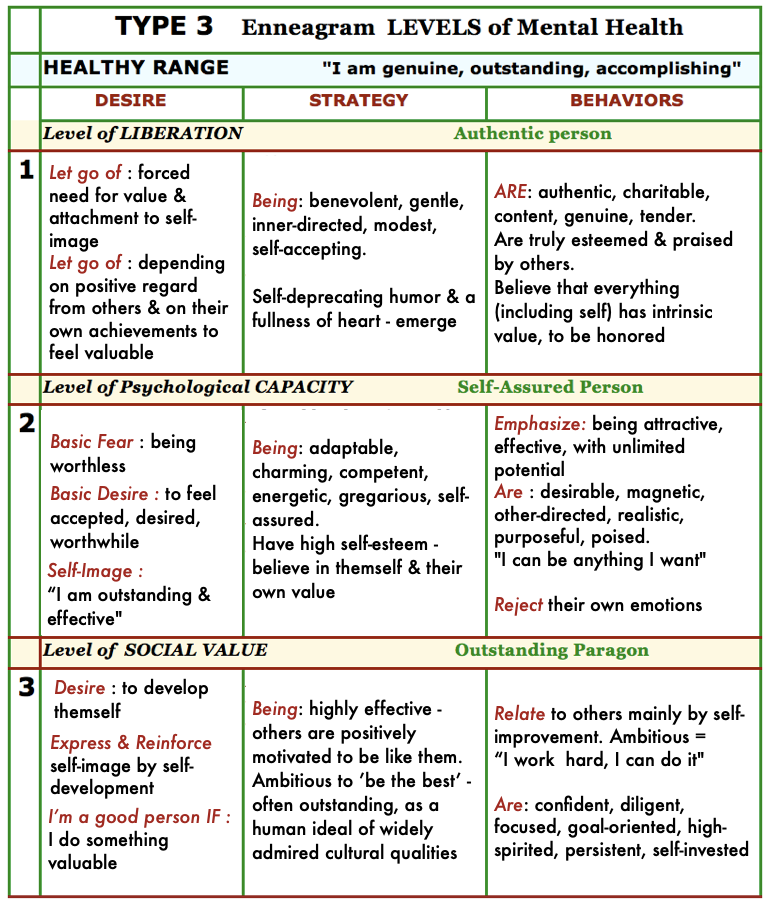
Enneagram – 9 LEVELS for Type 3

k13563290
I WORK HARD &

I want all the attention

PREVIOUS: Type 2 Levels

SITE: Type 3 overview


LEVELS by TYPE (cont.)
TYPE 3 – ACHIEVERS
Healthy Levels – Have Authenticity & Self-Acceptance. Able to inspire others as an example of personal excellence and emotional honesty.
Unhealthy Levels – Psychopathy & Monomaniacal behavior. Blindly pursue success and status.

HEALTHY 3s: “I can effortlessly handle the spotlight.”
The Performer: You are adaptable, attractive, authentic, charming, competent, enthusiastic, inner-directed, a motivator, self-assured
● Truthfulness overcomes 3’s flaw of Deceit, by accurately expressing reality & being down-to-earth. You have grand & successful ideas, but those are earned & reflect reality, & you’re open, generous & warm
● Promoter / good communicator: once given a goal you’ll work tirelessly to achieve it, & so can energize those around you with a can-do attitude. You’re a skilled performer/entertainer, effortlessly handle the spotlight, impressive without being arrogant.

AVERAGE 3s: I desire some level of fame in my community.
The Histrionic: You are a chameleon, calculating, career-focused, competitive, goal-oriented, a social-climber.
● You find it hard to value yourself, so are preoccupied with fame, prestige, social status & wanting others to find you impressive. Not truly aware of how you come across, you’re only focused on how attractive or unattractive you are to others. You treat people as objects – either as being helpful to you or as a barrier to getting the job done – which people resent.

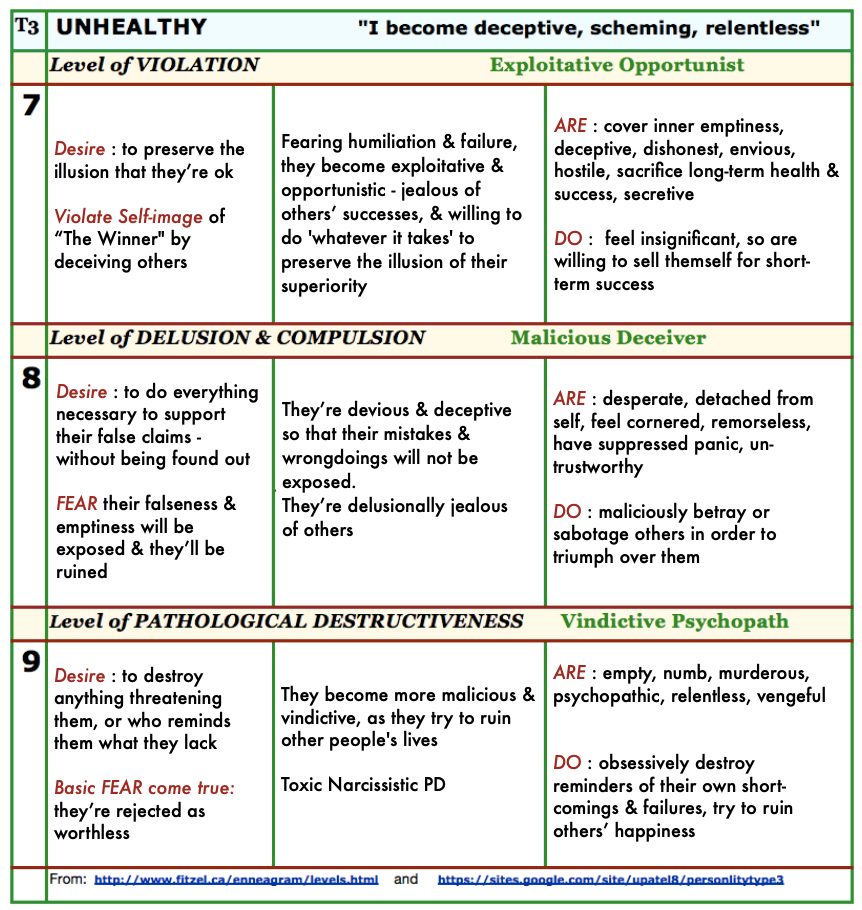
UNHEALTHY 3s: I will do anything for attention, even horrible things.
The Envier: You are arrogant, deceptive, envious, exploiting, immoral, overly competitive, narcissistic, pushy, self-serving, sleazy, superficial, vain,
untrustworthy.
● You constantly compare yourself to others more accomplished/successful,
longing for what you don’t have. You’re convinced that being ignored is = to not existing, so will act inappropriately to get attention, chasing an idealized image.

INTEGRATION (Loops)
Type 3 LEVELSHealthy loop: The Basic Desire of ‘Needing to be admired’ pushes 3s to work hard to improve themselves and succeed, often gaining admiration. Feeling admired, the need is satisfied & balance is reached.
Average state: 3s don’t work hard to improve themselves, so others admire them less, which increases 3s’ need to be praised. This can spur 3s to make more of an effort, & balance is created

Unhealthy loop : They’re run by the Basic “Fear of being rejected”, causing 3s to be competitive and hostile towards others, as a defense, which makes them even less valued, increases 3s’ basic fear & prevents balance.

LENS
you see the world thru: “How can I be successful? How can I accomplish the next goal as efficiently as possible?”

GROWTH: Don’t be competitive but focus on self-improvement instead
~~~~~~~~~~~~~~~~~~~~~~~~~~
LEVEL 5 in BIZ (Mid-Average)
AS LEADERS – Leadership is a 3’s preferred position.
'average' levelsTHEY:
— are highly functional, with a huge appetite for hard work
— focus on goals & keeping other moving toward getting results
— thrive on measuring their achievements
— can easily adapt or change their style to fit what’s popular or desired – in whatever environment they’re working in, like a chameleon
— compete for titles, & produce for the bonuses
— are acutely aware of differences in status, & want to climb as high as they can
— only see people by appointment, so get on their list! They’re too busy to schmooze

SUPERVISING Average Type 3 WORKERS
Be well-prepared & get to the point – don’t waste the 3’s time, & don’t interrupt them when they’re going full steam. Do what you say you’ll do. Give a clear outline for success, being explicit about what’s expected in performance & outcome.
THEY:
— confuse their real self with their work role “I am what I do”
— tend to assume they know more than they do – the ‘instant expert’
— are more likely to focus on quantity rather than quality
— want to be efficient & save time, even of that means cutting corners
— can do several things at once, using shortcuts & filling in details later
— want to know their efforts are valued, & need clear feedback on how well they’re doing
— don’t tolerate criticism, & blame others for any failures
— prefer short-range plans & deadlines, or reasonable stopping-points, so they can get the praise they crave
(From: Global Leadership Foundation)

NEXT: Type 4 Levels

Ennea – 9 LEVELS for Type #1

k13563295I WANT EVERYONE
to be perfect so I’ll be right!

PREVIOUS: Levels of Development – Intro (Part 4)

SITEs: Personality & the Brain” / #1 Overview


LEVELS by TYPE
NOTE: Each type is divided into 9 levels of Psychological Health, 1= highest & 9=lowest. These are grouped into Healthy, Average & Unhealthy. Here is a summary of these sub-groups by Type, in broad strokes, based on Oscar Ichazo’s work.

TYPE 1 – REFORMERS / Perfectionist
Healthy Levels – Characterized by Acceptance & Wisdom. You lead others through integrity & reason.
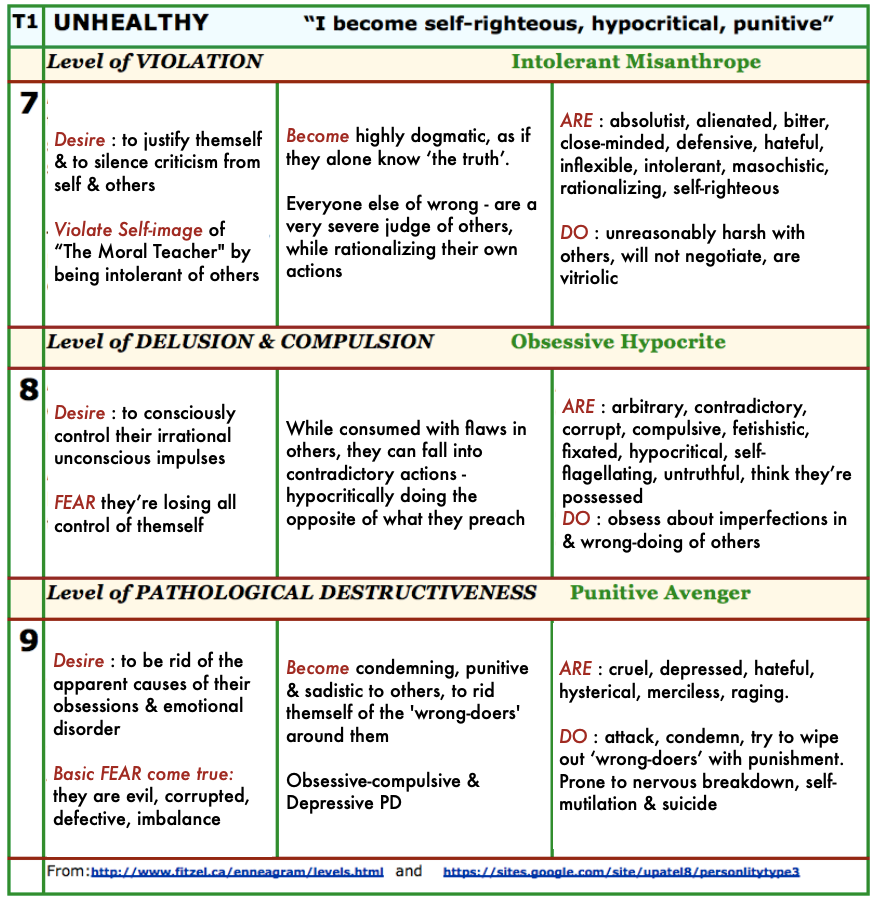
Unhealthy Levels – Use Condemnation & Punishing behavior. Hindered by perfectionism and resentment.

HEALTHY 1s  “I am hard-working and ethical”
The Upstanding Citizen: accepting, conscientious, ethical, hard-working, objective, responsible & wise. Rational yet idealistic.
Right Action overcomes the 1’s vice of anger & resentment, bringing you closer to your ideal of perfection. You have high standards, integrity, live by your values, are commitment to quality & don’t cut corners. You do more than is expected of you & finish most things you start.


AVERAGE 1s:
“I maintain my spaces in an orderly way.”
The Perfectionist: clean, conscientious, neat, organized, punctual, responsible & try to live up to good moral standards
● The reformer / crusader ‘high-minded’ idealist – you’re hard on yourself, which ‘leaks out’ as resentment & being critical of people-places-things. Anger at ‘things being wrong’ makes it seem like you’re making headway in advancing what is right, but actually resentment brings yours internal world further from it. This tempting path can lead to an outcome which is unintentional and counter-productive.


UNHEALTHY 1s
: “I am obsessive compulsive”
The Anal-Retentive: closed-minded, inflexible, obsessive-compulsive, overly traditional, self-righteous
● You’re ever more dogmatic, impersonal, intolerant, judgmental, moralizing, & can only see one ‘right way’ – yours.


Type 1 INTEGRATION

Type 1 LEVELSHealthy loop: The Basic Desire of ‘Needing to be Right’ leads 1s to seeking truth & do the right thing. When they do, the need is satisfied & balance is reached.

Average state: 1s don’t work as much to seek truth, so the need to be right increases. If 1s work hard toward their heart’s desire, balance is created.
Unhealthy loop is run by the Basic Fear of “being condemned”. This can make 1s condemn & correct others first, as a defense, which is not the right thing to do, further adding to their basic fear & prevents balance.

LENS you see the world thru: “I see what’s wrong & how it can be improved. I carry around an internal yardstick I use to measure myself & others.”
GROWTH: Stop correcting others & start examining yourself for ‘truth’.

~~~~~~~~~~~~~~~~~~~~~~~~~~
LEVEL 5 in BIZ (Mid-Average)
AS LEADERS
At this level – the best ONE leaders are
conscientious & rock solid , having the end goal in mind
Enn- 4-6 LEVELSTHEY:
• are guided by the idea of quality control, because for them quality & control go hand in hand
• have a clear picture of the ‘correct’ result & the best way to get there
• tend to mandate & prescribe, keeping others on the designated track
• like to plan in detail & to follow it rigidly

• lead by executing this plan & assigning responsibility for each part
• find it hard to delegate responsibility, since they worry about getting the job done right
• have a tendency to correct others & often criticize instead of praise
• have usually risen thru the ranks, & so are able to see who the hard workers & team players are – or not

SUPERVISING Type 1 WORKERS
At this levels, 1s need a plan to work toward, so you can either form a strategy with them or let them make one for themselves – within the context of your project. As a leader you need to play by the rules with 1s & clearly explain what you want.  When you either praise a 1’s performance or discuss their work deficiencies, be specific & detailed
THEY:
— are very practical, reshaping abstract approaches into step-by-step procedures
— are devoted to being on a schedule, so in dealing with them – be on time. And if you make them late they will not easily forget or forgive
— need specific guidelines, so loopholes can be very disconcerting to them
— prefer DO-ing rather than feeling, & to focus on work rather than relationships
— need a great deal of structure in assignments & reports

As a worker – if your boss is a 1, find out how they like things done & do it that way. It will make your life a lot easier.     From: Global Leadership Foundation

NEXT: Levels of Type 2s

Ennea – LEVELS of Development Outlined (Part 4)

levels 4EVERY BIT OF KNOWLEDGE
helps me n my journey

PREVIOUS: Levels outlined – #3c

SITE: SAMPLE of “Enneagram Monthly” magazine


OVERVIEW : The movement thru the levels is a barometer of how much we’re attached to vs free from our Type’s fixed self-image. (Defects #1). People generally operate within a fixed range of levels throughout life. EXP: Earlier in life a person may have operated between levels 5 – 7, while later in life some maturity may raise them to levels 2 – 5.

The 9 Psychological Levels help us see/find:
1.  Our FALSE self – The physical, emotional & mental habits which prevent our ability to experience the Authentic Self:false self
— the emotional (Passion) & mental habits (Fixation) that shut down our heart, body, and mind
— The Basic & Secondary Fear that unconsciously drives our specific Personality Habits (weakness)
— The shadow side of each type – our defensive responses – while we imagine being open & present to reality, but are actually caught in the unconscious pattern of our ‘persona’.

2. Our AUTHENTIC Self – Path of growth & transformation for each typetrue self
— The tools we can use to awaken joy, spaciousness, clarity, intuitive knowing & deep connection with self/others, which comes from being less defended, more Present
— The practices available to each type to digest & transcend our defensive habits developed in childhood as a response to suffering

MOVING UP? – In a talk by Edward Morler “Integrating the Enneagram of Personality with the Levels of Emotional Maturity”, he stated that modern Enneagram theory regarding Levels of Emotional Health does not offer much in terms of how to move from one level to the next. (How each level deals with a problem in Part 2) (Morler articles)
HELPING: In terms of how a leader / therapist / teacher / minister…. can use this list to help improve someone’s life – once you’ve identified the level someone is presently at, you can try moving them up the scale ONE stage at a time, and only as far up as you are. EXP:
— When someone is in apathy (9), remind them of a reason to grieve (like seeing his mom in bed in a pathetic depression – reminding her of a house they once had and lost)
— When someone is grieving (8), bring up something anxiety-provoking (7) ….. until they’re in a much better place.

SOLVING – Steps to making changes when facing a problem:
1) Recognize the problem
2) Own the problem (“What am I contributing to this?”)
3) Forgive oneself, & acknowledge one’s positive contributions
4) Do something different.
~~~~~~~~~~~~~~~~~~~~~~~~~~~~~~~~~~~~~~~~~~~~~~~~~~~~~~~~~~~
CENTER of GRAVITY
SEE: ‘Ennea Strengths #2’ // ‘Centers of Consciousness – Basic Triadsennea 2 halves
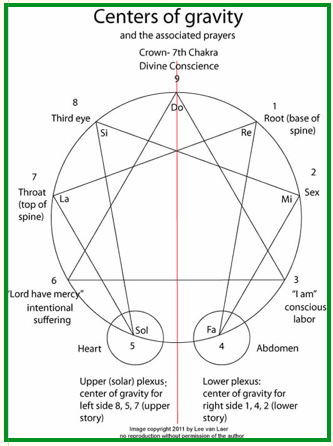
While we each has our own version of all 3 Centers (emotions, intellect, instinct), our personality has a center of gravity in one of them – our Type – which puts a specific ‘spin’ on the meaning of those 3 categories for each of us.  It is also useful to look at the chart divided vertically, because the Energy Centers (power sources /chakras) of the 2 sides do fundamentally different kinds of ‘growth work’. (MORE…..)

ctrs of gravityRIGHT side = the “lower” story – which relates to the physical, natural, mechanical forces. The dominant center of gravity is found at #4, the lower portion of the central nervous system plexus, located in the abdomen, below the navel

LEFT = the “upper” story – relating to the conscious, spiritual forces. Its center of gravity is found at #5, commonly referred to as the solar plexus, corresponds to the center of the spine, & heart energy position (MORE….)

Human Types: Essence & the Enneagram” notes that tarot & playing deck of cards are basically symbols representing the characteristics of individuals. The Queen = the Emotion / King = Head / Jack = ‘Moving’. The 4 ACES, as the main function, represent the Centers of Gravity in a human type: Ace of Clubs = instinctive / Ace of Spades = moving / Ace of Hearts = emotional / Ace of Diamonds = intellectual functions

FROM Colin Blundell  (8/3/14) “A Permanent Center of Gravity”
What’s needed to have integrity? In the Gurdjieff canon it requires a permanent & well-formed center of gravity. The whole integrated I-system is pulled inside one’s Being & assimilated into what could be called Real-I.:

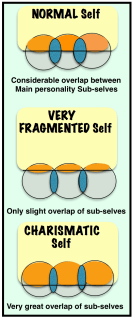
CHART: a graphic version  – the fragmented Self exists when the multiplicity of ‘I’s is not recognized, & so they don’t relate together. Only functioning on the periphery, they fight among themselves, & while they bicker continually we pretend to be Unified-I, which is senseless. As we begin to understand how multiple-I’s work & relate together we become more genuinely unified. When we choose to move from fragmented ‘I’ to normal ‘I’, as appropriate for the task at hand, & become a spectator of the constellations in Meta-I, a whole Integrated Self begins to emerge.”

“Right-work on oneself begins with the creation of a permanent center of gravity…. then everything else begins to be disposed and distributed in subordination to it… realization of the aimlessness & mechanicalness of everything can create a permanent center of gravity…” Ouspensky: In Search of the Miraculous (p.259)

NEXT: the 9 levels of each type – TYPE 1