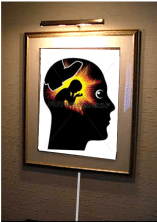
Mental Health DON’Ts – Emotional (Part 1b)

Screen Shot 2016-07-03 at 1.37.13 AM
MENTAL HEALTH
is easy – and fun!


PREVIOUS: EHP – Part 1a


SITE: Physiology and Biology of Mental Toughness


REMINDER: To be Mentally/ Emotionally well we need to develop the Healthy Adult & Loving Parent (UNIT). What the “Don’ts” represent are characteristics of our damage, run by our WIC (Damaged Child) & PP  (Introject) – but can be corrected.
Understanding the specifics of our childhood traumas helps to accept the reality that we can’tJust do it’ or ‘Just let go’. All of Recovery is a process – for everyone.
ALSO, each of us will have our own specific issues that are definitely more deeply ingrained than others & will therefore take longer to heal. Some will never go away, but can be greatly diminished, & we can learn to manage them whenever they do surface.

EMOTIONALLY HEALTHY People (EHP):
🔸EHP Don’t thrive on chaos
Successful people simplify life. They know that having as much order as possible in all parts of their life allows then to accomplish their goals, & not have to waste time looking for things or dealing with emotional drama.happy/sad

🔸EHP Don’t try to be happy all the time
One of the coping mechanisms for ACoA is the try to be ‘UP’ or ‘positive’ all the time. This usually applies to the Hero (Toxic Role) or the “Good girl/boy” false persona. This is as unrealistic as being miserable all the time. It’s just another way to deny having a wide range of emotions. For every ACoA, no matter our style, our underlying emotion is fear/terror. So we try to feel safe before we can truly be happy.

No one is happy all the time. Feeling peaceful & content – a day at a time – does not mean having no complaints, dislikes or distress. EHP don’t try to avoid painful emotions but incorporate them in an effort to be whole, to honor their True Self. They know that happiness, victory & fulfillment are a wonderful, valuable part of life, but not the whole story.

EHP learn from their ‘mistakes’ & correct distorted thinking, so avoid repeating harmful patterns. This may include making amends to others (AA’s 8th & 9th Steps) & forgiving themselves for ignorant or stubborn adherence to their Toxic Rules, so they no longer have to obsess about what happened in the past.
EHP know this takes time & need patience & perseverance to always be moving forward, no matter how slowly. One 12-Step slogan says: “Look back but don’t starelive in the present”.
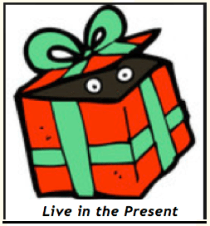
Some benefits from thinking about the past can be: identifying the lessons, considering facts not just emotions, & looking at PPT from a new perspective.

🔸EHP Don’t violate / sacrifice personal values
Each of us have more than one value system – what we were taught by our family, by our religion, our early social environment, AND what we develop in ourselves from our Core Truth. Some of these may overlap, some may not. The problem for ACoAs is that we are either not allowed to find out what we truly believe, or more often have been so brainwashed by our toxic upbringing that we’re not allowed to live according to our personal beliefs even if we know what they are. (Core Values lists)

EHP have figured out what they consider important – even essential – to their identity, for themselves & in relation to the rest of the world. A value is a belief, a mission, or a philosophy that is meaningful but not always conscious – as many are taken for granted. They know that their personal Core Values are not automatically the same as that of other people or institutions, & they don’t try to impose them on others.

They do NOT value the impossible, like perfectionism, eternal human love, fairness…. They know everyone falls short sometimes, so they get back on the horse when they don’t live up to their ideals, & are also patient & forgiving to others when they also fall short.

NEXT: MENTAL health Don’ts, 1c

Mental Health DON’Ts – Emotional (Part 1a)

live wellLIVING WELL
is the best revenge!

PREVIOUS: Psych Disorders #6

SITE: 10 Things (physically) Healthy People do differently

SOURCE: Composite of many lists, including Amy Morin’s “13 things Mentally Strong people Don’t Do.” – about being in charge of our thoughts, emotions & actions (T.E.A.)


EMOTIONALLY HEALTHY People (EHP)
:

🔸EHP Don’t Avoid Alone-Time
Many ACoAs are addicted to relationships & to staying busy, no matter how unsatisfying or damaging. They always need to be with or around someone, rescuing others or creating chaos, running away from themselves or desperate to hang on. They never seem to slow down enough to feel emotions, evaluate their motives or stop self-defeating behaviors.

ACoAs in Recovery often say they don’t know what to do with unstructured hours – because it’s for just themself. They feel depressed, too lonely, can’t decide what to do, aren’t allowed to have fun or relax….. wasting precious time on weekends or holidays, & then go back to their rat-race. Even those of us who are highly accomplished & talented are motivated by fear, rather than self-esteem.

But EHP treasure time by themself – to reflect, plan ahead, have alone timefun, be creative, do something not related to their work-life, OR just rest! And there are times when it’s truly necessary to pull back in order to allow internal healing, but it’s not endless.

EHP don’t need others to give them a direction or make them feel OK. They can be happy with others, but also happy alone. They’re comfortable with their thoughts & emotions, & when stressed they know how to comfort themself. They know that changing their routine or ‘vegging’ is crucial to mental & physical health. They know that play is part of a well-balanced life, so don’t need to be constantly ‘producing’ something to validate their existence.

🔸EHP Don’t Feel Pessimistic
ACoAs are more likely to see themself (S-H), others & the world from a negative point of view (hopelessness & some paranoia). The adults we grew up with either ignored us or were judgmental of everyone & everything, so we took on the same perspective. This means ignoring all the positive things available in life, including the good things that we have experienced.

EHP generally feel optimistic about their life & their future, without ignoring stresses or hoping for magic outcomes. They don’t let temporary difficulties or unimportant annoyances get them down – at least not for long. They know that obstacles are part of life, so they make an effort to solve whatever they can, & accept what they can’t change (Serenity  Prayer – backwards??).feel positive
They don’t focus on their weaknesses – while still acknowledging them. No one can be perfect, so they don’t waste time trying. Instead, they continue working on improving themselves rather than feeling defeated.

🔸EHP Don’t Feel Sorry for Themself
There’s a difference between feeling sorry for ourselves & healthy compassion for all we’ve been thru. The Victim’s outlook is that they can’t function because of being abused. While their childhood trauma was real, as adults they refuse to work on healing those wounds, which would improve their present & future. Their ‘position’ is that as long as they’re ‘incapacitated’ someone else will have to take care of them. If no one does, they stay helpless & depressed.

🔸EHP compassionately acknowledge past distress, while fully accepting the unfair & painful truth that they’re responsible for cleaning up the PMES mess their unhealthy family passed on.  compassionThey’re able to emerge from stressful circumstances with self-awareness & self-respect, even appreciating the lessons they’ve learned. When things don’t go well in the present, they find realistic ways to manage, get the support they need, & believe in their worth – no matter what.

They ALSO know it’s OK to feel sorry for oneself briefly from time to time, especially after an event that’s out of their control. It’s important to lick their wounds to regroup & regain strength, before moving on. EHP have gratitude for their positive qualities & the good thing they already have.

NEXT: EHP – Part 1b

Psychological DISORDERS – Intro (Part 1)

I’M NOT CRAZY – just a little ‘off’!

PREVIOUS: Communication (#6)

POSTs: Principles of Character 1 & 2

SITEs: STARLINGonline educational videos, community support, & tools  -to improve mental health
🌱  7  vitamin supplements that improve mental health


LEVELS of Mental Health, from highest to lowest functioning :  1.Healthy ——> 2.Neurotic ——> 3.Personality Disordered ——> 4.Sociopathic/Psychopathic ——> 5.Psychotic (deranged)


DEFINITIONS

✦ PERSONALITY
:
A pattern of relatively permanent traits & unique characteristics that give both consistency & individuality to a person’s behavior.
✦ TRAITS contribute to individual differences in behavior, consistently over time, & across a variety of situations.
✦ CHARACTERISTICS are unique qualities of a person that include temperament, physique & intelligence.

BEFORE looking at the various degrees of psychological disorders, we need a look at what mental health is – to use as a comparison. One way to identify it is :
O.C.E.A.N. traits: Openness to experience, Conscientiousness, Extroversion, Agreeableness, & Neuroticism
⬆️ It’s also called the BIG FIVE, (CHART) dimensions of character which represent the main qualities shaping our social interactions. Extensive research shows they have biological origins & are remarkably universal.
One study that looked at people from more than 50 countries found that these 5 traits accurately described personality from Germany to China. (Descriptions). Traits are rated on a scale from strongest  to weakest. (People at the extremes)

Thomas Fuchs (U. of Heidelbergs) : Narrative Identity** is a person’s combined personal past, present & future. Understanding that makes it possible to observe contradictory aspects & tendencies found in oneself & others —> & mentally integrate them into a consistent, inclusive picture about Self or ‘Other”.
**Narrative Identity = forming a sense of oneself from a combination of all life’s experiences into an internalized, evolving story of the Self that provides them with a feeling of unity & purpose

INTERESTING : people with long-term, stable mental health seem to be in the minority.  Several long-term studies – in the US, Switzerland & New Zealand – (covering a 27 yrs, with people ages 11 to 38) found that up to 83% of participants developed mental disorders sometime during those ages.

Re. the continually health people: while having loving, drama-free childhoods helped, these people were (born) naturally up-beat (emotionally not moody), had lots of friends & had superior self-control.
As adults, they reported more education, better jobs, higher-quality relationships & more satisfaction with their lives. Also, in New Zealand, the healthiest Kiwis had fewer first- & second-degree relatives with mental disorders. (More….)

1. HEALTHY  (NORMAL)
Basically – mental health is about knowing who you are – the very essence of you (not just your damage expressed as self-hate) but rather the person you were born as, called the True Self, found in the Natural Child.
IT IS:
• being comfortable in your own skin, even when things aren’t going well or you’re experiencing great difficulties (More….)
• being curious about yourself, other people & the world, always looking for new ways to grow & stay interested in life
• having access to all emotions (not all at once ):), knowing how to comfort yourself when in any kind of pain, AND being able to enjoy all the good things about yourself & your life

• knowing what your talents are & using them  to your best ability, learning what you don’t know & using all your imagination to express your ideas
• having strong, clear boundaries (not walls) so you can have safe relationships which can be loving, interesting &/or fun

• knowing what your limitations are, based on your natural personality, you experiences & your age. Accepting that you are imperfect & not all-powerful, both as a human being & as your unique self. It’s ACCEPTING this & being OK with it

💕 Healthier people can tolerate a wider, deeper range of emotion, so don’t have a compulsive need for distractions (alcohol, sugar, internet surfing, sex, doing / doing….). Being more honestly self-aware allows them to feel:
😟 the pain of their own human failings, limitations & eventual mortality, and
😍 the beauty of everyday living – precious moments with loved ones, appreciating delicate flowers, a kind word from someone, time spent with a pet or listening to favorite music….
‼as well as the high points, like weddings, births, promotions, personal milestones, artistic accomplishments….(SITE: Children’s Mental Health 2–8)

NEXT: Personality Disorders (Part 2a)

COMMUNICATION Categories – Ways (Part 6)

NOBODY SEEMS
to be listening to me!

PREVIOUS: Comm categories #5


CATEGORIZING Communication (Comm) cont.
7a. Re. Mechanical Networks  /// 7b. Re. Human Networks  

8. Re. WAYS to ENGAGE in communication
Level 1: Messages into the Ether
Snail mail, email & texting have some things in common. They’re sent out, & a response can sometimes take days or weeks. Since they’re not conversational (back & forth) there can be a high level of misunderstanding, possibly leading to hurt feelings, even fights.

Level 2: Back & forth Messaging
It’s conversational, but still done remotely (IM, text….). Such exchanges are more casual & direct, so confusion is less likely, since one or both can catch distortions or misses with each reply.
However, its bite-size style means it’s not well-suited to discussing complex issues.

Level 3: A Verbal Dialogue
Here participants get to express their opinions directly, plus adding a whole layer of implied info via Para-language. These can hint at excitement, pleasure, peacefulness OR annoyance, frustration, stress…. that are harder to detect in writing. A drawback is that they often require scheduling, but sometimes things need to be cleared up quickly via phone.

Level 4: In-Person Spontaneous Discussion
When something important comes up unexpectedly, we might decide to get together with the others person. Spontaneous discussions can be effective for problem-solving, getting an immediate need met or making a plan. Benefits come from adding a new level of mutual understanding & co-operation. But it doesn’t always work – discomfort with spontaneity, lack of privacy, the other person being too busy or not in the mood…. can get in the way.

Level 5: In-Person Scheduled Discussion
What makes this level special is the mutual agreement to set time aside.
Planning doedn’t have to make the meeting Formal, but gives both parties time to think about the topic. Successful & dynamic interactions (Zoom, Skype, FaceTime… OR office conference, private dinner….) come from combining self-awareness, non-verbal intelligence & privacy, to ensure comfort & trust. (From )

VALUE: Observing admired leaders, we can see that good comm. judgment is very important to their success.
EXP:  knowing what
can be done at Level 2, versus what must be done at Level 5 – & doing it – is a sign of sound leadership instinct, as well as knowing what to expect in personal relationships.

9. Re. PMES Categories
✒︎SOCIAL
: Talking about anything of mutual interest – world news, sports, weather…. It’s superficial but truly useful, allowing us to function among acquaintances & strangers without burdening them with TMI about our life.  It also helps determine whether someone is neutral, a potential friend or enemy

✒︎MENTAL: Talking about facts, helpful tips, ideas, non-controversial beliefs, plans & strategies, as in professional conversations. Unfortunately, some people go out of their way to be the ‘best’ at it, so that no one is smarter, wittier or more knowledgeable, & they never have to be wrong.

The distance between the first two levels is relatively short. Polite conversation can turn into a mentally stimulating one very quickly & then collapse back into small talk or none at all – without discomfort. Except for conversations with a controlling know-it-all, these two levels are safe.

✒︎EMOTIONAL: Here talk is about aspirations, fears, wants, needs & joys. Sometimes eyes well up, lips quiver, & the voice chokes. Other times those same eyes light up, heart pounds & words flow with joy, or fail from awe.

• The distance between #1 & 2 AND #3 is rather wide, because #3 requires intimacy, transparency, trust & vulnerability. Most of us are afraid of being wrong or looking foolish, & absolutely terrified of rejection.
Participating at this level opens us to possible rejection, hurt & being scarred. Over-all, this level is easier for women to navigate, partly because expressing emotions is more socially acceptable, & because a portion of women’s Corpus Callosum is thicker than men’s, perhaps allowing more access across the hemispheres emotions to be verbalized  (MORE….)

✒︎SPIRITUAL. This is the hardest to identify & describe, not only because our culture is so secular, but because few people are willing to drop down into the level of faith – for themselves – much less to speak of it to others.
It melts away push-pull, give-take win-lose, me-you. There are no distortions from emotional mental or social games, allowing for the highest level of resonance, creating an energetic embrace that sustains & heals.

‼️ Understanding all these forms of comm allows us to identify & then choose which is most appropriate for any given situation.
It can be too easy to go down the path of least resistance, but that can get us into trouble, so it’s important to be more thoughtful about how & when we communicate.
It’s better to do it the right way – focusing on our goals & using whichever level will help us get there.

NEXT: Psych Disorders #1

Passive Aggressives – Review for ACoAs (Part 3)

WHAT A CONCEPT : Honest doesn’t mean hostile.
Pleasant doesn’t mean passive!

PREVIOUS: P-A ACoAs (# 2)

SITEs:” Emotionally Volatile People
• “Difficult People & how to Handle Them

REVIEW (cont)
1.The GAME // 2. WHO plays the game

3. CAUSEs of the game
ACoAs ; from our family, school, religion…. we were NOT allowed :
• to be angry, to the point of not even knowing we are!
• to know what we wanted, how we felt, what we preferred (being too much of an individual got smashed – so it left us confused)
• to ask for anything (don’t bother them)
AND
• were taught to never put ourselves first
• always had to always be perfect (no mistakes) – so better not choose anything
• no matter what we did, we were punished, so we couldn’t win
• safer to not be too visible (in a dangerous family, & later in abusive relationships)
taking any risk was discouraged, made fun of, punished (so now we can’t risk ‘failing’ & being disappointed)

4. EFFECTs of the game, as the P-A
a. Negative BenefitsWE DON’T have to :
• figure out who we are, what we want & need
• disobey any of the toxic family rules
• admit we’re angry, even raging, underneath
• stand up to the ‘control freaks
• make a mistake & deal then with consequences
• AND we get to blame others when something goes wrong, & maintain the illusion of superiority

b. Negative Consequences of being P-A :
• always feel scared of disapproval & losing people (FoA)
• it increases our Self-Hate & Loneliness 
• lose out on many opportunities to grow, to be heard, to have fun
• make other people mad at us, a lot! for forcing them to carry all the responsibility & then getting blamed
• never get what we really want, unless by accident or by luck
• we are dis-empowered, lose self-esteem, stay a victim, are infantilized, stay mute, don’t risk anything

4. HEALTHY
a. General: We need TO
• identify all the ways we were hurt as kids, including the specific messages we still obey, like ‘don’t feel’ , ‘don’t talk’ (Toxic Rules)
• prevent the Wounded Inner Child from running our life BY growing a Healthy Adult & Loving Parent  (the UNIT) who can make executive decisions about how to own & fulfill our needs
book-end with the IC, to outgrow living in the past. If done consistently, it will teach the WIC the difference between what’s possible & real in the present, vs the way it was in our dysfunctional family

b. For Passive-Aggressives – we need TO:
• keep a safe distance from anyone who is easily provoked to anger
own our hidden resentments, anger, rage, bitterness
• learn safe ways of discharging rage, & healthy ways of expressing it to others, when needed
• practice saying what we need, want, like, prefer – to find out that nothing bad happens to us or others
• stop looking for other people to be in charge of our life, tell us what to do, make our decisions & choices

Practice making ‘I’ statements every day, silently to yourself, so it gets easier & easier to say out loud:  “I want… I need… I don’t like… I’d rather…  that’s not for me… ” UNTIL it’s your new norm!

c. For Volatiles – we need to:
• accept that the rage is legitimate, but our actions are not always healthy
• find out what’s under the rag e: the reality of child abuse & neglect we lived thru, and the pain it created
• become safe enough to feel what’s underneath – grief, sadness, loneliness, hurt, sorrow, vulnerability Screen Shot 2016-06-17 at 10.24.27 PM.png
• learn calming techniques (bio-feedback, prayer, poly vagal exercises, visualizations…)
• own our Inner Sadist: make friends with it, but never let it act out
• work on getting rage out in safe, appropriate places (therapy groups, 12-step programs, doing rage-work at home, drawing, writing….)

Practice comforting & mentally holding the WIC, so he/she doesn’t feel so alone with all its pain.  Give yourself permission to cry – it is not a weakness – no matter what our family taught us!  Crying clears out toxins & releases pent-up emotional stress. It’s very necessary!

Realistically, while P-As can definitely work on having permission to express anger & rage, it’s usually up to the V. to STOP the game, stop reacting to / expecting (anything) from the P-A. Maybe even having to leave!

NEXT: Qs – Are you P-A?

Passive Aggressives – Review for ACoAs (Part 2)


I’M NOT ALLOWED TO BE ANGRY
– but you are (lucky you)!

PREVIOUS: Passive-Aggressive ACoAs (#1)

SITE:When your Defenses lead you into trouble

REMINDER: See ACRONYM page for abbrev.


REVIEW –
(cont)
1.The GAME

2. WHO plays the game (Chart – slide #7)
a. P-As always look for & often find another person who is overtly angry / volatile* (V.) to play the game with – no fun being stuck with all that UN-expressed rage alone! (See: Inter-personal games, Eric Berne).

As adults, they desperately need to maintain their illusions of being perfect, in the faint hope of getting or keeping their parents’ approval, being taught that strong emotions are considered dirty, messy, dangerous – even murderous! Being P-A is another unsuccessful way of denying intense fear of abandonment

b. ✶ Volatiles need P-As (for their part, or the game wouldn’t work) :
• it gives them an excuse for letting out some of their rage ‘legitimately’
• it’s much safer than aiming the rage at the real target – their family
• the rage makes them feel powerful, to cover vulnerability & emptiness
• both Vs & P-As are addicted to finding someone they can act out their childhood ‘story’ with. Vs are used to being disappointed, too, & P-As do continually disappoint! It’s their trade-mark, & it can be used to identify them.
• sooner or later, usually later, it’s inevitable that Vs get angry, raging, even nasty at P-As – out of legitimate, intense, longstanding frustration at the P-As’ tactics!  Of course: Vs have to stick around for this! They’re part of the game.

DIRTY POOL – P-As unconsciously, sometimes knowingly, will find & use ‘available’ Volatiles as their own personal pressure valve – as if getting the V. to explode with rage would relieve their own pent-up hostility. When Vs get angry, P-As get very self-righteous. They feel victimized & cry: “I haven’t DONE anything!  Why are you attacking me?
SO THEY CAN
• Accuse Vs of being controlling, even though they set the V. up TO:
— take care of them emotionally & practically
— vent their anger/rage for them
— make all the decisions in the relationship!
— use the V a substitute for the original harmful parent

• Make Vs the crazy or bad one (instead of themself), of being abusive & unfair, of reacting to ‘nothing’. That way the Vs can be ‘the monster’ for pouring out that vile stuff (anger) which P-As are terrified in themself.
They can continue to feel superior & ‘clean’, keeping their ‘good-child’ status. After all, P-As can point to being easy-going, never raising their voice or letting out that ‘nasty‘ anger – right?
➼ BUT that is exactly the point – they don’t DO many things that are their responsibility.  P-As make other people responsible for decisions they should be making themself, (even if they like the ones being made for them). They neglect to ‘show up’, hold up their end, be an equal partner or peer – ie. an adult. P-As stubbornly – yes angrily – demand to be rescued, never not expressing their needs / wants.

• THEN, if /when something goes wrong – when they don’t like the choices the V. made for them, or are disappointed with the outcome – they can blame the other person & continue to play the victim.

• AND P-As can say to the other person: “YOU’RE so controlling!” (& unspoken: “I hate you”). Wow! How dishonest.
✶ BUT if the V. stops playing the game, the P-A may finally tip their hand – if only briefly – showing the true rage behind their mask

EXP: Mark (P-A) & Sandy (V.) meet at a classical concert & become art-loving, theater-going friends. Mark regularly says self-deprecating things that are clever & funny, & Sandy obliges by laughing.
After a few months Sandy becomes increasingly uncomfortable with her complicity in Screen Shot 2016-06-15 at 12.04.49 AMMark’s self-hate. The next time he makes a crack about himself – she doesn’t laugh & is quiet. He gets annoyed & indirectly insults her for not responding ‘correctly’.
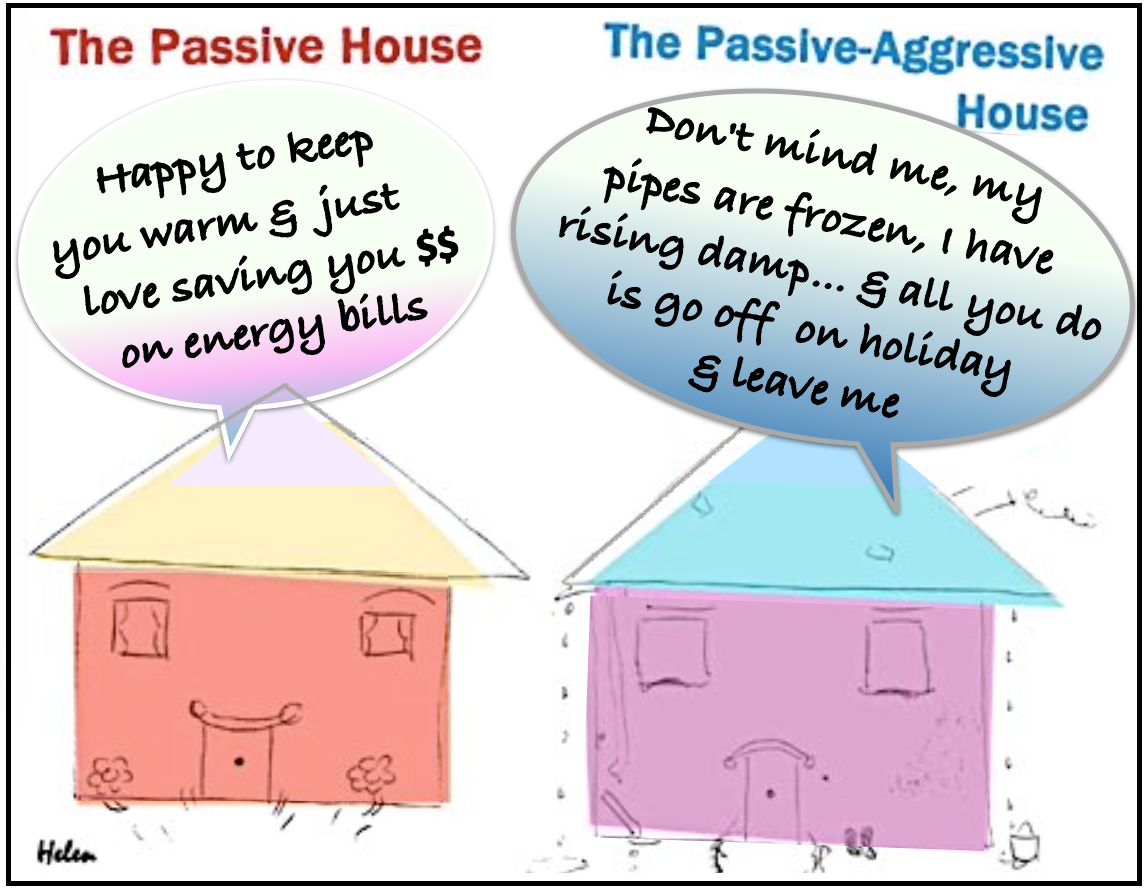
Later he buys her a B/day gift which deeply offends her artistic & Christian values – an ugly-made goddess statue – knowing her religious background! She can’t imagine his intention – but is outraged. She instantly blows up at him & gives the gift back. Naturally he’s shocked & insulted. After all – it was well-meaning. Instead he mails her a self-righteous note, asking “Is that any way for a Christian to act?”.  End of friendship! Sandy feels ashamed for blowing up but also relieved to get away.

NEXT: Passive-Aggressive ACoAs, (Part 3)

Passive Aggressives – Review for ACoAs (Part 1)


YOU’LL NEVER SEE HOW ANGRY I AM –
I barely know, myself!

PREVIOUS: P-A ‘nice’ comments

SITE: Constructive, Passive & Aggressive Leadership styles


REVIEW
1.The GAME (Post: How its played)
a. DEF : Passive-Aggressive ‘Personality Disorder’ (PAPD)
A 2-handed ‘game’ which always requires the Passive-Aggressive (P-As) person & the Volatile (Vs) one to react (in ‘Games People Play’ – audio – by Eric Berne)

✰ web-MD …. apparently compliant behavior, with intrinsic obstructive or stubborn qualities, to cover deeply felt aggressive feelings that cannot be more directly expressed….

✰ Wikipedia ….. a personality trait marked by a pervasive pattern of negative attitudes & passive, usually disavowed resistance … expressed as learned helplessness, procrastination, resentment, stubbornness, sullenness, or deliberate/repeated failure to accomplish requested tasks for which one is (often explicitly) responsible….

✰ DSM VI …. the behavior often reflects an unexpressed hostility or resentment stemming from a frustrating interpersonal or institutional relationship on which an individual is overly dependent

✰ The Straight Dope …. people who suffer from PAPD expect disappointment, and gain a sense of control over their lives by bringing it about.Screen Shot 2016-06-14 at 11.09.50 PM.png

b. ACoAs: MANY of us grew up in one of 2 emotional climates :
emotionally volatile – being around loud, hyper, dramatic, raging parents / relatives – which has made some ACoAs emotionally gun-shy. We had to sit on our own anger – there was so much flying around, and we didn’t want to be like them, so we shoved our rage into a huge locked room & tried to throw away the key. But now it comes out sideways!

Screen Shot 2016-06-14 at 11.00.40 PMemotionally repressed – the other extreme found some of us in a family of uptight, buttoned down, emotionally cut-off, perhaps P-A types, who made a point of suppressing any intense emotion in their children. They may have believed it was ‘spiritually correct’, or they just didn’t want their own repressed pain to get triggered, &y didn’t have the skill/ tools to deal with ‘big feelings’ from their kids. We either copied their style or became ‘dramatic’ & over-reactive to everything.

• Both styles have deeply effected our relationship to anger & rage.
IMP: These are normal human EMOTIONS (Es), which are just forms of energy & by themselves are not dangerous or bad.
✶✶ What to watch out for are the ACTIONS we take to express these Es! If we express them safely, we don’t hurt anyone & in fact feel lighter & can function better. If they’re expressed badly we can cause pain to others, while adding to our shame, guilt & S-H.

c. Briefly:  P-As ACoAs have a huge amount of accumulated anger & rage (from childhood, as well as in adulthood), which we’re not allowed to feel, much less admit to – in order to be the ‘good’ one. We have cultivated such a facade of ‘niceness’ we’ve fooled ourself (but not everyone).  We may be the Hero or Lost Child from any dysfunctional family –  the Rescuers, the People-pleasers, or the Invisibles. (Toxic Roles”)


no, noP-As compulsively resent, oppose & thwart – indirectly – what we see as demands to function at a level others expect of us. We’re convinced that we’re still not allowed to have real power for  ourself,  afraid to admit our anger at being neglected & unloved.
We end up saying NO to our own needs & wants – and to many things that would be good for us.

So we live in a state of deprivation, expecting others to read our mind & provide what we won’t give ourself . P-As are rarely if ever able to state outright what they want & don’t want, or distinguish between actual bullying & appropriate requests.

hidden handsSuppressing our anger is a form of negative self-control, then put all the rest of our effort into trying to control other people’s actions & emotions..  In light of our self-imposed limitation, P-As are inwardly driven to push others toward our secret goals: to prove we can’t be pushed around, and to get back at anyone who’s hurt us OR their substitutes) – while seeming to not push at all. (re. controlling). It’s a way  to get our agenda across without risking negative consequences.

NEXT: P-A ACoAs – Review (Part 2)

Passive-Aggressive ‘Nice’ COMMENTS

I HAVE LOTS OF WAYS
of being covertly angry
PREVIOUS: P-A #1

SITEs27 Most Passive-Aggressive Things That Ever Happened
P-A Commuter Types – (London)

** Southern P-A veiled insults 


Somethings Passive-Aggressives SAY :

Using their cherished bag-of-tricks to combat insecurity, especially if they feel pushed outside their comfort zone, P-As silently hope for attention & approval, trying to prevent loss of connection by avoiding confrontation.

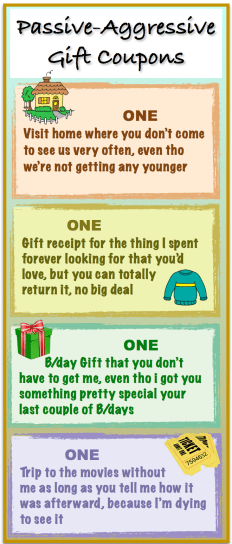
The following statements are meant to express disappointment, hurt & hostility, but are coded in the form of underhanded insults instead of respectful honesty. Totally confusing most people, this style insures P-As do not get their needs met, while feeling ONE UP.
When they give those little looks, roll their eyes, or throw out subtly sweetly nasty comments, they’re cresting brain fog, so most ‘recipients’ don’t catch on that they’re being messed with. 

NOTE: Emotionally healthy people are self-reflective, so not only do they have decent self-esteem, but aren’t afraid to own their ‘stuff’.  So they rarely point a finger at others,, keep the focus on themself, not ashamed of their emotions, & can communicate directly with ‘I‘ statements.
EXP: “I won’t be able to help you with that // This is who I am, please accept me as is….”

BUT dyed-in-the-wool P-As have none of those characteristics. Almost all the following statements are ‘you’ types (some implied), and none of the “I” statements are kind or supportive, nor admit personal responsibility for their feelings / opinions

THIS often leaves someone wondering:
“Did I hear right? / / Did they mean to be mean? / / If I catch them or say ‘this hurt’ – will they deny or attack?……”  What the P-A wants is for others to always be off-balance.

This list includes things said/written by any adult in any setting
Aren’t we pretty today? = Who do you think you are? / / Is that what you’re going to wear? // What you’re wearing is ugly
Don’t bother! = means I really want you to do _____, & angry that you won’t
• Don’t take it so personally = means that it was a very personal barb
Fine. Whatever = sulking, they want you to stop bugging them
• How is your therapy progressing? =You don’t seem to be getting any better (maybe worse!) // you’re still such a mess, I don’t think even this will help
I’m coming! = foot-dragging, putting off doing something they want // I’m busy!

I didn’t know you meant now = means I won’t let you control when I do what you want, which I don’t want to do anyway
If you really want to = means I don’t really want to, but won’t say so
• It’s nice that you’ve found a friend = finally, since you’re not very desirable
If you insist! = means I don’t agree //  I don’t want you to, but won’t ask you to stop
It’s fine if you’re late, again = they feel disrespected but think it’s too petty to object directly (don’t have a right to be considered)
I didn’t do anything (wrong) = complete denial of their abuse or neglect
• I didn’t mean anything by it = means ‘pretend you didn’t get it’
I h0pe it’s worth it = they’re “worried” about a choice or decision you’re making, think it’s wrong and hope you fail
I thought you knew/ are in the loop = 
they had no intention of including you
• I was curious about / surprised / confused by…  =
a disguised criticism
I was only joking = sarcasm meant to stab at you. It’s not funny

• Oh my dear, you’re looking so much better today = boy have you been looking like something the cat dragged in lately (although you have not been sick)
No worries = short for Screw You
So… (by itself) = another form of Screw you, or what’s your point? — If in a sentence : So….When are we going? / have you called them back yet?…..  = the P-A is clearly agitated, worried…. but won’t admit it
Sure, I’d be happy to = they don’t want to & have no intention of doing it
• This is far too complicated for you to understand = dumb, dumb, dumb
Thanks in advance = you’re will do what they want, without your input or consent

• You’re asking too much / just wanted everything to be perfect = they don’t want to do what you asked for, but can’t get away with putting it off, so do it badly or half-assed, then are defensive when you rightly object to a sloppy execution
• You’ve done so well for someone with your limitations / with what you had to work with = means the P-A is jealous, but patting you on the head like a child. OR are very displeased & disappointed in you, & blames you

You decide / whatever you want = (as a pattern) never taking responsibility for what they want & then objects or criticized your choices
You’re imagining things = means that if you’re ‘crazy’, they’re home free – got away with abuse

You’re so intense / too emotional = P-As are hiding their own anger & pain, so don’t want your strong emotions to stir up their suppressed ones
You’re too sensitive = P-As don’t want you to object to their hostility, judgement or insult
Why are you getting so upset? = means “Ha, I got you!”
• We’re watching your progress & hoping the best for you = we don’t have a lot of hope or confidence in you, but want to sound supportive!.

NEXT: P-A ACoAs (Part 1)

OUTGROWING Co-Dep Niceness (Part 5a)

I DON’T KNOW
if I’ll ever be able to

PREVIOUS: Outgrowing P-P #3

SITEs: PMES forms of Self-Care
• 30 day challenge, to make changes


RECOVERY from “Too Nice Syndrome” (TSN)
cont.
TOOL 3. ASSERTIVENESS  //  TOOL 4. HAVING RIGHTS

TOOL 5a. FORGIVING OTHERS
DEF:  a. LET GO of our anger  (Es= the emotion), & resentments (Ts= angry thoughts /obsessions) toward anyone whose offenses, flaws or mistakes have seriously injured us   (See “Letting go means….“), AND
b.  GIVE UP the desire to punish, seek revenge or exact payment

ACoAs
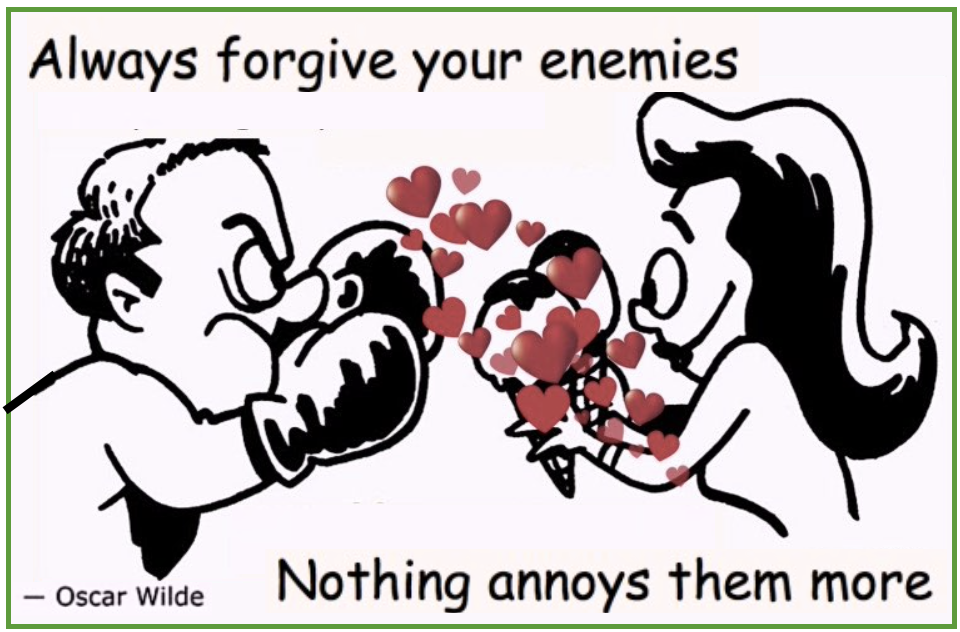
Mental health, Recovery & religious communities keep telling us we must forgive others in order to move on, insisting it must happen before healing can occur. This may be true for some people, but doesn’t really work for most ACoAs.

Forgiveness is important, but it’s not that easy to extend it to all the damaging & crazy mates, friends, bosses…. we’ve collected along the way, & especially not toward the adults who tortured & neglected us as kids.
There are things done to us that are – or seem to be – unforgivable.

▶︎ For ACoA angry-nice people forgiveness IS about ‘letting go’ – but not first. Instead, it is the outcome of the process of gradually releasing layers of old pain, combined with developing the UNIT, so we stop needing all those ‘unavailables’.

This takes a lot of time & effort, & maybe forgiving our abusers will never be complete because of the amount & intensity of trauma we suffered. But we are worth the effort to try, & that effort ends up benefiting every part of our life.

Not getting our rage out (& the tears underneath) is what keeps us stuck in obsession, which we’ve covered over with denial & then express as P-P angry-niceness. It will continue to plague us as long as we’re still desperate for their (unavailable) love & acceptance. AND the WIC wants the Perpetrators to admit what they did, to genuinely feel sorry & to apologize.

This rarely happens, so don’t hold your breath! Our anger is appropriate, but it must finally be vented safely, away from them, so we don’t have to keep carrying its corrosive effect. (“How to forgive” – even if they never come through!)

ACoAs go to one extreme or the other about almost everything.
As adult we’re responsible for our Ts, Es & As, but as angry ‘nice people’ (P-P) we’re afraid to admit our emotions & opinions. Instead, we take on the burden of other people’s feelings, especially if we love or need them, & especially if they’re acting needy or aloof. This comes from a set of opposites, a double message that becomes our bind :
❗️ the WIC’s narcissistic desire to symbiose (be the same as me), AND
❗️ the compulsion to escape from being ourselves (from S-H)

So, as long as we’re being run by the wounded child,
✐ we either refuse to even consider letting go (forgiving), or
✐ we’re too easy on everyone who hurt us.  The co-dep’s “High Road” is more likely a way of staying in denial than of being emotionally free.

► Forgiving requires some mental/emotional distance from our wounds, BY HAVING:
🔅 done enough venting of our old pain in safe ways
🔅 had our childhood experiences validated by people who understand
🔅 gotten enough correct info so our thinking is clearer
🔅 good enough boundaries so we can take care of ourselves
🔅 developed a healthy Adult to be more in charge of our choices

A VISUAL : We can think of our many painful memories as a series of pictures in a large gallery in our head – each one with an art lamp over it, the cord plugged into the wall at the baseboard. For us – the light is all the emotions attached to each memory, plugged into our nervous system.

A little at a time, by crying, raging, talking thru traumatic events, & being validated –  in safe places – the plug gets pulled out of the wall. We’ll still be able to see the images, but they will be in shadow because much of the pain will be gone. THAT is letting go. That is the forgiveness that benefits us.
AA saying : “Look back but don’t stare.”

NEXT: Recovery – Forgiving ourselves (#5b)

OUTGROWING Co-Dep Niceness (Part 2)

THERE ARE MANY WAYS
to help myself ‘let go’

PREVIOUS: Outgrowing P-P #1

SITE : 45 Confidence Exercises…..

<—- IMAGE from : “16 Acts of Self-Care to Get You Thru 2017

See ACRONYM page for abbrev.

RECOVERY from “Too Nice Syndrome” (TNS) cont.
TOOL 1. Facing FEARS

TOOL 2. SELF-WORTH
++ Self-esteem is fundamentally the result of unconditional love! To outgrow the need to P-P we can work at providing that for ourself now, even tho’ we didn’t get it as kids. Our attention has to be internal – on who we are, what we need, what our rights are & how well we take care of ourselves

☁︎ Co-deps base a lot of their ‘value’ on how much they do for others. This is self-defeating, guaranteeing ‘failure’, because :
• it’s only about action rather than personal identity, external vs internal
• we’re selfishly using others as a prop for our WIC’s distorted self-image
• we’re dependent on the unpredictability of how others respond to us
• we can never do enough for some people, so we’ll always come up short
• we can never fix anyone else’s pain, & even if it were possible, the people we most want to ‘save’ (rescuing=false helping) are usually the most recalcitrant (absolutely UNwilling to work on themselves!)
• some people will never give us any appreciation or validation. Sadly those are the ones we chase the hardest & longest!

Self-esteem allows for INTIMACY. To be capable of intimacy we need to overcome a large chunk of our self-hate – by developing at least a working knowledge of our Rights, using good Boundaries, having access to a wider range of Emotions & a nodding acquaintance with our Inner Child, the UNIT & our True Self.PP voice

☁︎ If you’re an ACoA, your needs & emotions (Es) were stomped on & ignored. Being ‘too nice’ was one way you survived, even if your siblings chose a different way to protect themselves. What does this tell us?
That we used whatever we could to deal with an emotionally & physically dangerous upbringing.
We didn’t create that situation, SO this pattern is not an innate flaw in us. It’s correctable!  Outgrowing P-P is a combination of:
— rooting out abusive self-talk & correcting distorted ideas about life (CDs)
— consistently comforting & nurturing ourselves (self-care)

As we “get it” in our bones that we didn’t cause our need to develop co-dep – it will greatly quiet the self-hate & PP voices, which tell us that it is our fault. Then we slowly outgrow the old pattern of people-pleasing (P-P) which is one of many defense mechanisms. We are “Damaged, not defective”

TOOL 3. ASSERTIVENESS
++ Practice saying YES to the things you do want
• SUCH AS things you’ve had an interest in or passionate about since childhood, even if you never got to pursue them. Now you can pick them up, just for pleasure, or maybe to start a whole new career:
— Say yes to learning new skills that will improve your income
— Say yes to healthier friends & lovers, jobs, living space….
— Say yes to a new couch, better clothes, flowers….(when you can)
— Say yes to filling some of your down-time with ‘good, clean fun’
— Say yes to taking time out just for yourself, to rest & recharge

➤ Say YES to one thing you’ve been wanting to do (a small tattoo, a dance class, a Spiritual retreat…..), but are afraid others won’t like it or will make fun of it. Too bad. Do it anyway!

• There are other things you can be enthused about as short-term enjoyment, something or someone you’re only into for a while (maybe even a few years) and then : You got what you wanted from the experience // or you did as much with it as you could // or you’ve gradually become disappointed in it // or you, they or it has changed, & now it doesn’t suit you anymore….  You’re done, so move on & choose new PPT (people, places, things)

NEXT: Outgrowing P-P #3