SAFE vs UNSAFE PEOPLE

sharing slaceI WANT TO BE COMFORTABLE
so I have to pay attention to who people are!

PREVIOUS:Healthy RULES & Lesson,- #3


HELPFUL INFO

❀ This outline is not earth shattering or even news, but it’s nice to have it all in one place. You may want to add to the list, based on your personal experiences – or maybe some variations.

• It comes from the book “SAFE PEOPLE” by Dr. Henry Cloud & Dr. John Townsend. The orientation of the book is Christian & has references to Biblical truths, which apply to all spiritual persuasions, so please don’t let it keep you from benefiting from the available info in it. “Take what you like & leave the rest”!

• The book also has excellent chapters on many of the same topics covered in this blog, under such heading as: “How we lost our safety”, “Do I have a Safety Deficit?”, “Learning how to be safe” ……

• ACoAs are so used to being around unhealthy people that we may not realize how we’re being damaged by them.
Even when we think something might be wrong – in how someone’s treating us – we don’t trust our gut or our head, so we get confused & think we’re crazy or over-reacting to what are actually toxic environments & relationships.

Once we have the right info, we can make informed choices, by either moving away, or setting boundaries with the unhealthy people we love!
«

«
NEXT :  My RIGHTS –  Qs, #1

ACoAs: Healthy RULES & Lessons (Part 3)

  new life“AND NOW, PRESENTING…. –
a new life, a better life !!”

PREVIOUS: Heathy Rules, #2

SITE: Healthy Family Rules


MORE GOOD Rules
As mentioned in the last post, these statements are to help the Healthy Adult & Loving Parent parts of our psyche to learn better ways to take care of our Inner Children. Each statement can be used as an inventory:
a. Resistance:
• why do I NOT want to include them in my life?
• what do I think will happen if I follow these ideas?
• what do I need to give up in order to incorporate them?
b. Willingness:many Qs
• what do I need to have / do, before I can use these positive rules ?
• how can I implement these concepts into my life?
• who can I ask for help with them?
• who do I know who already lives them?
c. Results:
• what happens when I do act on these statements?
• how is it different from what I assumed or projected?
• what do I need to do, to increase these principle in my life?
OF COURSE – If you can add questions to this list – please do.
«    «
NEXT
: Safe & Unsafe People

ACoAs: Healthy RULES (Part 2)

Snever give up
YEAH. I WANT TO FEEL SAFE! — Will you take care of me, Good Parent?

PREVIOUS: HEALTHY RIGHTS (#1)

SITE: How To Never Give Up On… (CHART)


HEALTHY RULES
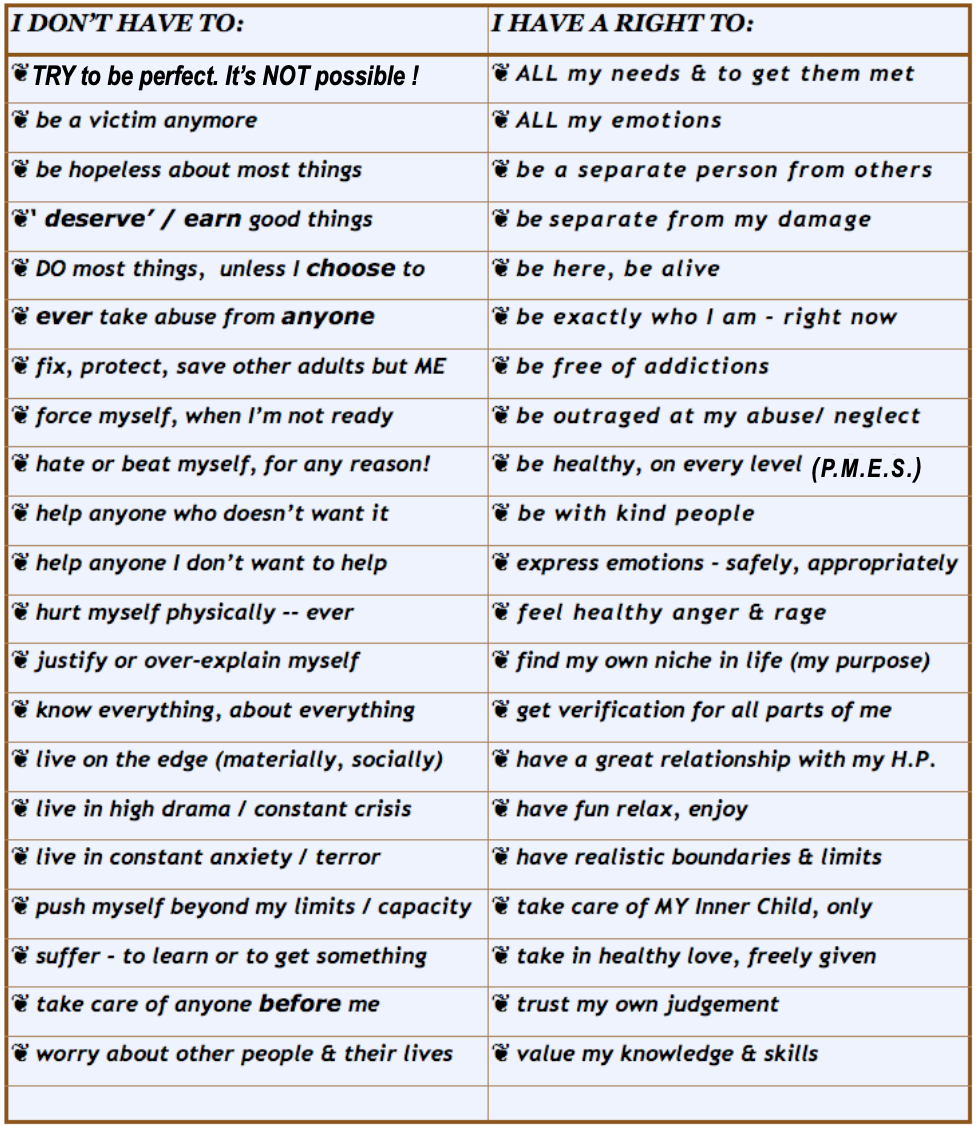
Part 2 & 3 list statement that have been accumulated from years of Recovery experience. They’re geared to the Healthy Adult / Loving Parent parts of our higher self – so we can know how to take care of our wounded and healthy Inner Children, in the best possible ways.

❀ YES, we have a broken heart!  What’s more painful to a child than not feeling loved by their parents?   BUT NOW – to be happy, we need to:
• accept who our family really was & is
• believe in every fiber that we did not cause our abuse & neglect
• accept that now we’re individually responsible for our life
• know that we have the ability to outgrow much of the damage, but not all completely
• consistently apply mental health truths to our life

❀ We all live by rules, whether we like to admit it or not.
• Some ACoAs were so neglected they think they weren’t taught any rules.  No, not good ones, but we did pick up all the Toxic Rules!
• Others of us were so constricted by rules & regulations, we nearly choked to death on them.
In either case we tend to shy away from rules, or have a raging hatred for them. And yet we are run by the bad ones, as long as they stay hidden and we don’t challenge them.

❀ So here are a few Healthy Rules to try out & apply to our every-day living.
Think about each one, carefully.
Pick one & try it out for a month. See what happens. Then try another….
«

«
NEXT : Healthy Rules & Lessons, #3

ACoAs: Healthy RULES / RIGHTS (Part 1)

JUST THINK, I COULD’A HAD A ….
no, not a V-8! …a lot of Love!

PREVIOUS: Toxic Family  Rules


Q:
What is the one & only source of self-esteem?
A:  Unconditional LOVE (acceptance, regard, respect, mirroring…)

EARLY: Heard a million times or not, it’s not trivial or a platitude
• The child’s brain develops its pathways using repeated experiences. If those experiences are disparaging, punitive, painful, limiting – then that becomes the norm for us when an adult
• Children look to their parents to tell them who they are and how they should act (guidance & mirroring). If the messages are negative, then the child’s self-image will be negative

Healthy Parental Love… (acoa website SiteMap, pgs 4, 18, 33, 62)
… does not mean giving the child everything it wants. Boundaries are imperative!
… doesn’t mean sacrificing everything for the child.  Kids need to see parents having a well-functioning life of their own which they can emulate
…. is provided by a ‘good enough’ parent, not a perfect one. Kids need to know they too don’t have to be perfect. Unconditional love is unconditional, not idealistic

NOW: Since ACoAs can’t change how we were raised –
• It’s not easy to change the old messages because we have to form new brain pathways, & the old ones are very deeply etched. That’s why repetition is so important
• We need to find all the possible ways to develop self-esteem
BOOK:Compassion & Self-Hate” ∼   Dr.T.Rubin

• The most successful way for us to change is to learn how to communicate with & comfort the WIC, becoming the Loving Parent & Healthy Adult most of us never had (the “UNIT)
BOOK: Recovery of Your Inner Child” ∼ Lucia Capacchione

 2-way conversations with the IC needs to be daily! It doesn’t have to be complicated or clever. Do you only talk to people you live with (have lived with) once every few months?
• At first you may find yourself very resistant, making excuses, think you can’t…. Yes – it’s a new language, & like learning any new language, it takes time, practice & more practice.  Don’t let the Negative Introject stop you from creating a better life

EFFECTIVE:
• The statements listed are sometimes called affirmations or mantra. ACoAs who are comfortable with the familiar ones – can use them if they resonate, since they ARE true. Whatever works to heal is valuablecomfort the kid
• However, many of us have heard platitudes from family, relative, school, religious communities, school… which didn’t mean much then because they weren’t backed up by ‘right-action’. They were substitutes for genuine communication & genuine emotional connections

• That’s why some ACoAs are frustrated with pre-packaged affirmations, since they don’t address our specific experiences & personality. We were SO unseen & unheard that now we have a desperate need for all communication to be accurate – down to the smallest word! – called “exquisite empathy”
We may prefer to create our own sayings, in exact response to the negative voice & which represent genuine caring for the WIC

• Keep in mind our IC is very smart, & won’t tolerate b.s. Don’t say: “I’ll always take care of you… be there for you… every thing’s going to be alright…” and then forget to talk to the kid for the next weeks or months, let the Bad Parent take over, not take proper care of yourself, let others walk all over you or keep on people-pleasing…. !
You must become trustworthy for the IC to listen & believe you!

EXERCISE:  Write out one of your Toxic Beliefs
• Then create as many counter statements as fit.
Put it aside, sleep on it, & go back the next day (or when you can), & see if you agree with your ideas, or have come up with others.
• If you’re completely stuck, ask someone safe for options. Sometimes watching how good parents on TV talk to their kids – can be good models.
BUT – try it out on yourself first.

EXP: Neg from WIC  – “ I can’t do anything right!”
Pos from Good Parent – “You / we can do some things very well, somethings so-so & some not at all.  If you want to know how to do X we can try to learn it. OK, Little One?”
Ask yourself & the IC:  “What would you have liked to hear back then – & now?”
«

«
NEXT:  Healthy Rules (Part 2)

ACoA : TOXIC Family RULES

Screen Shot 2015-07-09 at 12.10.53 PMTHEY DESIGNED MY STRAIGHT JACKET –
I’m gonna need some help getting it off!

PREVIOUS: Healthy Helping (Part 2)

SITE: Dysfunctional Family (Wikipedia)


RULES: No matter what our family environment looked like, all ACoAs have gathered a litany of TOXIC RULES, which we follow ‘religiously’, even well into Recovery – but hopefully less so with growth!

We absorbed these Toxic Rules from family, school, our community, religion…. They are the underlying beliefs the WIC is absolutely convinced are the absolute ‘truth’ which we are obligated to obey – on pain of death (abandonment)- even if we disagree or hate them. Notice the contradiction & conflict. No wonder we say we’re confused!

The BE and DON’T lists are the short forms, & just mirror opposites. Below are the expanded ones.  This is by no means complete. Each of us can have variations or additions.

INVENTORY: How do we know what our rules are?
a. Overview
As you read thru these lists – notice the ones that hit you the strongest. If you’re new-ish to recovery you may not recognize that you have more of them than you first think. Still confused?
✶ Ask yourself, & then siblings, mate, friends, therapist … for suggestions

✶ Do a Life Inventory, in 3-5 yr increments, listing all the major events you can remember – things that were important, relationships, when you started & stopped things, schools, moves, births, deaths …. choices made, opportunities we didn’t take…..
12065669231219144528Anonymous_work_in_progress.svg.med— Don’t go into detail. Just list things in one sentence each
— Notice the recurring themes, patterns, avoidances… What good things are missing?
— Ask : which toxic rules might your patterns represent?

b. Details
• Pick any one of the phrases that rings a bell & write what comes up.
— Where did you learn this? Who in your family exemplified it?
— How do you act it out in your life?
— How do your friends, lovers, bosses… express it?

• Take it very slow. Spread this exercise out over months & years, if needed. Maybe just write a little & go back to it when you have more info about yourself & your history
GOAL:

• See the toxic family rules you’ve been following – so clearly – that you won’t be fooled any longer into thinking they’re legitimate!
• Slowly disobey them by changing your behavior, an action at a time, a day at a time.

In the beginning – when you do some inventorying – you’re likely to feel fear & guilt. Those emotions prove you’re doing the right thing for your healing. Don’t give up!
• To orient yourself toward healthier goals –  pick out some Healthy Rules that fit your situation, & mindfully, deliberately, use one or more as often as you can (every day, a little?)

✶✶ Breaking family rules can create a lot of anxiety, as the Negative Introject will try to guilt you into returning to the fold – like good sheep.
So the work must be a slow & gentle but with steady process – with lots of support (Al-Anon as one of many resources)

If you read many other posts on this blog, you’ll see references to “Toxic Rules” over & over, so this post will give you a context for thinking about all the other topics & as you work with them. (Post: “Why Are You Stuck?“) .

«
NEXT : Healthy
Rules, #1

What is Self-Control ? (Part 4)

head or heartI CAN CHOOSE TO DO THINGS
that are good for me & are suited

PREVIOUS: What is Self-control (Part 3)

See ACRONYM page for abbrev.


Control is about POWER – to make someone do or be what we want. When applied to ourself – that power can be either –
• a defense to deny our pain, which is debilitating & destructive, OR
• to heal & nurture ourself, & express our best to the world

Healthy Self-MANAGEMENT (S-M) is not limiting or rigid, but rather providing the stamina to keep going & the ability to handle stresses with flexibility. It relies on the same willpower as rigid self-control, but instead is channeled to :
a. prevent us from doing whatever is unsuitable & harmful to ourself, OR
b. delay instant gratification & pleasure, in favor of some greater gain or for more satisfying results at a later time

VALUE of S-M. It allows us to :
a.  • obey legitimate rules & laws
• avoid talking or acting impulsively
• overcome being stuck or procrastinating

• prevent self-destructive patterns (addictions…)
AND
b. continue & finish internal or external projects, even after the initial rush of enthusiasm has faded, or when they get too boring or too hard

Having S-M means WE:
• are in present-day reality, which includes owning our adult abilities, acquired knowledge & useful experiences
• can stay centered & act according to our own mind
• have self-respect as a Healthy Adult, especially in our thinking
• know our Rights, options & what’s actually possible (not fantasy/ illusion)
• make declarative statements & ask for our needs – in the right places
• use that info to practice setting boundaries, with ourself & with others

HEALTHY GOAL
Screen Shot 2016-01-15 at 8.11.47 AM🔸To run our own life, rather than someone else’s, & not have someone else run ours – we must be our own Motivator, which is not selfishness but the opposite of co-dependence.

Being responsible for our own life also includes :
🔹AA Step 1: “We admitted we were powerless over____” other People, Places & Things
🔹AA Step 3: “…turn our will & our lives over to the care of God….

Having choices does fit with the Serenity Prayer:  “God grant me:
1. the serenity to accept the things I cannot change
2. the courage to change the things I can
3. and the wisdom to know the difference”

ACoAs are too long on a. negative self-discipline & short on b. healthy self-control, which is available by developing the “UNIT”. At first “a.” may seem like a good thing – because it’s supposed to keep us from doing actual bad or wrong things (which it can also do) – but that’s not the main way we use it

Instead, what ACoAs often do is to keep ourself from developing healthy T.E.As, but are in fact many positive ones DIS-allowed by our Toxic Family Rules.
EXP : Thinking for ourself, having opinions, standing up for our rights, Leaving bad situations, following our bliss, Feeling our emotions, relaxing, being happy, having fun ….

Actually, just because many of us start out as under-dogs, it doesn’t mean we can’t WIN – over our damage, over our pain, over others trying to control us! Being empowered can be every ACoA’s goal, deciding for ourself how to act from an inner place of certainty & serenity.
😠 And for those of us who don’t like the word CONTROL – we can say : being in charge, living in our Adult Ego state, taking responsibility, being our own motivator!….

So, how in charge are you of your life – actions, career, emotions, health, home, finances, relationships, work life…..?
Based on many studies, including Fujita (2008), correcting CDs  – our self-defeating self-talk – can extend the ability to be in charge of ourself, to keep our focus & have better self-care.

• Reasonable adults respect others who are in control (C) of themself & their life. Being respected is one of our many rights – the opposite of being shamed  As we develop & honor our True Self, we will be respected by others more often if we consistently handle what WE CAN, as in line 2 of the Serenity Prayer, & relinquish / let go of the demand to control what we do not have the power to do.

NEXT: Types of Self-Control (Part 5)

What is Self-Control ? (Part 1)

in controlWHO MOTIVATES ME – Others or myself?

PREVIOUS: Let go of Controlling -#3

POSTs:Personal Responsibility

☆ The UNIT:Healthy Adult, Loving Parent


SELF- CONTROL 101 (Normal)

Events or Thoughts —-> lead to —-> Emotions
Emotions ——-> lead to ——> Beliefs
Beliefs ——-> lead to ——> Decisions
Decisions ——-> lead to ——> Actions
Actions
—> lead to —> Rewards or Consequences

Def. of CONTROL, from the dictionary: to direct, command, exercise authority over -OR- to hold back, curb, restrain —> oneself or others.

PURPOSE of Self-Control (SC)
To gain a present reward or reach a delayed gratification
OR delay, reduce or eliminate punishment
DEF: ☀︎ to hold in check or curb (the WIC & PP ?)
☀︎ to exercise restraint or direction over something or someone
☀︎ to eliminate or prevent the spread of something (our damage ?)

ACoAs – Healthy S-C is very hard to achieve as long as:S-H
• the WIC is the ego state in charge of our daily emotions, actions & reactions
• we obey the Toxic Rules, suppressing our True Self
• externally, we stay symbiotically attached to our family
• internally, we continue to obey the Negative Introject (PP)

SELF-CONTROL (S-C) is about harnessing our willpower to accomplish things that are generally regarded as desirable & highly valued by society, including our personal long-term goals. As adults, we’re responsible for our thoughts, emotions & actions (T.E.A.) to the extent that it’s in our power, which is not always possible.

• People are born with varying degrees of tolerance for routine vs. change, patience vs boredom, social vs private interactions…. but the need for S-C applies to everyone. However,
it’s harder for us to maintain it IF we’re in the wrong environment, where others are not also willing to govern themself. (MORE…)

skillsHealthy families
help their children to develop this skill as part of their over-all training.  In adults – developing S-C requires a lessening of anxiety, & is motivated by a clear, conflict-free desire to stop harming oneself or others. Practice & perseverance are required, but it gets easier with repetition.
S-C  IS:
not an inborn character trait that would automatically allow us to govern our thoughts, emotions & behavior
a skill developed through education, social interaction & conditioning
✱ built up by the process of ‘stalling, distracting & resisting’ negative urges
✱ quite complex. It requires that we stay awake so our functioning is based in the present, not from trauma & Toxic Rules
S-C IS 
✱ internal mastery – by monitoring thoughts, regulating emotions, setting goals & making responsible choices. This allows us to moderate / manage competing activities, desires & urges
✱ the ability to make choices & decisions that benefit ourself, & then others. This requires knowing & honoring who we are – our abilities & experience, needs, preferences & tastes

✱ an important part of a cluster of fundamental internal resources (our core character, courage, determination, endurance, faith, purpose…. ) which do not disappear, even when tested by constant pressure or long-term deprivation
✱ requires motivation. In certain situations, such as a special celebration or an artificial psychological experiment, we may decide to briefly give up self-control for the occasion
S-C
✱ becomes self-discipline when we have to apply intentional effort. When practiced habitually for some time, it can become a character trait
✱ becomes a way of thinking because of the cognitive processes & mental discipline needed to use SC
✱ becomes a virtue when we resists temptations in order to achieve a desired goal, & can be considered a spiritual gift when it’s the result of spiritual growth & transformation.

VALUE of Self-Controlit allows us to:
• be a responsible & trustworthy human being
• be in charge of our moods & replace negative beliefs – to keep in check self-destructive, addictive behaviors & obsessive thoughts
• eliminate feeling helpless & having to be inappropriately dependent on others
• be in overall charge of our life = gaining self-esteem, confidence, balance, inner strength,&  a sense of personal mastery
• have enough mental & emotional detachment to give us peace of mind

NEXT: What is Self-Control (#2)

Letting GO of ACTING Controlling (Part 3)

 THE MORE I LET GO,
the more power I have!

PREVIOUS: Letting Go of Controlling -#2

Review: “Let Go of Control…Art of Surrender


MAKING CHANGES
“What we disown – we can’t change”.
Another Inventory: Consider the following points & write out as much as you can. Do a little for each point, then go back every few days & add more.
• If needed, get trusted people to make suggestions from their experiences with you. Try not to be defensive – just write them down & look at them later.
NOTE your patterns that crop up over & over, especially if mentioned by several people

EXTERNALLY
STAY AWAKE for ways you act Controlling:
⭐︎ When it happens    ⭐︎ What sets it off
⭐︎ How it shows up in your actions
⭐︎ Who is affected   ⭐︎ How does it affect them
⭐︎ How do others react to you   ⭐︎ How does that make you feel emotionally & what is the negative self-talk

INTERNALLY
Acknowledge that you are controlling, & identify the causes  behind it
Consider which ones :   • you’ve already been working on
• others you’re willing to tackle, & how you can change your reactions
• which you have to ‘put on the shelf ‘until you’re more healed
(review ‘Controlling & Abandonment posts)
list of needsMake a list of:
• all your unmet needs & slowly work at filling them
• your talents – develop, hone & get recognized for them
• backlogged old pain that causes anxiety, & gradually feel them

• the difference between assertiveness & aggression, controlling vs in control, connection vs symbiosis, humiliation vs.humility, rage vs anger, rescuing vs helping, possible vs impossible ….

Practice asking for legitimate needs & desires from others, without demanding or having unrealistic expectations. Know who can meet specific needs & who cannot – and to what degree!

The 3 As & T.E.A.
AWARENESS: Identify your unhealthy attitudes (Ts) towards situations, unrealistic expectations of others & beliefs about how life should be.
Also, life areas that are affected (work, home…) & which are more intense than others (more with spouse, less with friends ?…)

ACCEPTANCE: Then – write about the experiences growing up that fostered the need to be Controlling, especially emotions underlying the compulsion (Es).
Identify alternative or opposite beliefs (Ts) you can use when life-stressors set off the impulse to C. (Post ; “Heathy Helping”)
✶ Allow as much time as needed to make internal shifts. Acceptance is about staying in the process & not always trying to jump into Action

ACTION: List better ways (As) to act when feeling the pull to be C. & try them out a little at a time. Learn how to communicate with your WIC & do it consistently, to comfort & protect it (Ts & Es)

Keep these new thoughts & action handy, & in a variety of locations to remind yourself (home, car, office, fridge, wallet or purse …)

TEST-CASE: Pick one thing you feel a definite need to control, then DON’T make any effort what-so-ever to exert your will over that situation the next time.  Just do it & observe how the event unfold completely on its own, without any help from you. Notice you thoughts & emotionspeaceful

• You may feel shaky at first, as it may bring up anxiety from past trauma. HOLD onto to your WIC, & let it know it’s not in danger

• Use Bookending with the WIC, to prove that most things turn out much better that we anticipate – by writing how things turn out when you don’t C.

From “Losing Control, Finding Serenity” book by Daniel A. Miller
Daily Exercise:
• About your external children, listen attentively without offering advice, especially the older ones unless they ask. Recognize that they’re different from you in how they think & process things, and accept that your way may not be right – for them
• In your love relationship, lower your expectations of your mate AND of yourself. Focus on steps you can take to improve your love-bond. Appreciate the good things you have together.

• About creativity, focus on just enjoying the process, rather than thinking too much about the outcome. Don’t worry about making “mistakes.”
Start a piece (paint, crochet, a new song…) with the intention of not completing it, & see how it goes.
>> If you’re only partly successful, do not give yourself a hard time! Keep trying, try something else or get help if needed. You’ll see that letting go of control may bring success, or at least a sense of peace!

NEXT: Types of Self-Control – #1

Letting GO of ACTING Controlling (Part 2)

universeNEED TO HEAL THE FEAR –
to stop controlling

PREVIOUS: Letting Go, #1

POSTs : “Negative Benefits of…
☀︎” Discomfort & Comfort

Use Acronyms Page for abbrev.


Exercise:
 Write as much as you can about these 4 Qs.  Put it away for a week or a month & then go back & read it, adding more as ideas surface. Share about them where it’s safe

1. NEGATIVE BENEFITS (-+) of being Controlling
Q: What do you get from holding on to it?
• N.B. are patterns that keeps us attached to our damage, familiar but stunt our growth. It’s the narcissistic grandiosity of the WIC, as well as ‘entitlement’, which makes people temporarily feel powerfuldream control

• When in C. mode, we function from the underlying position that everything revolves around us – good or bad.
“My way or the highway // It’s late – I’ll let you go // I don’t understand why you don’t ____ (like what I like, think the way I do)….” .

This style lets us feel important & always : be right, get our way, never be vulnerable, be heard & paid attention to, have an effect on the world…. so many things we didn’t get as a kid. But they don’t actually heal us, because it keeps us totally dependent on others

2. NEGATIVE DETRIMENTS (–)
Q: How does it hurts you & others?in a vice
• This may be hard to answer at first, because Cs are not really interested in other people’s experiences, emotions or needs…
But we can remember how it felt when someone controlled us: resentful, stifled, belittled, disrespected….

• Being C. limits our options, keeping us out of the flow of life – preventing us from finding out the wonderful things that can happen if we stopped trying to force the world to conform to our narrow vision.

3. POSITIVE DISCOMFORT (+-)
Q: What are you afraid will happen?
Changing a deeply ingrained pattern like Controlling can bring up a lot of anxiety, especially if we’ve built our whole persona on ‘running things’, like Heroes. (although the other Roles alsocontrol in their own way).
It means giving up how we’ve been experiencing ourself, what we thought was our personality, but is actually the False Self

• We think we’ll be in some kind of danger, as if our actual life would be threatened! But it will only be the emotion of fear – feeling old abandonment pain & having to give up cherished illusions
OR
positive negatives• we’re afraid someone we love will be in danger. This may seem realistic if we’re dealing with an active addict bent on self-destruction.
We can present them with info & options for Recovery, but they have to want it. Sometimes formal interventions work, but not always. And sometimes, no matter what we do, active addicts die.

• When taking care of a very sick person we love, we may be the one responsible for many practical matters, but ultimately, we can’t control the outcome! Self-care becomes even more imperative!

• BUT – most of the time, the world goes on just fine without our two-cents! As we grow we can better tolerate the discomfort of not interfering with the natural order of things, which does gets easier.

4. POSITIVE BENEFITS (++)
Q: Why is it worth giving up?
• We get to find out who WE really are – talents, knowledge, gifts, experience… & finally take center stage in our own life, expressing a multifaceted Self, by being responsible for ourself – the opposite of being Controlled – instead of wasting energy on manipulating others

• Acceptance & gratitude! (not C.) lets us enjoy achievements & accolades, instead of cringing, or negating some success when it’s valued & acknowledged

• Recovery provides self-esteem, a genuine sense of freedom, the ability to connect with healthy people who respect us, & who we can trust to be OK without our constant vigilance!

REALITYimages copy 2
✶ Most people have more resiliency, depth, strength & flexibility than we give them credit for. That includes you. Believe you can handle all kinds of circumstances. Keep saying: “I know what I know – but I can’t know everything!”
SO – catch yourself in the act of being C. & stop as soon as you can. Remind yourself of the benefits of changing & give your inner kids a big hug!

NEXT: Letting Go, #3

Letting GO of ACTING Controlling (Part 1)

I CAN GET MY NEEDS MET –
without arranging everything!

PREVIOUS: Acting Controlling (#3)

SITE: Freedom & Control

See Acronyms Page for abbrev.


STOP Controlling

To change this dysfunctional pattern takes Willingness, Perseverance & Courage!  We have to be ready to look at ourself without intense judgement & S-H, or we’re not going to own the C. behaviors.

Reminder: You are not responsible for trying to make changes or correct problems which are beyond your competency, power, authority or responsibility – OR that ARE the responsibility of someone else!

The OLD Way: Being C. is to function from the assumption that the only way to feel safe in the world is by arranging everything OUR way, all the time.
But, the very act of Controlling is a betrayal of the True Self, shutting us off from healing our wounds & making loving connections with others, because of the fear & rage we carry from the WIC & PP.

Ironically, being a control freak never seems to include changing oneself! The Negative Introject (PP) keeps trying to deceive us, saying that the only way to proceed is to completely control every tiny detail of how & when things should happen, and/or how others should act.
At the same time the PP continues to tortures us so it won’t lose power over us – by making us believe that no matter how hard we work at it, we’ll never be good enough or do things right.

progress not perfectionBOTTOM LINE – BEING C. :
• can be called a character defect, but it’s imperative we don’t use that to berate ourself (vs. Being in Control of oneself)
• is NOT the same as having strong opinions. Rather, it’s a way to ‘force solutions’ by imposing our will on others

• is a form of grandiosity, a defense mechanism to defend against re-experiencing early vulnerability, powerlessness & daily neglect. NOTICE –
our style of controlling is likely a copy of someone in our family
• provides a temporary feeling of being powerful (not at the mercy of anyone!) but like all addictions, has to be constantly repeated, since it doesn’t heal our terror
GROWTH
 As the WIC heals & we strengthen our ‘Unit’, the need for C will diminish in intensity, but may never completely go away. This has to be accepted – with healthy humility & self-respect (opposite of grandiosity)
• Lessening it requires self-esteem, boundaries, making better choices & letting love in – wherever it may come from!
• Letting go of being C. can only be done in stages, & never perfectly!

LETTING GO 
There are many wise things to be said about ‘Letting Go’, but here are 2 main ones for ACoAs. To grow we need to —

1. STOP trying to win our parents’ love. We wouldn’t need to IF they had the capacity in the first place. Stop chasing them (or substitutes) for the nurturing every child needs but was simply not available because of their damage, even if they meant well & said they loved us

2. Relinquish the fantasy / illusion that doing things perfectly will get us that love & approval. All it does is increase our self-hate & fear, since perfection is unattainable AND our family’s mental or emotional health is not – and was never was – in our power to create.
People either can love us or not. We can not earn it!

A NEW Way
Freedom from Controlling comes from giving up the internal fight, to stop trying to manage everything, to stop trying to please the PP, & by staying out of whatever is none of our business!

self-fight✶ This does NOT mean being lazy, withholding or paralyzed.
• Rather – it comes from knowing that even in times of discomfort our inner foundation is built on solid ground – a support system made up of our Loving Inner Parent, the Higher Power & respectful / kind people.

• Being comfortable in our skin includes allowing OTHERS to be themselves, & letting many circumstances be – just as they are. There’s a time to act & a time to be still. The Serenity Prayer tells us:
✳️ Change what you can right now, & Accept what you can’t change at all, what’s not yet possible, or is not yet the right time.

NEXT: Letting Go of C. –  #2