Al-Anon STEP 10 – Comments (Part 2)


PREVIOUS : 10th Step #1

SITE: 10th Step Worksheet 

A Study of Step 10 


AA/ Al-Anon Step 10 : “Continued to take personal inventory AND when we were wrong promptly admitted it.”

1. Daily INVENTORY (cont.)
✔︎ What were my thoughts today?
NOTE: This is NOT what you said out loud – only what was in your head.
Re: Yourself – most of this list will be the self-abusing thoughts from :
✧ the PP /Introject, in the ‘You‘ form (You should have know that), OR
✧ the WIC who believe the PP as Self-Hate, in the ‘I‘ form (I’m such a failure, I can’t ___, I’ll never___ )

Re. Others – If you’re angry at someone else, the thoughts will be harsh judgments & derogatory name calling
If you’re anxious, they’ll usually be thoughts of how to placate or avoid that person – mind-reading about what they think of you

These will all be in the form of obsessions – round & round – without asking yourself what childhood button was pushed, nor looking for a solution to the situation. (POSTS: “What just happened?”)

IMAGEs: they illustrate the positive & negative sides ⏬️ of our thoughts & Es, NOT as mental illness, but actually normal in all humans
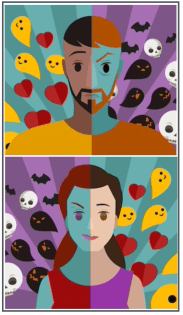
POSITIVE: Identify all helpful, kind, adult, realistic, mentally healthy thinking (“What she said had nothing to do with who I am // I’ve just reached my limit // I need help with this // that was a good meeting”…. )

✯   ✯   ✯   ✯   ✯
2. AND WHEN WE’RE WRONG  (see posts on “Being right“)

What kind of wrong(s)? First we need to distinguish between defects of character, what’s our responsibility & what’s S-H.
a. DEFECTS (same as shortcomings) can be defined as “a fault or failure to meet a certain standard….” They are basically defense mechanisms (unhealthy patterns) that all of us develop in response to a painful childhood & outside traumas

** IMP: in 12-Step ‘work’, lists of defects always include emotions. This is WRONG! Emotions are never defects – only some thinking (CDs), AND some behavior patters (abusive actions) – which together are used to deny painful emotions.

b.  RESPONSIBILITY is simply a frank acknowledgement of what we think, do & feel – or not, without judgement or self-abuse.
We can still ‘feel bad’ about hurting someone & need to make it right if possible, but it does NOT cause shame or self-abuse

c.  SELF-HATE is blaming ourself for causing ANY hurt or fear we feel, & projecting abandonment, especially if someone ignored or harmed us, or if we’re not perfect!

We also need to Identify our rights, so we know what a wrong IS or is NOT. Just because someone doesn’t like what we say or do – does not mean it was ‘a wrong’! SO, look for:

🔻 Something that was NOT ‘a wrong’ at all, but actually:
✒︎ someone else made it sound like it was. This can be from :
⚬ projecting their own disowned defect
⚬ a way to deflect blame from themself
⚬ we having pushed one of their buttons
⚬ being caught in a defect of theirs (lie, error, abuse….) which they’re ashamed of

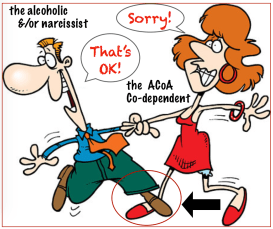
✒︎ someone hurt us & ⏫️ WE made it our fault – typical of codependents. We apologize in knee-jerk fashion, as if we caused the other person to say or do something inappropriate

✸ While this reaction is deeply ingrained in ACAs, it will most often show up when we’re around anyone who is oblivious to the effect of their actions, or who doesn’t care.
This is the WIC taking responsibility for someone else’s narcissism.
✧ It’s what we were trained to do by family & religion
✧ It’s carrying the guilt for them, since they won’t
✧ It’s as if we could teach them how to be responsible for their actions – like the alcoholic’s spouse who thinks they can ‘show’ the active drinker how to be moderate by example.

Also NOT ‘a wrong’ :
🔻 Something we were often punished for / made fun of…. as kids (family, school, religion…). It may have been normal child behaviors, or some inabilities, omissions, expressions of emotions….

This left us with a deep sense of Shame now re. expressing any imperfection which we then label as a character defect.
This emotion prevents us from thinking clearly, it silences us, makes us want to slink away, hide under the carpet, to die – the pain is so great, like a punch in the stomach!

NEXT: 10th Step, #3

EnneaTypes – LANGUAGE – INTRO (Part 3)

LANGUAGE CONNECTS
all aspects of human beings

PREVIOUS: Intro – #2

SITE: Unlocking the Secrets of Sacred Geometry : Understanding the Meaning & Benefits of Mystical Symbols

BOOK: “Sacred Number & the Origins of Civilization ~ Richard Heath

QUOTE: ‘Your Enneagram number is not for mere self- categorization, but for your enlightenment, to help you recognize your addictive patterns of seeing & thinking’ ~ Richard Rohr, Christian viewpoint (posts 11/22)


THE WHEEL = States of Consciousness
◆ The basic components of the Thinking Mind (in Part 1) can be reduced to 3 space-like realms + 4 time-like functions of language
= the 12 basic areas of the mind-map called ‘The Wheel’ – which is the basic gestalt of our mind, a valid outline of Reality.

◆ The Language Wheel, in some form, can be found in all anthropology studies of the world, which makes it a philosophy of tolerance – clearly showing us the common denominators underlying all social & religious traditions, based on conscious experiences & underlying mathematical criteria.

The Wheel can help make sense of the world (chart below), & clarify the path of growth.
📌 Its information can be used as a tool to find a deeper connection to ourselves so we can follow our life path

📌 It can show the connection between Science & Religion, our left & right brain sides, putting us in tune with history, & helping us think & act globally.
📌  It’s a weapon to open the gate to inspiration for anyone willing to divest themself of the false “I.” Anything not tested by the Wheel has no permanence.
EXP: The weapons of the Wheel will, unnoticed, smash false seriousness with a joke.

NOTE
🔸TIME terms are at points 9,6 3.
🔹 SPACE terms at 1,2,4,5,7,8 – (conjunction, noun, preposition, adjective, pronoun, adverb), which are complements so can be added together at will.

The FOUR (time) FUNCTIONS with Brain Parts
☀︎ FEELING
is right brain = metabolism.
Emotions (fun, joy, love, passion, humor…), moods, drives, imagination, impulses, dreams, force, power, strength
☀︎ SENSING is left brain = 5 senses, sex, excretion. Direct, immediate & waking consciousness, sense-data. Unprocessed information intake
☀︎ THINKING
is hind brain = breathing.
Language – both analytical & analogical. Reasoning, deliberate, to conceive, connect, enumerate, reflect.
☀︎ WILLING
is fore-brain = deep sleep, yes-no, on-off.
Attention, action of all kinds, to carry out, control, determine, order, work.

The THREE (space) REALMS of Ennea-Numbers
• BODY – 
brain stem, cerebellum, reptilian brain.
Mass, particle, physical, solid, space. Conditioned learning

❤️ Assertions (Affirm) = Body Willing
#2 Noun = Body Sensing
#7 Pronoun = Body Feeling
#9 Verbal Forms = Body Thinking

• SOUL – the middle link between Body & Spirit : Bio-plasma, limbic system, mammalian brain. Being, instincts, people, psyche, vital force.
Ego-self, social entity

💙 Verbal commands (Lead) = Soul Willing
#8 Adverb = Soul Sensing
#4 Preposition = Soul Feeling
#6 Person = Soul Thinking

• SPIRIT (mind) – Neo-cortex.
The Animating vital principal, sentient part of a being, space-time continuum, incorporeal
Abstract, intellect, ideas, ideal, gestalt, quality, meaning

💛 Questions (Inspire) = Spirit Willing
#5 Adjective = Spirit Sensing
#1 Conjunction = Spirit Feeling
#3 Verb = Spirit Thinking

⏬️ Grammar & Consciousness 
This chart is the archetypal symbol that combines language, Functions & Realms, separating software (language, science, religion) from hardware (structure of our mind).

Its basic components are deduced from the Mandelbrot vector 0 -> : Z -> Z + C, with 1 -> 9 as the fractal scaling. (EXP : image at page top ⬆️ )
This simple formula, discovered in 1962, identifies the structure for all complex geometric forms existing in nature.

◀️ The circle connects Universal Wisdom with the 9 points of the Enneagram, wisdom being the ability to live well in a chaotic world, & requires ‘inside information’ about how things really work.

The12 fields of civilization combine with the Language Wheel to naturally follow the forms of language, consciousness & personality.  As the reflection of reality, consciousness “moulds” the forms & dictates the laws of its existence, in the form of speech. Consciousness is always verbally expressed : if there is no language there can be no consciousness. They are two aspects of an integral process.

The combination suggests that human creativity can use language & life experiences to transform the ‘animal-human body from physical into spiritual. We can tune into & integrate the various aspects of our personality to develop our abilities, using Self-ego as a tool “ (More….)
«

«
NEXT
: Language Intro – #4

ACoAs & BLAME (Part 1)

the BLAME GAMETAKING RESPONSIBILITY
is a healthier way to live

PREVIOUS: Revenge #2

SITE: “Blame – What’s the Use?” Psych & religious

PostSatir’s BLAMER Role


BLAME as a ‘social disease’
– by Carl Alasko
“Deeply embedded throughout our society is the destructive psychology of blame. We tend to view it as a necessary behavior, a way to seek justice, a synonym for accountability or responsibility. It is none of these.
In fact, blame is a four-headed beast that attacks our very spirit.

We can launch these behaviors separately or fuse them into an assault that can annihilate the intended target. Painful emotions can & do kill. Consider those who commit suicide when battered by just one of these toxic tactics – that of humiliation. Indeed, blame is so unrelentingly harmful exactly because its primary function is to injure.

• There’s also an unacknowledged psychological paradox embedded in blame that preserves its vampire-like longevity : Screen Shot 2016-06-01 at 4.04.05 PM.pngHuman beings are hard-wired to dump their uncomfortable emotions on to others. So blame helps reduce our anxieties by externalizing our fears & stresses.

Naturally this does not excuse or condone it, since humans are also capable of learning how to accept & deal with our inner ‘demons’.

We see how political candidates temporarily surge in popularity when attacking an opponent, which reinforces the ‘value’ of the tactic. Then the opponents responds in kind, & the cycle continues. This dynamic is also at the root of bullying, whether in school or on the street. The bully’s internal anxieties are relieved by debasing another person or group. Thus blame feeds the roots of every form of bigotry, sexism and racism.”

🌀 🌀 🌀

ABUSE / cruelty : ‘Blaming the victim’ is holding someone responsible for pain they have or are suffering, especially when they did not cause it & had no way of preventing it
EXP: Born with some defect, illness, deficiency…..

Adult Blamers, in the present : the mental decision (conscious or not) to accuse someone of causing our suffering (even if accurate), WITHOUT acknowledging any possible part we may have in the source of our pain (sticking around for it, misunderstandings….)

Damaged parents often blame their children & the whole world for their own short coimages-2mings & life stressors (“Your made me hit you! If it weren’t for you I could have…..”). Then it’s only natural that as children we take on the blame. So we learned to:
• hold ourselves accountable for what was not our responsibility, AND
not hold others accountable for their bad behavior, and/OR
• blame others for our troubles, the way our parents did

SELF-HATE is the result – incorrectly blaming ourselves when anyone hurts us, even though we have nothing to do with causing it.
ACoAs IRONY:
While easily pointing out other people’s shortcomings (as it affect us, of course), <—-> being hurt by them triggers our S-H, to deny feeling vulnerable.
Actually, we have it backwards – we blame ourselves for the source of our pain to avoid holding our parents accountable for those original wounds.

Reality : We did not deserve being blamed as kids, & we don’t deserve our S-H now, which is simply agreeing with the Perpetrators. In many alcoholic & other unhealthy families, no one recognized or took responsibility for their abusive or neglectful ways, & certainly never for their twisted thoughts & disowned emotions.

• It’s imperative for ACoAs to identify when or if someone is actually doing something harmful, neglectful, abandoning – to us or to others. If we are not sure, we can start by making a list of all the ways & times various people have hurt us or our loved ones, & look for common threads. (22 POSTs : “What just happened?” re. Noticing Painful Events)

This inventory is a sincere effort to clarity what we’ve experienced, especially when at the hands of someone who is taking out their damage on us.
The legitimate motivation for this kind of writing has to be the desire to identify & distinguish between:
• when we’re angry because of unrealistic expectations & assumptions, vs.
• breaking denial about harmful relationships we hang on to, so we can outgrow the addiction to abuse

NEXT: Blame #2

ACoAs & SELF-ESTEEM – what it IS

self-evealuationI KNOW WHO I AM
– & I approve!

PREVIOUS: What Self-Esteem is NOT


SELF-ESTEEM IS:
1. Knowing Ourself well (with + & – characteristics), accepting & genuinely enjoying who we are, without denial or arrogance
** Some years after both her parents had died, one woman Recovery said about herself: “It’s sad that they missed out on experiencing the wonderful person their child has matured into, & always was  from the start.”

2. Knowing that all our Emotions (Es) are legitimate, valid & a part of the complete personality.  There are NO negative Es – when referring to painful or “unacceptable” ones – because anything that is considered a negative should be gotten rid of. Reality : ALL emotions are part of being human and are valuable, because they tell us what’s right or wrong for US! So the term does not apply to Es.

3. Knowing that all our Needs are normal & acceptable, but understanding that not all of them will be met, all of the time. That some will take longer than others to achieve, & that some which we didn’t get in childhood may never be fully realized.  But the more we reach for them, the more we’ll get. mistakes

4. Being OK with being Human – realistically knowing what our limits & limitations are. That to be human will always mean making mistakes, not knowing some things, being imperfect, having weaknesses – as well as having the gifts of abilities & talents, which we can hone & enjoy

5. Accepting that no matter how ‘Good or Spiritual’ we are, life can still be unfair, bad things can happen to us, other people will sometimes mess us up… but that does not mean it’s personal or that we’re not trying hard enough.  Having S.E. means we have a right to be here – on the planet – & that our H.P. wants the best for us

6. Being willing & able to take Responsibility for ourself (all our T.E.A.s) without guilt, shame, fear of punishment or of being abandoned (FoA). We’re able to be our own motivator, rather that using others to give us permission to be or act.  We can protect ourself from other people’s damage, but also own all our reactions, especially to upsetting eventsbalance Es

7. Being able to live in Balance between extremes, most of the time (minimizing drama / trauma). Part of S.E. is knowing how to think clearly & accurately, which lowers anxiety
✏︎ Being peaceful does not mean standing still
✏︎ Being calm is not the same as being bored
Living between +25 & -25 is the best option, rather than -100 hopeless or +100 fantasy high.

8. Accepting that Process is part of all accomplishments & personal growth. Delays do not mean failure or being abandoned (never reaching a goal). Process takes time & with S.E. we know we can do a great deal.  When we fail, we have the ability to learn from mistakes, improve ourself & keep reaching for our dreams

9. Always looking for new things to Learn & explore, curious about ourself, other people, including all the newest developments & difficulties in world.
We can take time to research topics we don’t know about, especially relating to problems that come up with ourself or family. As we age – our brain stays functional longer IF we include something new & different every so often

relax10. Being able to freely Express ourself artistically, using all our talents, knowledge & special gifts. S.E. allows us to pursue our dreams, no matter where they lead us. Knowing that we can’t be perfect, we’re not afraid to share those talents with others

11. Being able to Relax, Enjoy, have fun, take time off, rest, ‘veg’ – regularly.  These experiences are necessary to increase ‘good’ chemicals in the brain, which elevate mood. It also give us time to process our daily experiences on internal conscious & sub-conscious levels & to heal from past wounds. We have a right to healthy pleasure!

NEXT: RECOVERY – Is & is NOT (Part 1)