“FEELINGS AREN’T FACTS” (Part 2)

heart talkWHEN THE HEART TALKS….
… I should listen

PREVIOUS
: “Feelings aren’t facts” (#1)

SITEs: • How to listen to the heart
• Diff between feel, think, believe

POSTs : Use THINK instead of Feel


1. FEELINGS (Part 1)
2. ‘FACTS’:  The other problem with this platitude is that these 2 words don’t really belong together (feelings & facts).
a. Facts – are only actions, quantifiable, with measurable results. Simplified – facts come from the head.
b. Feelings – as pointed out in Part 1, has 3 different uses, 2 legit, 1 not.

For people who use this term – ‘feelings’ means Emotions (Es) and Es are never ‘facts’ – they are internal experiences – from the gut.  Yes, it’s a fact that we have emotions. Even Vulcans have those pesky things, underneath. For humans, to be cut off from them turn us into narcissists or worse – sociopaths!

• Eventually someone in Al-Anon added what they thought was a clarification: “Feelings aren’t facts, but it’s a fact that I’m having these feelings”.  OK – this does refer to Emotions. This was encouraging for many of us to hear, because as CoAs we were taught to repress some or all Es – to deny them as irrelevant or unacceptable.  So this version gave permission to FEEL emotions.
But this is not what the phrase “Feelings aren’t facts” actually means.

circular

c. Thoughts (Ts) are not technically facts either, but rather ‘constructs’ of the mind – not tangible in themselves. They are:
• the cause of emotions (in the present) :
EXP : T ⏩ “I can’t believe she never called me back. What a b— I’m so angry!” ⏪ E
Unrealistic expectations, cruel toxic rules, scary projections, unfounded assumptions & S-H … lead to distorted thinking & obsessions, which cause us great suffering, & often lead to unfair or harmful actions toward others!
OR
• the cause of actions, healthy or unhealthy, depending on the type (may not be conscious, but the real reason for behavior)
✒︎ NOTE : Watch out for people who ONLY talk about what they or other people are doing, where they’ve been, who they know, what they’ve accomplished…. Facts, facts, facts!  That tells us they’re NOT in touch with their emotions, which makes them unsafe in relationships, for anything other than giving information – if that!

CONCLUSION: Based of these distinctions, what does “Feelings are facts” really mean?
ANS: In this case ‘Feelings’ are obsessions, circular repetitive thinking built on negative, distorted beliefs, and NOT emotions at all! which are not telling us the truth (facts) about a situation.”
✒︎ In other words : “What my obsession is telling me is most likely a lie.”

And what do most ACoAs endlessly obsess about ? :
bad thoughts☁︎ EITHER Self-Hate
”I don’t know why he won’t talk to me – why is she ignoring me – was it something I said? Maybe I should have been nicer to her.  I probably sat in the wrong chair… I know he doesn’t like me… what can I do to change their mind… “  –  bla, bla, bla….
OR
👺 Rageful thoughts towards others
“How dare she treat me like that… Why didn’t he call me…. I never did anything to her… I’m going to give her a piece of my mind… I hate her, she’s a witch…. no I’d better not… what should I say… I don’t want to get fired…”  grrrrr , grrrrr

❖ Healthy THINKING is imperative for us to function well in the world & in personal relationships. This requires :
• accurate, reasonable & present-day information about how everything really work   • what our needs, goals & dreams are
• what is positive about oneself (character & abilities)
• what it means to be human (determined, imperfect) images-4
• universal spiritual truths about Higher Power.

EXRESS  thoughts
, opinions & beliefs, directly:
• “I think that the government should…”
• “That’s not my opinion”   •   “I wouldn’t say that…”
• “I suspect he’s not going to honor his agreement”
• “I’m convinced there’s a better way to do this project”

❖ Healthy EMOTIONS are NEVER good or bad, but rather range from the very painful <———–0————> to the very joyful.  ‘0’ is neutral.
✒︎ We’re most successful & comfortable when we live within a range of +5 to -5 on either side of center, most of the time, although not exclusively. Times of great stress OR great joy will push the range much higher or lower, but not get stuck at either extreme.
☆ This medium state can only happen when healing diminishes accumulated anxiety so we don’t have to alternate between the ‘outer limits’ of misery or fantasy/illusion!
(REVIEW all posts on Emotions)

NEXT: Getting to Our EMOTIONS – Under

RECOVERY – What IT IS & IS NOT (Part 2)

Screen Shot 2015-07-10 at 9.30.12 AMLEARNING HOW TO BUILD A LIFE
on the experience of those who know

PREVIOUS: RECOVERY – IS & is NOT (#1)

SITE: “25 Things you do as an Adult when you’ve experienced Childhood Emotional Abuse
(like the Laundry List)


RECOVERY
IS NOT….
❖…eliminating ALL pain from our life
IS...
❧…a combination of gains & losses, fulfillment & disappointment, joy & pain – part of being human, not superhuman.  Only addicts – of any kind – want ‘no pain’ & think that’s an appropriate goal
🦋

IS NOT…❖…trying to get from our family all the things we never got as kids, nor assume we can have a ‘great’ relationship with them – if only we were well enough

IS…❧…accepting there’s no ‘if only’ about our family & our childhood (SORRY!)
no more blame• It was their damage that prevented them from being all we needed.  It was never because of who we are/ were! Yes, it was done to us, at us, with us – but it was never ABOUT us  ie. our essence
and, unless family members have been growing too, or changing enough, we may take more radical steps

We can choose how to deal with them – by :
a. having rare or no contact, to protect ourself from abuse & mind games
b. no contact for a long time, until we are more healed, so our buttons (which they installed) get much smaller :)! Then re-connect & see….

c.
limited contact, to see who they really are, for clarification & validation of how they treated us – which will diminish our self-hate, & allow us to gain some emotional distance from the family drama
d. regular contact, spaced out AND only as friendly Adults.  Don’t expect them to be parental if they can’t. Interact superficially or only in ways that suites everyone. Don’t push for the impossible!

➼ Other people often disappoint, which can make us sad & angry. That’s normal. It just doesn’t have to devastate. NOW it’s truly up to us to become Kind Parent & Wise Adult for ourself, with the help of therapy, H.P., Program & other support systems.
🦋
IS NOT...❖…saying we have forgiven our family, as if it were an intellectual decision, made once & forever, hoping that will wipe out all of the damage they inflicted, & all of our pain

IS…❧…knowing that forgiveness is a gift from H.P. – a ‘letting go’ – as a result of our willingness to do Recovery work to clean out old emotional wounds.
Forgiveness is the end product of that work, rather than a prerequisite for growth, as many tell us. Forgiveness isn’t genuine without healing our rage & sorrow. (9 posts = 4 types)

PROOF : when we try to ‘will’ forgiveness & think it’s all behind us – eventually some life-event will stir up that unresolved pain & bite us in the butt. Besides, some abuses are un-forgivable! But we still have to let go of being a victim of our own rage by feeling the sadness that’s underneath (“Forgiveness Is an Inside Job“)
🦋

IS NOT…❖…getting over our rage, so we don’t have to feel it any more OR not having any more terror, worry, sadness… if/when we get ‘really healthy’Screen Shot 2015-07-10 at 9.38.11 AM

IS... ❧…knowing & accepting that we’ll always have some vestiges of the old pain, fear, rage, shame & abandonment hurt, BUT that those Es doesn’t have to control us
…. being willing to separate internally, from the bad voice & externally, from harmful people. It’s absolutely necessary to get away from damaging situations & negative thoughts. After all, if you kept scraping away at a sore on your skin, it wouldn’t heal, would it?

• At first this ‘letting go’ can bring up fear & depression, but with time, it will allow us to heal old wounds, making us less fearful & angry.
We can find & use new ways to deal with those painful Es – by: learning to accept & comfort ourself & letting them out in safe places & ways. Then we’ll experience pleasant & joyful emotions as well.

NEXT: RECOVERY – IS & is NOT (#3) 

RECOVERY – What it IS & IS NOT (Part 1)

in with the new
OUT WITH THE OLD, IN WITH THE NEW
Dismantling the old patterns

PREVIOUS: What Self-esteem IS

SITEBenefits of a Gratitude List

RECOVERY
IS NOT…❖…expecting to get unconditional love and perfect sanity from any human. It’s unrealistic, but the Wounded Inner Child demands it anyway. Now – when we don’t get it, we accuse others of abandoning us!

IS…❧…understanding that in adult relationships –  each person has their own needs.  Since our parents couldn’t give us unconditional love, when it would have been ‘normal’ & needed, we can only look for it now from ourself, our pets & our Higher Power.  As we interact with healthier people we will receive more appropriate companionship – be mirrored, understood, respected, considered, loved…but never perfectly!
🦋

IS NOT…❖…being free of emotions (Es) that were unacceptable in our family, controlling our Es or trying to have ‘appropriate’ Es. Those are signs of damaged thinking – (CDs) – NOT the same as being in control of our behavior!

IS…❧…accepting all emotions as legitimate. Humans are built with the capacity AND the need to feel. Es are the natural indicators of our reaction to any experience – to let us know whether something is good or bad for us. Re.T.E.A. —
Actions may, or may not, be good, & can be corrected, over time
• Unhealthy Thoughts can be reframed & replaced, when harmful or incorrect
Es just are. They can go from very joyful <–to–> very painful, but are never good or bad! We need to have access to a wide range of Es, with many shades. It gives us a sense of vibrancy & allows us to connect with others.

Only seeing everything in B & W = tv, paintings, walls, clothes….. can become quite boring. Suppressing or narrowing down Es (to 1 or 2, like rage or fear) will make us one-dimensional, possibly cold, hard, distant & ultimately limited.
The intensity & depth of our emotional reservoir of old childhood pain is so great that it will never be completely empty.  Accept this & learn how to manage Es rather than trying to spiritualize them away!
(review “Feelings Aren’t Facts” posts) (MORE re. hand-emotions)
🦋

IS NOT…❖…trying to permanently ‘fix’ our childhood damage, eliminating all character defects, doing is easily it & quickly.  Any effort to fix ourself means we think we’re bad, & that our badness is our own fault, SO we’re responsible for doing anything we can to eradicate it. (BTW, this is one of the reasons why many ACoAs are suicidal & want to be dead)

IS…❧…accepting that alcoholism & co-dependence have left deep scars & emotional hangovers. (Good / bad parenting @ ACoA site). These will take our life-time to gradually heal. Being human means we’ll never be perfect – but Recovery IS truly possible!  Many have proven it.

Humility (not humiliation) is acknowledging our human limitations, with a consistent willingness to evaluate ourself with compassion, in honesty & reality, modifying our thoughts & action when needed to reach our own goals
🦋

IS NOT…❖…being ‘serene’ all the time.
• To always be pleasant, kind, honest, thoughtful…is a disguise for a wide range of emotions we don’t find acceptable (anger, envy, greed….)
• To still be the good boy / girl, in the present, is the symbiotic need for our family’s approval, rather than becoming our own person
• Forever trying to be ‘so good’ is a negation of our legitimate rage & pain of childhood abandonment

IS...❧…gaining genuine serenity, based on a solid emotional, mental & spiritual foundation – from the inside.  This creates the unshakable knowledge that we are ok even when we’re in pain, under pressure, not understood or supported.
We can have upheaval, express intense pain / anger… and still be at peace, deep down.  Serenity is the by-product of knowing & accepting ourself in the moment, trusting our gut, having a great support system & a loving H. P.

NEXT: RECOVERY IS / IS NOT #2

ACoAs: Healthy RULES & Lessons (Part 3)

  new life“AND NOW, PRESENTING…. –
a new life, a better life !!”

PREVIOUS: Heathy Rules, #2

SITE: Healthy Family Rules


MORE GOOD Rules
As mentioned in the last post, these statements are to help the Healthy Adult & Loving Parent parts of our psyche to learn better ways to take care of our Inner Children. Each statement can be used as an inventory:
a. Resistance:
• why do I NOT want to include them in my life?
• what do I think will happen if I follow these ideas?
• what do I need to give up in order to incorporate them?
b. Willingness:many Qs
• what do I need to have / do, before I can use these positive rules ?
• how can I implement these concepts into my life?
• who can I ask for help with them?
• who do I know who already lives them?
c. Results:
• what happens when I do act on these statements?
• how is it different from what I assumed or projected?
• what do I need to do, to increase these principle in my life?
OF COURSE – If you can add questions to this list – please do.
«    «
NEXT
: Safe & Unsafe People

ACoAs: Healthy RULES (Part 2)

Snever give up
YEAH. I WANT TO FEEL SAFE! — Will you take care of me, Good Parent?

PREVIOUS: HEALTHY RIGHTS (#1)

SITE: How To Never Give Up On… (CHART)


HEALTHY RULES
Part 2 & 3 list statement that have been accumulated from years of Recovery experience. They’re geared to the Healthy Adult / Loving Parent parts of our higher self – so we can know how to take care of our wounded and healthy Inner Children, in the best possible ways.

❀ YES, we have a broken heart!  What’s more painful to a child than not feeling loved by their parents?   BUT NOW – to be happy, we need to:
• accept who our family really was & is
• believe in every fiber that we did not cause our abuse & neglect
• accept that now we’re individually responsible for our life
• know that we have the ability to outgrow much of the damage, but not all completely
• consistently apply mental health truths to our life

❀ We all live by rules, whether we like to admit it or not.
• Some ACoAs were so neglected they think they weren’t taught any rules.  No, not good ones, but we did pick up all the Toxic Rules!
• Others of us were so constricted by rules & regulations, we nearly choked to death on them.
In either case we tend to shy away from rules, or have a raging hatred for them. And yet we are run by the bad ones, as long as they stay hidden and we don’t challenge them.

❀ So here are a few Healthy Rules to try out & apply to our every-day living.
Think about each one, carefully.
Pick one & try it out for a month. See what happens. Then try another….
«

«
NEXT : Healthy Rules & Lessons, #3

ACoAs & Emotions (Part 3)

clean out old Es I JUST WANT TO BE HAPPY
but first I have to clean out the damage

PREVIOUS: ACoAs & Emotions #2

SITE: Help for Emotional Reactivity


WHY DO WE HATE having emotions so-o-o much? (cont)
b. OVER-REACTIONS 
(cont)
🦠 This is 
not self-indulgence or being manipulative, but rather:
1. Sensitivity = a person’s brain being wired to be intensely affected by  external cues, with nerve endings exposed & raw, causing out of control Es triggered by :
— the threat of or proof that a relationship is about to dissolve
— being told they can’t have something they badly want or are convinced they need
2
. Reactivity = having a reactive ‘higher baseline”, 0-20 vs a continual 80 out of 100 – so sadness is experienced as overwhelming despair, anger becomes rage….. and behavior is also intense & doesn’t fit the actual present situation
3. SLOW return to baseline = having a hard time calming down & staying upset longer than someone with a safer upbringing (an
emotion fires in the brain for around 12 sec. vs 20% longer)

EXP: You’re in the middle of working on a project & someone keeps trying to control how you’re doing it. You get angrier & angrier**, since you interpret their ‘directions’ as proof you’re not doing it right & so aren’t good enough – not just your work but as a person!
✶ This anger is caused by S-H.

ASK : “What does this reaction tell me about my damage?” – instead of just raging at the other person (in your head) & wanting to smash their face in
Ans: Some deep part still believes I’m so bad that I have to be perfect, to compensate, BUT since I can’t be, I hate you for exposing me, & it means I’ll never be loved!
not me• Yes, we are responsible for our behavior & attitudes.  But we also need to remember that HOW people treat us ALWAYS tells us about them. When their treatment is insensitive or mean it’s coming from their inner PP &/or WIC . Very few have a L.P. even when they have a functioning H.A. in the UNIT)

Their behavior tells us about their inner world, even if we made a mistake. So we don’t have to take responsibility for or try to fix our personality, only our actions – IF appropriate or possible!
In any case – OUR WIC desperately needs a hug & a mental course correction – modifying the CD of Perfectionism. If we do that every time – much of the anger will dissipate, even if the other person is still being a big pain!

CHECKLIST
ACoAs are often CONFUSED, because
• we combine Es with thoughts/ beliefs, usually Toxic one, because we use the word “feel” to mean both (“Use THINK instead of FEEL posts)

• of our conflicting Es: old vs. current, WIC vs Adult, PP vs Adult…
• mix up Es with normal human needs, which we’re deeply ashamed of
• don’t know our RIGHTS or what ‘normal’ is, much less have permission to act on them

1. Which Toxic Rule is in play? (all have turned into self-destructive toxic rules
behavior patterns, also called character defects)
Exp: “If I don’t like it, I have to stay” becomes passivity
2. Which of my WIC’s unmet needs am I re-experiencing?
Exp: Constantly ignored or punished for trying to get attention

3. What am I thinking about this situation?
Exp: “They’re never going to call / write back / I’m unlovable…..”
4. Which of my old buttons is getting activated? — an emotional sore spot from things your family & others consistently did to you &/or to each other – that hurt you  Exp: Being accused wrongly / being shushed

5. Which ego state is likely in charge at the moment (WIC or PP) ?
6. If I’m acting out, which parent am I copying & how?
7. What am I most afraid of in this situation? (FoA, punishment, isolation, not being heard…)
➼ Use the info in other posts to help you answer.

NEXT: ACoAs &  Emotions #4

Forming Boundaries – with OTHERS (Part 1)

THIS IS SO MUCH WORK!
But I feel better when I enforce my Boundaries

PREVIOUS: Repairing your Boundaries

POST: “Boundaries DEFINED


FORMING Boundaries (Bs) with OTHERS 

1. For OURSELF (previous)

2. In Relation to OTHERS
a.  Find a support system to help with follow-through.  No one can to go from weak to strong Bs instantly or easily, just because we heard a lecture or read a book. We need people who will remind us of our value, encouraging us to maintain & enforce our limits

b. Use an ACoA therapist, Al-Anon & ACA meetings & other resources – to identify & examine the underlying causes of your unhealthy Bs. While we may have an extensive knowledge of our background, we often need an experienced listener to tag distorted life-patterns that are so automatic we don’t even notice

c. Look for role models & other examples of healthy Bs in your life & in media (TED Talks, podcasts….).  In any situation that challenges your Bs, take a minute to ask: “What would my role model say or do?”
If they’re part of your life, ask them, but don’t assume that what’s good for them must be good for you. Try a variety of yes & no Bsoptions & come to your own conclusions. One size does NOT fit all

d. Identify specific people who YOU will:
— not tolerate any violations from (they’ve already proven to be dangerous, narcissistic, disrespectful…)
— give some leeway to, because usually they’re loving, kind, respectful, AND it’s not realistic to expect anyone to be perfect

e. Educate others on ways you want your Bs to be respected, by clearly stating them. Never assume that people know them. Bs need to be spelled out in detail, & for some people you may even have to write them down. Do not expect others to read your mind, even if they already know you

fSit down with each person you have a problem with & let them know what you need & don’t want from them. Try to get their agreement to honor your Bs.
Insist that everyone talk to you with respect – no more digs, making fun of, criticisms, controlling comments…. no matter what. That does NOT mean you lack a sense of humor !

talking @ Bs• With other adults : even if you get a verbal agreement, stay alert for how they actually treat you.
If they repeatedly can’t or won’t honor your request – limit your time with them, or end the relationship, after trying one more time.
You decide when to let go of them, based on the cost to you!
• With kids or teens, work out a plan to help them comply, using methods suggested by a Child Psychologist, or from books & online articles

g. Clearly state the consequences for violating your Bs, BUT NOT until you’re sure you can follow thru! Addicts & codependents have a tendency to violate Bs (deliberately or unconsciously is not the point) & Invaders will always test us, like 2-yr olds, trying to wear you down to get their way

⭐︎ Be ready to stand your ground, to prove you’re serious. How well you can manage that will depend on how strong your Inner Adult has become (in the UNIT)

h. Be consistent & persistent about confronting & enforcing violations, & do is as coolly as possible – even though it can be very tiring or enraging at first
It’s most effective when you don’t over-react emotionally, but come from the Healthy Adult Ego State. Otherwise people can just write you off as bitchy or crazy, especially if they want an excuse for their bad behaviorclear Bs

• If a particular wound in you is still unhealed – you’ll have a strong reaction to feeling abandoned or disrespected, making you anxious & angry
• If you have healthy Bs, you can speak up for yourself & then move on to someone or something else.
It’s not up to you to convince people how wrong they are. Your self-respecting actions will make the statement.

EXP: If someone is chronically late to meet you, tell them that if it continues, you won’t wait more than 15 minutes. Be sure you always have a plan B for yourself. WHEN they’re late again, do NOT wait. They’ll see you mean business – whether they change or not, & then they can decide how to act.

NEXT: Having Bs with OTHERS (Part 2)

POSITIVE Responses to Painful Events (Part 1)

flowers 1


THIS ISN’T RIGHT!
I don’t like the way I’m being treated

PREVIOUS: Negative Reactions (#3)

REVIEW:  Negative version of chart

POST : Emotional  Maturity


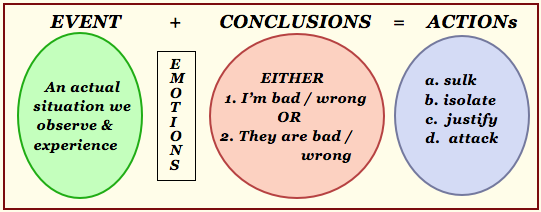
1. EVENTS
Circle
This new chart is the correction for the previous one, showing how to deal with stressors in a more appropriate & productive way. The first circle includes the same set of observations as in “Noticing Painful Events”

a. ACoA DIS-EASE
Lack of Acceptance: Even though ACoAs tend to accurately observe our environment, we often refuse to acknowledge what we see & hear, because:
i. we’ve been taught to repress what we know, developing a built-in forgetter / rose-colored-glasses / horse blinders, to keep us from looking around to see the truth or noticing other options. It’s a definite way to be loyal to the family toxic rules & stay the ‘good kid’ .


ii.
we don’t want to deal with the consequences of being awake – otherwise we’d have to make some hard decisions like speaking up for ourselves, having it out with someone, being less involved, or leaving. This prevents us from feeling old or new abandonment pain

EXP: You’ve know your BFF for a long time & have been thru a lot together. You’re in 12-step Recovery, learning to face your issues & own your CDs, she isn’t.  You’ve both had lots of lousy relationships, but now she’s married a young, gold-digging philanderer & she’s hurting – but doesn’t want to face being alone again.
You’re very upset for her & really angry at her denial – why can’t she admit she made a big mistake & dump him? She has blinders on, but so do you in some ways. She has never been willing to look at herself, her choices, her damage…. why do you think she’d start now?

b. RECOVERY
Awareness:
Accurately identifying & acknowledging what we experience is an important part of Recovery, & eventually leads to a better life, because it:
• honors our truth by respecting our cognitive abilities (info from our brains & intuition)
• allows us to make self-caring decisions, choosing what’s best for us
• encourages us to leave bad situations which would add to the original abandonment, causing more mental & emotional stress
Keep repeating: I KNOW WHAT I KNOW – but I can’t know everything!

For our observations to be reliable / valid, we need to (IMPERFECTLY) have:Screen Shot 2016-06-22 at 9.30.18 PM
❥ a lot less self-hate
❥ a clear distance from the bad voice (PP)
❥ decent boundaries, so less co-dependence
❥ a loving relationship with the Inner Child
❥ a connection to some kind of spirituality

EVENTs needed to be dealt with can be about:
a. any painful internal thought or emotion, not immediately triggered by a present event, but likely from our damaged past
b. a more immediate upset – having a fight, someone being mean, losing something valuable, a disappointed expectation….

c. a distressing situation of our own – death of a parent, a big break-up, losing a job, being in an accident, a fire…..
d. our reaction to a painful external info – like 911, pictures of people suffering anywhere, news of a death… not directly related to us

HEALTH means:
🌱 being able to quickly catch that we really are effected by something
🌱 acknowledging it withoutOR in spite of feeling shame, guilt, self-hate & anxiety, so we don’t have to deny or repress it
🌱 asking for support from appropriate people when we need help understanding & coping with a painful event
🌱 learning mental & emotional tools, & remembering to use them to take care of ourselves when distressed

EXP: Sam’s younger brother was in a terrible accident, has been in the ICU for some weeks Screen Shot 2016-06-22 at 9.30.26 PM& doesn’t have long to live (Event). Sam & all his family are devastated (Es), both by the upcoming loss, & because it reminds them of their own mortality

Some are in various states of denial (Ts) about how serious the brother’s damage is, but Sam is valiantly grappling with his shock & fear (Es). He shares his pain in Recovery & makes shifts in some of his long-help beliefs (Ts). Through the pain he’s using this Event as an opportunity for growth (As).  YOGA man: Grudging Acceptance 🥺

NEXT: Positive Responses – Emotions

NOTICING Painful EVENTS

Screen Shot 2015-06-20 at 5.24.34 PM 

IT’S EVERYWHERE!
life is full of pain

PREVIOUS: What just happened – 30 Qs


1. EVENT – the Stimulus (Green Oval)
Growing up with emotional & physical stress, we became hyper-alert to our environment, developing big antennae to catch even a whiff of dangerdoor slam

Early sources:  Being kept awake late, even on school nights, waiting anxiously to hear what state dad was in coming home – how did the car sound, how hard was the front door slammed, how heavy were the footsteps, which room was he going into…?

Was there going to be a fight – yelling, hitting – or worse, a ‘visit’ to your bed…?  trying to sleep with one foot on the floor, hating mornings, knowing you’d be a mess at school the next day, as usual being constantly worried…..

This endless pressure has left many of us with only 2 options:
⚠️ Vagueness: the ACoAs who seem to be so out-to-lunch that you wouldn’t think they are actually over-attentive. It’s why they need to be flaky, because internally they’re under overwhelming tension, but it’s split off from their own awareness –  (dissociation)
♨️ Hyper-vigilance: other ACoAs are noticeably anxious, worried, controlling, touchy, always looking around, easily taking offense (sitting with their back to any available wall!) – waiting to be attacked by others
🌀 Some of the paranoia comes from having a BadParent camera over one shoulder, constantly judging everything we say, do, think & feel

We’re still so focused on the possibility of being abused &/or abandoned – again – that we either isolate too much, are belligerent & difficult, or super people-pleaCause & Effectsers.
So every Event that upsets, hurts, disappoints & scares us becomes a cause for emotional drama

Approaches to EVENTS (present day)
CO-DEPENDENCE: disturbing situations are a challenge for the Rescuer to throw all their energy into fixing – the other person or event
COUNTER-PHOBIA: at the other extreme, we look for the most dangerous, drama-filled events to get involved with, while ignoring / denying / swallowing the pain it causes us

ISOLATION / Victim: having been hurt by so many people & events, we starve ourselves of potential benefits in the world, instead of ‘dealing & healing’

PARANOIA:
 the assumption is that the ‘universe’ (everyone & everything) is deliberately targeting us, to cause our suffering. We ignore all the good things in our life, OR explain them away as an accident, a fake / scam or “they’re just being polite”
6a011570338375970c01a511bdd4fb970c-pi
SCAPEGOAT
/ Victim:  we feel blamed for everything that goes wrong, which we agree with. It causes great anxiety & constant anger, but we don’t try to correct it

EXP of ‘Events’ = YOU are :
• going for an interview & do your best, but you’re not called back
• having lunch with a group of casual friends & new acquaintances.  Everyone seems easily engaged in conversation with their neighbors, & almost no-one has talked to you the whole time

• a new members of a long-standing group, out for coffee with them after a meeting. On the way, they all pair up, talking to each other, but no one walks with you – you’re all alone at the back of the ‘line’
• trying to cross a busy street & just then a cab turns the corner, almost hitting you
•  walking down the hall at work, & yet again Georgia  / Sam…. doesn’t acknowledge you

➼ Any of these may create a painful reaction in us. Our observation of the occurrence is accurate – it really did happen.  However – they triggered familiar cognitive distortions (CDs), which make the events more disturbing. That’s where we go off the rails.

‘EVENTS’ can be:
a. Neutral / mild : everyday situations that are not really bad, like – someone in the subway bumping into you, not getting that text you’re waiting for, a delivery being late….
b. Mild / bothersome: occasional annoyances that may or may not be aimed at you, like a rude salesman, your boss angry at you, getting a ticket, your child having trouble with a neighbor……
c. Severe: really painful encounters, like – a parent ignoring you or being cruel, a big fight with a BFF or spouse, your child getting arrested because of drugs….

• Each category will test our ‘mental health quotient’ – how realistic or distorted our thinking is, which will then govern how we act.

NEXT: Noticing painful events (Part 2)

WHAT JUST HAPPENED – Intro (Part 1)

confused monkey


I THINK I GOT BLINDSIDED – but I don’t know how or why!

PREVIOUS: ACoAs & Listening (#3)


See
ACRONYM page for abbrev.


In the AFTERMATH of a difficult / painful / scary experience (A)
Whenever ACoAs have a run-in with another person, our most common T.E.A. reactions afterward are:
(T) MENTAL – confused about what happened, how we got in that situation, what we should have said or done, wish we’d said – about what they actually ‘did’ to us….
(E) EMOTIONAL – ‘freaked’ out, but maybe not clear just what we’re actually feeling, not sure if we should be upset or what’s really bothering us, not wanting to be so aggravated or anxious, not feeling like oneself….

✶ If we’re upset AND don’t understand what happened, we automatically slide into:
(E) feeling guilty for our reaction (maybe breaking a Toxic Rule)
(T) blaming ourselves, thinking we’re weak & stupid for not handling it better…  (S-H, to mask abandonment pain, but not conscious of)
(A) ACTIONS – ‘dealing’ with it by hiding from the other person, ranting to everyone about the event, being overly solicitous (people-pleasing), stop functioning at all…. OR call / text the other person & blow them up, which usually adds to our S-H, guilt & shame.

Start CLARIFYING
• Talk oven the painful event with a healthy trusted person.
• We can also do a lot of work on our own, & feel good about that. It will help to eventually be more ‘present’ in the moment, to feel less like a victim, less scared, vulnerable…
• To that end, it’s useful to identify which ego state we were in when things ‘went wrong’.
• We can also ask ourselves what we observed or already know about the other person (but ignored).

SO:  ‘who’ – inside each participant – was in charge at the time of the incident?
PAC interationsour Wounded Inner Child was in the foreground, or their WIC was
our Pig Parent (Negative Introject) was acting up, or theirs was

🔹 It’s usually some combination:
– our IC reacting to their PP
– our IC provoking their IC
– their IC bringing out our PP
– their PP stomping on us – leaving our IC mute… (follow the arrows ➡️)

NOTE: It’s a good bet that neither person’s Healthy Adult was available & functioning, or it would have turned out differently. (See EGO STATES posts)

HEALTHY PEOPLE (HP) evaluate themselves & monitor their interactions, and when confronted with an objection or complaint, a question about their behavior &/or hurt feelings – they :
• catch it when their side of the street is not as ‘clean’ as it could be. They’re more likely to acknowledge it & make a correction or give an apology
• are able to hear the other person out, evaluate their own part in it & make whatever adjustments are possible, especially if the other person misunderstood or misread an interchange
• won’t accept blame when it’s not warrantedinventory

In PART 4 there are a series of 30 Qs to ask yourself, to encourage clarity. This set of posts is mainly about our Thoughts (Ts) & Emotions (Es). For suggestions re. Actions (As), review post: “What to DO when confused” & “Noticing Painful Events.”

The inventory can offer a way to break thru both our ignorance of what we’re thinking & feeling (Ts & Es), as well as putting a dent in our blindness about others, especially non-recovering people we’ve been dealing with for a long time.
Since everyone tells us about themselves all the time, it is up to us to pay attention to what we experience & admit “I KNOW WHAT I KNOW” (but I can’t know everything, & I don’t have to know everything to be OK)

NEXT: “What just happened” (#2)