ACoAs: Co-dependent vs Patient Waiting (Part 1)


PREVIOUS: ENFJ characteristics

SITEs: Why we hate to wait
“8 Factors that make the wait seem longer”


PATIENCE
Children are not patience creatures!
Most can’t wait to grow up & be in control of their choices & options. Everything seems to take such a long time. If it’s raining out & we had to stay in, if we had a serious illness that kept us in bed, if one parent was away a lot for business or serving our country…. waiting for it to change or finish —> seemed endless.

ACoAs: However, this normal anxiousness (not anxiety) is magnified for children in alcoholic / abusive homes. Nothing got better, nothing really changed, nothing we did or said made any difference!
Constantly abandoned in PMES ways when growing up, has left us with the conviction that we are not worthy of anything good.  So waiting is unbearable. Better to not want. We developed a hopelessness that we’ve carried over into adult life – a ‘learned helplessness’ we still believe is our inevitable lot in life.

“Learned Helplessness” is an attitude that wounded adults have. While reality NOW is that they have the option to be free, they seem to be unwilling to leave their childhood prison, living in deprivation, still trapped by emotional & mental attachment to their abusive family.

CO-DEPENDENT Waiting – RESIGNED ‘patience’
Co-depis one of the characteristics of the False Self the WIC formed as a substitute for the True Self – which our damaged family prevented us from developing. Not having had positive mirroring, we say “I don’t know who I am”- in the deepest part of ourselves – even when we can list a few likes, dislikes & accomplishments.

Because the WIC has no stable sense of identity, & without a UNIT, we rely on others to tell us who we are, how we should feel, think & act. We’re like flotsam in the ocean, drifting aimlessly thru mental confusion (T), dragge
d under by waves of emotional pain (E).
Co-dep UP: When anyone is at the -very least- not mean, not judgy, not dismissive, and -at best- paying attention to us, tolerant, helpful….., then the WIC feels OK, happy, relieved, alive, allowed to exist.
Co-dep DOWN: But if anyone is -at worst- mean, accusatory, controlling, or -at least- insensitive , silent or neglectful, the light goes out of us, & we feel depressed, immobile, dead.

Co-dep ‘long-suffering’ is PASSIVE waiting, waiting, waiting … for magic!
It means WAITING:
• to be taken care of by others, in ways we should be doing & can do ourself
• for certain people to come thru for us – who are not capable
• for the active addict (or co-dep parent) to go into Recovery
• for an important-someone to keep their promises – even tho’ we know they usually don’t
• for our S.O. to fulfill all our unmet childhood needs
• for our parents to see us, validate, understand, apologize…..
• for our pain to dissipate, without having to actually process it
• for H.P. to magically heal us so we don’t have to do the ‘work’ of Recovery

Fake Patience means TO:
assume someone will know what we need / want, without having to ask
• be stuck in hopelessness, unable to get out of bad or unsuitable situations/ relationships
• continually say ‘It’s OK’ when something definitely is NOT
• endlessly tolerate unacceptable behavior & situations

• keep ourselves ‘small‘, while waiting for our ‘golden future’ to materialize
• live in constant deprivation, because we don’t believe we deserve better
put up with whatever drifts into our life, just so we’re not alone
survive in the false hope that “One day I’ll be, I’ll have….”, because we’re not allowed the real thing…..

NEXT: Co-dep vs Patience #1

SYMPTOMS of Co-Dep Anger – toward others

WICs communicatingI’VE GOT TO BE NICE
so they won’t see my anger

PREVIOUS: Symptoms- in us

SITE: Co-Dependency  (includes characteristics Qs)

<— Inner children in adults


IMPORTANT:
as you scroll thru these various lists (this & the previous), do NOT use them to berate yourself. If they are primarily psychological rather than medical, they tell us our degree of woundedness, embodied in the False Self. We did not cause these patterns, but it is our choice & option to correct them, a little at a time.

• Looking at Plutchik’s “Emotion Wheel” – we see that anger & fear are opposites – so:
— if we are only aware of or act from being anxious, depressed, feeling like a victim – we’re hiding intense anger we’re afraid to admit to
— if we are in a continual state of anger, rage, resentment & hostility – we are denying feelings of sadness, vulnerability, hopelessness & fear

NOTE: Some things in the list will seem counter-opposite, but can in fact be different sides of the same person, like – act Superior on the outside, feel Inferior on the inside, calm on the surface, but roiling inside…..
ALSO – you don’t need to identify with everything to say you’re hiding rage, & as stated above, some of these things can be caused by sources other that repressed Es (medication, temporary intense stressors, a major illness….).
See —- upcoming — statements which signal indirect anger

How CO-DEPENDENTS behave
Behaviors
• anticipate needs of others & supply them before being asked
• do much more than you’ve been asked
• ‘love-buy’ – overspend on gifts, tips, treats
• overly-kind (one of the subtlest forms of anger – think of Dexter, TV‘s good-guy serial murderer bringing donuts to work)
• overly responsible at work, trouble delegating
• put yourself at risk rather than refuse someone’s request
• rarely buy anything for yourself
• women often financially support their spouse
screen-shot-2017-02-24-at-11-41-20-pm

 Communication
• agree with everything others say, or just smile
• complain to everyone about your relationship dissatisfaction except to the one involved
• laugh at jokes that are not funny or you’ve heard many times
• listen endlessly to other people’s problems & complaints, who never do anything to improve their life
• mistake honest, respectful dialogue for malicious confrontation
• only hint, obliquely, at what you want or don’t like
• patronize (as in the Southern phrase “Bless your heart!”)
• repress, deny, ignore true thoughts & emotions (dishonesty)
• won’t speak up against disrespect or abuse (Bystander)

Relationships
• cause many ‘little problems’ that irritate your partner, & then seem surprised
• don’t say what you want, like, need…. but expect others to mind-read
• don’t go places or do things if your mate isn’t available or interested – then sulk, complain, cold-shopeople-pleaseulder
• imagine worst-case scenarios even when things are going well
• go to any length to not rock the emotional boat
• keep attracting partners that are overtly angry, P-As & narcissist, so you can keep being secretly angry – at them
• keep bringing up old complaints with children or mates
• keep recycling old ways of dealing with complicated situations, without looking for better alternatives / options
• pick & stay with addicts, so you can fix them (control)
• refuse to leave harmful or ‘dead’ relationships, & make the other person responsible for ending it
• re. sex – women – refuse to ask for what you want/like, never initiate, undermine mate’s sense of adequacy & skill, refuse to respond, lack of desireat risk
• take a partner ‘hostage’ by needing them so much you can’t live without them, make them your whole world
• terrified of being dominated, & weakly try not to be, but  unconsciously act dependent, indecisive, unsure, non-assertive, with weak or no boundaries
• withdraw from anyone you like, if it will prevent conflict – without explanation

NEXT: Co-Dep behavior #1

Co-Dep Angry-Nice UNDERPINNINGS (Part 2)

I’LL DO ANYTHING
to keep you happy! 

PREVIOUS: Co-Dep Angry-Nice UNDERPINNINGS (#1)

SITE : 11 thing Codependents do unintentionally (scroll down)

BOOK: “Deceived” by Claudia Black, includes 3 types of anger

REVIEW : From LovetoPivot
“The anger or rage that codependents often experience arises from various factors related to their tendencies. The problem is that codependents are frequently drawn to relationships where their anger is perpetuated. A key reasons for the anger is the discrepancy between their expectations & reality.
The complexities of codependency can cause resentment as they may find themselves in relationships where their needs are not met, promises are broken, feel disappointed or betrayed. These experiences can trigger anger as a normal & healthy reaction to unfulfilled needs or compromised trust….. ”

Co-dependence UNDERPINNINGS (cont)
YOU HAVE:
• X-ray vision – inside your personal Fun House, you’re looking into the eyes of everyone distorted mirrorelse trying to figure out who you are, but only seeing other people or distorted versions of yourself thru their eyes

• Filters – you weed out anything positive about yourself, positive opportunities, your actual accomplishments….. including the people who actually do recognize value in you, who are willing to help you to help yourself…..

• Fuzz – like a grey TV screen – whenever extreme terror shuts down your frontal cortex, i.e.. the ability to think at all, OR just that familiar vagueness that comes over you, especially when it’s for your own benefit. Favorite phrases are: “I’m overwhelmed / I’m confused / I don’t know”. It’s easier to vegg out with favorite distractions than admit what you really feel & need

Magical thinking – you’re sure you have the ‘love’ & the will to fix broken people, & sure you’re doing it out of the goodness of your heart.  But actually – it’s to make them well enough to provide you with all the things you want for yourself but don’t have a right to get directly

• Pitch Fever – frantic to get everything done you’ve committed to, exhausted but never wanting to disappoint anyone, rushing from one task to the next, & feeling guilty for even thinking you need a break!

• Mommy Issues – careening thru life looking to finally be rescued & taken care of, secretly scanning everyone you interact with: “Are you my mommy? – Are you my mommy?” Even if you think you only have Daddy issues (yes, they may be very real too), you still needed a strong, healthy mother back then, but where was she???

Nose – even in a room full of ‘normal’ people, if there’s one sick or needy person, you’ll ferret them out to latch on to or seduce – whichever works, It’s mainly to stave off your loneliness but looking to be their savior so heel needed.  This is in spite of feeling barely a few inches higher off the ground than them yourself, so you can feel a tiny bit less unlovable. Or because you assume none of the others would want to be with you??

Reverse logic – getting the Serenity Prayer backwards. Instead of: “God grant me the serenity to accept the things I cannot change, the courage to change the things I can & the wisdom to know the difference”, you compulsive try to do the impossible & keep putting off the things you really can doput up walls

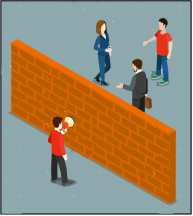
• Walls – in spite of a desperate need to connect, you’re so terrified of intimacy that you compulsively pick emotionally unavailable friends, mated, jobs…. their harmful patterns keeping you at arm’s length, to guarantee that no one gets too close.
If they did, you believe the only thing they’d ‘find out’ is how worthless you are – according to the PP in your head! Unfortunately, your WIC agrees, even through H.P & others do not!

NEXT: Negative results – Intro

Weak DECISION Styles (Part 1)

NO MATTER WHAT I PICK –
it’ll always be wrong!

PREVIOUS: Procrastinators Anon Tools

POST : Purpose of Emotions : DECISIONS


PART 1 = First 6 of 18 types of un-sound decision-making (D.M.) styles & their corrections. (No known source) While these types all represent dysfunction, people gravitate to one of these styles as a reflection of their inborn approach to life, along with an unhealthy upbringing.

• No matter what our personal style, ACoAs have a great deal of difficulty making decisions. This deficiency has nothing to do with our basic intelligence, only our damage. An apparent exception are those in the Hero / Rescuer family role – who seem to be able to make decisions easily & continuously. But the hidden worm in the fruit is that they only do it on behalf of others. Decisions for themselves are rare & usually unhealthy

– D.M. is the process of identifying & choosing alternatives, based on our values & preferences &
– D.M. is the process of reducing enough uncertainty & doubt about our options to give us the freedom to pick out the best one at the moment

SOME REASONS we have trouble with D.M.
• not having a clear identity (who am I, how do I present myself, what do I need or want….)
• letting the WIC (wounded inner child) be in charge of considering what to do, who either acts impulsively or is stuck / paralyzedbad decisions
• not trusting the knowledge, judgment & experience we’ve gathered throughout our life

• not realizing we have options to choose from, or better options than we think we have
not having permission to change our minds – about anything!
• being in denial about what we know regarding a person or situation

• fear of making the wrong choice – we think the wrong one will have life & death consequences, or result in severe punishment or self-hate, afraid of taking risks, asking for help, getting good things

• co-dependence: wanting to please everyone, all the time
• growing up with a series of double-binds (paralyzes us)
• not having enough or the correct information to decide accurately
• using CDs (cognitive distortions) in thinking about a problem

➼ As we Recover, some of these reasons melt away, some diminish & some we struggle with throughout life – & which is which will be different for different people.


ACoAs – ARROGANCE (Part 1)

I CAN ONLY STAND MYSELF  – if I pretend to be superior!

PREVIOUS: Humiliation (#3)

SITE: The Difference Between Confidence & Arrogance is Empathy
Teaching Humility in an Age of Arrogance

QUOTEs:“Much to learn, you still have” ~ YODA to Count Dooku, StarWars II
• “Do you wish people to think well of you? Don’t speak well of yourself” ~ Pascal

DEF: ARROGANCE (ARR) = inflating, exalting, over-valuing oneself. It’s “Bigging yourself up”, whether publicly or just inside your own mind, & often involves criticizing & knocking others down at the same time. (Ennea-Type #3)
“The act or habit of making unjustified declarations in an overbearing manner…. exorbitant claims of rank, dignity, estimation, or power”

♦️It is a major characteristic of all styles of narcissism – overt or covert, falling on a continuum from mild to severe. The extreme  expression of arrogance is Narcissistic Personality Disorder.  2 main types:
• Vulnerable – those who use arrogance to compensate for their insecurity
• Grandiose – who truly believe themselves to be perfect, without weakness or limitations.

It’s one of 7 features of “dark” personality traits, based on 7 basic fears, which are the False Self’s primary means of self-preservation.
• Arrogance = FEAR of vulnerability
• Greed = f. of lack / not having enough
• Impatience = f. of missed or lost opportunity
• Martyrdom = f. of worthlessness
• 
Self-Destruction
 = f.  of loss of control
• Self-Deprecation = f. of inadequacy
 Stubbornness = f. of change or of new situations (MORE…)

CHARACTERISTICS of ARR people (A G. Cerdan)
☂︎ Constantly talking about themselves & their achievements
☂︎ Charming – at first. Behind it is contempt, lack of empathy, resentment & selfishness
☂︎ Intolerant of anyone who doesn’t like or approve of them
☂︎ Never asking for forgiveness
☂︎ Over-compensate for insecurity – being loud, stubborn, showing off in dress & makeup….
☂︎ Tremendous need to be praised
☂︎ Trouble forming & keeping relationships
☂︎ Won’t admit mistakes, can’t handle criticism

ARR. is the result of Negative childhood experiences, causing:
a. deep (hidden) terror & insecurity (fear of abandonment)
b. the WIC’s dysfunctional strategy to ‘protect’ the Self
c. misconceptions about the nature of Self, life & others
d. a False Persona to hide a, b & c in adulthood

• We all have the potential to be arrogant in some area  of our life. But – for people terrified to admit or show common human limitations, it can become a dominant pattern.  This character defect represents the need to be seen as flawless, because exposing any weakness makes them feel unbearably vulnerable (like negative EnneaType 1, but not exclusively). See (Ennea-Flaws in All)

Hidden belief: “Who I really am will never be good enough for anyone to accept. So no one must ever see the real me.”
ACoAs are very familiar with this obsession with perfection, because our family punished or made fun of normal childhood needs & behavior, which they treated as unforgivable flaws!

Opposite poles 
– – Vanity (unhealthy False Self): 
an irrational / obsessive belief in our superior attractiveness or abilities as reflected in the eyes of others – which is falling for our own lies (egotism / narcissism).
It comes from the Latin vanities: empty, foolish, futile, untruthful

+ + Pride (healthy Confidence): recognizing, appreciating AND enjoying all our good qualities, rather than exaggerating or need yo make them up to mask or deny normal human limits & imperfection.
It’s a positive expression of the True Self, being realistic about our innate value & accomplishments  (“Worst & Best Personality Traits” – lists)

WHY do ARR people Succeed?
⚡️They use anger to intimidate
⚡️Being ‘difficult’ makes others give in to them more easily
⚡️Being dominant / domineering allows them to steal the show
⚡️Believing they’re superior helps them go for what they want
⚡️In disagreements, they attack the person rather than the issue

Arrogant leaders can do well in business, but rarely create lasting relationships – because they doesn’t inspire loyalty & trust. They’re often surrounded by users who are all too happy to take advantage of the egotist’s ruthless & obsessive need to ‘make good’, but will jump ship at the first sign of trouble

ARR is built on a variety of sandy / swampy foundations, such as:
– family lineage, ‘connections’, money, possessions
– achievements based on natural talents + hard work
– illusions / self-deception about non-existent personal qualities
– being stuck in past glory & accomplishments
HOWEVER none of these provide genuine self-esteem, which only has one source: Unconditional love!

NEXT: Arrogance #2

Co-dependence & the False Self

invisible barsTHESE INVISIBLE BARS
have me trapped in the mirror

PREVIOUS: Co-dep & Roles

SITE: False Self, Real Self – the games we play with our identity”

✤ Anatomy of Emotional Warfare (key player is the False Self)

✤ 3 Reasons to Embrace Your “False” Self

BOOK: Is it Love or is it Addiction? ~ Brenda Schaeffer


CO-DEPENDENCE runs us WHEN:
We focus all our attention on the needs, feelings & problems of another person – instead of ourself – including the ones we think someone else has, in order to make that person love us AND never leave us.  So we feel guilty when we don’t tend to their wishes, needs or demands!

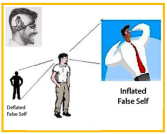
The False Self  (FS)
✶ We developed it in our dysfunctional home, where we came to believe we needed someone & something outside of ourself to be complete, to feel safe, to have any worth at all, even to give us permission to exist!

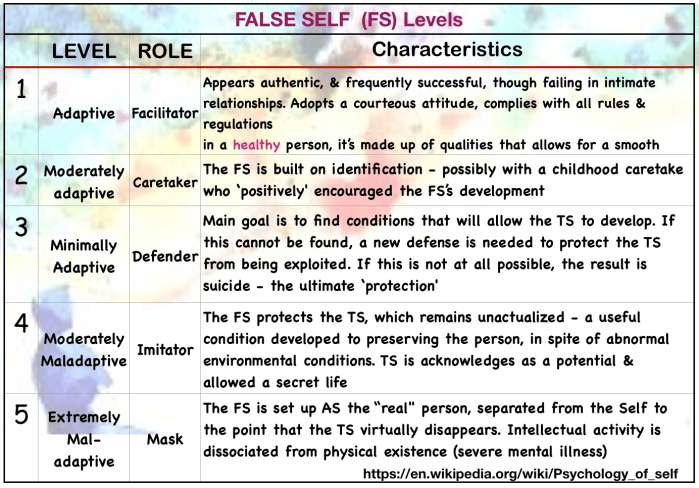
✶ Basing life on a False Self robs us of our dignity & individuality! It’s what the wounded version of the Adapted Child ego state becomes when we’re not properly nurtured in childhood, & which ends up running our life until we do FoO work in Recovery   (CHART  ➡️)

• The concept of the FS was identified in the 60s by Dr. Donald Winnicott, who specialized in Object-Relations psychology.
The FS is motivated by a basic need to survive, starting in infancy – an unconscious choice to change our behavior, repress our emotions & push aside our own needs – in order to fit in with others who cannot accept us as we really are.
It comes out of a desperate attempt to control a person or situation that is actually out of our control.

• It includes 5 USES and 5 levels ⬇️, the most extreme being when the True Self is completely hidden, while the FS appears authentic to the person & everyone else, & may be successful in the world but fails in intimate relationships  & secretly fuels anxiety
➼ In contrast, the True Self is the core of we who are, unshaped by upbringing or society, the person we were born as & still exists inside

CHILDHOOD Causes
☔︎ Attachment Trauma = a developmental shock that may become hard-wired into the child’s brain & personality structures. Desperate longing & emotion-addiction becomes a defense mechanism against the anxiety of too early or difficult separation from mother

☔︎ Toddlers = Defiant & oppositional behavior persisting beyond age 3 may indicate an attachment disorder.  Child can develop other “upper defenses” to maintain this separateness (over-independence), which support the inflated False Self.

☔︎ Co-dependent = Children create a False Self (FS) as a reaction to not having enough emotional & social support in order to become emotionally & psychologically separate from parents (grow up)
☔︎ Counter-dependent = child blocks feeling of the shame of only being ‘loved’ conditionally or not loved at all.  The FS prevents being totally traumatized by the abandonment & abuse. This defense typically shows up as the child (& later the adult) seeming to be strong & capable, while not feeling that way inside (like a fraud)

☔︎ Addictions = Later on – develop addictions in the areas associated with specific separation trauma (use ‘uppers’, work, quick sex, traveling & over-consuming…. ). These are inadequate & unsatisfying substitutes for deep union with the Divine who created the True Self, just like the unavailable emotional connection with the mother.
Unfortunately, it often takes people a long time to discover that unresolved developmental trauma is the cause of many of their adult problems.

«
CHART a
. False Self created by absorbing Negative Introject

«
CHART b.
True Self as the integrated authority of a fully developed, emotionally intelligent grownup (by Roland J. Schuster)

Also read  “What Represents True Self“?

«
NEXT: Satir’s LEVELER Role

SITE MAP of the ACoA website


“HEAL & GROW for ACoAs”
80+ pages of great info!  

Go to http://www.acoarecovery.com,
& click on SITE MAP to navigate


ABOUT ME
Pg. 81-83 • Info, Background & Testimonials

ACoA SYMPTOMS
3  • Laundry list, 12 Steps for ACoAs
4  • Unhealthy Parenting
5, 6   •  Expanded characteristics
7  •  NARCISSISTS – characteristics
8  • Cognitive Distortions, w/ examples

ARTICLE
69, 70 • “Healthy Opposites- Change Behavior to Change Your Life”

BARGAINs WITH FATE
12,13 •  Intro & 5 Bargains  (from Shakespeare’s plays)

BLOG
87 • as of 7/15/10 — 16 entries

BOOKS
84,85 • Recovery Titles

BOUNDARIES (Bs)
39  •  Definition, Purpose
40, 41  •  Unhealthy Bs
42-44  •  Healthy Bs  (emotional, mental, physical)

CO-DEPENDENCE
45, 46 • Definitions; Unhealthy & Healthy

COURSE
55-58 • “Knowledge is Power: What Makes an ACoA” outlines

DECISIONS
72 •  Good  & Bad Approaches
73-74 • Extensive List of Personal Values
75-76  • Types of Decision Makers
77-79  • Decision Making Criteria (1-5)

DEFINITIONS
52-54 • Brief explanations of Confusing Terms

4 FAMILY ROLES
20 • Toxic Roles: Hero, Scapegoat, Lost Child, Mascot

EFFECTIVE RESPONSES
51 • Short & longer THINGS to SAY back to abuse or stupidity !

EMOTIONS
47 • Extensive list of emotions words
48-50 • Unhealthy & Healthy expressions/ uses of ANGER

FRIENDS
80 • Extensive list of characteristics

HEAD GAMES
9, 10 • 4 common games
11 •  4 more games, Expanded

INNER CHILD
14 – 17 • ‘Parent, Adult & Child’: Voices, Purpose, Characteristicssca0219
18, 19  • Developmental Stages, Memo from Child

LINKS
86 • @ Narcissists, etc.

NEW RULES
65, 66 • Healthy rules to take care of the Inner Child

RECOVERY
59, 60 • What it’s NOT & what it IS
61- 63  • Mental Health & Healthy Families
64  •  Benefits of Group Therapy

RELATIONSHIPS
23,24 • Issues & Beliefs
25-27 • Intimacy – Unhealthy & Healthy
28 • Love addiction; Power Plays
32 • LOVE – 5 languages, 5 Types
33 • TRUST – Who can, why not, How To
34 • Gay & Lesbian ACoAs
35 • M vs F ways of Responding
36 • 16 Men – by Myers-Briggs Typing
37 • Givers vs Takers

SAYINGS
67, 68 • Affirmations, Promises, Serenity Prayer

SEX & LOVE ADDICTION
29, 30 • Self-Diagnostic Qs

SEXUAL ABUSE
31, 32 • Survivors’ Symptoms;  Recovery

TOXIC RULES
21, 22 • Long & Short versions of dysfunctional childhood rules

WORK ISSUES
71 • ACoAs at Work; Healthy ways to work

NEXT: What id GUILT?