ROMANTIC ATTRACTION – Qs (Part 2)

dancing 

I WANT TO BUILD MY LIFE AROUND YOU –
I hope you feel the same way!

Part 1: R.A.Qs, 1-30

POST: FRIENDS Inventory

INVENTORY (cont)
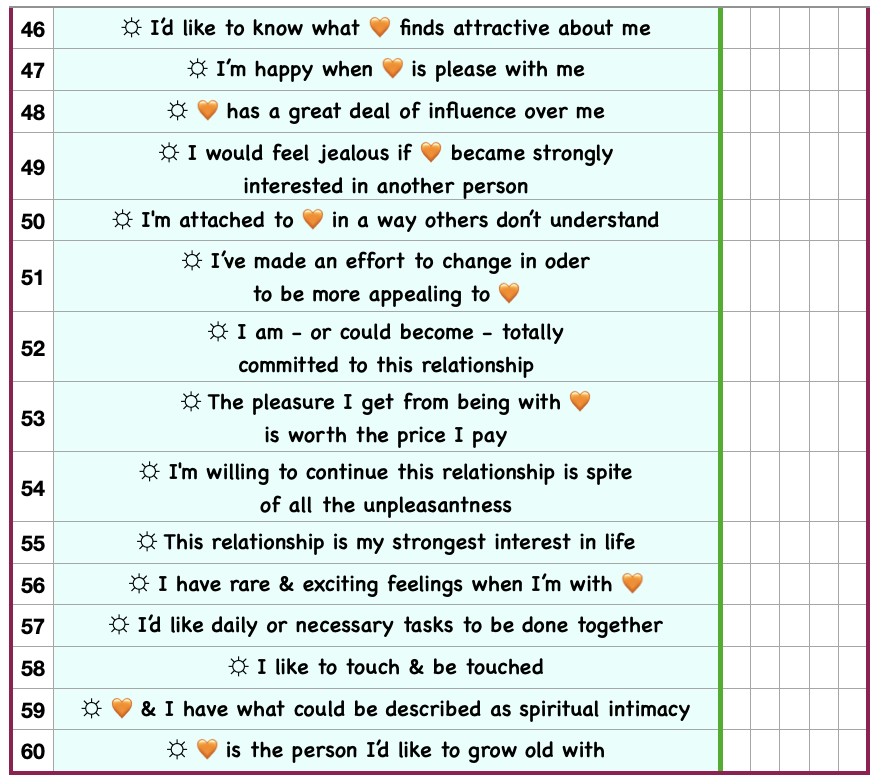
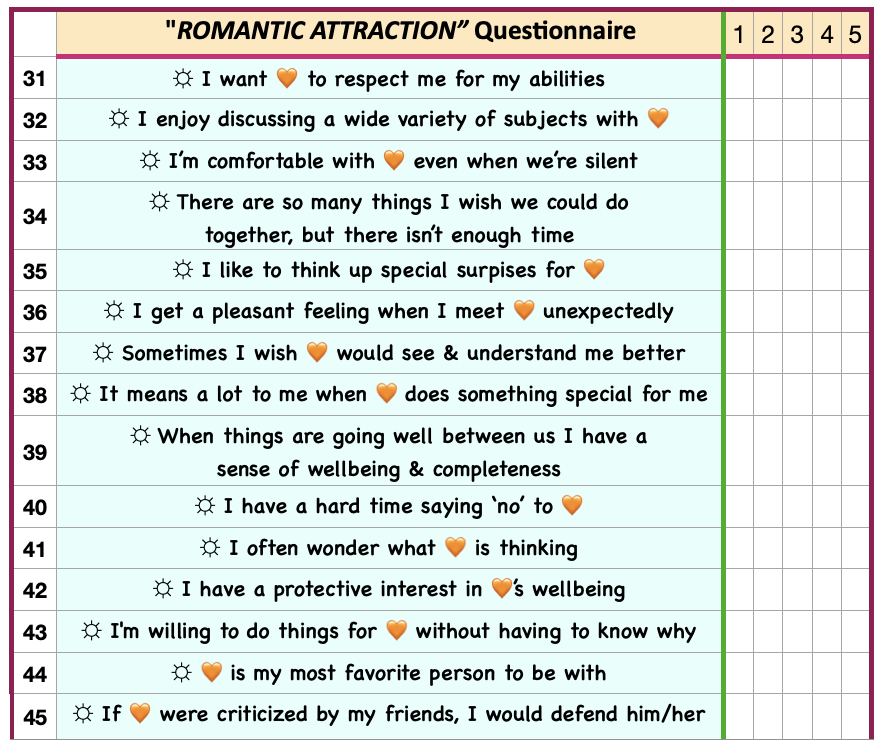
➼  Print out Part 1 & 2.  Put a check mark in the column which best fits your responses about a specific person: _____________ (🧡)

Use #1 as the weakest to #5 as the strongest feeling you have about each statement. Do NOT consider #5 as ‘perfect’, only as intensity
• If you don’t know or are confused, mark #3.  You can always go back later & fill the ‘blanks’ or reevaluate your answers

• Take your time considering the Qs – think about your own experience with each person AND what you know about them
• If possible, have your partner take the same test
• Total up each column & then add them all together.

👁 See below – to interpret your scores
EVALUATION
Add up each column (1-5) – for both Parts 1 & 2. Combine all columns , to get one number for your Romantic Attraction (R.A.)
• 180 -200 = Little or no romantic interest, so it’s not likely to work out, no matter how much one of you may wants it
• 200 – 220 = Weak R.A., indicating borderline interest
• 220 – 260 = Strong R.A., enough for a relationship to be satisfying if both of you fall in this range
260 – 300 = Very high R.A., indicating a strong compatibility, if both have similar scores

• If one of you scores below 200 & the other is over 220 – especially after several tries – expect the relationship to just run its course.  Enjoy what you can & then move on
• If both of you score below 200, you’re not suited for romance, unsatisfied
BUT it makes it easier to have a satisfying & long-lasting friendship, if you want to & there are enough compatible interests

REVIEW – ACoAs (& unrecovered addicts in general) usually have relationships:
• based on interlocking damage with another person
• driven by our WIC & PP, rather than the True Self
• just to keep from feeling alone & abandoned, no matter how unsatisfying or harmful
• trying to get the good parenting we never got in childhood – from someone else, instead of from Ourself & H.P.
• that act out our deepest fears & greatest wounds
rejectionWe’re afraid:
• to stand up for ourselves – say what we want or don’t want
• that we won’t ever be able to choose better friends & lovers
• our family will disapprove of / not accept our choices
• to risk ‘everything’ on our Inner Truth

A secondary GOAL of this kind of QUIZ is to get us thinking about the positive qualities we can own in ourself, as well as those we need to be looking for in partners & friends. Then we can grow into being comfortable & happy in any relationship
• Romantic excitement can not be manufactured or forced if it doesn’t already exist, but all good relationships require a level of emotional maturity, which can be improved on with continuing effort & the right tools.

NEXT: Infatuation…

“FEELINGS AREN’T FACTS” (Part 2)

heart talkWHEN THE HEART TALKS….
… I should listen

PREVIOUS
: “Feelings aren’t facts” (#1)

SITEs: • How to listen to the heart
• Diff between feel, think, believe

POSTs : Use THINK instead of Feel


1. FEELINGS (Part 1)
2. ‘FACTS’:  The other problem with this platitude is that these 2 words don’t really belong together (feelings & facts).
a. Facts – are only actions, quantifiable, with measurable results. Simplified – facts come from the head.
b. Feelings – as pointed out in Part 1, has 3 different uses, 2 legit, 1 not.

For people who use this term – ‘feelings’ means Emotions (Es) and Es are never ‘facts’ – they are internal experiences – from the gut.  Yes, it’s a fact that we have emotions. Even Vulcans have those pesky things, underneath. For humans, to be cut off from them turn us into narcissists or worse – sociopaths!

• Eventually someone in Al-Anon added what they thought was a clarification: “Feelings aren’t facts, but it’s a fact that I’m having these feelings”.  OK – this does refer to Emotions. This was encouraging for many of us to hear, because as CoAs we were taught to repress some or all Es – to deny them as irrelevant or unacceptable.  So this version gave permission to FEEL emotions.
But this is not what the phrase “Feelings aren’t facts” actually means.
circular

c. Thoughts (Ts) are not technically facts either, but rather ‘constructs’ of the mind – not tangible in themselves. They are:
• the cause of emotions (in the present) :
EXP : T ⏩ “I can’t believe she never called me back. What a b— I’m so angry!” ⏪ E
Unrealistic expectations, cruel toxic rules, scary projections, unfounded assumptions & S-H … lead to distorted thinking & obsessions, which cause us great suffering, & often lead to unfair or harmful actions toward others!
OR
• the cause of actions, healthy or unhealthy, depending on the type (may not be conscious, but the real reason for behavior)
✒︎ NOTE : Watch out for people who ONLY talk about what they or other people are doing, where they’ve been, who they know, what they’ve accomplished…. Facts, facts, facts!  That tells us they’re NOT in touch with their emotions, which makes them unsafe in relationships, for anything other than giving information – if that!

CONCLUSION: Based of these distinctions, what does “Feelings are facts” really mean?
ANS: In this case ‘Feelings’ are obsessions, circular repetitive thinking built on negative, distorted beliefs, and NOT emotions at all! which are not telling us the truth (facts) about a situation.”
✒︎ In other words : “What my obsession is telling me is most likely a lie.”

And what do most ACoAs endlessly obsess about ? :
bad thoughts☁︎ EITHER Self-Hate
”I don’t know why he won’t talk to me – why is she ignoring me – was it something I said? Maybe I should have been nicer to her.  I probably sat in the wrong chair… I know he doesn’t like me… what can I do to change their mind… “  –  bla, bla, bla….
OR
👺 Rageful thoughts towards others
“How dare she treat me like that… Why didn’t he call me…. I never did anything to her… I’m going to give her a piece of my mind… I hate her, she’s a witch…. no I’d better not… what should I say… I don’t want to get fired…”  grrrrr , grrrrr

❖ Healthy THINKING is imperative for us to function well in the world & in personal relationships. This requires :
• accurate, reasonable & present-day information about how everything really work   • what our needs, goals & dreams are
• what is positive about oneself (character & abilities)
• what it means to be human (determined, imperfect) images-4
• universal spiritual truths about Higher Power.

EXRESS  thoughts
, opinions & beliefs, directly:
• “I think that the government should…”
• “That’s not my opinion”   •   “I wouldn’t say that…”
• “I suspect he’s not going to honor his agreement”
• “I’m convinced there’s a better way to do this project”

❖ Healthy EMOTIONS are NEVER good or bad, but rather range from the very painful <———–0————> to the very joyful.  ‘0’ is neutral.
✒︎ We’re most successful & comfortable when we live within a range of +5 to -5 on either side of center, most of the time, although not exclusively. Times of great stress OR great joy will push the range much higher or lower, but not get stuck at either extreme.
☆ This medium state can only happen when healing diminishes accumulated anxiety so we don’t have to alternate between the ‘outer limits’ of misery or fantasy/illusion!
(REVIEW all posts on Emotions)

NEXT: Getting to Our EMOTIONS – Under

“FEELINGS AREN’T FACTS” (Part 1)

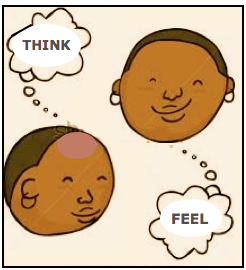
think or feelTHOUGHTS vs EMOTIONS
I’m confused! What are you talking about?

PREVIOUS: Recovery Thoughts


This is a familiar phrase used in 12-Step Programs, but not exclusively. It contains an intrinsic truth and an intrinsic lie.  We have to examine both words – ‘feelings’ and ‘facts’ – to understand.
1. FEELINGS
a. CONFUSION:
• In our language, the word feelings is used in almost every context to mean either thoughts, emotions or sensations, without distinction.
• The main problem is that most of the time people use ‘Feel’ to mean Thoughts, not emotions. This causes confusion for both speaker & listener.

confused• This triple usage may be a clever ploy in our culture – likely unconscious – to suppress Emotions! We’re taught to live in our head & only focus on actions (“Just do it”), which we gladly embrace as a defense against facing our deepest pain.
So, along with many other sources (family, media, male culture, war, sport…) our language encourages cutting us off from an essential part of ourself

b. CLARITY:  We’re not going to change how we talk, but we can understand the 3 uses of the word FEEL, so we can be accurate.
i. Sensations – ‘Feel’ as a Physical experience : I feel hungry, tired, thirsty, sexual…
ii. Emotions: If ‘feel’ as indicating Emotions –  followed only by a single words : “I feel…… sad, glad, mad, anxious, pleased…..”.
AND we can have more than one E at the same time, even contradictory ones.
“I’m happy to see you, but disappointed that Ted’s not here too.” (Posts: Use THINK, not feel)
iii. Thoughts :
 The word “Feel” should never be used to mean Thoughts / Opinions / Beliefs.  Thoughts are always in sentence form, always more than one word. 
When “Feel” is misused, it usually leads with ‘that‘ or ‘like’:
•  “I feel like he wants to talk about something”
•  “It feels like you’re not supporting me”
• “I feel that we should leave soon”
• “I don’t feel that we’re communicating”
•  “I feel like going to the movies”

Stated as such, none of these are about emotions, only ideas – ** even though emotions are implied but not acknowledged. It’s subtle & at best unintentionally, at worst it’s manipulative & dishonest

c. INDIRECTness : Another mix-up occurs when thoughts are expressed in a round-about way. Such statements are clearly sentences, but couched in terms of feeling, which makes the speaker sound unsure of themself. They’re not actually expressing confusion, but rather insecurity by asking for permission to have a voice.

ACoAs are ‘notorious’ for talking around an important point, leaving out crucial info, adding too many qualifiers, justifications & apologies! This misuse comes from not being allowed to own our personal power.
We say:
• “ I hope you don’t mind if I tell you…”
instead of
  “I’d like to tell you something / I need to talk to you about___”

• “Is it alright if I___ , Will you be upset if___ …”
instead of (with a smile, perhaps) “I won’t be able to____ , I need to____ , I’d like to___ , I’m not available for___”

• “I feel like I’m doing better”  instead of “I’m doing better”
• “I feel like I can’t trust them”  instead of “I know they’re not trustworthy”

☑️ Unfortunately, for many ACoAs, being direct is not just considered impolite but actually aggressive! which it is not IF statement are accurate & made without anger.
Sadly, women are more likely to be indirect as a way to not be pushy, which makes staying connected easier, but at a personal price. (BOOK : “He & She” by Chris Evatt)

YES, there is a time & place for careful wording, being respectful of others’ time & space, or for apologizing.
HOWEVER, the above examples of waffling have to do with ACoA shame, S-H, fear of being seen, of punishment or being cut off.

The BEST, clearest way to communicate combines emotions + thoughts in the same sentence : be clear
• “I’m scared you won’t stay with me”
• “I’m so happy that you got the promotion”
• “I feel sad that she’s ignoring me”
• “I’m worried that he won’t like this gift”
• “I’m excited for you & curious about what you’re going to be doing”
• “I’m concerned that you’re going there alone”
This of course implies that we know what we’re feeling (emotions) and have permissions to own & express them.
🔴 Practice verbalizing your thoughts & emotions using declarative sentences, so they come out of your mouth more easily. And repeat, daily: “I know what I know”!

NEXT: “Feelings aren’t facts”, Part 2

ACoAs: Healthy RULES (Part 2)

Snever give up
YEAH. I WANT TO FEEL SAFE! — Will you take care of me, Good Parent?

PREVIOUS: HEALTHY RIGHTS (#1)

SITE: How To Never Give Up On… (CHART)


HEALTHY RULES
Part 2 & 3 list statement that have been accumulated from years of Recovery experience. They’re geared to the Healthy Adult / Loving Parent parts of our higher self – so we can know how to take care of our wounded and healthy Inner Children, in the best possible ways.

❀ YES, we have a broken heart!  What’s more painful to a child than not feeling loved by their parents?   BUT NOW – to be happy, we need to:
• accept who our family really was & is
• believe in every fiber that we did not cause our abuse & neglect
• accept that now we’re individually responsible for our life
• know that we have the ability to outgrow much of the damage, but not all completely
• consistently apply mental health truths to our life

❀ We all live by rules, whether we like to admit it or not.
• Some ACoAs were so neglected they think they weren’t taught any rules.  No, not good ones, but we did pick up all the Toxic Rules!
• Others of us were so constricted by rules & regulations, we nearly choked to death on them.
In either case we tend to shy away from rules, or have a raging hatred for them. And yet we are run by the bad ones, as long as they stay hidden and we don’t challenge them.

❀ So here are a few Healthy Rules to try out & apply to our every-day living.
Think about each one, carefully.
Pick one & try it out for a month. See what happens. Then try another….
«

«
NEXT : Healthy Rules & Lessons, #3

ACoA : TOXIC Family RULES

Screen Shot 2015-07-09 at 12.10.53 PMTHEY DESIGNED MY STRAIGHT JACKET –
I’m gonna need some help getting it off!

PREVIOUS: Healthy Helping (Part 2)

SITE: Dysfunctional Family (Wikipedia)


RULES: No matter what our family environment looked like, all ACoAs have gathered a litany of TOXIC RULES, which we follow ‘religiously’, even well into Recovery – but hopefully less so with growth!

We absorbed these Toxic Rules from family, school, our community, religion…. They are the underlying beliefs the WIC is absolutely convinced are the absolute ‘truth’ which we are obligated to obey – on pain of death (abandonment)- even if we disagree or hate them. Notice the contradiction & conflict. No wonder we say we’re confused!

The BE and DON’T lists are the short forms, & just mirror opposites. Below are the expanded ones.  This is by no means complete. Each of us can have variations or additions.

INVENTORY: How do we know what our rules are?
a. Overview
As you read thru these lists – notice the ones that hit you the strongest. If you’re new-ish to recovery you may not recognize that you have more of them than you first think. Still confused?
✶ Ask yourself, & then siblings, mate, friends, therapist … for suggestions

✶ Do a Life Inventory, in 3-5 yr increments, listing all the major events you can remember – things that were important, relationships, when you started & stopped things, schools, moves, births, deaths …. choices made, opportunities we didn’t take…..
12065669231219144528Anonymous_work_in_progress.svg.med— Don’t go into detail. Just list things in one sentence each
— Notice the recurring themes, patterns, avoidances… What good things are missing?
— Ask : which toxic rules might your patterns represent?

b. Details
• Pick any one of the phrases that rings a bell & write what comes up.
— Where did you learn this? Who in your family exemplified it?
— How do you act it out in your life?
— How do your friends, lovers, bosses… express it?

• Take it very slow. Spread this exercise out over months & years, if needed. Maybe just write a little & go back to it when you have more info about yourself & your history
GOAL:

• See the toxic family rules you’ve been following – so clearly – that you won’t be fooled any longer into thinking they’re legitimate!
• Slowly disobey them by changing your behavior, an action at a time, a day at a time.

In the beginning – when you do some inventorying – you’re likely to feel fear & guilt. Those emotions prove you’re doing the right thing for your healing. Don’t give up!
• To orient yourself toward healthier goals –  pick out some Healthy Rules that fit your situation, & mindfully, deliberately, use one or more as often as you can (every day, a little?)

✶✶ Breaking family rules can create a lot of anxiety, as the Negative Introject will try to guilt you into returning to the fold – like good sheep.
So the work must be a slow & gentle but with steady process – with lots of support (Al-Anon as one of many resources)

If you read many other posts on this blog, you’ll see references to “Toxic Rules” over & over, so this post will give you a context for thinking about all the other topics & as you work with them. (Post: “Why Are You Stuck?“) .

«
NEXT : Healthy
Rules, #1

RESPONDING to Controllers (Part 3)

 Screen Shot 2015-07-06 at 7.55.09 AM
PREVIOUS : Responding to Controllers (#2)

SITE: “21 Common Mistakes to Avoid When Responding to Conflict


WHY ‘Control’ Responses to Controllers (Cs)?
Because it’s Empowering, to not be or stay a victim.
THE GOAL is to heal enough so we can speak up from the Adult ego state right away, but only if it’s safe & appropriate to insure not hurting ourself. That way our frustration, hurt & anger won’t build up – providing short & long-term benefits.
✳️ This ability comes with lowered WIC anxiety (Es) & practicing things to say (Ts)

Being KIND to ourselves
When we react impulsively or fight back we may temporarily feel powerful, but it doesn’t help self-esteem & personal growth. Even so, sometimes it’s the only way to get thru to a C. & stop them from seeing us as weak & vulnerable. Many Cs only understand ‘tit-for-tabe coolt’! even tough it doesn’t usually resolve conflict or protect us from further attacks

• It’s best when we can mentally take a step back (T), to breathe, process how we feel (Es) & check which of our buttons got pushed. If we can address the problem in a positive way in the moment, great. If not, consider what’s best for yourself & maybe deal with the offender later. In any case, the less we RE-act the more self-empowering & peaceful we’ll feel

Freedom of Speech
Other people seem to think it’s OK to say whatever they want, but we are afraid to do the same. We need to give ourself permission to know & express our point of view as well. But over-reacting to volatile or oppositional opinions has to do with our childhood wounds, & not just to what’s being said in the present. Be truthful, but don’t get into a pissing match. Al-Anon : “Say what you mean but don’t say it mean.”

Minimize Negativity
Nurturing all-consuming anger at someone for their comments or actions only hurts us, carrying painful energy into other parts of our life.  Malachy McCourt (actor, writer & participant in Occupy Wall Street, 10/2011) once quipped: “Holding a grudge against someone is like drinking poison and expecting the other person to die.

purpose For ACoAs, obsessions come from our damaged past. We can privately do rage-work, & process our wounds in Program & therapy, so we don’t keep reacting in ways that make us feel bad about ourself afterward.

What’s our Purpose?
To get the most our of life we have to be clear about our goal in each situation & act accordingly.  What our Adult self wants to accomplish & what the WIC wants are often 2 very different things. Any time we get riled up about something, remember it’s the WIC or PP, but how we respond will depend on whether the ‘Unit’ is in charge or not.

EXP: One week-day evening Ally was in a church auditorium waiting to hear a concert. In the back vestibule a maintenance man was polishing the floor with the door open to the lower level, & the machine was very noisy!
Ally went all the way down to the man, asking him to close the door adjoining the sanctuary, but he refused, so she went back & sat down. Immediately a man waiting in the audience also went down to the worker, & lo-&-behold — the door was closed! Ally smiled.
She knew that many years ago she would have taken offense & been very angry that the worker ignored her (a woman) yet ‘listened’ to a man. BUT now she was not upset at all – her only GOAL was to shut out some of the irritating noise – rather than being respected or validated, which was not the workers job !

Where’s the Focus?
The hardest thing for ACoAs is to not take things personally. Whether someone is mean or just tactless – they’re telling us about themselves – NOT US!
It’s most useful to mirror back to them what we’ve heard: ‘Why did you say that?”, or ‘What did you mean by that?”…. Where attention goes, energy flows. We can only focus fully on one things at a time. The sooner we clear up an obsession, the faster we get our life back. Often speaking up for ourself will rebalance our energy.


NEXT: Self-Care around Controllers – #1

‘ALONE’ – an ACoA POEM

NOT ALONE, BUT LONELY!
No one acknowledged the suffering.
They said it was just being ‘difficult’!

PREVIOUS: Emotional Needs & Innate Resources

DMT: I’m not a poet but wanted to include this one I wrote in 1975, as it reflects the emotions & sense of futility of a young person – a suffering GoA (grandchild of alcoholics), long before recovery, who was always searching for answers & healing. Eventually I found the validation, guidance & comfort that brought Recovery!

ALONE

Forgive me! I cried.
At every turn I wished I’d died
at birth, as near I did.
Strange thoughts drove through my child’s mind:
I closed my eyes & saw infinity!
Why am I here? What is my kind?
Am I insane?

Forgive me! I seem weak,
and yet I cannot help but speak
to everyone I meet
in marketplaces & on streets –
thus twice did strangers catch me up
and carry me away – well nearly.
Then caution dogged my every step,
but never ‘dearly’.

Forgive me! I Whispered.
Had I really erred so much?
Why all that poison guilt?
Was I an empty vessel to be filled
as my masters thought & willed?
Too much to know, no one to help!
Fear to anger on my lips had grown.
Be still! I moaned.

Hear me!
I then began
to scream the pain without a plan –
blindly striking all.
No one to guide, no one to help
in clearing paths & scaling walls.
Silent or blazing, to lose or to win,
the heart, without knowing, fought to be twin to a worthier mind.

NEXT: Excellent Inner-Child MOVIE

What Others Think of Me is None of My Business (#1)

LONELY CREATURES
We’re all social animals, but also need privacy

PREVIOUS: Safe & Unsafe People

REMINDER: See ACRONYM page for abbrev.

NOTE: Many people in the mental health field, spiritual practices & new-age wisdom say we shouldn’t worry about what others think of us. Yes, OK, but it’s not that simple! What they don’t tell you is that there’s 2 different aspects, the negative & the positive.

1. DAMAGE (ACoA version) – for anyone with limited self-esteem / S-H, there’s always the assumption that other people don’t like us – it’s our default position & hard to let go of.  And that has 2 parts too! Doesn’t everything?  AH, Dualism!  I can’t help it – I’m a 22/4 with an 8 Destiny. I see both sides – ‘now’. 🙂 Anyway…

a. Awkward (lame, a “drip”? —>)akward
• If we’re obnoxious, angry, childish, clingy, lazy, needy, selfish, un-groomed, or say lots of dumb things – OR just full of negativity & self-doubt, then most people will not like us!

• If we care, these problems can be worked on – if we have the courage, right kind of help & willingness to deal with the pain, sadness & fear that’s at the root all our ‘shortcomings’

• If we don’t care, or the resistance is too great to get past, the external signs & internal causes never get corrected. A great loss for us as individual & to society, but each has their own path.

b. Isolators: Some ACoAs (not about Extroverts / Introverts)
isolate• hide out because of some physical or mental disorder
• but mostly it’s from — Fear, Lack of good Boundaries & Self-hate : wounded souls who need lots of love but aren’t allowed to let it in, even when it’s available. They blame themself for everything that goes wrong. They ‘don’t belong’

• At the other extreme are those wounded ACoAs who are always angry,  complaining, dissatisfied & think they’re superior. They push others away & lose out. They have S-H too, but their whole focus is outside of themself, blaming everyone else for their troubles

c. Acceptable:  Most of us are not social misfits –
• we have an education, jobs, mates, maybe children & some outside interest. YET we think everyone is going to judge us harshly, find out we’re frauds, see  all our flaws… later if not sooner, especially if they get to know usbeing udged
• that’s straightforward Projection onto others of – how our parents treated us & now, our self-judgement

also, it’s Mind-reading (a CD). We’re sure we know what others are thinking – especially about us, & it’s always negative. That’s ACoA grandiosity.  Stay out of other people’s heads!
• Sadly, even when others like us, love, admire & laud us – we have a hard time believing it, don’t trust it, get embarrassed, tell them why it’s not true. Yuck!

2. Mental HEALTH  — All humans NEED connections, but in differing amounts.
a. Normal:
Extroverts. (They are 75-80% of the population, at least in the West)
They thrive on the energy absorbed by being around a lot of activity – choices, options, people, events….. even if not interacting with them directly.  (PS – not referring to the energy vampires).
Think: a walk in the park on a great spring day alone, when intro/extroeveryone’s out,  or an evening with a bunch of friends, just ‘messing around’. Doesn’t have to be heavy or deep, although that’s good too. Just being ‘part of’ feels great

Introverts need activity too with others, just in much smaller doses. They’re mostly comfortable one-on-one & in small groups, for short periods. They derive their energy internally, & are overwhelmed by too much external input.

NEXT: What others think…. #2

BOUNDARIES & ACoAs (Part 1)

Screen Shot 2015-06-25 at 12.05.31 AM 

I HATE YOU – DON’T LEAVE ME!
I need you but you’re too close – I can’t breathe

PREVIOUS:
Bs – Healthy Source ( #2)

REMINDER: See ACRONYM page for abbrev.

1. Normal Development – Stable Core (previous 2 posts)

2. ACoAs
Unfortunately, growing up – ACoAs did not originally have that all-important stable core to rely on, so weren’t able to form our own, because of:
• being overstimulated by chaos, emotional volatility & conflict
• being over-controlled, expected to be perfect, judged harshly
• not having role models for self-esteem & appropriate Bs
• not being loved & supported unconditionally

a. Wounded Adults
• Many un-recovered PARENTS are symbiotically enmeshed with their children, to cover their own FoA – ie. both the adults & the kids have similar immature mental drama & temperamental intensity, so they overlap each other, which is emotionally abandoning & terrifying for the children

• These parents function from their WIC’s ego state, so have:
— weak or no Adult & missing Loving Parent aspects
— weak or rigid boundaries, overlapping child’s feelings, as if the child were only an extension of themselves
— a narrow range of emotions available, w/ few nuances
AND
— their focus was on their addictions, bad relationships, financial worries, depression, mental illness, relatives, sickness ….
— often changed the rules arbitrarily or made them unreachable, so no matter how hard we tried to obey, it was inevitably going to be wrong – & then we got attacked & punished! We could ‘never win’.
As kids, this kept us off-balance so we wouldn’t become independent (& eventually be ‘separate’), which requires being sure of oneself.

Al-Anon visual: the alcoholic has their arms around the bottle & the co-dependent has their arms around the alcoholic!
In these households, children are just pawns to be used & burdens to be neglected, ( Games Alcoholics Play’)

b. Limiting our Emotionsnegate Es
• In an alcoholic, narcissistic family, one or both parents limit or repress the type of emotional responses allowed the children, who are expected to act like adults, both mentally & emotionally, long before maturation.
ACoAs were blamed for not behaving ‘right’,  even thought we were not experienced yet in social etiquette or subtleties, didn’t have enough motor co-ordination, weren’t old enough to actually act like adults!….

EXP: Beth was a pretty little girl who grew up in church. On one occasion her mother was at the dais addressing a Ladies Group. Beth was left all alone in the front pew & expected to sit for 2 hours like a perfectly groomed doll. But she was a normal 4-year-old – bored, lonely & fidgeting. Her mother was annoyed at her child’s ‘misbehavior’, confident it would make her look bad.

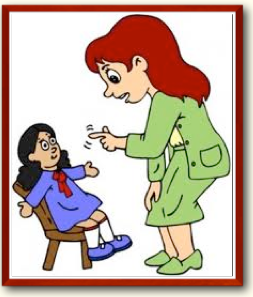
She gave Beth ‘the look‘, who immediately froze – terrified – knowing the dire consequences of displeasing her mother, but quick obedience saved her this time.
For years afterward her mother proudly liked to tell how the group afterward complemented heron having such a well-behaved child. Sadly – neither the mother or anyone else ever had a clue of the intense terror that was generated that day!

• We learned very early that our emotions & behavior had global impact – they effected the ‘gods’ badly. Our parents let us know blackmailin various ways that we harmed them just by being ourselves (kids). EXP: A mother repeated remarked : “You’ll be the death of me yet!”

• Many ACoAs experienced being emotionally blackmailed controlled using fear, obligation or guiltOur parents’ narcissism & lack of boundaries made it easy for them to:
— treat us the same way they had been – the ‘kick the dog syndrome’, ie. passing on their rage at their parents’ neglect & abuse
— project their self-hate onto us – they couldn’t face that they were considered ‘bad’ children’ so they made us bad instead – to preserve their fragile self-image

EXPs: “If you loved me…. I made that just for you…. If you don’t do your chores, dad will get really mad at me….
BOOKs: “Emotional Blackmail”  & “Toxic Parents“~ Susan Forward

NEXT: ACoAs & Bs (Part 2)

WHAT is SHAME? (Part 1)


THE BAD SEED
I was born bad & I’ll always be bad

PREVIOUS: What is Guilt?


While guilt is mainly about negative actions,
SHAME is about our IDENTITY – about who we are, fundamentally.

🔹 It tells us that our very essence is bad, unlovable, unacceptable – to be eliminated. It makes us:
• want to hide, isolate, not talk, try to be invisible
• want to be dead! The pain of shame is so great & the conviction that we’re un-redeemable is so deep (not worth saving), that it eliminates Hope. Why bother even trying!
OR
• we overcompensate – by acting superior, controlling, out-doing, knowing ‘everything’, never showing ‘weakness’ (grandiosity), shaming others…..

SHAME is connected to our NEEDs, rather than actions – specifically – each need we had as a child which was neglected, punished & made fun of.
Consider how many needs children have, & how many of them were met with abuse or not at all – you can imagine how huge our shame quotient is !!

BTW, most of us focus on the need for love, & while it is crucial, the need for safety is even more basic! We can’t begin to take in love, even when it’s available, if we’re terrified.

IN CHILDHOOD:
a. Being Ashamed – Children admire, even idealize their parents when they’re quite small. They need to do this to feel safe – to know they can rely on those people to be competent & available to them. It helps to compensate for the child’s extreme dependence & vulnerability.
✶ In reasonably healthy families, children gradually come to understand that their parents are human, fallible, imperfect – BUT still basically trustworthy & decent role models.

● But in dysfunctional families, one or more adults act out their damage ⬅️ 
All of these & more, make children feel ashamed of their family (the chaos, the craziness, the cruelty) – & by extension themselves, as members of that group.
A sense of pride in themselves & their parents is eroded & shattered.
This is devastating. That feeling is then carried, like a canker sore in our spirit, into adulthood.

b. Being Shamed – Children in damaged families are:
▪︎ expected to know or do the impossible
▪︎ insulted about ones gender, looks, tastes, interests….
▪︎ punished, yelled at, hit, humiliated – in public
▪︎ pushed to do things when too young & then punished for ‘failing’
▪︎ teased & made fun of for many things  (anger disguised with toxic humor)
▪︎ treated unfairly, abused & then punished for crying, being upset or getting angry at the mistreatment
▪︎ yelled at, attacked, harangued – often for nothing specific or obvious

These & many other ways of shaming have been called soul murder. It represents parents’ lack of love & respect for themselves & so for their children, who stand in for their own Inner Child. Their dysfunctions negate / abuse the needs that all children have.
EXP of NEEDS : be paid attention to & heard, feel safe & loved, find out who they are as individuals, grow & learn at their own pace, know they can depend on their caretakers, look up to their parents, treated with respect, to LIVE, prosper & succeed….

Many or all of these NEEDS became SHAMEFUL !
We conclude that if the adults hated these needs, then they’re bad (& us for still having them). So they must be suppressed, better yet Screen Shot 2016-06-11 at 6.28.55 PM– eliminated, no matter how deep & persistent they may be.

EXP: After hearing the 4th Step in Al-Anon (“Made a searching & fearless moral inventory of ourselves’), one member suddenly realized:
☁︎ his #1 toxic rule was: “I should be dead !”
☁︎ most shamed need was for love. “ I thought that was my greatest character defect!
After all, the constant message was that he wasn’t lovable – so he must be a fool to keep wanting it – which he does, desperately!”

In Recovery he learned that this & all his needs were legitimate, universal & his RIGHT, & so he was able to reject the need to die, & could start loving himself.
(The 12-Steps – comments & videos)

NEXT: Shame (Part 2)