ROMANTIC ATTRACTION – Qs (Part 2)

dancing 

I WANT TO BUILD MY LIFE AROUND YOU –
I hope you feel the same way!

Part 1: R.A.Qs, 1-30

POST: FRIENDS Inventory

INVENTORY (cont)
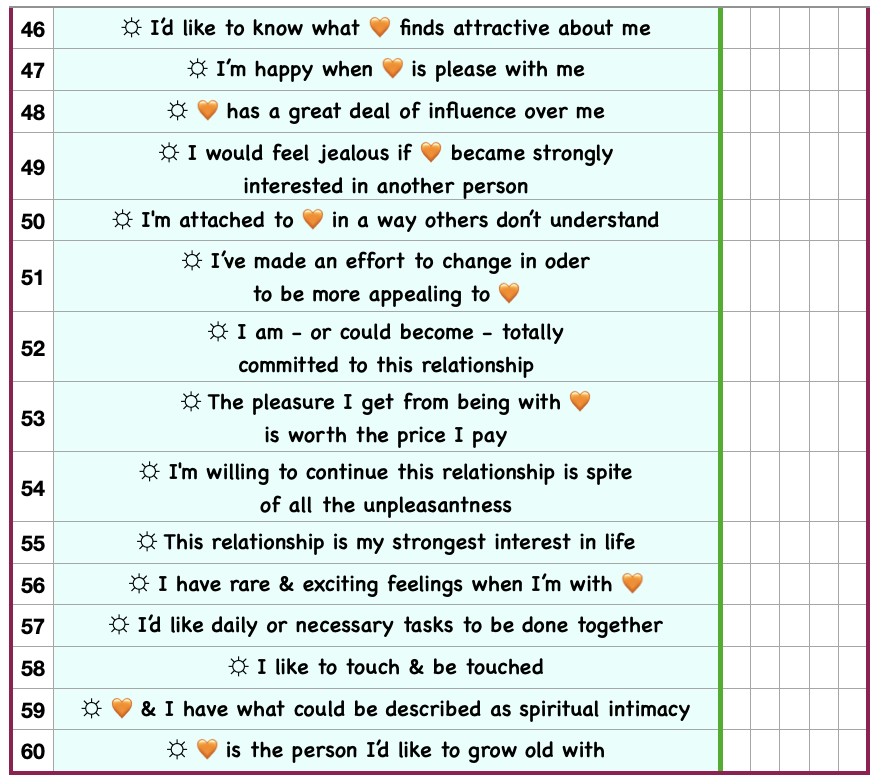
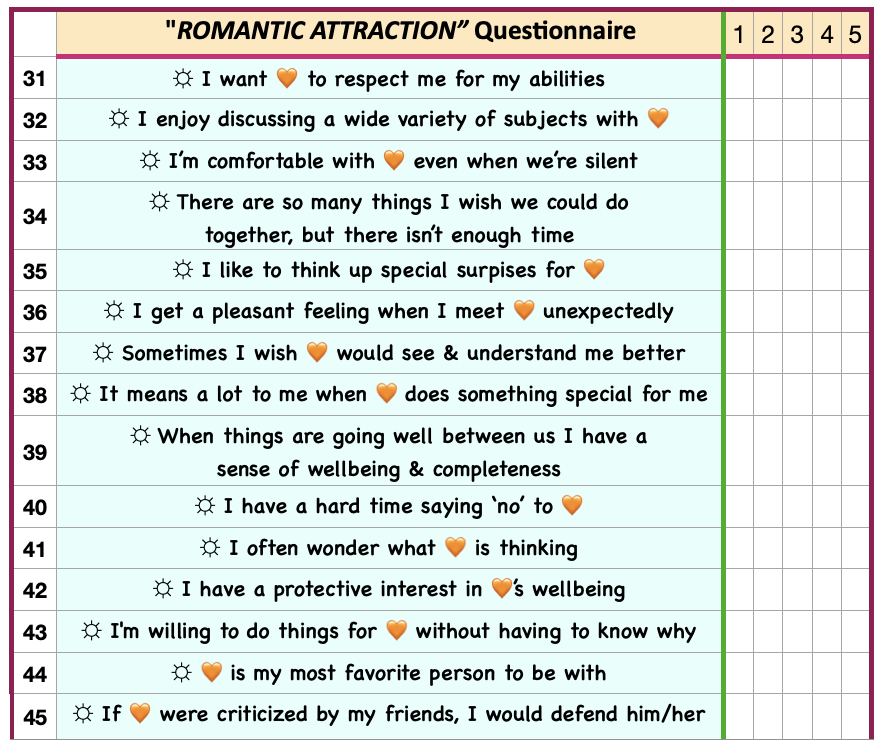
➼  Print out Part 1 & 2.  Put a check mark in the column which best fits your responses about a specific person: _____________ (🧡)

Use #1 as the weakest to #5 as the strongest feeling you have about each statement. Do NOT consider #5 as ‘perfect’, only as intensity
• If you don’t know or are confused, mark #3.  You can always go back later & fill the ‘blanks’ or reevaluate your answers

• Take your time considering the Qs – think about your own experience with each person AND what you know about them
• If possible, have your partner take the same test
• Total up each column & then add them all together.

👁 See below – to interpret your scores
EVALUATION
Add up each column (1-5) – for both Parts 1 & 2. Combine all columns , to get one number for your Romantic Attraction (R.A.)
• 180 -200 = Little or no romantic interest, so it’s not likely to work out, no matter how much one of you may wants it
• 200 – 220 = Weak R.A., indicating borderline interest
• 220 – 260 = Strong R.A., enough for a relationship to be satisfying if both of you fall in this range
260 – 300 = Very high R.A., indicating a strong compatibility, if both have similar scores

• If one of you scores below 200 & the other is over 220 – especially after several tries – expect the relationship to just run its course.  Enjoy what you can & then move on
• If both of you score below 200, you’re not suited for romance, unsatisfied
BUT it makes it easier to have a satisfying & long-lasting friendship, if you want to & there are enough compatible interests

REVIEW – ACoAs (& unrecovered addicts in general) usually have relationships:
• based on interlocking damage with another person
• driven by our WIC & PP, rather than the True Self
• just to keep from feeling alone & abandoned, no matter how unsatisfying or harmful
• trying to get the good parenting we never got in childhood – from someone else, instead of from Ourself & H.P.
• that act out our deepest fears & greatest wounds
rejectionWe’re afraid:
• to stand up for ourselves – say what we want or don’t want
• that we won’t ever be able to choose better friends & lovers
• our family will disapprove of / not accept our choices
• to risk ‘everything’ on our Inner Truth

A secondary GOAL of this kind of QUIZ is to get us thinking about the positive qualities we can own in ourself, as well as those we need to be looking for in partners & friends. Then we can grow into being comfortable & happy in any relationship
• Romantic excitement can not be manufactured or forced if it doesn’t already exist, but all good relationships require a level of emotional maturity, which can be improved on with continuing effort & the right tools.

NEXT: Infatuation…

ROMANTIC ATTRACTION – Qs (Part 1)

old fahionedHOW DO I FEEL ABOUT YOU?
I’m thinking, I’m thinking!

PREVIOUS: Infatuation, Sexual…..

See ACRONYM page for abbrev.

POST: FRIENDS Inventory

TO LIKE OR NOT TO LIKE, that is the question   🙂
ACoAs are often confused about their thoughts & emotions regarding others.
We  :
• were DIScouraged from knowing needs, preferences, dislikes
• & now are not allowed to have them even if we do know
• are more worried about how others feel about us – if they’ll approve or be angry at us, which leave us….
• in conflict between the damaged (WIC) & our developing Recovery (UNIT) voices

BESIDES being given distorted thinking, ACoAs grow up with little or no information about what ‘normal’ is, to help us figure out what’s going on in our head & with others.
These 2 posts list 60 questions to find out about your thoughts & emotions:
happy couple• regarding a new romance or marriage partner – OR
• review how you feel now about someone you’ve been in relationship with for a while (even yrs) but may be wondering how to evaluate it

Taken from “The Love Test” book by Harold Bessell, PhD, 1984
• The quiz is measures the degree of excitement about a specific person, & your desire for a permanent intimate relationship – sexual, mental, emotional & spiritual – with them. The focus is on the person-to-person factor, not sexual interest

• Research suggests that 6 out of 7x, a strong romantic attraction can dissipate within 3-4 months. If the desires remains after that rime, with enough contact it will likely continue for many years

• The 4 month rule doesn’t apply if there is physical distance, a fantasy connection (letters, email…) or an attraction to someone who’s not truly available. An interest in this type of lover will usually dissipate in a few days if you  spend face-to-face time with the real person

• Also, when someone has a ‘fear of intimacy’, living together or getting married may actually trigger withdrawing affection & sexual closeness. This disruption of the bond with a loved one is not from lack of compatibility but rather a person’s unresolved ifear of intimacy

• When taking the test, you will get the best results if you are NOT too tired, depressed, angry, sad, frightened or overwhelmed. If any of these emotions persist, take the test several times & see if there is a combined average
• There are no wrong answers – only your honest evaluation.
💋
INVENTORY info in Part 2  (Qs, 31-60)
➼  Print out Part 1 & 2.  Put a check mark in the column which best fits your responses about a specific person: _____________ (🧡)

NOTE: Evaluate previous partners & compare. Look for a pattern of qualities missing in any of them. Is that a coincidence?
👀 You may be able to use some of these Qs to evaluate a family member, friends, a mentor…. leaving out the romance / sex part.
🌹 Be gentle on yourself at all times, but especially if you’re a “survivor”.

NEXT : Questionnaire 31-60

‘TRYING TO LEAVE YOU’ Stages (Part 4)


PREVIOUS: “Trying to leave you” (#3)


STYLES of  ‘Leaving’

1. ACoA AVOIDERS (Part 3)

2. ACoA CLINGERS
(cont)
b. Shame // c. Control

d. Care-taking
• We take care of them, listen, take time, help with practical things, do way more than we should, pay for everything, worry, do research, take them to get help…. We must fix them, so it’ll work out.. anything to NOT have to leave them!
• THEN we feel resentful that we’re not appreciated, that they’re not getting healthier, not treating us better, not seeing or valuing all we’ve done!

e. Guilt
ACoA GUILT is generated by breaking a Toxic Rule. Re. the current topic it’s about : “Other people’s needs & feelings are more important than mine”.
• We thoroughly believe we can’t let others know what we really think, how we feel about things that bother us, what we actually want – so we don’t ‘upset’ them, make them angry, make them cut us off

• We stay, & suffer, because to stand up for ourselves would cause us too much guilt, which we can’t bear
• We stay because the other person guilts us (see ‘victim’) – “I need you, I’ll kill myself, I can’t make it alone, no one else understands me….”

f. Victim
• We complain to everyone about how bad things are, but don’t change what we can – playing a martyr
• We threaten the other person with leaving, but as long as we’re ambivalent, they don’t take us seriously
• If the other person plays the victim card, we identify with them so much, we can’t abandon them – after all, they say they LOVE US so-o-o much!

g. Self-Hate (see posts)
• When we’re with narcissists, addicts, the emotionally immature… who can’t connect with us as equals, we feel deeply lonely.  Since we’re so used to that from childhood, we think it’s normal AND that it’s our fault!
• We’re so beaten down by the verbal / physical abuse of parent, partner, ‘friend’, boss, cult, religion…… that we believe no one else will want us/ hire us, just like our family didn’t care & told us we were wrong, a nuisance, stupid & worthless

h. Bargaining
• When we DO notice something’s wrong in the relationship, we bargain with ourselves, the other person, even H.P.:
“If he gets help / stops using / stays sober – I’ll stay”
“If we have another kids, he won’t want to leave”
OR
“If they give me a raise, change my chair, give me less work, get off my back … I can do this”
“If I help him out financially, just for a little while, he won’t be so depressed, so violent, so suicidal….“
“If she only got a job / lost weight / had more sex with me, things would be ok”
“If they give me a raise, change my chair, give me less work, get off my back … I can do this”
….  BUT we’re just conning ourself!

i. Staying too long
This is not just about friends or lovers – but ALSO about staying with teachers, doctors, therapists, school…. when it’s the wrong fit or no longer working – even clothes we’ve outgrown, homes or cities we don’t belong in ….. AND books, movies….. we don’t like at all, but finish them any way (“hate-read, hate-watch”….). LEARN : It’s OK to LEAVE!!

j. Getting Dumped
• All ACoAs have a deep fear of commitment, so will hang on & on & on rather than be on our own….. even when we know very well that certain ‘people, places & things’ are not good for us or not what we want

💔 So when it becomes painfully clear that the other person is done
with us, some ACoAs just can’t believe or accept it!  We’ll stubbornly stick around, keep pushing for an explanation, cajoling, manipulating…..
• When we do get dumped, some of us chase after the person – texting, calling, threatening, begging….

OUTCOME : Whether we do the leaving or get left, having our old abandonment pain re-awakened is excruciating! We can’t think, eat, sleep…. that childhood terror of being totally dependent & powerless to get taken care of.
HOWEVER —
We are NO longer children. We can deal with the WIC’s pain & will heal it if we face  with the old damage when it gets triggered, learn to cope with losses in a new way, & CHOOSE healthier connections.

 NEXT: Romantic Attraction Qs – #1

‘TRYING TO LEAVE YOU’ Stages (Part 3)

stay sadPREVIOUS: “Trying to leave you” (#2)


STYLES of  ‘Leaving’

1. ACoA AVOIDERS
(see Part 1)
COMMENTS
Re. ACoAs: It’s hard to make notes for each stage separately because we are so extreme – not going thru the steps at all, going thru them all in the first few weeks, or staying for years even when we know better….  We too experience endings (leaving or being left), but suffer more that people who are less wounded. So these are general observations of ACoA patterns

LEAVING:  Regardless of our style, personality type, previous experiences…. when we can’t bear it anymore – we leave, but rarely in a healthy way:
a. Even though weither ore know a friendship or relationship is dead & hopeless, we desperately try to hang on, begging, chasing, manipulating, threatening to kill ourselves….
OR
b. We cut someone off – cold turkey, without explanation – & refuse any opportunity for closure.  If the partner or friend is the Clinging type, they will be unprepared & dumbfounded.
We are angry or fed up. We don’t want to deal with their abandonment issues, their tantrums, their sulking & self hate. We don’t want to get sucked back in. Our boundaries are not strong enough & it’s just not healthy

c. One or both create such drama, fighting, emotional upheaval – that the only possible outcome is an explosion & then the big split.  We don’t want to feel our abandonment pain either – anger is a cheap, fast & sometimes cruel or physically dangerous way to get out

d. For some, no matter how bad the situation, there’s no leaving at all – only an ending when one partner dies
e. Some ACoAs are capable of more appropriate exits, but it’s rare

STYLES
1. ACoA AVOIDERS: Some ACoAs are so afraid of commitment, being trapped, being abused & then left, that they don’t have avoidersany love relationships, don’t make long-term connection, or only have short serial relationships, friends, jobs…

• If they try, they’ll go thru the 5 Stages very quickly – or stop at #2 – over & over,
♝ always finding fault with any hint of imperfection, OR
♝ always picking people & situations that reproduce the original abuse & abandonment, OR
♝ not giving healthy people a chance to develop connections that would be beneficial & uplifting

2. ACoA CLINGERS
a. Fantasy
• ACoAs often start relationships in a fantasy fog of symbiosis, all hopeful & excited. There may be very little thought, just a whirlwind of emotions (Es).
Or the thought is: ‘This time it will be different’

• Then the dis-illusionment. The other person says or does something so unacceptable – to us- that it breaks the trance of togetherness.  It may be :
✐ something TOO healthy (setting a boundary, not rescuing),disillusioned OR
✐ something truly hurtful / abusive / disappointing, OR
✐ it’s just that they triggered an old wound of ours.

• We may object, complain, attack…. but we stay rather than start over. We don’t investigate the actual source of our own reaction, & accept the unacceptable, spending all our effort covering up the problems. And then feel depressed.

b. Denial
• We convince ourselves the situation isn’t really that bad – that the mate / job / parent / sponsor / friend … has some ‘superior’ qualities we can’t live without. They may have, but it’s just crumbs, compared to the problems!

• Some of us even KNEW before we got married that this was not the right person – while walking down the aisle, but went thru with it anyway. (like Princess Diana….)

c. Shame (see posts) is caused by currently having any need some up that was regularly abused or neglected in childhood. Many ACoAs consider the Need for Love as a character defect. But needs never goe away. SO we keep picking people whose damage guarantees our continued abandonment!

c. Control
tug_of_war• We make a huge effort to change the other person so we don’t have to leave, instead of changing ourselves. We badger, cajole, lecture, push, punish, bribe, manipulate. We get back only more resistance – of course!
• We spend a lot time punishing the other person for not being who & what we want, instead of moving on or letting go of our demands & expectations of another.

NEXT: Part 4 (Clingers d. – j.)

‘TRYING TO LEAVE YOU’ Stages (Part 2)

cutting strings

I GUESS THIS IS GOODBYE : (How could this happen to me!?)


PREVIOUS: Leaving
 (#1)

ACTS OF DISTANCING ▼  (cont)
5. DIFFERENTIATING
4. LIMITING

3. STAGNATING
Normal: They’re still together, but with a feeling of being stuck & not knowing how to make it better or how to get out. There’s not enough meaning or nourishment to keep it alive, but being in a long-term or committed relationship makes it harder to consider leaving.

They feel disconnected & depressed/ but stay together to avoid the pain of separation
Some form of talk is needed, but if either hints at starting an unpleasant conversation, they’ll find a way to prevent it so they don’t have to invest any feelings

stagnating• They have little to say to each other, are bored with the same old stories, don’t want any confrontation, & won’t talk about the relationship because it feels pointless

“Do you want to watch that program?” <> “No, but you go ahead” , “I don’t want to hear that again” <> “I know, you’re not interested in what I have to say!”

• One or both may be experiencing personal problems & possibly blame the other, rather than facing their own issues. But when people are no longer getting their needs met from their partner, they shut down the lines of communication & turn elsewhere

• People can start punishing each other for their own disappointment & loneliness: Well, she/he hasn’t helped me in a long time, so I’m not doing this for her/him”
– may be the kind of thinking behind further withdrawal.
💔

2.  AVOIDING

Normal: Now these 2 people who have been in a committed relationship, no longer see themselves in the dyad. They’ve withdrawn their emotions & are ‘spending‘ them elsewhere. Deep emotional distance is an indicator that the union is no longer salvageable. Each person knows in their mind  & heart they’ve detached, & need to protect themself

• They reorganize their lives to avoid being together & may even verbalize it: “I don’t want to talk to ____”.
It can also show up by sleeping in separate beds or rooms, & one or both looking for a new place to live

• People not living together will avoid calls, emails & texts.
“Leave me a message & I’ll get back to you” , “I’m really busy, so I’m sure you’ll understand if we don’t get together this week”

Usually there’s less fighting, but what’s left may be sniping, sarcasm, put-downs. Otherwise, communication is only about practical necessities, if at all
💔

1. TERMINATING (Final)
Normal: This stage can be done rather quickly or be dragged out for years.
• It’s the actual physical leaving of the relationship, with a little or a lot of psychological finality. If both parties can accept this, it makes it much easier to move on.

I can’t do this any more. This is the end for me.” <> “Yeah, sure, whatever separationyou say.”

• When one partner has come to their ending point, it’s important & respectful (be ‘clean‘) to actually tell the other person.  This is more likely with a longer-term connection.  Often with less developed ties, one person just stops taking calls, emails…..

• Verbal messages are used to prepare for the end by only using ‘I’ or ‘me’ statements, & meant to create finality & permanent distance “This relationship isn’t working for me anymore” , “Please don’t call me again” .

• It’s not uncommon for one or both people to have another relationship, job, even a new city… waiting in the wings, even if the new ‘love’ is temporary, to get them thru the transition.
✶ Leaving may actually be a benefit to both, even if it hurts. They may need the relationship to end so they can continue their career, their personal growth or to start a more suitable lifestyle.
♥               ♥                ♥

NEXT: “Trying to Leave you” (Part 2) – Clingers

‘TRYING TO LEAVE YOU’ Stages (Part 1)

 WE’RE NOT the SAME ANYMORE –
What’s happening to ‘us’?

PREVIOUS: “Getting to know you” (Part 5)

REVIEW: Relationship Continuum

BOOK :“Communication Patterns & Couple (Dis)satisfaction”.

Communication Indicators of DISSOLUTION
These 5 breaking-up stages are the ‘normal’ process of separating. The amount of time varies based on individual personalities, the length of the association & the type of relationship.
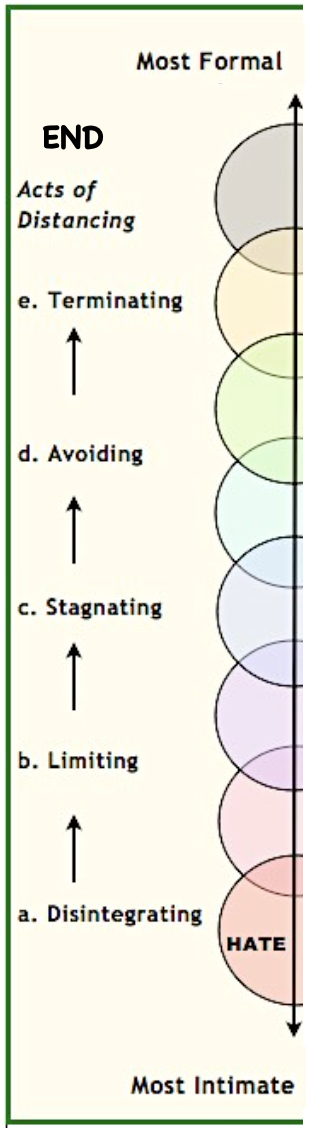
• The stages are listed ‘backwards’, from most intimate to most distant: #5 = Differentiation,  4 = Limiting,  3 = Stagnating, 2 = Avoiding, 1 = Terminating. The process applies to all types of relationships, not just romantic.

ENDINGS can be made by one or both parties:
When it’s mutual ….
a. …but not openly acknowledged:
both people become less & less interested & there’s a gradual fading of interactions.  There may be several attempt to -sort of- talk about it, & maybe one who is trying to fix it.
It can take a long time to actually end (this approach is more likely to be used by people with anxiety)

b. …and more direct: the couple is likely to have arguments or fights, each blaming the other, OR separation is negotiated & agreed on (less likely to try repairing)

When it’s one-sided ….
a. …if the end is in sight, & the ‘leaving’ person’s reaction is indirect – they’ll withdraw, avoid contact or get more annoying to be around, drop hints, try to be friends, manipulate
b. …if it’s more direct – the person will talk about what has gone wrong in the relationship, & is able to clearly say “It’s over”,  accepting reality

FOR ACoAs: Most of the time the ending of any relationship is painful & traumatic – from a job, an old friend, family member, sponsor, therapist… & even if it was with someone we met recently or with someone we barely like!

OVERALL COMMENTS will be in Part 3 & 4.

                              ▼   ACTS OF DISTANCING  
5. DIFFERENTIATING
Normal: Two people begin to notice a gap in their togetherness, less ‘we’, more ‘me’ statements. “Working together’ is gradually replaced by separate activities.

“I don’t see how you can like that group!”  <> “Well, I guess we’re not on the same page about that!” ,  “Why don’t we go dancing any more?” <> “You know I’m too busy”

Temporary separation is sometimes tried. The situation is uncomfortable & can lead to subtle disagreements or open fights, then more time apart….
This stage can occur when:annoying
• the relationship is still new-ish but the first idealized ‘bloom’ has worn off
• they’ve been together longer & one or both are disappointed in who the other turned out to be
OR
• something they first found macho, adorable, attractive… in the other person, now drives them crazy
• for longer-term couples, their personal interests may have caused them to grow apart
• with too much one-ness, togetherness – one person misses a sense of individuality, feels resentful, held down, maybe suffocated
💔

4. LIMITING (Circumscribing)
Normal: This stage has been called the ‘slow fade’, & is more likely to occurs in committed relationships, but not exclusively.
There’s a shift in the focus from each others’ differences to constricting & limiting communication, which decreases in amount & topics they talk about. It’s superficial, kept to ‘safe topics’ they know they can agree on, avoiding controversial subjects, iScreen Shot 2015-08-01 at 7.27.57 AMn order to prevent fights

This inevitably leads to less & less real sharing.
“Who was that on the phone?” , “What are we having for dinner?”  , “Do you like the food?” <> “It’s OK.”

• There’s a definite sense of not understanding each other any more, & their concern is with protecting themselves emotionally
• While still projecting a good public face as a couple, they’ve mostly stopped telling each other anything personal
 • Sexual intimacy disappears, & if there is fighting, it’s about not being heard.
💔

NEXT: Part 2: Terminating; ACoAs Leaving

‘GETTING TO KNOW YOU’ Stages (Part 5)


PREVIOUS: Part 4 – Intensifying

❖SITE:  Irritable Male Syndrome

BOOK: Enlightened Marriage (downloadable) ˜~Jed Diamond

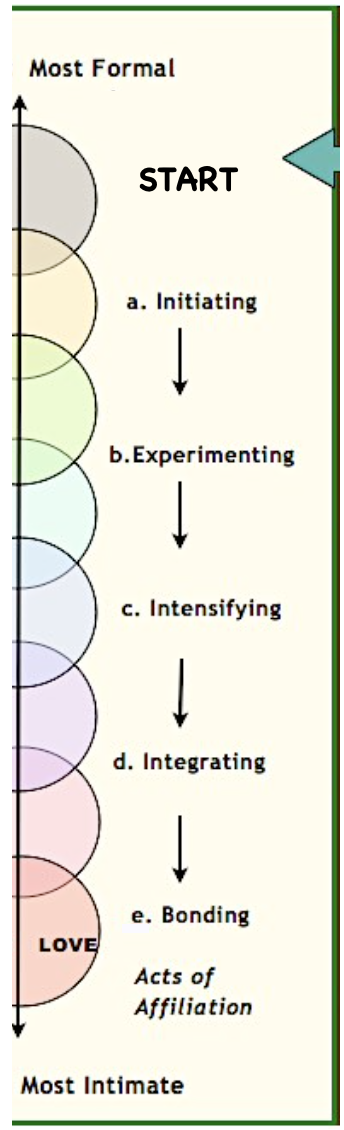
ACTS OF AFFILIATION ♥ (cont) indicated by Types of Communication
3. INTENSIFYING / 4. INTEGRATING

5. BONDING  (Long-term)
a. Normal:  The formalizing of the connection by a public ritual (a contract) whether by an engagement, a ‘moving-in-together’ party, a marriage, signing a lease, going into business together…..

“I think you’re wonderful.  I can see myself growing old with you.”  <> “Me too. Let’s move in together. We can talk marriage later”  •  “We’re in this together for the long haul” <> “I really want this to work!”

• The written or verbal contract is a framework for how the 2 want to & should proceed. In most cases this stage indicates a desire, need or willingness to gain social & institutional support — so the couple can rely on law, policy or precedent, when necessary

• Key points to maintaining a relationship from this stage onward, include : sharing power equally, emphasizing positive committedand constructive style of communication, and making frequent connections with one another
❣️ INTIMACY includes : a private world of rules & rituals, shared meanings, understanding & synchronous patterns of actions, similar ways of interpreting their world & agreeing on what makes their relationship work

• By this time the 2 people enjoy each others’ company, feel a deeper trust, comfortability, understanding & appreciation. Age is not a factor. It implies a genuine commitment to a common future & thus makes it harder to walk away from

• Successful long-term relationships also use ongoing ‘Navigation Communication’ to prevent problems, repair breaches, deal with the ups & downs of life & manage unpleasant surprises. People are willing to adjust, accommodate & compromise (not a dirty word) in order to maintain their unity

💔 However, this level sometimes changes the nature of the relationship & can cause it to disintegrate, especially if long-term spoken or unspoken expectations are not met

b. ACoAs: many do have long-term, formalized bonding, but even when there are good reasons to stay together, the relationship is often built on shaky foundations. EXP :

• reciprocal damage, where 2 wounded people fit each others WIC ‘needs’ – one pays the child, the other partner the mother or father role; one is controlling, the other passive; one is always angry, the other always fearful…personal development

• if only one person does healing work on themselves, they may be able to keep the dyad together, because of things they value in the relationship, AND because they’re not so reactive or wounded by the other person’s damage.
Also as they change, the old ‘games’ won’t work & the dynamic interactions will shift – often for the better

ideally, both people are willing to do Recovery work.  This may or may not save the relationship, but will of course greatly improve each individual’s life.
If there’s enough commonality between the partners (when the damage is lessened), the relationship can be re-built on a healthier foundation & grow into something precious!
🧡
OVERVIEW – Types of relationships

Source: “Relationship Typologies,” in The Cambridge Handbook of Personal Relationships 2006), pg 95. = C.A. VanLear, A. Koerner,  D. M. Allen


NEXT: Trying to leave #1

‘GETTING TO KNOW YOU’ Stages (Part 4)


PREVIOUS
: Part 3 – Experimenting


♥ ACTS OF AFFILIATION ♥ (cont) indicated by Types of Communication

2. EXPERIMENTING
3. INTENSIFYING

4. INTEGRATING  (Short-term)
a. Normal: This is when 2 people become a couple or close friends, emphasizing to themselves & others how similar they are. They depend on each other for confirmation & acceptance of self-concepts. Verbal statements change to indicate exclusivity & separation from others

• They feel unique, taking on each others thinking, style & mannerisms. The ‘we’ increase to ‘us’, with shared Intimacy & Trophies (the key, leaving clothes & toiletries, favorite book & music…) For some dyads, it’s the stage when sexual activity may begin (if they waited), & a deepening of self-disclosure

“…it feels like we’re one person!” <> “Yeah, we’re soul-mates!”  •  “I feel so much a part of you” <> “I know, like we have the same mind!”

coupleFriends from both sides are brought together & if they’re a couple, they’re treated as a unit, receiving one invitation, one gift, one email account…..
• While they may seem to be fused, it should not mean losing one’s individuality! This is crucial for a healthy relationship
• It’s also possible for people to love each other, be friends, partners or a romantic couple – for a while, but not make it permanent. They can remain friends & benefit from the time they spent together, but it’s not required

b. ACoAs: For those of us who get to this stage –
Re. Staying
• some of us are able to keep friends & lovers, but can have extreme ups & downs, huge fights, occasional separations….

• because ACoAs have so many unrealistic expectations of relationships, we can too easily become disillusioned & depressed, spending a lot of time being critical, suspicious, feeling unloved & generally dissatisfied, while not focusing on the benefit of being with this person – if there’s enough of it
OR
• because of denial, we are willing to just go along endlessly, putting up with & participate in unhealthy patterns with our partner, rather than outgrowing them

Re. Leaving
chained together• at this stage ACoAs may still assume the relationship will last forever.  If it doesn’t, we’re deeply shocked & devastated. We’re rarely prepared for yet another loss, not willing to notice the signs, not willing to let go

• by this time we may feel so enmeshed & trapped that we can’t get out even if we feel we want to (like not being able to leave our family, psychologically)

• we may be quietly or openly desperate to leave, but won’t because of
— our co-dependence, not wanting to hurt the other person, especially if they beg us not leave (altho they may secretly want out too)
— our FoA, believing that the misery of staying isn’t really so bad, compared to the unbearable pain of separation & loneliness

• if it’s a partner, & we’re determined to break up, but can’t do it directly, we may:
— start an affair with someone else, so we don’t have to go thru an ‘alone time’. Then feel guilty & anxiously wait to be found out, maybe confessing, as if we’re being honest
OR
— create a ruckus in the relationship – fighting, verbal attacks, withdrawal, the silent treatment, getting 3rd parties involved…..

📌 In either case, we’re trying to force our partner to do the leaving, knowing they’ll be hurt & feel betrayed, then we’ll secretly be the winner, while acting like the abandoned victim!

NEXT: #5 – Bonding

‘GETTING TO KNOW YOU’ Stages (Part 3)


I’M INTERESTED

what he’s saying

PREVIOUS: Part 2 – Experiment


♥ ACTS OF AFFILIATION ♥
(cont) indicated by Types of Communication 

3. INTENSIFYING (Exploratory)
a. Normal: ‘Partners’ start opening up, sharing deeper personal info, taking more risks.  Much more emotionally intense &/or passionate stage, using intimate language

“I love you” <> “Me too” ✥  “I think you’re the best” <> “ I’m glad we found each other”  ✥   “It’s great to be with someone with the same tastes” <> “Yeah, we have a lot in common. Makes me feel at home”

• Begin to use ‘we’, develop favorite palaces, nicknames, share / swap possessions, understand non-verbal cues, give gifts, idealize each other, even finding their flaws endearing.  People can be so excited with each other at this stage, they’ll spend hours talking – time passes quickly. There’s a feeling of exhilaration, & depending on the type of relationship, a strong sexual pull

This is the pivotal stage. Depending on whether or not both feel a chemistry (comfort, mutual value & excitement), and if the revealed info, attitudes & activities are sufficiently shared – people either continue to #4 & #5, or fall apart.

The connection at this point may be intense but short-lived, which is a shock to some who mistakenly assumed it would last because of the surface siminfatuationilarities & the emotional / sexual intensity.

➼  In some cases, there’s an intermediate stage called “Revising Communications” – when the euphoria has worn off.
The partners are able to review the strengths & weaknesses of the relationship from a more rational place, to see if they want to go on to the next phase. If they do, they begin working thru any problems or obstacles to further intimacy

b. ACoAs: we usually rush into this stage soon after meeting! Spoken or not, the communications is something like:
“Hi, my name is Sara, let’s be together forever!” <> “”OK, I’ll keep my eyes closed, as long as you make me feel good!”

✶✶✶ WARNING: ACoAs often misinterpret the ‘euphoria’ of this stage to mean there’s real intimacy happening! Spending every day for a week deeply immersed with a new friend or lover can end abruptly when they disappear on us!
Whatever their reason – they got scared, they feel suffocated… we feel conned, betrayed, angry… & are left with an acute sense of longing!

REALITY: We went too deep too soon, & now we’re alone – again!
• TYPICAL ACoA reaction: beside feeling rage, we obsessively ruminate on what we did wrong (S-H) without knowing what the real issues are! We either withdraw into a depressed ball or use all our energy to chase after them. We want the pain to stop & get back the HIGH. heart illusion

REALITY: WE got it wrong. Yes, the other person is also responsible for their part, but we can only deal with ourselves.  This is supposed to be stage 3, NOT instant love! It was not intimacy.

• HINT: if a ‘relationship’ develops too close, too fast – it’s likely NOT going to be healthy or real, but coming from both WICs!  ACoAs are addicted to fantasy & magic, as powerful as any chemical narcotic.
We have to work at going slowly or we’ll keep getting abandoned.

NEXT: Part 4 (Ingratiating)

‘GETTING TO KNOW YOU’ Stages (Part 2)

 GOING DEEPER!
Now we’re together forever – I think

 PREVIOUS: #1 Initiating

♥  ACTS OF AFFILIATION ♥ indicated by types of Communication

2. EXPERIMENTING (Potential)
a. Normal: Time for small talk, presenting our public face. The focus is on light, humorous, informative conversation:
“ Did you like Thai food?” <> “I don’t know – never tried it” . “I went to France this summer” <> “Really! I’ve always wanted to go there! Tell me about it”

• There is mutual attraction & also a desire to reduce uncertainly about one another. Telling more about oneself implies an increase in trust, & we expect others to do the same – so that neither will feel too vulnerable

• People use (secret) tests to check how attentive the other person is by how they respond to what we say (laugh at our jokes, respect our boundaries…).  Each has certain expectations of the other, which must be met for our interest to continue : being upbeat, neatly dressed, polite, interesting ….

b. ACoAs: People give us info about themselves all the time – by thchit chateir presentation, their actions & of course words — their tastes, interests, like & dislikes… and we need to PAY ATTENTION!
Yes, it takes months of regular contact to get a realistic picture of the other person, but we can glean a great deal from each conversation right from the beginning.

So after every encounter, always ASK:
“What did I learn about them? How did I feel when I was with them, & afterward? Are they moving too fast? How do they handle situations & other people?”
✶ How much are they truly reciprocating, or am I the only one sharing – OR only them?

If so – we can take that as a warning sign. They’re either too scared or too self-centered. If we proceed, we have to accept the consequences.
➼ This constant evaluation is crucial for us to do at each stage, because ACoAs have such strong training & defenses against seeing others accurately.  If the WIC likes someone AND they feel familiar (in some way like our family), WE may :

i.  be in ‘Lala Land’ = don’t want to know they may not be an appropriate fit, especially if we feel a very strong pull – so we idealize them, convinced they’re ‘the one’, or a BFF…  Actually, at this stage it’s just too early to know for sure

ii. get “the ICKs” (scroll down) = If we’re not quite comfortable with them, but they’re not blatantly abusive, we need time to find out if it’s becauselearn more
— the WIC &/or PP is acting up – with self-hate, lack of trust, old buttons triggered, our FoA, weak boundaries…
OR
— the person is actually icky in some way – their damage is showing & we’re picking it up, but can’t verbalize it yet
OR
— they’re genuinely NOT suited to our True Self, no matter how smart, competent, nice, or how much they may like us.
SO – we wait & LISTEN, hopefully with a clear, fair & open mind

IMPORTANT – Going slowly will allow us to:
• see how much like our family they are or aren’t (requires knowing ourself well, & paying attention to every interaction with the other person)
• find out if they are genuinely compatible with our Real Self
AND
• observe if they can truly see us for who we are, value, admire & respect us – realistically, not just for what we can give them
• how well or badly they handle our damage/ defects
AND
• what their character defects are, & how it will impact us over time
• see if the205108791ir positives outweigh the negatives (which everyone has), so that being with them will add value to our life
AND
• how capable & willing are they to take responsibility for their own life, so we don’t have to rescue or clean up after them
ALSO, if they have a spiritual life, is it internalized? does it show in the way they live? or is it just another band-aid or diversion from unresolved deeper issues

NOTE: When someone has too many negatives – no matter how much we like or love them – they’re unsafe to be with! Take stock & be honest with yourself. Get a trusted 2nd & 3rd opinion!  If we ACoAs are willing to take these stages a little at a time & ‘stay awake; with many of our relationships – we’ll save ourself a lot of heartache!

NEXT: Part 3 – Intensifying, Integrating