MBTI Type – ENFJ


PREVIOUS: ENTJ

SITE: Extra info per type experts don’t tell us


EXTROVERTS (EX)


ENFJ – The GIVER / Teacher / Advocate / Protagonist
E-Intuition-Feeling-Judging

Most PERSUASIVE – “Personal cheerleader”
• 1.6% males, 3.3% females

NATURAL
GOAL: To express. 
ENFJs have excellent people skills, believing in ‘people possibilities’ – with a real concern for how others think & feel.  Preferring to ignore unpleasantness, they see everything from the human angle, instead of through impersonal analysis. Interested in being of service, they tend to place the needs of others over their own.

Popular, sensitive & loyal, they’re responsive to both praise & criticism. Externally focused, they usually don’t want to be alone, & so can neglect their need for down-time, although when on their own they may fall into negativity. However, they can also feel lonely when around others, because of hiding parts of themself.

As leaders, they’re very effective at managing people, moderating group discussions, building consensus & being an inspiration. They see the potential in everyone, interested in helping others reach it. Highly responsible, they can get the most out of teams by working closely with them, & by making decisions that respect & take into account the values of others.

They’re : charismatic, collaborative, compassionate, driven, empathetic, idealistic, manipulative, passionate, supportive, talkative, warm.  And they don’t all want to interfere in your life. (More…)

Hidden Side
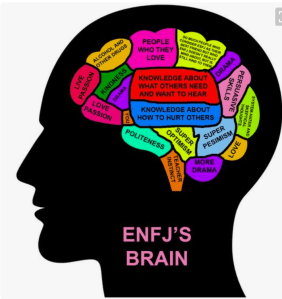
ENFJs tend to suffer from a poorer self-image than most E–Js. While their genuine concern for people is in their nature, over-focusing on others can be mislabeled as responsibility when it’s actually used to avoid dealing with their own problems.
Coupling a hyper-altruistic tendency with a weaker Si (their Stack’s Tertiary Sensing function) can make a mess of their life, but because their Fe (Primary Feeling function) is image-focused, they tend to be very good at hiding it. And they’re easily prone to vices / addictions, contrary to their goody-2-shoes image painted by most MBTI profiles.

Life’s Purpose: Bring love where there is hate
• Their Law: You shall always fulfill your dreams
• They Comfort others by saying: What’s wrong? Tell me everything – I’m here for you

• They Say: Rules are great – they help us be better people. I am loyal to anyone or anything I respect & admire. Do unto others as you would have them do unto you.
• Communication:  They’ll definitely start the conversation, & probably guide it too.  They’re warm & encouraging, but can be a bit overbearing. They should stop saying YES.

Weaknesses:  Fluctuating self-esteem, overly idealistic, struggle to make tough decisions, too sensitive, too selfless
Manipulate: Keep on smiling while ‘handling’ others to do what they want them to think/do/feel – but not to worry, it’s “for the greater good”  🦊
Paradoxes: Totally caring for others, yet their own feelings are more important than anyone else’s. Altruistic and intrusive.
Judge people: by their selfishness  • Fear: not able to help
• Are Judged for: not seengi other people’s point of view

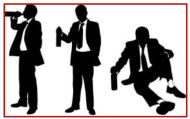
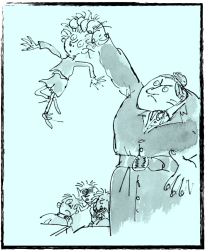
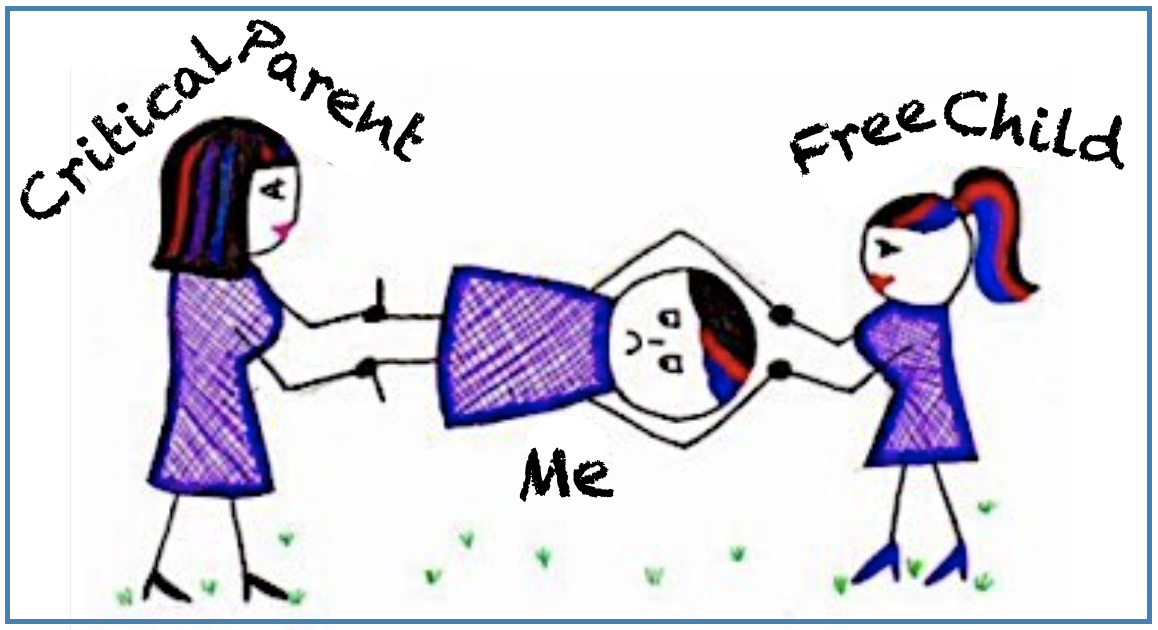
Become STRESSED from situations shown in the illustration.
ENFJs are likely to be disappointed by relationships they worked so hard to build. They stop being enthusiastic & passionate about those around them, then feel guilty about it. Believing they’re letting their loved ones down, as well as losing themselves, they take over all responsibility, trying to use logic to solve problems.

They obsess about not being seen as empathetic & loving. Highly sensitive to rejection & criticism, they work hard to keep up appearances, while deep inside they feel depressed & joyless.

If the stress continues or increases, ENFJs become pessimistic, rigid, & insensitive. Obsessed with escaping their guilt, they impulsively, inappropriately vent bottled-up emotions. Some may even abandon their loved ones or communities altogether, in search of a more inspiring environment.

• Hate: Anyone being closed-off. Being cheated on or abandoned. Cruelty, disharmony, unfairness & people being socially marginalized. Someone being really mean, & the ENFJ realizing they don’t have a sad back-story as an excuse. Asking for Help, because they think they’ll be a burden

Don’t argue with ENFJs when they’re holding: A conversation
• Never antagonize them.   • Never tell them: Your friendship means nothing to me

GROWTH
Advice:
Don’t assume you know someone well when trying to help.
ENFJs talk a lot, & may be discouraged if they don’t get a lot of feedback from others. They also expect everyone else to give as much to tasks as they do, but may overlook logical, factual realities when making decisions.

They find conflict & lack of consensus hard to deal with, so take on the burden of being responsible for others’ success or failure, which gets to be too much. They must work at letting go of control & guilt – permanently, especially when they can’t save someone – which is not the ENFJ’s fault. It’s best if they focus on themself, since they already have all the intuition & info needed for personal growth.

ENFJs can reduce stress by cultivating their own identity apart from society’s expectations & predefined roles. By exploring & loving their own interests & potential, they become less concerned with public approval. Then they’ll be able to appreciate their considerable talents & gifts, & be open to a wider mix of people & experiences (More….) 
ENFJ Relationships
You quickly understand the emotions of others & focus on encouraging their growth. Partners & friends will see you as gracious, expressive & congenial.

• Thrive in any situation that: Encourages mutual personal growth (More...)
• As a Friend, you’re the one who’s never available because you’re busy talking to everyone else & doing favors for them

Annoyed when: someone can’t see your point of view

ENFJ Parent, child of ENFJ, ENFJ child

• Still single because: playing the mentor has taken all the mystery out of you
• Unhealthy behavior: Stalk your S.O.’s ex on social media at 3a.m.
Show interest by: Trying to be ‘perfect’ for them
Show Love: Give time & affection, want to process emotions, explore & grow –  together
• You want to hear: I’m with you

• You’re attractive/sexy because: you have a warm & uplifting spirit – you can’t be missed. Like the sun, you radiate certainty in yourself & your devotion to those you love make you incredibly you incredibly attractive

• You should DATE someone who : can make you feel loved & cared for, who can take charge if necessary, & surprise you with romantic gestures.

• To attract you someone needs to : act like the bad boy/girl, but show glimpses of deep emotions. Who’ll make a great effort to figure you out & bring out the best in you.  (More….re. Turn-ons)

• Some Famous ENFJs : Barack Obama, Ronald Regan, Oprah, Diane Sawyer, Dick Van Dyke, King David (Bible), Andy Griffith, Ross Perot, Michael Jordan

NEXT: Co-dep vs Patience

MBTI Type – ENTJ


PREVIOUS: ENTP

SITE: How to attract each MBTI type


EXTROVERTS (EX)


ENTJ – The EXECUTIVE / Chief / Mobilizer
E-Intuitive-Feeling-Judging

Most COMMANDING  – “World Dominator”
2.7% males, 0.9% females

NATURAL
GOAL: To strategize.  
ENTJs are assertive, decisive, outspoken & straightforward. They’re driven to be in charge, readily stepping into leadership roles, & express their ideas forcefully. They value knowledge & competence, with little patience for inefficiency or disorganization. Intelligent & well-informed, they usually excel at public speaking.

They’re career-focused, & live in a world of possibilities, viewing problems as challenges to overcome.  Excellent at understanding difficult organizational problems, they can create solid solutions.  Because they see the big picture & think strategically about the future, they can efficiently mobilize people & resources to meet long-term goals.
Although not naturally tuned into others’ feelings, they can a have strong sentimental streaks.

They’re: authoritative, calculated, challenging, efficient, intense, questioning, strong, strategic, structured.  But not all are bossy & narcissists.

«
Hidden Side : They’re usually not Machiavellian. Their strong sense of individualism often extends to others, making them respectful of others’ uniqueness – using their brave, outspoken nature to amplify the voices of others who may be unheard. They’re often the ‘bully’s bully’ – if they see someone being picking on who can’t fight back, you can bet they won’t hesitate to put that offender in their place. They may seem tireless & unsinkable, but when they don’t live up to their own standards, they’ll temporarily withdraw from their efforts to regroup

Life’s Purpose: Thrive in the impossible
• Their Law: You shall always obey my orders!
• They Comfort others by saying : You don’t have to be sad – we’ll get ice cream or something

• They Say: I make the rules. I’m in charge here! You can’t make an omelet without breaking eggs. I can be tough when the situation calls for it
Communication:  They’ll start the conversation if you catch their eye, but you may be doing something they don’t like, so be prepared to run.  They should stop talking about world domination.

Weaknesses:  Arrogant, cold, controlling, dominant, impatient, intolerant, ruthless, stubborn, deny & mishandle emotions
Manipulate: Make others seem less-than with their holier-than-thou attitude, & treating everyone like pawns in their personal life-game

Paradoxes: Leader & stubborn. They’re good at organizing others, & their plan is always better than yours.
Judge people : by their competence  • Fear: Of intimacy
• Are Judged for : not being competent at ‘doing’ life

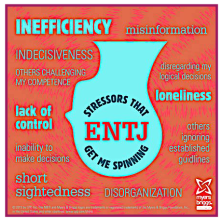
Become STRESSED from situations shown in the illustration.
ENTJs believe the source of their distress is totally outside themself, so they’re quick to blames others for their problems. They see people as needy & illogical, & systems or organizations as inefficient & hindering. They think everything & everyone is holding them back, afraid of being crushed underfoot, so they feel compelled to take matters into their own hands & set things right.

This makes them controlling, stubborn & insensitive to the delicate human element – which includes people’s emotions, ideals & limitations. Feeling increasingly stuck in a frustrating situation, ENTJs will feel out of control & act on gut impulses – such as physical & verbal violence, manipulation, sexual addiction….

• Hate: Being wrong, close-mindedness, failure, immaturity, not being listened to, people who are ignorant or won’t work together, having to handle something with kid gloves. Someone getting into a position of power over them who is really dumb. Asking for Help, because they’d rather do it their own way

Don’t argue with ENTJs when they’re holding: you in high respect
• Never ignore them. • Never tell them: I want you to redo everything – this just isn’t good enough.

GROWTH
Advice:
There is more to ‘stupid people’ than you think.
ENTJs live in the dog-eat-dog world (often of their own choosing), driving themselves strongly, so they unfairly expect the same from others, intimidate people with their take-charge attitude.
They often overlook the contributions of others, ignoring the emotional needs of the people who implement their plans. To soften their harshness, they need to cultivate a confidant or small group of trusted supporters.
Also, playing games in their personal life is a waste of precious time. Finding the right mate may not be easy, but worth the effort. Until then, it would benefit them to get involved in something altruistic or ‘spiritual’ – to cultivate empathy & patience.

ENTJs need to accept that life’s imperfections & everyone’s subjective experiences (emotions) – are normal & natural. Logic is not the answer to everything, so insisting on it only creates an irrational, distorted worldview, causing frustration & disappointment.

ENTJ Relationships (More….)
You enjoy & are energized by stimulating interactions with people. You’re seen by your partners & friends as decisive & fair

• Thrive in any situation that : has shared long-term goals (More…)
• As a Friend, you’re the who’s always commenting on everything that everyone does  • Annoyed when: someone’s not very good ‘at life’

ENTJ parent, child of ENTJ, ENTJ child

• Still single because: you’re too busy building your empire
• Unhealthy behavior: plant a keylogger to track your lover’s texts

Show interest by : Being hyper-critical 😦  (cleverness??)
Show Love : You give time & attention, offer advice & help, help them plan
• You want to hear: I’ll follow you

• You’re attractive/sexy because: you’re usually charismatic, calculating & confident in thought & deed – knowing what you’re doing, & pursue goals without second-guessing yourself. It makes others feel safe.

• You should DATE someone who : you can take care of & teach them how to be more practical. But also someone who can keep your ego in check, who helps you get in touch with a wider variety of emotions, & can teach you to be more sensitive to other people’s feelings.

• To attract you, someone needs to : have a strong character but not stronger than you. Who will assure you that being with them is a low-risk investment that will yield a sizable emotional return.

• Some Famous ENTJs: Presidents FDR & Nixon. Al Gore, Margaret Thatcher.  Harrison Ford, Steve Jobs, Dave Letterman, Whoopi Goldberg, Sigourney Weaver

NEXT: ENFP

MBTI Type – ESTP


PREVIOUS: Introverts vs Extroverts

SITEEach MBTI type as enemy


The EXTROVERTS (EX)

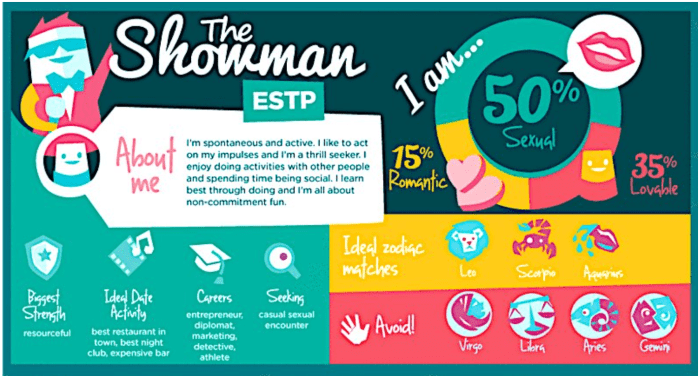
ESTP – ENTREPRENEUR / Doer / Persuader
Ex-Sensing-Thinking-Perceiving

Most FUN  – “Adrenalin junkie”   • 3.0% females, 5.6% males

NATURAL
GOAL: To win. 
ESTPs are adaptable & action-oriented, who like to take a practical approach to problem-solving that will produce immediate results.  They apply common sense & experience to problems, quickly analyzing what’s wrong, & then fixing it, often in an inventive or resourceful way. Living in the here-and-now, they’re risk-takers who live fast-paced, traveling the world. They tend to be bored by abstract theories, impatient with long explanations, & learn best by doing. 

They have great people-skills – friendly, outgoing straight-shooters, & extremely loyal to their peers. Are good at picking up on little clues about others’ personalities & feelings, & can motivate people by bringing energy into situations. They’re not usually respectful of laws & rules if those get in the way of accomplishing a goal. ESTPs leap before they look, fixing their mistakes as they go rather than being idle, but do prepare contingencies & escape clauses.

ESTPs are: charming, confident, crude, fearless, logical, spontaneous, trustworthy, unconventional. And not all are obsessed with sex. 

HIDDEN side
Surprising to some, ESTPs value book-smarts & often enjoy conversing with Rational types. They may not grasp ‘heady’ concepts as easily (nor apply them responsibly), but they find philosophical topics stimulating – just another piece of equipment in life’s big playground. While they’re naturally persuasive, they’re not usually interested in corporate & political arenas where they could thrive. Ladder-climbing in organizations doesn’t appeal to them – in fact, many ESTPs cringe at the very idea, so they rarely pursue those career tracks.

Life’s Purpose:  DOing when others don’t
• Their Law: “You shall always live in the moment!”
• They Comfort others by saying: “Alright…..So you’re sad. Why is that?”

• They say: I get more from first-hand experience than from study. Rules are made to be broken – so watch me break them! Life’s either a daring adventure or nothing at all
Communication: They’ll talk whether someone likes it or not – look out world! They should stop talking about ‘nothing’.

• Weaknesses:
Defiant, insensitive, impulsive, impatient, misses big picture, risk-prone, unstructured, contradicting themself
Manipulate: Frustrate others because – one day they’re hung-ho about a life-changing project or promise, then lose interest the next day

• Paradoxes: (Un-developed ESTP) Know they shouldn’t, & do it anyway. Bold & undependable. Think they’re funny, but only to those who are similar
Judge people : on their ‘smarts’  • Fear: Of commitment
Are Judged for: not taking life seriously

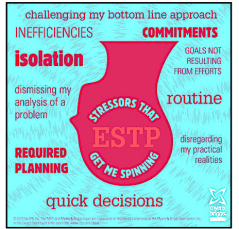
Become STRESSED from situations shown in the illustration.
Under stress they act first, figure things out later. They deal with problems & frustrations by going after more & more external stimulation & adventure (similar to EnneaType 7s). When disappointed or restless, they think it’s time to re-create their (lagging or previous) successful public persona. They either find a new audience to charm, or resort to some grand gesture to reinforce their image & make them feel desirable/popular again (Ennea #3)

However, internally they suffer from a deep sense of emptiness, so intimacy becomes almost impossible, as they get increasingly detached from true emotional connections. As stress mounts, they get more agitated, chronically anxious, distracted & paranoid, but overactive, frivolous & too concerned with people’s opinions of them.

• Hate: Authority.Asking for help – it makes them feel stupid. Limits. Conventional or monotonous situations. Over-sensitive people. Constantly being asked ‘how they feel’ about things. Forced to ‘tone it down’. Stupid people. When someone wants a heart-to-heart talk just as the ESTP is ready to go out for some fun

• Don’t argue with ESTPs when they’re : holding the door open for you
• Never: Dominate them.  • Never tell them: Nothing you do is very impressive

GROWTH
Advice: Keep your promises, or don’t make them at all.
ESTPs tend to have trouble managing their time, so they can lose interest in long, complex projects. Being so focused on immediate problems will lead to ignoring long-term ongoing issues. They live for excitement!, being the life of the party, thriving on adrenaline!  However, periodically taking some time to shut out the world – & writing down all their adventures – could help to create much-needed balance.

ESTP Relationships (More….) 
Many ESTPs are uncomfortable focusing on, exploring & talking about relationships. They need to take time to consider their true priorities, & to realize the effect their choices have on others around them. When they take responsibility for their actions & acknowledge their importance in a larger context, they become more stable, reliable, & emotionally honest.

You truly love life, immersing yourself in it. Partners & friends experience you as adventurous but also pragmatic
• Thrive in any situations that are: fun & easy-going (More….)
• As a Friend, you’re the one obsessed with that‘ thing’, & will. not. stop. talking. about it!
• Annoyed when: someone never wants to go outside

ESTP parent, & child of ESTP, ESTP child

Still single because: it’s your choice
• Unhealthy behavior: Cheating

Show interest by: Being awkward
Show love: You’re attentive to their comfort, will motivate & boost their courage
• You want to hear: I’m excited with you

• You’re attractive/sexy because: Something about your down-to-earth, hands-on style is tantalizing – you ooze ‘tactile’. It’s hard to resist your passion & will-power
You should DATE someone who : won’t take your occasional stream of b.s. Who’s intelligent & can stand up to your know-it-all attitude. Who can keep you from taking too many risks, but lets you be yourself, & can also keep you excited

• To attract you (men?), someone needs to: Act sweet, wide-eyed, impressed with everything you do. Your ego will respond well to their fuel.

FAMOUS ESTPs: Donald Trump, cowboy Roy Rodgers, actors Eddie Murphy, Madonna, Bruce Willis, Biblical Jacob (OT) & Peter (NT) (More….)

NEXT: ESTJ

Myers-Briggs INTRO (Part 2a)

PREVIOUS: MBTI Basics #1b

SITE: How Each Myers-Briggs Type Reacts to Stress (& Help!)

NOTE: Each dichotomy is on a continuum, from most….<— to —>most…..

OVERVIEW
The 2 ‘OUTER’  levels (E-I & J-P)

1. EXTROVERSION (E) vs INTROVERSION (I)
Where we prefer to put our ATTENTION, & get our energy from
Extroverts
focus on what’s happening in the real world around them – always in the present moment. Outward-oriented, Es get their mental energy by being around other people & in social situations. They think out loud, so can be quite talkative.

Strongly Extroverted people will gravitate to big events such as rock concerts, have season tickets to sporting events, go to big parties, conferences, loud family gatherings…. energized by conversations, excitement, noise, activities…… After a big events, they’ll look for the stimulation to continue, going on to another location &/or hanging out with friends

EXP: Es can get into a lively discussion or debate while paying attention to what everyone is saying / make a meal for a party / participate in a rally / play a group game / join a study group / lead a class …..
— 💋 —
• Introverts focus on what’s going on inside their mind, which can involve the past, present or future events. They’re usually more private, contained & a lot quieter than Es, but internally very ‘busy’. They get their mental energy from being alone, needing privacy to recharge, preferring to work through ideas by thinking about them first, before expressing them out loud. Large groups of any kind are draining.

Is still need & like people, but want their interactions to be a lot less noisy, less crowded & less chaotic. They can also be found at big events, along with the Es, but after all of that external input they can’t wait to get away & regroup in a quiet environment. If possible, they’ll leave early. And unless they really love it – or if work requires it or family insists – they’re not likely to repeat the experience.

Instead they do very well with 1 or 2 close friends or small groups, because their neuro-chemicals more sensitive. (See Posts ‘MBTI & the Brain’).

This characteristic even shows up in shopping – for an I to be in a store or mall with too many options to choose from  – like ‘Bed, Bath & Beyond’ – can feel just as confusing & overwhelming as being in a boisterous crowd (“Pick me, no pick me., no me…”) !!

EXP:  Is can get caught up in a good book / think about what they’re going to say or do / are aware of how they feel / daydream or imagine / think through a problem to understand it / review & process an interaction they’ve just had ….                                      4. JUDGING (J) vs PERCEIVING (P)
Preferred way of DEALING WITH the world around us,
& can be either Introverted or Extroverted

Judging (J) – These people prefer to be in charge, tend to be highly organized & methodical.
They’re neat, orderly, stable, & like to make extensive use of lists & calendars. They want things to be settled – so they plan & get things done way ahead of time.

EXP: Someone who form & expresses judgments / brings closure to an issue so they can move on / picks places to go ahead of time by doing research / concentrates on reaching goals & ‘doing’ their lists…..
— 👠 —
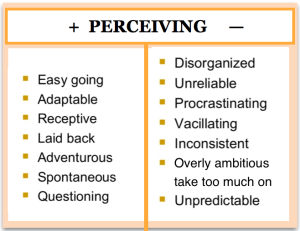
Perceiving (P) – These people prefer to let things play out by themself. They’re usually spontaneous & flexible, having a more open-ended approach to plans, deciding their next move in the moment, & tend to get things done at the last minute.
EXP: People who postpone decisions to see what other options are available / decide what else to do as we’re doing it, rather than forming a plan ahead of time / do things at the last minute / do a lot of research but not act on it because we can’t decide…..
NOTE: The practical differences between Js & Ps are quite noticeable & sometimes cause a lot of conflict.
EXP : A strongly J person can become very frustrated by a P’s careless casualness or indecisiveness, while a strong P can feel limited & controlled by a strong J , BUT even so will may make use of the J‘s extensive planning & preparedness (like on a trip), which can cause the J to feel angry for being taken advantage of!
On the other hand, a ‘mixed’ couple (one of each – friend, spouse, biz  partners…. ) can be complementary if they’re both mature enough to accept their different styles, & use those to accomplish mutual goals.

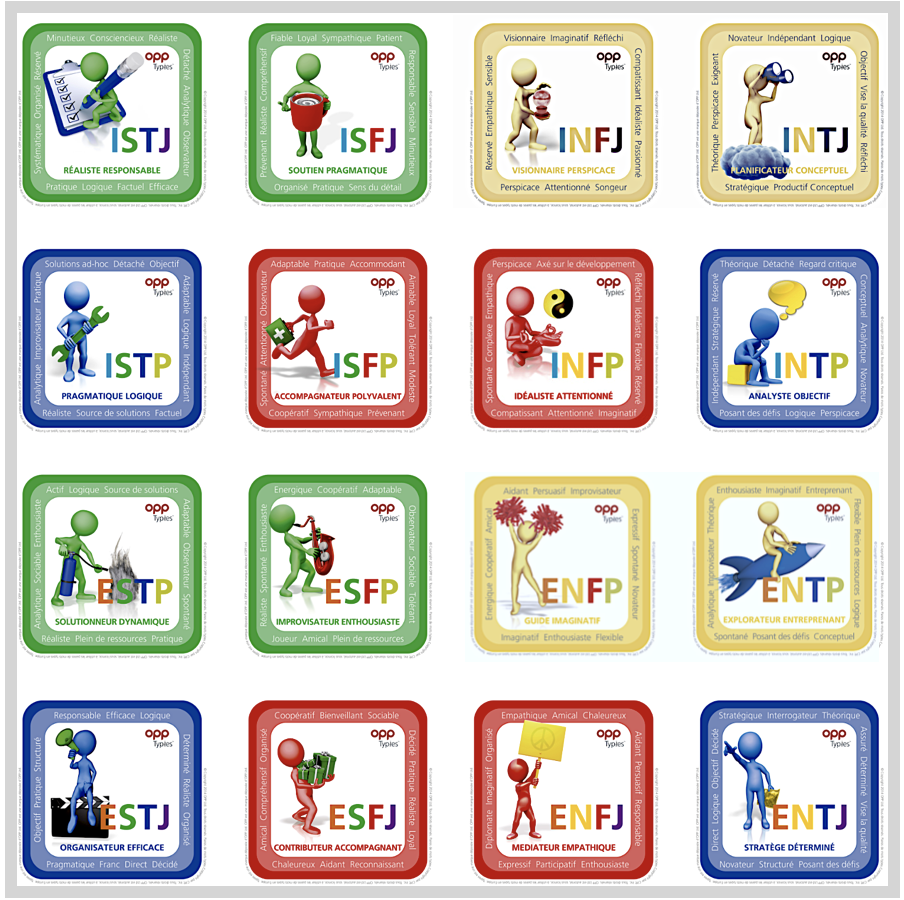
The 4 MBTI levels combine into 16 types, 8 Introverted & 8 Extroverted

«
 NEXT: MBTI Basics #2b

Mental Health DON’Ts – Emotional (Part 1b)

Screen Shot 2016-07-03 at 1.37.13 AM
MENTAL HEALTH
is easy – and fun!


PREVIOUS: EHP – Part 1a


SITE: Physiology and Biology of Mental Toughness


REMINDER: To be Mentally/ Emotionally well we need to develop the Healthy Adult & Loving Parent (UNIT). What the “Don’ts” represent are characteristics of our damage, run by our WIC (Damaged Child) & PP  (Introject) – but can be corrected.
Understanding the specifics of our childhood traumas helps to accept the reality that we can’tJust do it’ or ‘Just let go’. All of Recovery is a process – for everyone.
ALSO, each of us will have our own specific issues that are definitely more deeply ingrained than others & will therefore take longer to heal. Some will never go away, but can be greatly diminished, & we can learn to manage them whenever they do surface.

EMOTIONALLY HEALTHY People (EHP):
🔸EHP Don’t thrive on chaos
Successful people simplify life. They know that having as much order as possible in all parts of their life allows then to accomplish their goals, & not have to waste time looking for things or dealing with emotional drama.happy/sad

🔸EHP Don’t try to be happy all the time
One of the coping mechanisms for ACoA is the try to be ‘UP’ or ‘positive’ all the time. This usually applies to the Hero (Toxic Role) or the “Good girl/boy” false persona. This is as unrealistic as being miserable all the time. It’s just another way to deny having a wide range of emotions. For every ACoA, no matter our style, our underlying emotion is fear/terror. So we try to feel safe before we can truly be happy.

No one is happy all the time. Feeling peaceful & content – a day at a time – does not mean having no complaints, dislikes or distress. EHP don’t try to avoid painful emotions but incorporate them in an effort to be whole, to honor their True Self. They know that happiness, victory & fulfillment are a wonderful, valuable part of life, but not the whole story.

EHP learn from their ‘mistakes’ & correct distorted thinking, so avoid repeating harmful patterns. This may include making amends to others (AA’s 8th & 9th Steps) & forgiving themselves for ignorant or stubborn adherence to their Toxic Rules, so they no longer have to obsess about what happened in the past.
EHP know this takes time & need patience & perseverance to always be moving forward, no matter how slowly. One 12-Step slogan says: “Look back but don’t starelive in the present”.

Some benefits from thinking about the past can be: identifying the lessons, considering facts not just emotions, & looking at PPT from a new perspective.

🔸EHP Don’t violate / sacrifice personal values
Each of us have more than one value system – what we were taught by our family, by our religion, our early social environment, AND what we develop in ourselves from our Core Truth. Some of these may overlap, some may not. The problem for ACoAs is that we are either not allowed to find out what we truly believe, or more often have been so brainwashed by our toxic upbringing that we’re not allowed to live according to our personal beliefs even if we know what they are. (Core Values lists)

EHP have figured out what they consider important – even essential – to their identity, for themselves & in relation to the rest of the world. A value is a belief, a mission, or a philosophy that is meaningful but not always conscious – as many are taken for granted. They know that their personal Core Values are not automatically the same as that of other people or institutions, & they don’t try to impose them on others.

They do NOT value the impossible, like perfectionism, eternal human love, fairness…. They know everyone falls short sometimes, so they get back on the horse when they don’t live up to their ideals, & are also patient & forgiving to others when they also fall short.

NEXT: MENTAL health Don’ts, 1c

Mental Health DON’Ts – Emotional (Part 1a)

live wellLIVING WELL
is the best revenge!

PREVIOUS: Psych Disorders #6

SITE: 10 Things (physically) Healthy People do differently

SOURCE: Composite of many lists, including Amy Morin’s “13 things Mentally Strong people Don’t Do.” – about being in charge of our thoughts, emotions & actions (T.E.A.)


EMOTIONALLY HEALTHY People (EHP)
:

🔸EHP Don’t Avoid Alone-Time
Many ACoAs are addicted to relationships & to staying busy, no matter how unsatisfying or damaging. They always need to be with or around someone, rescuing others or creating chaos, running away from themselves or desperate to hang on. They never seem to slow down enough to feel emotions, evaluate their motives or stop self-defeating behaviors.

ACoAs in Recovery often say they don’t know what to do with unstructured hours – because it’s for just themself. They feel depressed, too lonely, can’t decide what to do, aren’t allowed to have fun or relax….. wasting precious time on weekends or holidays, & then go back to their rat-race. Even those of us who are highly accomplished & talented are motivated by fear, rather than self-esteem.

But EHP treasure time by themself – to reflect, plan ahead, have alone timefun, be creative, do something not related to their work-life, OR just rest! And there are times when it’s truly necessary to pull back in order to allow internal healing, but it’s not endless.

EHP don’t need others to give them a direction or make them feel OK. They can be happy with others, but also happy alone. They’re comfortable with their thoughts & emotions, & when stressed they know how to comfort themself. They know that changing their routine or ‘vegging’ is crucial to mental & physical health. They know that play is part of a well-balanced life, so don’t need to be constantly ‘producing’ something to validate their existence.

🔸EHP Don’t Feel Pessimistic
ACoAs are more likely to see themself (S-H), others & the world from a negative point of view (hopelessness & some paranoia). The adults we grew up with either ignored us or were judgmental of everyone & everything, so we took on the same perspective. This means ignoring all the positive things available in life, including the good things that we have experienced.

EHP generally feel optimistic about their life & their future, without ignoring stresses or hoping for magic outcomes. They don’t let temporary difficulties or unimportant annoyances get them down – at least not for long. They know that obstacles are part of life, so they make an effort to solve whatever they can, & accept what they can’t change (Serenity  Prayer – backwards??).feel positive
They don’t focus on their weaknesses – while still acknowledging them. No one can be perfect, so they don’t waste time trying. Instead, they continue working on improving themselves rather than feeling defeated.

🔸EHP Don’t Feel Sorry for Themself
There’s a difference between feeling sorry for ourselves & healthy compassion for all we’ve been thru. The Victim’s outlook is that they can’t function because of being abused. While their childhood trauma was real, as adults they refuse to work on healing those wounds, which would improve their present & future. Their ‘position’ is that as long as they’re ‘incapacitated’ someone else will have to take care of them. If no one does, they stay helpless & depressed.

🔸EHP compassionately acknowledge past distress, while fully accepting the unfair & painful truth that they’re responsible for cleaning up the PMES mess their unhealthy family passed on.  compassionThey’re able to emerge from stressful circumstances with self-awareness & self-respect, even appreciating the lessons they’ve learned. When things don’t go well in the present, they find realistic ways to manage, get the support they need, & believe in their worth – no matter what.

They ALSO know it’s OK to feel sorry for oneself briefly from time to time, especially after an event that’s out of their control. It’s important to lick their wounds to regroup & regain strength, before moving on. EHP have gratitude for their positive qualities & the good thing they already have.

NEXT: EHP – Part 1b

Psychological DISORDERS – PDs (Part 4c)


IF I REALLY WANT TO GROW
I have to crack thru my walls

PREVIOUS: Disorders #4a

SITEs : PDs PLAY DEFENSE
• EnneaType DEFENSES


2. NEUROSES


3. PERSONALITY DISORDERS (PDs)
(cont.)

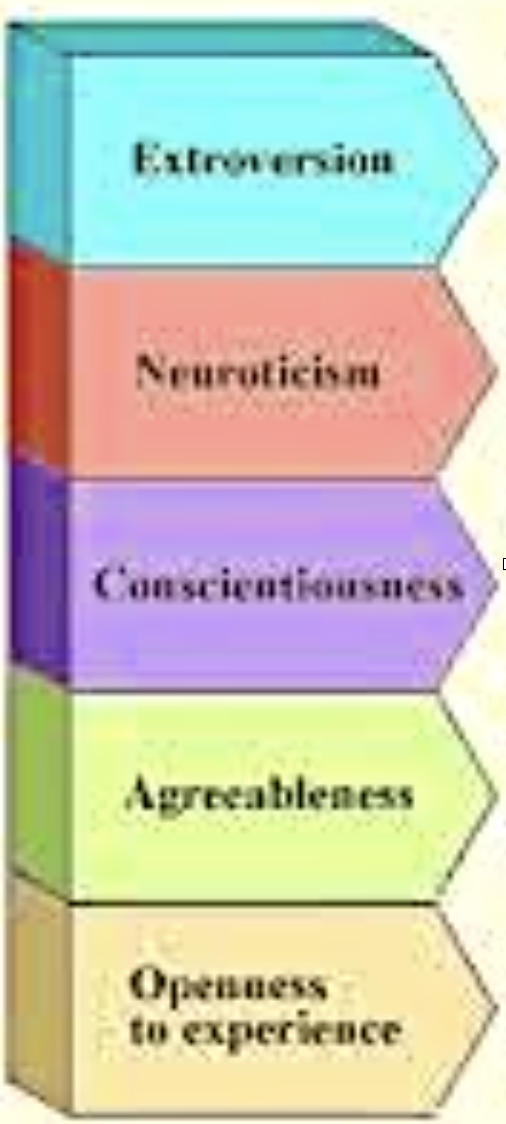
The Five Factor Model (FFM) groups human characteristics into:
1. Openness – re. Intellect
2. Conscientiousness – re. dependability
3. Extroversion – re. hi levels of positive emotions
4. Agreeableness – re. sociability
5. Neuroticism – re. emotional stability  (MORE…. w/ assessments)

SIDEBAR: A study of 468 young adults at risk for becoming alcoholics used a questionnaire based on the FFM.  It was designed to correlate: risk for alcoholism, alcohol-use disorder, & alcoholism subtyping . Some results:
• Familial risk for alcoholism was positively associated with openness, and negatively associated with agreeableness & conscientiousness.

• Alcohol use disorders were positively associated with neuroticism, and negatively associated with agreeableness & conscientiousness.

With the exception of family alcoholism, & a dual diagnosis with Antisocial PD  • all other alcoholic subtypes related to at least one of the 5 FFM.

E.M.Jellinek’s (1960) 5 SUBTYPES of alcoholism :
🍷ALPHA : Based in mental & emotional problems, drinking to drive away depression, stress, or anxiety
🍷 BETA: almost daily heavy drinking, leads to various physical & psychological symptoms
🍷 GAMMA: sudden cravings for alcohol after 1 or 2 episodes of ‘social drinking’, becomes continual drinking, drunkenness & full-fledged alcoholism

🍷 DELTA: the habit of drinking small amounts throughout the day, without ever really getting drunk. Like Gamma, but with inability to abstain, instead of loss of intake control
🍷 EPSILON: ‘periodic’ – drinking at regular intervals until they pass out completely – called dipsomania, but are sober more often than drunk

ALSO: 5 types of alcoholics, re. ‘Progressive Symptoms

PD develops from :  Environmental, genetic, pre-natal factors, as well as unhealthy parenting (no affection + harshness). Pathology is the extreme reverse of the BIG 5 :
1.PSYCHOTISM (➖ Openness – mental lucidity)
Eccentricity / Unusual or unrealistic beliefs & experiences

2. DIS-INHIBITION (➖ Conscientiousness)
Distractible / Impulsive / Irresponsible / Rigid perfectionism / Risk taking 

3. DETACHMENT (➖Extroversion)
Avoid intimacy / Depressed – long term / Joyless / Limited emotional range / Suspicion-paranoia / Withdrawal

4. ANTAGONISM (➖Agreeableness)
Attention seeking / Callous / Deceitful / Grandiose / Hostile / Manipulative

5. NEGATIVE AFFECT (➖ Neuroticism – emotional stability)
Anxious / Over-reactive w/ mood swings / Persistent talking or movement / Hostile / Submissive / Separation anxiety
💚
PDs & DEFENSES 
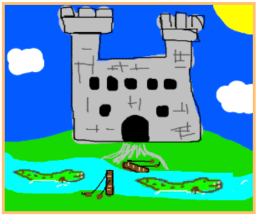
In the present – staying entrenched in defenses means the walls of the castle are high, the gate is up & the alligators are in the moat.
This makes it very unlikely you can take in another point of view – which is all that matters to you – (such as aBR), to keep everyone from adding to your vast pile of insecurities.
Where are your INNER archers & guys with the vats of boiling oil? 

NEGATIVE Toxic Beliefs lock us inside our armor, keeping us from being flexible in our thinking or adaptable in our actions. They lead to a defensive stance in life, as a dysfunctional way of protecting ourselves. Each PD can use one or more Defense Mechanisms to maintain their False Self .
EXP: NPDs & Anti-soc PDs share mirror image-distorting defenses – such as Omnipotence or Devaluation
— NPD uses Splitting of self-images, & Anti-Soc PD uses disavowal defenses like Denial
— Borderline is also strongly associated with image-distorting defenses, mainly Splitting & the hysterical level defenses of Dissociation & Repression

The following list is similar to the one in Part 4a, but here it’s referring to core statements which are each type’s defense (7 out of the 10 PDs, including defensive statements, as well as healing goals for each)

AVOIDER: “I don’t want to be hurt, ever, because I can’t bear it”
BORDERLINE: “No one is allowed to leave me, no matter how much I mistreat them”
DEPENDENT: “Please take care of me”

HYSTERICAL: “Please pay attention to me
NARCISSIST: “Please help me achieve success because I’m special”
OCD : “I act right & the world would be a better place if everyone else did too”
PARANOID: “It’s important to keep myself safe – people are not trustworthy & the world is dangerous”
«  

 NEXT: Disorders 5a

Psychological DISORDERS – PDs (Part 4b)

TRYING TO BE SOCIAL
is such hard work!

PREVIOUS: Disorders #4a

SITE: ‘Somatization’ & Psych terms used as swear words

HUMOR: 35 Undiagnosed Medical Conditions of Disney Characters 

1. NORMAL // 2. NEUROSES

3. PERSONALITY DISORDERS (PDs) (cont)
PDs describe types of ‘damage’ in adults who have long-standing problems in forming deep, meaningful, positive relationships with others. These people often show unusual, rigid or extreme patterns of thought, emotional reactions, &/or impulsive behavior, which consistently lead to problems for themself & others

● The brain uses Self-concept as a guide for interpreting the world. People with this diagnosis have a wounded core identity. How dysfunctional they are depends on how intensely they act in self-defeating ways.  
= At one extreme – some PD people assume they’re invulnerable & have a right to feel superior. They’re insulated in their carefully built shell of defenses, and flatly deny having a wounded core

= However, most feel empty, bad, ‘not right’ in their basic sense of Self.  Their sense of badness has a physical quality – as if it’s in their very bones or cells. They they truly believe it they’re not, & say there’s never been a time when they felt OK.
Transactional Analysis theory explains that this sense of wrongness comes from their WIC’s child parts (C1 or C0) – the most vulnerable aspect of personality. So this feeling is ego-syntonic – it ‘makes sense’ to them on a gut level, with no inner conflict, as there is with neurotics. So the damage started very early, likely at birth (Co).

Using the Gestalt technique, if we visualize putting a person’s Adult & Parents voices in 2 opposite chairs, & imagine the Inner Child between them, we ask the person “How do you feel about your IC?” Most people will have a fairly positive reaction.
In contrast, many PDs will say they hate their child – that it’s ugly, dirty, disgusting, full of needs ….. expressing their ingrained sense of worthlessness (typical of many ACoAs!).

💚 SIDEBAR: There is now a “Grand Unified Theory” of psychology (GUT) the relationship between psychology & neuroscience …..which clearly defines how the field relates to other disciplines (biology & sociology….) . It’s made up of :
1) the Tree of Knowledge System // 2) the Justification Hypothesis
3) the Influence Matrix  // 4) Behavioral Investment Theory (MORE….)  
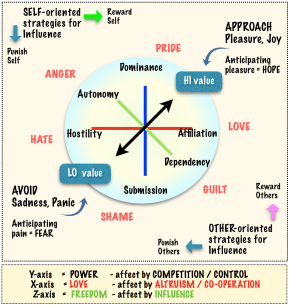
Relational INFLUENCE Matrix (IM)
It maps how people represent themself in relation to others. It grew out of the Behavioral Investment Theory of social motivational & emotional processes, based on Attachment Theory.  The Matrix makes 2 main points:
a. Humans are motivated by the need to be loved, admired & respected
b. They are equally driven by the need to avoid loss – being rejected, criticized or ostracized
(Freud’s Pleasure-Pain principal)

The green boxes at the BLACK axis points show that people have a mental/ emotional picture of how valuable different types of relationships are, & tend to approach or avoid them accordingly.
💗 EXP: Having ‘HI relational value’ can come from accomplishing 
something really hard that other people admire or love you for.

✥ Personality Disorder Star (these 2 CHARTS)
Karen Horney’s 3 main NEEDS – ways of relating to others – exactly parallel the IM dimensions (above) : Power is used to move against, Love for moving toward & Freedom for moving away – separate pathways to deciding relational value

HOWEVER – People with PDs consistently act in ways that reduce the relational value of themself & others – their self-defeating behavior causing everyone so much distress.
EXP: PDs are grouped by the direction of MOVEMENT  –
• Against = Narcissistic – hyper-competitive, constantly act superior to others (Steve Jobs)
• Away = Schizoid – deep detachment, without emotional connection & responsiveness
• Toward = Dependent – desperate fear of abandonment, they submit to the will of others to avoid rejection, & a need to caretake then

This star shows how certain PDs are the opposites of other negative personality characteristics.
Cluster A people are extreme on the need for Freedom dimension
Cluster B people are mainly selfish, competitive, manipulative & controlling
Cluster C people (especially Avoidant & Dependent PDs) are deeply concerned with affiliation – come here or go away – at any cost

NOTE that only 6 out of the 10 PDs are represented. The others tend to be combinations.
EXP: Borderlines (BPD) fluctuate between strong displays of dependency/ neediness followed by extreme displays of reactive hostility – described in”I hate you, don’t leave me” by Kreitman & Straus. They are less rigid than most PDs, with a weak or fragmented identity, & strong need for all 3 (power, love & freedom), covering a basically insecure Self (LO relational value).
«

«
NEXT: Personality Disorders (Part 4c)

Psychological DISORDERS – PDs (Part 4a)

I CAN’T HELP IT if I’m afraid of everything!

PREVIOUS: Psych Disorders (#3c)

POSTs: EGO States – summary

SITE: Re. PSYCH terms used as swear words

HUMOR: Hollywood PDs, as “Cars in the parking lot”


1. NORMAL  // 2. NEUROSES

3. PERSONALITY DISORDERS (PDs)
They are a group of 10 PMES mental/emotional illnesses,
consisting of  internal maladaptive – thinking (Ts), experiencing (Es) & behavior (As) – that deviate from norms & expectations of the person’s culture. These PDs make it very hard for the sufferers to accurately understand or relate to other people & situations.

PDs are pervasive & inflexible (unlike neuroses), have an onset in adolescence or early adulthood, are stable over time (consistent, persistent), & lead to emotional distress & impaired ‘normal’ functioning. Skodol, 2005 :
— PDs are about 15% of the US population, 10% worldwide
— They are usually chronic, & difficult to treat
— A person can be diagnosed with more than one PD, usually from the same cluster.
— Identifying a person’s specific PD (Axis I of the DSM) can help clinicians evaluate the risk of suicide & other psychological problems (any on Axis II) often accompanying PDs

This category fits into the hierarchy of mental states – Highest to Lowest functioning:
1. Healthy —-> 2. Neurotics —-> 3. Personality Disordered (PD)—-> 4. Sociopaths/Psychopaths —-> 5. Psychotics (who are not at all in reality)

●  All human traits range from
healthy & adaptive <—> to unhealthy & maladaptive.
PDs fall into the orange & red sectors, because the dysfunction affects
every part of a person’s life, usually as a result of an ongoing traumatic childhood. PDs tends to severely limit success in school, relationships, social encounters, work.

OVERVIEW – Main Symptoms of PDs
a. Distorted thinking patterns (CDs)
b. Over / under – regulated impulse control
• Odd / eccentric behavior patterns
• In some cases, periods of losing contact with reality (dissociations)
c. Interpersonal difficulties
• Avoid other people, feel empty & emotionally disconnected
• Trouble sustaining stable/close relationships (partners, children, professional helpers)

d. Problematic emotional responses
•  Overwhelmed by distress, anxiety, anger & worthlessness
• Trouble managing uncomfortable/painful emotions, especially without self-harming – use self-cutting, promiscuity, belligerent, withholding, chemical abuse… in order to ‘cope’ – but rarely harm others physically. Exceptions : bullying people,  torturing animals

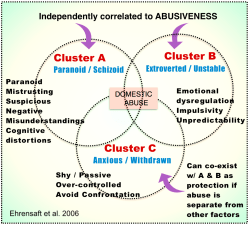
CLUSTERSCHART
Based on similarities, PDs are grouped into:

A3 “odd, eccentric” types: social awkwardness & withdrawal (MORE….) .  Dominated by distorted thinking, & extremes, they go:
— from eccentricity to fantasy
— from lonely to schizoid hiding
— from distorted thinking to delusion to paranoia
— from projective identification to projecting guilt on to others…..
Paranoid (2%) “The world is hostile, so don’t trust anyone, & deal with people by being angry & attacking.”
Schizoid – “The world is scary so I withdraw from it (people), & don’t show any emotion or other needs/feelings”
Schizotypal – “The world is too scary, so I withdraw from it (people), & being a bit crazy, I don’t think clearly”

B4 “dramatic, emotional, erratic” types
UNDER- controlled: People in this cluster share the pattern of little or no impulse control & have trouble emotionally regulating themself. This can include failure to plan ahead, or to consider the long-term consequences of their actions. At the extreme they can end up getting into trouble (like breaking the law), & hurting others.

Antisocial (3%) “You can’t trust anyone & life’s unfair, so I take advantage of people & do whatever I like”
Borderline (1-2%) “Relationships & life are very unreliable, so I frantically do anything to keep people around”
Histrionic (2-3%) “I must be the center of attention, so I will be dramatic, flirtatious & highly emotional”
Narcissistic (1%) “I’ve always been told that I’m very important & the best, so I agree & act that way”

C 3 “anxious, fearful” types  
OVER- controlled: This group shares a pattern of social inhibition, a deep sense of inadequacy, & hyper-sensitivity to other people’s negative opinions. They’re afraid to try new things lest they embarrass themself, & get ridiculed or outright rejected. They hold back around others, so can come across as uptight & snobbish. They lack spontaneity, since every action must be considered for its potential to cause themself emotional pain

Avoidant (1-10%) Life is scary & rejecting, so I feel worthless & withdraw ”
Dependent (0.5%) “I’m worthless & can’t cope with life, so I cling to others & do what they tell me”
Obsessive/compulsive (1-8%?) “Everything around me is chaotic, so I have to be in control of myself & everything in my life, by being orderly & perfectionistic (MORE….)

Other PDs not in DSM IV
Cyclothymic: Mood swings from Hi to Lo, with evenness in between – not as extreme as Manic-Depression
Masochistic (self-defeating): A need to fail, deliberately putting obstacles in ones own way to cause themself
frustration, grief, setbacks & suffering

Passive-aggressive: See POSTS
<— Sadistic: Derive pleasure from harming or humiliating others, using aggressive, cruel, demeaning & manipulative behavior

NEXT: Personality Disorders (Part 4b)

Psychological DISORDERS – Neuroses (3c)


MY CHARACTER DEFECTS
are just twisted versions of the True me!

PREVIOUS: Disorders #3b


1. HEALTHY


2. NEUROSES
 – Different  Perspective (cont) a. Enneagram  //  b. Trauma

c. Transactional Analysis  – The IMPASSE
Def : 
A road or passage having no exit, as a cul-de-sac
A situation so difficult that no progress can be made. Deadlock/stalemate

In psychological terms, impasses are formed at Type 1, 2 & 3 developmental stages in childhood ⬇️, when script-decisions are made. Scripts – our unconscious plan for life /internal ‘story’ – are usually based on unmet needs & abuse.
This causes inner conflicts between one’s Parent & Child ego states, & usually experienced by the child first as a personal failure – an internalized sense of inadequacy. Scripts are presented by, repeated & reinforced by parents, wider family & society —

— in some cases positive, but most often harmful. (Gouldings’ 12 script themes – similar to ACoA Toxic Rules)   ✥ This shows the power & active participation of children in their own development.

As adults, we all carry a representation (model) of the world & ourself – where we belong, how we fit in, our work & how we do it, & where we’re headed. If the source of this model comes from a dysfunctional family, it will always fall short of dynamic, ever-changing reality, limiting our S & I growth.  An impasse (being stuck in some area of life) indicates a need for change in order to move forward.
✺ The different intensities of psychological disorders represent various stages & intensities of impasse. (MORE...)

CHART : 3 developmental stages of conflicts between inner Parent (P) & Child (C)
✓ 3rd degree impasse (Po-Co: Birth to 6 months, pre-verbal, even pre-natal)

These earliest conflicts come from the type of connection between mother & child, depending on how they relate day after day. Conflicts will be around the issue of survival, between: abandonment & engulfment, destroying or being destroyed, worth & worthlessness….

EXPIf the mother has an unhealed WIC – stuck in her own impasse – her wounds get communicated to the baby, day after day. If she is insensitive, controlling or brutal – the effect on the baby is predictable.
However – much more difficult to identify later on –  is if h
er grown up Adult & Parent parts are used to activate, even improve her parenting style, but without Recovery her behavior won’t have any affect on her little C1 ego state. No matter how she tries to cover it up, her deepest damage will unconsciously keep re-traumatizing the baby. 

A depressed or angry mother can ‘responsibly’ feed & look after her baby son every day, but he knows / senses his mother is emotionally bereft. He intuits (or is told) that he needs to take care of her – all focus must be on her instead of his own feelings & needs – OR ELSE she may somehow leave (die). So he feels unworthy to be taken care of & worthless for not being able to help her, which causes intense anxiety. So he slowly develops defensive patterns like people-pleasing / isolation / addictions…., which form his False Self.

As an adult,
this earliest impasse continues as deep-seated conflicts in PMES forms such as muscle tension, psychosomatic complaints, immune disorders…. & expressed verbally in symbolic images, such as “I feel as if I’m in a fog, lost, cold & alone, there’s a wall up between me & everyone else” …. 

 ✓ 2 degree impasse (P1-C1:  6 mths – 6 yrs)
Made up of Injunctions (authoritative parental orders) carried by the child’s feelings /emotions. They become internalized, often through non-verbal comman
ds, at a time when the child has only a basic grasp of language. Script-decisions made are basic theme about the child’s identity, such as: “Who am I? // Am I important? // Don’t grow up // Don’t feel”…..
Later on, it’s much harder to remember how these issues developed, so the person usually doesn’t know they’re stuck back there

1 degree impasse (P2-C2 : 6+ yrs old, when they can understand language)
The struggle here is between what the child should & should not do, what behaviors are socially acceptable or not. Internalized verbal
instructions (counter-injunctions) will be things like: “Please others // Always try hard // Be a good boy or good girl // Never get angry”….. These are more accessible to awareness, so later on it’s easier to remember who gave them & in what form. (More….  in ‘Ego States’ posts).

BREAKING the Impasse – options
When the Bad Parent is so strong that it keeps the messages in place, the person gives in & continues to live by the original ‘rules’, keeping the Healthy Child bound.
HOWEVER –
a. When the person’s Wounded Child refuses to go along with its Bad Parent’s messages & is finally allowed to get angry, it liberates the Healthy / Free Child
b. The Bad Parent’s injunctions are agreed with, but the Healthy Child’s needs are ‘redefined’, often in humorous terms. Then both sides win.
EXP = Parent voice: “You’re crazy”  Child: “I may be crazy, but I’m never boring!”:)

NEXT: Disorders #4a