ACoAs: RESPONSIBILITY (Part 2a)

not trappedI ALWAYS MAKE SURE
there’s a way to protect myself

PREVIOUS:
Fear of Responsibility (#1)

POSTs: Toxic Family Rules

See ACRONYM page for abbrev.


🧍🏽‍♀️🧍🏽 AS ADULTS
With all the frustration & lack of ‘success’ as children to fix our family, we unconsciously assume that if we failed at that, we’ll inevitably fail at everything else – so why bother.
Since they didn’t take responsibility for their emotions & actions, we didn’t learn how to either, & we don’t know there is a clear line between what’s our job in life & what isn’t.

SELF-CARE (Part 2b) : Any activity we do deliberately to provide our mental, emotional & physical health needs. Good selfcare is key to reduced anxiety & improved mood

1. UNDER-RESPONSIBLE
a. Re. OTHERS:
Because we were treated badly by our family, we often treat others the same way (How ACoAs Abandon Othersposts) BY:
✦ not considering others’ rights, boundaries & emotions, being so focused on our own pain & trying to protect ourself
✦ our narcissism, idealizing, constant criticism, being controlling…..
which is how we treat our external children as well as other adults

ACoAs as ‘LEAVERS’
According to the WIC, we still have no one we can depend on for our needs, AND are responsible for everyone & slaveeverything around us.
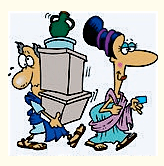
We say we don’t want to have such a great burden, YET we reject being with people or groups who are capable of being supportive, allowing us to relax & focusing on ourself

This leaves us completely overwhelmed & exhausted. So on the assumption that we still have to carry the weight of any association (personal or professional), we’re too scared to fully commit.

• To take healthy, ‘adult’ responsibility for our choices & relationships, we would need to be familiar with & embrace our True Self, via S & I, which is the goal of all therapy & Recovery.
However, ACoAs greatest addiction is to our family of origin, making it very hard to let go of our symbiotic attachment to them.

🔻This results in a great resistance to taking center stage in our own life, while playing the satellite (or slave) to someone or something else.
🔺 The irony is that at the same time – we think everything others do or say is about us, taking everything personally – which is not the ADULT ego state form of being responsible for oneself, but rather the narcissistic attitude of the WIC

• While we consciously insist we never want to be anything like ‘them’, unconsciously we copy them in many different ways, having absorbed the PigP, ie. negative introject.
Because the WIC is by definition narcissistic, it can’t distinguish itself from our narcissistic parents. SO:
√ If they didn’t take responsibility for themselves, we won’t either
√ If they never connected with their True Self, we won’t either
√ If they treated us badly, we’ll do the same to ourself & others

• Even when ACoAs truly want to be connected to Self or others in a meaningful way, our terror of being eternally trapped in the position of caretaker leads to having a back-door mentality – always looking for an out : finding fault, being resentful, feeling inferior or superior, getting bored….

And above all – picking people who are emotionally unavailabldistancee AND not suited to our personality, but familiar because of our family structure. Keeping ourself at emotional arm’s-length in all our interactions is the only way we think we can protect our fragile self-image, since we don’t have access to our needs & therefore no real boundaries

The WIC says: “I can’t afford to commit  to anything serious – especially if it’s really important to me – because then I’ll be stuck having to handle everything (perfectly) myself. I don’t know how, & I resent being in that position – so I won’t.”

Besides, since I always fail at getting my needs :
√ it’ll be too painful to try & fail again (lose out on what I really want)
v I’ll have to re-live all the ways I failed my family when I was a kid, adding to my S-H.

NEXT: Fear of Responsibility (Part 2b)
ACoAs: RESPONSIBILITY (Part 1b)

PREVIOUS :
Fear of Responsibility (FoR) #1a

BOOK: “So the Witch Won’t Eat Me: Fantasy & the Child’s Fear of Infanticide” ~ Dorothy Block (INTRO – especially important)


👼🏼 🫃🏽 CHILDHOOD
 ORIGINS (cont)
1. “I tried to fix them so they’d be OK”
2. “I failed to make them better & so to stop my pain”

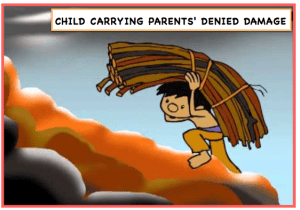
3. “I have to carry all the things they refuse to acknowledge
AWARENESS:
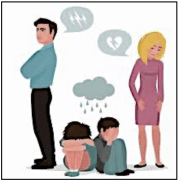
Children are highly sensitive to their environment, especially the emotions & attitude of their parents. Even as very little kids, ACoAs were smart enough to know when things were ‘off’ with adults, in terms of their behavior, motivation & interactions with others
The dysfunction in our home was so great that we felt unsafe all the time. Because kids see themselves as the center of the universe, we assumed that we could help out by picking up what they ‘dropped / denied’, as if that responsibility would even things out

COMMENTS: Unfortunately this is a common response for children. EXP:
• If they were hypocritical, did illegal things, were cruel & insensitive AND had no remorse – we felt ashamed for them!
• If one was depressed, suicidal (even if never acted on directly – but showed up in physically illness, addictions, not able to work…..), we took on their depression, lack of motivation & wanting to be dead

• If one or both parents’ never dealt with their own childhood pain, we took that on & “felt terribly sad/bad for them”. This is true whether the parent was numb & acted like they were OK, or if they were always in ‘suffering / martyr mode’

Loving them is not enough. No one can relieve another person of their hurt or other sickness by carrying it for them! no matter how pure our motives are. And children’s motives are never pure – understandably so. We desperately wanted them to be OK so they could be there for us. That was/is a legitimate need!

▶ All of this was in addition to our own pain from neglect & abuse. The combination of our suffering PLUS their dysfunction became overwhelming.
Unfortunately, holding all that extra responsibility was totally wasted – it never helped them nor changed our situation. No wonder we’re so terrified & traumatized now!take on their pain

4. “I’ll always fail at everything I do, so I won’t bother trying”
DISTORTION:
It’s natural for children to assume they have magical power over their circumstances, which in fact they do not have. This is normal childhood narcissism
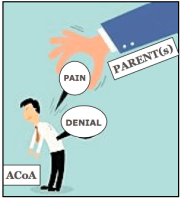
✦ Our family, & often other adults, were unable or unwilling to take on the ‘burden’ of their adult responsibilities – which left children having to carry it for them. Indeed, in many cases they actually dumped all their own weight on us, adding to our sense of obligation

COMMENTS: As children, being ineffective at stopping the abuse & improving our lot at home inevitably left us with the conclusion that it was because of some lack in ourself.
If we failed at such a basic goal – of helping to heal our parents & getting our needs met inside the family – our WIC thoroughly believed there’s no way we can now have any effect on anyone outside the family either – much less positively. This became the pattern for our adult life.

• This assumption is one of the many CDs common to ACoAs. As children we not only thought we could influence our parents with enough love & effort, but many of them did insisted it was in fact our job to take care of them.

We had no way of knowing know that:
√ we were given an impossible task, from the very beginning, which we took on because we had no choice
√ that the reason we were ineffective is only because of the persistent unhealed damage in our parents, not because of any lack in ourselves. Our self-appointed task was always impossible!

NOTE: In some cases the alcoholic parent joined AA, & stopped the overt part of the dis-ease. Even so, they rarely cleaned out their personal wounds (via Al-Anon & FoO work), which continued to infect the family system. And very often, the non-drinking parent did not want nor receive needed treatment either.

NEXT: Fear of Responsibility (Part 2a)

ACoAs: RESPONSIBILITY (Part 1a)

responsible??IT’S TOTALLY UP TO ME
to make everyone happy!

PREVIOUS:
Re. book “Trauma & Recovery”


WHAT IS IT? 
In its simplest form, Responsibility (R) is first of all : Honestly admitting, to ourself what we feel, think & have done – or – not. (T.E.A.).
It includes acknowledging both our limitations & our gifts, our ignorance & our knowledge. And if possible, always doing this without guilt, without judgment, without shame.  MOST of ALL – without self-hate.

DISTORTION  = 
ACoAs grew up with a great many cognitive distortions CDs , so it makes sense that we would carry them into our adult lives – as if they were the truth! One of these has to do with the issue of Responsibility (R). 12370991801134292684yyycatch_people_biz_-_male_sad.svg.med

FEAR of Responsibility 
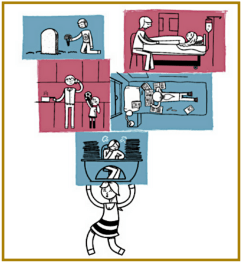
For many ACoAs, R. is a dirty word, both an absolute requirement & a hated burden!  We take responsibility for others’ actions & emotions, while in many ways not being responsible for ourself, hating ourselves (S-H) for the very things that make us human.

We believe we MUST take care of others instead of ourself, or someone will die & it’ll be our fault.  We’re overwhelmed by the heavy weight of it but believe we can’t escape. We were not taught healthy R. – which is taking care of ourself – so we find convoluted ways to avoid self-care.

👼🏼 🫃🏽 CHILDHOOD ORIGINS,  creating our aversion to R (FoR)
1. “I tried to fix them so they’d be OK”
GOALs:
✦ To stop them from suffering & make them happier, AND
✦ To make them ‘well’ so they would stop hurting us…..
….. AND be able to take care of us, the way all children need

COMMENTS – We were forced to be responsible (R) for our unhappy, angry, crazy, drunk parents, & sometimes siblings & extended family members. Many of us had to be the ‘designated adult’ even when we were very little, because of the adults’ incompetence, selfishness & addictions. We got the RULE loud & clear “Everyone else’s needs are more important than mine”.

• We understood early on that they couldn’t cope, so we had to be R. for ourself, to not ‘bother them’, to be self-sufficient
• We felt a great burden to fix their problems, make them feel better, to give them what they wanted – even when it was presented in the form of Double Messages.
• We were R. for doing whatever they wanted, how they wanted it, yet having to figure it out alone, because they didn’t say, or changed the rules arbitrarily, endlessly confusing us

• We may have lived with one parent who was totally irresponsible & we swore to never be like that, AND/OR with an over-R. parent, which we copied. Yet, some of us may have resented the responsible one for being too controlling, & adored the careless one, for being charming.

2. “I failed to make them better & so to stop my pain
REALITY
 It should never fall to a child to have to try healing their parents’ damage, in a role-reversal of being the little grownup
✦ No one can cause an adult to “heal & grow”. People can only improve their life if they’re willing to do the work required to change. In any case, it’s not something for a child to do, who needs to be cared for

COMMENTS: No matter how hard we tried we were never able to create a genuine improvement in our parents. This was devastating for us, because we needed them to be mentally sane (T), emotionally stable (E) & consistently dependable (A).
As kids we desperately wanted to stop hurting, AND get our needs met. So we made every effort to please them & minimize the damage they could do us, but nothing we did worked

Our ‘failure’ left us with 2 conflicting states: failed hope
• Hating ourselves: We concluded that something was profoundly wrong with US – we weren’t smart enough, attractive enough, perfect enough…. to have an impact on the adults

• Hating them: We did/do in fact love our parents very much – no matter how they treated us. However, years of abuse & neglect gave taken their toll, building & building our helpless rage, which we had to deny.

NEXT: Fear of Responsibility (Part 2)

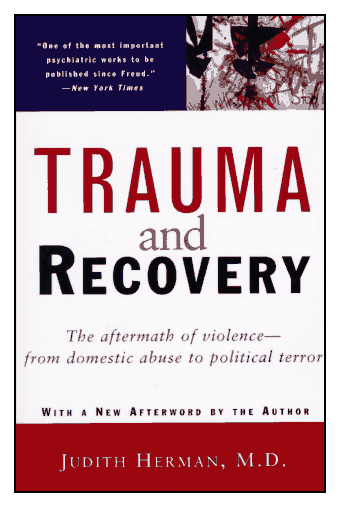
BOOK: “Trauma & Recovery”

Trauma book


PREVIOUS: “33 Things I’ve Learned” #3


AUTHOR
Judith Lewis Herman
is Associate Clinical Professor of Psychiatry at Harvard Medical School and Training Director of the Victims of Violence Program at The Cambridge Hospital.


See: REVIEW

In “Trauma and Recovery” Judith Herman describes in detail the healing process for people struggling with a combination of problems related to overt abuse, being unwanted, & other devastating experiences in their past. The book gives a three-stage model of recovery from these events, including childhood sexual abuse.

Trauma results include:
Substance addictions
Behavioral addictions (porn, anonymous sex, gambling,…)
Self-harming behaviors (cutting, burning, hair pulling…)
Dissociation (spacing out, blanking out, losing time…)

The following statement refers to how self-hate is formed – by introjecting
the Bad Parent – & why it’s so hard to give up
:

quote re abused child S-H

REVIEW posts:
ACoAs & Self-Hate  //  Negative Introject 
// Abuse of children //
  Toxic Family RULES //
Ego states –  Summary  // Ego states – PARENT  #4

“33 Things I’ve learned” (Part 2)

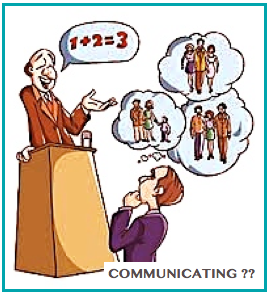
communicating

PREVIOUS : 33 Things, #1

IMPORTANT NOTE:
The original list is not available any more. There are 10 other sites under this title – each different.

🔺These 33 are still worth reading — they have more substance.

🔹 “Things”are listed by topic, not in numbered order.

COMMUNICATION
2: If you speak the truth, be prepared to be attacked & ridiculed.
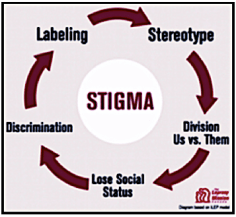
This is done to keep everyone in the “normal box.” To keep things under control & give everyone a mask. If you speak the truth through actions or words, people will be threatened. Those in power who feel threatened will do whatever it takes to silence you. This is where the judgments, labels & forced isolation come from

4: How well your message is received depends on how you deliver the message.
The world is full of people in power who know nothing. If you feel what’s going on is wrong, your attitude & responses will determine if people listen.

7: It’s not rScreen Shot 2016-05-31 at 6.20.53 PMeally about what you say but how you make other people feel.
If you believe in someone or something, don’t let anyone or anything stand in your way. You may change someone’s life by believing in them.

14: Do not ever leave words unsaid.
Speak from your heart in each moment. Every moment is precious. Tell people the greatness you see in them. It takes nothing away from you. In fact, you grow from it.

24: Fierceness & toughness are not always loud. 
Sometimes it’s timing. It is not what you say but when you say it. The best way to know when & what advice to give if any, is easy, but only if you’re truly listening. Don’t force it, timing is everything

OTHER PEOPLE
3: Just because a group of seemingly “educated” people say things are true does not mean they’re right. If there is one person against the group, they may be the only one that’s not willing to go along with the community lie. Sometimes, the teachers are wrongScreen Shot 2016-05-31 at 9.22.53 PM.png

6: There are many people in this world that have it much worse than you can possibly imagine.
There’s serious abuse & damage being done to kids, which will affect them & those they come in contact with the rest of their life. It is going on right now – a great deal of deep sadness & pain

8: Hurt people hurt people.
You have to love yourself first, or you’ll hurt others unintentionally. Monsters are created by other monsters. People who are very sad, especially as children, can do damage to the world. It doesn’t mean they’re bad people. It means they’re acting out their pain

22: You’ll never help anyone by punishing them.
Those who attack others usually have the most to hide. Loving is a sign of strength. To see someone for who they are, despite everyone what everyone else says, is a special person. If you ever have decision-making power over someone’s life – get to know them.

Don’t ever base it on what others say, because they have their own biases & agendas. If someone gossips a lot, they have a lot to hide. If you sit in silence while they gossip, you’re an active participant. Gossip & trash talk is not harmless, it destroys character. Punishment never works for an illness.

25: Appearance means nothing at all.
People at the top can be much, much sicker than so-called “sick” people. Screen Shot 2016-05-31 at 9.35.15 PMWhat others say a crazy person looks like is different than the truth. Don’t be swayed of by others’ opinions. What we see in others, good & bad, is a reflection of what we like or dislike about ourselves.

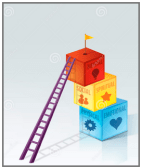
27: Labels are destructive.
People are not their illness, & no one fits the book pattern. Do not treat the illness. Treat the patient. What helps the most is love

28:  Sometimes, people live up to the hype
When the student is ready, the teacher will appear. Words can change people. But they must be pure, genuine & come from truth.

NEXT: ACoAs & Confusion (Part 1)

“33 Things I’ve learned” (Part 1)

Process

PREVIOUS: Permission to Leave

IMPORTANT NOTE:
The original list is not available any more. There are 10 other sites under this title – each different.

🔺These 33 are still worth reading — they have more substance.

🔹 “Things”are listed by topic, not in numbered order.

IDENTITY
1: If you are different, you will be separated & labeled.

It ‘s ok if you’re lonely & feel different. That doesn’t mean something’s wrong with you. In fact it’s a sign you’re on the right path if you do not fit in.
People in power aren’t always the wisest ones. It’s ok to question authority.Screen Shot 2016-05-31 at 6.49.44 PM

5: Stay true to yourself, even if it upsets others & they reject you.
The person who suffers the most from being someone that others want you to be, is you. What’s in your heart is all that’s real. Embrace who you are in your heart. Show the world that person. That person is beautiful.

30: Do not believe your own thoughts sometimes, they may come from other people.
Your False Self is just that, false. Acceptance comes first. You can change yourself only after you accept yourself

RECOVERY / GROWTH
12: When you’re silent, sit still & deal with emotions, only then will the answers come.
Then can you move forward. The only way out is through. You can not escape pain, which isn’t aways a bad thing. Things that seem great at the time can end up hurting you. Withhold judgment & let things play out. You can spend your whole life running from your pain. In the end, all you get is being tired, having spent a whole life running but not living.

15: It is hard to give love when you’re in pain. But try it, & watch the miracle. If you give love away, love will come back. You will get what you need, if & when you’re prepared for it. If you start to heal yourself & be good to others, regardless of your pain, great things – even miracles – start to happen. You’ll be amazed at what the world gives you.

 16: Where youScreen Shot 2016-05-31 at 6.32.40 PM end usually depends on where you start.
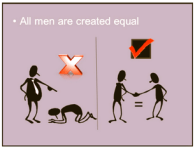
We need to equalize things for people that start off life with less opportunity. Those with privilege need to stop acting like they are on 3rd base because they hit a triple, when in fact they were born on 3rd base.

We have to stop penalizing people because they have less resources, & give everyone the same opportunity – or stop claiming we’re the land of opportunity when we’re not.

18: Living for others’ approval will kill you inside
Buying & accumulating things is not the answer. You’ll walk around depressed because you’re living someone else’s dream for you.

20: When you make someone the center of your world for the moment you’re with them, you can save their life.  You can change the world by simply being present with someone in pain.
Taking time with people. Listening to them is what ‘s important.

21: Lessons will repeat themselves until you finally learn what you’re supposed to. There are lots of ways to try escaping from yourself. Anger, alcohol, drugs, food, gambling, other people, self-harm, drugs…. How many have you tried?

29: Little things add up to big things
When trying to change things, patience is crucial. Systems don’t change fast. First, listen & observe. Pay attention to small things & details, so you gain credibility & build up through small things. You lose credibility if all you do is fight. You don’t need to fight all day, every day. Pick your battlesScreen Shot 2016-05-31 at 6.39.15 PM.png

31: If you want to help people, walk with them, not above them.
Stay in the senior slow lane of life. Let people rush by you if they want. Patience & moving with people is how you help them. Even if you get in a position of power, there’s more corruption at the top.

NEXT: 33 Things I’ve learned (Part 2)

PERMISSION to LEAVE

images-1PREVIOUS:  “Kind Self-Healing” book

A NEW YEAR SUGGESTION

SITE: “Staying away
from TOXIC people

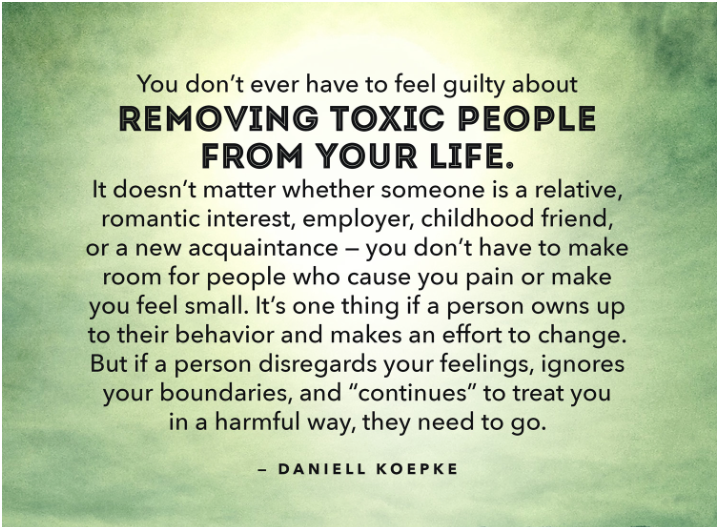
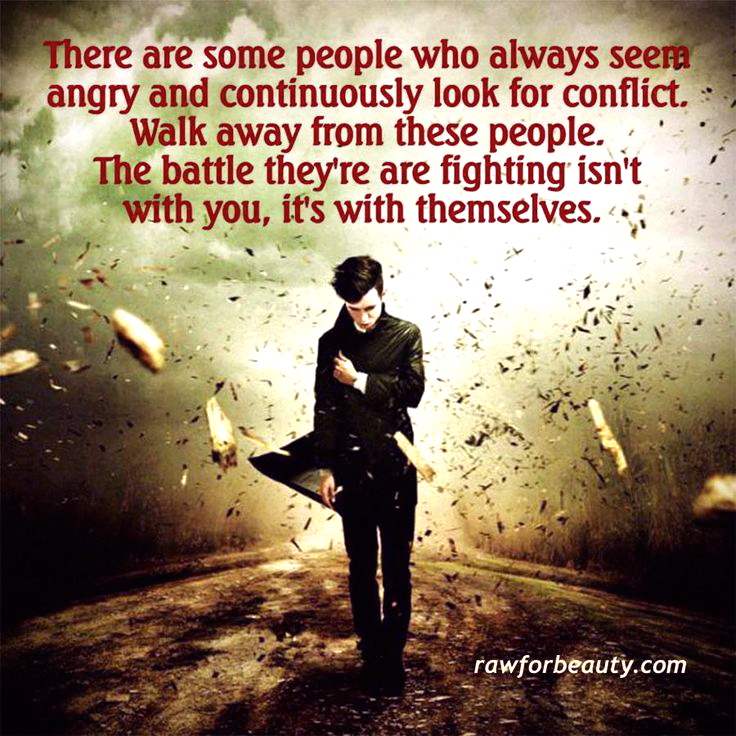
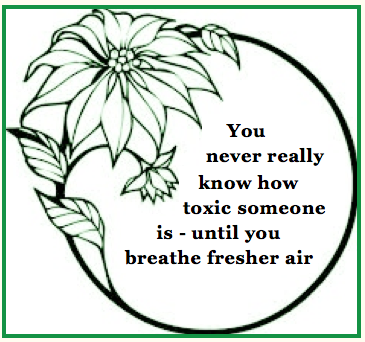
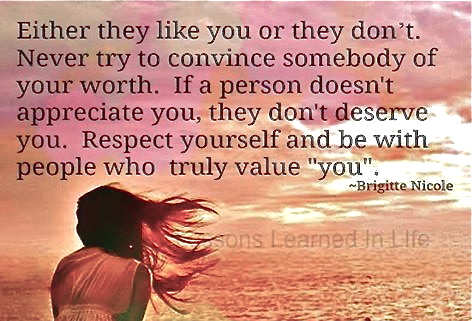
Normally I’m not fond of cutesie, ‘uplifting’ saying, but I know some of us are still struggling with the belief that it’s unkind & selfish to disengage (whatever that means for you) from unhealthy people who do not take responsibility for their damage and don’t want to /can’t yet do the hard work of Recovery.

So I’m posting a bunch of statements about permission, in the hope
that they may be of encouragement to make some changes this year.

leave toxics

LEAVING THEM

angry people

poison people

let them go

allowed to leavesoul therapy

fresher air

god says drop

god says drop

your worth it

BE KIND to YOURSELF

Ann Wilson Schaef PREVIOUS: Obituary of Evil Mother


AUTHOR :
Dr. Ann Wilson Schaef
is a well-known psychologist, international speaker & writer of 13 books.

She developed her own approach to healing the whole person, which comes out of the ancient teachings of her ancestors – Cherokee Indian –  called “Living in Process“.
It is a comprehensive program of recovery —
➼ FROM addictions – both ingestive  (alcohol, food, drugs….) and process  (work, gambling, sex, relationships…. )
➼ INTO wholeness of body, mind & spirit.

SEE her Book List

perfect=abuse

OBITUARY of evil mother


PREVIOUS: 5 HARMFUL Mothers , #3


PAINFUL VALIDATION

The link below is the obit Katherine Reddick wrote about her mother, & her rebuttal regarding comments she received about it.

I pass this article on to anyone who has been tortured by a parent, & is afraid to say so, or that no one will believe you.

Be aware it may take a ‘strong stomach’, but you are not alone.

“I WROTE the “SCATHING OBITUARY ABOUT MY MOTHER, AND HERE’S WHY I DID IT and HAVE NO REGRETS.  I’m only now speaking publicly about why I wrote the vicious obituary. Even in death, this woman still gives me nightmares.”

https://www.huffpost.com/entry/marianne-theresa-johnson-reddick-obituary_n_4602902

5 HARMFUL MOTHERS (Part 3)

PREVIOUS: Harmful mothers #2

SITES: “Effects of Emotionally distant parents on the child

•‘Confusion of Living with an Emotionally Unavailable Parent

DEALING with hateful or neglectful parents, now
Many ACoAs are so symbiotically bonded to their unloving / harmful parents that it hard for us to let go – even if we’ve moved a million miles away. When they get old, sick or have some other difficulties, we feel a strong pull to step in & ‘help’. Often this is just another form of rescuing & people-pleasing.

We know that there’s an enduring bond between parent & child. BUT continued interactions with our earliest abusers (if they’re still mean, crazy, drunk….) can keep re-traumatizing us, whether we’ve been away from them for a while, OR still around them, making healing that much harder & longer.

WARNING: Unfortunately there are many people – having no understanding of how traumatic & pointless reconnecting with our family is – who will urge us to “make up with them before it’s too late / they’re the only parents you have / of course they love you even if they don’t know how to show it / just take the high road, they don’t mean anything by it….”

👎🏽 While these people may believe they’re well-intentioned, their insistence that YOU do something which is unsafe for you, is actually:
√ a projection of who they are & what they will do or have done
√ their garden-variety narcissism, not even imagining that their way would harm you, much less that it’s not what you want!
DO NOT LISTEN to THEM.

NOTE: Many ACoAs say they stay in contact &/or help out their abusers because they are / want to be ‘a good person’. In our specific circumstances (not some TV-show ideal) this idea actually means being good to the perpetrator instead of oneself. 

ALSO : There’s a confusing belief that if we’re ‘well enough’  then their craziness won’t bother us AT ALL. This is 1/2 true & 1/2 false.

TRUE: As our wounds heal, many of the buttons they installed will shrink, but not all the way, & some not at all. So YES, we become less reactive to & definitely less hurt by many of their ploys. We might even be able to just say “Ohhh, mooom!”, or “Sure dad.”
FALSE: The healthier we get the less we’ll be able or want to tolerate their addictions, abuse & unavailability. We’ll stay away more often, & not get caught up in their games.

“Dear Prudence” columnist Emily Yoffe writes:
There is no formula for defining one’s obligations to the parents who didn’t fulfill their own needs. The stories of famous people with abusive parents reveal some possible responses.

Abraham Lincoln couldn’t stand his brutish father, Thomas, who hated Abraham’s books & sent him out to be an indentured servant. As an adult, Lincoln did occasionally bail his father out financially. But during the man’s final illness, Lincoln ignored letters indicating his end was near.

Finally he wrote – not to his father, but his stepbrother – to explain his absence: “Say to him that if we could meet now, it is doubtful whether it would not be more painful than pleasant.” Lincoln didn’t attend his father’s funeral.

Warren Buffett remained distantly dutiful to his mother, who had subjected her children to endless, rabid verbal attacks. On the occasions he visited her at the end of her life, he was a “wreck” of anxiety, sitting silently while his female companions made conversation.
He was 66 when she died at 92. His tears at her death were not because he was sad or because he missed her, he said in his biography, The Snowball. “It was because of the waste.”

old houseBruce Springsteen’s frustrated, depressive father took out much of his rage on his son. In a New Yorker profile, David Remnick writes that long after Springsteen’s family had moved away, he’d obsessively drive by the old house.
A therapist told him :  “Something went wrong, & you keep going back to see if you can fix it or somehow make it right.”
Springsteen finally came to accept that he couldn’t. When he became successful he did give his parents the money to buy their dream house. But he said of this seeming reconciliation, “Of course, all the deeper things go unsaid, that it all could have been a little different.”  (MORE…. both pages 1 & 2)

child abuse

HOW COMMON IS CHILD ABUSE? perpetrators
Statistics give us many painful truths:
Neglect is by far the most common form of child abuse  reported (USA) cases in 2008 (MORE….Also Report 2008  ☁︎”America’s child death shame” BBC News Article, October 17, 2011 (scroll)

NEXT: Obituary of evil mother