ACoAs & Being DISAPPOINTED (Part 1)

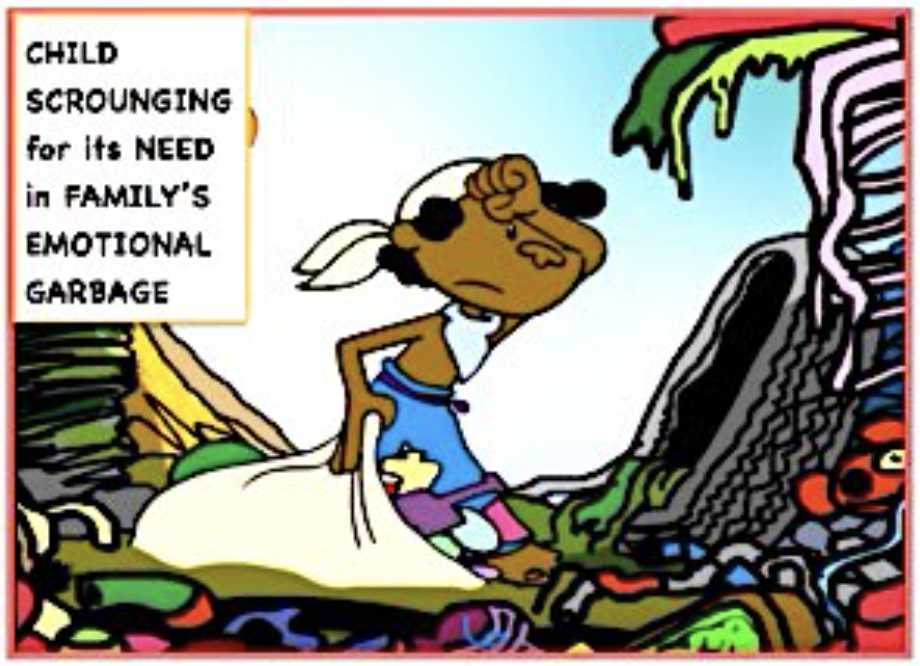
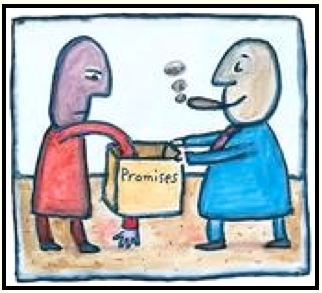
empty promises I CAN’T TRUST ANYONE – I’ve been disappointed too often

PREVIOUS: Anxiety & T.E.A. #3

QUOTES: “Longed for him. Got him. Shit.” ― Margaret Atwood

“Disappointment is a sort of bankruptcy of a soul that expends too much in hope & expectation.” ― Eric Hoffer

DEF: The feeling of dissatisfaction that follows the failure to manifest of expectations or hopes, with the focus on the outcome, rather than the poor choices one may have caused the failure – decisions / actions that got one there

• Decision Analysis studies many different topics, including Disappointment – its causes, impact & degree to which individual decisions are motivated by a desire to avoid it.

FROM the Regret & Disappointment Scale:
“The emotion most frequently studied by decision theorists is regret, the counter-factual thoughts that create emotions – when realizing or imagining we would have had a better outcome if we’d decided differently.

Regret depends on a Choice made in the past which led to an unfulfilling action – later causing  counter-factual** thinking.
And the intensity of regret depends on – whether suitable alternatives were available (to the person at the time) but were not chosen.
**Counter-factual thinking is picturing one or more outcomes different from what actually happened. It’s when we obsessively think  ‘If only I had… What if it hadn’t….”

Psychologists & economists have been investigating the relationship between Regret & Choice since the early 1980’s. The emotion of disappointment is also based on counter-factual thinking : when we keep wishing events had turned out more to our liking.

Although regret and disappointment are different emotions, they’re both generated by comparing “What IS” reality with “What might have been”.(MORE….)

ACoAs have very intense reactions to being disappointed (D) – either with outright rage OR deep depression, depending on the strength & importance of the unfulfilled needs, and how long we were deprived of those needs.
This to be such a big issue for ACoAs, which tells us how constant & overwhelmingly abandoned in PMES ways we were as kids – first & foremost by our parents, & then by everyone else who let us down.

• We needed them to be there for us, to encourage, guide, protect, validate, mirror, love…. & they either did these things sporadically, incompetently or not at all.
Constant, endless disappointment in our caretakers (also teachers, relatives, baby sitters…) has left us with a very big wound. It’s one of many wounds – & some of us have buried it so deep, we don’t evedisapponted catn recognize it when it happens again in the present.

To be disappointed we must:
1. have a need ( + desire, wish, dream, hope….)
We may not even know we have a particular need or wish, because we were not allowed to have them, or if we did, we were told in many ways, over & over – that they were not legitimate, were selfish, were dumb….
AND must :
2. (secretly) expect that need to be met.
Since we’re still not allowed to have them, we not aware that they’re always in the background. We still have needs, just by virtue of being alive. But since they go unmet – they can never go away, like being hungry but barely eating anything if ay all – OR eating empty calories & harmful foods / chemicals…..
For many of us, the greater a specific need, the more desperate we become – waiting for someone else to do something for us we should be doing for ourselves or can learn how to
and must :
3. not get that need met : We can track deprivation of need, hopes, wishes….  by the intensity of our reactions when we don’t get something we (unconsciously) longed for, actually asked for or tried to get in some indirect way.

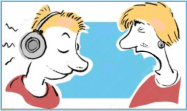
❥ HUMOR from Grant Snider


NEXT: ACoAs & Disappointment – Part 2
ACoAs – ANXIETY & T.E.A. (Part 4)

OUR NEEDS
IT’S ALWAYS WISE to pay attention to my needs!

PREVIOUS: T.E.A. & anxiety (#2)

SITEs:
T.E.A. charts from GOOD MEDICINE˜ Dr. James Hawkins

What Is Cognitive Behavioral Therapy (CBT)? – Using T.E.A.
2. ANXIETY (cont)
⚑ ⚑ TOXIC anxiety //  💚 GROWTH anxiety

🔔 AWARENESS
Cognitive Behavioral Therapy’s (CBT) basic messages :
◆ What we think and do affects the way we feel
◆ Our best effort to cope with our emotions sometimes ends in uncomfortable outcomes which keeps us from feeling better
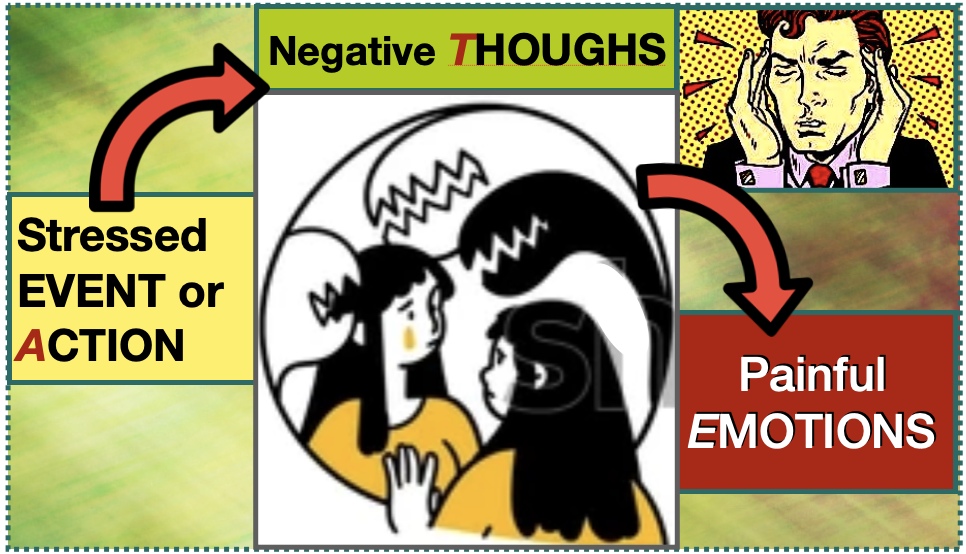
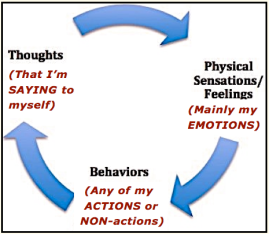
◆ We can better understand problems by examining our Thoughts, Emotions, physical sensations & Actions in specific situations, all interacting in a ‘hot cross bun’ formation.

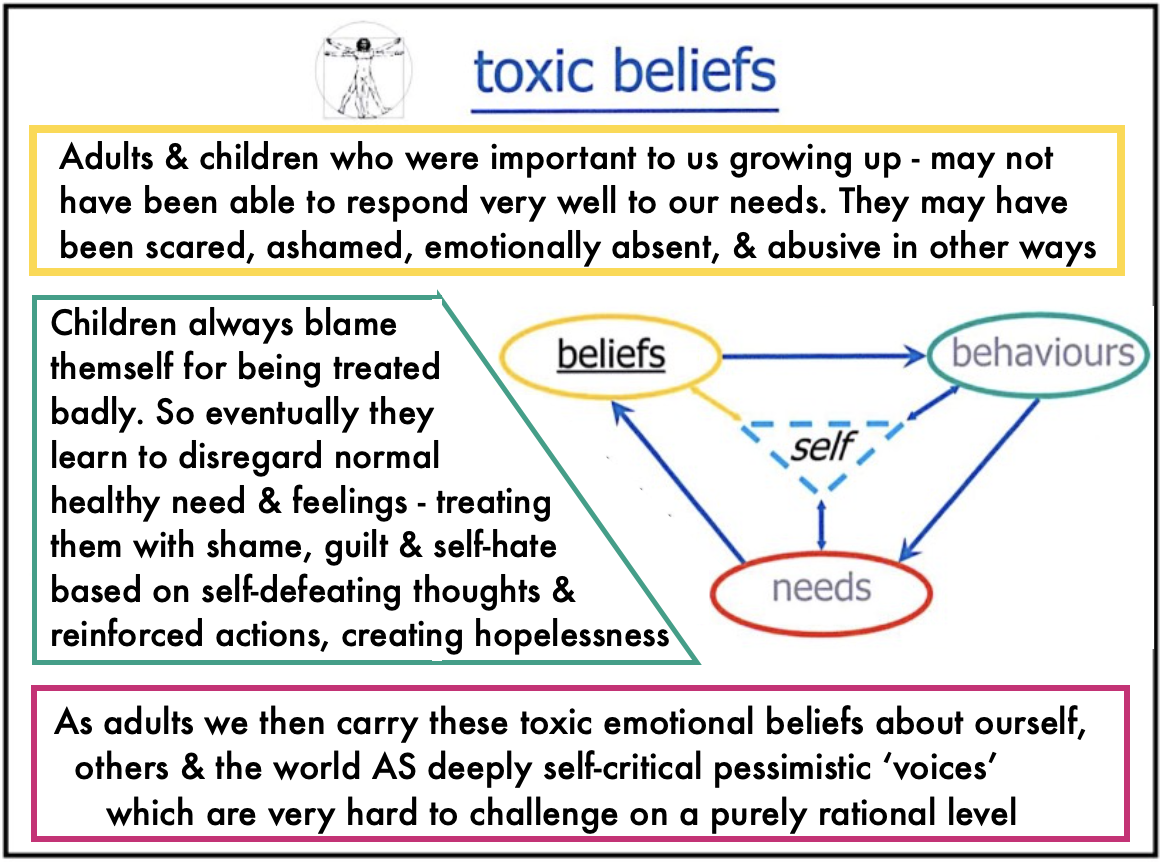
a. NEGATIVE BELIEFS create painful emotions. Just as we may sometimes be hungry or thirsty for food or drink that in fact isn’t good for us, so emotions are not always indicators of current reality. It’s important to notice when an intense emotion is healthy energy, vs. when it wants to push us in a distorted or unsafe direction.

Unfortunately for most of us, we didn’t always get the right responses to our original needs.  Our family, schools, religion  & other important early influences rarely were respectful of nor encouraged our normal drive to satisfy healthy needs.  It’s inevitably then that we try to make sense of why they didn’t.

As children, we had very limited information about the world, & expected that the adults would know better & more than us.
If we got into conflict or other unsatisfying interactions with adults, our normal child narcissism assumed we were at fault – not them. This is especially true because many of them actually told us we were wrong & the problem, which we had no choice but to believe.
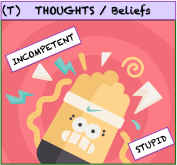
We assumed that : “It must be because I’m are unlovable, untrustworthy, not good enough – that I’m treated this way.”

✦ For many of us, we bring into adulthood the original trauma which lead to —-> a great deal of suffering, which led to —-> the toxic beliefs, which inevitably lead to —-> problems in relationships & general functioning in the present

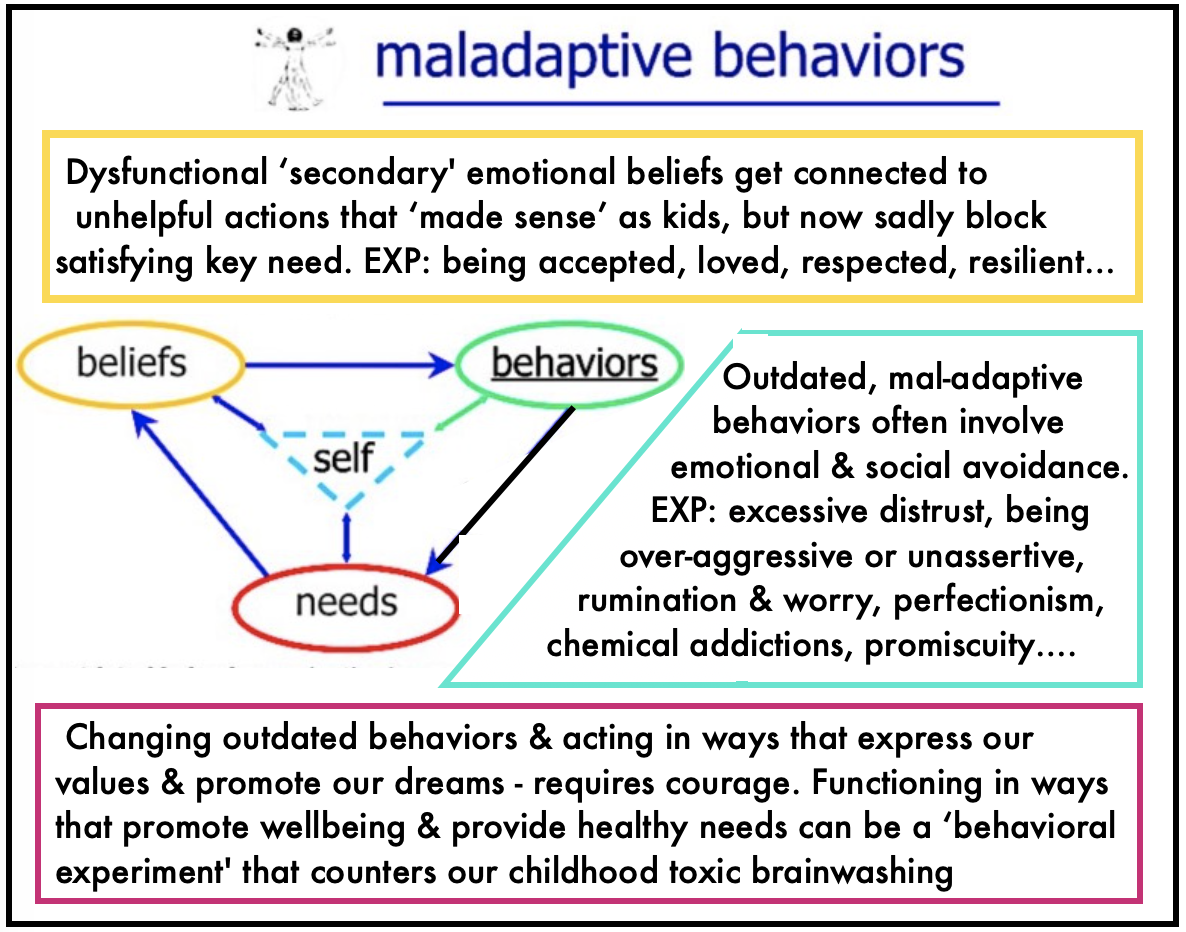
b. UNHEALTHY ACTIONS are created by toxic beliefs
This chart highlights how dysfunctional Behavior patterns develop from unmet Needs & toxic Beliefs – given what we were living thru, & may even have served us well for survival.
But as adults they definitely do not work in the larger world (outside of family), which we can see now having gathered  more info & experience.

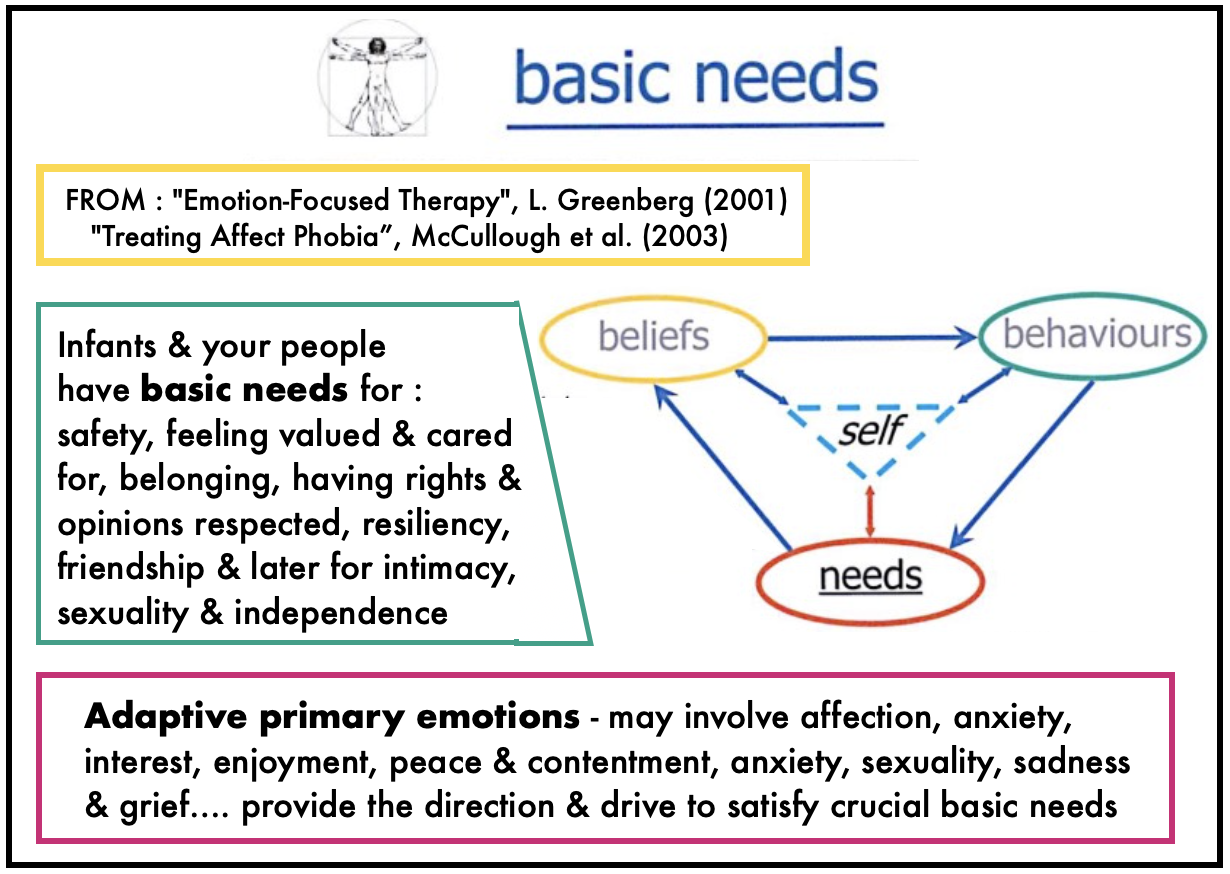
c. Mental/ Emotional Health is based on providing personal & universal human NEEDS & RIGHTS
Children need security, stability, feeling valued, encouraged, loved & trusted – in order to build self-esteem & independence. And these needs continue into adulthood for everyone, although ACoAs are still not allowed to fulfill them.

The drive to fulfill needs shows up in basic adaptive feelings & emotions that push us towards psychological health, just as hunger or thirst push to satisfying basic physical health.
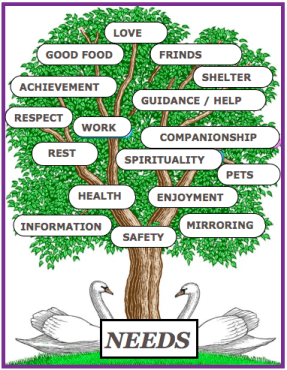
It’s imperative that we allow ourselves to acknowledge & work on providing them. See “Needs” on tree above.
(ChartsMORE info)

NEXT: Being Disappointed (#1)

ACoAs – ANXIETY & T.E.A. (Part 3)

PREVIOUS:
Anxiety & T.E.A. #2


2. ANXIETY (cont.)
⚑ UNDER / ⚑ OVER (Part 2)
⚑ ⚑ TOXIC anxiety
In the present : Our internal process causing anxiety begins with some action which we judge harshly (see Laundry List ),  our harmful, self-hating thoughts about some ‘failure’.  Only then do we become overwhelmed by fear/ anxiety/ panic.
OR the anxiety can be a response to how badly someone else is treating us, simmer to the way our family did.

RULE: Our negative, narcissistic, paranoid beliefs ALWAYS PRECEDE anxiety. Many of us don’t know this because we don’t :
⚡️pay attention to the chatter in our head
⚡️notice what we’re actually saying to ourselves (CDs)
⚡️realize it’s distorted alcoholic &/or co-dependent thoughts
⚡️understand that most of mental spinning is just a bunch of dangerous LIES!
We just end up FEELING scared, worried, in danger!

Yes, we do indeed carry with us piles & piles of old anxiety – from our traumatic, abusive, chaotic childhood. So, present-day distressing events – often beyond our control – can re-traumatize us, bringing to the surface long-held fear & panic we may not even realized was still there

It’s the constant fear we lived with on an almost daily basis as kids – not given comfort for it, & then punished if we cried or objected! And the causes of that fear never got talked about.
Those unresolved emotions got stored in our body as feeling memory (summary) – which need to be verbalized with safe people, then cried out & pounded out.

At the same time – we currently add emotional stress to our life by many self-defeating actions & inappropriate relationships, but more commonly by continuing to believe the abusive messages we got at kids, which we hold as gospel truths!
ALWAYS remember that both accumulated fear & current anxiety is in our WIC (“If it’s scared childhysterical, it’s historical”), who still loyally agrees with the Introject’s messages.

Whenever this wounded Child Ego State takes over – we can’y manage well or choose differently!
😿 It’s not up the child part of us to know how to function in the world!, especially given our woefully inadequate upbringing.
🤓 Rather, it’s our grown-up responsibility to develop a Healthy Adult & Loving Parent (the UNIT) capable of acting in safer, more successful ways.

 💚 GROWTH anxiety : At first, anxiety & guilt will come up any time we break family rules as we Heal & Grow – when taking better care of ourselves, when letting others be loving & kind toward us, when changing how we interacting with other in new positive ways…..

This anxiety is from our earliest experiences, the WIC still believing (T) that we don’t deserve good things, SO it’s convinced that if we reject the old patterns & focus on taking care of ourselves :
• we’ll lose the love of our family, spouse, boss, friends, children….
• we’ll be punished / ignored (again)
• we’ll be all alone forever
• we’ll hurt other people….

PAY ATTENTION! Al-Anon’s 3 As starts with Awareness – so we need to stop & ask:
♢ What is my WIC saying to itself about this situation?
♢ How accurate is it?
♢ How do these ideas reflect my alcoholic family?
♢ Do I need to check out my thinking with someone sane & trustworthy?
♢ What would be a kinder, more loving way to think about what I did or didn’t do?

T.E.A.
When something doesn’t work out for us – like getting caught in a mistake, or someone doesn’t like something we did…. we wonder why.
⬆️ INCORRECT order 
When upset : Totally
focused on the emotional pain triggered by a situation – assuming the anxiety is only from the difficult event (unaware of negative thoughts)
OR only on self-abusive obsessional thinking, trying to ‘figure things out’ but not feeling it

⬇️ CORRECT order
To understand what’s going on inside – we need to apply T.E.A. accurately.
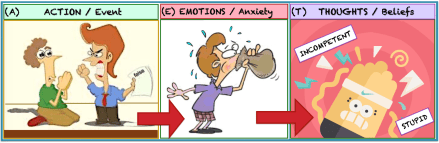
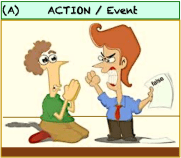
What generates our reactions to an external upsetting event (A) is our Thinking, which causes Emotions, which may or may not lead to your Actions in response.

Look for what you’re saying to yourself (T) when trying to explain how you feel (E) about an event (A).

NEXT: Anxiety & TEA #4

ACoAs – ANXIETY & T.E.A. (Part 2)

HOW AWARE AM I about my painful emotions?

PREVIOUS: T.E..A. & Anxiety (#1)

SITEs: Anxiety Fingerprint (Tool 3)
Consciousness & Emotions & the brain

BOOK: Freedom From Body Memory : Awaken the Courage to Let Go of the Past….. “a person can accumulate years, even a lifetime of stress in their body from past experiences….”

1. T.E.A defined (Part 1)

2. ANXIETY (cont)
⚑ UNDER: For those of us who try to skate past our anxiety when something sets it off – we’re deeply shocked, overwhelmed, can’t cope, think we’re losing our mind…… And if we unexpectedly get too flooded, without a healthy way to resolve it, it can trigger an anxiety attack, which is very scary & physically painful

ACoAs will do almost anything to avoid feeling our emotions – especially fear. ‘Coping’ styles (escapes):coping styles
• keep so busy you can’t feel it (or much of anything else)
• withdraw, isolate from people, refuse help or comfort
• find other ways to escape (internet, tv, sleeping……)
• stay angry so you don’t feel scared
• blame everyone / everything else

⚑ OVER: And then there are those of us who are drowning in anxiety – for days, months, years or as far back as we can remember – as our constant daily companion. We don’t know what to do about it, don’t know the source & have never learned how. It’s one reason why some ACoAs actively try suicide – even though few achieve it directly.

Reactions:
• obsess over that you did wrong when upset or disappointed
• search for answers outside of yourself to fix your problems
• use various categories of addiction to numb any unpleasant Es
• dump on anyone who’ll listen : compulsively go on & on about situations & people in your life that upsets you, without any self-awareness of internal causes,
or else try to make appropriate external changes where possible.

CHICKEN or EGG
Whether anxiety (physically & emotionally painful) has been a life-long black cloud always overhead  which has effected everything you do,
OR an occasional unexpected ‘visitor’, seemingly out of nowhere –
2 important questions come to mind:
Where is it coming from? // What can I do about it?
If you’ve asked yourself these Qs, you may have just shrugged ”I don’t know”.

a. Not everyone is self-reflective. Most people go thru life ignoring or using the list above as defense mechanisms to sidestep emotional pain. They’re just baffled & stay that way.

b. Some see a connection between an event (action) & anxiety, but don’t know what it is, & attribute it to something that shows our imperfection :
√ making a mistake, forgetting something, being late, saying the wrong thing, losing something valuable (even temporarily), making  a fool of ourselves, failing at some effort…..

More often it’s something or someone outside of ourselves that makes us anxious :
√ waiting for an important phone call, being called into the boss’s office, a break up, anticipating an attack or punishment, the death of a family member, someone important turning against us, being verbally attacked or accused wrongly, caught in a character defect …..

c. Emotionally oriented ACoAs feel the anxiety intensely, but will only ‘hear’ obsessive thoughts – “spinning” – & assume it’s a way to explain the emotional distress, after the fact. (Suggestion: Enneagram 2, 4, 6 types, & anyone with a lot Water signs in their Astro natal chart – Scorpio, Cancer & Pisces)

Sensitive /emotional ACoAs may assume that a stressful situation is what generates anxiety, CAUSING the spinning (obsessive thoughts) – as a way of explaining the emotional upset to ourselves. (Posts: “What just happened?“)
We may use this kind of endless ruminating:
to beat ourselves up, taking on all the blame for a situation
to identify how bad/ weak/ inadequate… we’re convinced we truly are & in what way
to figure out how to fix it, but from a narcissistic perspective (“It’s all about me!”), via people-pleasing, groveling, hiding out, being belligerent…. depending on our personal defensive style.

HOWEVER – the reality of our internal process is the reverse : our harmful THINKING CAUSES our anxiety!

NEXT: T.E.A. & Anxiety (Part 3)

ACoAs – ANXIETY & T.E.A. (Part 1)

T.E.A. chart

PREVIOUS: Fear of Responsibility (#5)


1. T.E.A.  = Thoughts, Emotions, Actions.
⚠️ Most people are not taught to distinguish between these 3 modalities. This causes much confusion in how we express ourselves, creating a great deal of mis-communication in relationships. While the 3 categories interact, they’re not the same parts of us.

The most important thing to remember is that Thoughts & Actions can be changed &/or modified, but emotions just are. It is not healthy nor legitimate to suppress emotions, while it is necessary & appropriate to choose what we say & do to express them (the words & actions), depending on the situation we’re in.

THOUGHTs – always made up of a string of words.
thinking mindAll of us have running dialogues in our head much of the day, on the surface of our awareness, such as:
• planning what we‘re going to do or ‘should’ be doing

• reviewing what’s happened to us or what we did (pleasant or not)
• ‘dreaming’, wishing, imagining, designing projects……
• worrying, obsessing – often about things we can’t control

• ranting to ourselves about people who hurt us & things we hate
• thinking about things we’ve seen or read
• planning things we want to say, either personal or for work……
AS WELL AS:
• what we’re thinking about under the surface, that’s out of our direct awareness. Some thoughts are deeply hidden, others accessible if we pay attention. This is what sitting quietly in ‘meditation’ is for – to hear the chatter in our head.
(Post:Using Think instead of Feel“)

EMOTIONs – see extensive posts
These are always ONE WORD things – happy, sad, angry, amused, lonely, scared, pleased, sexy, excited……(NOTE: if you say “I feel” immediately followed by a sentence – it’s not an emotion, but rather a thought – a string of words. EXP: “I feel like going for a walk”)

Posts
: Getting to Emotions – Under & Over // ACoA Emotions re Painful Events // ACoAs – accepting & accessing Es // What is Emotional Abuse? // Over-controlling ourselves

ACTIONs – Any activity we DO, as well as things we DON’T do, that are helpful or harmful to oursef & others

📌 An extension of this category – our behavior – is used as a defense mechanism, called “Acting out”, which can be defined as –
• Any compulsive (temporarily out of conscious control) ↵
action or non-action, which is ↵
• a way to externally express or demonstrate ↵
• painful emotions we’re not aware of at all (ongoing repression), or not experiencing at the time about a particular situation we’re in or that we anticipate happening

EXP
: ♟ being late for OR blanking out on an appointment we didn’t realize is making us anxious
♟ starting an argument (T) at the end of a nice evening, weekend (just before leaving the person or group)…. rather than feel the familiar old abandoned pain (E) at the separation, no matter how temporary!

Posts : Actions: Healthy opposites // Noticing painful events // Negative reactions to painful events // Positive responses
💚
2. ANXIETY
 All ACoAs are fear-based, whether our preferred defensive sty
le is to be :
• phobic (fearful, passive, victim, timid, worried, overwhelmed) OR
• counter-phobic (don’t consciously feel scared, & then keep anxietydoing dangerous things to ‘prove it’). This is a reaction to suppressed emotions accumulated from our abusive background or any other traumatic events in our life

❥ When was the last time you were struck by anxiety?
❥ How long did it last? What caused it?
❥ What did you do about it?
❥ OR is it with you all the time? & how do you cope?

Given our painful, chaotic, abusive early years – with very little comfort, explanations or guidance – we carry with us an enormous backlog of fear. This pile-up gets covered over & redirected, so we barely realize it’s there.
Once we’ve cut ourselves off from knowing the source of our fear, in many cases what we’re left with is anxiety – that free-floating painful flutter or tightness in our gut we don’t connect with anything in particular.

NEXT: T.E.A. & Anxiety (Part 2)

ACoAs: HEALTHY RESPONSIBILITY

PREVIOUS: (FoR) Fear of Responsibility  #3b

<—- CHART

SITE :

QUOTE: “In the long run, we shape our lives, and we shape ourself. The process never ends until we die. And the choices we make are ultimately our own responsibility.”  ~ Eleanor Roosevelt

HEALTHY appropriate Responsibility (R)
Psychological  / Social DEF: “…. R is the willingness to BOTH :
◆ accept the importance of standards that society establishes for individual behavior, AND
◆ to make determined personal effort to live by those standards

Personal responsibility also means that when individuals fail to meet expected standards, they do not look around for some cause outside themselves to blame.” (More….)
NOTE: This def. applies to us now as adults.
We were NOT responsible for what our parents did!

1. About Us

• as adults – we take care of our own needs, not wait for someone else to rescue us
• ask for help when we really do need it
• take time to rest, process, rejuvenate – but not isolate

• know ourselves well enough to observe how we functions in the world in many different situations. Improve where possible, but accept our limitations without S-H, & so gain mastery  (Posts: Multiple Intelligences ➡️)

• regularly check the motives that drive our words & actions, & correct them when they’re coming from our damage

• be willing to ‘fess up’ to words or actions we make in error or that hurt someone else, without self-recrimination
• make changes when our thinking & actions are self-defeating or harmful to others
• be interested in improving ourselves, whenever possible – allowing for resistance, damage or outer pressured which may slow down our growth

• identify all our talents, gifts, knowledge & hard work – and USE THEM
• own our strengths & weaknesses, from self-esteem rather than obeying Toxic Rules

2. About Others
• learn the difference between caring about someone & care-taking them
• honor everyone’s personal boundaries, as much as possible (no perfectionism)
• consider the other person’s ‘buttons’ so we don’t keep stepping on their toes

• never assume we know what’s going on with someone, no matter how intuitive we are or how well we know them
• notice what the other person says about themselves & use that (not ourself) as the basis for communicating, gift giving, giving support, choosing activities…

• ASK, ASK, ASK – before giving suggestions, advice, instructions….
— ask if they want or need it
— ask what they’ve done so far so we don’t waste their time (or yours) covering what’s already been tried & maybe didn’t work for them (POST: “ACoAs – Asking Questions“)

• if we can not keep a promise, let them know as soon as possible
• be emotionally honest with others, without dumping, whining, blaming, being too needy or manipulating

ADULTING
Taking personal responsibility can help us achieve more than we thought we could IF:
• we take actions aimed at reaching positive goals – not just do what’s in front of us at the moment
• we understand that long-term improvement comes from persistence, not by ‘trying’ in short spurts, once in a while
consistent ‘right action’ is what really pays off, not just thinking about it

T.E.A. – When we go about our daily activities from an accurate understanding of personal responsibility, we build self-esteem.
As we increase self-compassion (E) & self-awareness (T), some of the difficulties (A) that have plagued us our whole adult life will diminish or right themselves – without trying! This requires modifying or eliminating as many as our CDs as possible. CDs = “Cognitive Distortions

BENEFITS of Self-Responsibility
✶ we gain inner stability from knowing who we are, & then how to behave
✶ it increase self-esteem & allows the True Self to blossom
✶ it makes us more reliable, likable & trustworthy
✶ it allows us to get more of what we want in the world
✶ focusing on gratitude gives us comfort & hope

✶ we have less psychological distress
✶ we can trust our judgement & intuition
✶ it eliminates the need for lying or spin
✶ it significantly reduces guilt & shame
✶ it’s easier to solve problems
NOT BAD, huh?

❗️ Being respectful & kind – which comes from the Healthy Adult, is NOT co-dependence – which comes from the wounded IC.
➼ Consider how you’d like to be treated & then do likewise to others, whenever possible, without hurting yourself!

NEXT:Anxiety & TEA #1

ACoAs: RESPONSIBILITY (Part 3b)

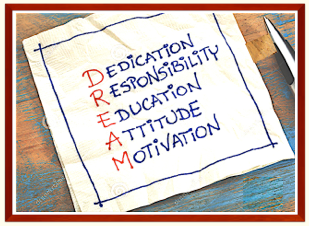
DREAMTAKING RESPONSIBILITY –  WITHOUT SELF-HATE greatly empowers me!

PREVIOUS:
Fear of Responsibility (FoR) #3a

🧍🏽‍♀️🧍🏽 AS ADULTS – GROWTH (cont)
🔆 Steps 4, 5, 9  (in #3a)

🔆 Step 10 – in AA, Al-Anon…. 
“Continued to take personal inventory, & when we were wrong, promptly admitted it

☑️ Comment on Step 10 (re. mindfulness)
This is often misused by ACoAs in the service of perpetuating our self-hate – seeing everything we do as wrong (sorry, sorry, sorry!), which is NOT what it says. Rather: “… and, when we were wrong…” which is not all of the time. (Posts on Step 10)

Because we don’t believe we have any positive, valuable characteristics, we’re constantly barraged by Bad Parent attacks. This is extremely stressful, & for some of us the pressure if so great that we end up spewing it out everywhere we go – constantly telling ALL our flaws, failures, trauma & problems – in great detail. We think it’s being honest & responsible. NOT. screen-shot-2015-07-15-at-10-09-17-pm

This compulsion is actually:

• SELF-HATE, which says: I’m so bad, worthless, unlovable & a f–k up, that I can never do anything right, AND I have to let everyone know that I know, so they don’t think I have an arrogant bone in my body

• LACK of BOUNDARIES – no sense of what’s appropriate about who, what, where & how to over-disclose our wounds. One woman at a Recovery Conference when meeting a friend of a friend – said all in one breath: ”Hi, I’m Mary, I was raped!”

• FEAR OF ABANDONMENT – ACoAs’ default position is that: “I will get abandoned by everyone, sooner or later anyway – so why not get it over with before I get too attached.
I’ll tell them what a mess I am so they won’t be shocked & disgusted later when they get to know me. That’s when they’ll dump me  – when I’m already involved – which will be unbearable”

✦ DOUBLE BIND (D-B) #1boy-sad-clipart-clip-art-clipart
• Our family made it clear they were not going to provide much of the PMES things every child needs. From that we concluded we didn’t deserve to have them anyway, we accepted this lack at a very deep level.
AND yet —
• Our needs never seem to go away, no matter how hard we try to ignore them, still longing to be taken care of anyway. Since we were on our own as kids, trying to get by as best as we could without knowledge or nurturing, & we still are. So we sneakily try to extract a little of those pesky need from the world – but usually in self-destructive ways.

✦ D-B #2
Long ago we gave up hope of ever succeeding at what we were ‘born to be/do”, so now we never go for the brass ring. ACoAs are ‘famous’ for being great at what we like to do the least, since it’s not a threat to our core Self. We think that if we fail at something we don’t care about it won’t matter as much!
⚠️ Andneeds if we dare reach for the sky & actually achieve some success >> at best we assume we’re frauds, & << at worst we find ways to sabotage it

AND at the same time —
— we keep trying to do & be what they said they wanted of us, or what we thought they meant – so we can finally get it right – to get their acceptance & approval!
We keep hoping someday all our effort will pay off, assuming it’s totally up to us to fix, so we bend ourselves into a pretzel – anything to deny our family’s disregard & abuse

✦ D-B #3a
Our family bullied us into emotionally & physically ‘taking care’ of them, insisting when we were children that we act as fully competent adultsfor them (as arbitrator, lawyer, doctor/ nurse/ psychologist, housekeeper, babysitter…..)
AND yet —
— any attempt we made to use those same skills for ourselves were continually belittled, discouraged, made fun of, punished, under-cut…..

#3b – As a result of 3a:
We have to – at least – try to get other people to take care of us, because we truly believe we don’t know how DB #3
AND yet —
— we do take care of others, actually exhibiting amazing skills & talent we never use for ourselves, still thinking we’re incompetent!

✦ D-B #4
We are angry at having to be responsible for others, still protecting the abusers in our life
AND yet —
if we don’t keep up our co-dependent dance with everyone (be over-responsible), we’re convinced we’ll never be able to get our needs met (as reward)  (MORE…. re. DBs)

NEXT: Healthy Responsibility

ACoAs: RESPONSIBILITY (Part 3a)

World-on-ShouldersOWNING MY T.E.A.s : even if my buttons get pushed, I’m responsible for my reactions

PREVIOUS
: Being responsible #3

See ACRONYM page for abbrev.


🧍🏽‍♀️🧍🏽 AS ADULTS – GROWTH

As a guide to personal growth, the 12 Steps of AA are all about taking personal responsibility. They include:
🔆 Step 4: Made a searching & fearless moral inventory of ourselves
🔆 Step 5: Admitted to God, to ourselves & to another human being the exact nature of our wrongs
🔆 Step 9: Made direct amends to such people (we had harmed) whenever possible, except when to do so would injure them or others
🔆 Step 10: Continued to take personal inventory, & when we were wrong, promptly admitted it

NOTE: However, it’s very common for addicts & co-dependents to not understand or to misuse the 12 Steps, especially in early Recovery.

☑️ Comment on Step 4 (re. ourself)
ACoAs find it very difficult, sometimes even for years into Recovery, to sit quietly & write this out. WE:
• don’t know what character defect are nor which ones we’re actually guilty of , since they’re so much a part of the fabric of our life. “Does a fish know it’s wet?”
• have so much S-H & shame that it’s too painful to admit anything, even though we think we’re guilty even when we’re not
❣️ Sadly – we don’t realize that inventories are supposed to include all our personal gifts, skills, talents….

☑️ Comments on Step 5 (re. hiding from everyone)
• Because of the WIC’s shame, it’s painful to share our defects with others. We’re so used to being chastised or made fun of, that doing this Step feels emotionally dangerous
• So many of us have a distorted view of ‘God as we understand Him/Her’, because as John rejct helpBradshaw reminds us:
“Before the age of 7 we deify our parents. After that we parentalize our deity.”

⛔ So if we make our Higher Power in the image of our abusive, neglectful parents, we can not avail ourselves of spiritual Source as a safe haven of help & comfort

• If we look up at the sky & only see our dangerous, neglectful mother’s or father’s face, it obscures the Loving Being who is waiting to connect with us & heal our fear & sorrow

Our WIC needs to be given a corrected view of HP. This comes first by developing the Loving Parent toward ourself that we never had – our responsibility to learn with appropriate guidance – & then we can have a more accurate vision of who the HP really is

☑️ Comment on Step 9 (re. TMI: Over-disclosing)
Making amends is a very important part of relieving guilt & shame – when done in the right way, in the right environment – “You’re only as sick as your secrets”.
However, ACoAs with weak boundaries & driven by the WIC’s anxiety, will either not ‘admit’ anything, or admit willy-nilly.

😳 A vital & much neglected part is at the end of this Step : ‘’…except when to do so…”  Sometimes telling an aggrieved person what we’ve done or said is not a responsible action, & will only do everyone harm.

EXP
: A wounded ACoA loves his wife & kids, & doesn’t want to lose them, but is nevertheless unfaithful (incest-survivor).  He’s filled with guilt, & tries to stop, but doesn’t. He wants to tell his wife, but knows if he does, she’ll leave.
a. Unhealthy reasons to tell her would be:
• temporarily relieve anxiety about ‘being bad’, so he doesn’t have to deal with his emotional painscreen-shot-2015-08-14-at-7-58-16-am
• have a fantasy hope that she’ll forgive & let him stay (so he can then ‘get away with it’ AND be absolved)

• the need to be punished, no matter the consequences to everyone (he doesn’t really deserve to be part of a loving family)
• a wish for his wife to be his watch-dog (use her as the controlling mother) – because he doesn’t really want to stop acting out, but may do so to be the ‘good boy’, or maybe keep acting out as a form of rebellion

b. Healthy (obvious): Stop all forms of cheating & work on his damage

NEXT: Fear of responsibility (Part 3b)

ACoAs: RESPONSIBILITY (Part 2c)

PREVIOUS: FoR #2

See ACRONYM page for abbrev.


🧍🏽‍♀️🧍🏽AS ADULTS
1. UNDER-RESPONSIBLE – as “Leavers” 


2. OVER-RESPONSIBLE = the “Stayers”
(cont)
We stay in Rescuer mode, because we don’t see that:
• there is much more support & info available that can help us manage life’s stressors
• now our options are much greater, if only we searched them out AND had permission to use them
• but MOSTLY because we don’t feel worthy of being given to

We stay hooked because we’re still needy as long AS:
• the WIC is still psychologically & emotionally in charge of out motivation. It’s using childhood experiences as its only point of reference, ignoring the fact that we’re not little anymore, have many adult experiences, & developed many skills
• we’ve reproduced our early environment elsewhere (being neglected, abused….)
AS –
• we keep taking on responsibilities that are not ours, while in many ways not being responsible for ourself (Serenity Prayer backwards)
• we believe that ‘committing’ ourselves to a job, a place, a group, or to loving another person – means only doing what others want or need, instead of what’s reasonable, & what fits our own personality. This comes from assuming we hahelpve to earn love & acceptance.
AS –
• the WIC thinks that if we did honor our own needs above others it would prove how selfish & bad we are – based on what they told us growing up – even that we’re incapable of loving!
How cruel!

Living this way is very stressful AND unsuccessful, since we can never please others completely, especially if they’re self-centered like our parents. Sooner or later we end up failing – again – but keep trying anyway.
Relationships with ‘Leaver’ types is deeply harmful to our Soul / Healthy Inner Child, reinforcing S-H & hopelessness.
But it also has the ‘negative benefit of giving our False Self a feeling of power & control. Then we don’t have to face what really happened to us as kids.

The TRUTH is that love cannot be earned or ‘created’ in another person. Ever! It has to be given freely. Either someone already has the capacity to love or they don’t.
It doesn’t mean such a person will love us, only that they’re capable. We say of our parents: “Of course he/she loves me”, but we don’t feel loved by them!  We blame that on ourselves (S-H), instead of acknowledging THEIR lack – which is the truth we keep avoiding. real love

• We don’t feel loved by our family for a legitimate reason. We were/are NOT part of their internal equation, even when they seem to be interacting with us.
They experienced us as : only an extension of themselves, a source of narcissistic supply, a parent-substitute, an ego-booster to brag about, a daily nuisance, an emotional annoyance ….. but not someone to cherish.
Severely wounded parents have little or no capacity for selfless caring, no matter how much they protest that they do, or how much we or they would like it to be otherwise.

If our parents say/ think/ feel that they love their children – it’s in their narcissistic Inner Child form (C2 —>), having to do with their needs & perceptions. If they were genuinely able to love – from a healthy Adult ego state – we would have felt it!
They would have consistently included us in their responses, acknowledging US as separate individuals for who we are & what WE need, rather than only considering everything from their own point of view.

ACoAs have a very distorted idea of love. We think it’s:
– either a fairy-tale all-consuming feeling, or we don’t think it exists at all
– either being manipulated & controlled by someone, or an obsessive longing for the one who doesn’t want us
– being loyal to a miserable relationship, or it’s something only others get to experience…..
None of these are love. They are addiction, co-dependence, FoA & S-H – copies of our family dynamics. (Post = “Fear is the Absence of Love”

HEALTH =  Being appropriately responsible in relationships requires being clear about our motives, & NOT caught up in the one of the “Games People Play”.
It requires that we provide what our Inner Child needs to heal & become healthy, so we can share our True Self with other appropriate adults.

NEXT: Fear of Responsibility #3

ACoAs: RESPONSIBILITY (Part 2b)

I GIVE IT ALL AWAY & have nothing left for myself

PREVIOUS: Fear of Responsibility (FoR)  #2a


🧍🏽‍♀️🧍🏽 AS ADULTS (cont)
1. UNDER-RESPONSIBLE – as “Leavers” (cont)
a. re. OTHERS – Part 2a

b. Re. US
Being aleaver’ includes leaving ourself – not just putting ourself last, but barely enough to survive, or to make life worth living.

We do NOT:
• take care of ourself – appearance, health, living space…..
• acknowledge the damage done to us, & get the right help
• stand up for our rights, provide for our personality needs
• use our inborn talents, so don’t contribute our best to society
• prosper, perpetuate general ‘anorexia’ – such as under-earning, bad relationships, isolation, no fun ….

Most ACoAs do not show outward signs of our underlying wounds, but all of us suffer from it to some degree, even in Recovery.
• We didn’t learn self-care from our family, having been neglected & mistreated, thus given the message that we didn’t deserve any better, and
• This left us with a lack of information about self-care, so we don’t actually think in terms of what we need

At the extreme, the self-neglect of some ACoAs is more visible (deprivation / anorexia in many areas of life).
Gibbons (2006) defined it as: “The inability – intentional or not – to maintain a socially & culturally accepted standard of self-care, with the potential for serious consequences to the health & well-being of the self-deprivers, perhaps even to their community.” (Wikipedia) (MORE….)

Some overt symptoms of personal deprivation include hoarding items & pets, a compulsive need to isolate, living in a dirty  environment, poor personal hygiene, neglecting household maintenance, unwillingness to take needed meds, unkempt / sloppy appearance, eccentric behaviors……

🍎🔥
2. OVER-RESPONSIBLE = the “Stayers”
Being ‘over-responsible’ toward others includes our children & grandchildren (small or grown),
BY: • doing too much for them
• people-pleasing & not setting boundaries
• letting them get away with unhealthy behavior, spoiling them
• giving in to unhealthy requests or demands
• not holding them responsible for bad behavior
• not teaching them the best ways to live in the world

ACoAs as ‘STAYERS’
As long as the WIC is still running our life, we focus all our attention outside of ourself. We’re looking for someone to take care of us – to give us permission to even be alive, much less be our True Self

• We do too much for others, & most of the PPT we pick to ‘help’ are just are incapable of being there for us as our family was, with a few exceptions.
Also –
• Because our parents were so angry, depressed & unhappy, ACoAs are convinced (unconsciously) that everyone else is the same.  We project how our family treated us onto every situation we encounter in our daily lives, whether it’s similar or not.

That means we react & behave in the same way we did as kids = that we have to be responsible (R) for others’ feelings & needs, to ‘help’ / fix everyone we deal with, whether important to us or not (lover, parent, sibling, OR “butcher, baker, candle-stick maker”…..) & suppress our own emotions, hopes & dreams.

We BELIEVE that:
• without our intervention – others we meet will also fall apart or put out firesgo crazy, which would be our fault, so we rush in to put out other people’s fires
• if we don’t take care of them they won’t have any need for us, & ‘leave’ us
• by rescuing / saving…. others we will finally become worthy of getting our needs met (‘earning’ love)

⚡️ For prolonged rescuing, we stay with those:
• who are more wounded than we are (assuming we’re not), so we can feel useful, appreciated, even superior
• who don’t want to take care of themselves & could, but live in Victim mode – so would rather we do it for them, since we’re so good at it (& desperate to please)
• who are intensely narcissistic, using us to feed off of, which we agree to, at least for a time, because it makes us feel needed & important

AND, we automatically stay away from anyone who is reasonably healthy – competent, self-directed, doesn’t need or want rescuing…. because they don’t ne-e-ed us & we wouldn’t know how to interact with them as equals!

NEXT:
 Fear of Responsibility – #2c