S & I : Healthy Individuation (Part 3)

S & I recoveryAS I WORK AT RECOVERY
I find out more about my True Self

PREVIOUS: Healthy I (Part 2)

POSTS:  PROCESS = ACoA version / vs / Recovery

CULTURALLY – Most people are wounded for one reason or another. Few have has a genuinely safe, truly nurturing childhood, especially in their first 10 years.
In his 1942 writing, “FEAR of FREEDOM”, psychoanalyst Erich Fromm deals with humanity’s reluctance to be alone – the lack of Individuation leading to our fear of isolation, & the resulting appeal of authoritarian regimes, such as Nazi Germany.
Fromm suggests that most are so afraid of freedom they find ways to minimize the fear by creating dogma & rituals that seem to provide a sense of security – whether for individuals or whole societies. (MORE…)

Authoritarianism: This personality type includes sadist & masochist elements. They need to have control over others to impose some kind of order on their world, but will also yield control to a superior force (government, religion…) from a person or abstract idea
Destructiveness
: Although there are similarities to sadism, Fromm argues that while the sadist needs to have control over something or someone, the destructive personality wants to destroy anything it can’t control

Conformity
: This happens when people unconsciously incorporate the over-all beliefs & Cognitive Distortions of their society, then believe it’s their own – so they can avoid genuine free thinking which would provoke anxiety

The PROCESS
If we can accept that we have our own specific lessons to learn, we’ll welcome them instead of complaining.
Lessons come in ever tighter circles until we’ve completed them, so knowing the stages of growth & accepting the spiral nature of self-healing (book), can help to appreciate our hard work & recognize successes

1. Develop awareness – notice what isn’t right in the quality of our life & relationships. It’s best to have a non-judgmental, observer’s point of view & friendly curiosity about ourself. This helps avoid triggering old patterns which originally formed as self-protection.
It’s imperative we don’t slip into S-H when we see these patterns again, to not add more pain, especially if we thought they’d already been ‘fixed’. No more salt in the wounds, please!
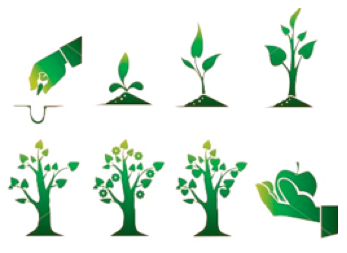
process2. Choose an alternative – this is an action step, but without aiming for perfection in any part of our life. It’s finding healthy opposites to break the trance of following the Toxic Family Rules, which can be a surprising & wonderful experience.

Switching to a better action (or non-action if called for) often brings up emotions of fear, guilt & shame, even anger, or sometimes feeling hopeless & suicidal – so be prepared to get the needed support

3. Practice what we learn – over & over.  Patience and Process are not our favorite things, but ARE the main ways we get better at anything – from sports & the arts to emotional, mental & spiritual growth. As long as we actively work to Individuate, we keep getting new info about ourself, which is exciting!

EXTERNALLY
The whole process of Individuation is the archetypal soup which all humankind is swimming in, the container that holds all our aspirations, dreams, fantasies, sense of vocation, successful ventures & wrong turnings (Marathi Culture 🔽)

Because it’s a universal human need, the physical expressions of Individuation Stages toward wholeness are found in all cultures, all eras, & in many forms:

Artistically, in the seemingly simple “Oxherder” pictures of Zen Buddhism or the cryptic, alchemical pictures of the Rosarium Philosophorum
Architecturally, in the labyrinth at Chartres Cathedral or the Bollingen tower that Jung built

Esoterically, in the Greater Trumps of the Tarot cards, or the pseudo-scientific, symbolic system of alchemy
Musically, in Mozart’s opera The Magic Flute or in Beethoven’s Fidelio

Mythologically, in the ancient story of Gilgamesh and Enkidu, or the Sumerian myth of Inanna and Ereshkigal
Playfully, in the many ball games played around the world

Poetically, in the spiraling journey of Dante’s Divine Comedy, or Hermann Hesse’s novel Siddhartha, about the life of the Buddha
Spiritually, in the Jewish Kabbalah, or the sayings and parables of Jesus of Nazareth, such as, “Whoever would seek to save their life will lose it; but whoever would lose their life will preserve it.”   From: “Individuation – the Process of a lifetime”
NEXT:  S & I needs a healthy ego – #1
S & I : Healthy Individuation (Part 2)

freedomSELF-AWARENESS IS GRADUAL
and worth every step

PREVIOUS: Healthy I. (#1)

SITE: “The Way of Individuation”, by Jolande Jacobi, in article by Martha Blake

Review: Autonomy & Attachment

See ACRONYM Page for abbrev.

Field-INDEPENDENT (F-I) – having a reasonable amount of S & I  (opposite of Field-dependent = F-D)

HEALTHY / normal : Individuation is inner-directed, mainly providing a sense of identity & value from our own unique nature, not just from heredity & social training, nor from how others see us.   People become F-I gradually, finding out what they think & how to act, based on rigorous honesty, staying awake (mindfulness) & self-evaluation

• Being internally motivated gives overall psychological & physical health : (T.E.A.)
T: improved conceptual & creative thinking, superior memory recall
E: pleasant emotions (& ability to handle painful ones)
A: enhanced performance & willingness to engage in a wide variety of tasks.

There’s a significant correlation between F-I and IQ. The most original, creative & outstanding people ‘march to their own drummer’, but expressing one’s highest potential isn’t limited to an elite group – it’s available to all humans with the courage of their convictions

CHARACTERISTICS
• Our True Self is a combination of F-I & F-D, grounded in self-esteem. Introverts are more naturally inner-directed, but most do not have a healthy Self. So Introversion & being FI are not synonymous

• While Extroverts are naturally outer-directed (not other-directed like F-Ds) they need to be emotionally healthy to be F-I . Since that comes from having good boundaries & permission to have all ones needs, it doesn’t limit or undermine the degree of Individuation anyone can achieve

• F-Is have the ability to focus on details in their environment in spite of the clutter of background ‘noise’, & can extract what they need from non-relevant items within the field (as in: “pick the item in this picture that doesn’t belong”).

• They’re able to create structure even when it is not inherent in a given situation, tend to be more efficient at retrieving items from memory, framing current experiences & info in the based on prior knowledge

• They learn more effectively by screening out distracting information, focusing on a task. Often favor natural sciences, math, engineering – but not exclusively.  ALSO, they can step back to see the whole forest (background) not just the tree in front of them

• F-Is have successful relationships with others in many different settings. They don’t wait to be chosen but are pro-active about who they want to interact with, & how. They can stay or leave, depending on what’s suitable for them, or not, rather than by people-pleasing (= passive) or being controlling (= aggressive)

STAGES
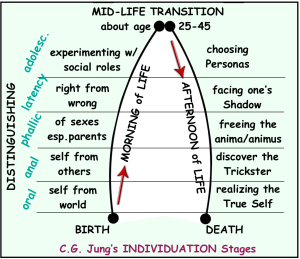
Individuation is the development of the mind / spirit, which matures in much the same way as the physical bjoin oppositesody.  It unites opposites in ourselves – good & bad, light & dark, male & female. A number of Jungian psychologists list this process into 4 stages, each with its dangers to be avoided, & each with rewards:

Becoming conscious of the Shadow
Facing our ‘dark side‘ – things we’ve repressed or ignored. Just as the Persona is what we present to the world, so Shadow holds all the things we want to hide from others, but mainly from ourself

Becoming conscious of the Anima or Animus
This has to do with sexual wholeness.  Anima is the ‘inner femininity’ of men & Animus the ‘inner masculinity’ of women. Jung (1978) wrote that they represent “functions which filter the contents of the collective unconscious through to the conscious mind”, coloring the Ego’s perception of Self & others in many different ways

Becoming aware of the Archetypal spirit
This is about uniting matter & spirit, body & mind – facing both the good & evil we’re all capable of.  It’s also about liberating us from our same-sex parent.  For men the archetype is the ‘Wise old Man’, & for women the ‘Magna Mater’, the great earth mother.

Becoming conscious of the Self
Jung (1977) called this final step ‘self-realization’. Jacobi (1973) wrote: “For the conscious personality, the birth of the Self means a shift in its psychic center, and consequently an entirely different attitude toward, and view of, life”.  (MORE….)

NEXT: S & I – Healthy Individuation (Part 3)

S & I : Healthy Individuation (Part 1)

healthy S & I 

THE REAL ME –
is unique but not alone!

PREVIOUS: S & I  – Separation

SITE: “Extroverts & Introverts…”


INDIVIDUATION
• Individuation is the ‘normal’ search for our True Self – our essence & goal of life.  In the past, mystics called it : the ascent of the soul, the alchemy of the soul, or enlightenment. Carl Jung believed that the nature of humans is to constantly develop, grow & move toward a level of completeness, which can only be done from the inside (opposite of co-dependence).

It’s the progressive development of our own voice, throughout life by trial & error, involving many successes as well as failures & frustrations.
Just like Separation – Healthy Individuation includes keeping our attachment & connection to others (children & parents, mentors & protégés, friendships, mates….) without enmeshment or fusion, in a delicate balance

• Putting Self-Actualizing needs in the foreground, Individuation is to ‘own’ at least 51% of ourselves, by having combined Ego & Shadow, & therefore freeing ourself of the Superego’s tyranny (Negative Introject).
The rest – 49% – is made up of heredity + all our family & social experiences, traditions & religion.
And, because Individuation is ongoing, there’s a periodic need to return to earlier developmental stages – to heal deeper & deeper layers of unfinished business. At the same time, the truer we are to our Real Self, the more INternally motivated we become

•Successful Separation & Individuation requires an intact Ego – the center of our conscious awareness. While providing a sense of uniqueness, the Ego lets us know that we’re just like all other humans – part of a larger whole.

In Jungian terms, the Self is the main archetype in the Collective Unconscious, needed for order & organization, unifying different aspects of personality. Therefore it’s of a higher order than Ego – made up of both conscious (ego = public face) & unconscious (shadow= primitive impulses such as selfishness, greed, envy…..)

✶ Shadow :  For Jung, both constructive & destructive forces exist in the human psyche, requiring psychological integration. To become fully actualized – at the top of Maslow’s “Hierarchy of Needs”- we have to be aware of & accept all our parts.
NOTE:
Ironically, for ACoAs, much of what also gets shunted off into our Shadow are the good parts of ourselves which were not accepted or allowed in our family & society! Having normal human needs such as wanting attention, intense emotions, our own way of thinking & doing things, being heard & respected…. were punished or so controlled that we end up forgetting them OR hating ourselves when they surface

• Jung believed that we don’t suddenly make a conscious decision to free ourselves from the herd, with its well-worn paths, in order to go our own way – ie. to Individuate.
Instead, the deciding influence is an irrational factor he called “vocation – like a law of God from which there is no escape”. It’s the Ego’s response to a call from the unconscious to express our core self , whether we like it or not

• Based on personal & professional experience, he concluded that Individuation happens in the second half of life, when people reach their goals & suddenly find themselves facing an unknown possibility or unexpected upheaval.
This turning point usually is a crisis in mid-life (not necessarily something bad), that upsets the status quo, causing a shift in perspective :
new way– a financial failure    – health problem
– broken relationship or death
– change of residence or profession
OR
– a message from powerful dreams & fantasies, creating —
– deep yearning or “call” to change direction
– profound self-doubt, loss of meaning or religious conviction
– questioning everything previously held as important, valuable or precious

• Then the essence of the personality moves from Ego toward Self, trying to form a new center. Parts that were ignored or under-developed (interests, talents, characteristics, experiences, issues…) may ‘suddenly’ want to be acknowledged
What was:
– fragmented now strives for unity  – broken now yearns for wholeness
– neglected now seeks expression   – formless now starts to take shape

While these changes can be very surprising & uncomfortable, shifting the ground under us, we intuitively recognize they fit our deeply truth

PS: Many psychologists now argue that while Individuation may be a natural outcome of age & experience, it can also be brought on sooner by deep therapy, but it’s mainly considered a life-long journey, which starts soon after birth.

MASLOW's needs

NEXT: Healthy Individuation (Part 2)

S & I : Lack of Individuation (Part 1)

taken care of  

I WANT SOMEONE TO TAKE CARE OF ME – rather that “grow up”!

PREVIOUS: Separation – #2

HEALTHY – in future posts

DEF : Individuation “is the process of self realization, the discovery & experience of meaning & purpose in life. It’s the means by which one finds oneself & becomes who one really is.
It depends upon the interplay & synthesis of opposites e.g. conscious & unconscious, personal & collective, psyche & soma, divine & human, life & death.” (Carl Jung)

INCOMPLETE / DAMAGEDshut down Es
Damaging parents interfere with the Individuation process in many ways, including preventing us from having a wide range of emotions – such as when only one or two are acceptable (only happy, only scared, only angry…) OR when any expression of E. is ignored or punished.

A study from Belgium looked at the effect of parental dysfunction on their 20-Something adult-children, studying 2 extremes – unhealthy independence or dependence. Over all, psychologically controlling parents ignore their child’s needs using manipulative tactics (guilt, shaming, love withdrawal) to pressure the child into meeting the parents’ standards – causing anxiety, depression & perfectionism

Parents who use intrusive tactics scored high on:
dependency-oriented control (DPC) to keep children physically & emotionally close, not allowing them take independent actions.
They end up feeling threatened & anxious by being on their own
AND
achievement-oriented control (APC) to make children reach the parents’ goals of individual performance, where love and acceptance are based on meeting strict rules of achievement.
These children can become self-critical perfectionists, obsessed with showing off personal ability, while ignoring the need for closeness & at expense of satisfying relationships

RESULT : We had to shut down most Es – which would normally give us subtle but definite private information about what’s right or wrong for us. Being cut off from the cues Es would provide –
— we’re deprived of the ability to reflect on our internal process
— aren’t able to trust ourself, procrastinating & confused
— & decision-making becomes very difficult or distorted

a. One extreme is when a child is forced to experience a later stage of individuation – prematurely, out of order, like ACoAs who as kids had to be ‘little adults’: a parelittle adultnt’s confidant or rescuer, or someone’s object of sexual attention).
This can turns a child INTO:
i. an arrogant ACoA adult with an over-developed, inflated False Persona, preventing or severely slowing down self-examination & emotional growth

They can function quite well as long as they’re in familiar settings, but miss genuine spontaneity, the ability to let go of control, even to the point of being unnaturally rigid, lacking zest or authenticity

Others people can be taken in by their ‘so together’ exterior. But hidden under that surface there’s a lack of personal development – a very unhealthy WIC – which mainly shows up in private, as unavailable & harmful mates & parents
OR INTO:
ii. an isolated ACoA adult, going to work every day, maybe even being in the helping professions, such as nurse, social worker…. or trapped with an addict spouse, a severely disabled child…. to take care of. They continue playing out the Hero-rescuer role, but are plagued by constantly second-guessing themself & the accompanying anxiety

like father....b. At the other end of the spectrum are the children who were bullied, browbeaten & brainwashed into buying every aspect of their family & social culture – with no room to breathe. They conformed to the dysfunction from a combination of their natural personality (more compliant OR most like the parents), and from a deep terror of being punished for disagreeing

• They too grow up without knowing who they are as individuals apart from their training, so they’re out of touch with even their most basic tendencies, dreams, wishes. Many will continually react to everything & everyone like a child, emotionally & mentally, without realizing it

However, people in this category are more likely to seek out therapy & recovery, because they know they’re incomplete, feeling lost, stuck & unhappy. Unfortunately they blame themselves (S-H) rather than correctly identifying the source of their lack!

NEXT: S & I – Individuation #1

S & I : Separation (Part 2)

PREVIOUS : S & I – Separation #1

SITE: Object Constancy


DYSFUNCTION

Symbiotic, addictive families experience S & I as a betrayal of the family unit, &/or as a threat to its stability. This forces members to choose staying attached & co-dependently loyal over personal growth, having to sacrifice their unique personality & ability to act in their own best interest.
This is always a developmental dilemma which ends badly – either capitulating to the destructive family system or having to wrench away with great anger & pain on all sides.
🔻The most common emotion for the adult-child then is guilt – for breaking several Toxic Rules
🔹And for the rest of the family – anger, & resentment, accusations, confusion (“why are you doing this?”) and often a persistent attempt at pulling the escapee back into the fold.

EXP: When teenagers try to break the bonds holding them to their parents there are often great upsets for both child & parents. When teens are not allowed to successfully complete this process, it can cause them to be disruptive (acting out) – rejecting societal & family rules, and potentially suicide.

Also, when adolescents are subjected to family stressors (drugs & alcoholism, separation, divorce, death of a parent &/or adding a step-parent….) without help to deal with them emotionally & practically, their sense of grief & loss is carried into adulthood, bteen repressionlocking the necessary process of S & I. (MORE….)

• There is growing clinical evidence that adult psycho-pathology is related to a lack of healthy Separation (staying symbiotically attached), OR from having experienced too much Separation Anxiety as a small child (caretakers un safe & undependable).

Some results:

a. Dependent Personality Disorder (DPD) – a long-standing need to be taken care of & a deep terror of being separated from important people in their life (FoA). This leads the sufferer to act clingy, needy & submissive, which is unconsciously designed to make others want to take care of them. DPDs are convinced they can’t survive without constant outside help & validation. (MORE…)

• Dependents tend to be passive & stay in relationships for a long time, no matter how bad. They can be caring & sympathetic, but their main reason for doing so is to get a return on their investment (get taken care of)

b. Borderline Personality Disorder (BPD) has its roots in faulty childhood S & I. While BPD people have many of the same terrors as the DPD – mainly fear of abandonment – the differences are marked. Borderlines are likely to have frequent, intense & volatile relationships, E damagewhile DPDs just stay.

• BPDs do a lot of come-here-go-away, idealizing people & then hating them intensely when the illusion is disappointed.  They have quick shifts in their feeling toward others, seeing their friends, lovers, even co-workers as positive supports or as cruel & punishing

c. Psychopathic Personality Disorder (PPD). NOT to be confused with the Psychotic – which is being out of touch with reality.
Psychopaths make conscious, rational choices, using premeditated strategies that effectively serve their specific goals, no matter the cost to self or others.
The ‘problem’ is their lack of internal emotional connection, so they can’t understand or empathize with other people’s emotions.

“Psychopaths are social predators who charm, manipulate & ruthlessly plow their way through life, leaving a broad trail of broken hearts, shattered expectations, & empty wallets. Completely lacking in conscience or feeling for others, they selfishly take what they want & do as they please, violating social expectations or rules, without the slightest sense of guilt or regret.” from Major Theories of Personality Disorder, M F. Lenzenweger & J.F. Clarkin.

HEALTHY SEPARATION shows when:
a. we have the right to be, & function from our True Self in all circumstances,
b. while still being able to comfortably, consistently connect with others.
In fact the latter is dependent on the former.

NEXT : Healthy Individuation – #1

S & I : Separation (Part 1)

hanging on to momSEPARATING FROM THEM
is good for me and them!

PREVIOUS: Lack of Individuation

POST:Symbiosis & ACoAs’


See ACRONYM Page for abbrev.

QUOTE: “The successful process of Separation is the source of our personal autonomy, our independence, our ability to assert ourselves and our capacity to make choices.”    From The Ties that Bind, the Ties that Strangle

A CHILD’S BRAIN
Adult life is influenced by infancy in spite of our inability to remember that far back.  In Why Love Matters: how affection shapes a baby’s brain”,  Sue Gerhardt considers how the mother-child relationship creates baby’s nervous system, with lasting consequences, affecting our future emotional well-being.

New research on early brain development showed very early signs of brain differences between low-, middle- or high-income children. For babies raised in stressed environments, the study found depressed growth in the hippocampus (memory), amygdala (involving emotion understanding), & frontal lobes (dealing with attention, language & self-control. (More…)

• “… foundations are built during pregnancy & in the first two years of life… This is when the social brain is shaped, the emotional style & emotional resources established”

• “… a poorly handled baby develops a more reactive stress response & different biochemical patterns from a well handled baby…”
• “Babies of agitated mothers may stay over-aroused & have a sense that feelings explode out of you, & that there is nothing to be done about it. CHART ⬆️ (also Teenage brain)
Well-managed babies come to expect a responsive world”

CHILDHOOD
Separation = the internal process of the child’s mental separation from the mother. Individuation = a developing Self-concept
Margaret Mahler : Her interest in the developing ego centered on its growth within the context of Object Relations, which refers to the way an individual’s interactions with another comes to be represented in the mind & then is internalized as part of the Self.

terrible 2sIn the normal Separation process – the formation of psychological limits & boundaries allow the infant to experience itself as separate from the mother.
But this is only possible if the infant is absolutely secure in its attachment to the caregiver during its first year of life, AND then begins to develop enough of a capacity for autonomy, self-reflection & self-reliance, normally by age 2.

For this to happen the mother will have to be able to accurately, consistently respond to the child’s internal emotional, mental & physical needs, at the right time & in just the right amount – using intuition & common sense. What a big job!

• This safety would allow the child to form a stable emotional core, as it recognizes & accurately interpret its mental & physical experiences (touch, talk, play….), which are then organized & grouped into loose patterns by category.
The first act of separation occurs during the ‘terrible 2s’ when children hit on the idea of “no.” They are exercising a natural instinct to be unique, but while they may be annoyingly persistent, they don’t yet have the power or autonomy to enforce it.chase 2 yr old

As children grow they can put more power behind their “NOs”, which sometimes includes doing fun things, at other times potentially dangerous ones. It’s all part of the Separation process,   but it’s even hard for heathy parents to let their children take the risks that NO imply – who love & want to protect them, having much more reality-knowledge. (MORE…. Saying YES to oneself)

▪️Providing this freedom is even harder or impossible for dysfunctional parents to provide, who have their own S & I, FoA & power/ control issues! In this case, it’s not about loving & protecting their children, but rather trying to stifle their own anxiety!

ADULTHOOD
Well-differentiated families, with good S & I & therefore are non-symbiotic, have the flexibility to balance the need for connection & stability against the need for each member to also have autonomy.
NO : Separation does not mean giving up the close attachment we have with parents or other people, nor having to be geographically separate.
YES : Separation does mean that we recognize we’re not the same as our loved significant others, that we react & think differently, AND that is OK!

NEXT: Separation #2

Separation & Individuation (Part 3)


PREVIOUS
: S & I #2


Mahler’s S & I CYCLE (cont.)

S & I (6-24 mths) is divided into overlapping minor phases:
1. HATCHING / Differentiation (6-9 mths)  Using mother as the base of operation – a point of reference or orientation, the infant is increasingly alert to & interested in events, objects & people in the outside world, beginning to ‘hatch’ from the symbiotic bond
2. PRACTICING (9-16 mths)  Baby’s developing motor skills (crawling, then walking) allows it to explore its world & move a bit away, but is still fused with mother
Emotionally – It’s about pleasure, energy & narcissism (“Aren’t I great?”), as long as baby can return to the stable caregiver for reassurance, encouragement & re-fueling

3. RAPPROCHEMENT (15 – 24 mths) (“to turn away & then come back”)
Now a toddler, the child begins to realize limitations to its sense of omnipotence, so wants to be close to mother again, aware that physical mobility creates psychic separateness, which feels scary

Yet wanting some independence leads to ‘ambi-tendency’ – a need for separation AND for support, shown as pushing away alttoddler/bearernated with whining & clinging. The child needs help resolving the conflict between autonomous functioning & frustration about parents who scale back earlier vigilance, which can feel like abandonment

Emotionally – this ambivalence can lead to tantrums, sadness & anger, as in the “terrible 2s”. The child may cling to transitional objects, like a special blanket or toy, & will use earlier defense mechanisms, such as splitting important ‘objects’ into good vs. bad, to deal with the demands of leaving babyhood

Risk : that mother will either be annoyed by this clinging & become impatient, or be over-protective, or withdraw – leaving the child feeling unsafe. Too much of any of these parental reactions creates fear of total abandonment leading to death – setting an emotional tone for life  = constant anxiety.

IMP:  Some ACoAs get stuck at this stage, afraid to stay & afraid to leave! Without Recovery, it can shows up as “Push-Pull / Come here – Go away” in adult relationships

Rapprochement sub-phases:
i. Beginning – A desire to share discoveries with the mother
ii. Crisis – Torn between staying with parent to feel emotionally close vs. being more independent, as child begins to explore on its own

iii. Solution – Crisis is resolved by the newly forming personality, from of the child’s fledgling use of language, developing superego & interactions with the personality of the ‘good-enough’ mother

iv. Open-ended – allows the child to keep growing towards ‘Object Constancy. The child carapprochementn then hold on to its own identity of being separate from everyone else, while staying mental / emotionally connected to others, whether with them or not, or no matter how it’s being treated!
IF available, it will minimize the terrible pain of anxiety, aloneness, isolation, being ‘different’ & feeling unloved

NOTE: For ACoAs to be fully ‘integrated’ (healthy adults) we need to resolve this stage – to hold on to our identity while staying connected to others!

4. CONSOLIDATION Phase (by age 3)
Object constancy is formed when he child’s split image of ‘good & bad mother’ is consolidated into a stable internal image (but only with a healthy parent), which comforts the child in her absence. D.K.Lapsley & P. Stey

Adolescence (Second half of S & I)
This is the time to shift from blindly following the internalized caretakers, to gradually form a distinct & unique sense of Self, slowly reducing the teen’s dependence on the Parental Introject for approval, self-esteem & rules. They have to learn to take over the tasks of self-regulation, self-definition & self-esteem.

Emotionally : mourning the loss of childhood dependence & safety, as the teen experiences the old ambivalence of having freedom vs a return to earlier narcissism (“I’m all-powerful”) to cope with the temporary lack of ego-strength & self-confidence.

IN ADULTHOOD (Vesna Andjelkovic)
Even though S & I continues to build on previous adult experience, it is not a copy of childhood stages. Some midlife tasks are TO gradually:
🔸build & maintain friendships
🔸maintain sexual intimacy
🔸exercise, & then relinquish power in the workplace
🔸accept the aging process in the body
🔸come to terms with time limitation & personal death
🔸change relationship with grown children by letting them go, & connect to new family members
🔸enjoy becoming grandparents
🔸care for aging & dying parents

NEXT: Lack of Individuation

Separation & Individuation (Part 2)

TO BE MYSELF –
 I need to let go of them

PREVIOUS: S & I – Intro, Part 1

SITES: Lack of Object Constancy (causes Narcissism & other Personality Disorders)

Hole in my heart   re. BOOK about how Kathy Brous ” ….. accidentally regressed myself back to infancy and healed it all.” Includes interview with Goldie Hawn & Dr. Dan Siegel, about the brain & Attachment Disorder, from lack of Object Constancy in childhood.

S & I DILEMA – every child’s internal conflict between wanting to crawl around to explore their world, & needing to know they can always stay close to mom. This continues – as adults – wanting our needs to be met (by someone else) AND wanting to have personal freedom (autonomy). This dilemma is intensified for anyone deprived of original symbiotic safety.

If we only think in terms of either being dependent or being independent  – we put ourselves in a bind. It’s:
EITHER
• staying emotionally dependent, leading to the fear that if we speak up for ourselves or express our True Self we risk hurting the other person or making them mad – so, losing the connection with them (A.)
-OR-
• we the assumption that being independent means always being serious, being alone, not having fun, taking on responsibilities that we don’t feel ready for, being burdened or trapped …..

✶ However, genuine maturity (inter-dependence) includes a balance of these two needs. How much of each category will vary from person to person, & can vary from day-to-day!

🚴🏻‍♂️ SEPARATION – for ACoAs in the present: It’s about unhooking ourselves from the addictive symbiotic attachment to our dysfunctional family. This separation is not primarily physical, although sometimes that too is necessary, but rather needs to happen inside of us.

🚀 INDIVIDUATION
– the transition from our family’s ways of viewing the world & defining us as a person, to become fully ourselves – the True Self we were born as, but didn’t originally get to know or weren’t allowed to develop

S & I  – Growing up really means shifting away :
FROM– the FS which is controlled by our inner parental sub-self (Introject)
TO– our True Self. This gradually happens as the WIC realizes that it can rely on the ever-present Healthy Core which has actually gained a great deal of knowledge & wisdom over the years.

Our developing ‘UNIT’ (Healthy Adult & Loving Parent) is quite capable of being an effective internal leader & caretaker of the Child in a wide variety of situations, once we access all that accumulated experience.
Keep saying: “I know what I know”! Book-ending helps to make this shift.

DEVELOPMENTAL TASKS Theory (Robert Havighurst)
Development is continuous throughout a person’s entire life, in stages. Moving from one stage to the next comes by successfully solving a problem or accomplishing certain age-related tasks, common to the majority of people in a culture.

Tasks at each stage are influenced by
• biology (physical maturation, genetic makeup)
• psychology (personal values, goals)  • sociology (child’s specific culture) CHART

ORIGINS of S & I Theory describes how people develop an identity – pushed by biological urges & pulled by socio-cultural forces.
🚦🚥 Repeated disruptions in this all-important process usually results in great difficulty creating & maintaining a reliable sense of Self in adulthood.(Margaret Mahler (1897 – 1985)

The S & I  CYCLE – phases
Normal Autistic: (first month) Mahler eventually abandoning this phase, based on later infant research, leading her to believe it doesn’t actually exist – but is still included in many books
Normal Symbiotic : (0-5 mths) when the child is fused with the mother, & together they’re separate from the rest of the world. The infant is aware of its mother, but has no sense of individuality, with a barrier between the two of them & the rest of the world

S & I (6-24 mths), the infant begins to break out of the ‘autistic shell’ of self-absorption, into the world of human connections
Separation is the start of breaking the fusion with mother, developing limits, & the infant’s sense that there’s a difference between the mind of the mother & its own
Individuation is the development of the infant’s ego with a sense of identity & cognitive abilities (thinking), leading eventually to the formation of it’s own unique character – if allowed!

NEXT: S & I (#3)

Separation & Individuation (Part 1)

family tree TO STAY ATTACHED OR NOT – how can I be truly safe?

PREVIOUS: Symbiosis #3

POSTs: Autonomy & Attachment

SITE: Object constancy (vs object permanence)

BOOK re. S & I:‘‘The UNFOLDING SELF”  by Mara Sidoli

Normal DEPENDENCE
As children we are all dependent on the ‘kindness of  strangers’ (parents / caretakers). This makes us vulnerable to their personal, social & religious training, so children are either nurtured & loved OR abused & neglected.  Even those of us who had an outwardly ok family may have experienced abandonment in ways that others can’t see from the outside

As adults, IF we were originally victimized at home, we have the illusion that staying dependent will get us taken care of, making up for the past. However, the tradeoff is to give up adult rights – to have our own opinions, make our own choices, follow our own destiny

Healthy INDEPENDENCE
French aristocrat, writer, poet & pioneering aviator Antoine de Saint-Exupery said, “I know but freedom of mindone freedom and that is the freedom of the mind.”  We can say that the root of independence lies in our ability to think freely, since to a large extent, our thoughts determine our actions & experiences.

• Some expressions of independence are : being competent, having our own unique voice, acting autonomously in the world – while still being able to consider the differing ideas & feelings of others. It allows us to stay connected without being symbiotic.

Object Constancy: To develop healthy independence a person would have needed a genuine connection with dependable, competent & emotionally available caretakers, starting with a psychologically healthy mother.
🌺 That would result in the ability to remember that people or objects are consistent, trustworthy & reliable, especially when out of the person’s immediate field of vision

THE GOAL of all therapy & other types of Recovery is Separation & Individuation (S & I), the struggle to become an adult**. This can only be done by clearly identifying & expressing the person we were born to be, as part of our genetic & social heritage, yet not a carbon copy of anyone else. Children from healthy families are allowed this process while growing up, so they don’t have to go thru the stress of this particular type of ‘letting go’.

**Many ACoAs balk at the suggestion that we have to grow up (become an adult), because —
✓ the WIC doesn’t want to give up being in charge. This ego state has allowed us to survive thus far – but with great limitations. Having to rely on ourselves way too early gave the WIC the only sense of power it has ever known & won’t relinquish it easily

✓ we equate being an adult with being like our drunk & narcissistic parents – either mean, weak or crazy.  They were acting out of their Bad Parent & WIC, but never from a Loving Parent / Healthy Adult state.
Of course we don’t want to be like them – BUT we are, in the way the False Self was formed, using the Toxic Rules & Toxic Roles.
So we can’t look to them for a model of adulthood!

S & IThe False Self (FS) is made up of two or more sub-selves that develop from childhood damage – as the only way to survive we had at the time. These well-meaning but wounded, comfort-seeking persona usurped leadership from our naturally talented True Self (TS).

It’s not just the mask we present to the world, it’s what we now assume IS us, the only Self we’ve ever known.
As the FS aspects formed, they disabled or stunted our TS, preventing our wise brain/body’s ability to make instinctively natural, holistic mental decisions & action-choices, so what we truly think, perceive, feel & how we act – are distorted or hidden.

• These sub-selves (FS) have tried valiantly to manage under extremely difficult conditions, & we can appreciate their efforts that allowed us to survive.  However, they no longer serve our adult needs, so we can’t afford to let them continue ruling our life.
In our ‘language’, it means not letting the WIC be in charge anymore, by growing the UNIT.
(⬆️ CHART modified from “Break the Cycle”)

NEXT: S & I (#2)

SYMBIOSIS & ACoAs (Part 3)


PREVIOUS: Symbiosis & ACoAs (Part 1)


SEVERE version of Symbiosis

CONTROL, CONTROL, CONTROL – is all about keeping someone or something in a symbiotic lock. For many ACoAs, the early wounds are so deep that we’ll symbiose with a wall, because at least it will hold us up! Or with a book, a chair, even the corner of a sofa – if it makes us feel cozy & safe – for a little while

Fantasy can serve the same purpose – the one person in the office who doesn’t notice you, a movie star, professor, guru, …. AND of course we can be in fantasy about the person we’re currently with, assuming they have qualities that will soothe our anxiety

• The hunger for a connection with someone who is our carbon copy & therefore can’t leave us, is so great that NO differences are tolerated. When the other person has their own need, taste or opinion, they’re not mirroring us (perfectly) & without that we don’t know who we are. Without that reflection it feels as if we’re going to die – that we’re invisible & therefore non-existent hole in soul

The WIC is absolutely sure that our very life depends on that false bond, because the HOLE inside (scroll way down)where the Good Parent should be – is so great.

We experience any ‘differences’ as a betrayal, & if the other person tries to leave, the profound loss can make our reaction quite severe:
–  chasing (an ACoA favorite!), stalking, kidnapping….
– we get very ill, threaten or try suicide, but usually not ‘serious’
– threaten harm, verbally or physically attack, or otherwise punish
– whine, cry, accuse, manipulate, to get then back with us

MILDER 
People with less severe damage, or a fair amount of Recovery have less extreme ways of trying enmeshment. These are often garden-variety forms of controlling actions or statement. It still has more than a whiff of narcissism, but indirect – so it doesn’t SEEM as bad. We have to be more awake for this type, because It looks like they’re including you, but they’re not. EXPs:
When someone (you?) likes or hates something & assume others will too:
• “Don’t take your bag / that coat / this paper… – you don’t need it!”
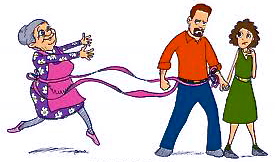
• “Here, try this on / We’re going to this restaurant / Kids, we’re moving to …. I know you’ll love it!”a little shove
• “You just have to see that movie / read this / go to that shoe store…”

• “I don’t see why you’d want to go there / do that / be with them…”
• “I just don’t understand her /him… I would never do / say that!”…..
• “Are you sure you want that dress, pen, car, class….?” (I can’t stand it!)

RELATIONSHIPS
SIMILAR: Sometimes kindred souls, looking for the ultimate bond, will find each other – as a friendship, but more often a mating. With similar interests, perhaps a sexual attraction & always a shared traumatic background, they link up & are ‘loyal forever’

It may be a kind of love, but really it’s the love of 2 wounded children trying to provide for each other what they barely have for themselves. It’s not uncommon for such couples to isolate & insulate themselves from the rest of the world

OPPOSITES: More often it’s when a needy, ES person (the ‘Stayer’) chooses to marry, become best friends with or go into business with  a ‘Leaver’ type, although terrified of being swallowed up, also wants to be taken care of

They seem to be a right fit – for a while! Eventually, the Stayer’s dependency becomes too much for the Leaver & a rupture occurs. It may take years, but it’s inevitable. The Leaver finally has to get away, & the Stayer is devastated!

• WHEN we rely exclusively on others to hold us up, they will eventually become exhausted. And when that person, group or institution we’re too reliant on needs to save themselves – from us, OR go away for some other reason (divorce, death, a kid going off the college or getting married…),
the loss of symbiosis brings up abandonment panic. Then the unhealed ACoA can :
✑ become almost immobilized by depression
✑ increase familiar addictions or take up new ones
✑ have panic attacks // end up in the hospital // try suicide

MILD: Naturally there are degrees, & all wounded people are afflicted with the longing to be cocooned, to some extent. With long-term recovery / sobriety, our day-to-day life may not reflect this issue, but once in a while some big stressor may  trigger that old terror in the pit of our stomach

HEALING: The best case scenario for anyone, but especially when losing a long-term symbiotic connection, is that it drives us into Recovery, via Al-Anon, therapy & other appropriate groups, often with the help of some medication, & hopefully with spiritual guidance & support.

NEXT: Separation & Individuation – #1