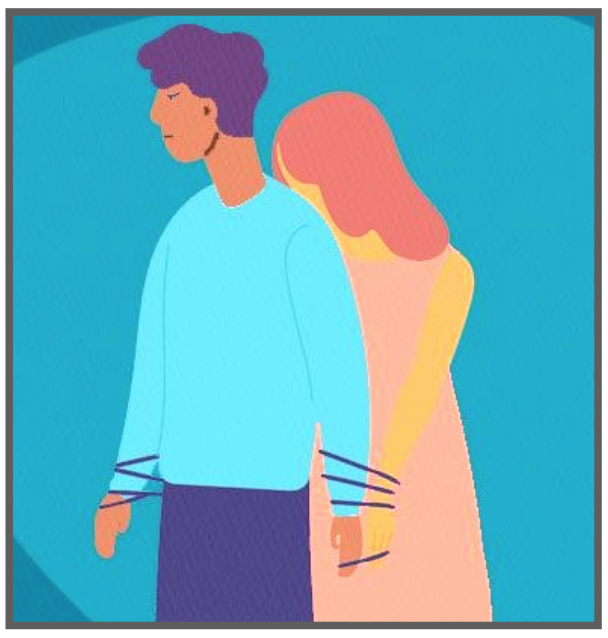
Narcissist MIND GAMES : a-b (#1)


PREVIOUS : Narc-Speak #2

SITE : The Power of Silence


NOTE: Narcissists often pause their abuse, using intermittent periods of seeming kindness & warmth. This creates a trauma-bond for the victim – so when the abuse starts again the V will assume they caused it & deserve it. It makes them even more eager to please, desperately trying to make the N happy again.

MIND GAMES
a. As ACoAs – you may also identify with many characteristics of this very detailed list (they tend to overlap), since we inevitably incorporated unhealthy maneuvers perpetrated by our family, school & religion
b. And – you may need to acknowledge that the parentmate, adult-child, friend, boss…. you’re dealing with act some these ways. This is especially true if they mirror who & what you grew up with.

It’s imperative to see Ns for what they are – to prevent being used, or as a way to untangle yourself. These ‘games’ have certain things in common, designed TO :
1. keep you in a one-down, subservient position to the N, making sure you’re convinced you need them to function & survive
2. keep promoting the N as superior & therefore worthy of obedience & ‘worship’
3. insure you provide them with all the ‘nourishment’ they can’t or won’t give themselves, draining you of all your vitality

PS: When the N is your grown child – & they’re being abusive, standoffish, favoring the alcoholic parent against you…. – what they more likely want is for you to :
agree with anything & everything they do
never want anything from them (a connection, be responsible, get help, be respectful….), regardless of what you want or have done for them!

√ AMBIENT ABUSE
The N surrounds the victim (you ) with a haze of fear, instability & intimidation. It’s so toxic because it’s made up of subtle, underground currents of mistreatment that can go unnoticed by the V until you’re wrapped in their spider web.

√ AGGRESSION
Ns are well known for their verbal attacks & inability to control behavior whenever they get angry. They can blow up suddenly, or regularly spew rage, which effectively stops you even from asking questions – much less objecting or needing something, in case it provokes another explosion

√ BE INAPPROPRIATE
To keep you small & ashamed, the N will make a point of embarrassing you in public by what they say & how they act, whether alcohol is involved or not, without feeling ashamed of themselves. But they know you will be – by association. EXP: being insulting, creating an argument, staring a fight… with another group member, a stranger, waiter, cop….

√ BLAME
Ns want you to keep thinking you’re doing everything wrong – even though you have not. They know that if they can make you feel guilty, they’ll have ammo if you ever have the nerve to call them out on their behavior.
That way you’ll always feel guiltier than a dog who’s just peed in the house. So you’ll roll over, be extra nice & do whatever they want, to make it up to them

√BLOW HOT & COLD
When someone’s nice one minute, then nasty the next, you’ll naturally stay on edge, since even when they’re acting all warm & fuzzy, you’ll be anticipating the next sudden switch. Being deliberately unpredictable is crazy-making, so you end up walking on egg shells.

Purpose: If the N thinks you’re getting a bit cocky ‘for your own good’ (confident, objecting to their games), the N will shoot you down with another bout of cruelty.
THEN, If they feel they’ve pushed too far, they’ll switch back to being ‘good’. Unless the N has other options, they’ll want to hang on to you, so the ‘nice’ act is used to get you back on their side – temporarily of course

√ BRAINWASH
The NPD’s got you thinking you have to serve & obey them, otherwise you’ll be in BIG trouble. If you’re around them long enough, you end up doing things you don’t feel comfortable with, just because the N wants it.  If you don’t, you think it means you’ve failed them, feeling guilty about not ‘performing’ the way you ‘should’.

NEXT : More Mind Games #2

CONVERSATIONAL Narcissism


PREVIOUS
Narc-Speak #2

SITE: “Conversational Narcissism: How to Deal Without Draining Your Energy“(scroll)


NARC SELF-FOCUS
👄 You know the type – not you of course – the one who :
✦ never shuts up so you can’t get a word in edgewise
✦ asks you how you are but won’t let you answer more than 2 words
✦ is always interrupting to add their 2-cents
✦ knows exactly what you need to fix your problem or upset
✦ goes on & on about something that’s bothering them, blaming others
✦ talks in endless circles, until you’re punch drunk just listening to them ….

💟 Anita Vangelisti, a Texas U psychologist, found that conversational narcissism is keeping the attention on oneself, & can include : boasting, speaking loudly, using exaggerated gestures, & a ‘glazed overlook’ in the eyes when someone else is talking.

Deep-dish narcissists (NPDs) will use the technique of endless talking – to control & trap their target (victim / empath) who finds it very hard to get out of these filibusters.

💟 FROM Brett & Kate McKay (2011)
In The Pursuit of Attention, sociologist Charles Derber describes research results from 1,500 face-to-face conversations that recorded how people traded & vied for attention.
He found that despite good intentions, & often without awareness, most people use conversational narcissism. This can take subtle forms, in deference to social norms & etiquette.

Conversational responses :
1. In the shift-response, an anxious listener is internally preparing to change the subject, so attention can shift back to themselves. EXP:
James: I’m thinking about buying a new car
Rob: “Oh yeah? I’m thinking about buying a new car too”
James: Really?
Rob: Yup, I just test-drove a Mustang yesterday & it was awesome.

This style is a way to grab the focus away from the current speaker, but not always done blatantly.
The clever person can put in a nice transition comment to disguise the intention, like “That’s interesting. /  Really? I can see that…. ,”
right before shifting into a comment about themselves, tying their response to the topic at hand : “I was thinking about trading mine in….”

2. The support-response keeps complete attention on the current speaker & topic. EXP:
James: I’m thinking about buying a new car.
Rob: Oh yeah? What models have you looked at?

This style can come in 3 sub-forms, each a higher level of attention & interest in speaker & topic:
Background statements are minimal, to show you’re listening: “Uh-huh”
Supportive assertions show active listening. “You’re right. That’s not OK.”
Supportive questions indicate you’re not only listening, but also interested in hearing more. “What are you going to do now?”  (MORE…..)
✫     ✫     ✫   ✫
💟 Michelle Loch, coach, speaker, author (2017) – combined colors with 5 talking styles & the reason they can cause problems with others. Conversational narcissism (CN) shuts down thinking, fuels defensive responses, creates apathy & wastes time. In each color-style, it’s all about you – whether to protect or defend, or assuming you know what others need or want.

AT WORK, CN is someone WHO :
✴︎ always sets & leads the agenda at every meetings, or in work conversations
✴︎ assumes their team or colleagues have understood their instructions or requests (but they didn’t)
✴︎ assumes others have their goals or desired outcomes (but they don’t)
WHO:
✴︎ never asks for your opinion or ideas, or if they do, doesn’t take the time to understand your reasoning or perspective
✴︎ wastes your time, because nothing in the meeting is of value to the issues you‘ve asked feedback or help with
✴︎ ends a meeting or conversation that leaves you thinking “Well, that was all about them!” …..

Improving Leadership
❧ Be a facilitator, not a consultant with all the answers. Ask for input – trust that others know what they want or need from a conversation or meeting
❧ Ask if they want feedback from you, don’t just tell them what you think. If they say yes, then find out what specific kind they need, & in what form
Let others do the thinking : What are their needs for the project? What would be the best outcome for them? What other perspectives or customer should we be considering?

NEXT: N Mind games (#1)

Narc-Speak : Distorted Communication (Part 2)

PREVIOUS : Narc Speak (#1)

SITE14 more manipulative phrases from Ns (some overlap)


◀︎ “Word Salad” – the verbal sandwich you eat, but comes with a poisonous sauce that gives you a stomach ache!

2. HOOVERING
3. IN RELATIONSHIPS

4. N-EGO Phrases 
•  I’m so modest = Don’t consider what I’m doing or saying as abuse. Just accept it

• How dare you accuse me of lying?! I’ve always told you the truth = I only say what I want you to believe, which it rarely the truth. And if you question me, you’ll be in big trouble!

• I don’t have an anger problem = So what? I’ll yell & insult you no matter what you think
❗️ ❗️
• That never happened  = So I made a mistake – but you’re not supposed to notice, much less bring it up

• I can’t remember what happenedI’m perfectly aware what happened, but if I pretend not to, I expect you to as well

• I never said that. You heard wrong. You misunderstood me = I’ll change your reality any time I please, & you will go along with it!

• Don’t know what you’re talking about. You’re making absolutely no sense =  I’m pretending to not understand your point or your experience. Since it disagrees with mine, I don’t have to admit anything!
❗️ ❗️
• That’s not what I meant. I’m sorry that’s how you feel = I’m pretending to be the rational one OR that I care – but I say things that ever-so-subtly invalidate you, so you can never win

• Why are you always attacking me? Don’t! Stop holding me accountable. Why do you keep expecting me to admit when I so or say something wrong (that you don’t like)?

• YOU are the problem  = I’m the problem but will never say so. Besides, I don’t care how you feel

• I didn’t hurt you – you hurt yourself. Maybe you deserved it  = I so don’t care, that I literally believe your effort to stand up for yourself (or a cause) forced me to abuse you – some more.
You deserve it because you don’t see things my way or didn’t do exactly what I wanted

• You’re too sensitive = Cut the emotional crap now. Stop being upset & talking about your feelings, or my meanness & bad behavior
❗️ ❗️
• Forgive & forget = Keep tolerating my abuse, aways
• Stop living in the past = Okay. Peace. Forget it, so I can go back to being comfortable

• That’s in the past. 15 minutes ago IS the past! Why can’t we just forget it ? Why you don’t get over being abused – it’s over, so you should be all cheerful now. Stop making ME the bad one

• Nobody likes you = I don’t really like you – & secretly don’t myself either, so you have to feel as bad about yourself as I do about me
• You’re crazy = I can’t bear that you know the truth about me, & are starting to tell others about it. I have to stop you!

•  It’s all in your head. You need to see a shrink = I need you to doubt your perception & your reality, so I can keep manipulating you easily.
(from :  Emily Gordon // Angie Atkinson)
❗️ ❗️
5. TACTIC : False Praise with Real Criticism
Many Ns are skilled at sounding pleasant, agreeable, even complimentary. They can lavish praise when it suits them, but not a single word is heartfelt or honest.

Instead, they use false praise to manipulate, to get you on their side, and to make the criticisms that follow more palatable.
EXP: “I like your dress, but it really doesn’t flatter your figure”,  “You draw beautifully, but that’s not a real job” = softening the blow while sticking the knife in. (Post “How to / not to talk to Kids…. “)

It might seem like honesty, but is anything but. The compliment is nothing short of a lie – something they don’t actually believe, but serves their purpose, to keep you down

This is indirect abuse. It may not seem so bad to the victim, nor to onlookers – but over time such verbal combos are painfully cumulative, having a damaging effect on self-esteem & affecting the ability to function well. (More….)

NEXT: CONVERSATIONAL Narcissism

Narc-Speak : Distorted Communication (Part 1)


PREVIOUS : ACoAs as Ns (#3)


1. ‘WORD SALAD’
 – the slang term for a type of narcissistic speech used purposefully to control by being confusing & degrading.
THEY:
✴︎ Accuse you of their bad behavior, especially things you never do/ never done
✴︎ Blame you for their shortcomings, deny reality & responsibility, find excuses, shame / mock you
USE:
✴︎ Confusing statements that never come to the point & never end, so you’re caught in a mental spiral
✴︎ Cognitive distortions – the basis for insensitive, abusive actions
✴︎ Condescending tone, as if talking to a child
✴︎ Conversation as competition, to frustrate or create arguments. If you’re always wrong, it insures they are always right (More….)
✴︎ NO logic, clarity or verbal direction about the topic being talked about
✴︎ Lots of irrelevant or meaningless ‘facts’
THEY:
✴︎ Never address the current issue or problem
✴︎ Outright lie, make excuses, change the subject
✴︎ Refuse to answer, or belittle & insult
✴︎ Repeat the same stories, opinions, pet peeves, arguments…. year after year, even using the exact same words

✴︎ Project their inner world onto to you . Whatever they feel is unacceptable in themselves – becomes the flaw in you
✴︎ Purposely confuse your reality by denying your experience (gaslighting)
✴︎ Verbally rage, when unmasked for what they really are
✴︎ Reverse Toxic Roles: accuse you of making them a Victim, then magically turn themselves into a saintly Hero
📣     📢    📣    📢

2. HOOVERING If you’re a Victim who’s trying to get away, or walked out – this manipulation is used to try sucking you back in by promising improved or desirable behavior, but they’ll end up treating you like dirt (like what’s in the vacuum cleaner)

Hoovering Ns may say:
✦ You can’t leave, I need you. You’re the only one who’s ever understood me (clever you!)
✦ We’re soul-mates – meant to be together (as a copy of me)
✦ I know you’re the right one for me, we get along so well (when you agree)
✦ I’ve had an epiphany – I love only you! (Right now, maybe)

✦ After the break up, the N says “I’m here for you – you shouldn’t go thru this alone (you still need me and have to make ME feel better)
✦ I’m sorry for hurting you & I promise to change / stop drinking …. (sure thing)
✦ OK, I’ve decided to get help. OR – OK, I’ll go to couple’s counseling with you (but not for long)

✦ Can’t we be friends? We care about each other (as long as you please me)
✦ I met him / her when we were broken up (they didn’t mean a thing to me) OR I met them before you (I can still fool around with an ex)
❗️❗️
3. IN RELATIONSHIPS
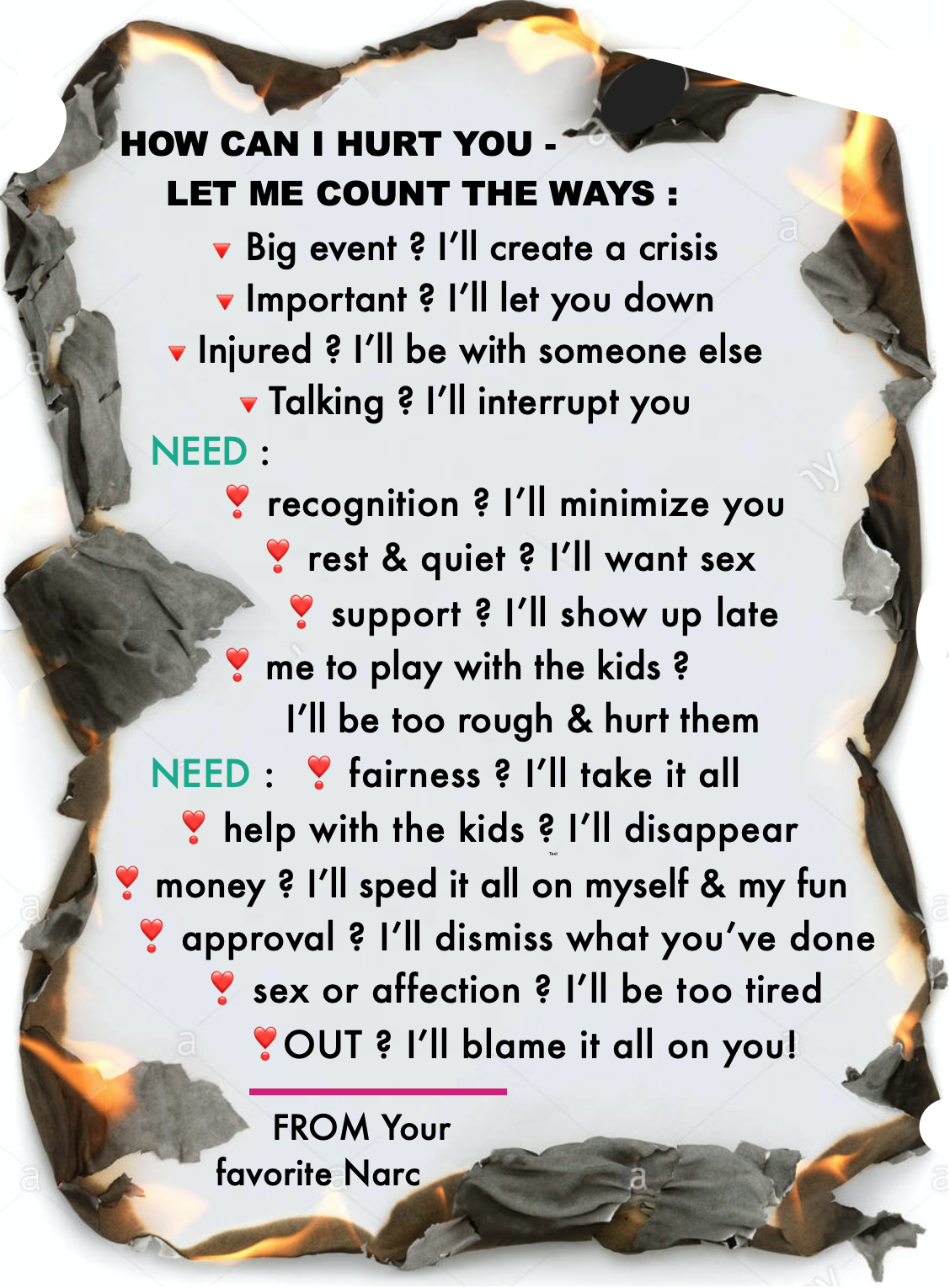
• I love you = Damn! You’re starting to figure out my real intentions. I’d better distract you
• Cheaters are scum = I’m cheating on you, but don’t notice!  (➡️ IMAGE : Ego kibbles)

• I’m sorry = Forget what just happened! Don’t hold me responsible. Make me feel good.
I’m upset = Pay more attention to me!

I’ve never met anyone like you = You all are the same to me. I’m texting 5 others the same thing right now
 I’ve been really wanting to settle down = This should make you believe I’m a responsible guy & a nice person, so ‘trust me’
❗️❗️
• I can’t help what I am, take it or leave itI may act like a total douche, but I expect you to overlook obvious facts, & act like I’m the most amazing person you’ve EVER met. MMmmkay?

I don’t want to talk = Go away! unless you can flatter & pamper me
• Why do you keep going on about ___ ? This is boring! Let’s talk about something else = Focus only on ME. I don’t care about what you’re saying. And even if I do ‘listen’, I’ll act like you’re stupid & boring so you’ll get discouraged & stop bugging me

• I don’t like talking about my past I’ve carefully crafted the image I’m showing you (& the world), so if I talk about my past, it’ll crash. I can’t keep up my false self if you know who I used to be.

NEXT: More PHRASES (Part 2)

NARCISSIST TYPES (#2)


PREVIOUS :
Narcissist Types #1


Narc VICTIM Roles
The N’s overriding objective in life is finding fuel, from :
💘 a Primary Source, who the N has determined will provide it on a regular basis, of high-grade & in copious amounts. Such a person will experience – at first – the elation of the N’s overwhelming Seduction, but later face the horror of Devaluation, the bewilderment of Discard & the lure of Hoovering.

💟 Supplementary Sources – anyone else the N can seduce other than an intimate partner. It includes family, friends, colleagues, strangers … all ranked according to the strength of the fuel they provide.

TYPES (cont)
1. GRANDIOSE Ns /// 2. SPIRITUAL Ns

3. COMMUNAL Ns
At the ‘mild’ end of the narcissism spectrum, they’re very hard to catch, since these Ns value agreeableness, relatedness & warmth. Seeing themselves as the most giving, helpful trustworthy & supportive person, they want everyone else to think so too, by trying to always be friendly & kind.

Far from showing a lack of empathy, as with standard NPDs, this type uses their intuition-antennae to tune in to what pleases you, making you feel validated.
While they don’t seem to be as damaging as other types, they too are using people to feel good. Their decisions & actions are motivated by outside sources – making them vulnerable to disappointment & frustration, which can turn into being depressed & judgmental.

So – this type’s dishonest selflessness is just as selfish as that of grandiose Ns. Their drive is also for esteem, power & superiority, just using very different tactics. When their hypocrisy is discovered, it’s an even bigger disappointment to others.

4. VULNERABLE (COVERT) Ns
Hardest to spot, until it’s too late, they hide behind passive-aggressiveness, but are un-empathetic, exploitive & manipulative.
EXP: Setting others up to be constantly frustrated, they :
▶︎ insist that someone else make all the decisions & then accuse them of being controlling
▶︎ often say they’ll do something but keep ‘forgetting’, then slyly get a kick out of the other’s annoyance, disappointment, rage…..

What’s confusing to observers is that these Ns can be 
: anxious, clingy, act helpless & incompetent, are needy, pathetic, sickly, weak, withdrawn…..
while also secretly believing they’re superior. They may see themselves as brilliant, courageous, desirable, entitled, magical….. but just not yet expressed.

This combination also causes the N great internal conflict, by holding both over-inflated & under-rated irrational beliefs about themselves. EXP:  CDs such as self-hate and perfectionism.

Since a closet N would never admit to feeling ‘special’, they instead point to something else – a person, a religion, a book, a dress designer – that’s lauded by others, so they can feel special by association.

Their fear of criticism is so strong that they try to avoid getting attention. Their life is hampered by a weak identity, lack of autonomy & self-motivation, ‘imposter syndrome’, & procrastination. Being insecure & easily stressed, these Ns are unhappy, with anxietydepression, guilt, hypersensitivity & shame.

Their negative self-beliefs are projected onto other people & their own future, making personal growth difficult or impossible. Always looking for their secretly grandiose self-image to be reinforced, they’re highly defensive when actual or perceived criticism triggers their self-hate.

They don’t have positive relationships, with as attachment style that’s more avoidant & anxious. Distrustful of everyone, they’re always looking for danger, so they internalize their N, isolating with hostile blame & resentment.

5. MALIGNANT Ns
These are at the other extreme of the N continuum, cruel & aggressive. They’re a-moral, immoral, paranoid & sadistic – finding pleasure in creating chaos, physical torture, & destroying lives.
They’re not grandiose & extroverted, but more closely related to the dark triad of anti-social personality disorder (APD), psychopathy, & Machiavellianism. They can form long-term relationships – with extreme victims – easily being nasty whenever they feel threatened.
5a. SEDUCING Ns
A particularly tricky type – these will make you feel great about yourself to ‘win’ you over as a sexual or love conquest. At first they seem to admire & fawn over you, only to disappear once you’re hooked. (think: Regina George).

They’re emotionally dangerous. Other types don’t usually go out of their way to hurt somebody – they’re just obsessed with themselves. But this one can leave a trail of broken hearts, so avoid them.

5b.BULLYING Ns
This type combines 2 terrible traits: bullying & self-absorption. They boost themselves by trashing others, fixated on winning & mock or threaten people to get their way. They get a personal kick out of making others feel bad, unworthy & invisible, which is different from a ‘regular’ bully who belittles for social benefit.

NEXT:  Narc-Speak #1

NARCISSIST TYPES (#1)


PREVIOUS : N. Levels (#3)

SITE: Narcissists ‘horrible people but happy’


Narcissists
fit into:
3 schools – Lesser, Mid-Range or Greater
& 4 cadres – Victim, Somatic, Cerebral & Elite
Ns belong to both groups, but not into every combination, since some types are mutually exclusive.  (MORE….)

Narcissistic Behavior is consistent 
Unhealthy N symptoms are present – if camouflaged – in all situations, not just when they’re around certain people or when under stress. A person can be considered a N IF they have 5 or more symptoms persisting since their early 20s or before, which limit or prevent the ability to maintain healthy relationships.
ARTICLE: “N as a consequence of Trauma & Early Experiences

SUB-TYPES, both Grandiose & Vulnerable:
♣︎ BOOMERANG Ns – the one who keeps popping in & out of your life. They offer very few explanations or excuses, & co-dep partners keep taking them back.
AND they’re also involved with several other partners (as Supply), staying when it suits them, leaving when anything is expected of them in the relationship

♣︎ CEREBRAL Ns – they get a sense of self-importance from their mental abilities, believing themselves to be smarter & cleverer than almost everyone else. To feed their ego, they’ll try to make others feel ignorant & stupid. No one’s ever going to win an argument with them or get them to admit they’re wrong. (More… )

♣︎ PARASITIC Ns – They feed off of a host, using anyone who’ll take care of them. They don’t want any responsibility, so find someone who’s intelligent, strong & successful – but also needs to feel useful & is self-sacrificing. CHILDREN are easy targets, since they have no choice about being a Victim, but they too are singled out for their intelligence, sensitivity & compassionate nature.

♣︎ SEXUAL Ns – get self-validation from sexual attractiveness & being ‘very good’ in bed. They have an overly-positive, egotistical admiration of their own seduction-power, consumed by an obsession with performance, & the need for constant sexual admiration. (Think young Tom Jones, singer)

♣︎ SOMATIC Ns – get self-worth from their bodies, which shows up as a conviction that they’re more beautiful, stronger, or fitter than others. They obsess about weight & physical appearance, judging others based only on externals. (Think young Arnold)

♣︎ SPIRITUAL Ns – they get self-worth from being other-world oriented. They use spiritual practices & ‘insight’ to increase self-importance, in some cases for fame & wealth – instead of humility & decreasing the ego, which are the hallmarks of true spirituality. (MORE….. scroll to Narcissists , Co-deps) // (More….scroll to traits) // (More….)

♣︎ WHITE NIGHT Ns – to camouflage emptiness, shame & fear of abandonment, they need to be seen as a great human being, via rescuing & people-pleasing.
They get narcissistic supplies by publicly doing helpful things for others, such as the “good neighbor” N – who compulsively runs errands, does chores, fixes things for ‘free’, gives their own things away to anyone who asks – all out of the ‘goodness of their heart’ – but at the expense of their own families, their finances & health.

🔻A sub-category is the parent who compulsively / deliberately gives away their children’s toys or other possessions to their own adult friends – in order to seem generous, but without the child’s knowledge or OK, and which are not items no longer needed or wanted by the child. (MORE….)

1. GRANDIOSE Ns
These are the boastful public figures, recognizable in films. As extroverts, they are usually very charming & seductive, although their vanity & boldness can also be obnoxious & shameless.

They’re aggressive, authoritarian, callous & self-absorbed. Some are also physically abusive. These un-empathic, arrogant Ns have great disdain for others. Underpinned by Extraversion, they report high self-esteem & satisfaction with their lives, despite all the pain they cause others. 

This comes from internal congruence – their opinion of themselves meshes with how the world sees them –  so they rarely have anxiety. This allows them to have a deep belief that there’s nothing wrong with them – only with other people & circumstances.

Ns demand direct acclaim, attention & domination – even in ‘love’, game-playing being used to keep the upper hand. Many do maintain relationships, in spite of the fact that their compliant partners are unhappy with the N’s emotional insensitivity & criticism, but are seduced by the N’s self-assurance, forcefulness & income.

2. SPIRITUAL Ns
(See above def) They need to project an idealized version of themselves by influencing & captivating their audience, masking imperfection & existential guilt (being a sinner). They compensate & feel special by performing seemingly sensitive & religious actions (helping the poor & needy, being spiritual counselors, giving lectures & seminars, writing books….).

They cloak harmful behaviors such as controlling, coercing, judging, misleading…. in false ‘righteousness’, & will justify intimidating or belittling others using platitudes & religious jargon. They’re the ultimate hypocrites.

NEXT: N. Types (#2)

LEVELS of NARCISSISM (#3)


PREVIOUS: Levels of N (#2)

POSTs : Psychological Disorders #4 – 6

THESE last categories will be the focus of the rest of this series, so here will only be briefly summarized.

1. HEALTHY N
2. STABLE N


3. DESTRUCTIVE
 

This group has abusive attitudes & behaviors that harm self & others.
They devalue, lacks empathy… & create frustration in almost everyone who has to deal with them.  This is an easy way to identify them – by the negative reactions they create in others, similar to NPDs (Type 4)

UNPRODUCTIVEs :
“Unproductive Ns retreat into their own world & blame others for their isolation. Ns are unproductive when, lacking self-knowledge & restraining anchors, they become unrealistic dreamers. They nurture grand schemes & harbor the illusion that only circumstances or enemies block their success.
Grandiosity & distrust are the N’s Achilles heel, so even brilliant Ns can become self-involved, unpredictable, & in extreme cases paranoid.” ~Michael Maccoby link

Therapist Steven Johnson believes that Ns are “good people tortured by psychological injury & crippled by arrested development, robbing them of the richness of life they deserve. They are living & suffering the narcissistic style”
Gestalt practitioner Linda Martin’s response:   “To only stress their suffering could lead to sentimentality & collusion.”

Destructive MANAGERS
✧ Confidence : Grandiose, overblown, unrealistic
✧ Consistency : Lacks values, is easily bored, often changes course
✧ Foundation : Traumatic childhood undercutting true self-esteem, and/or learning they doesn’t need to be considerate of others
✧ Power : Pursues it at all costs, & lacks normal inhibitions in its pursuit
✧ Relationships : Concern is only expressed in socially appropriate ways when convenient & useful. Devalues & exploits others without remorse.
= = = = = =

4. PATHOLOGICAL
This level includes several PDs – Cluster B personality disorders – such as Anti-social (the most severe form), Borderline, Histrionic & Narcissistic. PDs represent a way of thinking & feeling about oneself & others that very negatively affect how someone functions in most parts of their life.
“Pathological forms of competitiveness show themselves in many, many areas of human activity. EXP: They’ll go from failing to give others credit for their contributions <– to –> outright plagiarism or stealing of other’s ideas.” ~ Michael H. Stone (2008)

NPD levels
1.  
Mild : Obvious problems in many interpersonal relationships & social roles, & in the performance of expected work, but with some areas still functioning. It’s usually not associated with substantial harm to self or others.
✴︎ At this level, such people are capable of achieving the admiration they crave, to gratify their grandiose needs (self-importance). They may function successfully throughout most of their life, but are vulnerable to a breakdown with advancing age as they get less & less attention (N supply)

2. Moderate : Marked problems in most areas of functioning, across a wide range of situations, sufficiently severe that most are not very functional. It’s usually associated with a past history & future expectation of harm to self or others, but not to the degree that it has / will cause long-term damage or endanger life.
✴︎ At the mid-level, their grandiosity prevents any interest in true intimacy

3. Severe : Intense problems in inter-personal functioning, affecting all areas of life. Their overall social dysfunction is profound, with little or no ability or willingness to perform expected work & social roles.
It’s usually associated with a past history & future expectation of severe harm to self or others that caused long-term damage or endangered life – & will again.
✴︎ At this lowest level, their persona also includes borderline personality traits (BPD). Their sense of self is generally unstable & scattered, reeling between pathological grandiosity & being suicidal. ~ Kenneth Levy (2012)

MALIGNANT Ns are even more dysfunctional than NPDs, but not quite AsPD (anti-social). “These lower functioning NPDs (more like sociopaths) will constantly bend the rules for themselves, while outwardly criticizing others for doing the same negative things. They have no remorse for the effects their abuses have on others, & use many rationalizations for their manipulations.” ~ Payson

PSYCHOPATHs – have no ethics, & so don’t need rationalizations.  For them life is a game – figuring out ways to get what they wants now, by whatever means necessary. Since they don’t go by anyone else’s rules, so as far as they’re concerned there are no violations, no exploitation.
They make up their own as they go along, duping whoever they can, shamelessly lying their way in and out of schemes, always ignoring or absolutely indifferent to, the damage they cause. ~Steve Becker

NEXT: N. Types #1

LEVELS of NARCISSISM (#2)


PREVIOUS: LEVELS of N (#1)

SITE: See great chart
re. Human Magnet Syndrome (scroll way down)


CORE attitude of unhealthy NARCISSISM : “I am the center of the universe. Everything that happens to me & around me, good & bad, is about me. I cause everything, so everything is up to me to handle.”

1. HEALTHY N

2. STABLE N
This category of the N continuum ↗️ was proposed by Kohut (1977) as less than full-blown narcissism (not yet NPD). Stable Ns have age-appropriate self-centeredness, but with areas of personality that are not fully developed.
EXP: Stable Ns generally function, day-to-day, with reasonably OK relationships, but also (secretly) conceited, selfish & vain, which shows up as being smug, withholding on occasion, & very concerned about the image they project.

However, shame
is the emotion that lurks behind most unhealthy narcissism, with the inability to process it in beneficial ways – to face it, neutralize it & move on. This weakness leads to the typical defensive postures, attitudes & behaviors of Ns.

🕯Extraordinary Ns & Productive Ns
“Ns may be either productive or unproductive. The most productive ones, who do change our world, have the charisma & drive to convince others to buy in to their vision or embrace a common purpose. They communicate a sense of meaning that inspires others to follow them.”
BOOK: “The Productive Narcissist~ Michael Maccoby

Strategic intelligence is their hallmark : foresight, systems thinking, visioning, motivating, & partnering. But narcissistic leaders can also be problematic.
EXP:  If the N boss or owner is an unrealistic dreamer with the illusion that only circumstances or enemies block their success, &/or they lack strategic skill – they’re fated to crash & burn. 

🕯Co-dependent Ns  / Co-Narcissists / Co-alcoholics
“….they act the way parents probably meant when they told us not to be “selfish”, but without teaching us healthy self-care”. ~ C. Whitfield.

‣ “Active” Co-dependents are missing a connection to their Innate Self, compulsively rejecting it (opposite of Ns). They revolve their thinking & behavior around other people, events, substances, & environments.
✴︎ Consciously, their inter-personal focus is only on others.

‣ Narcissists also suffer from this lack. In its place, they identify with the Ideal Self of a young child – an inflated, impossible image.
✴︎ Consciously, their inter-personal focus is only on themselves.

However, unconsciously, both types are other-oriented. Their self-image, beliefs & actions are aimed at stabilizing & validating their insecure, fragile ego.
Their dependency on external input is as great as that of any ‘substance’ addict. Both desperately want to be like, accepted & loved. And both types go about it the wrong way.

‘Classic’ Ns & co-deps do have different behavior patterns, but Ns can have some co-dep characteristics as well (play victim, do for others…..), while co-deps are less likely to use blatant N tactics, because they do have empathy, & overtly lack entitlement & exploitation.

ACoAs: As co-dependent caretakers, ACoAs shudder at the idea of considering themselves narcissists, & many are not NPDs . BUT – in spite of being ‘helpful‘, the underlying motivation for rescuing & people-pleasing is completely selfish, so narcissism is lurking.

❥ The main N motive is to control everyone & everything – with gifts & a smile or through gritted teeth – to prevent getting even a whiff of potential abandonment, regardless of who or what other people need & want.

As adults, “Children of the self-absorbed have to work particularly hard to form a healthy True Self, as they weren’t allowed to complete the required developmental tasks at an earlier age. Growing up with a destructively narcissistic parent, you’re likely to have an under-developed Self that needs serious attention.” ~ Nina Brown link

Generally, Co-Ns are functioning depressives, constantly anxious, seeing themselves as unworthy of anything good – so they obsessively work to please others, deferring to the opinions of others & taking on their world view.
They don’t know their own needs & beliefs, finding it hard-to-impossible to identify what they think & feel about most things, doubting the validity of their own thoughts (especially when these conflict with anyone else’s), & take total blame for inter-personal problems.

Co-Narcs may or may not start out as co-deps, but in a prolonged relationship with a NPD, they can end up with a trauma &/or fantasy bond, even Stockholm Syndrome – because of cognitive dissonance, gaslighting &  intermittent reinforcement.
REQUIRED: grief work & PTSD-trauma recovery

NEXT: LEVELS of N (#3)

LEVELS of NARCISSISM (#1)

PREVIOUS: Harmful ‘innocent’ sayings #2

NPI = Narcissism Personality Inventory measures:
Authority, Entitlement, Exhibitionism, Exploitativness, Self-sufficiency, Superiority, Vanity

UNHEALTHY N: The common use of the term ‘Narcissism’ refers to an unhealthy, selfish focus on oneself, without a genuine concern for the needs & desires of others. It’s the yucky narcissism staring back at us in the mirror when our inner-brat holds the outer-adult hostage (regression / ‘kid-whipped’). This unhealthy, age-INappropriate N. retards or prevents psychological growth, & frustrates intimacy in relationships.

1. HEALTHY N, on the other hand, is based on knowing AND accepting yourself so thoroughly that you can interact with others, safely & comfortably, without– always having to be the center of everyone’s attention, being afraid of abandonment or using others to take care of your emotional needs.

In psychoanalytic terms,”normal (legitimate) narcissism is defined as a positive investment in a normally functioning self-structure….
It plays a crucial role in the human capacity to:
‣ manage challenges, successes & changes
‣ overcome defeats, illnesses, losses & trauma
‣ experience happiness, satisfaction, & acceptance of the course of one’s life
‣ love, be productive & creative (Ronningstam).
Kohut (1977) considers that healthy narcissism in adults is expressed as creativity, empathy, a sense of humor, awareness of finiteness (limitations) & wisdom.

The N Phase of CHILDHOOD 
A complete preoccupation with oneself is normal & expected in young children, beginning around age 2, the same time they start talking – using words like “I, mine” and “no.” They assume the world revolves around them, with little awareness that others are separate entities.

Mahler described this phase as a “love affair with the world.” If development proceeds as it should, the child learns, through close contact with loving parents, friends & teachers, that those people also have needs & desires. Egocentrism diminishes as the child develops concern for others.

ACoAs didn’t get the opportunity to develop healthy narcissism. Many of us were ignored or punished for being exuberant or succeeding – at anything. We learned to be afraid of shining, because others did  envy &/or punish us, so we diminished our talents or hid them, even from ourselves.

ADULTHOOD : A Cohesive Self is a psychologically positive identity.
❤︎ It’s comes from combining the child’s Grandiose Self with the Idealized Parent Image (Omnipotent or Idealized Object), which allows the Adult TO :
= feel worthy of existing, have ambition, confidence & self-esteem
= have ideals, a meaning to life, & form healthy connections with others

Relinquishing or modifying childish behaviors to improve important adult relationships we don’t want to lose – increases self-development, preventing depression & burnout.

At its best, every-day narcissism is a normal part of everyone’s Self.
We need it functioning – on our own behalf – to feel good about ourselves & other people. If we had been safe enough to experiencing normal ‘ecstatic joy in yourself’ when we were a kid, it would have provided a residual strength to get through tough times later on.
EXP: Now, if you allow yourself narcissistic pleasure from a difficult job well done, it can sustain you through times of disappointment, frustration or failure.

In a healthy adult, the Inner Child’s normal Grandiose Self is tamed by being attached to an appropriate set of ideals – gathered from healthy role models & eventually our own values. IF this happens, it allows us to experience others as separate-from-us sources of actions, thoughts & emotions. All humans must undergo this process of maturation to develop a Cohesive Self.

This unified identity develops from a complicated interaction between :
(1) inborn capabilities & inherited genetic vulnerabilities – predisposing each person toward or away from psycho-pathology (strong or weak ego structure)

(2) the environment – especially interactions in childhood with Significant Others, who either strengthen & support the emerging child’s Self, OR interfere with its optimal development

A Cohesive Self basically means that all our Ego states are in sync, with the Healthy Adult in the driver’s seat. It means that we know what we need & like, with the willingness to be our own Good Parent, & respectfully express our Truth without needing to step on other’s emotional toes.  Because of this, we can let others be who they are without it threatening our wellbeing. We know we have choices, & we make the best ones we can, based on our personality.

NEXT: N. Levels #2

HARMFUL ‘innocent’ Parental Phrases (Part 2)


PREVIOUS: Harmful Parental Phrases (#1)

SITE: “My Mothers Love……Arsenic, Grain Alcohol and a Straight Razor


MORE HARMFUL PHRASES from the mental health community at “THE MIGHTY”
15. ‘You’re just going through a phase.’
Mom said about my panic attacks I’ve had since adoption, & still have. When is this ‘phase’ over?” — Elizabeth M.
16. ‘You keep messing everything up.’
“I was told that I ‘slop things up’  – whether in the kitchen or my handwriting ….” — Jen B.
17. ‘You need to act your age.’
“‘Act your age, not your IQ,’ said mom right in front of my friends when I was 11. It pierced my heart.” — Carre L.

18. ‘Should you be eating that?’
“‘Food is not your friend.’ my mom said when I started gaining weight after going through a breakup & a hard time in my life.” — Shauna A.
“My dad said : ‘Maybe guys don’t like you because of the way you look. I’m not saying you need to lose weight, but you know how guys are.’” — Morrigan R.

19. ‘Oh so now I’m the bad guy?’….
“….they said when I told told them about something they were doing that was hurtful or  made me uncomfortable.” — Bethany R.

20. ‘Are you sure you’d be qualified for that job?
“’I don’t think you have the skills for that career’ or ‘Are you SURE? That career is really difficult,’ said my parents when I was younger. I’ve had trouble now finding a career path I really want because I always think back to what they said” — Kachina M.

“When I told my mom I wanted to be a makeup artist, she said : ‘You don’t really handle people well. Maybe a nice desk job?’ Thanks for killing my dreams & making
me believe I can’t do anything.
Anytime I’d brought up a new interest for a career, she’d immediately find something wrong with it. Now I don’t have a career because I never believed I was good at anything. I still don’t.” — Kimy L.

😲    😛   😢   😡

A FEW MORE, from DMT at HEAL & GROW for ACoAs:
Mom
was an ACA & definitely a narcissist, but disguised as a ‘spiritually’ motivated righteous do-gooder who everyone (other adults) absolutely thought she was the bee’s knees! wherever we moved to – which was often & in several countries.
These are some of her favorite sayings, repeated often throughout my childhood :

❗️”Look ashamed!” =  whenever I did something she didn’t approve of, not anything actually bad, just if it made her look bad to others

❗️”You’ll be the death of me yet” = the message was 2-fold: I’m killing her & I should
be dead. I became suicidal – which morphed into long-term depression

❗️”Why did I have to have a kid like you?” = meaning I’m a disappointment, I’m a burden, nothing I do is ever right or good enough….

❗️”Now I’ve seen everything!” = her reaction when – as a tween – I designed & made a stylish, beautifully-made hat (I was always a sewer), & shaking her head, said it in front of a neighbor lady. It was not a compliment. Mom had very middle class, conservative taste & this hat was a NYC designer-style creation.
I did later go to FIT in NY, & for a while became a designer. But with all the put-downs over the years, there was no self-confidence – until therapy & Recovery.

❗️”It’s the bad coming out”  = referred to having acne as a teen. She implied there was so much bad inside me it even showed on my face. Just one more cruel comment

❗️”See, she got someone” = Looking good was the only thing that mattered & I always fell short (being so bad on the inside) so I ended up convinced I was ugly, which she knew but never corrected.
So one day after school I was walking with her when she notice a rather ‘less than attractive’ couple walking hand-in-hand across the street. She actually pointed them out & said “See, she got someone!”

❗️I’m glad I’m not sensitive like you & your dad = self-evident, we all got the message that having emotions – unless always happy – were to be avoided, ignored, never identified, explained AND never comforted !

❗️”Why can’t you be more like L.& L.?? (my cousins) = They were ‘perfect’ according to her. It turns out they’re the same Astro Sign as her – Taurus – and I’m not! Perfect match for a narcissist mom – rather than me!

❗️”You’re such a pig. You could lie down next to dirt and sleep!” = What can one say? She exaggerated – typical Narc. What she called dirt was more like disorganized & messy. She was a cleaner. I’m an artist.

NEXT:  Narcissist Levels (#1)