ATTACHMENT – INTRO (Part 4)

PREVIOUS : Attachment Theory #3

SITE : ATT style QUIZ (short)

DURABILITY
Psychoanalyst John Bowlby believed that “ATT behavior characterizes human beings from the cradle to the grave” (1979),  & that it’s instinctive in infants. His main research goal was to describe & explain how children become emotionally attached to their primary caregivers, & are emotionally distressed when separated from them.
ATT behaviors are activated by any situation which seems to threaten the achievement of proximity (staying physically near the parent/ main caretaker).

Based on Bowlby & M’s work (1965 thru 1988), the most common opinion is that a person’s ATT style formed in childhood will be maintained throughout life.
More recent theorists disagree – indicating that ATT bonds are flexible, that dynamic changes can & do occur, & on a quite short time scale.

Research shows that not all children who experience inadequate & abusive parenting go on to develop an insecure attachment style, just as not all children who receive emotionally attuned, available, or responsive care-taking automatically develop a secure attachment style. 

PERSPECTIVES
🔅Organizational : 
“Early experiences should be construed not as determinants of development, but rather as setting the stage for optimal psychological functioning” (see here). So while childhood may create a specific ATT type, later events & environment will determine whether the early patterns will remain in place or change.

🔅Differentiation of ATT representations : This suggests that over a person’s life span, rather than updating existent representations (changing our image of the original caretakers), new ones are created (added) when we bond with other people

🔅Socialization–selection asymmetries : Att bonds & representations are more or less stable at different stages of life, with more stability during adulthood – compared to adolescence – & for more established relationships, as with one’s parents. (see here).

A Minneapolis U. 30 yr. longitudinal study found that :
Of the participants who had experienced significant loss or stress, 44% changed attachment categories from infancy to early adulthood, versus only 22% who had not experienced negative life events.  (MORE….)

So, as adults, forming positive new relationships can create improved changes in the “working model” of the Self & Others. Such improved experiences can help some people override the traumatic influence of their first 6 years with family, indicating that ATT styles may not be set in stone. While there are no guarantees, both risk & protective factors have a major impact.

The good news is, it’s never too late to develop a secure attachment. The style you developed as a child based on your
relationship with a parent or early caretaker doesn’t have to define your ways of relating to those you love in your adult life.

By identifying your original ATT style, you can see ways you defend yourself from getting close enough to suitable people who you can become emotionally connected to, and then work toward developing an “earned secure attachment.”

One essential way to do this is by “making sense” of your story. The key to making the shift is to write a coherent narrative of your childhood experiences. That kind of inventory actually rewire your brain, which helps cultivate more security within yourself & so in your relationships.

NEXT : SECURE ATT, #1

ATTACHMENT – INTRO (Part 3)

PREVIOUS : INTRO #2

Internal WORKING MODELS (IWM)
Over time, children internalize their specific attachment style as a base to form a prototype for later relationships outside the family. This is made up of a set of archetypes of Self & Others, an automatic process of creating cognitive schemas (mental pictures).

IWMs are a key component of a person’s earliest development, because those schemas become an inner guidance system for future behavior. (as SBS = secure base scripts)
They govern the way each child interprets & responds to the caregiver’s behavior, as an expectation of care, which is then used to make decisions about & plans for ways to interact with others.

EXP: As an adult, it’s used to decide whether to approach or withdraw from a situation, as well as for voluntary emotion- & distress-regulation strategies

IWMs influence a person’s emotions, general behavior, interaction with others, & assumptions about how others will treat them in relationships. For most, IWMs operate unconsciously, guiding our attention & actions in social situations.

IWMs are dynamic, so can be modified under some conditions, but tend to remain stable over time, based on the quality of the original parent-child relationship.
🌗  This is why Recovery from an unhealthy or traumatic childhood takes so much time & effort!

RESEARCH  
Studies validate the reality of universal human social needs. In the UK, after World War II, the unmet needs of homeless & orphaned children created great distress for the British. To deal with this, relief organizations addressed the problem with the help of attachment theory, based on Maslow & Bowlby’s developmental psychology work.

At the time, the focus was mainly on maternal deprivation & the corresponding loss of the child’s essential / primal needs. Attachment theory has since been extended to explain nearly all the human needs in Maslow’s hierarchy, from basic physical needs & mating -to- group membership & justice.

The theory indicates that attachment Security or Insecurity are connected with specific images & beliefs about the Self & Others.
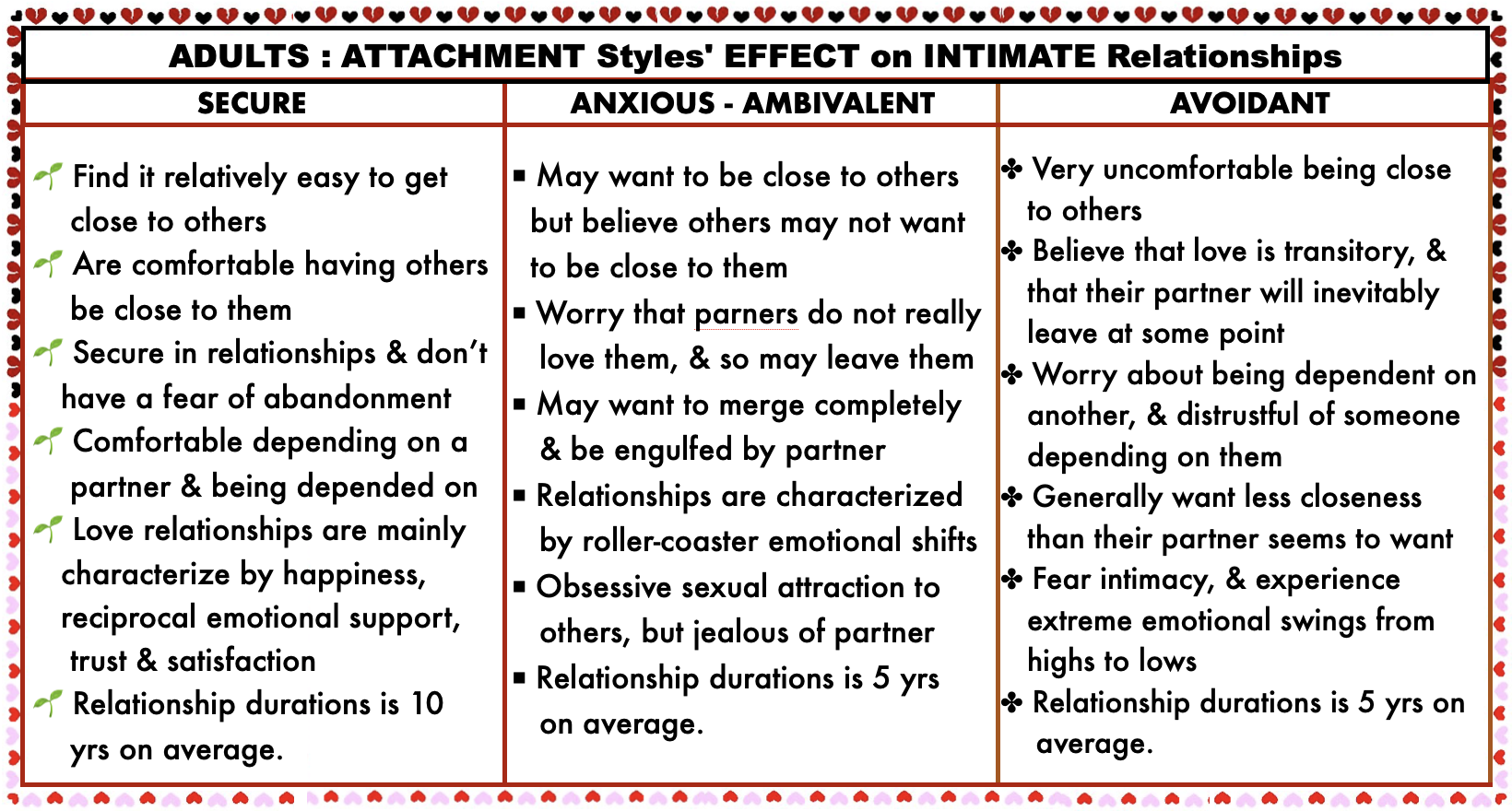
♝ Security is usually related to positive Self- & Other-models
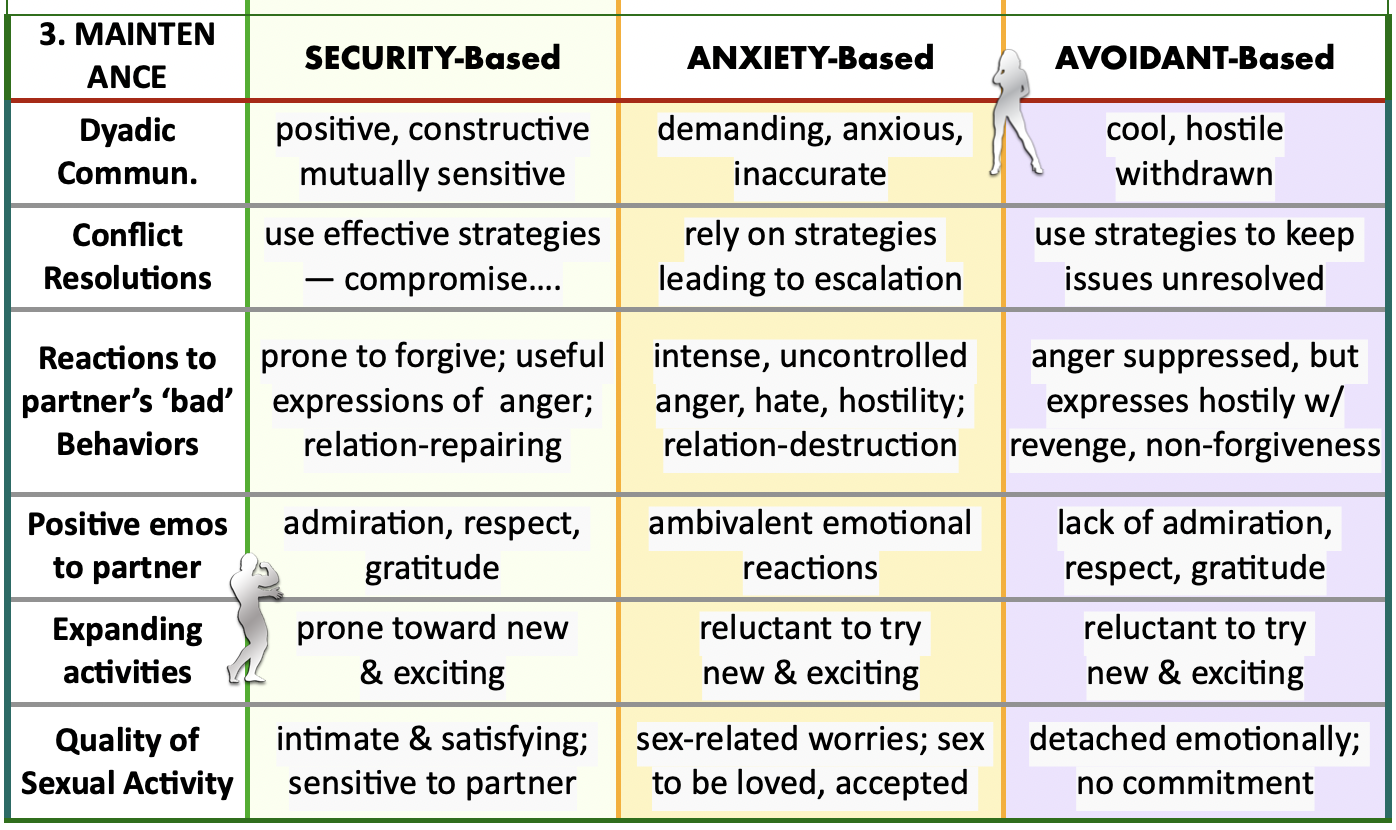
♝ Avoidance comes from an overly positive Self- but negative Other- view
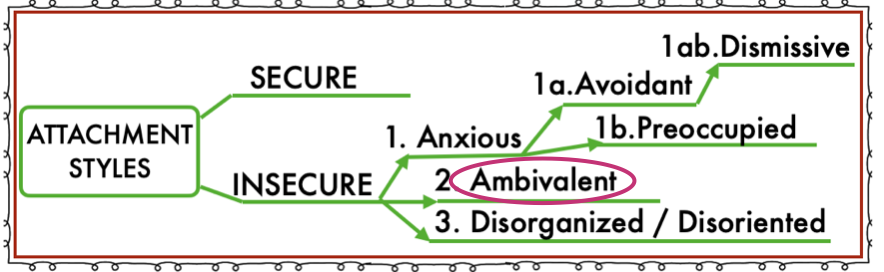
♝ Anxiety is linked to a more ambivalent Self- & Other opinion

Based on a person’s childhood experiences, R. C. Fraley, (2002) adults pay particular attention to experiences & information that fit their internal expectation about how the world works, referred to as the Confirmation bias.
CONCLUSIONS
Both insecure styles (Avoidance & Anxiety) interfere with rational thinking & reality evaluation of people / places / things (PPT) – which would normally regulate emotion as part of a person’s positive functioning. Interestingly, they seem to have opposite effects on how life is understood ⇓

🔹 Avoidance is linked to a general decrease of emotional reactions, especially re. incoming positive social info (good news is not comforting!)

🔹 Anxiety includes a general increase in emotional reactions, especially in the case of incoming negative social information (bad news is very triggering)
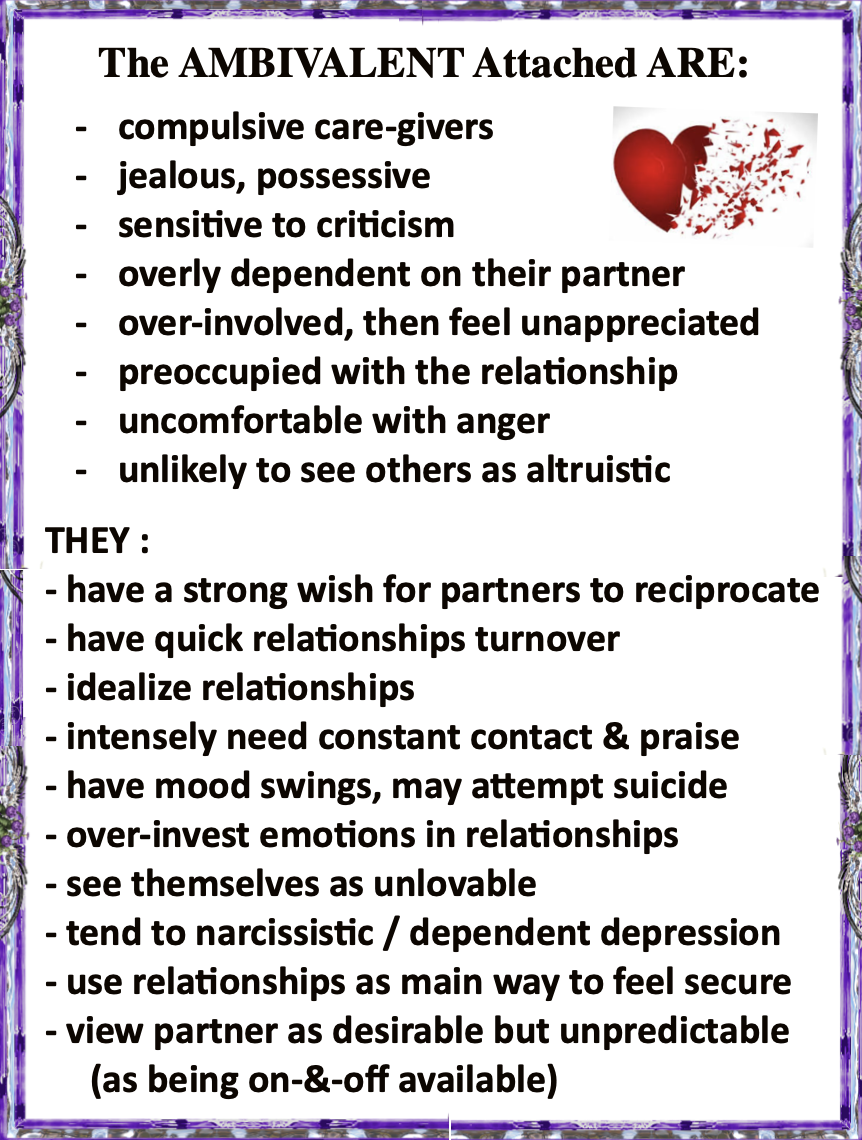
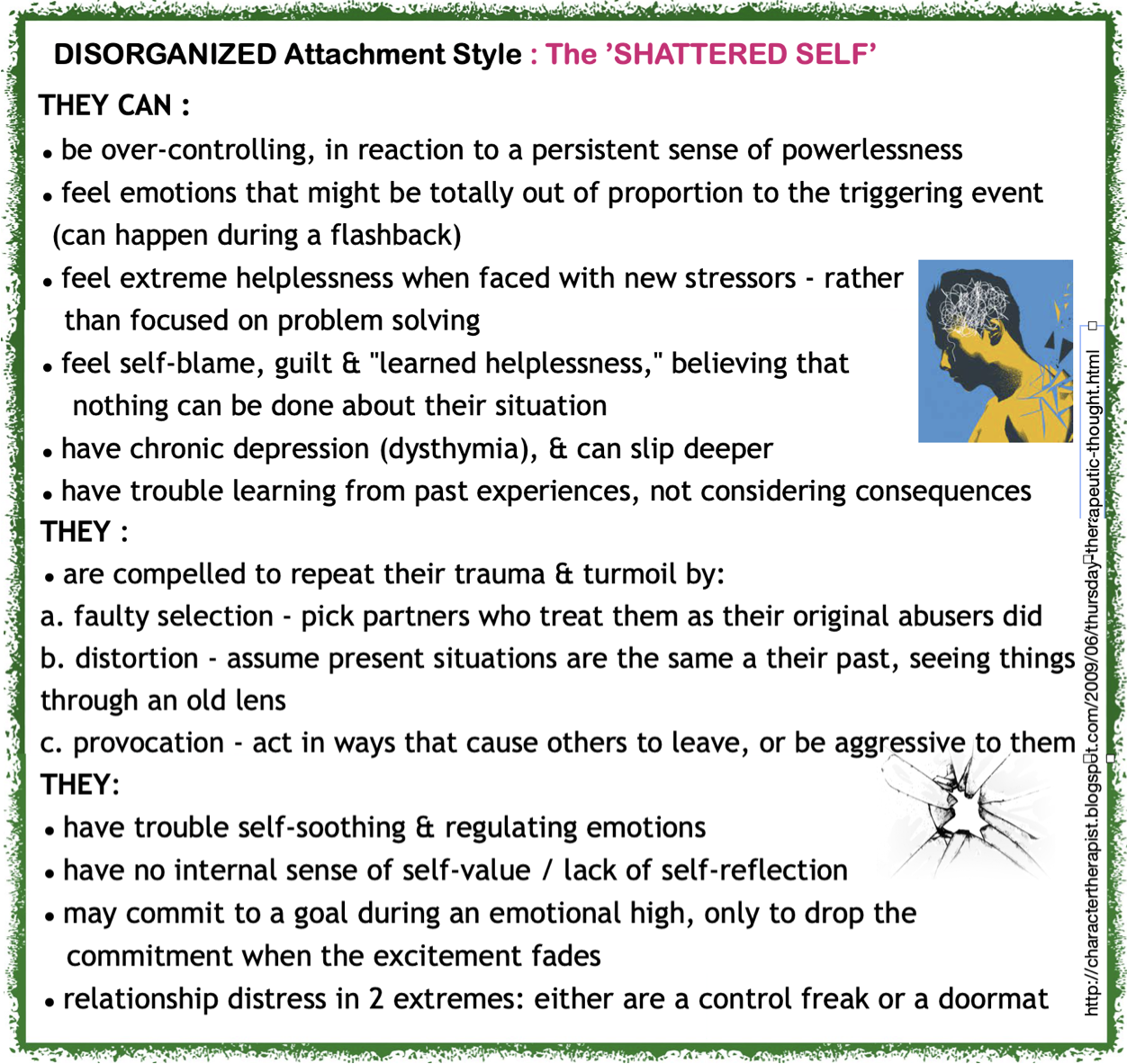
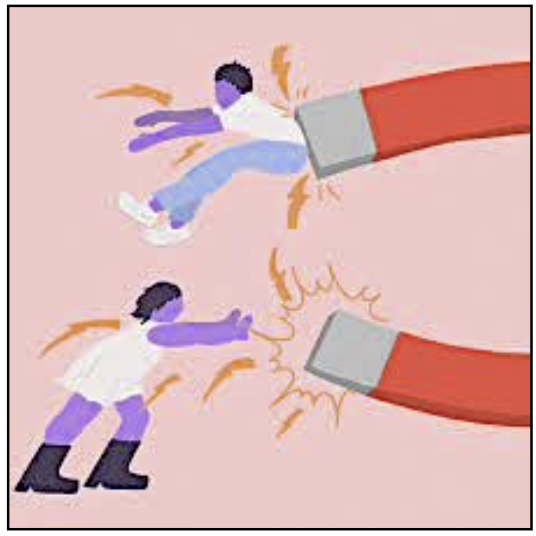
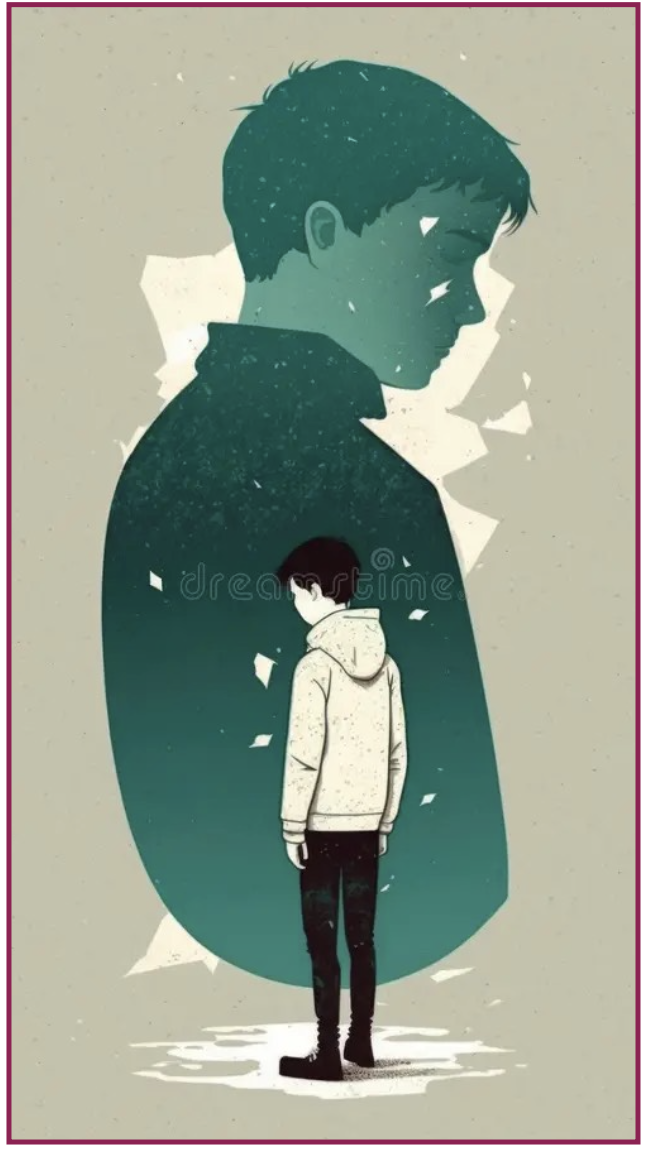
➡️  IMAGES from “Early Attachment Relationships & Their Impact on the Brain’s Wiring
ALSO :
Two studies used a brief adjective checklist (strong, safe, cruel, stupid….) to measure attachment. Data revealed that participants with a more negative self-image showed — ⇓

🔸 increased brain activity >thinking< during either positive or negative adjective evaluation about the Self (“I’m strong OR I’m unattractive”) (pleased OR upset)

🔸 but decreased brain activity >stop thinking< when hearing negative adjective about a close ‘other’ (“Mom is selfish / My kids are aggravating”).  (More….)

re. TEENS (More….)
Normally, as a teen grows, they can better cope with incongruent (unclear or negative) reaction to themself in social situations.

For Anxiety attachment, the observed effects were similar to age-related brain activation –  increased brain activity (being upset) when dealing with incongruent social feedback or conflict.

However, Avoidance attachment influences brain activity opposite to “normal” development, causing a stronger focus on congruent (clear & positive) social feedback, AND ignoring anything unpleasant – which is less psychologically mature.

‘High’ Avoidance seems to make a person unable to notice or deal with variations in social interactions.
EXP : Avoidant teens will gravitate to friends & locations which totally agree with their own attitude & point of view.
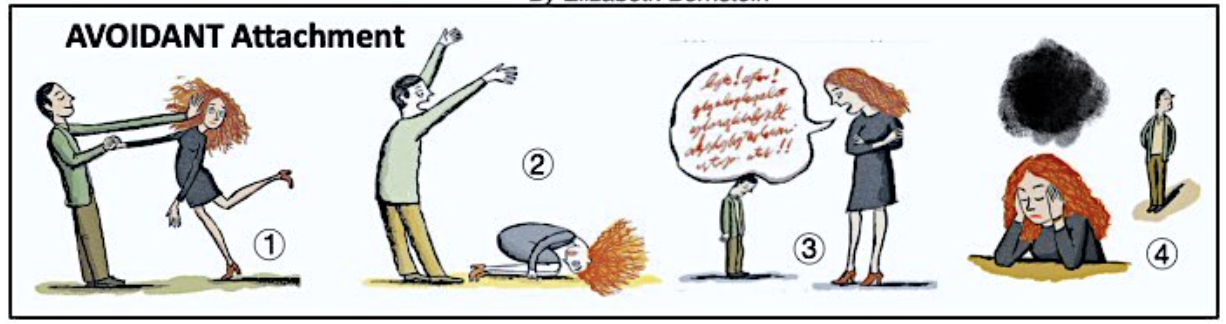
NOTE : Avoidant Attachment does not always mean physical isolation, but rather emotional withholding.

NEXT: INTRO – #4

ATTACHMENT – INTRO (Part 2)

 PREVIOUS :
Attachment Theory #1

SITE : QUIZ – re.  Love & Attachment 


T.E.A.

The three emotion (E) regulation & coping strategies >>problem, emotion & avoidance -focused << are the source of many interesting cognitive (T) & behavioral (A) outcomes discovered in people with different attachment styles.

Different patterns in children’s attachment styles or orientations in adults —> reflect different ways of regulating affect (observable manifestations of emotion), particularly the way painful emotions in especially challenging or threatening situations are controlled or dampened.

◎ More Securely attached adults usually experience more intense & mildly pleasant emotions in romantic relationships, fewer intense & mildly uncomfortable emotions ……
◉ ……. whereas the reverse is true of the more insecurely attached.
In one study students classified as insecure (anxious-avoidant or anxious-resistant) were rated by teachers as less socially competent during early elementary school.

⁍ Similarly, teens rated as insecurely attached were seen to have lower social competence when interacting with their same-sex friends at age 16…..

⁍ …… which in turn predicts both feeling & expressing unhappy / painful emotions in romantic relationships when in their early 20s.

THEORIES
Conceptual Models  = WHO qualifies as an ATT figure
▪︎ Monotropy – that the main ATT figure (usually the mother) has an exclusive impact on children’s personality development

▪︎ Hierarchy – Adds that relationships with subsidiary ATT figures (like the father) may also contribute, although to a lesser extent. However, since the 1960s fathers‘ contribution to child development is increasingly recognized

▪︎ Independence – all ATT relationships are assumed to be equally important
▪︎ Integration – the quality of all ATT relationships, taken together as a whole, is what optimally predicts children’s developmental outcomes

🚼 Sensitivity Hypothesis = HOW is ATT transmitted from from one generation to the next?
Theory : the assumption is that once a certain attachment style has been formed in early life, it remains relatively stable throughout, & is then transmitted from one generation to the next. The main variable of this transmission emphasizes parental / maternal sensitivity.

However, the amount of variance evident in families indicates there are many other variables moderate it, called the ‘transmission gap’

🚼 Competence Hypothesis = Secure is good, Insecure is bad
Theory : an early Secure attachment is a prerequisite for healthy emotional & social development, necessary to become a competent child, adolescent & adult.

Competence includes the ability to understand & regulate the expression of emotions – individually & in response to others. It’s associated with better well-being, life satisfaction & higher self-esteem, & can ease cognitive tasks.

However, starting life with an insecure ATT can represent a risk factor for developing mental health, it’s no longer assumed to inevitably produce negative outcomes.

🚼 Universality Hypothesis = built on 3 assertions that :
— healthy attachment is facilitated through parental sensitivity
— secure attachment is normative
— healthy attachment leads to longitudinal competence.

Critics argue that contemporary attachment theory privileges a conception of child-rearing that is fundamentally based on family structures & societal conditions that ignore the cultural practices of most of the non-Western world.

🚼 Cross-cultural similarities vs differences = Theories have mainly been tested on people from western, educated, industrialized, rich & democratic societies – in short, “WIERD”(rare) cultures (scroll down).
However, now there are many implications of cross-cultural differences in ATT on various levels, having to do with moral judgments about good & bad parenting.  EXP: a comparison of US versus Japanese values. Rothbaum et al

EXP: A study done in the slums of Nairobi, Kenya (pub 2021) of 2,400 households with children under 5. Researchers evaluated caregiver-child relationships in the routine home visits, using an adapted version of the Ainsworth “Strange Situation”.
RESULTS  : Of the 2,560 children studied from July to December 2010, 2,391 (90.2%) were assessed as having a secure attachment with a parent or other caregiver, while only 259 (9.8%) were assessed as being at risk for having an insecure attachment.

NEXT : Attachment – INTRO #3

ATTACHMENT – INTRO (Part 1)

PREVIOUS : Enneagram WINGS (Types 8, 9)

SITEs:  ☼ History of Attachment Theory
☼ “What is Somatic Experiencing ?

ATTACHMENT THEORY can be considered a variation of Object Relations Theory. It tries to understand & clarify people’s emotional connections throughout their lives, first with parents & then with everyone else. Attachment styles may vary & change over time, but we all have a tendency to favor the ‘original’ one.

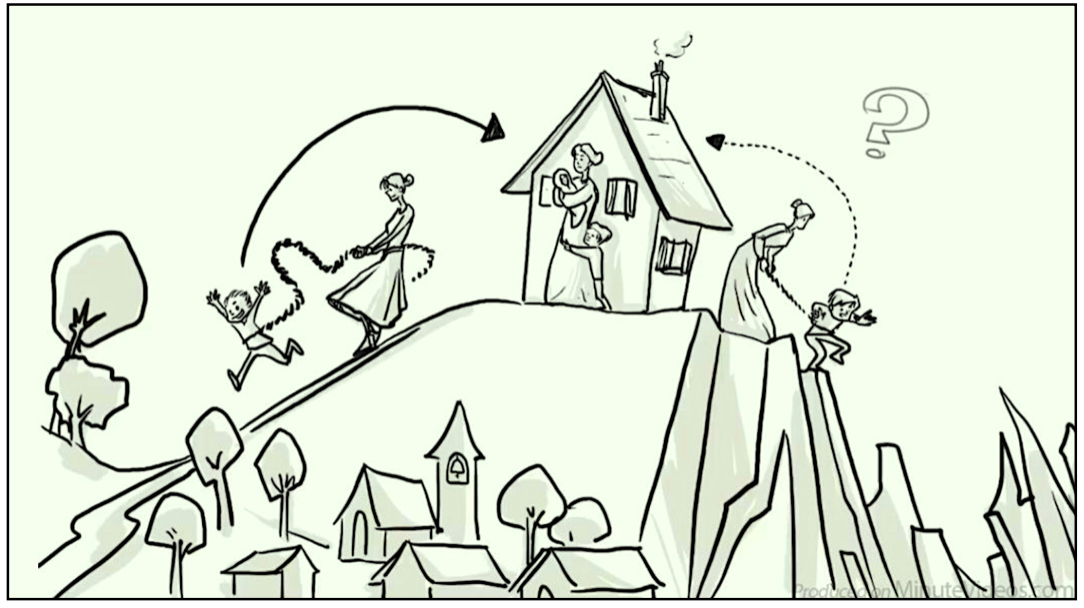
When positive : the basic idea is that the primary caregiver (an emotionally healthy mother) who is available & responsive to an infant’s needs – allows the child to develop a sense of security. Because she’s dependable, the child will feel safe, & so is comfortable to explore the world.

Attachment styles don’t develop overnight. A few really positive or negative interactions with parent(s) / primary caregiver(s) are unlikely to have a permanent impact.
▪︎ Rather – it’s by repetitive interactions – either frustrating or rewarding – that attachment styles take shape.
In addition to parental behavior, a child’s inborn temperament plays an important role in creating that bond.

According to attachment theory, formative relationships serve as a psychological foundation of personality, from which we develop —
‣ an understanding of how relationships work
‣ what to expect from other people
‣ how safe or “secure” we feel in any relationship

«
Our style can be thought of as the “lens” through which we see ourselves with others. If it’s blurry or cracked, we’ll experience inter-personal interactions -at best- as slightly ‘off’, -at worst- as very distorted.

Children have a built-in drive to seek proximity in order to bond with a primary caretaker (usually the mother). This is a highly adaptive survival strategy that ideally leads to the child’s ability to :
manage stress 
— explore the world without undue fear
— develop a coherent sense of Self in relation to others.
The child’s tie to the mother is called —> ‘attachment’, whereas the mother’s tie to her child is called —-> the ‘care-giving bond’.

Developmental psychologist Mary Ainsworth defined ‘normal’ attachment as “An affectional tie that one person or animal forms between themself & another specific one – that binds them together in physical space, & endures over time.”
It involves a desire for regular contact with that person, & produces distress when separated from them.

3 Key Propositions of SECURE attachment (Bowlby)
First When children are raised with the confidence that their primary caregiver will be available to them – they’re less likely to experience fear throughout their life – than those who are raised without such conviction.

Secondly – this confidence is forged during a critical period of development – throughout infancy, childhood & adolescence. The expectations formed in those years tend to remain relatively unchanged for the rest of the person’s life

Finally – these expectations are a direct result of the child’s experiences. Their assumption is that caregivers will continue to be responsive to their needs, because those people (parents….) have been responsive in the past.

4 Distinguishing characteristics of attachment:
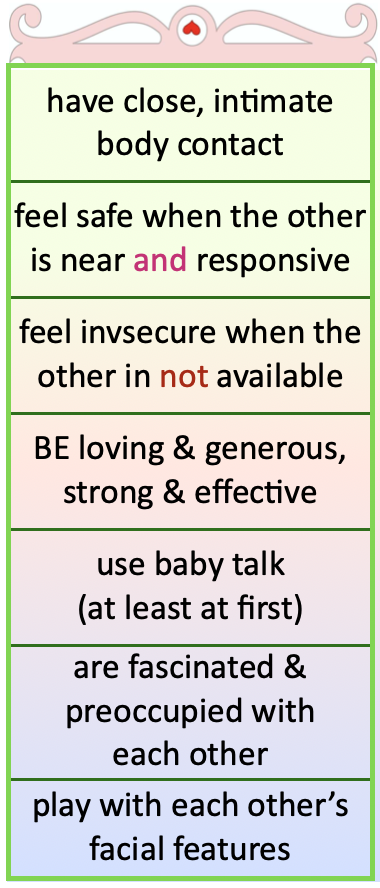
Proximity Maintenance – The desire to be near the people we’re attached to
Safe Haven – Returning to the attachment figure for comfort & safety in the face of a fear or threat
Secure Base – The attachment figure acts as a base of security from which the child can explore the surrounding environment
Separation Distress – Anxiety that occurs in the absence of the attachment figure

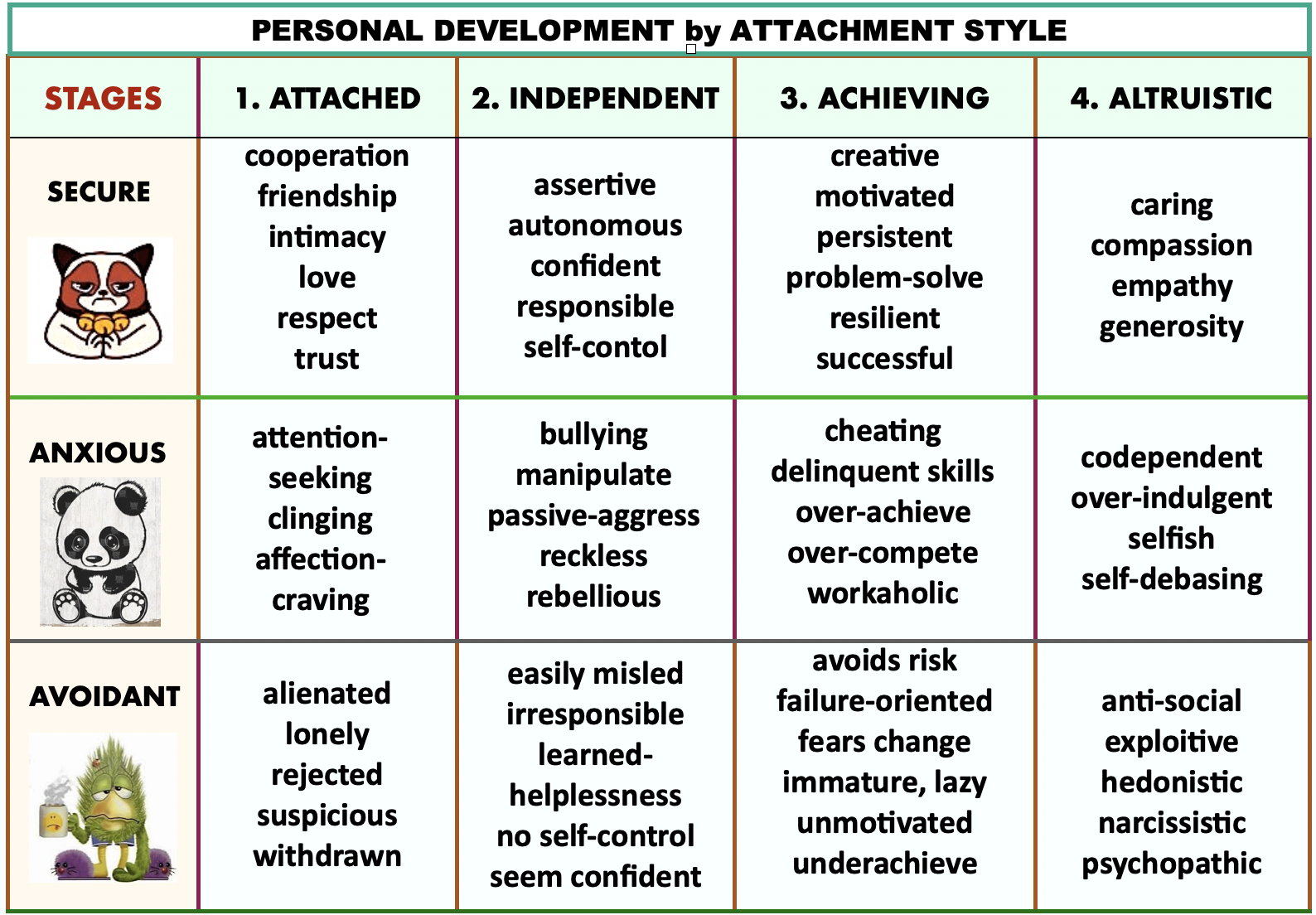
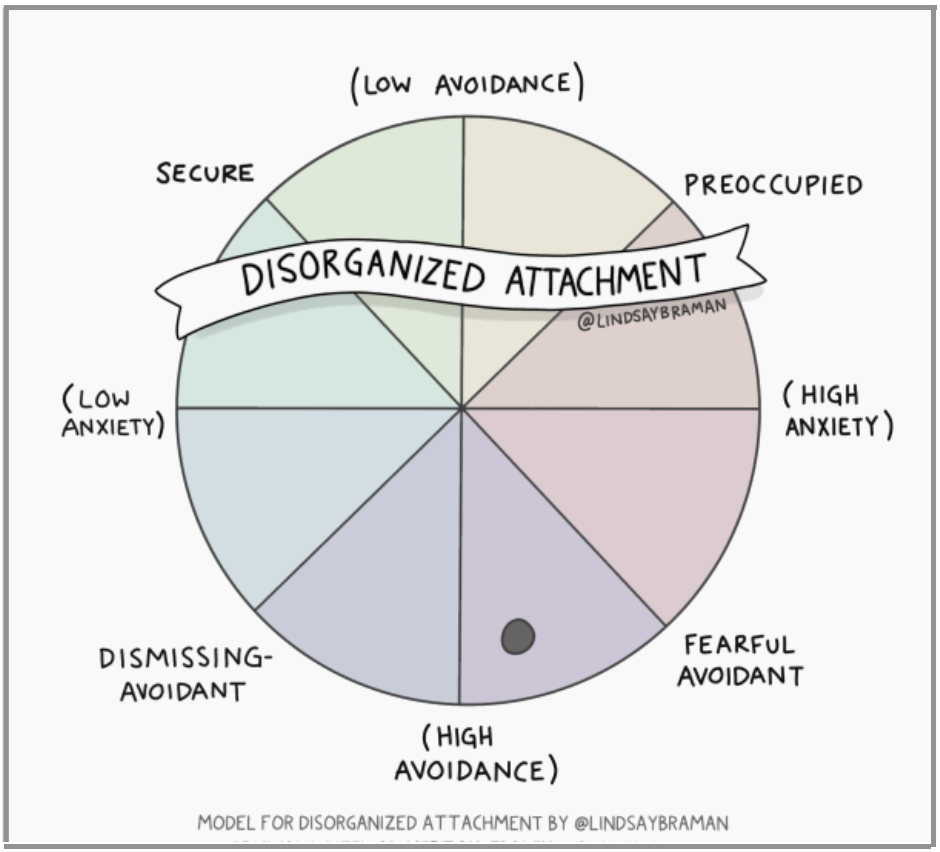
As seen in the chart at the top :
Q : What causes differences in styles?
ANS : A combination of inborn differences in the infant, & how they respond to a variety of parental treatment over time

SECURE infants are more likely to have parents who are consistently, appropriately able to attend the child’s needs
EXPs: Feed infant when hungry, rather than on a set schedule
– Cuddle baby at times other than when feeding or changing

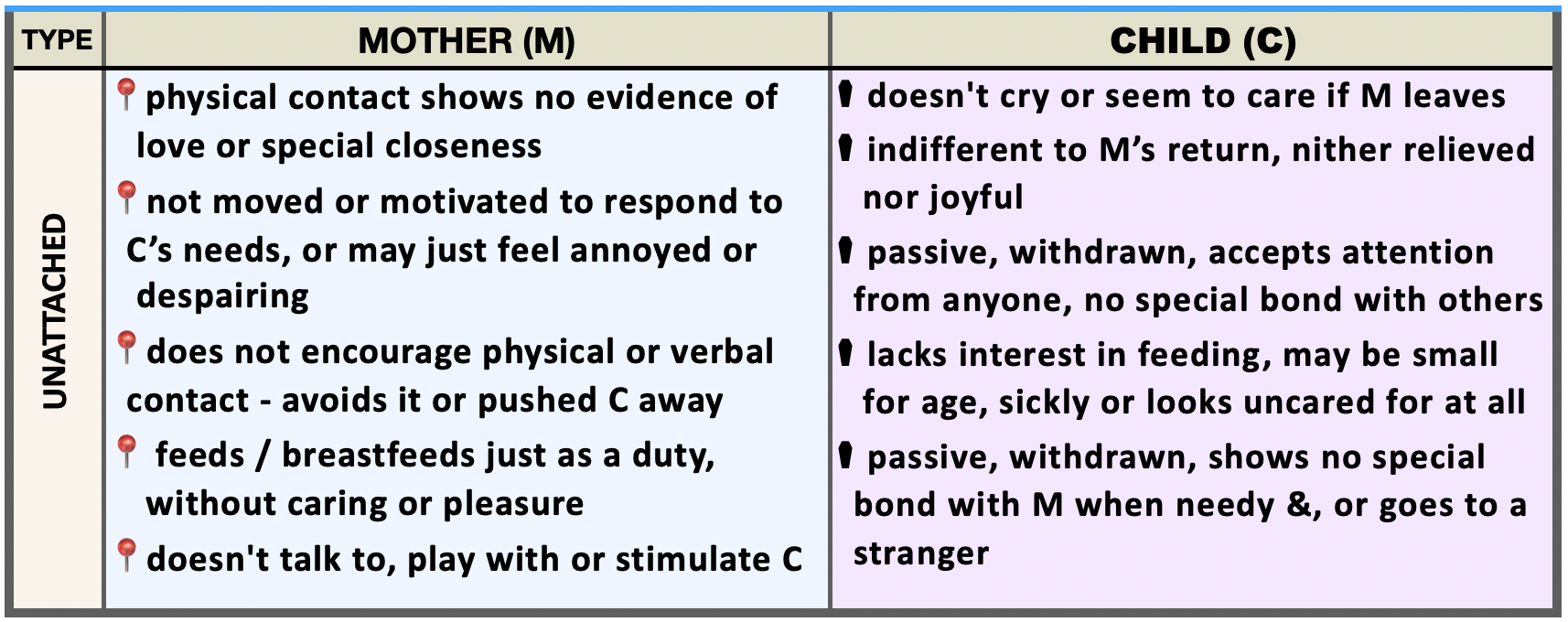
INSECURELY attached – results from the mother (or other caretaker) being less sensitive, less responsive &/or inconsistent
EXPs: Feed infant only when convenient for parent
– Sometimes ignore baby’s cry of hunger
– Avoid physical contact with baby as much as possible, or only to harm it (slap, shake, yell at….)


NEXT : Attachment INTRO #2

ACoAs – fear of EMPTY TIME

PREVIOUS : Enneagram WINGS Types 8, 9

SITE: ☼ “Weekend anxiety: Are you dreading time off?

 ☼ 7 Exercises to Heal You Inner Child


✳️ ISSUE
:  many ACoAs notice that when there is no action-goal in sight – the WIC gets panicked. This blank-time can be early mornings, evenings after work, but more likely non-workdays, usually weekends. (POSTS :  ACoAs & TIME )

We don’t know what to do with free time.  We may sleep too much, or
— wander around the apartment / house empty-minded
— endlessly obsess about something trivial or worrisome
— find some activity to distract (internet / social media / movies….)
— act out some addiction (shop, overeat, sleep around….)

If someone asks us “What do you want to do with this open time?” The most often response is “I don’t know.” This is in spite of the fact that on other occasions we’ve said – “I’d like to learn a language / go to the gym / take a walk / read some books / practice my guitar…..”

Yet when we have the time – we don’t. We waste many precious hours not really accomplishing anything worthwhile, which includes putting off things we say we want to do. AND then we give ourself a hard time about procrastinating – again!

🚼 REASONS
1. Lack of “Identity”
Many ACoA say “I don’t know who I am”, this in spite of the fact that we may have actual tangible accomplishments. Again, this plaint is the WIC’s very real feeling-sense – when looking inside all we see is either a ‘monster’ or a blanks. (Post: “Abandonment pain“). 

This comes from : a lack of legitimate mirroring (parents reflecting back to us who we are) so we can’t see ourself,
AND not having our human needs & personality needs identified, much less allowed to express & have provided

2. Fear of painful emotions
We bring with us into adulthood an enormous backlog of unresolved childhood pain. When things are too quiet – we may feel – which we don’t know how to cope with. (Posts : “What about Emotions?”)
And vagueness about taking actions includes trying to escape a deep inner loneliness which is not about being physically by ourself, since we can also feel disconnected & isolated in groups.

Rather, it’s the WIC’s aloneness we still carry – from the trauma of our parents not being able to connect to us/ with us in PMES ways, no matter how it seemed on the surface. They ignored & invalidated our emotions, punished us when we expressed any (excited, loving, hurt, angry….), and didn’t comforted us when we were in pain.

So now we’re terrified of experiencing any emotion, assuming all are ‘heavy’. We miss out on the pleasurable & joyful ones we can have from  finding & expressing our True Self  (Posts : “Being Confident“)

3. Lack of self-motivation
The ability to determine our own actions is based on having a fundamental sense of who we are (point 1), what our needs (point 2) & our rights are.

No matter how talented & accomplished many of us are, unrecovered ACoA are almost totally driven by external requirements, while still thinking we’re frauds!

This means we can & will do what is required or demanded of us from others – whether family, friends, work or religious community. (Posts: Co-dependence)
SO – when there’s nothing or no one else who needs our attention – we don’t know what to do. Like a stalled car, we’re going nowhere!

4. Wrong choices
It’s true that over the years we’ve accumulated a personal history of dysfunctional decisions that have turned out badly – because they were based on our S-H. & obeying the Toxic family Rules.

Without FoO work, we still don’t know how to pick any better, as long as our weak decision-making style is run by the PigParent & the WIC. We’re afraid to make yet another mistake, so are paralyzed.

5. Perfectionism
Our WIC (listing to the PP) is convinced that whatever we do must be done exactly right! It’s the WIC’s uncontested belief, & this supposed requirement leaves us feeling overwhelmed, beyond our ability. So there doesn’t seem to be any point in even trying.

ERROR: In some “recovery” setting there’s a phrase that many people use – “I don’t have to be perfect” – thinking they’re relieving the pressure.

Q : What’s wrong with this statement? Why is the soooo harmful?
ANS: It implies that you could be perfect – if you just wanted to. WRONG, wrong, wrong! NO ONE is!
The belief in perfection prevents us from taking actions we’re very capable of.

❤️ To counter perfectionism, we must develop & apply the UNIT every day – by unconditionally loving our WIC, consistently disobeying the Toxic Rules, and actively providing our needs – to the best of our ability. (Posts : “Set goals to meet needs“)

NEXT : Attachment, Intro #1

Enneagram WINGS for Types 8, 9

PREVIOUS : Ennea-Wings for 6, 7

Radar charts show the dimensions profile of statistically average Types 8, 9 (2022)
⬆️ This chart shows how a Type 8 scores on 14 key traits. EXP : High on Assertive & Industrious, but Low on Cooperative.
↗️ This chart shows how Type 9s score on the 14 traits – in the Average range for most traits, with a slightly Below-Average score on Need-for-achievement, & slightly Above-Average score for Team-oriented.

⭐️ 8 w 7 : The Maverick
Headstrong & confident self-starter, these 8s work & plays hard – with a fearless attitude. The are ambitious, assertive, & likely to take risks, a natural determination & leadership combines with some of the 7’s charisma & social skills.

The extroverted, playful, life-affirming 7-wing gives 8s more vitality, so they find it easier to enjoy things, & often want to invest their energy into causes that have a positive impact. It helps them be more easygoing rather than intimidating.

Setting clear boundaries & showing their authority gives them confidence, & the advantage to prepare themself for difficult situations. However, they also struggle for love & support. They need a safe environment they can trust which provides care & reassurance.

These 8s are more experimental at work & in their personal life because they find that trying out new people, situations & things are fun & exciting.

Stressful situations can make them addictive, impulsive, reactive, or materialistic. To feel safe, they become very self-protective & eventually be intensively aggressive.

“ATTITUDE” : i am a plague upon humanity, i burned the crops and poisoned the water supply, and you can’t do anything about it
♥︎   ♥︎   ♥︎
8 w 9: The Bear
This 8 is a servant-leader, gently taking actions that keep others’ best interests in mind in order to preserve harmony. They’re more family-oriented, with a quiet groundedness to their confidence, lead by protecting rather than intimidating.

The 8’s natural determination meets some of the calm & serenity of the 9, making them more helpful, quiet, reliable, patient & supportive. Less confrontational & more willing to mediate or negotiate, they & lead by protecting rather than intimidating.

They advocate for others & have a sixth sense that detects threats to self & their loved ones.  Being really good listeners, they take the time to listen to others people’s opinions, rather than only sticking to their own opinions.

These 8s are less quick to anger & more empathetic that 8s in general so they’re they’re very welcoming . They like taking on all the responsibility in relationships even though this can become exhausting.

In times of stress, they can become cold & indifferent.

“ATTITUDE” :  If only you’d have realized what unholy retribution your little “clever” comment about me was going to bring down on you, maybe you’d have held your **** tongue

⭐️ 9 w 8: The Comfort Seeker
These types are the independent yet calm vagabond on a (rather quiet) mission to discover what makes society a kinder, more accepting place. They also have better access to their anger & more willing to deal with conflict.

8w gives the 9 with a more forceful nature, so they’re more energetic, confident & practical. This makes them leadership material because they can take charge & be assertive, while still listening to & understanding others’ ideas & needs. Thus wing helps them work quickly & with mental clearly, even under pressure.

They still have their extremely calmness of 9s, but put more trust in their gut when making decisions, so don’t need to plan as much because they know it will all work out in the end.

Under stress they because they can become aggressive, callous & lustful.

“ATTITUDE” : [takes a nap while maintaining an air of aloof morality]
♥︎   ♥︎   ♥︎

⭐️ 9 w 1: The Dreamer
A a bit more introverted, these pragmatic ‘savers’ value cooperation & justice, with a more idealistic sense of right & wrong – more refined with good morals.
They want harmony, so can be somewhat utopian, letting their ideals motivate their actions. When they find peace of mind, they can share some of their good feelings.

Highly principled & hardworking, these 9s are often modest, composed, & orderly. A strong 1-wing greatly helps 9s find their own voice, & wanting to stay connected to others in their community are more inclined to share their opinions with the world.

They don’t like asking for permission or giving explanations, preferring to enjoy things without having to defend themself. They can stay focused because they like to pay attention to the fine details of a job or a situation.

As dreamers, they can see the whole picture, able to form conclusions & make decisions. They can’t stand seeing things as commands, but if something’s not good they let people know.

When stressed they can be obsessive-compulsive & self-righteous.

“ATTITUDE” : I’m either decent at confrontation or ___awful at it. Have I ever been truly, rightly pissed off?

NEXT : Empty weekends

Enneagram WINGS for Types 6, 7

PREVIOUS : WINGS (4,5)

Radar charts show the dimensions profile of statistically average Types 6, 7 (2022)
⬆️ This chart shows how Type 6s score on 14 key personality traits. EXP : High on Suspicious & Altruistic, Low on Self-efficacy.
↗️ This chart shows how Type 7s score on 14 traits. EXP : High on Spontaneity, & Low on Need for achievement (nA).

⭐️ 6 w 5 : The Defender
These 6s are resourceful & dutiful team worker who highly value security, with a great passion for knowledge, whether it’s to feel prepared or just for the sake of learning. They value honesty & clarity, fiercely defending their values in order to keep their honor, & give life a clear frame.

Tending to be serious & studious, they can be original thinkers, quiet, private. Defenders not only use common sense when making decisions – they take the effort to find new and more convenient ways to do it, with a low emotional cost.

The rational and detached Type Five wing makes it easier for Sixes to spend time alone & function independently. They’re often outstanding problem-solvers who care less about what other people think of them, while still comfortable inside predictable & rule-based environments.
They often having a great sense of humor.

When under stress, can become arrogant & reclusive workaholics, image-conscience, dismissive of their own thoughts & feelings.

“ATTITUDE” : If my social group isn’t equal and homogenous i will pick it apart, send a letter of resignation and leave
♥︎   ♥︎   ♥︎

⭐️ 6 w 7 : The Buddy
These 6s are optimistic & fun-loving explorers of life with a (somewhat contradictory) need for safety & comfort. They thrive on creating interesting plans & options, but they also need to know what the limits are.
They take things more lightly, are optimistic, very observant, open to risk & more comfortable with the unexpected.     

The combination of 6’s honorable manners with 7’s optimism makes them very engaging, being playful, relaxed, & find it easier to connect with others. They know the best way to talk to people to get their needs met, conscientious of including them..

The skeptical or doubting mind is still present, but they’re more likely to engage in spirited discussion of ideas & issues. They’re a mix of outgoing & edgy, inclusive yet critical. They want to work things out with people even if that means agreeing to disagree. Group trips, projects & sports are preferred.

When unhealthy, they can overreact, become impatient & materialistic.

“ATTITUDE” : If people look at me enough maybe it will alleviate my paranoia and anxiety about everything as long as i don’t act TOO out there. wait. wait guys where are you going?

⭐️ 7 w 6: The Entertainer
7’s natural optimism & enthusiasm meet 6’s responsibility & seriousness, the 6 giving them more control so the 7 can act deliberately rather than impulsively. They’re excellent problem-solvers because of excellent observation skills, allowing them to anticipate problems before they even happen.

The 6-w gives them more control so the 7 can act deliberately rather than impulsively. Committed & reliable, they’re also more light-hearted. As happy-go-lucky & humorous experience-junkies, they’re always on the search for new projects, easier for them to carry their child-like wonder into maturity.
The combination is a restless person that looks for new & exciting experiences to lift their spirit while taking care of their obligations.

In stressful situations they cab become anxious, fidgety, hesitant & too sensitive.

“ATTITUDE” : I want to be fun & also be liked, but my self-generated conflict threatens me
♥︎   ♥︎   ♥︎

⭐️ 7 w 8: The Realist
These 7s are creative, innovative entrepreneur who enjoys experimenting & creating with new  ideas & mediums. Determined & persistent they often show an almost pure, genuine joy of life, pulled toward more sensate (physical) experiences. 

With the strength-oriented 8-wing, 7s are more assertive  &
ambitious, powerful, & confident.  Their thinking often is strategic & aimed at efficiency, approaching tasks with a more hands-on focus from a desire to make things happen.

The expansiveness of both numbers can take them far in the world. They can be great adventurers, whether in extreme sports, business ventures, travel, partying, or all the above. 

They have to watch out for getting overextended in whatever they do & losing their grounding. They can become self-focused to an extreme, following their own desires or vision of what life should be. While this makes them highly creative, it can also lead to self-absorption.

Under stress, they become impatient, indulgent & narcissistic.

“ATTITUDE” : I am a plague on humanity, burning crops & poisoning the water supply. I’m curious – what are you going to do about it?

NEXT : Wings 8 & 9

Enneagram WINGS for Types 4, 5

PREVIOUS : WINGS (1,2)

Radar charts show the dimensions profile of statistically average Types 4 & 5 (2022)
⬆️
This chart shows how Type 4s score on 14 traits.
EXP: High on Complexity & Low on Principled
↗️ This chart shows how Type 5s score on 14 traits.
EXP : High on Complexity & Self-efficacy, Low on Team-oriented.

⭐️4 w 3 : The Aristocrat
They are charismatic & individualistic artists with a sense of wonder about the underlying beauty in nature as well as the spectrum of human emotions.

The ambitious, goal-oriented 3-wing makes Fours more willing to put themselves out there, work on their skills, & learn to market them. They’re better at dialing back their emotions in order to be productive & efficient, often having more energy to pursue their ideas.

A 3-wing helps turn their attention to the external world. It tempers the Four’s self-absorption from a desire to prove their specialness through achievement, making these 4s more task-focused. It also tailors their dramatic style to be more socially-acceptable while still being distinctive.

They will put aside much of their individualism to blend in, while keeping some personalized touches in style or presentation. They’re good at “feeling out” & meeting others’ expectations, but with some tension between their public or social image vs their inner life. 

They can be impatient with superficial activities, going after things that offer more depth. This can either make them just complainers, or actively pursue excellence in whatever they do. In stressful situations they may become attention-seeking & elitist.

“ATTITUDE” : I don’t know what I want (sitting in a corner rocking back & forth)
♥︎   ♥︎   ♥︎

⭐️4 w 5 : The Bohemian
These intense creators are on a mission to use self-expression to highlight the universality of the human condition. They’re more contemplative, objective, quiet & unconventional, such as artists, writers, musicians & scholars

With a 5-wing, Fours become more analytical & intellectually observant about themself, not getting as quickly overwhelmed by their emotions, so find it easier to stop, focus, listen & concentrate.

If 4w5s stop chasing the ‘universal Ideal’, they can fall into hopeless defeatism. Despairing of being understood & accepted, they can retreat into themself, appearing almost stoic despite swirling emotions under the surface. If this happens, they come across as aloof, eccentric, or avant-garde.

Under stress, they can detach from themself & be withdrawn or pessimistic.

“ATTITUDE”: I want to stand out by not standing out. Also, I’m a tool ⭐️ 5 w 4: The Iconoclast
 The 4-wing helps these 5s either be artists, doing their ‘normal’ work in creative ways, or generally have an appreciation for the arts. They’re often very interested in unique & creative ways to use their minds, & like to tinker with objects.

Idiosyncratic (& often self-taught) lone rangers, they deeply value autonomy & mastery of a subject. Both 4s & 5s are introverts, so when combined these 5s can easily disconnect from the environment.

However, the emotionally expressive 4-wing does help Fives better identify & communicate emotions, instead of just analyzing them, allowing deeper intimate connections with partners & close friends.

While the 4-wing may support greater interpersonal warmth, it can also lead to a more erratic or disjointed style. Their challenge is to integrate thinking & feeling so they aren’t being pulled in different directions, or creating conflict. 

When unhealthy, they can become moody, melancholic, and self-absorbed.

“ATTITUDE” : See how smart & passionate I am while standing out. But please don’t actually pay attention to me because if you look too hard I’ll shatter. WAIT – why are you looking at me? Stop. Please!
♥︎   ♥︎   ♥︎

⭐️5 w 6 : The Problem Solver
These 5s are detached & curious researcher who gather energy from digging into fascinating topics, under the radar. Having scientific or intellectual interests makes them more logical, analytical, & hard-working.

The 6-wing reinforces the activity of the mental center (5,6,7). A strong focus is on technical data, systems of information & knowledge – as a solution to life’s challenges.

Their intuition comes naturally through instant social processing, rather than from intense thinking & information about people & situations. 5s combine their observing skills with the foresight of 6s, while the suspicion & deep observation of 6 is added to the 5’s natural logic.

The 6-wing helps make these 5s excellent team players. They’re more social, finding it easier to contribute to group efforts. Their thinking is practical & problem-oriented, with social instincts that are more family-oriented, on the lookout for stability.

If unhealthy, they can be anxious, skeptical & afraid of intimacy.

“ATTITUDE” : I’m paranoid about being paranoid

NEXT : 6 & 7 Wings

Enneagram WINGS for Types 2, 3

PREVIOUS : Wings INTRO #2

Radar charts show the dimensions-profile of statistically average Types 2, 3 (2022)
⬆️ 
This Chart shows how Type 2s score on 14 key traits.
EXP: High on Altruistic & Cooperative, but Low on Suspicious
↗️ This chart shows how Type 3s score on the 14 traits.
EXP:  Very High on Industrious & Competitive.

⭐️ 2 w 1 :  The Servant / Companion
They’re respectful & proper, a little more reserved, quiet & perfectionistic than basic 2s. Also – more reasonable, self-critical & judgmental. While being generous & demonstrative, even self-sacrificing, they can also be possessive & people-pleasing. 

The idealistic 1-wing makes the 2 more disciplined, focused & self-reflective.  2w1s are comfortable holding back in order to improve themself, having high standards for their work ethic, their personal conduct and the behavior of others

Deeply empathetic & caring people, they find fulfillment in others’ happiness & well-being. They can be available to others without forgetting about themself, aware that proper self-care allows them to take better care of others.
These 2s feel less obligated to help everyone, & can focus more on people who actually need help with specific tasks. The 1-wing makes them less afraid to say No.

It’s  important to show them gratitude & attention.
If unhealthy, they can become guilt-ridden, self-critical, controlling, self-righteous & judgmental. 

“ATTITUDE” : I’m a slightly more sensitive moral crusader, existing literally to serve things & causes, rather than to lead.
♥︎   ♥︎   ♥︎

⭐️ 2 w 3The Host/Hostess
These 2s tend to be very helpful, caring & attached to people – charming, outgoing, playful & more self-assured than 2s in general, which makes makes it easier for them to share their emotions & opinions.

The 3-wing also makes them ambitious, determined, flattering & more self-centered. They like to be in the spotlight & tell people directly what they want or what they have to offer in return.

Productive organizers, they thrive on connecting people together & being part of groups. These 2s are more comfortable having a leadership role, who find that being respected by others is just as satisfying as being liked.

Their basic fear is to feel adrift without love & acceptance.  To compensate, they constantly work at developing deep & intimate bonds they can rely on, emotionally dependent but ashamed of their needs.

When unhealthy, they can become deceptive, manipulative, & vain – their image being most important (the 3), for what they accomplish themself as well as for others.

“ATTITUDE” : I’m a pathetic slave to others’ opinions ⭐️ 3 w 2The Star / Enchanter
3s with a strong 2-wing are quite warm & engaging, showing better people-skills that average 3s, with the ability to lead & manage large groups. Their aim is to achieve in competitive & energetic ways, while still focusing mainly on individual self-expression. 

They actively form successful relationships with others as part of their overall program for achievement & productivity. Being very gregarious, they can maintain contact with people way beyond what most other  types can tolerate.  

The problem is that both numbers reinforce a dependency on external approval & recognition, which may lead to being superficial. Their biggest desire is to be worthy of others’ love, so the biggest fear is to not have it. This can make 3w2s ‘Charmers’ powerful individuals, but also troublesome.

Their desperate wish to be liked can too easily lead to losing an awareness of they own personal needs. They find it hard to stop constantly showing off & making a scene – even though it’s not a positive strategy in group settings.

“ATTITUDE” : I need to climb the social ladder, but alternate between doormat & hyper competitive jerk, bringing two-facedness to a whole other level
♥︎   ♥︎   ♥︎

⭐️ 3 w 4The Professional
The 4-wing makes these people more subdued, introspective & emotional, with a strong  imagination, with a tendency to dabble in the arts. It also makes the 3 pay more attention to intellectual information, compared to 2-wings.

They’re driven & organized bosses, always on the go with new business ideas & projects, finding great joy in efficiency & rewards, but will also have a personal agenda in off hours.
At times they’ll retreat from constant busyness to regroup or analyze their options, which may seem contradiction to the outgoing & performance-oriented 4.

These 3w4s have better access to their internal states & moods, but don’t like being used as a shoulder to be cried one, preferring two-way beneficial conversations. The4-Wing can make them more vulnerable as they express themselves openly, & so become more ‘introverted’. 

Under stress, they can be moody, arrogant & pretentious, or suffer from depression

“ATTITUDE” : I need to stand out by achieving things, & I am the definition of ‘stomping on people’s faces’ to get what I want

NEXT : Wings of 4 & 5

Enneagram WINGS – Intro (#2) + Type 1 Wings

PREVIOUS : Ennea-wings INTRO (#1)

SITE : The Typology Podcast, hosted by Ian Morgan Cron, 

⬅️ The radar chart shows the dimensional profile of a statistically average Type One re. 14 key personality traits.
All 9 Ennea-scales are derived from “our internal research(2022)
EXP: Ones score high on Perfectionism & low on Spontaneity.

BENEFITS
Each Wing influences our core type differently because they’re fluid rather than static, so we can draw from their specific strengths as we become more self-aware & intentional.

Our favorite wing widens the spectrum of possible behaviors for our type, giving us several positive options to act on. When facing a challenging situation or uncomfortable conversation, it will greatly help to draw on what we know about our stronger side-kick to successfully navigate it.
That’s why it’s so important to know the strength & weaknesses of each Ennea-#.

EXPs : 🔹 a 3w2 would focus on getting ahead, aiming to acquire a fanbase or support network // while 3w4 would mainly primarily aim for self-expression & originality.

🔹 Opposites – The 5w6 would place more value on intellectual pursuits, whereas 6w5 focuses actions on trying to eliminate their anxieties.

🔹A Type 7 with a strong 6 Wing will be more caution about making decisions, while those with a strong 8 can be more intense or urgent.
OR – a 7w6 may opt for a career in stand-up comedy to combat anxieties of the Six
AND – a 7w8 could gravitate towards travel blogging & exploring the world while keeping lots of creative freedom.

Because each of us can choose to use specific characteristics of our chosen wing, we may act differently with different people, places or things (PPT) based on whichever one we pick – consistently or at the moment.
☀︎ This helps explain why people who share the same Ennea- type can sometimes seem like different types.

Although wings are commonly referred to as ‘extensions’ or ‘helpers’, they hold great power to unlock our multifaceted personality. By understanding & using them, we can :
☆ form a clearer picture of what our inner motivations look like & how they emerge from our thoughts, emotions & actions
☆ figure out which career paths align well with our interests & talents
☆ explore potential lifestyles & environments / locations we would thrive in, to help achieve long-term career & life goals.
🌐
Ennea-Type WINGS

⭐️ 1 w 9: The Idealist / OptimistThey’re practical & meticulous perfectionists, but are kinder to themselves & others (than a ‘straight’ 1) , adding a gentler touch to their need to improve. The peace-seeking 9 wing makes 1s more laid-back & relaxed. They want to be good / right but with a touch of peace.

Also, the 9 wing tends to make 1s more introverted, more objective & more emotionally detached. They find it easier to back down, to listen & explain their ideas, & not be as resentful, but can also be more prone to isolation & procrastination.

They have a knack for catching inconsistencies in others’ reasoning & judgment, but tend to ask others for their opinions about another person before judging them, instead of following their own intuition.

Under stress, they can be impersonal & stubborn. They respond to negativity by either redirecting their feelings or by avoiding them altogether. They may push themself deeper into work (1’s defense) or withdraw from it (9’s protection).

“ATTITUDE” : My morals are better than your morals, & I’m going to nap instead of listen to your criticism. Goodbye.

⭐️ 1 w 2The Advocate / Lawyer. They’re socially aware activists who work tirelessly behind the scenes to uphold high safety standards for others. Being more vocal, they like to accept challenges & do whatever it takes – sometimes even aggressively – to reach their goals. (↙️ Image – scroll down for all 9)

The 2 wing helps the 1 be a bit warmer & somewhat more selfless, giving them more compassion & empathy than other 1s. But it can also increase their need for control, being more manipulative by trying to turn people into who the 1w2 thinks they should be. In times of stress they can become image-conscience, with a need for approval.

They’re more extroverted, more empathetic, fiery, action-oriented, & more helpful than other 1s. Kinder & more generous toward people they love, they’re not as hard on them because of the 1’s too-high standards & ideals. They want to be good /right with a touch of being lovable /wanted. (More…)

“ATTITUDE” : I’m a self righteous moral crusader

Sources : Enneagram Institute, The Enneagram In Business

NEXT : WINGS 2, 3