Co-Dependent Anger-Niceness (Part 2)


I NEED SUPPORT

from ‘availables’!

PREVIOUS: Co-dep angry-nice #1

SITE: 6 Basic human NEEDS

Remember: we are “Damaged, not defective”!


NEEDS:
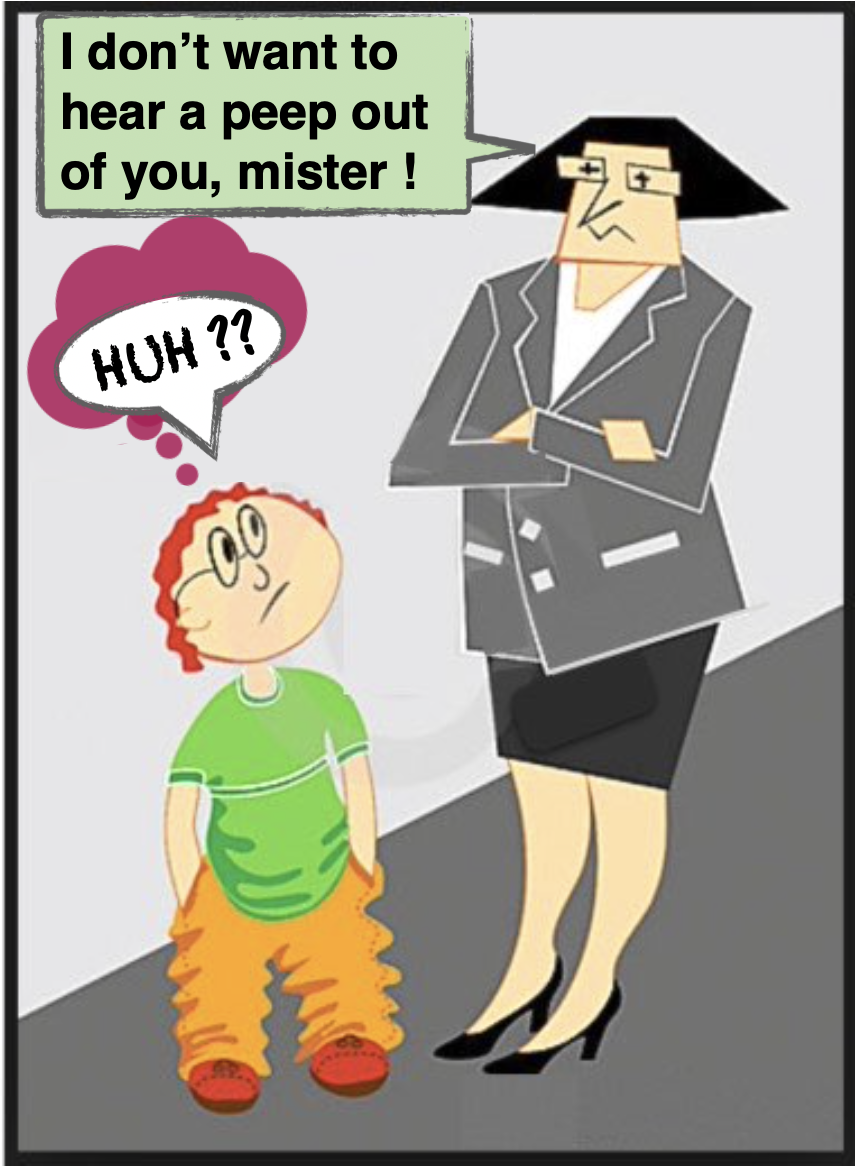
  As young, vulnerable beings every one of us had legitimate needs that were supposed to be met by caretakers, in order to flourish. Instead, many of us kept getting the message that our need were annoying, overwhelming, unacceptable, even ‘evil’. But since normal human requirements don’t go away, we had to find other ways to try to supply them.
As a result Co-deps & Passive-aggressives (P-As) interact with others from the False Self, both styles trying to get our disavowed needs met indirectly, while hiding fear & rage from early abandonment.
AND we also adopt these styles in an unconscious effort to ‘protect’ others from the WIC’s rage, which is murderous.

A fundamental human need is for connection, but unfortunately angry-niceness, in any form, prevents that very thing, keeping us from fulfilling our needs, wants & dreams.
Sadly, ACoAs tend to surround ourself & stay in relationships with un-recovering addicts & other narcissists – who take their damage out on us.

NOTE the difference between needs & obligations:
a. NEEDS are qualities, necessities & situations that are universal – see Maslow’s pyramid. There are also needs specific to you, based on your unique personality (using EnneaType, Myers-Briggs Type, Signs, Numbers, Learning Style, heredity…..)

b. OBLIGATIONS are activities that relate to functioning in the world as older children (homework, chores….) and as adults. People tend to say “I need to do the laundry, to get to work, to call my doctor, to finish this project, to do my taxes, to walk the dog….”. These are important but not your personality needs.


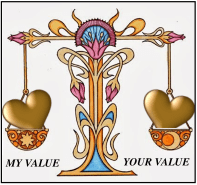
1. Co-Dependent version : one of their Toxic Rules is : “Everyone else’s needs are more important than mine (always)”. The obvious implication is that we should not have any needs of our own.
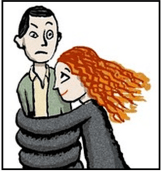
So co-deps focus all our energy on tasks & obligations, as if we could earn our way to heaven – the heaven of our family’s love! We take on too much – of everything – & then pile on the tasks of others as well, trying to do it all without help! No wonder we get sick, feel depressed, overwhelmed & angry!

2.  Passive-Aggressive version : one of the P-As’ toxic rules is “The world is a dangerous, dog-eat-dog place” so we have to protect ourself at all costs, hiding how angry we really are. P-As find it hard to take care of basic maintenance self-care tasks, or to honor outside obligations, like doing work they’re being paid to do. They show anger indirectly by stonewalling, or “forgetting”. It’s the WIC saying – not just “I don’t wanna” – but flat-out “I won’t! & you can’t make me! You don’t care about me so I don’t care either”, but we’re still waiting for magic. 

As adults we’re afraid to honor the need to set boundaries, & afraid to admit the need to be treated – at the very least – with respect, much less kindness. Asking directly for better responses from others is very hard for us, because WE :
• have been trained to not deserve better, so we think it’s selfish
• keep asking the wrong people when we do try
• refuse to admit the obvious — that unhealthy, narcissistic people only care about themself, don’t want to change, might retaliate in some form…..
• are convinced heathy people will ignore us !

Even so, we need to ask!  but from our ADULT, not from the WIC.
We may get some false promises from them, but even if you get thrown an occasional crumb, don’t let that keep you on their hook! It’s much better to stop chasing,.gather your resolve, back away & temporarily suffer crumb-withdrawal!

While most un-recovered people truly do not have the capacity to provide emotional connection (compassion, empathy, understanding, love….), we can still clearly state how we want them to behave toward us, ★ which is about actions, not emotions (T.E.A.). Otherwise, we end up feeling more & more confused, frustrated & hopeless, wondering why all our efforts aren’t paying off.
Speaking up from our True Self also benefits our Inner Child – no matter what the response is from others ! 

NEXT :

Co-Dependent Anger-Niceness (Part 1)

too niceWHY DON’T PEOPLE APPRECIATE
how hard I work at pleasing them??

PREVIOUS: Symptoms of Angry-niceness – toward others

SITE: Being too nice – dangers in 4 areas of life

QUOTE: ” A person cannot truly be free without self-reflecting” — Hegel

POWER ISSUES
All dysfunctional thinking & behavior grows out of our personality interacting with the unhealthy parenting we were originally stuck with.

Co-dependence (‘Roles & Co-dep’ and ‘Anger & C0-dep’ posts) begins in early childhood, & rarely if ever diminishes on its own. Instead, without Recovery, it usually gets progressively more exaggerated & painful. It’s most often set up by a dominant-submissive family pattern. Only the parent(s) or other caretakers were allowed to have any power – over everything – what you did, what you thought, what you felt, what you wore….. & all the things you were not allowed.
When children’s PMES needs & emotions are ignored & punished, they grow up without knowing who they are, what their rights are & with the assumption they are not allowed to exercise personal power. (Our Rights).

Power is not a dirty word or an evil concept. It is only a negative when used to force others to do what we want, since that means it’s without their consent & against their will. (Rescuing vs. Healthy Helping)
Internal, genuine personal power is essential for healthy functioning. This is what’s missing or very weak in all secretly-angry people.
 ❤️
 Being thoughtful & kind to others, needing companionship, or even going out of our way to be helpful is NOT automatically co-dependence. Motivation is what counts. (Deserving vs. Rights)

USES: The seemingly contradictory reasons for people-pleasing is the 2-sided coin of being afraid of independence & at the same time of being dependent. Some people are more terrified of one than the other – consciously – but the 2 are so deeply connected, they both contribute to ‘over-niceness’ as a way of feeling ‘safe’. (Boundaries & ACoAs #3, re. Stayers & Leavers)fear of enmeshment

1. Fear of abandonment (FoA) (Separation) : We always feel like outsiders, longing to belong. Being over-nice is supposed to keep people attached to us, but is counter-productive since they never get to know our whole self, not just our wound-flaws but also our true beauty.

fear of abandonment2. Fear of enmeshment (FoE) (Symbiosis): We’ve been hurt & betrayed too many time, & suffocated by a needy parent. Well, we’re nobody’s fool – we’ll just stay behind our wall!
Being over-nice is supposed to prevent others from crossing our boundaries to the point of strangulation, but instead it just covers a layer of ice, creating PMES starvation. That’s because we don’t actually have boundaries, so have to use artificial protection.  (Insecure Attachment styles)

SELF-CENTERED?
If asked, most Co-dependents would swear they’re giving, caring, selfless creatures. Their True Self may be all those things & more, but Co-dependent Angry-niceness is a defense mechanism, & the motivation for all those ‘helpful’ ways actually comes from the desperate needs of the WIC to shut up the PP in our head! Not to mention that under all that sweetness lurks a volcano, dormant but deadly.(‘Rescuing)

• We’re told that we can’t love others until we love ourselves. But we were taught that’s selfish & that we don’t deserve it anyway
• We’re supposed to stop only thinking of ourselves & consider other people’s point of view – but isn’t that what we’re already doing???

So, which is it? Me or them? Selfish or self-less? Well, it both because Mental Health is always about balance (20 characteristics).

3 Forms of Selfishness (S)
a. Neutral when we do anything good for ourself, & it doesn’t involve anyone else
b. Bad – when we do interact with another in a way that seems to only benefit us, AND hurts the other – which can backfire.
c
. Good
– when we do something that we like/ love/ want – with someone else, who also benefits. (MORE… )

SO? In recovery our P-P / Co-dep hopefully diminishes, but any acting it out is the BAD kind of Selfish, because – no matter how much we con ourselves, aware or not – the wounded part of us is only interested in manipulate others into providing needs we didn’t get at home, & that we don’t believe we can provide for ourselves.

NEXT: Co-Dep angry-nice, #2

Secretly Angry “Nice” People (Intro-b)

I CAN NEVER LET GO 
no matter how bad it is!

PREVIOUS: Intro-a

SITE:You’re Not Allowed To Have Feelings” (in our culture)


UNHEALTHY ‘Nice’ People have low self-esteem. They are: EITHER co-dependent (Co-dep): over-doing for everyone else, rescuing, self-sacrificing, the ‘good’ one, always ‘up’
OR passive-aggressive (P-A): resistant, obstructive, deliberately forgetful, plotting, ‘innocent’, pretend-incompetent

When we go thru something difficult or painful, and haven’t learned appropriate ways to cope with the Es that come up (usually fear, &/or anger), we’re either not aware of them at all, or dismiss what we’re feeling & find ways to distract ourself. This stifling is a continuation of how we tried to protect ourself as kids because we kept being punished for expressing those Es. Now it just keeps us stuck in our own emotional mud.

Aggressive Anger is obvious – shown as verbal threats, screaming, physical blows, breaking / destroying objects or property…. The consequences are usually harmful to someone or something.

Hidden Anger, on the other hand, is subtle & manipulative (Co-dep or P-A), but also comes with its own risks & negative outcomes. Behaviors can be so indirect, often not related to anything that’s currently happening, that others either can’t easily catch on, or will be puzzled by it. Angry-nice people may seem like victims but are actually perpetrators, acting out their hidden rage in ways that insure they can keep denying it, keeping their ‘good-guy’ status.

🔸 If the anger is so deeply suppressed that it’s now unconscious, the person will not be able to acknowledge that certain actions or non-actions are a sign of being ‘triggered’ (hurt, scared, frustrated)
🔹 If the anger is conscious but concealed, then the unhealthy patterns are deliberate, & may be vindictive : planned to sneakily annoy, hurt or destroy someone they blame for their own shame or guilt.

Either way, ignoring our anger cuts us off from a vitality that could give us the power to forge ahead on our own behalf, leavings us feeling powerless.
Yet many ‘nice’ people are so dedicated to their carefully constructed facade of ‘OK-ness’, they refuse to feel their anger directly & deal with situations that caused it. This prevents any resolution or growth.

ACoAs

For those of us who suffered a great deal of PMES abuse by our family, it’s only natural to have built up a backlog of anger towards drunk, raging, selfish parents, abusive siblings & unsupportive relatives.  As kids we gradually suppressed some or all of that anger (A.) & rage (as well as other painful Es), for 3 major reasons:
1. We were humiliated & abused if we had the nerve to get visibly angry at adults
2. It was (& may still be) too overwhelming to consciously face that our parents truly were/are unsafe, cruel, crazy, addicted, neglectful….
3. We were afraid that our anger would literally harm them – because  children think their emotions have magical powers to injure or kill others
(BOOK:So the Witch Won’t Eat Me“, Dorothy Block. Intro explains it)

Shutting down on painful Es was self-protection.
If we had to severely stifle our anger, it was because our parents (see ‘ACoAs & Anger‘ post) :
— believed it was disrespectful or a ‘sin’ to be A.
— didn’t know how to deal with strong Es
— didn’t want us A. at them (their Co-dep & FoA)
— only they were allowed to be A.
— refused to be held accountable for what was hurting & therefore making us A.
— wanted to look ‘good’ to everyone else
— they were too weak, sick, ‘delicate’ to bear having us challenge / disobey them
— they weren’t allowed to feel their own A.

Sadly, most of us were taught to not have any Emotions. For some of us – being sad / crying was punished, made fun of, ignored, while for others – & our anger was the biggest no-no. So now many of us either refuse to acknowledge that we do indeed get angry, or are so shut down that we actually believe we never are.
 Instead, we may recognize experiencing some of the following, which are all versions of ANGER:
annoyed, blaming, cranky, impatient, irritated, jealous, ‘justified’, outraged, resentful, self-blaming, over-reaction to being treated unjustly / unfairly, ‘touchy’, vindictive…

NEXT: Intro-c

Secretly Angry “Nice” People (Intro-a)

secretly nice -1I ALWAYS HAVE TO ACT NICE
to hide how angry I really am

PREVIOUS: Multiple Intelligences #3e

POST: What about Anger?”


REVIEW
Our culture does not support, tolerate or excuse expressing anger in obvious ways – except when participating in or watching sports, or being drunk! Oh right, the BIRDS can be angry – but not humans! One reason is that most people assume there’s only one way to let it out – explosively, dangerously – which of course scares other people, since it can be physically & emotionally unsafe.
But it’s not the only way (“Ways to react” posts).

Since everyone was born with the ability to feel anger (A.), just as we have the natural capacity to experience all the other Es – in varying degrees – each of us figures out how to deal with it, based on our personal tendencies & what we copied or learned as kids.

BTW : The Enneagram triad GUT numbers▼ related to Anger are #8, 9 & 1, Each expresses anger & aggression in a nuanced way :
#8 – it’s externalized, acting automatically, & when pushed – reacts blindingly fast
— angry 8s will think in caricatures or temporarily blank out (9 levels)
#9 – repress A., processing it unconsciously, ignore it by idealizing everything
— repressed 9s tend to get mentally fuzzy, or go into long ramblings (9 levels)
#1- use the superego to represses it, then it comes out as being righteous
— compulsive 1s tends to think only in black & white (9 levels)

In our society, A. is usually called a ‘negative’* emotion – even by the best regarded teachers, writers & therapists. This is wrong!
This misnomer comes from NOT separating the TEA components:
❤️ The Emotion itself (physical energy & information about our environment), vs.
💀 the way we frame it in our Thinking (acceptable or unacceptable), vs.
✍🏽 how we Act on it – Positively or Negatively.

*The EMOTION of Anger itself should never be designated as a negative! It is not only blatantly inaccurate to do so, but does it a great injustice – because A. gives vital information about bad things happening to us or around us. NO emotion is negative, only harmful thoughts & actions are! Anger is a necessary & appropriate reaction to 3 main things:
✔︎ being scared, being frustrated & being hurt (such as threatened, ignored, disrespected….). (see T.E.A. // ‘Feelings aren’t facts’ )

★ And anger is a healthy response to any abuse & deprivation of very real needs (attention, safety, respect, love, freedom, encouragement, comfort….)

Normally, Anger can be:
• an immediate response to a particular situation, or
• gradually built up from a series of real or perceived injustices or threats, or
• a slow escalation from long-term abuse, neglect, or being treated unfairly

Emotionally HEALTHY Nice People have good self-esteem. They are:
• direct, clear & positive in communication & behavior
• happy, self-assured, assertive, confident, relaxed, easy
• well-behaved, socially appropriate, well-mannered, generous
• thoughtful, helpful, kind, loyal, respectful, sensitive to others

But when someone doesn’t have any safe outlet for their anger, it will go underground. It becomes a part of our ‘Shadow“,  (aspects of ourselves we find unacceptable) so we reject & push the anger into the unconscious.
However, the emotion never goes away on its own – until it’s expressed in safe ways and by fixing the causes, if possible. Instead, it stays locked in our muscles, ligaments, organs & auras. (See ‘Symptoms)
Over time, this trapped energy will become too big to be contained & will end up coming out sideways!

Freud once likened anger to the smoke in an old-fashioned wood-burning stove: Normally, the smoke goes up the chimney, safely away. But if this is blocked up, the smoke will leak out – thru the grate, under the door, thru the vents…. choking everyone in the house. It needs to be cleaned out. But if all avenues of escape stay blocked, the fire will eventually go out, making the stove useless.

In the same way, blocking up the natural flow of our anger-energy becomes harmful to self and others. If we shut it down for too long, it puts out our internal fire, & makes us ineffective. We need a safe outlet for all emotions.

NEXT: Secretly angry nice people (Intro-b)

MULTIPLE Intelligences – Spiritual (Part 6)

Spiritual growthTHE DEEPER MY INSIGHT,
the more I connect with the universal

PREVIOUS: M.I. (Part 5)

SITE: Gardner’s M.I. apps for iPads

See ACRONYM page for abbrev.


MULTIPLE INTELLIGENCES (cont)
8. SPACIAL/VISUAL (picture-smart)

9. SPIRITUAL / EXISTENTIAL (spirit-smart) – seeing the big picture. Likely a whole-brain function, which is increased by prayer & meditation, because they lessen the blood flow to the parietal lobes, which normally gives us a sense of time & space.

This group is concerned with the morals, ethics & values of life, looking for real-world understanding, & the application of new learning. They have the sensitivity & capacity to tackle deep questions about human existence, such as the meaning of life, how did we get here, what’s our purpose, & why do we die. They’re not afraid to look into the depths of truth to find hidden answers, & to think of other possibilities.

Being particularly introspective, aware of their own existence, they’re drawn to exploring existential & philosophical questions, including what may lie beyond death. Even as ‘every-day’ people, they have deep thoughts. They understand their role in others’ lives, and how they play a small but important part of the whole game. They are in constant search for their purpose of living.
SPIRITUALThey:
— are sensitive to different cultural environments
— are “universalistic”, value truth & justice
— enjoy discussing questions @ life & death
— learn new things better when it’s value is known
— more tolerant  & respectful of diversity
— relaxation or meditation exercises are rewarding
— religion or spirituality is important to them
— see their role in the ‘big picture’ of things
— seem “wise beyond their years”, peaceful
— want to make a difference in the world

For centuries philosophers have been debating the nature of human intelligence. We are different from the other animals, but why? Do we have a soul? Is there some sort of duality between the corporeal flesh and the mind or spirit? Did we acquire our unique capacity for rational thought and all that goes with it as a result of some special act of creation or did it just happen as a result of evolution through natural selection?

Dr. Gardner divided this category into:
Existential Intelligence
— an ability to intuitively sense & gather clues from the environment (PPT = people, places, things), contributing to the whole picture
— the ability to pick up energies & have access to information without actually being able explain exactly why or how we know these things
— concerned with ultimate issues, the larger spiritual concerns of life

Moral-Ethical Intelligence
— an innate sense of morality, not necessarily associated with religion, but as a statement about the kind of personality, individuality, will, and/or character that a person has developed
— focused on the highest realization of human nature.

VIRTUES8 virtues
Conscience – know the right, decent way to act, & act that way
Empathy – identify with & feel other people’s concerns
Fairness – choose to be open-minded, & act in a just way
Kindness – show concern for the welfare & feelings of others
Respect – value others by treating them in a courteous, considerate way
Self-control – regulate thoughts & actions , to stop internal pressure & external reactions & act in the right way
Tolerance – respect everyone’s dignity & rights, even if they have beliefs & behaviors we disagree with

CAREERS : life coach, cosmologist, prophet, philosopher, religious teacher, poet
INCREASE ability : make connections between book-learning & the world outside, see the big picture, look at every issue from different points of view, relate specific topics with national & global concerns

TECH ideas: Google earth, Discovery Education, Podcasts, GarageBand, Powerpoint, Keynote
FAMOUS Peopl e: Jesus, Aristotle, Plato, Socrates, Martin Heidegger, Buddha, St. Augustine, Wayne Dyer.

BOOK: “Ethical Intelligenceby Bruce Weinstein, PhD   // REVIEW  //  QUIZ

* * * * * * * * * * *
WORK: There’s a natural correlation between the M.I. categories of human learning
& the knowledge & skills needed for 21st century workplace productivity.  This CHART shows the way each mental style contributes it’s specialty to modern-day tasks.
«wok & M.I.s

«
NEXT : Comment on ACRONYMS

MULTIPLE Intelligences – Nature (Part 5)

nature loversI LOVE OPEN SPACES
inside & outside!

PREVIOUS: Multiple intelligences (Part 4)

SITE: “The Heart’s Code – tapping the wisdom & power of our hear energy”
~ Paul P. Pearsall


MULTIPLE INTELLIGENCES
(cont)
6. MUSICAL/RHYTHMIC (musical-smart)

7. NATURALIST (nature-smart) – respond to the natural environment.
This group is sensitive to all living things (plants, animals) & other features of the natural world (clouds, rock formations, minerals) – due to a highly developed sensory perception. This ability was clearly of value in our historical past as hunters-gatherers & farmers, and continues into today for chefs, horticulturists, scientists….. Also used by consumers to make choices from the overwhelming variety of brands in the marketplace.

As young people they enjoy shows & stories about animals or natural phenomena. May show a strong interest in astronomy, biology, botany, geology, meteorology, paleontology or zoology. They feel most alive when in contact with nature, & so are interested in exploring, nurturing & preserving the environment.

The repetition & boredom of office, factory & other workplaces can stifle creative thinking. This is because the brain-area that stores routines / patterns based on daily activities (basal ganglia) does not encourage new thinking. To give imagination a boost, we can tap into our latent Naturalistic I. whenever /wherever possible – like sometimes going barefoot . Nature helps stir insights & connections, to nurture our mind & encourage sensory awareness!
They:
NATURALIST— are bothered by pollution, sensitive to weather
— automatically categorize or collect things
— collect natural things (rocks, feathers, shells….)
— enjoy studying plant parts & reading about nature
— have a green thumb, garden, photograph landscapes
— highly aware of surrounding, even subtle changes
— keep notebooks, dry flowers, create specimens
— like to learn names of all kinds of living things
— like to play in/live by water, be in the wilderness
— love walks in the woods, follow animal footprints
— passionate about animals, pets, zoos
— prefer being in nature preserves, parks, forests

ENJOY: being outdoors & with animals
LEARN: By using the senses, watching animal behavior, experiencing, identifying & recording ecological principles
TOOLS: binoculars, magnifying glass, microscopes, telescopes

CAREERS: Scientist, ecologist, animal trainer, farmer, traditional medicine man using herbal remedies (MORE….)
INCREASE ability : be in the great outdoors: plant a seed, volunteer at an animal shelter, take a walk with a naturalist, read about animal classifications . Study relationships in the natural world, compare/contrast groups or make connections to real life issues

TECH ideas: Discovery Education, online encyclopedias, Google earth, virtual explorations, iMovie, digital cameras, iPods, video cameras
FAMOUS People: Charles Darwin, John Muir, George Washington Carver, Rachel Carson, J.J. Audubon, Jacques Cousteau

* * * * * * * * * * * *
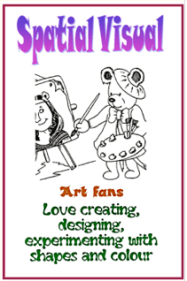
8. SPACIAL/VISUAL (picture-smart) – think in images & pictures.
This group has the ability to think in 3 dimensions – imagine, understand & represent the visual-spatial world. They can orient themselves in their environment with either vision or touch, navigate the world as well as determine the perspective of others.

As young adults they may be fascinated with mazes, jigsaw puzzles, or spend free time drawing or daydreaming. Compared to Auditory-Sequential learners, they tend to be late-bloomers.
Core capacities include mental imagery, spatial reasoning, image manipulation, graphic and artistic skills & an active imagination.  EXP: know exactly how furniture will fit into a room without measuring, or buy a scarf that beautifully matches/complements the blue in a blouse you have at home (perfect “chromatic pitch”).
Includes street smarts & common sense, by making decisions based on matching a variety of situations & contexts. This requires learning & remembering almost simultaneously (fluid & crystalline), possible because of a switchboard in the brain.
SPACIAL : VISUALThey:
— build interesting 3-dimensional objects
— can rotate, transform & otherwise manipulate objects
— daydream, imagine & pretend more than others
— enjoy art & other visual activities
— good at formulating hypotheses
— have good hand-eye coordination
— like machines, drawing figures
— need to doodle or draw
— notice details, good with maps & directions
— prefer geometry over algebra

ENJOY: art, designing, drawing, imagination games, illustrated books, movies, puzzles, trips to art galleries / museums, visualizing
LEARN: visually & by organizing ideas spatially, verbal & physical imagery. Need to see concepts in action to understand them.
TOOLS: charts, 3-D modeling, drawings, graphics, photographs, TV/ video, multimedia

CAREERS: architect, film director, chess player, painter, pilot, sailor, sculptor (MORE…)
INCREASE ability: change main color of work or home environment, be a backseat driver & provide directions for a trip, fit groceries in back of car, do jigsaw puzzles & mazes, sculpt clay, play chess. Capture ideas on video. Take an architecture course. Use PechaKucha to stimulate & challenge (embraced by all types of designers)

TECH ideas: Kid Pix, Draw and paint programs, Excel, Create A Graph, United Streaming, Visual brainstorming, organizational tools, charting, diagramming, bubbl.us, gliffy, YouTube, Discovery Education, Comic Life, Quicktime, add music to presentations and movies, Podcasts, iPhoto, Photo Booth, Read Write Think: timeline

FAMOUS People: Winston Churchill, Einstein, Picasso, Stanley Kubrick, Anatoly Karpov (chess master), Georgia O’Keefe

NEXT: Multiple intelligences (Part 6)

MULTIPLE Intelligences – Logic (Part 4)

music / mathI’M GOOD AT CALCULATING
the odds & ‘hearing’ patterns!

PREVIOUS:

 Multiple Is (Part 3)

SITE:World needs all kinds of music
~ TED talk by Temple Grandin

See ACRONYM page for abbrev.

MULTIPLE INTELLIGENCES (cont)
4. LINGUISTIC (word-smart)

5. LOGICAL-MATHEMATICAL (number/ reasoning-smart) – learn by reasoning things through.
This group has the ability to look for patterns, making connections between many & diverse pieces of information. They can then calculate & quantify that info to carry out complex mathematical operations, & create hypotheses or propositions. To foster creative problem solving they analyze, predict & manipulate real-world models.

They ask lots of questions, are always curious about natural events & the world around them, like to carry out studies & can handle long chains of reasoning to predict ‘local progressions’ (an increase in something). As young adults they’re drawn to arithmetic problems, strategy games & experiments. This is a less commonly seen Intelligence – since not everyone is automatically good at math, or they don’t give themselves the chance to develop their math-reasoning potential.
They:
math / logic — are better at budgeting, balancing the checkbook
— can reason their way into winning every argument
— comfortable w/ numbers, logic, reasoning, abstractions
— enjoy putting things in order, creating schedules
— generate and use abstract thoughts
— get frustrated by disorganization
— have a sense of cause & effect
— like reading about scientific discoveries
— like to solve mysteries & ask cosmic questions
— try to find logical solutions to problems
— use inductive & deductive logic
— use sequential reasoning skills
— usually good with computers & lots of gadgets
— will try to figure out how broken things work or untangle messes

ENJOY: calculating, experimenting, logic puzzles, questioning, science museums, things to explore and think about
LEARN: through logic games, investigations, mysteries. Need to learn & form broad concepts before dealing with details
TOOLS: pencil/paper, computers

CAREERS: accountant, programmer, detective, engineer, mathematician, researcher /scientist (MORE….)
INCREASE ability: books of logic games, knit a sweater, watch a video movie & stop it to predict what will happen. Learn computer programming languages, try critical-thinking activities, linear outlining, Piaget’s cognitive stretching exercises, science-fiction scenarios, logic puzzles. Article: “Your brain on numbers

TECH ideas: Excel, Numbers, Logo, create a survey with Survey Monkey
FAMOUS People: Albert Einstein, Niels Bohr, John Dewey, Stephen Hawking,
Leonhard Euler, Alan Turing (WWII computer genius)

* * * * * * * * * * * * * *
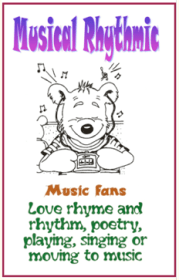
6. MUSICAL/RHYTHMIC (musical-smart) – think in rhythms & melodies.
This group can recognize, reflect on, create & reproduce music. It’s the capacity to discern pitch, rhythm, timbre & tone. As young adults they’re usually singing or drumming to themselves, very aware of sounds others may miss.
There’s a connection between music and emotions, & between music and math – which share thinking processes. Playing, singing, dancing or even listening to music can help the brain form or combine ideas in new ways.
Moving to music is beneficial, since music moves brain waves. At Karaoke, our brain anticipates songs on CD we’ve chosen, so “excitatory signals pass from the prefrontal cortex to the premotor cortex, preparing the body to act”.

Playing an instrument improves associative thinking, helping to choose our actions from a variety of options – which requires accessing stored info about a great many ‘sequences’ of activities (crystalline – Part 1a), allowing us to predict possible outcomes.
Music can be used to improve work productivity or change our mood – any time. Interestingly, some rhythms trigger brain enzymes to give an amazing feeling of well-being. Other tunes leave us punchy, unable to focus. (Different types of music produce.….)
They:MUSIC:Rhythm
— can read music, play a variety of instruments
— can tell if music is off-key or ‘off’ in other ways
— can naturally figure out how to play a tune on an instrument
— easily remember scores & melodies
— enjoy & respond to many types of music
— know the structure of songs to symphonies
— like to hum or sing when on their own
— may study better with music in the background
— more effected by noise & sound than others
— remembers info better if in rhyme or rhythm
— use all the sense to identify musical patterns

ENJOY: humming, listening, singing, tapping hands & feet, whistling
LEARN: by turning lessons into lyrics, speaking rhythmicall.
TOOLS: musical instruments, musical scores, multimedia

CAREERS: audio recording, disc jockey, composer, conductor, musical performer, (MORE….)
INCREASE ability: attend concerts, play an instrument, hum melodies, sing to iPod or with others. Listen to a wide variety of music, be quiet & listen to all sounds everywhere

TECH ideas: iMovie, GarageBand, Audacity, iTunes, iPod, Media Player
FAMOUS People: Beethoven, Mozart, Stevie Wonder, Joni Mitchell, Louis Armstrong, Senegalese musician Youssou N’dour, Yo-Yo Ma

NEXT: Multiple intelligences (Part 5)

MULTIPLE Intelligences – Self (Part 3)

liguistic / aloneTHE BETTER I KNOW MYSELF
the happier I am & so get along

PREVIOUS: Multiple intelligences (#2)


SITEs: M.I. TESTS
Which I. is your dominant one?

NOTE: See ACRONYM page for abbrev.


MULTIPLE INTELLIGENCES
(cont)
2. INTER-PERSONAL (people-smart)

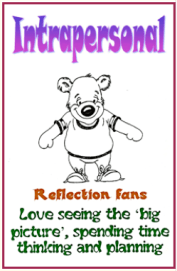
3. INTRA-PERSONAL (self-smart) – learn by thinking alone
This group has the capacity to understand themselves – their thoughts & feelings – & use that knowledge plan & guide their life. It’s an internal version of the external Inter-personal style – the ability to be self-aware, explore emotions, goals & motivations, but which also requires a wider understanding of the human condition. Sometimes called ‘learned common sense’, because these people intuitively cultivate their values & learn from ‘teachable’ moments. Even as young adults they are self-motivated, tend to be shy & very aware of their emotions.

NOTE: To fully express this style all the intelligences have to be tapped into & woven together. Self-growth activities build more dendrite brain cells for this Intelligence – the brain being rewired at night as we sleep on what we’ve done during the day
They:
INTRA-P— are highly aware of their strengths & weaknesses
— can ‘show the way’ to deeper awareness by EXP
— do well when left alone, don’t like crowds
— have a strong will, opinions & confidence
— have intuition, drive, self-reliance, wisdom
–‘march to the beat of a different drummer’
— often keep a journal, being in tune with Inner Self
— see the world realistically, not idealistically
— think a lot & deeply, are good at analyzing things
— try to understand their own interests & goals
— work on unraveling dreams, relationships with others

ENJOY: being quiet/ time alone, dreaming, having choices, meditating, planning, self-paced projects, setting goals
LEARN: through study & introspection – the most independent type
TOOLS: books, creative materials, diaries, privacy, time

CAREERS: writer, psychologist, spiritual leader, philosopher (MORE….)
INCREASE ability: to “know thyself” – take personality tests, ask an expert re. things you wonder about. Give a talk to an new audience about self-improvement, or strategies for accomplishing a task. Work on conquering a problem & a keeping a record of growth. Reward yourself when you’ve reached a goal.

TECH ideas:
Tutorials, Bubbl.us, slide shows with Powerpoint or Keynote, collaborative Wiki or Blog, Wikispaces, Blogger, Inspiration
FAMOUS People: Jean Paul Sartre, Frederick Douglas, Helen Keller, Malcolm X, Emily Dickinson, Dalai Lama, Mother Theresa

Emotional (EQ), (heart-smart) – learn thru emotions.
Fits into Walter McKenzie’sIntrospective learning’ profile, considered part of both the Intra- and Inter-personal styles. RULE: Any event that generates strong emotion is more likely to be remembered.
If pleasurable, we want to repeat it physically, or by mentally reliving the atmosphere, context, people involved, what was said….
If unpleasant or painful, emotional memory will prefer to skip all information related to it. BUT if the harmful events are repeated too often – especially in childhood – we become unconsciously addicted to repeating it.

* * * * * * * * * * * * * * * * * *
4. LINGUISTIC (word-smart) – learn by thinking in words.
This group has the ability to use language to form & express complex ideas. It is the most widely shared human competence – allowing us to make ourselves understood. Traditionally, Linguistic & Logical Is have been highly valued in educational environments. Young adults with this I. enjoy writing, reading, telling stories or doing crossword puzzles.
They:LANGUAGE
— appreciate puns, tongue twisters, nonsense rhymes
— are aware of others’ moods & motivations
— are generally elegant speakers
— are great at storytelling, explaining
— are natural leaders, good at organizing people
— can convince others of their point of view
— can learn languages, grammar & syntax
— enjoy listening to the spoken word
— good memory for names, events, situations
— good with body language, speaking and acting
— have highly developed auditory skills
— think in words rather than pictures

ENJOY: dialogue, debate, reading, telling stories, writing, word games
LEARN: by saying & seeing words, reading & discussing books
TOOLS: books, computers, games, classes, multimedia, tape recorders

CAREERS: author, comedian, journalist, lawyer, poet, politician, speaker, teacher, translator (MORE….)
INCREASE ability: learn a new language, expand vocabulary, create metaphors (making the strange familiar & the familiar strange), do interviews, talk to strangers. Read “On Writing Well”, & to help with word flow – avoid editing as you write. (MORE…..)

TECH ideas
: PowerPoint, Pages, Podcasts, GarageBand, Audacity, Skype, ThinkQuest, Wikispaces, photo editing software, Text to Speech, VoiceThread, Blogger, Digital books, Storytelling, Zoom
FAMOUS People: Shakespeare, T.S. Elliot, Maya Angelou, Martin Luther King Jr., Agatha Christie, Hemingway, Robin Williams

NEXT: M.I. (Part 4)

MULTIPLE Intelligences – Body (Part 2)

body / interpersonalI ALWAYS WONDERED
why I need to keep moving!

PREVIOUS: Multiple intelligences (Part 1b)

QUOTE: “It’s not how smart you are, it’s how you are smart” – Howard Gardner, 1993

REMINDER: See Acronym page for abbrev.

BEAR images from “MargD Teaching Posters”


MULTIPLE INTELLIGENCES (Howard Gardner)
1. BODILY-KINESTHETIC (body-smart) – learn by moving.
These people process information through physical sensations. Most have the ability to stay graceful & coordinated when using a range of action skills or manipulating objects – unless they have ADD, a physical injury &/or childhood trauma still locked in the body
All emotional responses are rooted in finely tuned body-awareness. EXP – After seeing something intense, they may say: “It was gut wrenching, stomachs turning, heart pounding, took my breath away, I was shaken….
They:
kenesthetic
— can mimic easily & well, good sense of ‘timing’
— can train responses to become like reflexes
— communicate emotion through body language
— don’t like to sit still for too long
— have nearly faultless mind-body coordination
— excellent use of space, have great balance
— good with sports and movement
— need to manipulate & handle objects, build things
— often talk with their hands, clown around in class
— prefer hands-on experimentation
— use their hands & whole body when talking

ENJOY: building, dancing, drama, gesturing, running, touching
LEARN: thru physical activity (doing, tasting, making ‘messes’), acting out situations, role-playing
TOOLS: equipment and real objects

CAREERS: athlete, builder, craftsperson, dancer, fire-fighter, gym teacher, surgeon (More..)
INCREASE ability: do yoga, make crafts or build, ride a bike, dance, learn tai chi or any sport, the wave dance, walking tours / hikes, swimming

TECH ideas: Notetaker, navigating through software, WII, iPod Touch, Keyboarding, making video documentaries with iMovie, video or still cameras, record voice & sounds
VALUE of movement: Studies confirms that exercise can reverse age-related decline in the production of neural stem cells in the hippocampus of the mouse brain. Exercise restores a brain chemical which promotes the production & maturation of new stem cells.

FAMOUS People: Gene Kelly, James Brown, Michael Jordan, Martina Navratilova, Jim Carrey, Marcel Marceau
* * * * * * * * * * * * * * * * * *

2. INTER-PERSONAL (people-smart) – learn by talking with others.
These people are able to get along superbly with others, even as young adults, & are often leaders among their peers. They can see things from another’s point of view, so can understand how they think & feel. Knowing what makes people ‘tick’ can be used to their advantage, such as manipulating to get their own way. But most are considerate & genuinely care about others. They can range from party animals, to fighting for the the underdog, to being indecisive for fear of offending
They:INTRApersonal
— understand & interact well with others
— are effective both verbally & non-verbally
— aware of moods & motivations in others
— can see through dishonesty
— enjoy deep conversations, can build trust
— generally try to keep peace in groups & encourage co-operation
— good at organizing & conflict-resolution
— good listeners, can read body language
— hate injustice, have empathy for others
— hurt when others hurt, will reach out to comfort
— make good leaders, have many friends

ENJOY: community events, clubs, group games, having friends, leading, maneuvering, organizing, relating, talking. Need mentors
LEARN: through dialogues, group activities, seminars.
TOOLS: audio or video conferencing, eMail, phone, time & attention from instructors, writing

CAREERS: celebrity, counselor, diplomat, educator, religious or political leader, salesperson (MORE….)
INCREASE ability : practice active listening by repeating back what you think someone said. Learn about personalities types from Myers-Briggs, Enneagram…. create “dopamine-rich salons,” collaborate by working with someone who has complementary skills, invite someone from another culture to your home

TECH ideas: Simulation games with chat, Skype, online collaboration, Wikispaces, Google Doc, Blogger, chat rooms, ThinkQuest, VoiceThread, Group Powerpoint or Keynote, slide share, Zoom
FAMOUS People: Gandhi, Ronald Reagan, Bill Clinton, Oprah, Clara Luper (cilvil rights leader), Haley Westenra (UNICF supporter), William Booth (Salvation Army founder)

NEXT: M.I. Part 3

MULTIPLE Intelligences – Intro (Part 1b)

9 styles of IntellI DIDN’T KNOW 
there was so many options

PREVIOUS:
 Multiple Intelligences (#1)

SITEs : Five New Minds for the New Year (Dec. 2012)
Your 12 types of Intelligence


Multiple Intelligences (M.I.) are mainly about our style of learning.
We may have a dominant one, a mixture, or use a different style for different situations. The most well-know ones are based on our senses (eyes, ears, gut, & less used are tongue & nose). Nor are they fixed – less dominant ones can be developed, & preferred ones enhanced.

• In the 1960‘s, Dr. Howard Gardner, a Harvard Professor of Cognition & Education, revolutionized our understanding of Intelligence (I.).
The inspiration for his theory of Multiple Intelligences (M.I.) came from his work with two distinct groups: stroke victims & children. “Both were clueing me into the same message : that the human mind is better thought of as a series of relatively separate faculties, with only loose & non-predictable relations with one another – rather than as a single, all-purpose machine that performs steadily at a certain horsepower, independent of content & context” (Theory development)

Dr. Gardner’s framework for M.I. offers a practical model for identifying the many paths to learning – regardless of content, skills or desired outcome. He believes that the current list is not exhaustive, & he’s added 7 to them since he first started.  I. is much more than IQ, because it requires useful action to be valid. “Intelligence is a bio-psychological potential to process information that can be activated in a cultural setting to solve problems, or create products that are of value in a culture”.

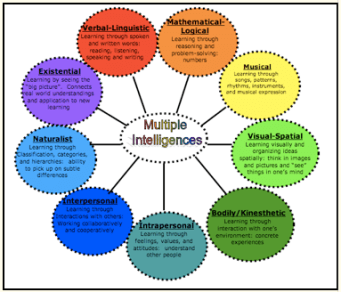
These 9 Is are expanded in future posts:
• Body /Kinesthetic: interacting with one’s environment
• Inter-personal I.: connecting with others
• Intra-personal I.: self-awareness, values & attitudes
Linguistic / Verbal: expression thru the spoken & written word
Logical / Mathematical : problem solving through reasoning
Naturalistic I.: classifying and categorizing data
Rhythmic I.: identifying and extending patterns
Spiritual / Existential: understanding beyond the senses
Visual / Spacial : the ability to see, envision & imagine
NOTE: Only Linguistic & Logical are measured by old-fashioned IQ tests.

• This list is a way to categorize how humans naturally become aware of, understand & process our environment. This helps us figure out where our weaknesses come from, but mainly they pinpoint natural strengths – seen in our preferred learning, behavior & work styles – so we can make the best use of inborn preferences. Sadly, from ignorance or necessity, many people are in jobs that go counter to those natural preferences.

EXP: A highly Body-Kinesthetic person may be stuck in a Logic desk-job, instead of being able to move around, such as a forest ranger, sports coach, physical therapist, gym teacher…..
— or a Visual / Artistic person in a Linguistic position, instead of being able to dance, paint, act….

• Although each of us can access all 9 styles, no two people have the same amount of each.
Some people are Mono-endowed, like being able to speak 4 languages – but takes them awhile to calculate a tip, OR someone who’s a whiz with numbers – but are awkward in conversations. If their single talent is honed & monetized, such people can become celebrated for incredible accomplishments
A few are at the other end of the spectrum, ‘Renaissance’ men or women who can cross-access several Intelligences, superior at almost everything they do
The rest of us have one or two dominant talents, which serve us well if we have the opportunity to freely express them

• Dr. Gardner tells us that I. involves problem solving – creating ‘products ’ (outcomes) when in a context-rich & natural setting. What many scientists used to think were just soft-skills, such as the Inter-/ Intra-personal ones, Gardener realized were actually types of Intelligences.
EXP: Being a math whiz gives the ability to quantify the world, but so does being people-smart, just from a different perspective. So someone with Intra-Personal talent may not be able to calculate the rate at which the universe is expanding, but will easily find someone who can!
The 9 types also provide a way to recognize & own potentials which many of us left behind in childhood (love for art, computers…), & can now take the opportunity to develop.

BOOSTING Intelligence
Since different areas of Is are related to each other, it’s possible to increase it in one area by developing another, because many problems can be dealt with in more than one way. learning options
— One third-grade teacher found her students’ scores on a math test (logic) nearly doubled after giving them training in visual (spatial) skills with a micro-computer program
— “Early music training (for 3-year olds) prepares young brains for spatial & abstract reasoning skills crucial to engineers, scientists & mathematicians.” ~ study from U of Cal. Irvine
— “An enriched environment that helps very young children develop each area of talent or intelligence is one of the best possible investments in their future” ~ Ron Fitzgerald, D.Ed.

NEXT: Multiple Intelligences (Part 3)