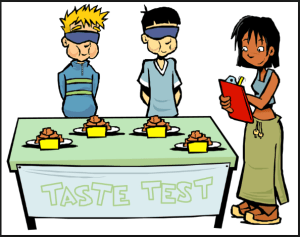
OUR SENSES & Learning – Taste (#4a)

taste testPREVIOUS: SMELL & TASTE (Part 4d)

SITE: Acetylcholine & Olfactory Perceptual Learning


GUSTATORY Learning
(Taste)
In some ways understanding taste is more complex than the other senses because even though taste, smell & sight are separate areas of the brain, they overlap significantly in how we experience things in our environment.

All our senses work together, but smell & taste are special partners. When we eat, our tongue gives us the taste & our nose the smell of food. Approximately 80–90% of what we perceive as ‘taste’ is in fact due to our sense of smell, so when the nose is congested, food tends to lose its taste.

Taste & smell are essential for survival, helping to identifying what’s edible & what’s toxic material. Together, these two neural-peripheral systems lets us identify flavors. They’re being used in the development of food, beverages & pharmaceuticals, to enhance or mask their tastes & smells.
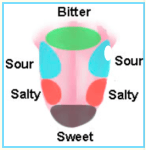
tongue tastes•The ancient Greeks believed that the 2 most basic tastes were sweet & bitter, but Aristotle (c. 350 BC) was one of the first to develop a list of others.
Ayurveda, an ancient Indian healing science, has its own tradition of basic tastes: sweet, salty, sour, pungent, bitter & astringent
•The Ancient Chinese regarded spiciness as a basic taste
• Now we know the mouth can distinguish sweet, salty, sour, bitter & umami (flavor of certain glutamates, described as savory, meaty or as broth), long known in Asian cooking, & which only recently has been found to have its own taste receptors.

Taste is produced when something put into the mouth reacts chemically with receptor cells on taste buds that are mainly on the tongue, but also in the roof of the mouth & near the pharynx. (BUDS)
The number of taste buds can vary greatly from person to person. Average is about 10,000, each one having about 1,000 taste cells, acting as receptors. In general, women have more than men, & as is the case of color blindness, some people are insensitive to some tastes.

smell process

People develop taste preferences based on what they are fed in early life. Giving children a chance to think about which tastes they do or don’t like encourages them to try new types and/or new combos of foods.

While our sense of taste & smell may seem less involved in learning, they are our oldest ones, built into the oldest structures of the brain, so are often more deeply ingrained & intact than the other, ‘newer’ senses.

Although most researchers assume that no one is a Gustatory Learner, those who do favor ‘taste’ as a way to express themselves tend to use words such as bitter, chocolate, minty, sour, spicy….

However, some do acknowledge the importance of this sense. The Forest School in a woodland setting (UK) have incorporate Gustatory & Olfactory education. They believe smells & tastes provide valuable links to learning & remembered experiences, much as Proust described how the taste of the madeleine biscuit evoked a string of memories.
Students of all ages & learning levels benefit from Forest School activities which require them to use these senses, such as having a drink & snack while key information or explanations are made on forest trips, & cooking on campfires which lend their own special flavor to the food. food choices
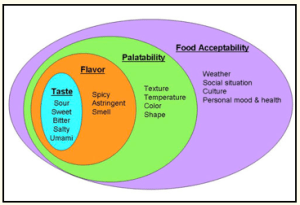
DIAGRAM: People use a wide variety of  factors to decide if something is acceptable to eat. These include types of flavor, like how spicy a food is, how it smells, its texture, temperature & whether it’s something they want to eat for personal, cultural or religious reasons.

The Monell Chemical Senses Center (PA) is the world’s only independent, non-profit scientific institute dedicated to basic research & publications on taste & smell. Their scientists come from many disciplines, working to understand the mechanisms & functions of taste & smell, to define the wider importance of these senses in human health & disease. They also conduct studies on chemesthesis – chemically induced skin sensations, such as the burn of capsaicin (in hot peppers) or the tingle of carbonation. Their experts are available to comment on how taste and olfaction relate to any aspect of our daily lives.

NEXT: Overview (Part 5)
OUR SENSES & Learning – Smell (#3b)

chef smelling soup

PREVIOUS: Olfactory Learners (#2d)

SITEs: The World Though our Senses

Learning Styles Affects How You Play GOLF


OLFACTORY Learning

According to Dr. Ira Greene, of “The Nose Knows: A Nasal-Based Curriculum Development Guide”, there are 3 distinct types of nasal learners:, which need to be treated differently: goal-oriented, activity-oriented & learning-oriented.

EXP
: “…while activity & goal oriented learners may be sufficiently motivated by the prospect of an olfactory reward at the end of a task, the learning-oriented students needs something more to sustain their interest.”

Few people appreciate the range of info provided by the sense of smell.
Anosmia – the clinical term for the inability to smell – is a little-known & invisible but serious problem. We do notice it’s loss when we have a cold or allergies, but rarely consider what would happen if it disappeared altogether. Olfaction is a vulnerable sense, & smell disorders or total loss are more common than realized. (“A Sense of Hope” – Monell Center. PA)  (SMELLS: Consumer preferences)

smell & imagesResearch also shows that smell has a unique relationship to words & images. Scents are normally experienced as purely visceral, subjective experiences, hard to put into words, yet writers often describe them.

The “Proust Effect” – from Marcel Proust’s influential multi-volume novel “In Search of Lost Time” – names smell’s ability to trigger involuntary memories, illustrating literature’s crucial role in shaping our understanding of how smell works.

Since 2000, Scholastic Scents in Cambridge, MA. has been working to fill the void in materials geared towards nasal learners, by providing scratch-and-sniff textbooks & variety of educational packets such as the Oregon Trail fragrance set, & “Speak and Smell” language workshops.  (Scented Children’s books)

L. Stanley’s article “What does purple smell like?” (Child-Ed) describes one of the few studies to examine smell as part of a multi-sensory approach to helping children learn – by investigating & discovering the world around them.happy grapes

EXP
: In one study, teachers of 2-year-olds matched colors to familiar objects, like purple with the smell & taste of grapes, & then played the blindfold game “Smell the Color.” The children enthusiastically & successfully learned those colors presented, & paid closer attention to other colors in their environment.

L. Burmark, in “They Snooze, You Lose: The Educator’s Guide to Successful Presentations “, recommends going beyond auditory or visual forms to more engaging lessons to keep students interested. Studies show that multi-media presentations increase in effectiveness by 300%.

Burmark is particularly interested in incorporating smell. A powerful tool for gathering info, it’s strongly related to memory & emotion, with 75% of emotional responses being based on smell. This connection makes it possible to use scents for memory improvement

In July 2003, the Summer School on HUMAN OLFACTION was held in Dresden, Germany.
Its aim was to provide participants with up-to-date info on various aspects of human chemical senses, through lectures, practical demonstrations & experiments carried out by participants.

EXP: 6 Vehicle Warning SMELLS  (from the Car Care Council, in MD.)
1. Burning Carpet – often a sign of brake trouble, a serious safety hazard, noticeable even under normal driving conditions

2. Burnt rubber – could mean slipping drive belts, or a misplaced loose hoses that could be rubbing against rotating accessory drive pulleys.
Note: don’t reach in if the engine is hot

3. Gasoline – likely sign of a gas leak, possibly from a fuel injector line, or the fuel tank. Check right away, as any gas leakage is a potential fire hazard

4. Hot oil – could mean oil is leaking on to the exhaust system. Signs will be oil on the pavement, or smoke from the engine area

5. Rotten eggs – could mean the catalytic converter is not properly converting hydrogen sulfide into sulfur dioxide in the exhaust. Can cause converter to overload & break down.

6. Syrup – could be a sign the car is leaking engine coolant from some component of the cooling system. Note – don’t open radiator cap when hot

NEXT: Taste (Part 2f)

OUR SENSES & Learning – Smell (#3a)

 olfactory circuitPREVIOUS:
Kinesthetic Learners (#2c)

SITEs: Learning styles & Memory (scroll down)

Memory For Different Smells: Synaptic Memory Found In Olfactory Bulb

OLFACTORY Learning (Smell)
Our sense of smell is 10,000 times more sensitive than our sense of taste. In childhood all of us gradually learn which smells are comforting, exciting, scary, yummy… Smell warns us of dangers, like smoke & poisonous gases, as well as helping to appreciate the full flavor of food & drink.

Olfactory memory plays an important role in many types of human behavior, including mother–infant interactions, food-finding & preferences, emotional states, sexual attraction, & mate choice. Subconsciously we associate smells with things that are important to us, such as family members, & happy or dangerous events & places. (MORE….)

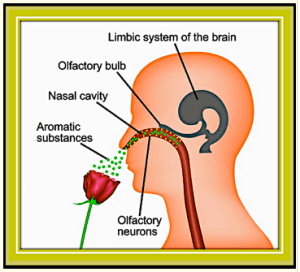
Neuro-anatomy supports the idea that our olfactory system is especially set up to ‘understand’ smells. Odor molecules picked up by the nose travel from sensory neurons to the olfactory bulb at the base of the forebrain,  relaying the signal to other brain areas for additional processing.  Smelling is the only sense that doesn’t shunt its data to the brain via spinal cord or cranial nerves.

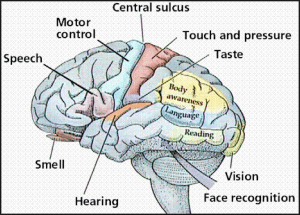
brain & sensesThe orbito-frontal cortex processes olfaction & amygdala are brain areas critical for assigning emotional value to stimuli.
Smells transmit impulses to areas directly connected to the limbic system, the part that deals with emotions.

So there’s good scientific evidence for the validity of aromatherapy, from studies that examine chemical reactions – of the nerve endings in the nose – to various substances, how that data is conveyed to the cortex & then coded. (“Women nose ahead in smell tests”). (“Smell & the Brain”) // (Essential Oils = scroll to 11/2014)

Other studies tell us that the average person can detect at least one trillion different smells, a far cry from the previous estimate of 10,000.  No longer should humans be considered poor smellers!

In fact we now know the nose can out-perform eyes & ears which discriminate between several million colors & about half a million tones.
“It’s time to give our sense of smell the recognition it deserves,” said Leslie Vosshall, at Rockefeller U (Her NYC talk on Smell vs vision & hearing)

Experiences that connect odors with emotions (learned responses) explain how odors come to be liked or disliked, as well as how their later presence can call up emotion, influencing thinking & behavior.
Olfactory stimulation can change our brain waves & mood in powerful ways.

Some smells – from food, air fresheners, perfume & even some essential oils – can interfere with concentration, distracting to the point of inhibiting our brain’s ability to learn something (studying, practicing….). .

EXP: A ‘lucky’ survivor of a devastating apartment fire reacts with some anxiety whenever she smells wood burning from fireplaces in the buildings near hers, or a match being lit, even after 20 years.

perdume creatorWhile these facts apply to everyone, smells have a very special meaning for Olfactory Learners. They grasp info best when incorporating both smell & taste, easily distinguishing substances from one another, often connecting a particular smell with a specific past memory

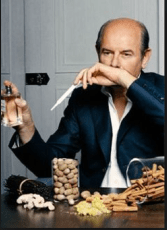
Such learners can be found in Chemistry, Botany, Biology & other scientific/ technical fields (perfume & wine makers, chefs, sommeliers ……)  PICTURE: Jaques Polge, French perfumer, head of Parfums Chanel

Since these people represent a small percentage of the population, there is relatively little info about the importance of olfactory learning, even though this sense is a valuable part of absorbing info, & is especially needed by children with visual impairment or other disabilities.

As smell & taste learning are not usually thought of as scholastically important, most educators have been slow to recognize such students, so their needs are not addressed.
In standard learning settings olfactory learners have trouble concentrating, dislike doing homework, often with low grades in math, reading, & science. They are not stupid or ‘slow’ – they just need a different style of education.  (Olfactory perception in children) (SMELL: Learning & Emotion)

Reyna Panos (Brown U.) writes: “In the early years of educational psychology, children were believed to fall into one of two camps: visual or auditory. Eventually, kinesthetic & tactile learning styles were recognized as well, but to this day nasal learning continues to go unacknowledged.” Panos’s studies suggest that 10-20% of all students fall into this category, children indicating nasal needs as early as 1st grade.

SITE: “Effects of diversity in olfactory environment on children’s sense of smell”

NEXT: Smell (Part 2e)

OUR SENSES & LEARNING – Touch (#2c)

kinestheric learningPREVIOUS: Auditory (#4b)

SITEs: Learning Style Preferences & ESL Students (Study)

6 important things you should know about how your brain learns


KINESTHETIC  (somatic/physical actions) Learning

About 35% of children &  5 – 15% of Adults learn most easily while moving (kinesthetic) or handling (tactile) things, which helps them understand the world around them.
Physical movement: The Cerebellum & motor cortex, at the back of the frontal lobe, are mainly in charge of much of the body’s activity
Kinesthetic thought: lets us experience bodily sensations, feelings & emotions, which come from immediate experience, memories or imagined situations

“Children enter kindergarten as kinesthetic/ tactile learners, moving & touching everything as they go. By 2nd or 3rd grade, some have become visual learners. During the late elementary years, others – mainly girls – become auditory learners, while many males keep their kinesthetic/ tactile strengths throughout their lives.” Rita Stafford and Kenneth J. Dunn; Allyn and Bacon, 1993)

antsy in schoolWhen young, these learners are life’s little wiggle worms, often mis-diagnosed with ADD or ADHD.
They’re smart & eager to learn, but first need their attention captured. Then their energy can be directed by drawing on their natural curiosity & offered hand-on activities.
They do best when they have something in front of them they can physically touch, and even better if they made it themselves.

They come to understand how to use their bodies & how to communicate with others by touch, most of which comes through feet & hands. So activities that focus on those body parts help them learn how to write, share their toys, button shirts, tie shoes, hold a fork…

Kinesthetic learners express themselves through movement, with the distinct ability to control the body’s actions & handle objects skillfully. Through interacting with the space around them, they are able to remember and process information, which allows for a good sense of balance & eye-hand co-ordination.

learn by doingDOING something active allows them to learn, which helps them stay focused & retain information. This can include taking note (an action), but use their own language to express what they’re hearing.

They need external stimulation, otherwise they may lose interest, preferring to think broadly before going in-depth. It doesn’t mean they act before thinking or are reckless, but that they understand things better by getting immersed in a situation or lesson, in order to evaluate facts for themselves.

Learning a physical skill by first visualizing the activity (dance, a sport, driving…. ) is known to be very successful.
EXP:
Focus on the sensations you would expect for each activity or experience. So, for a tack (turn) on a sailboat, feel the pressure against your hand as you turn the rudder & the tension lessening on the ropes. Feel the wind change to the other side, feel the thud as the sail swaps with the wind, feel the boat speed up as you start the new leg….

Phrases used by Kinesthetics :
” I can’t get a grip on this // Stay in touch // That doesn’t sit right with me // I have a good feeling about this // My gut is telling me // I get your drift….”

Re. INTUITION (Clear sensing)
 This is actually getting vibes in the body such as Tingles, goosebumps, electricity, lump in throat, tickle in ear….

Gut Instinct
(Clear knowing)
Harder to describe – more of a crystal clear ‘I just know!”, like a ring or ping, but coming from the belly rather than the mind. Not so thick or dense as many deliberate thoughts.

abuse muscle painNOTE: All experiences of physical, sexual, verbal & emotional abuse are stored in the body (muscles, organs, energy centers….), and need to be released in movement, taking & crying.
Such history can be from childhood battering &/or incest, domestic abuse, war-time trauma, severe physical-illness-treatments or accidents…..

The physical expression of stored pain (getting it out) is necessary for all learning types, but especially for Kinesthetics – using experiential modalities, such as
Core Energetics, Psychodrama,
Trauma release exercises……
ASLO: Some books & LINKS to many therapies

General KINESTHETIC Characteristics
Remember, you’re not going to identify with every characteristic. which will depend on other factors, such as mixing in other learning styles, education & basic personality.

kinestetic char
NEXT: SMELL (4d)

OUR SENSES &LEARNING – Hearing (#2b)

auditury learningPREVIOUS: Visual (2a)

SITEs: Complex learning dismantles brain barriers

What’s my learning Style? – Auditory


AUDITORY (Aural) Learning

It’s estimated that about 30% of Americans prefer either listening or discussing/talking as the main way of receiving information, & retain up to 75% of what they hear. The Temporal Lobes handle aural content, the right lobe being especially important for music.

The human ear can detect pitch changes as small as 3 hundredths of 1% of the original frequency in some ranges. Some people have ‘perfect pitch’ – the ability to name any musical note heard or sung correctly, without help = to map a tone precisely on the musical scale without reference to an external standard

It’s estimated that less than 1 in 10,000 people have perfect pitch, but speakers of tonal languages like Vietnamese & Mandarin show remarkably precise absolute pitch when reading out lists of words, as pitch is an essential feature in conveying the meaning of words in tone languages.

Sound plays a crucial role for everyone when learning, but especially so for auditory learners. In a typically developing child, hearing & vision work in tandem, to take in information about things around them. This helps them absorb their environment better, providing another layer of understanding that sight alone can’t offer.

Like other skills, listening takes practice. Developing good listening habits helps children get important information from family, teachers & friends.
EXP: Using tapes with pictures, names & sounds are best. Children may know what an animal looks like, but also hearing the sound it makes allows they a fuller experience.lestening learners

As a group, strong auditory learners are somewhat difficult to describe.  Some learn best by listening, & some by talking, but most combine them, with strengths & weaknesses in each. This style is considered a difficult way to learn new material.

Auditory Listeners learn mainly by hearing. When listening to a new topic, or overhearing conversations – they focus on what’s being said, often remembering key words and phrases, directions & descriptions – in great detail. They may like to hear stories, or learn the context of a subject, while others may actually find off-topic background confusing.

Since listening requires more concentration than seeing, they’re usually slower at reading than other learners, preferring plays & dialogue to lengthy passages. Hearing an overview of a lesson is helpful, allowing them to better absorb subsequent info. Some auditory learners find it hard to listen & take notes, or to listen & watch something at the same time.
Also, some study better with ambient sounds (TV, music, people talking….) – to block out distraction, while others find noise breaks concentration.

audotory talkersAuditory Talkers need to discuss what they’re learning. They ask a lot of questions to solidify new info, & helps them pass it on to others. By discussing what they understand about something new, they form links between that & what they already know, clarifying their grasp of a topic.
Speaking also gives a chance to learn by listening – to themselves. When studying on their own they’ll move their lips or talk to themselves. Because of a fine-tuned ‘ear’ they may find learning a foreign language relatively easy.

Strong verbal skills allows them to express ideas clearly, carry on interesting conversations, have an appreciation for words & with a well-developed vocabulary. Auditory learners become skilled at interpreting info & reproducing it. This giving many a knack for deciphering the true meaning of someone’s words – from tone of voice, pitch, speed & other vocal nuances.

Speech patterns include phrases “I hear you // That clicks // That rings a bell // That sounds about right // It’s coming through loud and clear // Tune in to what I’m saying // That’s music to my ears…..”

Those with an Auditory Numerical Style understand numbers best if spoken or heard. They’ll say numbers to themselves when mentally figuring math problems, learning a phone number, or add 3 numbers together without writing them down – & then easily remember sequences later.

listen 7 studyAuditory learners often have Musical talents & like to work with sound – with a good sense of pitch & rhythm, hearing tones & individual notes.
Many can sing, play or at least identify musical instruments, find themselves humming or tapping a song or jingle, that pop into their head without prompting. Some music will invoke strong emotions in them.

EXP: Research shows that playing certain classical music while studying, such as a Baroque Largo, is highly beneficial. This is because its BPM (beats per minute) is the same as alpha brain waves, providing our most receptive & alert mental state. Also, waltzes have a BPM that are in tune with the natural rhythm of our body, creating positive mental energies & consciousness

Re. INTUITION (Clear hearing)
This is hearing in the mind’s ear as if remembering a sound (words, letters, music….), although sometimes it’s so strong you think it’s real.

General AUDITORY Characteristics
Regardless of which style you prefer, you’re not going to identify with every characteristic. That will depend on other factors, such as mixing in other learning styles, education & native personality

auditory characteristics

NEXT: Kinesthetic Learning (Part 4c)

OUR SENSES & LEARNING – Vision (#2a)

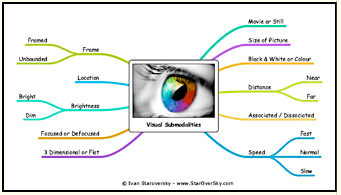
visual learning
I GET MOST OF MY INFO
through my eyes

PREVIOUS: Sensory Learning #3

SITE: MANY links re learning
• “5 things to know about how the brain learns”

QUOTE: “To develop a complete mind, study the science of art and the art of science. Learn to see. Realize that everything connects to everything else.“ ~ Leonardo DaVinci

VISUAL Learning Style
According to Dr. David Sousa, 45% or more student in most American classrooms prefer to receive information visually. This includes pictures, video tapes & charts, as well as reading, because the interpretation of symbols translate into mental pictures (“How the Brain Learns”)

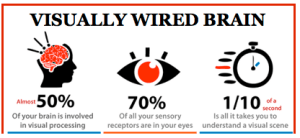
Our brains give preference to processing vision, compared to our other senses.
EXP: Imagine being in an open field. How far can you see? About 50 miles. How far can you hear? Maybe a mile or two. How about smell? 10-20 yards, assuming that the wind is not blowing. How about touch? Just an arm’s length. Taste? A couple of inches.

The Visual Cortex, in the Occipital Lobes, is the largest system in the human brain, responsible for higher-level processing or visual images. It’s at the back of the brain, above the cerebellum. It interprets info from visible light to build model of the world around the body. As the eyes gather information, the brain interprets & makes sense of what we take in. Both occipital & parietal lobes manage spatial orientation.

The eyes & the Visual Cortex form a massive parallel processor that provides the highest band-width channel into human cognitive centers. At the higher level of processing, perception & cognition are closely interrelated, which is the reason why the words “understanding & seeing’ are synonymous.” ~ Colin Ware (slide 17) attention span

The average human attention span is 8 seconds, & our brain processes visual images 60,000 times faster than a text, in roughly 1/10 of a second.

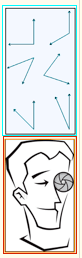
Hubel and Weisel showed that the primary visual cortex consists of cells responsive to both the simple & the complex features of whatever we’re seeing. Interestingly, most of these cells have a preference for one edges of an angle over another, called ‘orientation preference’, & to inputs from one eye over the other, called ‘ocular dominance’.
These 2 patterns (preference & dominance) are not fixed genetically, but develop from visual experience, mostly soon after birth.

80-90% of children use their eyes to learn about their world. They’re used to gathering information nearby (what can be touched) & at a distance (beyond arm’s reach). Visual stimulation helps to shape children’s minds in powerful ways.eye preference & dominance

Science tells us the neurons that handle visual processing make up about 30% of the brain’s cortex – more than double that of hearing & touch combined. Via this method we store both negative & positive impressions in the brain (images of AK-47s & beautiful waterfalls), at conscious & subconscious levels. All imprints have a deep & lasting effect on the way we learn & think.

Most of our activities involve ‘seeing’, so the importance of this sense can easily be taken for granted, yet sight is crucial to learning. Visual learners take what is spoken or heard & make it into something they can see in their mind’s eye. They get the most out of visual aids, & put a lot of effort into observing / listening so they can turn info into notes, charts, graphs, pictures….

Re. INTUITION (Clear Seeing) Being able to visualize possible scenarios in the mind’s eye, as if recalling a memory or imagining an actual picture.

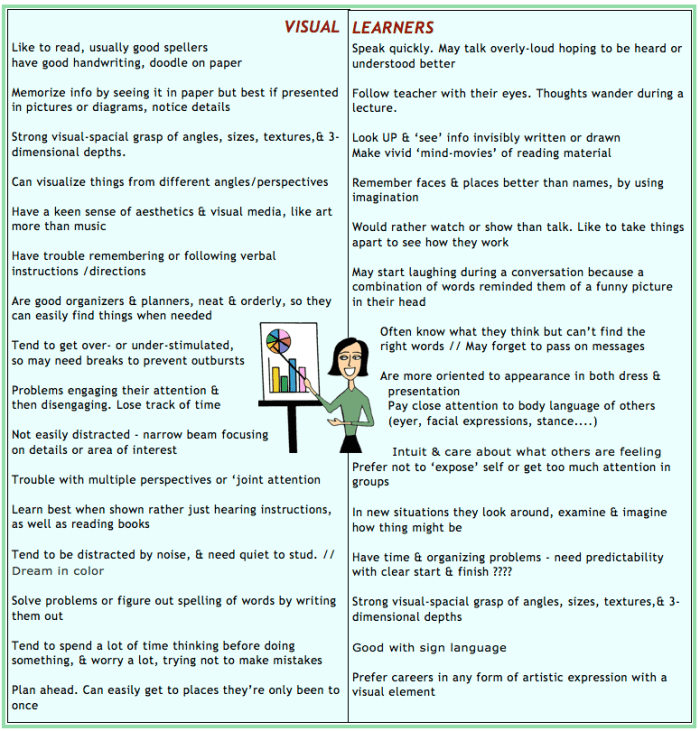
SOME general VISUAL Characteristics
KEEP IN MIND that whichever style is your preference you’re not going to identify with every single characteristic listed. That will depend on other factors, such as mixing in other learning styles with your primary one, your educational background and your native personality.visual Lern - charact
NEXT: Auditory Learners (Part 4b)

OUR SENSES &LEARNING – Intro #1c

sense learning %


PREVIOUS: Sensory Learning (Part 2)


SITE: Sight, Scent & Sound: The Role of Senses in Retail Marketing

QUOTE: “Live as if you were to die tomorrow. Learn as if you were to live forever.” ~ Mahatma Gandhi

OLD CHINESE PROVERB: “When I hear, I forget. When I see, I remember. When I do, I understand.”

🌺      🕺🏼     🧤     🕶    👂🏾
MAIN SENSORY INPUTS

We express ourselves internally & externally from VAKOG forms of gathering knowledge & understanding:
1. Visual = SEEING 🌀 2. Auditory = HEARING
3a/b. Kinesthetic/Tactile = SENSING/TOUCHING
4. Olfactory = SMELLING 🌀 5. Gustatory = TASTING

Only the first 3 are widely used as major input channels for collecting data about our surroundings. 1, 2, 4 & 5 are obvious. #3a refers to whole body experiences involving sensations, emotions & motion itself. #b refers to learning by touch – such as the blind reading in Braille.

Summary of stimulus-to-response pathwayssensory process


OTHER sensory sources (equally important sources of internal/external info) : senses circle
1. Chemo-receptors:  These trigger an area of the medulla which detect blood-born hormones & drugs. Also involved in the vomiting reflex

2. Equilibrio-ception
: This helps to keep our balance & a sense of physical movements, such as acceleration, directional changes, & a sense of gravity.
It’s the Vestibular Labyrinthine system. located in the inner ear. When malfunctioning, we can’t tell up from down, so moving from place to place without help is nearly impossible

3. Hunger
: This system allows the body to detect when we need to eat
4. Itch:  A distinct sensor system, part of other touch-related senses

5. Magneto-ception
: This gives us the ability to detect magnetic fields, providing a sense of direction, based on Earth’s magnetic field. It’s not strong (like in birds), but experiments show that we do have some

The mechanism is not clear, but may have to do with deposits of ferric iron in our nose. It could be, since humans given magnetic implants have a much stronger magneto-ception than those without (MORE…. )

6. Noci-ception:  i.e Pain – once thought to simply come from overloading other senses such as Touch. Actually, it is its own unique sensory system.  with 3 types of pain receptors: cutaneous (skin), somatic (bones and joints) & visceral (body organs)
7. Pressure: Identifying shapes, softness, textures, vibrations….

8. Proprio-ception
: Gives the ability to tell where our body parts are, relative to each other. Police test this when checking for a potential DUI driving drunk, by asking: “Close your eyes & touch your nose”.
This sense is used regularly in small ways, such as scratching an itch without having to see where the hand needs to goear structure

9. Sound: Detecting vibrations along some medium in contact with the ear drum, such as air or water
10. Stretch Receptors: These are found in the lungs, bladder, stomach & the gastro-intestinal tract. One type, which senses dilation of blood vessels, is often involved in headaches
11. Tension Sensors: These are found in places like muscles, allowing the brain to monitor muscle tension
12. Thirst: This system allows the body to monitor its hydration level so the body knows when we need to drink

13. Thermo-ception: a specific brain system, plus a combo of senses, for monitoring internal body temperature. This includes the ability to notice heat & cold, using the 2 hot/cold receptors

14. Time:  This one is debated, since no single mechanism has been found that allows people to perceive time. However, experiments have definitely show that humans have a startlingly accurate sense of time, particularly when younger.

This seems to come from some combination of the cerebral cortex, cerebellum & basal ganglia.
— Long-term time-keeping seems to be monitored by the supra-chiasmatic nuclei, responsible for the circadian rhythm
— Short term time-keeping is handled by other cell systems

15. Touch: Rather than located in one or more specific areas, this sense is our whole body – made up of a very fine network of receptors in our skin, forming our largest sensory system. (More….)

HIDDEN Senses automatically, unconsciously help to:
• control bodily functions, such as temperature & bladder fullness
• control timing & movement of food through the body (digestion)
• measure the amount of sugar & salt in the blood
• regulate the amount of oxygen that’s taken in, for breathing…..synesthesia

SYNESTHESIA – when 2 or more senses combine / overlap, such as seeing numbers in color, tasting words….
It’s hereditary, estimated to occurs in 1 out of 1000 individuals, in various forms & intensity.
(MORE…) // (Science of Synesthesia chart)

NEXT: Visual Learning (Part 2a)

OUR SENSES & LEARNING – Intro – #1b

SO MUCH TO SEE & DO
so much to learn


PREVIOUS:

 Sensory Learning (#1)

SITE: “Sensory Integration”
• “Understanding Temperament – Sensory Sensitivity ”
• “ Arousal & Anxiety”


STYLES:
Everyone uses all sensory channels to some degree, but the most valued are those we use on a regular basis – from birth – to bring information into conscious. While we all have the same basic brain structures, how these parts work can vary greatly.
EXP: One person sleeps better on their side, another does better on their stomach…..
If we diligently pay attention to how our brain ‘likes’ to receive information & in what form, we can better understand & make sense of what we experience, which helps to improve learning.

AROUSAL: Successful sensory processing (gathering info thru the senses) is strongly linked to emotional well-being, governed by the ’Sensory Threshold’ – our point of initial contact with a stimulus.
‘For most of us, this threshold is high enough that we can tolerate the complexity & stimulation of our environment, & low enough that we can notice new input & subtle changes around us.’ (INSIDE OUT, slide 21)

A suitable amount of sensing allows us to achieve & maintain optimal arousal levels – a combination of alertness, situational awareness, vigilance, level of distraction, stress & direction of attention. (See “Inside Out” slide 18)

In effect, it’s how ready a person is to perform appropriate tasks in a timely, effective manner:
• Top-down (cortical inhibition) – uses strategies such as thinking & self-talk to stay on task
• Bottom Up (cerebellum inhibition) – heavy work with muscles & joints, which regulates arousal & so promotes focus & attention

LOW arousal will limit general interactions, cause depressed emotions & prevent forming primary attachments (parents, mates, children, friends….)
— Extreme under-arousal can cause unconsciousness, possibly from tiredness, fatigue, hypoxia, poisoning or illnesses.

HIGH arousal can show up as hypersensitivity from too much input (especially for Introverts), such as noise, touch, crowds, social anxiety….. Also, low self-confidence, feeling inadequate, constant frustration…..

— Extreme over-arousal can be seen in a range of symptoms peculiar to the individual, the environment, the task and other factors. This may include: panic, aggression, submission, resignation, withdrawal, irrational behavior, mood swings, or unconsciousness. (MORE….)

Learning STYLES vs MULTIPLE Intelligences (MI)
Both are considered ways we learn. However,
INPUTLearning Styles identify the broad-strokes way we gather & store information, using our 5 senses, while —
OUTPUTthe 9 MI posts identify specific ways we express ourselves, having absorbed information via the various senses. (MORE…… excellent comparison)

Learning Styles identify how each of us is most comfortable learning & retaining new information. They indicate how we gather, sift through, interpret, organize, come to conclusions about, & “store” information for further use. Everyone has their own mixture of strengths & preferences, but usually one is dominant.

Info gathered thru our specific style of sensory input affects the way we internally ‘see’ our experiences, & the way we recall facts, even to the words we choose. It allows for more efficient ways to learn, whether formally in school, or in daily from relationships or at work.

Research shows that each learning brain & senses style uses different parts of the brain. By involving more of the brain during learning, the more we remember.

FAST learners incorporate all 3 main modalities (eyes, ears, body). Even so, our dominant style can help us excel, & can compensate for the less developed ones.

Brain-imaging has found the relevant brain areas:
Aural: Temporal lobes. The right lobe is especially important for music
Logical: Parietal lobes drive logical thinking, especially the left side

Physical
: Cerebellum & the motor cortex (back of frontal lobe) handle much of our physical movement
Social: Frontal & Temporal lobes handle much of our social activities. The Limbic system (with the Hippocampus) also influences both social & solitary styles, as it deals with emotions, moods & aggression

Solitary
: Frontal and Parietal lobes, & the limbic system
Verbal: Temporal & Frontal lobes, especially 2 specialized areas = Broca’s & Wernicke’s (left side of these two lobes).
Visual: Occipital lobes at the back of the brain. Both Occipital & parietal lobes manage spatial orientation.

NEXT: Sensory Learning (Part 3)

OUR SENSES & LEARNING – Intro #1a

learning styles


I USE MY WHOLE BODY
to understand the world

PREVIOUS: “They did the best they could”#3


SENSORY EXPERIENCES for Learning
We’re born with 2 essential skills: our reflexes & our senses.
We learn when the mind is able to put together input from all senses, which make connections with past learning. The brain is always working, just as lungs breathe automatically, not stopping unless there’s major interference.

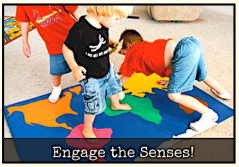
Children are active learners who need to be involved in activities using as many senses as possible. They listen to & watch adults around them, language being the glue that helps them make sense of it all. This complex of sensory information allows us to create relationships with our environment  – physically, mentally & emotionally. So children need to grow up in a world that’s beautiful to smell, hear & look at.

multi-sensory gameJean Piaget, a 20th century Swiss psychologist, described the learning process of babies & toddlers:
• From the moment of birth onward, information comes in to the brain through firsthand experiences with things, people & feelings, depending entirely on the senses of vision, hearing, touch, smell & taste.

• The brain continually assimilates (gathers & digests) information, adding all new input to what it already knows.  Around 12-18 months old, children become able to form mental pictures of things, people & feelings. At this point, they start talking in their native language, which is actually a system of symbols (images). Their brains are now ready to use this existing knowledge to form new ideas, called accommodation.

For the next several years children continue to learn by depending mainly on their senses & firsthand experiences, rather than language. Gradually they’re able to picture the consequences of future events & actions in a more adult-like fashion.

Intellectual Potential is built on our genetic heritage, but can’t be entirely predicted at birth. It’s development during the rest of life is a constant combination of assimilation & accommodation, an upward spiral through a series of stages & sub-stages, making higher & higher levels of learning possible as we adapt to our environment.
Therefore, our sensory environment will make an important difference in our lifelong learning ability. (from “Keys to Great Parenting”)

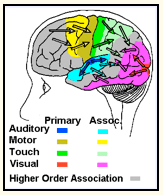
Sensory inputprimary assoc. from the outside is constantly bombarding us. We need this info for the brain to develop & continue to function properly. Although there’s still much more to learn about brain function, research suggests we may be able to use input to improve neural circuitry & thus neural plasticity – the ability of the brain to form new connections, which can continue throughout our life.

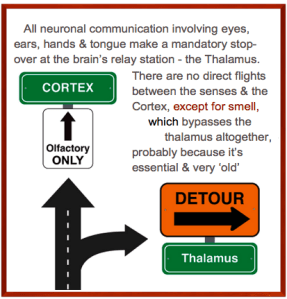
The Association Cortex is outside of the primary areas of the surface of our brain. It’s essential for mental functions that are more complex than the basic aspects of sensory stimulation which use primary sensory areas.  All the senses – except for smell – are filtered by the brain stem before being sent to other areas,
info which is then: sense & thalamus
• Screened out or ignored if it isn’t important or meaningful
EXP: Dust particles in the air are all around us, but we tend not to see them unless they’re in the sunlight, or when there are too many of them

• Noticed
& assigned relevant importance, so the info is sent to the appropriate area of the brain for a response
EXP: A car honks at us & we look to see if we need to do anything about it

• Habituated
or eventually ignored if the input is constant or doesn’t change much over time.  EXP: Wearing a watch or ring. (MORE….)

• Senses allow us to learn, to protect ourselves & enjoy the world. They detect stimuli – anything that causes a reaction in a living organism (pain, heat, sound, chemicals….). When something is detected, receptor cells in the appropriate sensory organ are triggered, generating impulses transmitted through the nerve to the brain. The brain’s interpretation of this info will tell us how to respond.
If one sense is not working due to birth defect, accident or illness, other senses will take over or become stronger to make up for the missing one(s).Screen Shot 2016-05-16 at 12.17.24 AM

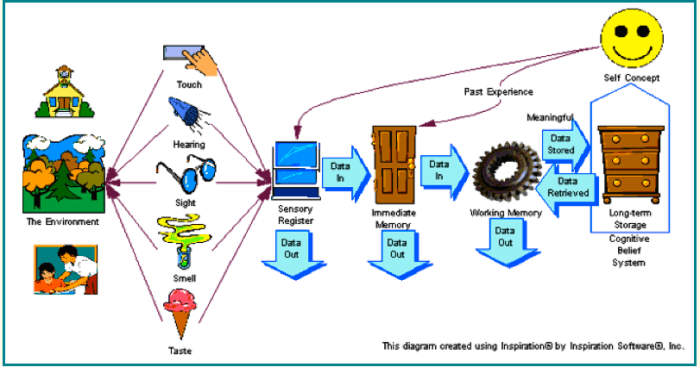
DIAGRAM: How the brain takes in information from the environment & processes it.
~ David Sousa & Patricia Wolfe (2001)

NEXT: Sensory Learning – Arousal (Part 2)

Weak DECISION Styles (Part 3)

I’LL RISK EVERYTHING –
to feel that ‘high’

PREVIOUS: Bad Decision Styles – #2


PART 3: Last 6 of 18 types of unsound decision-making (D.M.) styles & their corrections (no known source).  While these types represent dysfunction, they’re based on each person’s native approach to life, with the addition of an unhealthy upbringing.

Some EFFECTS of bad D.M.:
• we compromise ourselves – our self-worth, values, needs….
• we don’t get what we say we want, so we can obey our Toxic Rules
• we do get what they want, but at the expense of others, damaging our relationships
• they generate anxiety, distress, shame, guilt, self-hate….
• we experience physical symptoms, aches and pains, major illness
• have to learn lessons the hard way instead of making life easier
• waste a lot of time, either doing unnecessary things or having to cleanup a mess later

• we hurt, disappoint, ‘abandon’ people we care about & love
• loss of important opportunities, with some that can’t be retrieved
• suffer unnecessary financial distress, debt, loss of valuable property
• get in trouble with authorities, the law, go to jail
• they may lead to accidents, permanent injuries, deathconsequences
• they’re a waste of our precious life, talents, abilities, potential….

Allowing for Nuances
• Most decisions are NOT written in stone, so they’re nor forever, even tho some do have far-reaching consequences, so it’s wise to strive for ‘sane’, healthy, adult choices as often as possible
D.M. is inherently circular, since most are made by moving back and forth between:

a. the characteristics we want our choice to meet (the ‘new’ car we want to get should be small, used & inexpensive but not worn out)
b. identifying the possibilities we can choose from  (depending on where we live, how much money we have, our knowledge about used cars…)
— The alternatives available influence the criteria we apply to them, and vice versa – the criteria we set influence the alternatives we consider

• ACoAs tend to lump all types of decisions together – all are huge, impossible, overwhelming, undo-able — we think ALL have equal importance & equal consequences. NOT SO!
We can divide decisions into (at least) 3 levels of importance & intensity. Use these suggestions to make your own outline.  It can be argued than any choice can cause a big problem OR have a great benefit, but if we use our Adult observation we can have a general sense of what to expect, as long as we don’t limit our thinking to what happened in our childhood

SMALL-ish Decisions: where to do for dinner, what to wear, when to talk to someone, to go or not go to a party, which errands to do when, buying something for the house…..
MEDIUM Decisions: Where to go on vacation, what diet to use, to go back to school, change accountants, redecorate, get a new car….
BIG Decision: change careers, get married or leave a relationship, move to a different city or country, stop using drugs / alcohol / cigarettes, start going to therapy, have an operation…..

✶ The more we come to believe “I KNOW WHAT I KNOW”, trusting our intuition & judgment, the easier the process of D.M. becomes.