Developing RESILIENCE – Spiritual (Part 2)

PREVIOUS: Resilience – Spiritual #1

SITE: The Spirituality of Resilience

COMPONENTS of Spiritual Resilience (S>R>)
We need to take care of the sum of our parts first before we can be whole. Mind, heart, body & soul (PMES) are all elements of our core, so not nourishing each one regularly leads to negative thinking & disordered behavior. Without a spiritual life, people are more likely to live in monotony, uncertainty &/or narcissism.

BALANCE is an essential feature of mental health – in this case the balance between faith & free will. Both are true & both are necessary. Faith could be expressed as religious participation, trusting the unseen from positive experiences.
Free will would be actively practicing the Golden Rule: ‘Love thy neighbor as thyself, or Do unto others as you would have them do unto you’.

1. Spirituality – Faith, Belief
Human beings’ innate self-righting ability – the capacity for Resilience – is connected to our basic spiritual nature. Activist Patrisse Cullors said: “People’s resilience, I think, is tied to their will to live, our will to survive, which is deeply spiritual. The fight to save your life is a spiritual fight”. When people include spirituality in how they ‘understand’ a tragedy they’ve suffered (ascribe meaning to events), they come thru it with much less trauma-hangover

As listed in Part #1 the term has several meanings, & people use it differently. It has been called Inner Growth, Mindfulness, a Spiritual Awakening….
In 2015 a request went out in the US & Germany: “How would you define the term ‘spirituality’?”and over 1,77o people answered. 10 concepts divided into 3 groupings (see chart above) emerged from an analysis of the responses

PRACTICAL Spirituality is the Regular Renewal of:
Basic trust that we belong. Resilient people have learned to trust their experience, intelligence & intuition. They don’t depend on over or under-trusting other people, but have a deep reliance on a power greater than themselves

• Commitment to & relationship with a personal Higher Power of your understanding
• Community participation with others of shared spiritual values, nurturing interactions with people & nature
Forgiveness – for oneself, & Reconciliation – with others, when possible

• Hope – believing in realistic possibilities & knowing practical options encourages constructive living in the present, thereby being responsible for future outcomes
• Self-acceptance – we are the way God made us. Value that!
• Sound values – a meaningful life philosophy to support & guide all relationships
Transcendent experience (s) that energize – developing our higher self (the soul)  (Christian renewal)  (3 Cs of Spirituality

2. Humility (not humiliation, which is = to shame another)
Being in charge of our own life is one of the cornerstones of Resilience (R.). That’s balanced against Humility – knowing & accepting our imperfections as human beings, without self-condemnation. Resilient people do not aspire to perfection! True resilience is based in reality, & Higher Truth is that only Higher Power is perfect – no human can even achieve it.

Perfectionism is a cognitive distortion (CD) many ACoAs are deeply committed to 😇 – from deep in the mind of our WIC. Catch yourself saying : “I don’t have to be perfect”. This implies you could be, you just don’t have to. NO – you can’t be – AT ALL.

Trying to be perfect is trying to be God! It’s true that not everyone believes in a Higher Power, but even on a psychological level – struggling to do the impossible always leads to disappointment, adding to our sense of abandonment.
Re. shame : John Bradshaw noted that there’s such a thing as psychologically ‘healthy shame’, which admits to realistic limitations. It’s the opposite of grandiosity – the child’s belief that they have no limits & there are no bad consequences.
3. Emotions
Developing emotional equilibrium is part of Spiritual Resilience, by correctly evaluating a situation, safely sharing the pain & receiving emotional comfort. Some psychologists have become aware of the connection between emotional regulation & religion.
Spirituality helps balance well-managed emotions with accurate healthy thinking, to form a spirit-in-action attitude that allows us to succeed by being ‘in the flow’ of life-energy.
Spiritual practices that help people cope with trauma-generated intense emotions include:
Acceptance & Forgiveness, which nurture empathy & modify harsh emotions
• Meditating on Scripture & Mindfulness, reducing excessive arousal
• Prayer, for gratitude & asking for help = an exercise in religious re-framing of events

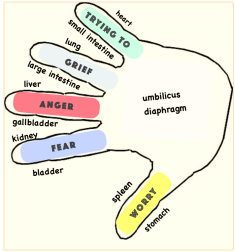
HAND – explanations // the Jin Shin Jyutsu version w/ healing exercises // as hand acupuncture

NEXT: Spiritual resilience #3

Developing RESILIENCE – Spiritual (Part 1)

PREVIOUS: Resilience – emotions #2

SITE: Spiritual life coaching
(non-Christian)


BENEFIT:  Resilient people tend to find a bit of silver lining in even the worst situations, & are *Grateful* for the things they still are & have. While they certainly see & admit the bad, they’re not limited by it, or stuck in it

SPIRITUAL RESILIENCE (S>R>)
DEF: The ability to sustain one’s sense of self & purpose through a set of principles or values.
While it may be in the form of specific religious beliefs for many, it’s more than that – it’s a way of life. The West needs to go back to the awareness that Spiritual health is important in balancing heart & mind – which the East has never forgotten.

Spirituality can be:  Connecting with the sacred, believing in God as Higher Power with a personal experience, understanding life through events, connecting with the Existential Self, finding meaning & purpose, having ethical values & beliefs, positive relationships & helping others, & experiencing transcendence.

In broad terms, whether religious or not, Spirituality can be thought of as:
• Moral Responsibility: A healthy value system (personal code of ethics), spiritual
choosing what’s right for ourself first, then in relation to others
• Congruence: Acting honestly, living by our principles & listening to our intuition
• Altruism: Being concerned for all humanity, & doing what we can to help others – realistically, from healthy motives

Interesting: Various US military branches have started actively including Spirituality in their Resiliency Training. “As a pillar of Comprehensive Airman Fitness, maintaining & strengthening individual spirituality is a primary component for one’s overall well-being.” Fairchild AF Base, Wash.
Capt. Jeffrey Solheim (92nd Air Refueling Wing chaplain) explained that “Spiritual Resilience is about fueling & refueling our heart & soul – that inward part that helps to make sense of our existence & experiences…..”

Spiritual beliefs & general ‘right’ thinking allows people to see the world thru a positive (but realistic) lens, which benefits our day-to-day functioning, & offers solace in turbulent times – especially if supported by participation in like-minded communities.
A Spiritual focus helps to decrease anxiety, depression, addictions & suicide, while increasing personal & family intimacy & stability. It gives people the strength to work toward personal improvements, or to fulfill lifelong dreams.  (RAND Corp paper for the US Air Force).

In 2009, the Defense Department (DoD) conducted a psychological study showing how spirituality has helped service members cope with difficult & traumatic events. The study found that most of them use spirituality to cope with multiple deployments, combat stress or injury. The research also found that it lessens becoming overwhelmed by “moral injuries” – from participating in or witnessing terrible acts of war that conflict with one’s moral beliefs.

Before looking deeper into characteristics of S.R. – some comments:
✧ Many ACAs are OK with some kind of spiritual life, while others don’t believe in any Higher Power.
✧ Many of us are angry at ‘the God of our understanding’, because our understanding is immature & incomplete.
As kids we prayed & prayed for the alcoholic to stop drinking, for the rage, beatings & other abuses to end – but they didn’t. So we hate God – because we don’t understand the Laws of nature.  It’s a substitute for feeling legitimate rage at our parents, siblings…… (For comfort, read Psalm 3)

John Bradshaw pointed out that “Until the age of 7 we deify our parents. After that we parentalize our deity”.  So if our parents were drunk, mean, absent, judgemental, perfectionistic, narcissistic…. then we assume God is too & we don’t trust H.P. or want anything to do with spirituality.
But God is not an alcoholic parent! In recovery, one woman realized that she couldn’t trust a ‘male’ god because her father was brutal. So she decided to think of H.P. as female, & was then able to consider trusting “a power greater than ourselves.”

Since we are all spiritual beings, we short-change ourself by not correcting our WIC’s mis-understanding, & not updating our perspective – whatever form that takes. 12-Step Programs like Al-Anon are spiritual-based, using the power of the Steps & the group to heal our wounds. But it does not ask us to be religious, or even ‘believe’. Only to “keep an open mind & keep coming back.”
(Wide variety of articles re. faith, religion, spiritual anger…..)

NEXT: Resilience – Spiritual #2

Developing RESILIENCE – Emotions (Part 2)

PREVIOUS: R-emotions #1

QUOTE:  “Love does not need to be understood, just to be demonstrated” ~ Paulo Coelho

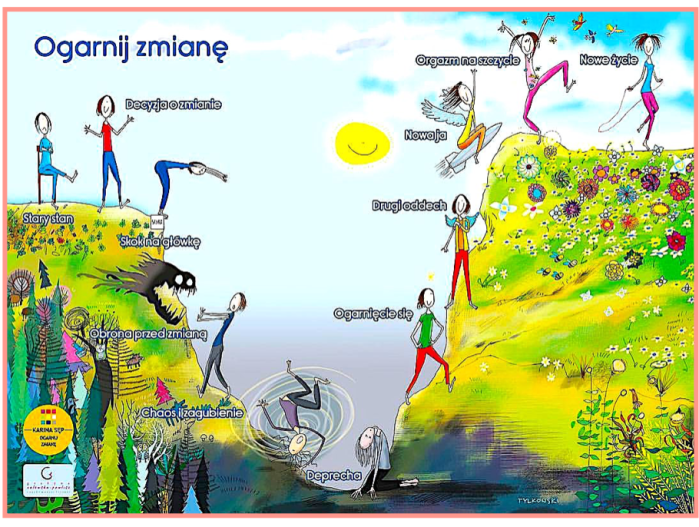
⬆️ Art work on Pictame: by Karina Sep from Poland.
Translation,
from top left to top right: Embrace Change – old state, decision to change, jump head first, chaos & confusion, defense against change, depression, I embrace it, second breath, new me, joy at the top, new life.

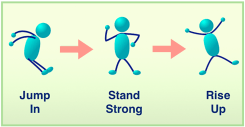
❤️ We can use this model ✒︎ to teach our WIC how to deal with difficult or unpleasant Es:
⚬ JUMP In! = Recognize & acknowledge them
⚬ STAND Strong! = Own them & Survive
⚬ RISE Up! = Grow from them & Thrive .….(explanations)

REQUIREMENTS for Emotional Resilience (E>R>)
Acceptance : In touch with your needs – what’s good for you & what’s bad for you, what’s lacking or OK things that simply don’t suit – and when it’s time to reach out for some extra help

Awareness: Learned to identify what Es you’re experiencing, either at the time or soon after

Capacity : Know you have a wide range of Es, that you can have more than one E at a time, & that they can sometimes be contradictory

Courage : Willing to risk facing your Es, in spite of being afraid of the pain. It will help to have the right external support

Focus : Notice & keep a connection to pleasant, positive Es, balancing them against the unpleasant ones

 Motivation : (internal locus of control) Know in your cells that you have the right to be in charge of your own life – as an adult – & are not pushed around by outside forces. So you have choices, in most situations

Permission : Have come to believe you have a right to all your Es, because they are our built-in early warning system of danger, AND a great source of comfort & pleasure

Responsibility : As adults – Know that your Es come from inside, rather than being caused by external People, Places or Things (PPT)

Self-esteem : Have a clear sense of your True Self, & are comfortable with all your qualities & characteristics, even those you want to improve or enhance. You know you are a basic source of feeling loved

SKILLS for E>R>
Attention : Keep an eye out for things that recharge your batteries & fill your cup, so you’ll have the reserves needed for hard times

Balance: Find & retreat to your personal sweet spot of peacefulness when needed, & be present in the moment without judgment (mindfulness)

Body info: Able to locate & experience physical sensations in your body that go with current Es, good at catching even subtle cues (clutch in the heart, Ick factor in the stomach, tingling nerves from fear ….)

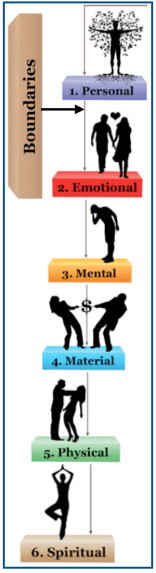
Boundaries : Know what your Es are, & don’t take on the Es of other people in your environment, no matter how much you love or care about them

Connections : Understand, accept, & empathize with other people’s feelings more easily because of being in touch with your own inner life  (without absorbing theirs !). Can pick up social / emotional signals from others
Control : Able to regulate your E responses, considering the situations you’re in

Faith : in a Power greater than yourself Who can & will help get you thru painful events
Feel : Able to sit with Es instead of using distractions – but not necessarily alone

Gratitude : Identify & value your personality assets & accomplishment, as well as the good PPTs -people, places & things in your life – who help put great pain or small annoyances in proper emotional proportion & perspective

Reality: Separate who you are at your core from any situation or person that’s causing you temporary suffering

Support: Gravitate to healthy people who are happy to share your joys with you, as well as give you the space to grieve or work through other painful Es

Time: Understand & accept that all emotional wounds take time to heal – just like physical injuries (process). And that some – like deep abandonment pain – may never completely go away, but can be greatly reduced

Triggers: Identify, accept & work on the things that set you off the most (like being accused wrongly) – buttons installed by your family

Trust : Know you don’t have to push to figure everything out. Rather – allow time for your natural internal process & intuition to find solutions to difficult Qs in the face of traumatic events.

NEXT: Resilience – Spirituality

Developing RESILIENCE – Emotions (Part 1)

PREVIOUS: Resilient Thinking – #2

SITEs: 15 Traits of Emotionally Wealthy People

POSTS: All about Es (June/July 2011) & Accepting & Accessing Es (2012)


EMOTIONAL RESILIENCE (E>R>)
Emotional (E) STYLE the consistent way we respond to our experiences, governed by specific brain circuitry that can be measured scientifically. All stressors trigger emotional responses, so we need a solid mental & emotional foundation to help us cope.

Growth GOAL:
To be in charge of our Es, & function from a tough-soft healthy UNIT (not from the vulnerable WIC nor the hard, bitter PP).

DEF of E>R>

• An emotionally flexible state allowing a person to return to a previous ‘even keel’, by making big or small adjustments in response to stressful situations, without loss of basic identity
The capacity to bend or stretch without breaking, make meaning out of adversity & return to original condition

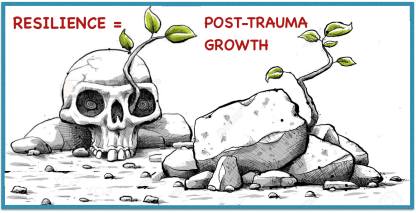
ACAs: Of course – what we would be returning to after another upsetting situation can hardly be called ‘an even keel’. The norm for us is some combination of depression, anger & isolation – fight or flight or freeze – or fawn!  So we’re not looking to bounce back to that, but aim for P-TGpost trauma growth.

Process: A major prerequisite for gaining E.R. is lowering the anxiety level that’s left over from our damaged childhood. That comes with doing deep FoO work, sometimes aided by the right kind of meds. It includes:
•  Correcting Toxic Beliefs, & changing defensive behaviors
• Finding the right combination of support systems
• Getting new, correct info about addictions & our human needs  and rights
• Re-experiencing old painful emotions, & learning what comfort is, and comforting ourself (Secure Attachment #1,2)

Frame-Reframe: Our E. are related to what we’re thinking about ourself & another person or event, related to our early experiences.
In a tough situation, ask which parts of the current situation are permanent & which can possibly change (see post Thinking #1)
Is my reaction colored by my wounded past OR seen thru healthy adult eyes?  // Do I need to think about this differently, OR is my evaluation accurate?”  (⏫️  CHART)

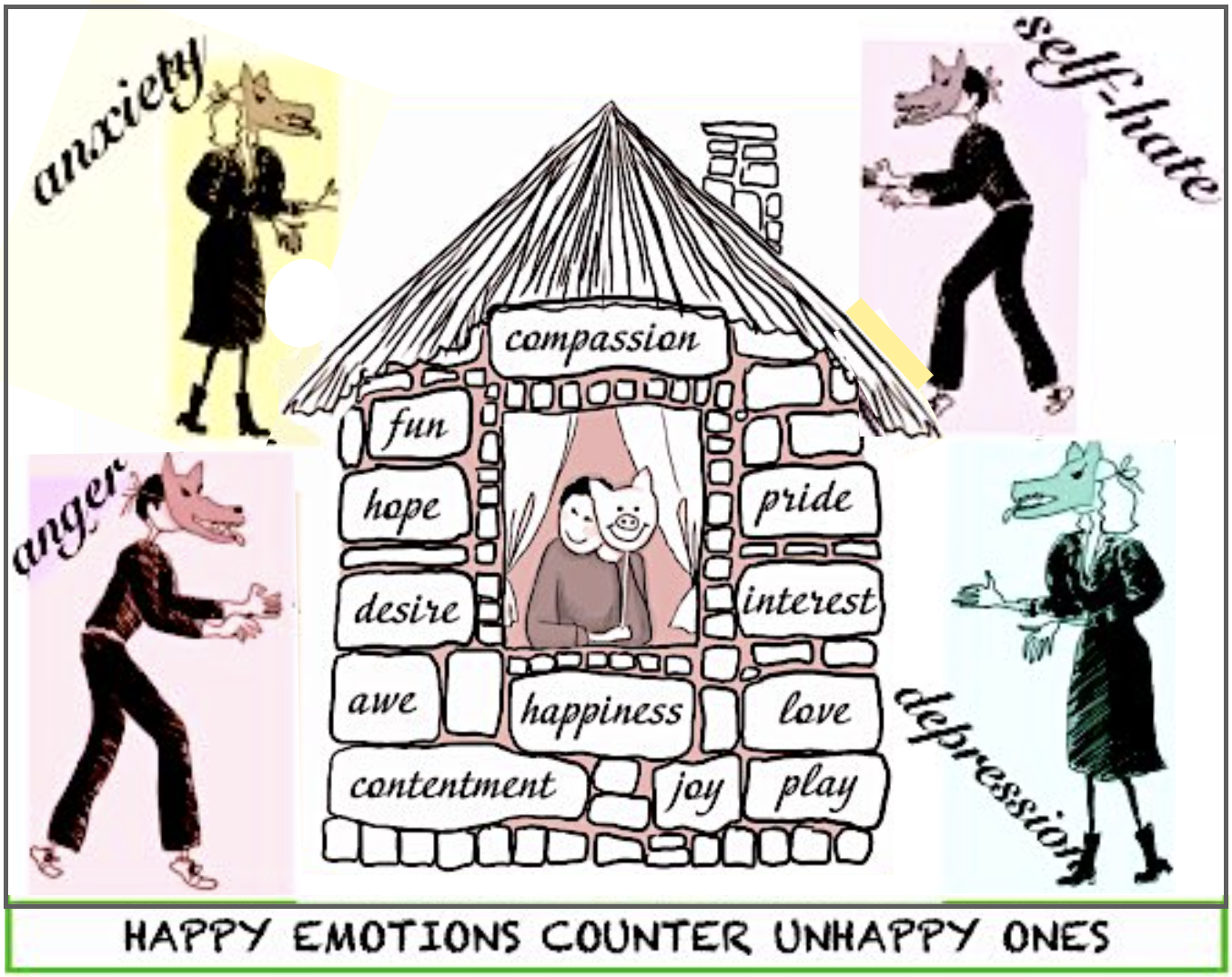
Pleasant Es: ACAs are addicted to painful Es – what we lived with day-in-day-out as kids. Healing allows us access to the pleasant-to-joyful ones as well, maybe for the 1st. time. All the literature refers to them as “Positive”, which implies we should not have the ‘negative one’. But we need a wide range, while not being stuck in old pain.

Research suggests that pleasant Es (amusement, awe, enjoyment, gratitude, hope, love, pride, self-respect, serenity….) provide many benefits. They :
Increase curiosity, open decision-making, mindfulness, physical health (7-10 years longer) better peripheral vision, connections with people, combine ideas more easily, & turn hopeful dreams into practical outcomes
Encourage emotional flexibility, healthy helping, the sense of ‘we’ instead of just ‘me’, tolerate ambiguity & uncertainly

Handling Es : In ‘R. ‘Individual #1‘, self-regulation was related to actions. Here it’s in relation to Es. Emotions also move us. Whether conscious or unconscious, all Es tell us to either Approach, Avoid, or Attack something or someone.

So, emotional resilience must include being in charge of our emotional responses, since they’re related to actions. Self-regulation is the capacity to manage strong feelings & impulses rather than ‘acting out’ inappropriately – the ability to calm oneself down when anxious or angry, & cheer oneself up when sad or depressed.

This doesn’t come naturally for young children because their emotions are bigger-than-life, their brain not yet fine-tuned, being programmed to be aroused (up) rather than to dampen (down). So it’s a skill all children must learn from adults – as their role models – if the caretakers are usually in control of their own Es & willing to actively sooth their children, when upset.

For those of us who got little or no soothing & had depressed or volatile parents – it takes time, consistent effort & lots of help – to develop this ability now. We need:
• new role models – available, fun, kind, reasonable, sober, & with boundaries
• AND daily communication with both our healthy AND wounded Inner Kids
(POSTS: resisting dialoguing)

NOTABLE Internal Experience
❤️
In a comfortable space my reality will be agreed with, validated & unchallenged. I don’t have to explain myself to be understood, or justify my feelings, because we all share them.
💛 In a safe place I can ask Qs without being judged. I can say what I think & know it will be validated as my Truth. Others can disagree, but it’s OK because that allows shared understanding & growth. (with boundaries)
💝 True dialogue happens where everyone is safe but not always comfortable.    (from Seattle Girl’s School)

NEXT
: R- emotions #2

Developing RESILIENCE – Thinking (Part 2)

PREVIOUS: Resilience – Thinking  #1

SITE: Basic differences between Optimists, Pessimists & Realists”


MENTAL RESILIENCE (cont)
Being mentally resilient gives us ‘response flexibility’ – the ability to pause > step back > reflect > shift perspectives > create options > & choose wisely.  Psychologist Linda Graham calls this process ‘de-centering’ – a way to not get lost in the moment. Then we can observe the experience from a neutral standpoint, & try to solve the problem – using appropriate thinking, instead of acting on impulse.

As a starting point for this ability – think about a child when very upset – just crying, pouting or raging. An attentive, caring parent could say “Use your words! Tell me what’s bothering you. What hurts? ! ”
Once the child is old enough to form thoughts & has a basic knowledge of emotion words – this can be very beneficial.
Taking a breath & the time to identify feelings & thoughts effectively switches the brain from the emotional narrative side (Right) to the observational, thinking side (Left).
This is not to deny or suppress the child’s upset, but rather it will teach them to find balance, which  promotes resilience.

“Living well is the best revenge” includes keeping a realistic sense of optimism, by accurate & flexible thinking in each situation. Reframing how we think about stressful events & correcting any cognitive distortion helps make hard times turn out better, in spite of unfair & undeserved suffering.

Dr. Martin Seligman put together the ABC model of “Learned Optimism:
“Beliefs (B) about an adversity (A) – not the adversity itself – cause the consequent (C) feelings. (see Post)
This means that external events do not automatically cause our Emotions – since what bothers one person is neutral to another. Actually, Reactive Emos come from what we think about painful events – which can be modified or changed. (More…..)

All forms of resilience require a certain level of maturity. Most of us are some combination of the following categories (Least to Most ‘psychologically/ spiritually’ mature) & we can even switch between them during the day.

OPPORTUNISTS – are very adaptable, seeing possibilities everywhere they can take advantage of, with little regard to how it affects others (think Quark of DS9)

PESSIMISTS – are either ‘addicted’ to a deprivation mentality, or skeptical worriers who need proof that something’s safe before they agree with an idea, take on a task, a relationship, a new way of life….

REALISTS – are independent, practical-minded & excellent problem-solvers. They see things as they are, without sugar-coating

OPTIMISTS – generally look on the brightest side, appreciating every little thing, & tend not to ‘understand’ anyone who’s depressed & negative (think Goldie Hawn or Jenna Elfman – in their early yrs)

IDEALISTS – look for things that have deeper meanings, working to form genuine relationships. They have a bright outlook on the future, but aren’t always realistic. Helping & seeing others succeed brings them joy.

NOTE: What the top cartoon ↖️ does not include is that when Optimists are punched by life – they get up again & move on!
«

«
Pessimism  (P) & Optimism (O) on the brain
Neuro-scientists studying Ps & Os (with college students in the West) noticed that several parts of the brain (IFG=inferior frontal gyrus, the amygdala & anterior cingulate cortex) were activated differently when subjects were shown negative, neutral or positive images.
One result seen in these 2 scans:
a. When you ‘find out the world is better than you thought’ = updating beliefs in a positive direction,  the brain showed increased activity in the left IFG.
b. When ‘finding out the world is worse than you thought’ = updating beliefs in a negative direction, pessimists’ brains showed significant decreased activation in the right IFG.  The worse the participant’s mood (from a questionnaire), the higher the activation in that area.

Comparing Ps & Os, when using updated beliefs in a negative direction, both groups showed some activation in the right IFG, & but the pessimists had significantly less reaction in their left IFG than optimists.
Several other studies have also tied activation in the right IFG to pessimistic thinking.

Neurotransmitter systems also can differentiate Ps from Os. Sufficient Dopamine seems important in maintaining the positive bias, & low Serotonin has been implicated in the negative bias. (MORE….)

BTW – correcting chemical imbalances is the reason for taking meds – although not everyone can take them safely.

NEXT: Resilience – Emotions #1

Developing RESILIENCE – Thinking (Part 1)

PREVIOUS: Social 

SITE: RESILIENCE 101….  re. thinking


MENTAL RESILIENCE
💛 What we think
how we talk to ourselves – affects the quality of every part of our life. Research show that the #1 roadblock to resilience (R). is not genetics or past difficulties, but negative thinking (as adults). Our 5 senses always take in much more info than the brain can process easily or quickly. So to cope, it creates mental shortcuts (mostly unconscious), to simplify & make sense of it all, especially when under stress. Unfortunately this can backfire, often trapping us into making assumptions & jumping to conclusions.

When trying to figure out what went wrong, we wonder:
Who caused the problem? (me / not me)
How long will it last? (always / not always)
How much of my life does it affect? (all / not all)
ACAs usually answer these Qs based on childhood damage rather than current or universal reality – even for the slightest frustration or annoyance, like not being able to find something at home, much less the big hurts …  we think (from the WIC ) : Who = me , How long = always , How much = all of it!
✥ No wonder we procrastinate & feel hopeless! Note how they fit the ‘Pessimist’ column in ‘Thinking Part 2

Instead, being able to handle stressors well is built on positive beliefs about ourself & the world. Facing difficulties & disappointments takes courage & learning from them, sticking to goals, being creative – to use as future reference – to not get trapped in ‘victim mentality’.
And that starts with our inner dialogue – how kindly, respectfully we talk to ourself.
What are some of your negative labels that can be changed into legitimate positives? ⬅️
➖ ➖ In a desperate attempt to prevent feeling abandoned, many ACAs will keep chasing the wrong kind of people (unavailable, needy, narcissistic….who can’t connect) & in wrong ways (pushy, people-pleasing, controlling….) . This leads to constant disappointment, so we label ourself ‘stupid, undesirable, ugly, useless…..
➕ ➕ While our choice of relationships may need a radical shift, our drive to connect is actually very healthy. So we can legitimately say that, as “chasers”, we’re Courageous, Curious, Determined, Persevering, .…. With this cognitive correction we can travel on a new, positive path – to chase & catch the good things in life that fit our True Self!

💚 Post-traumatic growth (P-TG)
Traditional psychology equates thriving with R., which is: “reaching the previous level of functioning before a trauma”. However, in Recovery – thriving goes above & beyond R., to find the benefits within each challenge or trauma.
Q: How is it that some people – when they fall down – can get up even with a limp, dust themselves off & keep going, even improve, after a bad experience?
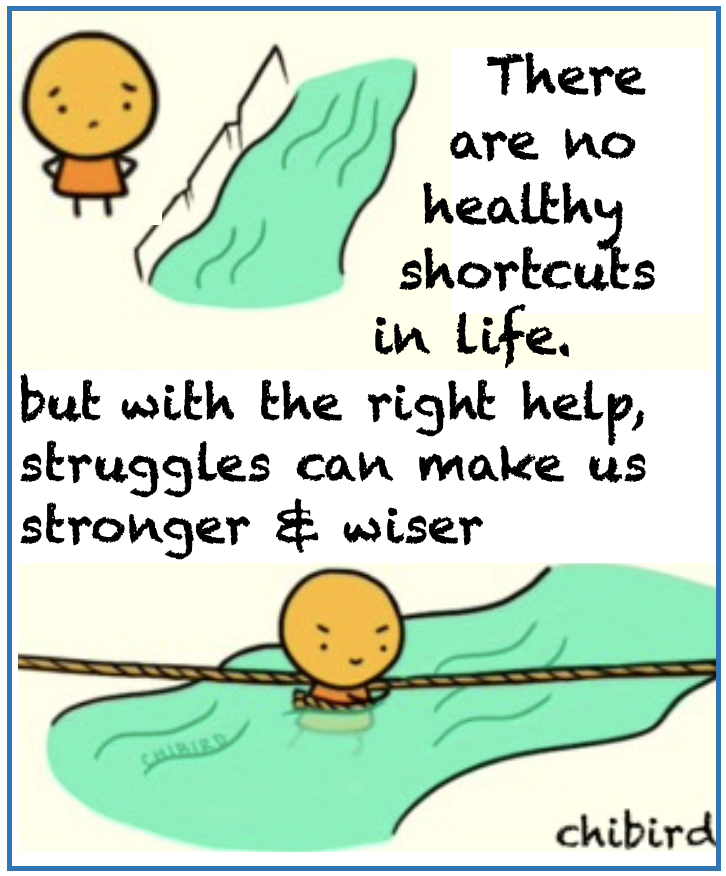
ANS: They have accumulated strong inner resources AND the right kind of external help.

We can find examples of P-TG in ancient spiritual traditions, literature, & philosophy. New studies of R. (‘benefit finding’) verify that after trauma – in spite of all their suffering – some people experience them as valuable life-changing events.
THEY:
•  are less triggered & have faster recovery time after future stressors occur
•  develop greater inner strength than they thought possible
• find unexpected possibilities open to them, & can tap into creativity
• rise to a new level of functioning, shaken out of routine or limitation
• have a new understanding of the world, & an appreciation for being alive
• have more emotional intimacy with loved ones & gain deeper spirituality

Mentally resilient people will look at any problem or difficulty & ask, ‘What are some possible solutions? , What action is most useful? , What are my available choices?, What do I need to change or improve?…..’
They see painful events as a chance to problem-solve & learn something from them – which builds confidence. They develop the habit of moving thru the pain instead of running from it,  preventing bitterness & resentments.

It makes them winners, no matter how limited their real-life options may be, because they’re happier – which is better for them & everyone around them. Realistic optimists don’t do drama. Without being in denial about the level of difficulty they face, they experience every situation in its proper proportion. For winners there are no ‘unbearable’ events. They just build their castles out of every stone life throws at them!
And they say YES to any & all good things that come their way.

NEXT: Resilience – Thinking #2

Developing RESILIENCE – Social

PREVIOUS: Resilience – HUMOR

SITE: Resiliency LINKS


SOCIAL CONNECTIONS
• Social support’s value depends on how well a person can – rely on or turn to – others for ‘presence‘, advice or encouragement.

🙂 Positive relationships:
Scientific studies show they form the external nourishment that creates the inner resources to soften harmful reaction to stress, & increases overall well-being.
For P-TG (post-trauma recovery) to be successful, people who are over-stressed need to receive & take in the benefits of social support. Resilience does not develope by suffering in isolation, but rather by surrounding oneself with the right kind of friends – & any family members with enough mental health to be encouraging companions.

Finding one or more communities (12-Step, MeetUp.com, spiritual, intellectual, political….) – with its variety of personalities – can help by sharing one’s burdens, as well as seeing one’s own troubles from new perspectives.
Groups provide a sense of connection that reduces loneliness, & can become healthy role models (not co-dep or symbiotic) to encourage a genuine sense of worth that was never received from one’s family.
EXP:  After 9/11, New Yorkers who used a variety of emotional supports had a faster recovery, with fewer PTSD symptoms.

😌 Cooperativeness – DEF: “behavior that benefits the group rather than the individual, which ultimately benefits the individual”- opposite of competitiveness.
It’s the ability to connect with others with sympathy or empathy, rather than being emotionally insensitive. It’s evaluated in terms of how – forgiving, helpful, principled & tolerant – someone is. Helthy cooperative people (not co-deps) are able to accept, even empathize with another’s point of view or behavior, even when those are unhealthy or contrary to their own.  When there are conflicts, ‘centered’ people don’t lose sight of their own principles while working out solutions to get the best results for everyone. In terms of resiliency, when we cooperate we’re less stuck in our pain

😇 Acts of Kindness: Giving a moment of oneself to others is tied to P-TG resilience. Acts of altruism decrease stress & encourages the giver’s mental health. Volunteering has been found to increase self-worth & the sense of efficacy, adding meaning & purpose. (“I have an effect on my world, I matter, I can make a difference”)

Studies have found that the beneficial effects of serotonin (the ‘happiness & comfort’ neuro-transmitter) increases in people who have just engaged in an act of kindness.
This chemical boost is cumulative. Adding generous actions to one’s life – consistent or periodic – increases serotonin’s benefits exponentially, so that in times of difficulty there is a well of resiliency to draw from.

Psychologists named the euphoria of generosity ‘helpers high’, which has been backed by neuroscience. “Giving” produces endorphins in the brain that makes us feel good, in the same area as when we get a reward or experience other pleasures.

🥲 Purpose & Meaning: Any adult experiencing severe trauma can have their inner foundation shaken, but even more so for those with wounded backgrounds. New painful events can re-traumatize ACAs, increasing self-doubt & fear about their future in an unsafe world. We all want to make sense of bad things, but that’s not always possible. Even so, we need to have a purpose to our own life, no matter the circumstances.

Finding hope can be hard in times of extreme stress, but hope is exactly what fuels resilience. Hope empowers & motivates people to believe in the possibility of a manageable, if not a brighter, future – seeing it as worth participating in.
BUT it must be based in what’s possible. EXP: Hope that a battering mate will wake up one day & become kind – is not hope – it’s denial!

When hope is realistic, acting-as-if can actually create the energy & drive needed to keep going, generating more hope in the process. Hope fuels our capacity to:
1. dream up goals/ plans
2. create specific strategies for accomplishing them
3. generate & sustain the momentum to carrying them out

T.E.A. Those who have enough resilience can help (A) others in the aftermath of traumatic events (but not ‘rescue’). One person’s support can be crucial in developing another’s resilience. It can encourage the distressed person to build P-TG by increase their optimism, positive emotions (E), & self-esteem. When they come to believe (T) in their ability to overcome difficulties & losses, they end up better adjusted.

NEXT: Resilience – Thinking #1

Developing RESILIENCE – Humor

PREVIOUS: Resilience – Individual, #2

SITEs:   Creating Resilience thru Humor

• Building Resiliency in Children Through Humor


HUMOR
Being able to laugh is a very important ability, which represents intelligence, imagination & emotional release – all part of resilience. It’s so important that Alice Miller (“For Your Own Good” & other books) observed that murderers & other psychopaths do not have the capacity for humor – needed as a release valve for anger & frustration – so they take their rage out on others instead.

People under duress who can use humor to cope are much more resilient. Norman Cousins used the Marx Bothers movies to help heal his illness (along with Vit C). With humor, people suffering bereavement, major illness, war…. experience less hopelessness & depression. Those in a high-stress careers (like cops) will often make jokes in the face of tragedy & suffering, & the USO sends comedians to the front lines…..

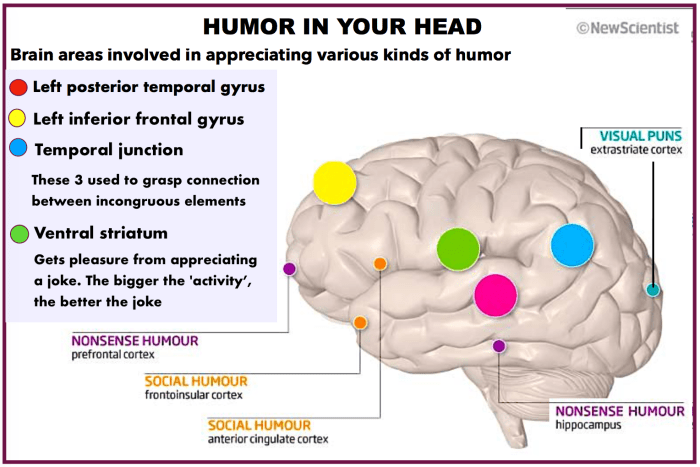
Recent research says that humor requires a tremendous amount of brain power. “Getting a joke would seem, on the surface, to be an intuitive but trivial process. Instead, brain imaging shows that there’s more going on than we might think.” (Andrea Samson – Switzerland). .(More info)

«
But unrecovered ACAs
can have a hard time finding anything funny. After all, growing up in a very painful environment left little room for humor – unless it came in the form of cruel teasing or clever sarcasm, which was just passive-aggressive anger! There was nothing funny about the yelling, fighting, isolation, drunkenness, beatings, put-downs, mental illness…..

That’s why, as adults, we need to add some humor into every day –  being around people who are funny in good ways, finding the irony in daily events, watching stand-up, funny movies, comedies….

EXP: Comics like Robin Williams, Gabriel Iglesias or Jeff Dunham — but not like Sam Kinison, Andrew Dice Clay, Andy Kaufman.... Apologies to anyone who likes any of the last 3.
There may be an exception in Lewis Black – his anger makes sense about a lot of things, but especially if you’re into liberal political commentary.
Then there’s always Bill Engvall, or Ron White (the clever, sexy, overweight, blatant alcoholic 😀 – if you like that type 🤠)…..
And YES, there are lots of great women too, as in the “10 Greatest Female Comedians“.

Keep in mind that we are now the parent to our Inner Child/ Children – who still take in everything around them – little pitchers have big ears – so it’s up to us to protect them from PPT (people, places & things) that are too harsh or gross – given our WIC’s high anxiety level & many terrible experiences, even if our adult-self doesn’t mind.

Some people like ‘gallows humor’, because laughing at someone else’ misfortune makes them feel superior. Ugh! We got enough of that as kids !!
😨 And then there are the self-deprecating ACAs who continually make fun of themself AND demand that others be amused by it – as if it’s so clever.
EXP: Sheara once has a sponsee who did that, & when Sheara didn’t laugh, the young woman said “What’s the matter, don’t you have a sense of humor?” The sponsor’s response : “I don’t find self-hate funny!” 😂

Interesting: A study was done in the US with 201 adult twin pairs, to see if there might be a connection between ‘mental toughness’ & humor styles.
• Mental toughness = measure of a person’s resilience & confidence, that may predict success in sports, education & the workplace. Characteristics : Emotional Control, Control over life events, Confidence in Abilities, Interpersonal /Social Confidence…… (Qualities to develop it)
• Humor styles = 2 Positives (affiliative, self-enhancing) & 2 negatives (aggressive, self-defeating) (Descriptions)

Participants took assessment test on both factors. RESULTS: There was a Positive correlation between the positive humor styles and all but one of the mental toughness factors. Conversely, no correlations were found between any mental toughness factor & negative humor styles.
SO – the healthier a person’s mind, the less interest there is in negative-style humor!

When listening to humor or anything else – consider your emotions & physical sensations! Does it feel uplifting, are you happier, relaxed, relieved…. or uncomfortable, angry, grossed out…. You do not have to hate-listen/ hate-watch/ hate-read – anything, or stay anywhere that hurts.
Al-Anon teaches: “Go where it’s warm”!

NEXT: Resilience – Social

Developing RESILIENCE – Individual (Part 2)


PREVIOUS: Resilience – individual #1

SITE: 25 Resiliency Affirmations   // IMAGE above

2. SELF-DIRECTEDNESS (Part 1)

3. FAILING & Resilience
The secret of very successful people is their ability to handle situations that don’t turn out well – somewhere along the way. Because they’re willing to risk trying, trying, trying – to achieve their goals – they can rack up a lot of rejection from others & /or failures from their own efforts.

EXPs : Thomas Edison, J.K. Rowling, Col. Sanders…..). A key factor in their success was that they put all their efforts into something they deeply believed in AND that was actually achievable. 

Rs use each disappointment as an opportunity to :
◎ figure out what went wrong (procedures, methods, their skill level, presentation….), & then make corrections  OR
◎ recognize their main task is to find the right person or venue for their product or skill.
They do not waste time second-guessing themself, beating themself up, wondering what’s wrong with them, trying to figure out what everyone else may want, or thinking the universe is against them!
The combination of objective learning & perseverance keeps them on track – & eventually they reach their goal. The bigger the risk, the bigger the payoff.

IMP: As recovering ACAs, we can make that shift in perspective – to accept  the need for process, which includes not knowing everything, sometimes making mistakes, cutting big jobs into bite size pieces, & never giving up.  This is so hard, because we may have done all that with / for our family – & never got anywhere.
★ But we didn’t actually fail, because our goal in childhood was impossible to achieve.
⭐︎ Perseverance is only useful if we push for what’s realistic. Part 3 of the Serenity Prayer says: “…and the wisdom to know the difference” – but we keep getting it backwards!
For perspective, try documenting (Excel?), every time you’ve been turned down, made a mess or missed the mark – when working on a project or toward a goal.
⭐︎ Then put it side by side with every success, every compliment, every paycheck! You may find your thinking shifts. Whatever you lack may not be as big or bad as you thought. You may have many more up-sides. Take that in!

4. PHYSICAL HEALTH & Resilience
We’ve all heard “Healthy body, healthy mind”. Body gurus insist that ‘to make healthy decisions in life, you have to lead a healthy (physical) life.’
Research suggests that as little as 10 minutes of exercise increases blood flow to the brain, & spending 20 minutes outside in nice weather leads to “more expansive, open thinking – a pro-resiliency mindset”.
Other studies say that time in nature helps combat anxiety & depression, improves immunity, & lowers inflammatory chemicals in the body. These are all true.

And it’s also true that long-term depression, environmental illness, severe dyslexia…. messes with our thinking & motivation, and auto-immune diseases require constant vigilance. But in many cases the right meds, location change, certain foods & supplements, Meetings & psychotherapy —-> improve well-being.

Yes, one component of “Inner Resources” is physical stamina. However, basing mental health (& resilience) primarily on physical functioning implies that if we don’t have a sound body, our mind will inevitably be – what??? confused, fuzzy, depressed, unfocused, a ‘mess’, weak…. ??? NO!
There are people everywhere with severe disabilities whose minds & hearts are not only resilient – but who soar!

• The obvious example is Stephen Hawking. He was diagnosed at 21 & was expected to die in 2 years, yet lived until age 76, continuing his work in spite of an extreme disability
• Consider how much Frida Kahlo accomplished, in spite of being in constant physical agony (polio & bus accident)
• And what about the elderly Christian lady who became permanently bedridden, & then spent all her time praying for other people, from requests sent to her from all over the US?

• There are children in cancer wards (often terminal) with better attitudes than most healthy people. And there are adults who have survived cancer treatment but have residual side-effect that debilitate, yet have a positive mental perspective
• And we’ve read about blind people who water-ski, bike ride, take pictures…. or have world-wide musical careers; or people with ALS, Down Syn…. or deafness – with successful acting careers….

These & many more are all people whose mental state in/was grounded solidly in a clear sense of themself & in positive beliefs. Their lives are/were not limited by their physical limitations.

NEXT: Resilience & Humor

Developing RESILIENCE – Individual (Part 1)

PREVIOUS: Resilience – Personality

SITE: 12 Easy Ways to Build Your Resilience at Work


1. CHARACTER
Review: Resilience is all about being able to get thru life’s difficulties & then bounce back – either to a previous level, if that was acceptable – or to an internal & external upgrade, if needed (Post-Traumatic Growth).

As listed in Resiliency – Traits‘, healthy internal resources are a foundation for thriving – in general,  but especially needed in times of stress – to solve problems or just to stay afloat. They include:
creativity, confidence, courage, gratitude, humor, kindness, optimism, persistence & spirituality.

2. SELF-DIRECTEDNESS
In “Resilience – Personality“, this trait is identified as crucial to successfully managing all sorts of problems. It means the person is their own motivator, not pushed around by other people’s needs & wishes. It’s the opposite of co-dependence, which comes from violation of our deepest values causes guilt, shame & anxiety.

✅  Being self-directed is only about adults. By definition, children are directed by others, but healthy parents teach them to develop this quality, so they can eventually function both autonomously & inter-dependently with others. This eliminates the need for the compulsive, constant “Harm-Avoidance” of most ACoAs.

Naturally, appropriate harm-avoidance is part of being resilient – the wisdom of staying away from PPT that drain energy & have little or nothing to give back. At the same time resilient people (Rs) do not assume everyone & everything are potentially ‘dangerous’ to their well-being. They trust their own observations & intuition to distinguish safe from unsafe.

PREPARED : In order to already have self-directedness, Rs would have had to grow up with a consistent sense of efficacy – the actual experience of having an effect on their environment (not just in fantasy), starting with parents.  As children, it meant that —
✧ they never needed to be in charge of drunks, siblings, the depressed, a dying relative, all the chores….. since these were not part of their family system
✧ they were not left to their own devices to figure things out without guidance or supervision

As children, in a healthy family  —
• It would mean THEIR needs were heard & provided, whenever possible – instead of having to ignore & suppress them.
• It would mean they were listened to when unhappy (comforted & validated), had a legitimate need ($ for school), a problem to be solved (a school bully), a passionate desire (for karate or piano lessons)…. without being ignored, shamed or punished.

• It would mean they were allowed to gradually figure out their own natural way of thinking, feeling & doing things – with age-appropriate boundaries, but without being forced into a mold that didn’t fit
• It would mean that the adults paid attention & responded well when the child objected to how they were being treated, or pushed in a direction that ‘isn’t me’
• It would mean the children were supported in exploring their own interests, as well as encouraged to expand their talents & dreams a little beyond their comfort

Adults with some or all of these early benefits became their own motivator, instead of having to rely on everyone else to tell them what to be & do – “a strong sense of ownership over their fate”. Self-directedness means having a gut-knowledge of their choices & actions, empowered to be the best they can in the circumstances, & so never need to see themselves as victims.

Self-Regulation (re. Actions)
Being in the driver’s seat of their life, self-focused Rs are strongly motivated, with concentration & effort – in both planning & execution. Having an ‘Internal Locus of Control’ means the ability to act in their own long-term best interest, consistent with their principles & beliefs. This is especially true when trying to master a skill – hopefully one that interests them a great deal. It would require being goal-oriented, responsible, reliable & resourceful.

✧ They’re able to focus attention on small tasks or big goals, without obsessing about what others think or want – while also taking into account possible consequences to self & others.
✧ They do not take responsibility for things out of their control, but manage to cope using available resources.
✧They do accept responsibility for their own problems, without self-judgement or blaming others, so they can learn from any mistakes, & then continue toward their end-point.
♥️ And they evaluate their progress or achievements realistically, valuing & enjoying the fruits of their talent & labor.

NEXT: Resilience – individual #2