PARENTS BLAMING US (Part 1) 

being blamedWHY IS IT ALWAYS MY FAULT?
No matter what I do, it’s wrong!

PREVIOUS: Rebellion vs Compliance #2

SEE posts : What is Guilt?
What is Shame?
• ACoAs’ Need for Revenge


INTRO

There is a lot of talk in the ‘spiritual’ community about forgiveness, ie – that we should not be blamers.
Not blaming ourself (S-H) or others (attacks) is a good rule for us in the present – now that we’re adults. And that’s a discussion for another post.

However, those same teachers & preachers never talk about what was done to us as kids – that among many other types of harm, our parents unfairly, inappropriately blamed us for all kinds of things – and what that did to our tender & vulnerable developing sense of identity!

This post is about what happened TO US as children. A hallmark of alcoholic & other emotionally unhealthy families is the mistreatment of their children in all 4 of life’s aspects: Spiritual, Emotional, Mental, Physical (PMES).

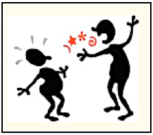
😿 Parents blaming their children for ANYTHING is ABUSIVE. Blaming us is the same as holding us responsible for their deficiencies & unhappiness.

Remember – abuse is not just Physical, in its various forms. Abuse encompasses all the ways people harm others – especially their children – by injuring another’s rights, self-esteem, mental clarity, sense of safety, emotional equilibrium & boundaries. So Blame fits into the other 3 categories – M, E & S..

👥 A variation on parental Blame is a constant and negative COMPARISON of a living child to a dead or other living sibling, another relative, a famous person….  “Why can’t you be more like ____”

1. IN OUR CHILDHOOD
✅ Damaged parents blamed YOU for things WHICH :
a. were NOT your fault
• your difficulties because of a learning disability, like dyslexia or ADD
• the illness or death of a parent; a parent being left by a lover or spouse..

b. was a projection
of what the parents were guilty of being (fearful, irresponsible, lazy, feeling unlovable, risk-averse….)

c. you were not doing
what you were accused of
• being a ‘whore’ when you were too young to have had sex at all OR
• of seducing a parent’s lover/ spouse, when that adult was actually sexually abusing the child
• of using drugs when you never did – at least not at the point…) Screen Shot 2016-06-12 at 5.07.37 AM
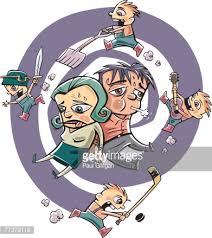
d. you could not do, especially without any instruction, & then accused of being stupid
• when you legitimately couldn’t know something (fixing a car or other machinery, shopping by yourself, def. of a big word…)
• ‘getting’ a hard school subject
• expected to know how to fix a parent’s personal, sexual & financial problems
• forced to take care of a drunk or crazy parent, alone…
WHICH
e. were truly no one’s fault. EXP :  • an act of God
• being born with a physical or mental limitation
•  getting severely ill or having an accident…

f. you were held responsible for –
 something one of your siblings or other child did, especially if you were the Hero or Scapegoat (start a fight; steal or break something; get into trouble at school…)

g. your parents were jealous of, because they couldn’t do something you could, even as a youngster (a natural skill or gift), so they made that ability stupid or a bad thing

h. was mostly not true
always lying (“Kids always lie so we can’t believe anything they say”)
always being stubborn, selfish, too sensitive, difficult, disobedient, stupid….

➼ This last category are a group of normal childhood characteristics which:
√ sick parent cannot tolerate because of their own issues
√ occur sometimes as a defense in the child because of family abuse & neglect…
√ happens occasionally because kids are human ie. imperfect.
Those behaviors & attitudes then get demonized – which make them a ‘sin’ and more likely to continue, causing the child to TRY becoming perfect’. We CAN’T WIN in a sick environment.

NEXT: ACoAs’ need for revenge
Anger – CATEGORIES : Powerless, Rebel, Retaliatory (#12)

small red a.b.

I’LL GET YOU – if it’s the last thing I do!

PREVIOUS: Anger categories #11

SITE: “Violent Communication & child abuse…..


OTHER Anger-EXPRESSIONS (cont)

▪️PASSIVE anger
When we avoid dealing with any situation that severely upsets us, we’re likely suppressing both the awareness & the expressions of anger.
The underlying belief is that “I must never make anyone else uncomfortable, disappointed or displeased…. but it’s perfectly acceptable if I am”
This shows up as being emotionally self-dishonest, anxious, helpless, invisible, manipulated :
💭 Passives (Victims) – we let others choose for us, are inhibited, self-denying, always on the losing end of win-lose, only accidentally or indirectly getting what we want

🔻The Passive’s assumption is that their self-denial will produce the result they deeply desire – by being totally inoffensive – everyone will approve of & want to be with them.
Sad IRONY
▫️ Their rights are continually violated, while everyone else achieves their goals – at the victim’s expense
▫️ Other people will eventually become frustrated with the Passive’s wishy-washy-ness, costing them respect & credibility, AND make others angry
▫️ They’re never fully trusted because no one can tell where they stand. Some people may feel guilt or superiority – for taking advantage of that weakness
SO
Passives’ constant disappointment generates a lot of anger, which has to stay hidden. However it can also show up, indirectly as being resentful, holding a grudge, spreading nasty rumors, turning a cold-shoulder……

▪️REBELLIOUS anger
Rebellion in teens is a ‘normal’ stage of development, not automatically an indictment of their parents’ personalities or way of life. The need is to separate & individuate (S & I) from the adults, in order to develop their own Identity. It does not have to be severe or destructive.

In relatively healthy families it most often shows up as contrariness – constant disagreements with parental mores & points of view. Anger at family restrictions is a way to form necessary boundaries.
If allowed to run it’s course, young people will eventually settle into a way of life that suits themself & may actually end up agreeing with the family in some basic respects.

rebellion• However, in dysfunctional/ abusive families, any disagreement is seen as a threat to the whole fabric of the system (see Family Mobile)
While one or more children will become the ‘good boy or girl”, at least one other may become the rebellious, angry ‘difficult’ one, taking on the Scapegoat Toxic Role. Such children may be continually punished, accused of disloyalty, &/or thrown out.  It makes sense this child will conclude that since “No one cares about me, everyone thinks I’m bad – I might as well be bad” !!

As adults
– Rebellious anger is most often directed at any form of authority – being sullen & withdrawn or openly defiant, joining up with other unhappy peers, & show up in all kinds of anti-social behavior. It’s rage that’s projected onto others which we deny feeling about our family’s neglect incompetence, & many forms of abuse.

▪️RETALIATORY / revenge anger
This is another very dangerous type of anger – a primitive, destructive, violent response to a personal insult, injury or humiliation from others. It can surface as a direct response to someone else lashing out at us, but our intuitive ‘logic’ about wanting revenge is often twisted, conflicted & small-minded.

Sometimes the trigger is a real-world situation, other times it’s only a perceived wrong. Either way the intensity of our reaction will dependent on how much a current event reminds us of childhood hurts & disappointments.
Revenge-actions include being over-harsh, refusing to forgive & forget, bringing up hurtful memories from the past….

Anger + Violence = REVENGE
👹 Using ‘Violent Communication‘ toward bullies / intimidators can easily make them switch to the Revenge cycle, so the punishment doled out to the ‘Enemy’ (you) continues to grow.

Anger in the form of Revenge only encourages the problem, perpetuating the cycle of violence. No matter how much we want justice or pay-back, the cycle always ends in one person being a Victim. It never leads to a resolution. (SITE:R – will it make you feel better?“).

INTERESTING: Complete outline of Hamlet’s Revenges

NEXT: Anger categories #13

Anger – Ways to REACT (Part 3)

escape

I LOSE MYSELF IN ESCAPE
when I can’t face my ange

PREVIOUS: Ways to react (#2)


LEVELS of anger – Variations
4. Three TYPES
(cont.)
a. Hidden Type (Part 1)
b. Habitually IRRITATED Type  // c. EXPLOSIVE  (Part 2)

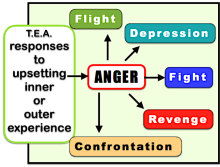
5. Anger EXPRESSIONS (CHART by Don Lehman Jr ↘️)
e. Last Compassionate Confrontationin next Post (#4)

a. Flight = (internal) running away from someone who is angry or is triggering our anger. This starts internally – shutting down emotionally, but can also take the form of temporary physical paralysis, leaving the situation as soon as possible, or permanently avoiding angry people / situations (isolation).
Sometimes the Flight response encourages aggression in the other person, if they feel disrespected or abandoned, adding to our Fear/Terror

Flight in adults is:
√ most often an inappropriate response to a current event – which may in fact not be abusive at all but is experienced that way – as a PTSD reaction from long-term childhood trauma
OR
√ appropriate when there’s a very real present-day abuser we need to get away from, which can be emotional & psychological, or a threat of imminent physical danger

b. Depression = (internal), when anger is not dealt with, & gets turned inward on oneself
• Lashing out can cause guilt & alienation, leading to depression OR
• Long-term depression creates isolation, make emotions overwhelming, & increases the likelihood of anger outbursts. Breaking this cycle usually requires therapy & sometimes meds. Al-Anon & Spirituality helps too.

c. Fight = (external) a verbally or physically violent confrontation, either to what’s ‘causing’ the anger or to the angry person. Usually a Fear cover-up reaction, the other half the Fight-Flight response hard-wired in our brain for protection.fight reaction
— Appropriate when we or someone / something we love is threatened
— Not appropriate in most current cases (also part of PTSD)
NOTE:
• Someone can accidentally step on our emotional toes (land-mine) & get blasted
• Unhealthy people who know us well, know our buttons & can always push them to manipulate, punish or get back at us (sibling, boss….)
• Some are perpetrators who use anger to get ‘a rise’ out of others, which many ACoAs will fall for, since we have hidden reservoirs of anger easily tapped into
• Narcissists can easily get us riled up because of their inability to consider us at all, as if we didn’t exist…….

d. Revenge = (external, indirect) can start as a retreat, in order to attack later (Passive-Aggressive), & can be habitual but unconscious.
When it’s deliberate, it includes obsessive planning, made between injury & retaliation.    IMAGE 🔽 : “Cycle of Revenge

Considered consciously, these angry people start by evaluating the possibility of winning or losing. Because of the emotional intensity, they can easily overestimate their personal power – getting into unnecessary losing battles (Fight).

Revenge & Fight responses from an anger-victim are linked:
– Revenge as a desire foo regain control over a situation
– Revenge as retaliation for an injury (real or not). If someone is truly in a powerless position, it may seem the only option to express ‘displeasure’.
Both can lead to increasing external damage, as each pours gasoline on the emotional fire

Abused children:
– may vow to never again let themselves be vulnerable, so become hostile toward others on the theory that “a good offense is the best defense”
– may over-generalize & want to take revenge on an entire group (all men, all authorities….), only some of whom may have actually harmed them
– may be reinforced & rewarded by becoming a bully, finding that it helps raise their ‘street cred’.   (CHART + good info)

• However, if a perpetually angry person’s emotions do not completely overcome their reason so that they figure they’ll lose by using a frontal attack, (Fight) they’ll resorts to the P-A Revenge response.
Punishment is then dealt out just as in Fight, but done later – when the victim least expects it, maybe in small doses & anonymously, or may come in disguised form. (2 Posts : ACoAs wanting Revenge“)

◀️ NOTE: Not Included in Lehman’s Chart, but part of the reactive sequence:
Freeze – Blanking out / dissociated, can’t talk, muscles get physically “scared stiff”.
Freezing is fight-or-flight on hold, preparing to protect yourself even more. It’s also called ‘reactive or attentive immobility’. It involves similar physical changes, but instead you stay completely still & get ready for the next move.

Fawn – a 4th F has been added, which is basically co-dependent people-pleasing .

NEXT: Ways to react (Part 4)

Negative ReACTions to Painful Events (Anger)

daggers 

THAT SO-&-SO!
one way or another, I’m gonna get ‘im

PREVIOUS: ACTIONS – Fearful


3. ACTIONS (cont)
a. Fearful reactions

b. ANGRY reactions to painful events
💥 Attack / Revenge (sue, fight, yell…)
This is the most obvious & direct. The need  to be violent – verbally, physically or legally – is used by some ACoAs as a way of venting old pain on the world – anyone except facing the original perpetrators, if possible.
OR we may have tried every other avenue to resolve a problem, but to no avail. Then the only recourse left is to go after our tormentor directly, never considering “letting go”.

⚒ The dysfunctional ‘acting out’ of our rage is WIC’s response to decades of abuse & abandonment.  We’re not crazy, only traumatized
⚒ Continuing to be angry in the present is still wanting the impossible – to be loved & accepted by people who can not & will never be able to provide them!

Remember: When we still over-react to a particular event – it does not mean all our recovery is invalidated. Nip any S-H in the bud! “Progress, NOT Perfection”

💥 Gossip Maliciously almost any group of people in regular, long-term contact is prone to gossiping. Mostly it’s a common but unhealthy way to pass the time & connect with peers.
However, when ACoAs are in a rage at someone (X), we want to do harm, to make them look bad, in the same way we feel harmed. Then we :
• act like a victim, martyr, the ‘white hat’
• tell secrets we know about (X)
• make up false info to damage (X)‘s rep
• seduce others away from (X) – by shifting people’s allegiance to ourself

💥Make Fun Of making jokes at someone’s expense ….  While gossip & teasing is indirect, this is a more obvious way to show anger at (Y). Sometimes we believe our meanness has been earned by (Y), at other times it’s just displacing our rage at someone else like a boss, parent or mate

EXPs: Jimmy is a popular techie at a big company, who likes to ‘stir the pot’, & gets away with a lot of bad behavior using charm & gossip.  He’s taken a special dislike to an older woman, who undeservedly reminds him of his alcoholic, controlling mother. He has a key chain ornament of a cow that mo-o-os when squeezed.  For months, every time he passes the woman, he squeezes the cow & smiles impishly.  To please him, all of his coworkers are also amused.  When reprimanded, he finally stops.

💥Sulk – ‘staring daggers’ , ‘if looks could kill’ ….↖️
While this too is about not talking (being mute), it is by no means passive.  Others can feel the rage emanating from us & generally stay Screen Shot 2016-06-19 at 7.58.25 AMaway!
In this case, not saying anything may be that:
• it’s not appropriate right then (in public, at work…)
• we’re so unprepared for a nasty comment or shocked by a scary event, that we can’t find the words at that moment
• we’re afraid of our own intensity – that we’ll do some long-term damage, either physical or emotional, if we let fly
OR • we’re afraid of being punished if we speak up, & we could be

EXP: Zina worked for an active alcoholic who constantly pushed her buttons.  She didn’t know how to stand up for herself, felt she owed him for helping her out at the beginning, & didn’t want to lose her job. So she just fumed!
One day she overheard her boss telling someone: “That Zina has the loudest silences”! She was shocked because she hadn’t realized her (unexpressed) anger was radiating such intensity. It also made her see she needed to change jobs, which she eventually was able to do

💥Tease – always an indirect form of anger & is always abusive. It’s a way to ‘get back at’ someone by using a personal trait against them – their name, size, religion ethnicity, way of talking….. such as ‘hazing’ a new student or employee. It’s a form of adult scapegoating, & leaves permanent emotional scars if continually repeated.
But since teasing is couched in humor, it’s generally considered ‘good fun’, harmless & socially acceptable, therefore allowed & encouraged by others.
But teasing is toxic!

NEXT: ‘Responding Positively to Events’