ACoAs MANIPULATING Self & Others (Part 1)

controling manipulatorPREVIOUS: Multiple Intelligences

SITE: “Steve Jobs – biography by Walter Isaacson  & Commentary by Dave Smith

See ACRONYM page for abbrev.

DEFs : Manipulation (M) is made up of a series of statement &/or actions, always indirectly trying to &/or succeeding in get our needs/wants met, in round-about ways


Normal – must be used sparingly, & only when there is no other legitimate option. When used for good, one can try to manipulate others to help a worthy cause, but even when well-intended, for M to be effective it has to target people’s weak spots

Unhealthy  – Because M is never straightforward, it’s hard to spot, especially when used by an experiences & skilled perpetrator, for strictly selfish reasons (narcissistically).
The subtle control of M can easily be overlooked or denied – our awareness buried under obligation, love, guilt, fear of abuse, FoA & long-term exposure

Severe – A perpetrator / bully forcefully controls another person or group who feel or actually are powerless to resist (child, battered spouse, sex slaves, gang members, war victims…..) to satisfy the manipulator’s ‘sick’ needs

PURPOSE – For ACoAs, addicts & other wounded people:
M. is used to try getting needs/wants met by underhanded tactics, to extract from other PPT something they may or not want to give
OR trying to force PPT (person, group, environment) to provide something we need/want which they actually do not have tomental fitness pyramid give
AND which in many cases we can provide for ourselves OR find a more direct way of obtaining something we lack – from appropriate sources

Re. NEEDS: It’s important to note the 2 major categories of needs.
Without deep FoO work we compulsively, slavishly insist on reinforcing unhealthy childhood patterns.
This insures that we stay deprived the same ways we were back then.
Normal needs
a: Those which EVERYONE has, & which we can’t get rid of because they’re fundamental to our humanity

b: Needs specific to YOU, based on your native personality
EXP: need to be/live near water, or other outdoor nature // to be artistic/creative // to be orderly/organized….

c. AND to some degree your specific needs in response to repeated harmful childhood PTSDevents & severe trauma
EXP:
— need to live in one location for the rest of one’s life after moving 10-20 times as kid
— need to not be around crazy/angry people – at all, ever!
— need for a great deal of predictability…..

Unhealthy ‘needs’ / compulsive desires TO —
• please & be approved of by parents who can’t be pleased
• stay in unhappy, unsuitable or abusive relationships, jobs…. for fear of abandonment & disobeying Toxic Rules
• hang on to negative thinking & actions, believing it’s ‘safe’
• keep using addictions (sex, food, spending, internet, chemicals….)
so we don’t have to face the pain underneath

• keep trying to fix other people, especially those who don’t want to change/grow/improve
• keep chasing people who don’t want to connect with us, always finding the one person in the group who will reject us
• always be one-up on others, to show off, to act superior
• grab & hang on to position, power, status…. at any cost to others
• always be the center of attention   (Add your own)

MANIPULATIONsqueeze my brain
General:  serving a hidden agenda, to coerce others into giving in. Perpetual manipulators present themselves as strong & in control, but underneath – have a great deal of insecurity & a deep sense of personal powerlessness to get their needs met – directly. They can’t connect to or keep healthy, loving relationships

vs Influenceinfluence
Used on others to advance a goal, a mark of normal social interactions – in general, & a way of functioning effectively in the world – personally. Uses direct, honest communication, recognizing the integrity, boundaries & rights of others, including the right to not go along with the attempted persuasion

vs Boundaries (Bs)
Knowing our rights & personal needs so well that we can set Bs byB invade telling others what’s acceptable & what’s not. Like with influence, it’s also direct, but a way of getting our needs met without depending on other people’s help or co-operation. Comes from having permission to provide for oneself, & having access to choices

vs
Personality Disorders (PDs)

In PDs, manipulation is a defensive style permeating a person’s every interaction, even tho they may hide their true intention, & act in ways that look ‘normal’, which in itself is a manipulation.

NEXT : Manipulating OURSELVES (Part 2a)

ACoAs being SCAPEGOATED (Part 5)

pointing finger

 IT HELPS TO KNOW – I’m not the ‘crazy’ on

PREVIOUS: Scapegoating #4

SITEScapegoating in Families-What We Need to Know

QUOTE: “Most of the time, victims sense that their attacker is a threat, but ignore this inner knowing.” from The Gift of Fear ~ Gavin De Becker, Criminologist

3. Scapegoat-ed CHILD
4. CONSEQUENCES for the SCAPEGOAT

5. Scapegoat-ING ADULT  (towards a parent, boss, mate, adult-child….) Just las in Double Binds, scapegoating can be called “enemy behavior against an innocent & helpless victim”, because the real source of the abuser’s frustration is
• at themselves, but denying S-H
• at someone else who’s not available to be attacked
• someone in their life who’s unsafe to confront

Their frustration is projected on to others (Thoughts) & then acted out (Behavior), usually a person or group without supporters or otherwise can’t protect themselves.  Even if others observe the abuse, they rarely want to get involved, so the victim stays unprotected & alone.

HABITUAL scapegoaters are irritatingly smug, managing to convince themselves that the way they’re treating the Sc is somehow justified. But behind the facade, they’re actually miserable, extremely dissatisfied with themselves & life in general. It’s expressed as hostility – at the least punitive, at the worst sadistic.

Just like double-binders, they raise themselves up by lowering another person, getting narcissistic satisfaction from being controlling, & some from torturing the Sc. Scapegoating is their self-righteous discharge of aggression, which momentarily frees them from a little of their own S-H & inner powerlessness

Narcissists (Ns being overt, & Co-deps because they’re covert Ns) generally blame their bad behavior – addictions, emotional immaturity, volatility, cruelty – on other people or things (partnersangry-father-scolding-son, children, the weather, the ‘system’….)
They’re master fantasists – no one is better than an N for looking directly at another person & only seeing who they want/need that person to be

EXP: When a N parent considers their child, they see many things: a source of narcissistic supply, an ally or obstacle to their lust for personal power, a string of intolerable annoyances, the inconvenience of the child’s emotions & needs, unwanted personal limitations, someone to rescue & take care of them or to take their frustrations out on…. BUT never the actual child.

Scapegoaters’ main characteristics are cowardice, dishonesty, egotism, immaturity, pride, self-righteousness & weak character, with Borderline, Narcissistic or Histrionic Personality Disorders.
They live through a manufactured looking-good public image they desperately need. ANY truth-telling child or other adult who challenges it risks destroying everything, so they have to be stopped at all costs!

• Scapegoaters are not in touch with most of their emotions, rarely knowing how full of hate they really are. They just feel dissatisfied & frustrated, while ‘blissfully’ unaware of the original source of their hurt & resulting ragecenteroftheuniverse

• Since self-deception is a major trait, the Perpetrator’s (P) drive to displace & transfer responsibility away from themselves may not be totally conscious, which makes it easy to cut off any guilt or shame, & deny what they’re doing.
But even if they do become aware of the actual cause of their unhappiness, they can’t or won’t direct their anger where it truly belongs – usually their original family

• To deal with their deep anxiety, scapegoaters will rationalize that this specific victim \ group is somehow responsible for their frustration.
A perfect candidate can be anyone who reminds them of the person who originally injured them (parents or parent-figures). They look for someone who’s not socially confident, is emotionally over-reactive, anxious & self-hating – which makes them an easy target

• Often the main scapegoater (parent, spouse, teacher….) has a good social standing in their community, & some power. Naturally they don’t want to lose either one – at any price. If the Perpetrator consciously knows the victim is innocent, they may increase the attacks, to keep their house-of-cards standing, & keep the upper hand
Assistant scapegoaters will also add to the fire, to stay in the P’s good graces, & to never admit they’ve been gullible – being manipulated into blaming the innocent

• In milder cases, occasional scapegoaters can be anyone temporarily angry & dissatisfied, who uses this tactic as a relief valve. If they’re not too damaged they will experience some shame & guilt afterwards, & pull back.

NEXT: ACoAs being Scapegoated (Part 6)

Anger TYPES (Part 2)

PREVIOUS: Anger TYPES (Part 1)

SITEs: The Primacy of Anger Problems
Anger Problems: A Smokescreen for Fear-Shame Phobia
• 5-min. stress release exercise (Green : Anger —-> Compassion, Love)

⬆️ HAND : Emotions for each finger (painful & pleasant forms), with  senses & body areas, & how they’re connected to the Spinal Column 

🌐
DEGREES of FEAR & ANGER
We can use the temperature chart below to stay aware of what we’re T.E.A. chartfeeling, mainly driven by what we’re thinking, since the combination directly effects how we act (TEAs)

• Whenever possible, especially around people we don’t know, are not close to, or who are unhealthy (active addicts & other narcissists), it’s self-protective & appropriate to only show how we feel on the outside of the Emotion Circle 🔽, because those reactions are milder.Screen Shot 2014-12-26 at 10.41.37 PM
In most social situations, people will be more comfortable around us if we’re ‘tentative’ or ‘pleasant’ — > rather than ‘hysterical’, ‘aggravated’ or ‘enraged’…. making us more likable, which we all want, whether we admit it to ourselves or not. ( 2 CHARTS )

ALSO, if we do let out how we actually feel – from the center of the circle (intense) – it can influence others to become reactive too, as a result of echoing our feelings (via mirror neurons), so that when we:
• get enraged, others may also get angry
• feel depressed, others can get ‘down’,
JUST AS when we:
• get exited, others tend to also feel happy
• feel calm, others can feel more relaxed

REMINDER: This in not to deny our emotions, nor to be co-dependent – worrying about how others feel. Always distinguish between having an emotion & expressing it. It is a reminder :
➼ to stay awake for what’s going on inside, & work on letting the Adult ego state be more in charge, rather than the WIC
AND
➼ that we do have an effect on others – surprise, surprise! which many of us don’t realize – or believe – since our family never saw or responded to the REAL us.

For many of us, we were treated only as a burden, a nuisance or as a useful ‘tool’. 
So now we need to become visible to ourself & choose healthy people to correctly mirror us (validate) – people who have good boundaries & a clear sense of their own True Self.  (MORE…..The Anger Thermostat)

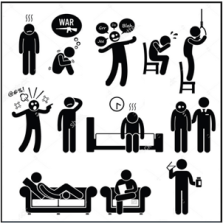
Anger as predictive SYMPTOM of Psychological Disorders

Intermittent Explosive Disorder (IED)emotional illness
Periodic eruptions of anger & rage, which are not in proportion to circumstances, most commonly seen in impulsive young men – but also for some ACoAs.
In this state they may threaten, assault others, harm themself, &/or destroy property. Such eruptions come after a period of heightened internal tension, followed by a feeling of emotional release, & then immediate regret

Depressive Disorders
Diminished self-esteem, heightened self-pity, irritability, low mood, low frustration tolerance – can create anger-control problems. Men are less likely to report depression & anxiety, with ego-shame an underlying cause. For women it’s more likely fear-of-abandonment, loss & rejection.

Anxiety Disorders
Sufferers of Depression & Anxiety are often in a continual state of tension. Their overworked nervous system alternates between hyper-arousal & exhaustion, priming the brain for an anger or rage reaction.

This group includes those with Generalized Anxiety, Panic attacks, PTSD, & Phobias. Also, OCD (mainly physical), setting the stage for resentments, because the person is more likely to hang on to envy / jealousy, fear of abandonment, & fantasies of being disrespected, harmed or victimized – in the present.

Personality Disorders are characterized by overall rigidity & denial.
Obsessive Compulsives : OCPD – mainly psychological, and OCD -mainly chemical – sufferers act as if their life depends on reaching a particular goal or having their demands met. Anger rises when those are frustrated. They are demanding, judgmental & perfectionistic.

Narcissists (NPD) are subject to rage reactions when their desperate need for attention or admiration is frustrated
• Histrionics (HPD) are vulnerable to angry outbursts when emotionally flooded
• Borderlines (BPD) are exceptionally vulnerable to anger because of weak or nonexistent sense of belonging & self-worth. This causes a roller-coaster emotionality, with rage reactions & unstable relationships.  (See all Psych Disorder posts w/ extended info).

CONSTRUCTIVE ANGER
In contrast, for healthy people, anger comes from their Adult ego state, in response to a specific present-day issue, prompting us to act in a positive way to protect against danger, to remove an obstacle in our path, or to right an injustice. (More in other posts).

NEXT: ANGER – ways to react (Part 1)