Al-Anon STEP 10 – Comments (Part 2)


PREVIOUS : 10th Step #1

SITE: 10th Step Worksheet 

A Study of Step 10 


AA/ Al-Anon Step 10 : “Continued to take personal inventory AND when we were wrong promptly admitted it.”

1. Daily INVENTORY (cont.)
✔︎ What were my thoughts today?
NOTE: This is NOT what you said out loud – only what was in your head.
Re: Yourself – most of this list will be the self-abusing thoughts from :
✧ the PP /Introject, in the ‘You‘ form (You should have know that), OR
✧ the WIC who believe the PP as Self-Hate, in the ‘I‘ form (I’m such a failure, I can’t ___, I’ll never___ )

Re. Others – If you’re angry at someone else, the thoughts will be harsh judgments & derogatory name calling
If you’re anxious, they’ll usually be thoughts of how to placate or avoid that person – mind-reading about what they think of you

These will all be in the form of obsessions – round & round – without asking yourself what childhood button was pushed, nor looking for a solution to the situation. (POSTS: “What just happened?”)

IMAGEs: they illustrate the positive & negative sides ⏬️ of our thoughts & Es, NOT as mental illness, but actually normal in all humans
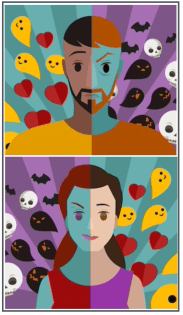
POSITIVE: Identify all helpful, kind, adult, realistic, mentally healthy thinking (“What she said had nothing to do with who I am // I’ve just reached my limit // I need help with this // that was a good meeting”…. )

✯   ✯   ✯   ✯   ✯
2. AND WHEN WE’RE WRONG  (see posts on “Being right“)

What kind of wrong(s)? First we need to distinguish between defects of character, what’s our responsibility & what’s S-H.
a. DEFECTS (same as shortcomings) can be defined as “a fault or failure to meet a certain standard….” They are basically defense mechanisms (unhealthy patterns) that all of us develop in response to a painful childhood & outside traumas

** IMP: in 12-Step ‘work’, lists of defects always include emotions. This is WRONG! Emotions are never defects – only some thinking (CDs), AND some behavior patters (abusive actions) – which together are used to deny painful emotions.

b.  RESPONSIBILITY is simply a frank acknowledgement of what we think, do & feel – or not, without judgement or self-abuse.
We can still ‘feel bad’ about hurting someone & need to make it right if possible, but it does NOT cause shame or self-abuse

c.  SELF-HATE is blaming ourself for causing ANY hurt or fear we feel, & projecting abandonment, especially if someone ignored or harmed us, or if we’re not perfect!

We also need to Identify our rights, so we know what a wrong IS or is NOT. Just because someone doesn’t like what we say or do – does not mean it was ‘a wrong’! SO, look for:

🔻 Something that was NOT ‘a wrong’ at all, but actually:
✒︎ someone else made it sound like it was. This can be from :
⚬ projecting their own disowned defect
⚬ a way to deflect blame from themself
⚬ we having pushed one of their buttons
⚬ being caught in a defect of theirs (lie, error, abuse….) which they’re ashamed of

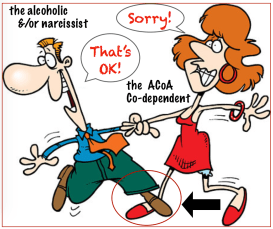
✒︎ someone hurt us & ⏫️ WE made it our fault – typical of codependents. We apologize in knee-jerk fashion, as if we caused the other person to say or do something inappropriate

✸ While this reaction is deeply ingrained in ACAs, it will most often show up when we’re around anyone who is oblivious to the effect of their actions, or who doesn’t care.
This is the WIC taking responsibility for someone else’s narcissism.
✧ It’s what we were trained to do by family & religion
✧ It’s carrying the guilt for them, since they won’t
✧ It’s as if we could teach them how to be responsible for their actions – like the alcoholic’s spouse who thinks they can ‘show’ the active drinker how to be moderate by example.

Also NOT ‘a wrong’ :
🔻 Something we were often punished for / made fun of…. as kids (family, school, religion…). It may have been normal child behaviors, or some inabilities, omissions, expressions of emotions….

This left us with a deep sense of Shame now re. expressing any imperfection which we then label as a character defect.
This emotion prevents us from thinking clearly, it silences us, makes us want to slink away, hide under the carpet, to die – the pain is so great, like a punch in the stomach!

NEXT: 10th Step, #3

ACoAs – Set GOALS to MEET NEEDS (Part 3)

positive peoplePREVIOUS: Meeting our NEEDS #2

SITE: “Asking to have your needs met

POST: #3 = “Damage Needs

1. GOALS
2. IMPLEMENTATION

3. PEOPLE
The third component to reaching our goals has to do with who we surround ourselves with.
Everyone on the planet needs a support system to function well, from family, friends, teachers… to mates, colleagues & partners, psychological helpers & spiritual leaders. And everyone needs help to implement goals – from time to time – whether it’s a store clerk or house wife, the boss who hires us or the mate we live with……

Yet ACoAs find it shameful, terrifying & enraging to have to ask for help & let anyone get too close. For us, closeness is automatically associated with physical / emotional abuse or outright abandonment. Better to do everything ourself, or simply do without.
Even so, we still do need connection, cooperation, information, intimacy, guidance, validation….. So when we try to get Help or Love, the WIC (wounded part of us) automatically go to unhealed people who are the least likely to provide it, but who can ‘feel right’ at the time, because they’re familiar – like family. We keep going to the desert to quench our thirst!self-centered

These are people who are —
— either too narcissistic to actually care about us, so we spend a lot of our time trying to get their approval, pleasing them, hanging on for fear of losing them……needy man
— or are blatantly needy, so they don’t have much to contribute, & we end up spending a lot of time, money & energy taking care of them, worrying about their feelings, trying to ‘heal’ them….

Sadly, we know how to play the game with them using all our old defenses, but never being our True Self. Their lack of emotional/spiritual health guarantees that we continue to starve in PMES ways, continuing to not S & I – staying loyal to our family’s dysfunction.

REVIEW
We grow up, we have lives, jobs, our own families, friends, interests…. but are not supposed to want anything for ourself.
So any time we actually try to, we have to ensure that we fail – to continue obeying the Toxic Family Rules. We can’t afford to know how toxic they are, so we think we’re free of our past. We insist that we’re nothing like ‘them’, it was all a long time ago, it didn’t really effect us all that much anyway……YET the WIC is still totally dependent on the PP, attached & loyal to our early training & trauma.WIC & PP

With this dependence on dysfunctional beliefs & patterns, everything we try is done with one hand tied behind our back & dragging a dead weight on our back. So any time we actually think about pursuing someone or something that can make us genuinely safe, appreciated, happy, respected…. we either put it off endlessly, or we give it a shot, but in a distorted way & with inappropriate people.
And then wonder why we never get anywhere. Most if us blame others God, the world, our spouse & children…. as well as beating ourselves up for not knowing how to do things others seem be to able to, effortlessly.

REALITY: The only way to change this ugly, self-defeating pattern is to stop obeying the PP in the way we live our lives & treat the WIC, & instead get the help we need to develop compassion for ourselves.

STAGES of GROWTH
DEPENDENCE
Stage 1 WISDOM is about tradition, belonging, power and survival

Less healthy adults set up relationships with the main objective to get another person meet all their needs. It’s trying to use others as a substitute Mother, instead of becoming their own Loving Parent.

INDEPENDENCE
Stage 2 WISDOM is about the journey of the self, and the power of personal experience & rational thinking.

We escape from the heartbreak of childhood by becoming independent. This allows us some self-sufficiency & autonomy, with more freedom & success in the short-term, but avoids admitting the pain of our original Dependence. By burying early feelings of anger & fear, we end up damaging current relationships, & rob ourself of long-term happiness.

This stage includes outgrowing:
√  the demand to be perfect, & how others should do things our way – so we can reach our goalsgrowth stages
BY letting go of having to be seen in a specific way, & by taking responsibility for the outcome of our actions

√  being controlling, which creates arguments & power struggles because of the demands we put on others
BY healing deep-seated anxiety which minimizing the need for it – with trust in ourself, in others & in the H.P. of our understanding

√ self-focused emotional disconnection (dissociation), leading to emotional & mental boredom in relationships

BY reconnecting Physically, Mentally, Emotionally & Spiritually (PMES) to ourself

INTER-DEPENDENCE
Stage 3 WISDOM is about the interconnection of everything and the mysteries of existence.

With PMES maturity , we form a stable inner core we can rely on, no matter what. This allows us to have relationships with other self-caring adults we can rely on, learn from  & enjoy. We work together to benefit our personal relationships, as well as for the good of others & the world.
We can then:
1. Reveal our True Self, full of creativity, confidence & wisdom. We have faith in a positive future, rather than living in the past
2. Respond appropriately to the emotional needs of those around us with love & compassion AND avoid self-attacks
3. Have a true sense of ‘belonging’ in the world, linked with everyone / everything else by love, experiencing the calm of Spiritual Dependence (MORE…..)

Inter-dependence makes getting our needs met & reaching our goals more likely, more often & easier – a natural part of living well.  (CHART )


NEXT: Discomfort & Comfort, #1

Anger – CATEGORIES : Envy, Frustration, Habitual (#8)

yellow a.b.I JUST CAN’T HANDLE
all the stuff I have to deal with!

PREVIOUS: A. Categories (#6)

SITE: What Your Anger May Be Hiding
(scroll to: “Anger as a ‘Safe’ Way to attach….)


OTHER Anger-EXPRESSIONS
(cont)
▪️ENVY / JEALOUSY anger
Both come from a feeling of being powerless to get what WE want /need, but do not have the right or ability to achieve.

Envy is between 2 people :
“I want what you have, which I never had (a loving family, a healthy body, the right to be who you are, good looks, an education….). OR
I may or may not want exactly what you have, but I’m not allowed 
to have what’s right for me ” (ACoA powerlessness ).
SITE re. the differences also re. God

Jealousy is between 3 or more people :jealous heart
▫️ I want who or what you have, which I never had or can’t get (lots of friends, a wonderful mate, a great boss…..) AND don’t believe I ever will
OR
▫️I’am terrified of losing of something I have or thought I had (love of my mate, connection to my children, full attention from a parent…..), because sooner or later they’ll want someone else – instead of me
EXP: Dolly Parton’s “Jolene – from her real experience

▪️FRUSTRATION anger
Frustration is the emotion we feel whenever we’re blocked from reaching a desired outcome – anywhere from the minor irritations of losing something to the major aggravation of a long-term inability to reach an important goal.
It’s often experienced when a result doesn’t match all the effort we put in to achieving something, or our work produces fewer, weaker results than we think it should have.

If the frustration goes on too long or is too great, is can make us irritable, resentful & angry. The more important the goal, the greater the frustration, resulting in anger & loss of confidence.
▫️ At worst – one can spiral downward into depression & resignation
▫️ At ‘best’, frustration can be a used to identify AND correct a problem that needs to be Screen Shot 2016-06-02 at 8.06.30 PMcorrected or changed

Internal sources can come from real personal damage OR imagined deficiencies (S-H) which prevent us from getting what we want. This can lead to turning the anger against ourself, criticizing ourself for lack of knowledge, planning, preparation, perseverance……

▫️We can stay in a frustrating situation from a mistaken belief that making life easier is a weakness, a loss of control
▫️Frustration can come from having competing goals that interfere with one another (internal DBs), even when both are positive (Child wishes vs Adult needs....).

External causes involve conditions outside ourself coming from other people or situations that get in our way. Deliberately frustrating others is an act of control, for power & status. When we are refused permission, our actions blocked or resources withdrawn – we feel angry, but it’s not always wise or safe to show it. Somethings we can get around or modify the obstacle, but others are inescapable (Serenity Prayer)
EXP: MINOR: traffic, waiting in line, put ‘on hold’, something’s sold out, crying baby on airplane…..
MAJOR: Gov’t or legal regulations, politics & bureaucracy at work, long-term / chronic illness, permanent disability, all forms of prejudice….

▪️HABITUAL Anger  (“Anger – Ways to React” #2, Chronic)
These people have the habit of always being angry, which they think makes life predictable. They’re convinced they always know what’s ‘real, so they believe that even though life may be lousy it has a shape – their anger making it ‘safe’ & stable.
The down side – their porcupine exterior insures they can’t get close to anyone – to show love to others or let themselves be loved

Trapped in a vicious loop, they start out being angry about something that made them unhappy – probably legitimate. It then morphs into a whole way of life, a vicious cycle where —> they’re angry about being unhappy & unsuccessful, which makes them angry, which keeps them unhappy…..!!

EXP: Like the stereotype mean old man who’s always cranky.  It’s his go-to response, especially when he doesn’t understand something & doesn’t want to seem stupid or out of date. And he may have given up trying to figure the world out, “too old” to learn technology or ‘get’ the younger generation…. so he can never be peaceful!

NEXT: Anger Categories (Part 8)

ACoA CONCLUSIONS re. Painful Events (Part 2a)


THEY JUST WANT TO HURT ME
– & I hate everyone!

PREVIOUS: OUR THINKING (#1b)

5 POSTS: Emotional abuse

See ACRONYM page for abbrev.


2. CONCLUSIONS – OUR
 THINKING (cont)
💦 It’s ALL ME (victim)

🔩 IT’S ALL THEM – Perpetrators
THEY are crazy, mean, unfair, stupid, stupid, stupid!

NOTE : Parts 1 a-b & 2 a-c are about what ACoAs THINK, when having a painful run-in with someone. Depending on the type of Ts (thoughts / beliefs / assumptions / judgements), how we behave tells us which specific but disowned emotions are triggered – anger, paranoia, fear or counter-phobia (between green & pink)

🔻 Being a “Perpetrator” is not always about committing a crime, domestic abuse or sexual assault. It can show up as being a “negative downer, passive-aggressive , withholding ….”, & often comes in the form of “blaming-the victim”, as many of othinling re eventsur parents did – which is emotionally assaultive

When telling our parents about being mistreated in the neighborhood, at school, a boyfriend, a boss…. we heard : “So, what did you do?” Their cruelty enraged us, but set the model for becoming a blamer as well

The Co-dependent Triangle – Victim. Perpetrator. Rescuer,
(stay away, or push away or connect by placating)

Every ACoA can switch between them at a moment’s notice – depending on the person or situation, but some live in one role more than the others

🔩 IT’S ALL THEM  crazy, mean, unfair, stupid, stupid, stupid!
⚙️Our Core emotion is ANGER

i. PERPETRATORS
In the ‘CONCLUSIONS’ category, the opposite reactions to Victim is expressed by the overtly rageful ACoAs. These attack anything & anyone we think have hurt us, whether real or not, because we can’t bear to take any responsibility for our T.E.A.s!

We passionately believe all our troubles are always other people’s fault – no matter how minor or unimportant the situation – & not just occasionally, as everyone sometimes feels, but as a life-pattern
EXP:
Carl is having a bad week. His computer isn’t working right & he can’t figure it out.  He gets an unexpected bill in the mail, & there’s no hot water.  He makes it to an interview for a gig but the club owner never shows, & to top it off, someone cuts him off on the way home.

He’s in a rage! He storms around, yelling at anyone who gets in his way. He’s so upset that he drives too fast & almost gets in an accident! “That @%!! incompetent  ÂØˆÒÏ! I can’t believe the stupidity! They shouldn’t be allowed to live”…!

•Yes, S— happens – often out of our control, although not every day! But Ragers can’t bear to ever feel powerless, so we use the defense of Blaming all our pain on others. It does not mean we should be blaming ourselves.

This approach to life is just as narcissistic as the Victims’ – “Everything is about me” – just from opposite poles. Both types are convinced we’re the butt of a cosmic joke, the universe is the cause of our suffering, dedicated to preventing us from being happy or getting our most fundamental needs met – to be loved & feel safe.

Negative THINKING
While the overtly fearful ACoAs believe they have caused every tragedy, the obviously angry ones feel victimized & totally blameless. They step on other people’s feelings & barely notice. They complain, complain, complain – not an a whiney way, but with criticism, cynicism, judgement, & sarcasm.

Their general attitude is:
• Nothing is my fault or responsibility
• Nothing matters but MY needs, opinions & feelings
• Everything & everyone is doing / not doing – something – TO me.
• Everyone (but me) is weak & stupid!
• Every delay, disappointment, flaw, mistake… from others, is disrespectful & a personal affront

EXPs: • You’re always — . You never —-
• Everyone’s so ignorant – I can’t have a decent conversation
• This place is too small. I just can’t stand it
• Look at that ugly dress. How can she show her face?
• What a lousy movie & waste of my time
• This food is awful – send it back! & the waiters are so lazy
• Look at that stupid driver. Get off the road!
• That’s HOW much? That’s outrageous
• Going there was a waste of my money ….

NEXT: CONCLUSIONS – Paranoia (2b)

ACoAs: NOT ENOUGH LOVE? (Part 2)

misisng heart


THEY SAY THEY LOVE ME
so why is there a hole in my heart?!

PREVIOUS: “Not enough Love?” #1

SITE: Can’t Fall In Love? 10 Psychological Issues That Could Be Stopping You


Where do our fearful, LOVE-LIMITING beliefs come from? (cont)
From THEM
a. Parents ISOLATING (see Part 1)

b. Our parents INTERACTING with the world:
▶ Focus – while some parents may have said they loved us, our experience was very different. The real message sent was that we didn’t count very much, leaving us deprived, because they consistently gave their ‘love’ to anything/ anyone but us:Screen Shot 2016-06-17 at 10.41.42 PM
— TO their spouse/ mates, parents, friends, religion, community
— TO their addictions, jobs/ careers, hobbies
— TO one or more of our siblings (dead or alive!)

Looking ‘Good’ – some parents, who also had all the above issues, created a facade for the public which made them seem healthy, even ‘wonderful’ – to others, such as being:
• amusing, friendly & well-liked at work
• respected public figures in their careers
• pious & scholarly in their religious circle
• popular in the local social networks, clubs, groups

• admired for doing community service, helping others in need, generous with their time & possessions ….   but at home, with their own children they were abusive, controlling, demanding,  raging, insensitive, neglectful, perfectionistic….. which left us very confused, and even more convinced that others were ok but we were unlovable!
EXP: More than one of us had a parent give our toys or clothes away to others kids / families without telling us or considering how betrayed & devastated we would feel, just to make themselves look good!

IF a PARENT:
Strapped girl▪︎ constantly teases or makes jokes at the child’s expense, “all in good fun”
▪︎ doesn’t take the child seriously, belittling any effort, wish or dream
▪︎ ignores, shushes, neglects (not warm, affectionate, responsive)
▪︎ over-controls, watches the child’s every move, always correcting
▪︎ narcissistically treats the child as an extension of themselves, rather than seeing them as a legitimately separate being
▪︎ puts down, verbally harasses, judges, criticizes
▪︎ uses a child as a mate / parent substitute or ‘friend’ (emotional incest), to make themselves feel better, stave off their own abandonment fears, loneliness & self-hate….

…. then that child will be so love-deprived, that not only will they feel unloved for their Core Self, they’ll also conclude they don’t have the capacity to give love either – just like the parents. This creates great anxiety, with the fear of allowing themselves to connect with others.

EXP: While doing FoO work, Jenna had a dream: She’s 3 or 4 yrs old, standing in a big room in front of a huge life-size octopus she knows are both her parents.  As their arms undulate towards her she hears their seductive voices: “You’re so beautiful, you’re so smart, you’re so sweet…”

She loves to hear what they’re saying, but knows that if she lets the arms enfold her, the suckers will slowly draw out the vitality of her life energy to nourish themselves. She’s paralyzed – to stay is to die slowly, to run away is to die quickly. Since she’s too little to leave them, the only option she has is to split off her essence & hide it in a ‘gray space’ in her mind – as the arms circle her ….

✶✶ In this dream Jenna saw why she’d been missing the joy of life for so long! Her essential self was wonderfully alive, full of love, beauty & generosity – which her needy parents had been drawing on. Now she was in the process of reconnecting with that essence. It wasn’t gone, just hidden. Now she could reclaim her birthright & shine!

NEXT: Healthy Adult / Loving Parent – #1