ACoAs & Emotions (Part 1)

acoa EsI DON’T WANT to FEEL ANYTHING – & you can’t make me!

PREVIOUS : EmotionIdentifying  (#2) Parrott’s Emotions List

REMINDER: See ACRONYM page for abbrev.

REVIEW: The Body & Emotions & Identifying Emotions


Those DREADED Emotions (Es) !
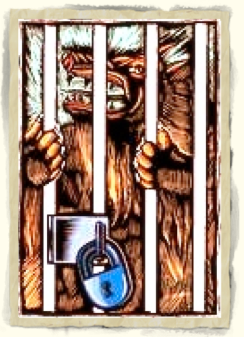
• ACoAs definitely believe all emotions are a bad thing. When asked what’s going on with us, or how we’re feeling, ACoAs usually fail to mention Es. We’ll talk around them, over & under, but never hit the bulls-eye.  We’re terrified of them like mice are afraid of cats.  We treat our Es as if they were a wild beast inside that has to be locked away in a deep dark dungeon.

• Then we wonder why we can’t get out of bed, always feel like the outsider, feel so alone, don’t get along with others, have panic attacks….. ⭐︎ Emotions that are ignored have sneaky ways of showing up in disguise. BUT those ways (listed throughout this blog) are the symptoms that provide vital information we can use to reverse-engineer events that distress us. Then we can make the necessary corrections

• Without enough healing, ACoAs are clearly not happy campers, having lived with depression most of their life – even if we don’t show it on the outside.  It’s not surprising, since our dysfunctional families indicated in thousands of direct & indirect ways that we should never object to being hurt by them, and then not express any pain from their abuse & neglect! (“Stop your whimpering. You’re such a baby. You’re just too sensitive!”). They didn’t give us much to be happy about, but they also didn’t want us to hold them accountable. So we learned: “DON’T FEEL”!healthy combo
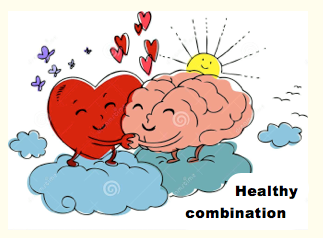
IMP: What they never told us was that 💗 it’s not intrinsically bad to have Emotions but were simply unacceptable to them, because:
they didn’t experience love & nurturing, so could not give it to us
• they had no clue how to cope with their own problems, much less be there for us. The responsibility of parenting terrified them
AND
• if one or more parent had chronic mental or physical illness, or who were overly dramatic themselves, there was clearly no room for our needs or feelings
• never having dealt with their wounded Es as adults, they shoved them under the carpet & demanded we do the same.
🥺 An infant’s first ‘language’ is that of intense emotions. Only after that do they learn to use words! This combination would be a constant irritant to parents who already felt too much OR didn’t want to feel at all – our emotions & needs acting like sandpaper. They had to shut us up!
AND
• our needs as children enraged them because they wanted all the attention for themselves
• some parent & teachers delighted in hurting & humiliating us, & had no intention of giving us comfort or validation (did you catch one of them smirking when you cried?)
✶ One tender soul remembers her mother, the heartless narcissist, saying with a sneer: “I’m so glad I’m not sensitive like you & your father!”

muted EsAs a result:  
• many ACoAs have a limited range of Es they’re aware of – like only able to play 3 or 4 notes on a full piano keyboard – such as anger & disdain, fear & guilt, loneliness & desperation…. even tho’ there are many more available on both scales
• some have so many feelings that we can hardly breathe, acting them out all over the place or hiding under the covers as much as possible, always in ‘suffering mode’, which makes us wish we were like the other ones – numb (or dead)

• others of us have intense Es without consciously knowing it OR being able to identify them by name – not associating certain physical sensations with actual emotions, but tending to be cranky & exhausted.

NEXT: ACoAs & Emotions (Part 2)
IDENTIFYING Emotions (Part 2)


EENY MEENY MYNIE MOE – catch a feeling by it’s show!

PREVIOUS: Identifying Es (#1) – Plutchik’s Emotion Wheel

SEE post
: Getting to our Emotions – OVER


This CHART, by W. G. Parrott, is another way of grouping emotions – a general guide you can agree with in whole, in part or not at all. The more Es you can identify in yourself & others, the better. One reason I’ve added it is that it includes the Es of Shame & Guilt, which Plutchik does not.
«

«
NEXT : ACoAs & Emotions, #1

IDENTIFYING Emotions (Part 1)

emotions-poster-I HAVE TOO MANY FEELINGS –
I just can’t handle them

PREVIOUS: The Body & Emotions – #4

REVIEW: Getting to our Emotions – Under


CATEGORIES
Many psychologists & sociologists have created their own Primary Emotions list (90 so far), some of which are seen on the Changing Minds & Alley Dog sites.
One THEORY of Emotions
A variety of concepts try to explain the source of Emotions (Es), put forth by psychologists, sociologists, philosophers & scientist.
EXP: The James-Lange theory argues that an ‘event’ first causes physical arousal (body), which we then interpret (mind). Only after the interpretation do we experience emotions (body) related to the event.  However, if the physical ‘symptoms’ are not noticed or not given any thought about a specific event, then we don’t experience emotions

Here are some ways to think about this theory:
Expl: You’re walking down a dark alley late at night. You hear footsteps behind you. You start to shake, your heart beats faster & your breathing deepens. As you notice these body changes & decide this is telling you you’re in danger – then you feel fear

BUT
: Those same physical symptoms can also occur when you met your exciting new lover – & your interpretation (what you’re thinking) is that this is a very good thing – so you feel the emotions of excitement, joy & sexual desire!

No Reaction: If you just found out that you lost out on a job opportunity you interviewed for but weren’t crazy about getting – you don’t have a physical response & don’t give it a second thought – so you’re not upsetBIG Es

Suppressed Reaction: You’re having a very busy day, running around without a moment to think.  You pass by a major car accident on the street, with people screaming & bodies everywhere.  You don’t stop – you’re mind is on the next task & how late you are, so you’re too preoccupied to feel anything about the event you just saw

However – you did register fear, sorrow, revulsion…. at some physical level you weren’t aware of – so maybe late that nite you have a nightmare, or the next day you’re sluggish & cranky but don’t know why!

EMOTION WHEELs
Below is Robert Plutchik’s well-know chart, a 3-D model using the color spectrum to indicate adjacent & opposite Es, (Fear opposite Anger, Sadness between Surprise & Disgust …..) The vertical dimension represents intensity & the circles are degrees of similarity.

1. Fundamental – inner circle shows the most basic Es. They are the intensity of an infant’s feelings, whose brain pathways are not yet developed enough to experience a variety of emotional nuances
2. Secondary – each row out from there are milder versions of the core
3. Tertiary – in the white spaces, each E. is made up of the 2 adjacent secondary Es (Trust + Fear = Submission; Anticipation + Anger = Aggressiveness ….)

2nd CHART indicates triads – emotions formed by combining 3 primary emotions, leading to 24 dyads & 32 triads (MORE….— also several other theories of Es)

EXP: Fear opposite Anger in extremes
• Think of some people who always seem angry. They’re using that emotion to feel powerful while covering up how scared they are, unwilling to be vulnerable (they wouldn’t be if they had a strong identity, good boundaries & healthy self-esteem!).  They believe that feeling fear is a weakness & will do anything to avoid it
• Now notice people who usually present themselves as scared, delicate, easily hurt, a victim, isolating….. You can be sure that hidden underground is a lot of suppressed rage which they’ve been taught to deny & are terrified of in themself!

➼ Yes, anger AND fear can also mask sadness, loneliness, shame, guilt, hopelessness….. BUT we can actually see the difference when someone does FoO work & those extremes get evened out. The person is easier to be around since they live less in the painful Es, but can still respond with fear or anger when it’s appropriate, as well as have a wide variety of pleasurable feelings.


«
NEXT: Identifying Es #2 :
W. G. Parrott’s Emotion List

The BODY & Emotions (Part 3)

body Es 3

I TRY TO HIDE MY FEELINGS, but my body keeps giving me away

PREVIOUS: The BODY & Emotions – #2


SENSING Emotions
• Emotions (Es) represent a large part of our interchanges with others. If we leave out how we feel, or if we communicate them inadequately, we fail to get across an important chunk of what we mean.
NLP tells us that the Verbal part of Communication is only one aspect of the message we present, the others being our tone & body language. Words are important & have power – they can inspire or they can do great harm.  But it’s tonality & body language that convey emotions.

Even though there are still people who deny the value of having emotions, (& some still flatly deny that animals also have them!) – fortunately there are scientists who continue to gather data identifying brain structures associated with emotions & the ways we can use our senses. Maybe it will eventually convince the skeptics!

BLINDSIGHT is a term coined by researchers at Oxford in the UK, over 40 years ago – working with blind monkeys & then humans, in the process of testing their ability to sense their environment using parts of the brain other than eyes.

• In the TV series “Through the Wormhole” the episode Blind Sight’ (clips) shows a scientific study from the Netherlands about how Es travel from person to person, by picking up changes in faces. Dr. de Gelder’s subjects were stroke victims who can see with one eye but not the other.
They were shown pictures of people with neutral emotions – to their ‘good’ eye – at the same time that faces with a variety of emotions were shown to the blind eye.

• In every case, each time the unseeing eye was presented with people’s features that expressed emotions, the subjects automatically mimicked those exact expressions on their own face – without realizing it. When asked if they knew what emotion was on the screen, they all said they were just guessing.
Clearly they were using some other areas of the brain.  For an explanation see the whole program

• CAT Scans show our brains experience many complex interaction we don’t consciously realize & don’t make enough use of, which include the emotion centers of the brain.  It would benefit us as ACoAs to learn about these connections & realize they are legitimate parts of us – built into our biological system. We can then become more comfortable with our Es & use them to navigate the complexities of life – which is why we have them!

concave solar plexusHOLDING IN Es
• How we carry our body can indicate how we’re feeling emotionally, not just at the moment, but habitually. We store un-processed stress in our body’s organs, muscles, chakras, meridians & electro-magnetic layers. Specific emotional residue of abuse AND negative beliefs are stored in various locations in theabused body.  (Anger in the liver, not being supported is in the lower back muscles, shame in the gut, fear in the heart or stomach….)

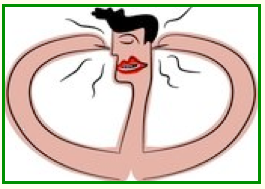
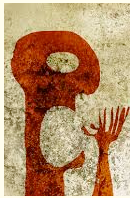
EXP:  Some people’s whole body center is visibly concave, as in these drawings. It shows they were severely & regularly abused in childhood, often continued in current toxic relationships.

☁︎ Their solar plexus has been emotionally punched (sometimes physically too) so often that their body is trying to pullback from future blows they know will come – or are still expecting, even long after the danger has passed.
There are also many abused people whose outward signs are much subtler, but the cues are there as well – to help us understand their behavior
➼ Generally, people who are confident & happy stand erect, head up, shoulders back, & walk with a sure but not arrogant gait. Depressed or self-hating people may stand with head down, slumped shoulders, slow or unsure walk…..  Changing how we hold our body can improve how we feel about ourselves.

Of course there are exceptions:
♿️ someone with a chronic physical illness or disability may move slowly, be hunched over, clumsy, needing a wheelchair. Yet they can be confident & emotionally balanced, with ups & downs, but not miserable,
☢️ while some who are deeply insecure may strut & seem ‘strong’ emotionally, only because they present a facade to compensate for being afraid, expressed as anger & inflated self-importance.

NEXT:  Emotions & the Body  (#4)

The BODY & Emotions (Part 2)

body Es 2OK, TELL ME ALL ABOUT IT.
Yeah, but you left out how you feel!

PREVIOUS: Emotions & the Body (#1)

SITEEmotions Are Physical 
INCLUDES “Signs You May Be Afraid of Your Emotions”

IMPRESSIONS
1. Showing strong Es in public too blatently is usually looked down on or made fun of – in the theater it’s called ‘chewing the scenery’ (think Captain Kirk) but is acceptable if we’re at a ballgame or rock concert. We remember how Jackie Kennedy was endlessly praised for her stoicism at JFK’s funeral.

2. On the other hand, when someone shows NO sign of emotion, it will be read by others as an indication that —
a. the topic is not important, as when :
= someone carries on about something too intellectually, or is just talking BS
OR
= talk in a monotone (flat affect), a neutral voice or with a smile about very painful events – the way many ACoAs do about their traumatic childhood, or newscasters reporting a tragedy.
The listener may just gloss over it or not actually ‘hear’ the info!

b. OR that they’re a ‘cold’ fish, heartless, even psychopathic, like if there’s no emotional reaction to the news of their child being horribly killed, or told they’ve lost everything in a disaster

c. BUT if someone doesn’t show any Es about an event or person –
it can imply that they disapprove of it / them, like when there’s complete silence from an audience toward a performance or a public figure, or we ignore a friend or spouse…..

REALITY
Regardless of the actual reason for a person not adding emotional subtext to their communication (from boredom, exhaustion, sickness, shock, shyness, shut down, terror….), the average observer is looking for some cue to the meaning (value & relevance) of what they’re hearing from or seeing in another person – which would help them know how they themself should feel & respond (If you don’t care then I won’t care either)
HOWEVER
Everyone does unconsciously telegraph their true feelings – even the reticent & the repressed – by micro-expressions of the face & throat muscles (as well as other physical signs like a clenched fist, leaning forward or back, slouching….).
Normally, both sender & receiver of these tiny movements are unaware of them, but astute observers can pick them up anyway & respond internally, if not outwardly. As in the “Lie to Me” TV series, anyone trained to carefully read them can identify what someone else is feeling / experiencing

ACoAs
1.
Toward ourself –  we were thoroughly trained to ignore our own   experiences (intuition, emotions & thinking), that we’ve suppressed (but NOT lost) the ability to know what we feel, becoming numb to this level of internal information, from both feelings & body sensations

2a. re.Others
• Because involuntary muscle contractions are such subtle cues to someone’s emotional state, and –
• we’ve just as thoroughly been taught to deny / ignore what we hear & see from others, unfortunately :
— we don’t even notice these interaction, BUT
— if we do pick up the cues from others (what they’re actually telling us about themselves), we don’t trust what we’ve seen, & then talk ourself out of the implications.
This is one reason we’re greatly handicapped in understanding & dealing with others.  Fortunately, we can change this!

2b. At the same time, as kids in a chaotic, abusive environment – we became overly focused on how the adults were feeling, in an understandable desire to protect ourself. Their every nuance became signals – are they going to beat me, fall asleep drunk, stay in bed depressed or “sick”, be in a rage & get ready for a fight…..
Our goal was to placate the monsters & stop the abuse. This never worked! to change them, so one conclusion was that we’re a failure at understating moods & ‘fixing  pain’.

SO NOW – it’s hard for us to evaluate :
• what someone is actually telling us. We easily misread their meaning or motives
• what we feel emotionally about their communication. We react from internal wounds instead of responding to present info
• how to respond appropriately, so our actions are too harsh or too weak

Because of our ‘limited vision’, when someone is verbally insensitive or mean, we don’t feel the emotional punch in the stomach until sometime later if at all, & then are more likely to feel scared, or maybe get angry but blame ourself!

NEXT: The Body & Emotions (Part 3)

What about EMOTIONS? (Part 4)

therapy couch 3 I CAN HAVE ALL MY FEELINGS, & still be in control of myself!

PREVIOUS: What about Es? (Part 2)


MASTERY vs CONTROL
EXTERNAL focus: Control : “TO direct & command & having authority over others, OR to hold back, curb, restrain”.
The need for negative control (being controlling) in our personal life comes from an intense desire to avoid feeling fear – fear we’ve been storing away a little at a time, year after year, until it’s a mountain too overwhelming to face

Without realizing it, we believe that if we can ‘direct or restrain’ other people & situations around us we can prevent feelings of terror & rage from surfacing.  Controlling our Es keeps us from knowing ourself fully, while trying desperately to manage other people’s perceptions of us.

INTERNAL focus: Mastery, on the other hand, is about becoming an expert in some area.
Regarding emotions (Es), it’s recognizing & accepting our True Self &  others’ – since we’re all emotional beings.  We can be in charge of our feelings & behavior, as well understand & be respectful of others

• In ACoAs language,  mastery of our Es means having our Healthy Adult & Loving Parent in charge (the UNIT), instead of the WIC or PP, while giving lots of room for the Healthy Child to thrive & express itself.
When we let ourself to have a wide range of Es & learn how to handle them correctly, their intensity fades because they don’t get back-logged & then have to explode.

painfull EsUNHEALTHY or UNUSUAL:  Painful Es that we feel continually over long periods of time (rage, fear, sorrow, hopelessness …..) may be:
• from a traumatic past, & are tightly linked to beliefs, fantasies, wishes, resentments…. that we haven’t processed yet, & so are harmful to us
• caused by sudden shock or unexpected loss we can’t seem to get over (such as with PTSD)
• the result of aging, a brain injury, chemical imbalance (like with clinical depression) or side0effects of legal & illegal drugs or medications

Many (but not all) of these causes of Es can be worked thru psychologically so they can be released, & in some cases be greatly helped by corrective medication.

NOT ALL EMOTIONS are big, scary or overwhelming.
The ones we have in the moment are usually subtle, short-lived & sometimes conflicting.  ACoAs have been so brain-washed to not recognize Es in general, that we barely acknowledge the big ones, so the subtler ones can get missed altogether (non-dramatic ones like – being pleased, relieved, quite comfortable, a little frustrated, mildly annoyed, glad…..)

Some ways to relieve the pressure of backed-up E:
• sometimes just writing them out is enough, or drawing them using pens or crayons
• call someone who won’t try to fix or control you, share your Es in Al-anon & therapy
• if angry, do a minute or more of under-your-breath yelling while pounding on the couch or bed, sit in the car, or go outside to vent
• if sad, listen to music, watch a movie, read a book…. to trigger your tears.  Some of us can only cry when we are with others – if they’re safe, some of us only when we’re alone
➼ In many cases you’ll feel lighter & be able to sleep better!

EXP: You got an email from an ex you haven’t heard from in a long time. You’re over him/her, & the content was ok – nothing special.
So — you don’t feel anything. Right?
Well — look inside, & you’ll find there are some left over from old wounds – still vivid & intense.  Don’t judge, just accept & use all your tools to process them.a little sad

• OR maybe there’s only a little sadness, or guilt, or loss or forgotten anger or disappointment – that got activated. But you’re not aware of it – because, you don’t really care anymore, you’ve moved on…. And yes, you really are not invested in this person now, BUT feelings are feelings & aren’t logical.  Just say “I might be feeling something – just quietly.” It’s normal. Acknowledge whatever Es you identify (quiet or loud), give your kid a warm hug & go on with your life – no drama!

NEXT: Es & the body (Part 1)

What about EMOTIONS? (Part 2)

therapy couch 2I FEEL THAT SHE DOESN’T LIKE ME!
OOPS – that’s not a feeling. It’s a thought!

PREVIOUS : What about Es? (#1)

POSTS : USE THINK …..


HEALTHY
 emotions (Es) usually are brief / short-term, & will dissipate rather quickly. They’re an immediate response to a thought or some situation at the moment. They give us important information about what’s going on, & get us ready or motivated to act, when appropriate or necessary.
Es come from :
external events, like being cut off in traffic or your boss being annoying, so you may feel angry, irritated, frustrated…. OR
internal ‘events’, such as memories of —
— a bad job, a lost loved one, so you may feel sad, lonely, angry, scared OR
— a fun party, great success, a great trip, so you may feel happy, relieved, proud, nostalgic…..

LONG-TERM** emotions are those unhappy, intense ones that – when triggered – seem to go on forever! causing great stress on the body so we never relax. The intensity lets us know they’re not about something current, but rather taping into the unprocessed deep well of accumulated childhood pain.
In the present, when an old button is pushed, we chew & chew on a feeling (anger, abandonment, disappointment….), obsessing on painful experiences, & then add more pain by judging ourself for what we’re feeling.

** Unexplored childhood Es prevent us from being in touch with or honoring honest gut responses in the present, which then distract us from taking needed actions, or drive us to take the wrong kind.

Old painful Es don’t dissipate easily or quickly because they’re still attached to self-abusing beliefs that our WIC is loyal to – the Toxic Family Rules & Roles.
The only ‘benefit’ they provide now is to let us know how we felt in childhood. Accumulated Es hang on until we can verbalize & finally experience them safely.

EXP: You got really angry at a rotten driver on the highway, yelling & giving them the bird… but then gave yourself a hard time for being angry – because you learned as a kid that anger is BAD. You keep judging yourself, maybe also feeling guilt, shame, anxiety & S-H.
WHY? Not making a distinction between the emotion of anger vs. behaviors that expresses it.

Truth: All emotions are legitimate, but not all actions are appropriate!
Even if you can’t prevent the bad-voice tape from clicking on, do NOT let it run – stop it right away AND strongly disagree with what it’s saying. If you do that each time, its power will eventually diminish!

TIME FACTOR
REMINDER – In a psychological healthy state, emotions usually come & go rather quickly. We can have several, even conflicting Es, at the same time – about a specific person or situation.
They’re brief because they’re situation-specific, & we’re not holding on to a negative mental interpretation of what’s being felt (not judging or being afraid of Es)   (More…..)

Interesting : A pioneering study about how long various emotions can be felt, identified – being ashamed or disgusted lasts about (30 min), bored (about 2 hrs), guilt (3.5 hrs), but sadness outlasts them all (up to 120 hours!) The next longest was anger, about 60 hrs.!

⚙️ SOME Es: There are some healthy long-term ‘states’ like love, loyalty, faith…. that can last years or a life-time, even with ups & downs, depending on the individual &/or the relationship

RECOGNIZING Es
Regularly ask What am I feeling emotionally right now?  Name any that you can. If you’re not sure, keep the blog’s list of Es on your phone. Write about recent events & talk about them to a friend or in a meeting. Not being alone with them helps.

feelingsQ: Have you noticed that at the end of a day – or week – you feel heavy, tired, depressed – BUT you think ‘Nothing really big / bad happened’ ?
A: List every event, no matter how trivial or ‘innocuous’. Some may actually have been quite stressful
• Next to each one – list Es you had been ‘in touch’ (sad, mad, lonely… or happy, relieved, peaceful….) ,   OR – If you don’t know or are unsure,  imagine which Es you may have felt about them EXP : Your boss ignored you, again – & it didn’t bother you.  Are you sure?

• There are many different Es associated with people & situations that come in & out of your life. If you don’t regularly discharge all that emotional energy, usually from uncomfortable Es, they accumulate in the body & you end up feeling weighed down!
💗 We can also overlook pleasant Es if we’re not used to or allowed to feel them, losing out on healing energy.

NEXT: What about Es? #3

Forming Boundaries – with OTHERS (Part 2)

setting ;imitsIT’S UP to ME to SET MY LIMITS
it’s up to others to honor or ignore them

PREVIOUS: Bs with OTHERS (#1)

POST:   ‘ACoAs & Self-Esteem’

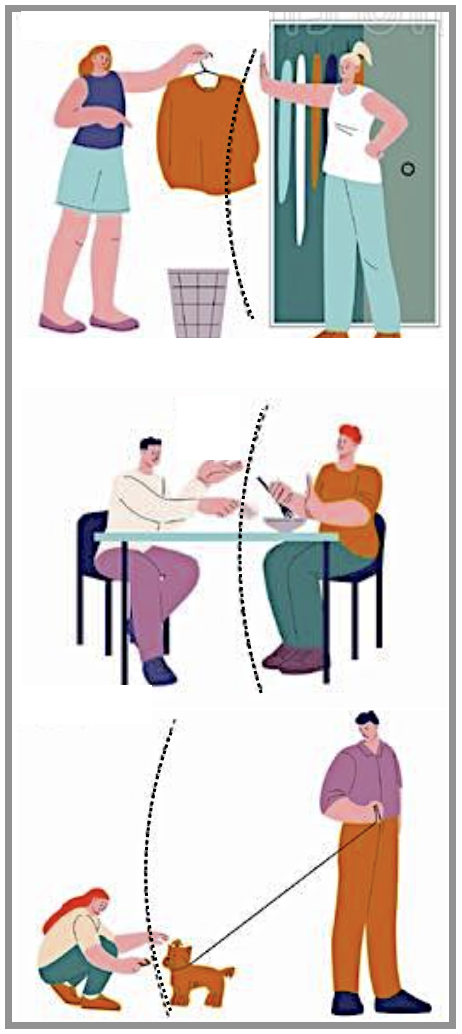
DEF : A boundary is a PMES space you put around yourself, & so do others for themselves

FORMING Boundaries (Bs) with OTHERS 
1. For OURSELF 

2. In Relation to OTHERS
a. Don’t punish others if they’ve forgotten your B. requirements. Consequences should be an inevitable outcome of the choices we each make. Outcomes (our reactions to them) may or may not feel like punishment to the B violator – depending on how intensely they’re still run by their WIC or PP.

• If you feel a strong urge to punish someone for ignoring your requests, it would be best to work on yourself before talking to them again. While they did indeed ‘stepped on your toes’, you may have let the violation go on too long, or else you’re making it too personal. NOT everything is about us!

★ Persistent B violators act like that with everyone, or anyone who will let them!  Do rage work in private, share about it in Al-Anon & therapy, pray for patience, & talk or write to your Inner Child.
Then remind the other person again, OR tell them they’ve crossed the line for the last time!

ii. Make a plan of action for when someone severely violates your Bs (& somebody will!) :
a. Tell them what you don’t like about their behavior – be specific. If you’ve already talked to them about it, refer back to those conversations
b. Ask they to stop immediately – when this is a possibility. If they don’t, then strongly insist
c. Ask for help from your support system when stressed, especially if you feel in danger
d. If there are no other options, walk away with as much dignity as possible, without sarcasm or nasty get-even comments.

💗 Thank anyone who honors your boundaries

REMINDERS
• You can not set Bs AND take care of someone else’s needs! They’re mutually exclusive

• When you feel angry, complaining, rageful, threatened, suffocated, victimized, whiny…..  it’s the pain of not having your Bs respected. These emotions are like flashing red lights telling you something’s wrong – something you don’t like, can’t stand or hate. It means you have to say or change something

• Talk to a Violator from your ADULT ego state,
— since you will inevitably get frustrated & annoyed with someone you love & don’t want to leave, who’s being a pain in the neck
— you may need to express your anger, to get past your resistance to speaking up. Anger makes us feel less vulnerable when we’re afraid —
— AND there are people who will only pay attention when you get ‘heavy’, but getting Adult-angry is not the same as being nasty (from the WIC or PP)

Avoid justifying yourself, apologizing for or rationalizing your needs – because it’ll sound like you don’t believe what you’re saying – so Violators won’t take you seriously either.
Say very little, OR offer a brief explanation – if appropriate & you feel ok doing it. It’s hard to be genuinely intimate with someone if you don’t tell them what’s bothering or hurting you

• At first you may feel afraid, ashamed or guilty when setting a Bs, so it’s it easier to let it slide.
— Do it anyway, the next time you’re with them – because it’s our job to let others know, & some don’t realize they’re trespassing
— Also, people don’t respect someone they can use, manipulate or control, even though they’ll try to get away with itangry at Bs

• Be prepared for anger, attacks, denial, opposition, resistance. Violators don’t like being reined in.
Don’t let their reactions make you doubt your rights! They’re just having a 2-yr olds’ tantrum when they don’t get their way. You have to be ready to enforce your needs, otherwise people will simply ignore you.

• The main prerequisite for good boundary setting is believing you have a right to them! When you’re sure, it will be clear to others even when you don’t say anything, AND fewer B-invaders will show up in your life

• ALSO: make a list of 5-10 ways you violate other people’s Bs. (ACoAs violating Bs) Work on correcting them.  You’ll  feel better about yourself!

NEXT: “What other think of me….”

Forming Boundaries – with OTHERS (Part 1)

THIS IS SO MUCH WORK!
But I feel better when I enforce my Boundaries

PREVIOUS: Repairing your Boundaries

POST: “Boundaries DEFINED


FORMING Boundaries (Bs) with OTHERS 

1. For OURSELF (previous)

2. In Relation to OTHERS
a.  Find a support system to help with follow-through.  No one can to go from weak to strong Bs instantly or easily, just because we heard a lecture or read a book. We need people who will remind us of our value, encouraging us to maintain & enforce our limits

b. Use an ACoA therapist, Al-Anon & ACA meetings & other resources – to identify & examine the underlying causes of your unhealthy Bs. While we may have an extensive knowledge of our background, we often need an experienced listener to tag distorted life-patterns that are so automatic we don’t even notice

c. Look for role models & other examples of healthy Bs in your life & in media (TED Talks, podcasts….).  In any situation that challenges your Bs, take a minute to ask: “What would my role model say or do?”
If they’re part of your life, ask them, but don’t assume that what’s good for them must be good for you. Try a variety of yes & no Bsoptions & come to your own conclusions. One size does NOT fit all

d. Identify specific people who YOU will:
— not tolerate any violations from (they’ve already proven to be dangerous, narcissistic, disrespectful…)
— give some leeway to, because usually they’re loving, kind, respectful, AND it’s not realistic to expect anyone to be perfect

e. Educate others on ways you want your Bs to be respected, by clearly stating them. Never assume that people know them. Bs need to be spelled out in detail, & for some people you may even have to write them down. Do not expect others to read your mind, even if they already know you

fSit down with each person you have a problem with & let them know what you need & don’t want from them. Try to get their agreement to honor your Bs.
Insist that everyone talk to you with respect – no more digs, making fun of, criticisms, controlling comments…. no matter what. That does NOT mean you lack a sense of humor !

talking @ Bs• With other adults : even if you get a verbal agreement, stay alert for how they actually treat you.
If they repeatedly can’t or won’t honor your request – limit your time with them, or end the relationship, after trying one more time.
You decide when to let go of them, based on the cost to you!
• With kids or teens, work out a plan to help them comply, using methods suggested by a Child Psychologist, or from books & online articles

g. Clearly state the consequences for violating your Bs, BUT NOT until you’re sure you can follow thru! Addicts & codependents have a tendency to violate Bs (deliberately or unconsciously is not the point) & Invaders will always test us, like 2-yr olds, trying to wear you down to get their way

⭐︎ Be ready to stand your ground, to prove you’re serious. How well you can manage that will depend on how strong your Inner Adult has become (in the UNIT)

h. Be consistent & persistent about confronting & enforcing violations, & do is as coolly as possible – even though it can be very tiring or enraging at first
It’s most effective when you don’t over-react emotionally, but come from the Healthy Adult Ego State. Otherwise people can just write you off as bitchy or crazy, especially if they want an excuse for their bad behaviorclear Bs

• If a particular wound in you is still unhealed – you’ll have a strong reaction to feeling abandoned or disrespected, making you anxious & angry
• If you have healthy Bs, you can speak up for yourself & then move on to someone or something else.
It’s not up to you to convince people how wrong they are. Your self-respecting actions will make the statement.

EXP: If someone is chronically late to meet you, tell them that if it continues, you won’t wait more than 15 minutes. Be sure you always have a plan B for yourself. WHEN they’re late again, do NOT wait. They’ll see you mean business – whether they change or not, & then they can decide how to act.

NEXT: Having Bs with OTHERS (Part 2)

REPAIRING Boundaries – with SELF

Bs OY, ANOTHER PROCESS!
It’s so much work – but I need it

PREVIOUS : Healthy Bs, #2

REVIEW Boundaries Defined // Source / / Info

SITE : “Setting Bs with Oneself”


REPAIRING Damaged Boundaries 
(Bs)
The source of unhealthy Bs comes from our upbringing. As a result – in the present – it’s a lack of self-worth, not believing we have any rights.
“SIEVES” (leaking from damaged or non-functioning Bs) are trying to gain value by trying to please others, so they let everyone invade their space, obeying Toxic Rules like “Everyone else’s needs are more important than mine”

1. FOR YOURSELF
a.
Form a clear sense of your personal values.
b. Identify specific ways your WEAK Bs are unproductive & self-defeating, & write down how they show up in your life. Think of ‘character defects’ as expressions of Self-Hate

c. Notice the fear-based beliefs that reinforce your resistance to change (CDs & Toxic Rules).  List specific ones that apply to you & how you act them out (talking & doing)

dIdentify all POSITIVE Bs that are important to you (5-15 items). These may shift over time, so stay current.
List at least 1 B. from each PMES category that you:
— absolutely will not compromise on, because they’re CORE
— can afford some wiggle room on, because they’re not as crucial to your comfort & safety

e. Make a “Who Am I?” journal. Have separate pages for PMES sub-headings like – Accomplishments, Education, Natural Qualities, Skills, Strengths, Talents, Tastes, Values …..
Fill in any characteristics that come to mind. Ask others to provide the positive qualities they see in you. Continue adding to it as you see more good things about yourselfself-writing

f. Write letters to yourself encouraging the changes you want to activate, that nurture your right to have healthy Bs.
Include 2-handed conversations with your:
Wounded Child, about how you’d like to help it heal from S-H
Healthy Inner Child – about ways you want to support it to be visible & happy
• Pig Parent (Negative Introject) – about how you don’t agree with its lies any more!

g. Make 2 lists of Personal Rights, for yourself & for relationships. Keep them on your phone so you can read them often & also keep hard copies on your mirrors, fridge…. (Qs re. Friends….)rights
Pick one ‘Right’ you’d like to develop & incorporate it into your life for a month. At the end of that time write down what happened & how you feel.
Pick another ‘Right’ & do the same….
Re. “Support” – see next post.

h. Keep a separate journal to record the PMES pain** you feel when you don’t stick to your Bs with others. The idea is to cut thru denial about how it affects you, practically & emotionally.
🥲 This kind of pain is NOT from self-recrimination or fear of rejection. Rather, it is the most basic pain of self-abandonment, reproducing what our parents did to us. Without connecting to our emotions, we keep repeating the old ways – as if they don’t cause more damage. It does!

**A certain level of pain is a useful motivator if it’s not too much. Don’t turn ‘failures’ into S-H, depression & isolation. Identify what led up to each B violation, because you were :hurting
• in a situation which pushed a very big button that’s still unhealed
• still letting the WIC run your life, or at least in certain areas….
• tired, ill or otherwise stressed, so more vulnerable
• unaware there would be problems in a new situation
• with the wrong person who always invades Bs, & who no one can stop

i. Regularly build in time for yourself, away from your job, mate, children, & pets – alone to relax (just veg).
Take space for spiritual growth, self-care, humor, fun & creativity, AND make plans to be with close friends
fun• If you have a hard time saying ‘No’, look for opportunities to practice, without anger if possible, or with anger if that‘s the only way – at first. Eventually people will get used to this change in you. If they don’t, one of you will inevitably let go

• If you have trouble saying “Yes” for one-to-one social events, or anything involving groups, be willing to accept an invitation from time to time. You’ll be uncomfortable, but do the Inner Child book-ending for each situation & see what the realistic outcomes usually are.

NEXT:  Forming  Bs with OTHERS (#1)