ACoAs dealing with ABUSERS (Part 3)

IS IT ME, OR –
are they the crazy ones?

PREVIOUS: Dealing with Abusers -#1

SEE post: “They did the best they could”


1. ACoA Silence (Part 1 & 2)

2. SPEAKING UP
a. “Wrong” Talking
Unhealthy – over-explaining or justifying ourself, pushing our opinions, trying to be heard & be ‘right‘. It can be in the form of ranting, repeating the same thing over & over, having a tantrum or being preachy.
It’s most likely to happen when we’re with someone who clearly is not interested in what we feel or think – but we refuse to accept it, & keep trying!
“Maybe I can wear them down OR figure out the ‘right way’ to say it!” It’s classic ACoA to try getting our needs met from the very people who can’t do it!
b. Healthy Talking
Taking care of ourselves includes having to ASK for something (don’t expect mind-reading), or just expressing our point of view.  It’s important to let others know what we want, but this must be done…communication

i. ….once we’re sure we know what our real need is in a given situation (respect, stopping an abuse, getting info or a service….).
That way we can be direct & clear, rather than assuming someone should know. That’s only legitimate for infants, who can’t talk yet.
FROM :
ii. ….our Adult ego state, not from the WIC. It means short, to the point & unemotional. This works most of the time!  Reasons for us to speak up to abusers are :
• putting the Perp on notice that we’re not available to be their Victim (V), which represents our self-esteem, knowing we deserve respect
UNIT ego state• standing up for our WIC and the Healthy Child. It’s the job of the Loving Inner Parent, especially since no one did that for us, growing up.
Our attention is best focused on what’s appropriate for us rather than trying to control others. We’ll not be speaking up for the P’s benefit – ever! It does not matter that the P. will not be able to hear you, much less willing to change. The WIC can hear you. Be your own champion!
BY :
iii. ….asking the right person :
• If it’s someone you already know well, always check in with yourself first : “Can they provide what I’m asking for, or am I barking up the wrong tree?”
DO NOT chase a hope-filled fantasy. We just diminish ourself, get furious, feel ‘bad’, then hopeless.

• If you’re asking a stranger (like ‘Customer Service’) & you don’t get what you need from one person, hang up & keep trying until you get someone else who knows what they’re doing, & can provide an answer or service – if it’s actually possible & realistic! It may take 3 or 4 calls, but it works!

BOTTOM LINE
Silence or Denial?  Can you save yourself from getting run over by a car if you’re blindfolded & wandering in the street? NO!
ACoAs keep suffering – unnecessarily – as long as our eyes are tightly closed to the damage others do to us, even inadvertently. Yes, sometimes we are the source of our pain – from the WIC or the PP – which can be corrected with compassion & eliminating harmful self-talk.

But when someone else is being mean, selfish, crazy or cruel toward us, it causes us pain – just as it would for anyone. But it’s even more so for ACoAs because of our earlier wounds.  By recognizing when the pain is coming from (our damage vs another person’s), we eliminate much of our Self-Hate.

PONDER: You get shot by stray bullets in a nearby gunfight you have nothing to do with. You don’t die, but are left having to deal with severe injuries that take a long time to heal. You didn’t do the shooting, so you didn’t cause your wounds – even if you unfortunately happened to be in the vicinity.

So why do ACoAs blame ourself for the abuse we got from our sick parents & now from others who spray their mental / emotional illness over everything?
REMEMBER : we were not the source of the original mistreatment!
It’s not our fault that the other person chose to act in a certain way. The clearer we are about who is responsible for what – theirs vs. ours – the kinder we can be to ourself, & the better our life becomes.

NEXT: Traits of  Victims #1

DENIAL & ACTING OUT


I HAVE TO BE IN LA-LA LAND
to suppress the pain

PREVIOUS:
Deliberate or not? #2

See ACRONYM page for abbrev.


REVIEW: Most people are capable of some emotional abuse (E.A.) because most people have experienced E.A. as children. Sooner or later, we treat others the way our family treated us – acting out our parents, just as we act out the WIC.
The focus here is on breaking out of the ACoA’s denial about how & when others act badly toward us, which we have a habit of ignoring, mis-identifying or not noticing, because it’s so familiar.

ACTING OUT 
a. Any compulsive behavior you don’t consciously choose & so can’t seem to stop yourself from doing, OR compulsively not doing….
b. …. which expresses intense emotions you’re not actually feeling at the time, but that are rumbling under the surface

• This term is usually assumed to mean overt actions, against oneself or towards others – getting drunk, starting a fight, being late for work, being promiscuous … ♼ But it just as often the NOT taking :
✂︎ specific actions that would be good for you (walking out on a bad date)
✂︎ legitimate actions you planned on (making a call, going to a job interview), but “forgot”

spacing outEXP: You’ve made an appointment with a new therapist & consciously – you’re looking forward to it. It’s on your calendar & you remind yourself of it the day before. Then you go thru the whole day of the appointment without going – totally oblivious – until late that night as you’re falling asleep. “Oh No! I forgot all about it, & I really meant to go!”

😱This is an EXP of the WIC’s un-felt but intense fear of being vulnerable with a new authority/ parent figure who may or may not be safe.**
✶✶ When we’ve done or neglected to do something that seems baffling, inappropriate, even out of character, we can figure it out : Identify what emotions we were spaced out on (dissociating) but which desperately needed to be expressed – somehow!

DENIAL
Denial allows us to look for & stay with abusers, which is potentially life threatening, & definitely damages us psychologically!

a. MIS-USED: ‘Denial’ is typically meant as – Deliberately ignoring something we know but don’t want to deal with. This is not Denial.
When people say “I just won’t think about it. I’ve put it out of my mind… ” they’re referring to ‘suppression’ – a conscious decision.
Of course, if what we’ve push away was traumatic, that emotional pain will be festering in a dark corner, & eventually comes out in some others form – as hidden or direct rage at others, &/or self-destructive behavior.

b. GENUINE psychological ‘Denial’ is NOT deliberate. It’s a defense mechanism to “not acknowledge an unacceptable truth or emotion by not allowing it into consciousness.” = meaning that we don’t know we don’t know (something)! – either about ourself or someone else, even though it may be perfectly obvious to others.

This ‘skill’ comes from years of childhood training, hardened into Toxic Family Rules & Roles, as well as our human need for emotional survival. As an adult, it usually takes a lot of work to bring up long-buried traumatic experiences & associated pain into awareness, but once in a while some life-event can force a chunk of it to shake loose & shoot to the surface, like an erupting volcano, possible accompanied by overwhelming panic.

PAY ATTENTION• We can counter Denial & Suppression by carefully paying attention to what we see & hear every day in the present.  People tell us about themselves all the time, which we would pick up if we were allowed to listen to our intuition & intelligence. Repeatedly ignoring what’s in front of us is wounding to our sanity & our soul!

In recovery – once we become aware of abusive patterns we will notice them everywhere – in songs, movies, our family & friends, at work….
The opposite of Denial is ‘Being in the now’, or ‘Mindfulness’, making it easier TO:
♡ notice of what we’re needing, wanting, responding to, feeling – every day…. AND
♡ keep us awake to who others are, how they act, what they’re saying…. & how we feel when we’re with them.

NEXT: Dealing with Abusers #1

DELIBERATE Abuse or Not? (Part 1)


I’M SO CONFUSED!
Are they good, bad or evil? 

PREVIOUS: Indirect abusers #2

Review post series:
▪︎  Noticing painful Events” ….

▪︎  Double Messages and Double Binds)


DELIBERATE Abuse or NOT?
Most ACoAs assume that if our parents / lovers… don’t mean to hurt us, &/or can’t help themselves because of their damage, then their behavior can be overlooked.
So – as adults – we shouldn’t call them on it, don’t have to ‘protect’ ourself & we should never get upset with them. After all “it’s not their fault – “They did the best they could…..”.

This is our self-destructive attitude – & takes a toll on our psyche that’s too high a price to pay for staying connected, just to stave off our guilt & loneliness. ACoAs are famous for white-washing abusers, especially parents. We believe that acknowledging what the Ps have done would be disloyal to the family system (or marriage, friendship, boss….), & would cause a rift we think we couldn’t bear. AND yes, for some of us, punishment from those Ps for hearing the Truth can feel like too much for our WIC.

CATEGORIES of Perpetrators (Ps)
a. Overt  – ‘easiest’ to see
• Sometimes a parent will blatantly admit they’re ‘not nice’, don’t care, didn’t love us & never will – “I didn’t want kids in the first place”.
The Family Wayepisode of BBC’s “Doc Martin”(12/05), is so very clear – when his estranged parents visit him & the truth comes out!

Some part of us already knew it & it’s excruciating to admit, but hearing it out loud makes it real, eliminating illusion & a hope for the impossible. Of course we have to be willing to work with this info to recover, & not everyone is able or ready. (ARTICLE :“My parents say I’m ugly and wish they’d never had me” )

Also, any type of physical  abuse is horrifying, but simpler to acknowledge, because the injuries are easy to identify, even getting outside validation (as opposed to the other types). Our suffering & our rage is no less intense, which has to be cleaned out, but at least it’s tangible.

• As adults we’ve gotten involved with outright skunks, people who from the beginning were obviously unsafe – unreliable, insensitive, active addicts, under-earning…… They may say : “You knew what I was like / I told you what to expect – or not / I said I wasn’t into relationships” ….

The main problem in facing this kind of abuse is our denial – not the P’s. It was our unwillingness to believe what they were saying, which let us get involved in the first place, because their ‘style’ was so familiar! We didn’t cause the abuse but we sure stayed for it.
😱 These kinds of Ps cause just as much emotionally pain as any other, but the least mentally confusing for us, because if cornered, they’re capable of admitting what they’ve done – although not willingly & without any remorse!. We can heal faster because it’s not mentally crazy-making.  Once we’ve raged & mourned, we can move on.

b. Sneaky (much harder)
• It’s really tough to identify the source of our damage when our family (mates, friends…) profess to love us, but mistreat us much of the time anyway. This can apply to being put-down, manipulated, over-controlled, gaslighted….
As adults it can also be in the form of sexual coercion, or any shade of previous child sexual abuse, especially when you were singled out as a ‘favorite’ (“You’re mysneaky bad special girl”….), & told to keep it a secret. (Indirect Abusers – Part 2)

• They may say they love us (& we believe them) BUT we feel like crap when we’re with them – exhausted, scared, miserable, angry, bored – yet can’t put our finger on why, since nothing seems obviously wrong.
Then after spending time or even just texting / talking with them – sometimes for days or weeks we’re depressed & can’t get back to our life. Naturally ACoAs figure it must be us, right? NO!!
Your body & emotions are clearly telling you that something’s ‘rotten in Denmark’ – & your name isn’t Denmark!

SITE: “TRAUMA HEALING for Your Mind, Body & Soul” with Bible verses

NEXT: Deliberate… #2

DIRECT ABUSERS

THEY ALWAYS SCARED ME  now I can’t say how I really feel

PREVIOUS: What is abuse #4

SITE: Characteristics of Abusers

QUOTE: “Social anxiety results from being around people who are resolutely opposed to who you are.” ✍︎ Stefan Molyneux (Freedomain Radio)

OVERT ABUSE
(Perps = Perpetrators, Abusers / Vs = Victims)
• The visible form of overt abuse – physical violence – is easiest to identify. But Vs are usually too broken & ashamed to acknowledge what they’re enduring : “I walked into a door, I accidentally fell , It’s nothing, they didn’t mean it”…..

However, there are other direct ways that only the V experiences (list below). Cover-ups are used by all types of Vs : TOWARD single women, financially dependent mothers, children, the elderly, and abused men – to not show weakness. Shame silences.

• All blatant abuse is done with no concern for the physical or mental well-being of the victim. Even ‘loved ones’ have no real or separate existence – the V is just an extension of the Perp’s internal world, experienced as part of themself, like one of their own limbs. Narcissistic mother to child:  “Put a sweater on, I’m cold!”

👺 Most Perps totally believe they have a right to control, put down, manipulate. They consider it legitimate to exert power over others, and that weak people deserve to be put in their place – because weakness is to be despised. By extension any weakness in themself has to be eradicated!  Besides, they say Vs are ‘asking for it’ by being pathetic. So there’s no reason for the P to change!

IRONY: Abusers believe & act as if they’re the god of their personal world – to be obeyed & worshiped. YET they’re totally dependent on others for their sense of equilibrium & well-being!

IF they loses power over others, it can feel like they’re losing control of a limb, even their mind. Their insecurity-driven anxiety will trigger violence, intense manipulations & frantic attacks, in an effort to shore up the endangered False Self & force the V. back into alignment.
BECAUSE:
• the independence or disobedience of a significant other radically diminish the Perp’s identity & supply of psychic nourishment
• it forces the P to experience not being the center of everything, while not realizing their world view is way ‘off’
• they lose the sense of control over their inner world (thoughts, feelings….), which they find intolerable

CONFUSED Victims often say “I just don’t understand why they…” OR obsessively repeat: “Why are they doing this? What did I do wrong?”….

➼ Vs are not asking for self-knowledge, nor compassion for the P. Rather, it’s their WIC’s need to placate the monster they’re not allowed to leave.
Traumatized ACoAs believe that – “If I could only figure out exactly why they’re acting this way, then I can change myself, them or the situation (mainly myself), then things will get much better & we’ll all be happy!”

BEHAVIORS  (see also  “TRAITS” )
Degradation: make the cost of resisting seem more dangerous to the V’s self-esteem than giving in. Reduces them to “animal level” concerns
Enforce Trivial Demands: create the habit of giving in (compliance)
Induced Debility & Exhaustion: weaken mental & physical ability to resist
Isolation : eliminate all social support which would help the V. to resist. Create in the V. an intense concern for & dependence on the P
THEY:
Monopolize Perception : focus the V’s attention on some immediate problem, forming a narrowed vision of reality.  Eliminate any input competing with those chosen by the abuser, preventing the V. from taking any opposing actions
Omnipotence: make it clear it’s impossible to resist being abused & dominated
🖤 Use Occasional Indulgences: The P provides ‘positive’ motivation for the V’s continued compliance (payoffs for obeying), but keeps the V starving with crumbs to keep them quiet & coming back for more
Threats: Cultivate fear, anxiety & despair
(from Dr. Judith Biderman, MORE...)

NOTE:  At the end of “The Sopranos’, the therapist fires Tony after reading a -genuine – study by Samuel Yochelson & Stanton Samenow, psychiatrists specializing in the criminal mind. It reports that therapy doesn’t actually help sociopaths – only further enables their bad behavior by sharpening their manipulative skills.

NEXT: Indirect Abusers, #1

What is EMOTIONAL Abuse? (Part 3)

YOU NEVER ADMIT
what’s really going on!

PREVIOUS: What is E. A.? (#2)

SEE ACRONYM Page for abbrev.


P. = Perpetrator / V. = Victim
TYPES of EMOTIONAL ABUSE (E.A.) 

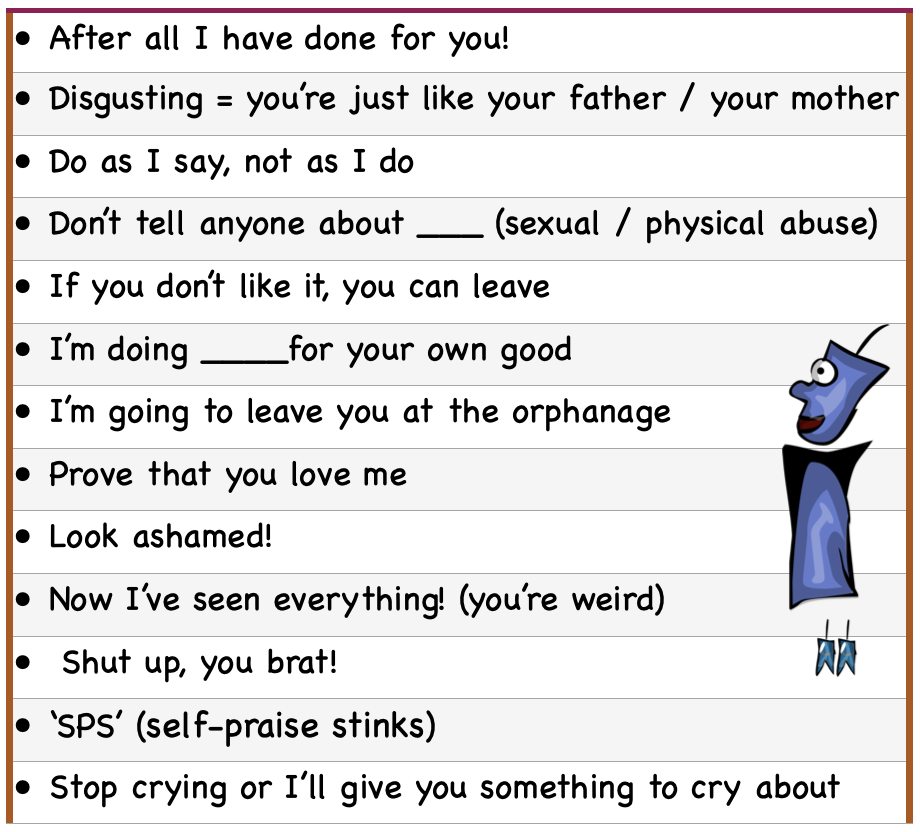
ASSERTIVE = standing up for ones rights without intent to harm.
Statements we may have heard growing up
VS
AGGRESSIVE  = deliberately trying to hurt someone, at any level (PMES). The receiver of the aggression may not be the actual target, like kicking the dog when you’re mad at your boss

EMOTIONALLY HARMFUL statements we may have heard growing up ALSO, they tell outright lies about us, and love to recount to everyone -sensitive, shameful or embarrassing stories about us
Naturally, this list is only a fraction of what damaging family & other adults are capable of – a guide to help us think about what we may still be ignoring from the past OR still putting up with, maybe without realizing. (Journaling POSTS – “Writing for Personal Growth“)

TYPES of EMOTIONAL ABUSE (E.A.)
✔️ Direct & obvious
Perps usually have an angry, attacking attitude. THEY :
• make you one-down to them by judging & invalidating you, undermining the equality & autonomy essential for healthy adult relationships
• use accusations, blaming, labeling, name-calling, ordering around
• use one-up parent-to-child communications, infantilizing you

✔️ Dominating
INDIRECT -They
• railroad discussions, talk over you, won’t give you room to respond…. so you don’t have time to identify what’s wrong with what they’re saying or doing
• if verbally clever, they’ll make their point seem perfectly logical even though they’re twisting everything in their favor, using CDs
DIRECT – They
• give away or throw your things out without discussion or permission
• smash, throw, deface or cut up personal or household items

• want to control your every action, to have their own way – and will resort to threats & verbal attacks to get it

✔️ Emotional Blackmail – they
scared• draw you in by being nice, then unpredictably say something cruel, or push you away, act disgusted
• play on your compassion, values, guilt, shame, limitations or other “hot buttons” to get what they want
• threaten to end the relationship, to totally reject or abandon you, ignore or use other fear tactics, unless you give in

✔️ Indirect – they
• are often disguised as “helping”- BUT it’s actually criticizing – ‘fixing you’, giving unsolicited advise, analyzing you, questioning your tastes & decisions
•  use the implied judgmental tone of “I know best” – to belittle, control, or demean, rather than support your growth & development

✔️ Threaten
• to leave, any time they don’t like something – but doesn’t go
• to take the kids, the car, the house…  • to stop paying for important necessities  • to get you fired  &/or ruin you reputation using lies
• to hit or do other harm (your kids), but don’t follow thru
• to commit suicide (& it will be your fault), but never do

✔️ Verbal assaults – theyScreen Shot 2015-07-15 at 2.51.42 PM

• berate, belittle, criticize, name call
• blow your flaws out of proportion, harping on them
• constantly blame, use sarcasm & humiliation
• make fun of you, any time, & in front of others
• scream, threaten you physically

NEXT: EMOTIONAL Abuse? (Part 4)

What is EMOTIONAL Abuse? (Part 2)

CRUELTY COMES IN MANY FORMS –
& they all hurt my feelings!

PREVIOUS: Emotional Abuse (Part 1)

SITE: Types of Emotional Abuse 


EMOTIONAL REACTIONS to Emotional Abuse (E.A.)

✶ The most important thing to remember is that ALL categories of abuse cause emotional damage. We need  to notice how those actions or words make us feel emotionally – as in – NOT happy!

UNDER
– No matter how much head knowledge we have about our issues, without doing deeper FoO work many ACoAs have a hard time even recognizing familiar abuses as they’re happening, much less feel an emotional sting. If we’re still numb from old pain & lack of self-care, it’s very hard to connect depression & S-H with being exposed to E.A.

• It’s as if we were wearing that huge white medical collar that vets sometimes put on dogs/cats – we can see over the top, but not the knife in someone’s hand as they stick it in our gut – especially if they’re smiling!
We may feel some pain, but don’t understand that it’s truly coming from outside of ourself. As trained victims from childhood, we always assume that – if we’re hurting – it a sure sign there’s something wrong with us. NOT SO!

OVER – When we do over-react emotionally to a person or event, the tricky part is being able to over-reactseparate what just happened in the present from the accumulated suffering of past abuse. Often it IS a combination of the two, in layers – like when someone’s only ‘stepped on your toe’

Instead, it feels like the foot has been cut off & we’re left bleeding, because of all the times our family did the same thing to us.
Whenever we have an intense reaction we know “If it’s hysterical, it’s historical”. We need to validate our fear, outrage, sadness…. while still staying in the present moment & seeing reality.
SO,  we can:
• double check** if something was actually an abusive situation – or are we reading into it (projection) because it’s so similar from the past.
⚙︎ ASK: “Did this current event call for such an intense reaction?
Do I feel like I’m being stomped on, discarded like garbage or my life is being threatened – when all someone did was not text immediately back, looked at me ‘funny’’, not said hello, told me what to do…..

** ‘Checking’ may include asking someone we trust for an evaluation of the event, or going back to the original person & asking what they meant by ___?, or why they did ____?.
Whether they tell us the truth or not, many times their answer will be surprising – it’s not what we thought they meant, because it had nothing to do with us.  So we could not have guessed what they actually meant!  It’s important to ask.
work abuseWe can also:
• identify unpleasant or inappropriate words & actions that did actually happen, instead of ignoring the event or how we feel. They weren’t just in our imagination.
For some ACoAs this may take outside validation too, including comparing lists of ‘My Rights’ against Abusive Behaviors.

✶ All Over & Under-reactions come from our WIC or PP. Appropriate responses (not reactions) come from our UNIT.
Learning to tell the difference between actual abuse & our projections or paranoia comes from internalizing the healing of Recovery work + accumulated information about present-day reality + validating our feelings & experiences – via meetings, reading, healers & therapists.

UNPREDICTABILITY
a. Their Reactions
Perps have drastic mood changes or sudden emotional outbursts –
✓ with unpredictable, irrational changes in reaction to you or your normal behaviors
✓ who will say one thing one day & the opposite the next, &
✓ will like what you do one day & hate it the next…
SO: mood swings
• being maddeningly inconsistent, you never know what’s expected of you
• you’re always waiting for the other shoe to drop
• you have to stay hyper-vigilant so you know when to ‘duck’

b. Constant Chaos – THEY
• are ‘addicted to drama’ causing endless upheaval for everyone
• change plans or ‘rules’ at the last minute, without informing you
• keep you off-balance, never knowing what’s real or ‘safe’, so they have all the power
• often start arguments, disagreements, create conflicts
• make promises you depend on, but rarely follow thru

NEXT: Emotional Abuse (Part 3)

VICTIMS or NOT? (Part 1)

HOW BAD WAS IT?
It’s hard for me to know!

PREVIOUS: Victims or Not?

REVIEW: “Feeling Sorry For….

See ACRONYM Page for abbrev.

VICTIMs or NOT?  (V = victim , P = Perpetrator / abuser)
Victims can be of any age or gender & from any socio-economic level. While standards differ by culture, it occurs in every country. Because being a V. is often created at an early age, being abused (learned helplessness) is passed from generation to generation like a family disease, called the “inter-generational cycle”.

Victim’s reaction to abuse is great confusion. 
“Do I have a right to say, or even think, that what’s happening is really Abuse? I doubt it. After all, sometimes the other person is nice to me & fun to be with, says they can’t live without me, & tells me they’re sorry. And their actions aren’t always obvious to others, so I may just be making it all up!  Is feeling overwhelmed (self-doubting, drained, fearful, angry, frustrated, hopeless …) about what they are doing, or am I just over-reacting?”

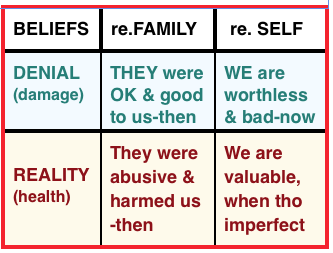
ACoAs often get things backward: (S-H vs Truth)
OLD/NEWThe distorted logic of our self-hate says :
1. it wasn’t all that bad (although some part of us know it was)
2. they DID love us / they did the best they could
3. we were NOT really Victims – just annoying, needy, selfish, weak, bad, flawed kids – & will be forever!

Actually, sanity tells us the truth
✺ We did go thru a terribly painful, chaotic childhood – very real Victims of our home, neighborhood, school, religion, & playground.  We had no choice & very few options at the time. We were Vs then, BUT don’t have to be Vs any more.

YET, as long as we hold on to the S-H lies as our main internal reality, we’re stuck & can’t fully heal. Before Recovery – & sometimes long into it – ACoAs’ reaction to early trauma is either Perpetual Victim or Stoic.

a. Perpetual Victim:  Many ACoAs are still actively living in the old destructive patterns set out for us, & refuse to give up the V. role.
Their attitude is: “I was then & am forever a casualty of my family / school / church…..  I just can’t cope with life, so you can’t expect me to function. I can’t do anything differently now because I’m so debilitated by those experiences. Someone has to take care of me”….
We stay “sick” to stay loyal to our Parents, so we don’t have to:
• do the lifelong hard work of healing our wounds (feel the old pain, change CDs)
• fully take care of ourself as healthy adults, especially if we had to do that for a parent & siblings when we were kids. “Been there – done that”

The is one of many ACoA ironies:
🔶 we cling to deep denial – the abuse & neglect didn’t affect us!
BUT
🔷 we won’t try to heal & be comfortable because we’d lose the proof of what did happened to us back then! “If I get better, no one will ever know how bad it was, & I want everyone to see it & feel sorry for me!”.

This partially comes from a sad reality that most people in our culture assume that if someone ‘looks good / does well’ it means that :
the person is healthy, always had it easy, must have come from a good home, don’t have any problems & never needed to overcome anything.

So, ACoAs who desperately long for external validation for our trauma – from everyone – believe we can only get it if we stay miserable.
This keeps us torturing ourselves unnecessarily – a great shame. We DO need validation, from a few legitimate sources, but then it has to be internalized, so we always “know what I know” in any setting. (re. ACEs – w/ Tree)

re. Self-Pity – from John W. Garner (HEW Sec.)
“Self-pity is easily the most destructive of the non-pharmaceutical narcotics. It’s addictive, gives momentary pleasure, & separates the victim from reality.” For ACoAs – IT’S:
NEGATIVE: being perpetually immersed in the “poor-me’s”
POSITIVE: having deep compassion for ourself – not wallowing. (POSTs “Feeling Sorry for“).
We do have to mourn the loss of all the needs we never got met – a crucial part of Recovery, & the beginning of Transformation. (More…. re. image)

«
NEXT
: Victim or NOT (Stoic)  #2

Considering Abuse

I’M SO UNHAPPY BEING WITH THEM
but it must be my fault!

PREVIOUS: Principles of    Character

SITE: re. Categories of abuse

NOTE: This series will have many lists of abusive behaviors, in many categories, & from different perspectives, so there will be a lot of over-lap in headings & examples. This is deliberate. As kids we HAD to ignore, trivialize or forget what was done to us, & then act out those self-destructive patterns in our adult life.

We must identify exactly what happened before we can change it, & repetition is useful in breaking thru our denial. Also, reading or hearing something in different wording & context can more easily get past our defenses. The main (but not exclusive) focus of these posts is on Emotional Abuse.

DEF : Abuse – are all the painful things done to us & around us as kids, & comes in each of 4 PMES categories,
and Neglect – are all the good things we didn’t get, growing up

ABUSE : In general, it’s any communication or behavior designed to control & enslave someone. In alcoholic & narcissistic families it was to keep us ‘in our place’, to prevent us from leaving home, to punish us for not being who or what the Perpetrators expected, or wanted!
It is & was done by causing continual fear, humiliation, intimidation, guilt, coercion & manipulation.

Its any form of intrusion into another’s psyche, including :
• a desire to to denigrate, to ignore, to causes pain
• financial, intellectual or spiritual tactics, ranging from mild to lethal
• ignoring or making fun of another’s basic needs & interests
• verbal, physical, sexual &/or emotional attacks
• not respecting privacy, being brutally honest with a sadistic sense of humor, consistently tactless, expect too much

⚙︎ Most people automatically assume ‘abuse’ only refers to physical harm – yelling, hitting, beating, broken bones …. so will firmly state: “I was never abused growing up”. However, because human beings are made up of 4 interlocking categories (PMES = Physical, Mental, Emotional, Spiritual) we can be wounded OR encouraged in many ways at each level.

Being abused can happen just once with someone, or when subjected to a bully for a short time. But usually it’s a long-term pattern of behavior by a severely damaged, cruel, angry &/or mentally ill person who uses their position (as parent, boss, teacher, mate, older sibling or friend, community leader…. ) to:
▷ intimidate others who have less personal or social power, OR
▷ take advantage of those who by nature or training are more accommodating, compliant & sensitive

While most people on occasion act unkindly, even cruelly, when provoked or under great stress, what we’re looking at here is ongoing attitudes & actions that tear us down, body & soul. Even when they seem intermittent, over time they wear at us !
Therefore ACoAs can honestly say that we were severely & regularly abused by our damaged parents (& other authority figures) , especially re. emotions (Es). Genuine Es are NOT widely recognized, valued or encouraged in our society, much less in dysfunctional families. So we ended up ignoring or minimizing them in ourself, as well as in others, especially if we didn’t get physically or sexually attacked as kids.

Most of us never felt loved but blamed ourself for the lack. Regardless of what our parents said or how they felt about us in their own mind & heart – their distorted way of treating us was not an expression of healthy Love.
So to compensate – as adults – we look for it everywhere we go, & from everyone we deal with.
This can make us vulnerable to a subtle form of abuse – being ‘over-loved’, needed & depended on too much, OR being over-protected & infantilized, OR controlled & used.

These are actually ways to treat us as an extension of the person who claims to love us, as an object rather than a separate being, or a means of their personal gratification. It’s never about what the way the ‘beloved’ really needs or wants.
BTW,
LOVE is the emotion with the highest energy vibration. IT:
🔅feels good, because it’s the absence of fear
🔅is an action, not just a feeling, so requires attention
🔅is unconditional, understands & accepts differences
🔅has empathy, no room for jealousy, has wants but is not needy
🔅means putting other people’s needs equal to, or before our own
🔅varies in how it’s expressed & accepted, which can include letting go, so doesn’t demand continuing a relationship that no longer works.

NEXT: Victims or not?

Principles of Character – Outline

self-awarenessTHESE ARE THE QUALITIES
I aspire to, a day-at-a-time

PREVIOUS: “Keep the focus on yourself” means? (Part 2)

POSTs: What is Character ?


PRINCIPLES  —> Values —> Comments useful for Character Education

1. ATTRACTION: Courage, Discernment, Self-awareness
We attract whatever we put our attention to, which makes it bigger. If we don’t do anything to limit destructive impulses, life becomes increasingly difficult for us to control. By staying awake & using discernment, we can see the difference between what’s helping or harming us. Then we need the courage to take steps toward health, by eliminating negative desires that attract chaos into our life. (POST  : ACoAs & Risk“)

2. CAUSE & EFFECT : Accountability, Good Intentions, Restraint
According to the ‘law of the universe’ – for every action there’s an equal re-action. When we realize that we’re accountable for our thoughts, words & actions, we can own what motivates our actions, & recognize the wisdom of reasonable restraint
. calmness(POSTs : “Keep the focus on yourself” and “Fear of Responsibility“)

3. DEVOTION : Concentration, Calmness, Focus
We can connect with Creative Intelligence by taking the time to find our True Self, not the false ego. This can be done by being calm, & concentrating on deeper thoughts, whether through prayer, song, meditation or a walk in the woods. When we focus on Spiritual Principles & actions, we glimpse the Divine

4. FAITH : Trust, Hope, Patience
There is a Loving Intelligence that pervades all things. What’s needed is to hold on to our trust & hope, even when living in the midst of uncertainty. Faith is the willingness to take the next step required without fear or looking back, with the patience to allow Divine Order to work-through our situation without trying to force solutions.. (POST “Lack of Trust and Healthy Trusting“)

5. FORGIVENESS : Compassion, Mercy, Understandingforgiveness
Forgiveness frees us from the damaging image of ourself as a victim. It dissolves the poison of resentment which blocks healing & growth. Choosing a new understanding of our pain & trauma, it gives us the freedom to treat ourself with mercy & compassion, as well as to those who have wronged us. This reconnects us to our Real Self. (many POSTs : …. Forgiveness)

6. GRATITUDE: Generosity, Magnanimity, Appreciation
True Universal Reality provides abundance. When we’re grateful & appreciate what life has to offer, it shows H.P. that we accept whatever’s been given to us, & therefore lacking nothing essential.
To attract more prosperity, feel generous toward all life. This opens the flow of supply into our world – because whatever we give to life returns to us.

7. HARMONY : Optimism, Co-operation, Enthusiasm
copoperationA Universal law : We can choose what attitudes we want to focus on, such as optimism & cooperation, rather than being a victim of painful experiences, It allows being in control of ourself, & having inner quiet.
Enthusiasm means to willingly, happily perform all types of jobs (large or small) which generate beneficial energy, making us far more likely to succeed.

8. HUMILITY : Modesty, Unpretentious, Gentleness
Being modest & un-pretentious keeps us from puffing ourself up with self-importance. God in His own way & time provides us with whatever we need, as we rid ourself of pride, & maintain an attitude of gentleness & acceptance. (POSTs “Humiliation“, and “Arrogance vs Humility”)

9. INTEGRITY : Truthfulness, Courage, Sincerity, Honesty
“Earning future trust by accurately reporting past facts.”
It means to act according to the values, beliefs & principles we claim to hold (internally consistent, opposite of hypocrisy).
The connection to our Inner Self is strengthened when we align our thoughts, words & actions with Truth, & have the courage to act with sincerity & honesty. It’s letting go of “our will run riot”, & honor the Divine Will.   (POSTs Why ACoAs Lie)

10. LOVE : Compassion, Kindness, Nurturing, Self-Esteem, Self-Respect
serenityAll living things need love to survive. We must first take care of our own need for it so we don’t become emotionally toxic. When we shift self-talk from the Inner Critic (Introject) to the Inner Companion (Loving Parent), we increase self-esteem & self-respect. Then we’re free to be the helpful, caring & thoughtful people we want to be.

11. SURRENDER : Acceptance, Freedom, Contentment
When we accept what’s happening to us in the moment as part of a grander plan needed for our growth – we experience a new freedom. We welcome whatever comes into our life, surrendering to a Higher will. This awareness provides contentment & peace.   (POST :Acceptance & ACoAs”)

NEXT: Considering abuse

Positive Character: HUMANITY (Part 1)

BEING RESPECTFUL & RESPONSIBLE
makes me a better world citizen

PREVIOUS: Character – Social IQ

SEE: Expanded list of Traits to choose from


💚 APPRECIATION of beauty and excellence
(awe, wonder, elevation):
The ability to admire the masterful design of a person, place or thing, especially if it has many levels of meaning, each layer with a distinct flavor & secret. Notice & value skilled performances & the high quality in all areas of life – arts & sciences, nature & everyday experiences.art appreciation
EXP:
• be awed by the vastness of nature & the intimate details of life • enjoy good craftsmanship  • pause often to take in a view, & look at the sky • understand & appreciate what goes into making anything artistic   • watch people & animals in motion

💚 CITIZENSHIP (social responsibility, loyalty, teamwork
GENERAL: be an active part of a political community, enjoying its rights & assuming duties of membership – which form a distinct sense of identity
SPECIFIC: work well as part of a group or team, be loyal to the unit, do our share, take responsibility for our actionsvote
EXP:
• are troubled by social injustice  • aware of the wider world, with a sense of our role as world citizens  • respect & value diversity  • willing to take actions to make the world a more equitable & sustainable place

💚 GENEROSITY (liberal in giving)
Carefully manage resources so we can freely give to those in need.generosity
NARROW: willing to give money, time, energy, info….to help others, or in order to give them pleasure, and to give more than is expected.
BROADER: be sympathetic in how we deal with people. Tend to see the good qualities of someone or something
EXP:
• give of our time and talents  • not expect anything in return for our generosity  •  praise the good we see in others   • share what we have with others • recycle

💚 GRATEFULNESS  (is NOT like being indebted)
Have an appropriate sense of & value the benefits we have received – at birth, from family, from our environment. Also, a desire to repay  or pass on some of the advantages we were given.
Let others know by words & actions how they have improved our life.  Acknowledge someone for a favor they have done us.  Focus on the positives in our life
EXP:
• be content with what we have  •  count our benefits / blessings, rather than our burdens   • take care of our things    • show helpful people that we appreciate them   • take care of our things  • write “thank you” notes

💚 FAIRNESS
Treating all people the same, according to universal ideals of equality and justice, the same way we want to be treated. Do not make mental evaluations or decisions that unfairly favor or discriminate against others – because of incorrect or inappropriate considerations.
Act consistent with rules, logic, ethics, or in a proper legal manner.  Don’t let personal feelings bias our decisions about others.  Give everyone a fair chance & not take advantage
EXP:
• be willing to give up our share of something for someone who has a lot less  • play fair   • see everyone as having equal rights  • think how our actions will affect others

💚 KINDNESS / COMPASSION (amiable, nurturing, gentle)
Show consideration, personal concern or deep sympathy for others.  The ability to make other people feel comfortable by our inner calmness.  Sometimes putting our own need for attention & self-esteem second to the needs of others. Feel sincere sorrow for others who are stricken by misfortune, accompanied by a strong desire to alleviate the suffering if we can
EXP:
• comfort others without regard to race, gender, faith, age, or nationality   • do a good deed for strangers   • listen when others want to talk • look for lasting solutions  • don’t annoy or irritate people   • have good manners

NEXT: C for HUMANITY, #2