COMMUNICATION Categories – Topologies (Part 4)

I HAVE SO MANY OPTIONS for connecting with others

PREVIOUS: Categories #3

QUOTE: “A genius is capable of making the complex simple.
An idiot is capable of making the simple complex!”


CATEGORIES of Communication
(Comm) cont.
4. Re. SYNERGY levels /// 5. Re. WHO the participants are // 6. Re. Focus of STRUCTURE

7a. Re. MECHANICAL Networks (as of 2017)
a. Local Area Network of computers in a localized area, such as office or school. All are connected through the LAN via a hub or a switch. A large number of computers drag down the speed of a LAN

b. Wide Area Network – Covers a large geographical area, usually made up of multiple computer networks. The Internet is a WAN that relies on a complex global interface of service providers using routers, switches, modems & servers, which carry data, media & Web pages

c. Public Switched –  A network of circuit-switched telephones – basically the phone version of the Internet. It’s mainly digital, which includes services for both cells & landlines

d. Telecommunication – The transmission of signals over a large distance, usually by electromagnetic waves. It’s used for TV, radio & phones, as well as computer data

e. Wireless – It provided info transmission & network connectivity to devices without cables or wires – such as broadcast radio – over long geographical distances. Wi-Fi is for computers, & Bluetooth is a shorter-range version, which connects with a nearby mobile phone

f. Satellite – It comes in several types, such as those used by phone companies. Some provide navigation info, military surveillance or weather data. Others provide TV programming, radio broadcasts, & broadband Internet service

TOPOLOGIES : the ways component parts are interrelated or arranged
NODE:  hub or switch // workstation or other device

STAR – a network where each component is attached to a central node, with a point-to-point connection. This reduces the probability of network failure. All peripheral nodes can only communicate with all others by transmitting to, & receiving from, the central node

The BUS – each node is connected to a single cable – the network’s backbone , via interface connectors. A signal from the source travels in both directions to all connected machines until it finds the intended recipient. If the machine address does not match the intended address for the data, it ignores the sent info

RING – a Bus topology LAN in a closed loop, forming a single continuous pathway for signals going through each node, with data only traveling around the ring in one direction. When data is sent from any one node to another, it passes through each intermediate node until it reaches its destination

MESH – a LAN, WLAN or VLAN. In ‘full mesh’, each network node is connected directly to all the others. In partial mesh, some nodes are connected to all, while others are only connected to those nodes they exchange the most data with

Mesh networks play an important part in the Internet of Things (IoT). Unlike the star, which require a router to deliver Internet service, network nodes are decentralized, so they can “talk” directly to each other without requiring an Internet connection. A big advantage is that there can’t be a single point of failure (SPoF).

IoT – In 2016 30 cities (including Phoenix, Dallas & Fort Worth) were connect to a new M2M network specifically geared towards the Internet of Things (IoT), by Ingenu, the company building the project. The Machine Network is the “largest exclusive IoT and M2M network serving 100 million users in the U.S. covering nearly 100,000 square miles.”
The technology is designed to avoid interference by being able to self-modulate within the band to find a clear signal at both network & device levels

HYBRID networks – combining 2 or more basic topologies, so the resulting network is different (not bus, star, ring…..). EXPs: A tree network is a star interconnected via a bus , but a Tree connected to another Tree is still topologically the same, not a distinct type. A star-ring network consists of two or more ring networks connected, using a multi-station access unit (MAU) as a centralized hub. 2 other hybrids are hybrid mesh and hierarchical star. (MORE…. Wikipedia)

EDITORIAL comment: NOTE all the acronyms!
NEXT: Comm. Categories #5

COMMUNICATION Categories – Types (Part 2)

I GET ALONG BEST with people who get me

PREVIOUS: Communication, #1

QUOTE: “A man’s character may be learned from the adjectives which he habitually uses in conversation.”  ~ Mark Twain

↗️ “FORIGN STUDENTS” designed & created by DMT

CATEGORIES of Communication (Comm) cont.
1. Re. CONTENT (in Part 1 a & b)

2. Re.
AVAILABILITY to self & others
The Johari Window works best for groups because it allows for self-awareness & useful feedback. It can also be used to track the growth of an individual, in their progress towards intimacy in 1-to-1 relationships.

Even when we decide to take the risk of being open with others, doing so fully is much scarier & more complicated than most will admit. The chart shows what people know or don’t know about themselves, & what they reveal or don’t reveal to others.

JOHARI Windows  explained ➡️
GREEN: Initially, what is known & shared with others will be very small – should be!

⬅️ The longer 2 people or a group interact, the more the ‘windows’ change size for the better – IF they are reasonable healthy & well-meaning. The larger the Open section, the better the communication.

3. Re. FORMS of Comm.
a. Verbal – using words to deliver an intended message. While it’s still the most successful form, this makes up only @ 7-20% of all human comm! Effectiveness depends on clarity, grammar, vocabulary & writing style, plus the skillful use of the other 80%
• Written: brochures, contracts, formal business proposals, handbooks, memos, press releases…..
• Oral : face-to-face, phone, text, voice chat, video conferencing …. Can be either Informal, such as the grapevine & rumor mill, arguing a topic…. or Formal, such as conferences, debates, lectures….

b. Visual Aids: Use of color, drawings & illustrations, media, graphic design, typography…. Graphs & charts reinforce anything written, or can replace it altogether.

c. Para-language (non-verbal/gestural) : Physical ways to convey thoughts & feelings – the way something is said – such as expressing approval, interest or lack of it.
It includes emotion, intonation, pitch, style of speaking, stress, tone, voice quality & touch. Some research estimates tone of the voice accounts for 38% of all comm, 55% is from body posture & gestures, & only 7% from the actual words used. (MORE….)

EXP of shortcuts • shrugging = “I don’t know”
• crooking a finger = asking someone to come closer
• holding a hand up = stop / back off / enough
• laughing = I agree / I identify -OR- I think that’s ridiculous
• looking away =  I’m thinking -OR-  I’m lying / withholding
• patting = I empathize / “Poor dear”…
• tapping = Hello / Pay attention
• tone of voice = pleasure at seeing someone, – OR-
displeasure / anger about something
• wagging a finger = saying “naughty, naughty”

Other FORMS can also express one’s personality, social status & taste :
▸ Aesthetic comm & creative expressions – dancing, art work….
▸ Appearance, & style of dressing/ grooming
▸ Space language – owning paintings & landscapes
▸ Symbols – any religious or ego-building images
(From: Bright Hub Project Management)

4. Re. SYNERGY levels, via TRUST + CO-OPERATION
Synergy means that the whole is greater than the sum of its parts – so inter-actions between them create new connections. The result is not just another ‘part’, but the most catalytic, empowering, unifying & exciting outcome.(CHART)

LOW-Trust: These interactions are expressed thru defensive, over-protective & often legalistic language – used to ‘covers all the bases’, to indicate escape clauses & qualifiers (if…then) – in case things ‘go south’

MIDDLE: This is ‘careful’ communication, used by average/normal people, who have respect for each other, & want to avoid the possibility of ugly confrontations, so they’re polite rather than emphatic or confrontive. They might understand each other intellectually, but are not likely aware of their own underlying patterns & assumptions, so aren’t really open to new possibilities available from connecting with others

HIGH: Synergy allows interactions with creative solutions offered by others that are much better than any available at the lower levels. Here all participant know it, feel it & enjoy the outcome – practical, emotional &/or artistic. It means that 1+1 may equal 8, 16, or even 1,600. The possibility of truly significant gains & improvements in such relationships are so real that it’s worth the risk to let oneself welcome the unknown. 

NEXT: Comm Categories #3

COMMUNICATION Categories – Content (Part 1a)

THE MORE I KNOW
the better I can do

PREVIOUS: Dealing with disputes, #3

SITE: Barriers to effective Communication & Skills needed


DEF: 
Communication is the process of passing info & understanding from one person to another – which includes any behavior that results in an exchange of meaning.
 • It’s the sum of all the things one person does when they want to create understanding in the mind of another.
• It is a bridge of meaning, involving a systematic & continuous process of telling, listening & understanding.

ACoA Communication (comm)
IF we are being appropriate – we will comm. differently in different situations. So –
♟ the way we verbally play while watching a game together is not how we behave in a religious setting
♟ what we eventually confide in a good friend is much greater than what we let out at first
♟ things we tell our mate aren’t usually things we tell co-workers
♟ things we say at work may not be appropriate for our children to hear. (Posts: Relationship Continuum)

It’s sad that many of us say we yearn for emotional connection & yet adamantly push it away – spending much of our time —> monologuing / pontificating at, gossiping with, or chit-chatting about trivial or pointless topics.

🚩While these are used by most people as a type of social glue or social currency – it’s also typical of what passes for communication in alcoholic & other narcissistic households. Nothing ‘real’ is ever said or talked about – how each member feels or thinks, what drives their behavior, what their true Self’s  motivation might be…..

But at the other extreme are the emotionally & verbally starved ACoAs who desperately want to be heard. They’ll take any opportunity to “go deep”, as in spilling TMI to whoever will listen. This kind of sharing is necessary BUT belongs in 12-Step meetings, therapy & a daily diary. The alternative is to not talk at all.

In fact, many ACoAs are notoriously reluctant (refusing) to make light conversation (small talk) , meaning : the ‘normal’ sharing of mutually interesting but not earth-shattering experiences, tastes & opinions. They feel that only ‘serious’ counts – but is most often just dumping, the WIC without socially appropriate boundaries.

Careless over-sharing is a mistake – there is a time & place for the ‘heavy’ stuff. We say we want to be accepted, but then act inappropriately. Keeping things light in many situations makes us much more approachable & likable!

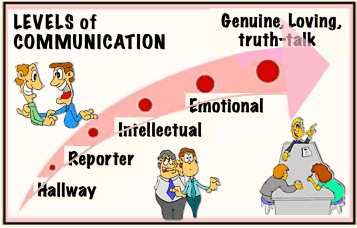
It’s true that healthy relationships – whether private or public – are based on some degree of Emotional honesty. And the deepest level is the realm of Spiritual communion – with oneself, others, nature & Higher Power. (4 Qs to Ask Yourself Every Day).

However, as powerful & precious as the Emotional & Spiritual levels are, they’re too intense & raw to sit with for too long, at any one time.
1. If our tendency is to get heavy too fast with another person – we need to set boundaries – with our Inner Child! It’s not appropriate to assume that someone is a ‘friend’ & then jump into telling our deepest thoughts & emotions (suffering, complaints…..), which is almost always about our S-H & dysfunctional family history.

2. In general, most people are simply not equipped emotionally to go ‘deep’ at all, & it’s not fair to spring such comm. on someone without their consent, or on those we know can not handle it. It’s disrespectful to others (our narcissism) to inflict our intensity on them. (from C. Gilkey)

NOTE: Small-talk is appropriate, from time to time, to keep things on the surface when with acquaintances, or with people we know have very little depth. It is also not a substitute for meaningful conversation with ’emotional peers’, no matter their age or level of self-awareness.

We need to learn that we are in fact fundamentally like everyone else – we share the same needs & desires, & even many times similar experiences. It counteracts our suspicion & isolation.
We also need a break from our own emotional intensity, which will help to balance us. And we may even learn something new!

NEXT: Comm. Categories #2

ACoAs being “RIGHT” (Part 3a)

IF I’M THE ONLY ONE WHO’S RIGHT
everyone else is useless!

PREVIOUS: Being Right (#2)

SITEs: 38 (
unhealthy) Ways to Win an Argument w/chart


DEFs
:
▶︎ Rightness = A belief or action conforming to facts or truth. What is most favorable or desired
❖ Self-righteous = Convinced of one’s own virtue ((being perfect & therefore superior, even when well-hidden from most others) which is in stark contrast to the actions & beliefs of society. Being narrow-mindedly, moralistic. ~ Webster’s dictionary

REMINDER: BR comes in various degrees of intensity. You may have a touch of it, or it may run your whole way of interacting with others.

ACoA ADDICTED to Being Right (aBR) (cont. from Part 2)
PAST: We suffered thru an abusive, controlling & neglected upbringing, Constantly forced to give up our way of thinking, doing or feeling around a Right-ist – we gradually became less able to express ourself, seemingly less competent & articulate (brain-freeze).

We may have seemed stupid, making the bullying Right-ist even more convinced of their superiority. Flooded with fear & anger temporarily diminishes the capacity to use the frontal cortex, which is needed for thinking, decision-making & self-control.

• With some oppressive authority figures, BR was dangerous because it showed them up & was considered ‘arrogant’, slowly forming our belief that we don’t know anything

• With others, a way to survive & avoid punishment was to always get it right, prove it without mistakes & justify ourself – forming the assumption that we must know everything.

🚦Double bind: Many of us were constantly told we were ignorant / stupid / unteachable – while at the same time expected to take care of them as if we were adults trained in several professions!

NOW: Always having to be right can be used as a protective cover, giving us a false sense of stability & control. Projecting our scary childhood onto the whole world, we assume everything is still & forever unsafe, assuming we need to be perfect – to prevent further danger.
Still desperate to please so we won’t keep getting abandoned, we wobble on the fence between these 2 false beliefs (know everything, know nothing), inevitably falling off, inevitably feeling miserable. This original dilemma has left us with rage & S-H, alternating between rebellion & paralysis.

• Many grew up with one or more severe narcissist – who always had to have their way. Then some of us took up the Right-ist mantle & carry it forward, tromping on others as we were tromped on. (See Right-ist characteristics – Part 2)

— SUBTLE but pervasive – perfectionism is aBR in disguise. We can keep this obsession better hidden, but the obvious result is decades of procrastination

— BLATANT: Wanting & insisting on getting our own way most or all of the time – is the narcissism of the False Self, a common character flaw of wounded people (the majority!). We will push & push to get others to see that our way is the not only correct – but the only possibility.

• Feeling superior (aBR), we may not even realize our anxiety is temporarily relieved when we get our way: “I knew I was right! Now that you’ve got that straight, we can go on.” It calms us – our security blanket in an unsafe world. But it’s a false solution because our damage is still lurking in the background, waiting for someone or something to set it off. Unhealed, we’re driven by old, deep terror.

• But like any addiction, having to BR is very stressful – always vigilant, afraid to make a mistake, never truly safe, never comfortable.
While outside it shows up as false pride – the need to feel important or better than everyone else – inside it’s driven by inadequacy & shame, which we may not even be aware of! Especially if we need to be seen as innocent, good & all-knowing.

We’ll use charm & manipulation alternating with anger & intimidation, to force our agenda on whoever we deal with . However, all we end up doing is alienating others by being high maintenance, or taking psychological prisoners of the insecure. In the process we sacrifice our own well-being.

NEXT : BR, #3b.

ACoAs being ‘RIGHT’ (Part 2)

IF I’M NOT RIGHT,
then
who am I?

PREVIOUS: Being Right (#1)

⬅ “ARROGANT BOSS” by DMT


🟧 WHAT’S WRONG With Being ‘Right’?
Unhealthy (mild): The narcissist in us (& every ACoA has one) will think or say “If I can see this so clearly, why in the world can’t you? // If I can do that task, what’s your problem? // If I love that, I assume you will too. If not, why not?!”
This attitude makes no sense at all. Even identical twins are different in some fundamental ways. One person is not automatically better or more correct than another – just different. (See “Symbiosis & ACoAs #3“)

UNHEALTHY (severe) Addicted to being right (aBR)
🖤 This character defect (a cognitive distortion) applies TO :
— some adults we grew up with, AND
— those of us who have copied them , &
— anyone we’re ‘stuck to’ as adults who is like that

A Closed System – The state of a person or thing being isolated from its surrounding environment.
a : Any one person so rigid in their opinions that they can’t let in anything which differs from their own determined ‘correctness’

b 2 people, a Dominant (D) & a Submissive (S) personality, who interact in an ongoing feedback loop, constantly exchanging limited, often distorted, info – characterized by coercion/compliance, co-dependence, sameness & symbiosis (like Mrs Bucket & husband)

For the D – there is no concern & equality for others, or desire to change, and –
For the S – there is no autonomy, questioning, rocking the boat, separateness, speaking up or taking a stand . (More….)

● GROUPS: (family, academia, church… )
Groups who assert they have the only right answer – discourage change, differences, disrupting the status quo, equality, independence, objecting, questioning, or taking a stand.
They tend to promote factions, gossip, immaturity, repression, secrets & triangulation. It makes members reactive & anxious, even if this is hidden from each other. They don’t feel safe to question or disagree leadership or the official rules, feafulr of disapproval, punishment or rejection. (MORE…)

🔒 At the extreme ‘right’ we find the ‘Right-ists’.

RIGHT-ists are in a world of their own, extremely self-absorbed & arrogant – The accuracy or importance of whatever point they’re pushing is not as relevant as their need to be agreed with.
Their rigid thinking is used in a power struggle to bring everyone else to their knees – psychologically, mentally & emotionally. They want to capture other people’s thoughts – even in situations truly & totally beyond their control, such as with the active addicts .(Serenity Prayer backwards“).
Ingrained Right-ists truly feel justified in their position, rarely if ever seeing the arrogance & selfishness of their attitude. Sure of themself & comfortable in their superiority – so there’s no internal cognitive dissonance.

NOTE: Some right-ists camouflage their compulsion by seeming concerned for others’ welfare, sounding reasonable or just giving ‘helpful’ suggestions. But all the while they’re trying to control their environment – to make it conform to their world-view.
One hint: they consistently make unsolicited & often unwanted suggestions, give advice & offer help – there version.
DO NOT be taken in by the presentation. If your own opinions & needs are often or always ignored or over-ruled – you’re dealing with a sneak-narcissist.

Re. SELF,  RIGHT-ists:
• are rigid & controlling, so they don’t work well with others
• can become quite aggressive in order to eliminate the threat to their (secret or unconscious) weak self-image
• experience anyone who opposes or simply has differing opinions – as a direct threat to their sense of well-being
• lack empathy, have no patience with others & are often snide
• need the world to revolve around them

Re. OTHERS
., RIGHT-ists :
• alienate others without realizing it, OR of they do, they wonder why, then assume it’s the other person’s fault
• can end up isolated & deprived of companionship, love, affection, …. unless they find a passive person who uses the ‘Right-ist’ to think for them!
• can’t imagine that other people actually have different needs & opinions from their own (NPD mother = “Put a sweater on, I’m cold”)
• may push good info from ‘good intentions’, without considering that they’re discrediting another’s process, boundary invading, & being arrogant (“others NEED me”)
• regard others’ ideas or viewpoints as inferior or worthless, often losing out on new info, & wonderful opportunities or relationships.

NEXT: Being Right (Part 3a)

ACoAs being ‘RIGHT’ (Part 1)

IF I DON’T INSIST
no one will pay attention!

PREVIOUS: Psychopath Red flags #3

SITEs:
 Why is it so important to be right? 

QUOTEs: “Everything that is in agreement with our personal desires seems true. Everything that is not – puts us in a rage.”~ Andre Maurois
🔎
People who think they know everything are a great annoyance to those of us who do.”   Isaac Asimov


What does ‘BEING RIGHT’ (BR) mean?
a. OK : Generally refers to having accurate information, knowing the right way to do something, or being sure of who we are, what we want, how we feel… It can be about:
Assertiveness: being accurately sure about a subject or a person (“I know what I know”) & not afraid to stand by it
Justice: fighting for what is just & right, especially in the face of opposition, but not for personal gain or to feed one’s ego
OR
b. NOT OK : Trying to force others to see our point of view & see the world exactly the way we do. It can be from:
Narcissism: needing others to agree with us (“I’m right & you’re not”), in order to preserve the False Persona we’ve carefully crafted to cover up feeling insecure & vulnerable
Symbiosis: the need/demand that others are just like us (“agree with me”) in order to not feel alone & abandoned
🚫 BOTH are being out of touch with one’s True Self

SO – it’s important to know when it’s legitimate to be right or not
Al-Anon tells us to ask ourselves “Do I want to be right or do I want to be happy?” It’s a choice between getting our way (at any cost) OR having peaceful encounters with others.
This Q. is addressed to those of us who are co-dependents & addicts, since it would be a rare issue for healthy people. We can also say that Right and Happy are really not opposite ends of a spectrum. Instead it’s about the right/freedom of others to have their own point of view, AND being OK/safe with their right/freedom.

● The Q. comes up when we are having a disagreement with someone & feel an internal pressure (from the PP or the WIC) to get them to do something our way, to understand our point or to agree with our opinion – in order to feel connected. This can only happen if we still have a great deal of unresolved abandonment fear. Remembering the co-dep Triangle (Rescuer-Victim-Persecutor), even victims can become bullies when terrified & desperate to not feel but off.

● It’s a tricky Q. for us to answer because:
💌 some of us go along with whatever others say just to ‘keep the peace’ but really it’s to not have the other person be angry or leave us
💌 some of us never agree with anyone for fear of being swallowed up & disappear (used as a false boundary), while –
💌 others can manage disagreements in some situations (casual friends, co-workers….) but not in others, as when deeply attached to a person or position (lover, job…), then our WIC desperately feels it needs to go along with ‘whatever.

The Brain Is Hooked on Being Right
In situations of high stress, fear or distrust – like being wrong, ignored or laughed at – our brain chemistry (cortisol….) makes ‘decisions’ about how best to protect itself. We default to 1 of 4 F responses:
fight – keep arguing the point, which is the hardest on relationships, & unfortunately the most common
flight – revert to or hide behind group consensus
freeze – mentally disengage, or shut up
fawnappease, ‘make nice’ by simply agreeing

The Fight reaction is partly due to other neuro-chemicals. When we argue & win, our brain floods with adrenaline & dopamine, making us feel good, dominant, even invincible. It’s understandable that we’d want to repeat those feelings. So the next time we’re in a tense situation, we fight again, & over time will get addicted to being ‘right’.
BUT if we’re getting high from being one-up, then the other person / group is one-down & therefore diminished.

NEXT: Being Right (Part 2)

RED FLAGS from Psychopaths (Part 3)


ALL OF THEIR CHARM

is a lie, but hard to resist

PREVIOUS: Psychopath RED FLAGS #2

BOOKs: “Psychopath FREE”


2. SOCIAL Manipulation (in Part 2)

3. GENERAL  (cont)
Hate filled – they’re obsessed with humiliating anyone who is successful, kind & cheerful, taking a delight in breaking up friendships & marriages

Lie & make excuses – about everything, even when it’s not necessary, & can make up lies faster than you can question them

No startle response – they have a total absence of anxiety, fear & worry – where there would be in a ‘normal’ person. They always seem to be calm, rarely stressed or nervous. This may be the result of decreased activity in the amygdala (emotion center of the brain)

• No boundaries – they invade personal space, standing too close. Research shows that ‘cold-hearted’ (inter-personally aloof) people prefer less distance between themselves & others. It may be a subtle symptom of aggression, as in “In your face”

• Physical — psychopaths need very little sleep – maybe 4-5 hrs a night. They’re always on the go, searching for new stimulation
— Research indicates they have a poor sense of smell – have a hard time identifying something or knowing the difference between smells
— They seem to have little or no body odor, maybe from frequent showers, carrying deodorant or a change of clothes – all to make a good impression

Thirst for attention & adoration is obsessive & insatiable. You thought you were the only one who could make them happy, but now you see that anyone with a pulse can fill the role. They will drain you dry, but no one can fill the void in a psychopath’s ‘soul

4. REACTIONS – in YOU, the ‘Receiver’ of P-A
.• Crazed – After being around a psychopath for a while, you’ll feel insane, exhausted, drained, shocked, suicidal & empty. You’ve torn your entire life apart for them – spending money, ending friendships, searching for some sort of reason behind it all. None of it worked & there is no sane explanation. Psychopaths are hollow, deliberately using people & then discarding them like soiled clothes

Denial – You feel on edge around this person, but you still want them to like you. You write off most of their questionable behavior as accidental or insensitive, because you’re insecure & in constant competition with others for their attention & praise

Explaining (a) – You desperately ask them to imagine how they’d feel if you treated them in a hurtful way, but they just stare at you blankly. No adult should have to be told how they are making others feel. But psychopaths can’t seem to put themselves in your shoes, or anyone else’s either.  If it doesn’t bother them, why would it bother you?

•  Explaining (b) You find yourself trying to get across the basic elements of human respect to a full-grown adult. ‘Normal’ people understand the fundamental concepts of honesty & kindness, but not a psychopath. They don’t have a conscience.

Insecurity – During & after the relationship, you’ll spend a lot more time in front of the mirror. (Thank You to “ckwanderlust” for their valuable insights)

•  No fighting – you’re afraid that any way you disagree with them could mean the end. Normal couples argue to resolve issues, but psychopaths make it clear that unpleasant conversations will jeopardize the relationship, especially anything to do with their behavior. You apologize & forgive quickly, otherwise you know they’ll lose interest

Research – You find yourself playing detective, looking for answers to a feeling you can’t quite explain. It’s never happened in your other relationship, but suddenly you’re checking their old emails, cell phone texts, search logs, old Facebook pages & pics, about their ex…..

It’s not you! Their treatment was never about you! What you’re responsible for is staying with someone who mistreated you. That you can change – but never them!

KNOWLEDGE – If you’re wise enough to be on the outside looking at the psychopath, you may be the only one who knows that something’s seriously wrong with them. But no one will listen. Psychopaths are able to maintain superficial friendships far longer than ‘intimate’ relationships.

Friends, family, co-workers will think he/she is great, even though they’ve been taken advantage of, even outright scammed. Unfortunately, ‘victims’ won’t object because they’re distracted with shallow attention & praise – often on social media.
All you can do is say what is true & then let go!

NEXT: Being ‘Right’ #1

RED FLAGS from Psychopaths (Part 1)


NOTICE HOW OUT OF TUNE

they are with the rest of us

PREVIOUS: Dealing with P-As, #5

SITE: Movie Psychopaths – Most & Least realistic 


BASED ON: “30 Red Flags of Manipulative People”

Many of these Red Flags are contradictory – which is part of the psychopath’s bag of tricks. Don’t be fooled, because if  you believe their initial con-job, then they can keep you off balance, & you stay hooked.

★ We always need to be awake for what people are telling us about themselves – in all relationships. One Red Flag to look for is:
Always be suspicious of anyone who comes on too strong, too attentive & complimentary, too easily ‘attached’ – almost as soon as they meet you, even if some of what they say about you is accurate. They simply don’t know you yet, so all their sweet-talk is a form of manipulation & narcissism. It’s creepy!

Healthy people are not taken in by this – they can ‘feel’ such a person’s inappropriateness, whether from neediness or used as a self-serving hook. Smart adults take the time to slowly get to know others, allowing the process to unfold the truth. This is especially important for ACoAs, who are looking for a symbiotic, instant attachment – but which makes us vulnerable to being used & then thrown away!

1. RELATIONAL Manipulation
Bait & Switch. After the initial seduction & idealization phase, they stop the compliments & flattery, then undermine your self-esteem by being degrading & belittling

• Be Non-reactive – they’re cool, calm & collected & want you to feel inferior or over-sensitive for having normal human emotions & reactions

Controlling – They tell you what to of, say & feel. They try to ‘fix’ you up, obsessed with your appearance, making comments about what you’re wearing  & how you look, always picking at you, pointing out flaws that don’t even exist\

Declare you are their soul mate – in the beginning: psychopaths will tell you how much you have in common, they just can’t believe how perfect you are for them, let you do all the talking…. so you’re enchanted

Flatter your deepest insecurities, mirroring your greatest fantasies, playing whatever role is necessary to win your heart. EXP:
— If you’re self-conscious about your looks, they’ll say you’re the sexiest person in the world
— If you have a need to be entertaining, they’ll say you’re the funniest most interesting person they’ve ever known….

Gaslighting. Psychopaths blatantly deny their own manipulative behavior, ignoring clear evidence when confronted with it. They get angry if you try to disprove their denial / delusions using facts

Insult you in a joking but condescending way, subtly minimizing your intelligence & achievements, such as smirk any time you try to express yourself

Over-emphasize emotions, verbally, but not ever show any themselves. Make passionate statements like “I’ve never felt so happy in my life”, but in a robotic, detached voice – like an alien trying to imitate human feelings

Provoke emotional reactions – deliberately setting you up. EXP:
— call you jealous after blatantly flirting with their ex on social media
— call you needy after intentionally ignoring you for 3 days straight…..

Teasing you becomes their major style of communication – “just joking”! If you point this out, they call you hypersensitive, paranoid & cra

Ultimate hypocrite. Psychopaths expect you to be their perfect mate, demanding total fidelity, respect & admiration – while they cheat, lie, steal & use you emotionally

Withhold attention. Once you’re hooked they suddenly become withdrawn & physically uninterested – without any obvious reason or explanation. They act bored, like it’s a chore to be intimate, completely annoyed that you expect to continue the passionate relationship they started.
It make you desperate & needy, ensuring that you’ll always be the one to initiate contact

• Silent treatment: If they stop talking to you for several days, it’s to show their displeasure because they want you to believe that it was your fault for expecting too much from them, for ruining their plans, for not being available when they wanted you…. & they’ll play the victim as an excuse for not telling you

Spotlight – always shining it on your faults and ignoring their own. If you point out their mistakes, they’re quick to point the finger back at you.  EXP:
— If they’re 2 hours late, they remind you that you were once 5 minutes late to your first date
— If they’ve forgotten to keep a promise, they remind you of the time you didn’t buy the milk you said you’d pick it up for their breakfast…..

Teasing you becomes their major style of communication – “just joking”! If you point this out, they call you hypersensitive, paranoid & crazy

NEXT: Red Flags, #2

DEALING with P-As: Managing (Part 5)

I’LL DO WHAT I CAN
but it’s not all up to me!

PREVIOUS: Dealing with PAs – #4

SITE: Confronting P-A behavior
 re. resistance to being confronted = #4


OUR RESPONSES

Set limits, list consequences – then follow through.
CRUCIAL: Identify the P-A’s dysfunctional behavior, & then state what it will cost them to continue it – with you. It’s a powerful tool, throwing down the gauntlet. It says you’re not the pushover they’re used to dealing with. Their maneuvers are basically a power struggle – with the whole world, but especially against anyone they see as an authority figure – in relation to themselves (spouse, teacher, family member, church, governments….) . So you can’t let it pass.

One of the biggest mistakes Receivers make is to be much too lenient. Once you give in to the P-A’s pattern, you’ve lost the game they’re playing. Ignoring or going along with their tactics, or taking on their responsibilities, is enabling & encourage them to continue.

Although you don’t want to provoke an angry confrontation, you also don’t need to be the P-A’s punching bag. Make it clear you won’t tolerate being mistreated. It’s your right to set boundaries. This is equally true about their language & their non-actions, all of which are forms of abuse & therefore damaging to your relationship, & to work outcomes. For most of us it takes practice to be assertive, & sometimes even courage.

Offer one or more serious/ important consequences that you know will matter to the P-A . Said simply & calmly, it may make them think twice about their automatic reactions, & maybe encourage them to modify their behavior – shifting from obstruction to cooperation. READ  7  types of power that encourages positive change.

Make sure the punishment fits the crime. Because P-A patterns are so frustrating, consequences/punishments can quickly go overboard (like in the heat of the moment screaming “I’m never ever talking to you again!”). Taking a time-out for yourself can help you come up with the best response.
AND – you may need to talk to someone else you trust to give you another perspective – or just a word of encouragement to stay strong. There’s nothing weak or shameful in getting support.

EXP
: If this problem has gone on for too long – decide: Do I just need a break, or is it time to end the friendship altogether? / Is this person needed in this job, or should I fire them?….. OR – If someone is habitually late to meet you at an agreed upon time – after the 3rd or 4th time let them know that from now on that you’ll only wait 15 min. & then leave. Don’t keep waiting.

So no matter what their reaction is to being called out, as an Rs you need to stand pat about how much you’re willing to take going forward. Follow through on the limits you set – to let the P-A know you’re not willing to pay the price for their acting out.
If possible, give the P-A a chance to help solve the problem at hand, asking them for constructive, practical solutions that work for them, to improve or fix the situation (at work or at home). BUT if all you get are complaints & criticisms, don’t agree or disagree. Just say that you’ll keep what they said in mind, & go back to the point you were making.

Reinforce appropriate/good behavior – with the goal of increasing its frequency. It can be : punishing bad responses or rewarding good ones – which are harder so notice. So be on the lookout for positive changes – which include expressions of true emotions & any unhealthy tactic not done.

Decide when to detach or avoid the P-A completely. If you’ve given them every chance to ‘correct’, spoken to them reasonable, given them options &/or consequences – AND nothing changes – it’s perfectly reasonable to spend a lot less time with them or end the relationship. Sometimes this can be very difficult & painful, but you have to put your own well-being first. (Self-care)
However, if it’s a casual acquaintance – it’s easier to just avoid them.

What can help you deal with a P-A you care deeply about is to focus on their best qualities. Make a list & add to it if /when you see positive changes. Sometimes reinforcing the best in others will give them a reason to improve themselves.
NOTE: This does not apply to active addicts or other narcissists. Their S-H won’t allow for compliments & their acting-out can not be reinforced or excused.

NEXT: RED FLAGS in Psychopaths

Passive Aggressives – Review for ACoAs (Part 3)

WHAT A CONCEPT : Honest doesn’t mean hostile.
Pleasant doesn’t mean passive!

PREVIOUS: P-A ACoAs (# 2)

SITEs:” Emotionally Volatile People
• “Difficult People & how to Handle Them

REVIEW (cont)
1.The GAME // 2. WHO plays the game

3. CAUSEs of the game
ACoAs ; from our family, school, religion…. we were NOT allowed :
• to be angry, to the point of not even knowing we are!
• to know what we wanted, how we felt, what we preferred (being too much of an individual got smashed – so it left us confused)
• to ask for anything (don’t bother them)
AND
• were taught to never put ourselves first
• always had to always be perfect (no mistakes) – so better not choose anything
• no matter what we did, we were punished, so we couldn’t win
• safer to not be too visible (in a dangerous family, & later in abusive relationships)
taking any risk was discouraged, made fun of, punished (so now we can’t risk ‘failing’ & being disappointed)

4. EFFECTs of the game, as the P-A
a. Negative BenefitsWE DON’T have to :
• figure out who we are, what we want & need
• disobey any of the toxic family rules
• admit we’re angry, even raging, underneath
• stand up to the ‘control freaks
• make a mistake & deal then with consequences
• AND we get to blame others when something goes wrong, & maintain the illusion of superiority

b. Negative Consequences of being P-A :
• always feel scared of disapproval & losing people (FoA)
• it increases our Self-Hate & Loneliness 
• lose out on many opportunities to grow, to be heard, to have fun
• make other people mad at us, a lot! for forcing them to carry all the responsibility & then getting blamed
• never get what we really want, unless by accident or by luck
• we are dis-empowered, lose self-esteem, stay a victim, are infantilized, stay mute, don’t risk anything

4. HEALTHY
a. General: We need TO
• identify all the ways we were hurt as kids, including the specific messages we still obey, like ‘don’t feel’ , ‘don’t talk’ (Toxic Rules)
• prevent the Wounded Inner Child from running our life BY growing a Healthy Adult & Loving Parent  (the UNIT) who can make executive decisions about how to own & fulfill our needs
book-end with the IC, to outgrow living in the past. If done consistently, it will teach the WIC the difference between what’s possible & real in the present, vs the way it was in our dysfunctional family

b. For Passive-Aggressives – we need TO:
• keep a safe distance from anyone who is easily provoked to anger
own our hidden resentments, anger, rage, bitterness
• learn safe ways of discharging rage, & healthy ways of expressing it to others, when needed
• practice saying what we need, want, like, prefer – to find out that nothing bad happens to us or others
• stop looking for other people to be in charge of our life, tell us what to do, make our decisions & choices

Practice making ‘I’ statements every day, silently to yourself, so it gets easier & easier to say out loud:  “I want… I need… I don’t like… I’d rather…  that’s not for me… ” UNTIL it’s your new norm!

c. For Volatiles – we need to:
• accept that the rage is legitimate, but our actions are not always healthy
• find out what’s under the rag e: the reality of child abuse & neglect we lived thru, and the pain it created
• become safe enough to feel what’s underneath – grief, sadness, loneliness, hurt, sorrow, vulnerability Screen Shot 2016-06-17 at 10.24.27 PM.png
• learn calming techniques (bio-feedback, prayer, poly vagal exercises, visualizations…)
• own our Inner Sadist: make friends with it, but never let it act out
• work on getting rage out in safe, appropriate places (therapy groups, 12-step programs, doing rage-work at home, drawing, writing….)

Practice comforting & mentally holding the WIC, so he/she doesn’t feel so alone with all its pain.  Give yourself permission to cry – it is not a weakness – no matter what our family taught us!  Crying clears out toxins & releases pent-up emotional stress. It’s very necessary!

Realistically, while P-As can definitely work on having permission to express anger & rage, it’s usually up to the V. to STOP the game, stop reacting to / expecting (anything) from the P-A. Maybe even having to leave!

NEXT: Qs – Are you P-A?