Positive Character: HUMANITY (Part 2)

THE BETTER MY SELF-ESTEEM
the better my relationships

PREVIOUS: Character: HUMANITY (#1)

See ACRONYM Page for abbrev.


💚 INTEGRITY
(giving our very best)
It’s uprightness of character – decency, honesty, soundness, & being internally complete or undivided (the True Self).
Expressed as – being loyal, faithful, dependable, & dedicated.
Conducting ourself responsibly – to the rules & laws of our community & spiritual beliefs. EXP : Consistent Honesty eliminates guilt & shame, while increasing self-confidence & sense of inner peace.
EXP:
• able to admit to making a mistake  • be dependable & trustworthy
• be fair in our dealing with others & not be manipulative
• be willing to tell the truth even if it costs us money, friends, even our reputation
• don’t exaggerate to make ourself or things seem bigger or better than we are
•  do the ‘right’ thing all the time, even when no one is watching

💚 JUSTICE (rectitude, fairness, uprightness).
adam-and-eve Taking personal responsibility to uphold what is pure, right & true.
 Conforming to the principles of human or divine law, strict performance of moral obligations, integrity in dealing with people, correctly representing facts about their value or demerit
EXP:
• always remain open to reason  • keep our own conscience clean  • never prejudice others  • render to everyone their due or right • have respect for the authority of law   • speak out for what is pure, right & true

💚 LOVE (well-wishing, kindness, self-sacrifice). Screen Shot 2015-07-14 at 8.18.43 PM
The emotion of strong affection & attachment. An unselfish loyal & benevolent concern for the good of another. Can be passionate desire, closeness & intimacy, platonic or devotional
EXP:
•  feel a deep appreciation for everyone we meet because each is unique & special • put a special someone’s needs before our own • see people for who they really are, & still care deeply

💚 LOYALTY (unswerving allegiance)
Show commitment to those we serve or care about, especially during hard times. Hold to our vows, allegiance or obligations towards any person or group. Screen Shot 2015-07-14 at 5.54.07 PM
It’s being supportive, consistent & faithful to a custom, cause, duty, legitimate (healthy) person or ideal that we believe in
It does NOT demand our silence or paralysis when somebody or something is in the wrong, is unfair, unjust….
EXP:
• be of service to family & community  • encourage others in hard times  • don’t mock authorities • point out the good in others

💚 SERVICE (massing on what we receive)
Giving up some personal rights & expectations – temporarily or for the long term – from a desire to serve. Not just providing goods & services as payment, or performing one’s duties.
It’s also helping others to get what they want – actions that don’t involve a return, compensation, or consideration to oneself. Unsolicited help or benefit to someone in need, or doing someone a favor. Also, active devotion to God, through good works & prayer. give a leg up
EXP:
• be humble, but not humiliated!    • be slow to react • be willing to go last, sometimes   •  don’t be boastful  • don’t grumble or complain   •  honor one’s country   • look for ways to help others without being asked

💚 TOLERANCE (towards self & others)
Accept ourself & others just as we /they are, rather than how we’d like ourself /them to be. Appreciate diversity – willing to recognize & respect the beliefs or practices of others. Allow others the right to their own opinions & peculiarities, & to be happy in their own way – if it doesn’t hurt others.
Realize that everyone is at a different stage of their character development, & accept that they express their unique character qualities in varying degrees of maturity. Overlook minor irritants in others. When annoyed, ask ourself “How important is it?” images-6
EXP:
• accept the parts of ourself & other people that are UNchangeable  • don’t confuse what’s popular with what’s right  •  expect the same of ourself as we expect of others or vice-versa   • listen carefully with an open mind, before forming an opinion   • look for ways to help others to grow & mature.

NEXT: Principles of C. Outline

Positive Character: HUMANITY (Part 1)

BEING RESPECTFUL & RESPONSIBLE
makes me a better world citizen

PREVIOUS: Character – Social IQ

SEE: Expanded list of Traits to choose from


💚 APPRECIATION of beauty and excellence
(awe, wonder, elevation):
The ability to admire the masterful design of a person, place or thing, especially if it has many levels of meaning, each layer with a distinct flavor & secret. Notice & value skilled performances & the high quality in all areas of life – arts & sciences, nature & everyday experiences.art appreciation
EXP:
• be awed by the vastness of nature & the intimate details of life • enjoy good craftsmanship  • pause often to take in a view, & look at the sky • understand & appreciate what goes into making anything artistic   • watch people & animals in motion

💚 CITIZENSHIP (social responsibility, loyalty, teamwork
GENERAL: be an active part of a political community, enjoying its rights & assuming duties of membership – which form a distinct sense of identity
SPECIFIC: work well as part of a group or team, be loyal to the unit, do our share, take responsibility for our actionsvote
EXP:
• are troubled by social injustice  • aware of the wider world, with a sense of our role as world citizens  • respect & value diversity  • willing to take actions to make the world a more equitable & sustainable place

💚 GENEROSITY (liberal in giving)
Carefully manage resources so we can freely give to those in need.generosity
NARROW: willing to give money, time, energy, info….to help others, or in order to give them pleasure, and to give more than is expected.
BROADER: be sympathetic in how we deal with people. Tend to see the good qualities of someone or something
EXP:
• give of our time and talents  • not expect anything in return for our generosity  •  praise the good we see in others   • share what we have with others • recycle

💚 GRATEFULNESS  (is NOT like being indebted)
Have an appropriate sense of & value the benefits we have received – at birth, from family, from our environment. Also, a desire to repay  or pass on some of the advantages we were given.
Let others know by words & actions how they have improved our life.  Acknowledge someone for a favor they have done us.  Focus on the positives in our life
EXP:
• be content with what we have  •  count our benefits / blessings, rather than our burdens   • take care of our things    • show helpful people that we appreciate them   • take care of our things  • write “thank you” notes

💚 FAIRNESS
Treating all people the same, according to universal ideals of equality and justice, the same way we want to be treated. Do not make mental evaluations or decisions that unfairly favor or discriminate against others – because of incorrect or inappropriate considerations.
Act consistent with rules, logic, ethics, or in a proper legal manner.  Don’t let personal feelings bias our decisions about others.  Give everyone a fair chance & not take advantage
EXP:
• be willing to give up our share of something for someone who has a lot less  • play fair   • see everyone as having equal rights  • think how our actions will affect others

💚 KINDNESS / COMPASSION (amiable, nurturing, gentle)
Show consideration, personal concern or deep sympathy for others.  The ability to make other people feel comfortable by our inner calmness.  Sometimes putting our own need for attention & self-esteem second to the needs of others. Feel sincere sorrow for others who are stricken by misfortune, accompanied by a strong desire to alleviate the suffering if we can
EXP:
• comfort others without regard to race, gender, faith, age, or nationality   • do a good deed for strangers   • listen when others want to talk • look for lasting solutions  • don’t annoy or irritate people   • have good manners

NEXT: C for HUMANITY, #2

Positive Character: SOCIAL IQ

  positive characterIT’S TIME TO ”ADULT” 
– wherever I am

PREVIOUS:  Knowledge #2

See ACRONYM Page for abbrev.


✿ ACCOUNTABILITY 
“The buck stops here” ∟ Harry S. Truman.
It may be called the ‘ultimate responsibility‘ because it can’t be shared – it’s the obligation to bear the consequences of any action, & especially for failure to perform as expected. It includes striving to express our highest values in whatever we do, aspiring to be our best in all interactions.
accountable
Re. work: each person responsible for the tasks & functions essential to our role or position
Re. relationships: admitting & owning our motivations, words & actions – but not more than that (opposite of co-dependence)
EXP: • being clear & direct  • being trustworthy • not blaming others  • doing things the right way & for the right reason

✿ DISCRETIONdiscreet
Recognizing & avoiding any attitudes, words & actions that could create unpleasant or undesirable consequences. It includes being tactful – avoiding embarrassing situations, not upsetting others, good at keeping secrets, & not attracting inappropriate attention to ourself. Respectful of taboos, not being sucked into what we know is unhealthy or illegal – for ourself or in general
EXP: • choose our words carefully  • don’t make fun of others  • have good manners • thoughtfully consider criticism   • turn down any invitation to do what we know is socially or morally wrong

✿ PERSUASIVENESS (being effective)
The ability to gently maneuver “vital truths around another’s mental roadblocks.” Appeal to someone’s reason, values, beliefs or emotions, in order to convince them to adopt a particular belief or pursue a specific action to their benefit – without doing harm to them or ourself.
Having legitimate influence over others (parent, teacher, boss…. ) allows us to live more in line with what’s suitable, instead of what others want us to do or be
EXP:  • appeal to a person’s conscience in terms of their best qualities  • don’t argue or bully in order to convince someone  • don’t stretch the truth (lie) to make it more attractive  • point others in the right direction   • wait for the best time (have good timing)

✿ PUNCTUALITY
Having a good sense of timing & foresight, with the ability to plan ahead.  Consistently being on time shows that we’re the master of our life & therefore can be counted on.
It shows up as completing required tasks or fulfilling obligations before or by the time it’s due, being on time for appointments AND being prepared on arrival.  It’s knowing when our responsibility ends & someone else’s begins (boundaries), while showing respect for others’ time & plans.
EXP:
• be at the right place at the right time   • don’t make people wait for us  • don’t fall into the trap of “just one more”  • prepare for unexpected delays  • plan a daily schedule and keep it

✿ RECEPTIVITY
receptiveBeing ready & willing to gladly receive all the beneficial & beautiful things life has to offer. Notice whatever positive situation is unfolding in the present moment, taking in what’s available, & making the best use if it. Absorb & hold new suggestions or concepts quickly & easily, open to reasonable arguments, ideas, or changes.  Not having to fight for or be pushy about getting what we want.
EXP:
• accept people for who & what they are   • be grateful for what we have • be willing to receive when it appears  • patiently wait for things to develop

✿ SENSITIVITY / EMPATHY
Show consideration & personal concern for others. Consider things from someone else’s point of view. Be able to pick up on others’ actual attitudes, motives & state of mind (not mind-reading but rather from careful observation).  Understand & identify with the emotions of others – as a direct result of having access to a wide range of our own emotions.in their shoes

Making other people feel comfortable. Being able to fit into different social situations. Don’t decide about someone based only on one interaction, & don’t let our own fears or prejudices get in the way of how to treat them.  EXP:
•  do not feel sorry for yourself • have a deep appreciation for & acceptance of another’s point of view   • make it easy for people to click with us   • read body signals, tone of voice & facial expressions  • say supportive & comforting things to someone in pain

NEXT: Positive C. – Humanity #1

Positive Character: KNOWLEDGE (Part 2)

PREVIOUS: Character – Knowledge #1

QUOTE : “Learning is not attained by chance. It must be sought with ardor and attended with diligence” ∟ Abigail Adams.


◎ CREATIVITY
◎ CURIOSITY
◎ DISCERNMENT

◉ LOVE of LEARNING
It’s the main basis for achieving goals which are important to us : we need to be internally motivated, persist in spite of challenges & have a growth mindset. Love of Learning is related to Curiosity, but goes beyond it – as the desire to systematically add to what we know, & taking joy in the intrinsic value of the process. It includes the effort to master new skills, topics & bodies of knowledge, whether on ones own or formally.thinking it thru

It’s wanting to make sense of things, finding out how things work, gaining competence & control over self & the environment. It’s being open, perceptive & experimental.
EXP: • being excited by new ways of understanding • not afraid to admit ignorance  • open to all types of information  • wanting to know how the world works  • willing to go the extra mile to gather all the facts possible

◉ OPEN-MINDEDNESS
It’s being able to listen attentively to other points of view in order to understand & respect them – without necessarily agreeing.  It includes the ability to hold 2 contradictory thoughts at the same time (ambiguity), while others are taking sides. When presented with a new or radical idea, consider it a possibility instead of looking for points to disagree with or immediately rejecting it.
fairnessWhen appropriate, embrace ideas that can help self-growth & raise self-esteem, which decreases the need to always be right, & also helps to neutralize the inappropriate desire for power. By welcoming the ideas of others (listening without necessarily agreeing), we increase their confidence.
EXP:
• accept the goodwill of others (not being cynical)  • be able to see all sides of an issue  • listen without pre-judgement  • willing to follow where true evidence leads

◉ PERSPECTIVE
The ability to understand how things are inter-related or can be compared – how parts of a topic or situation relate to each other & to the whole. Seeing things from different points of view or re-framing a problem, with or without effort.  It helps to judge distances (like what it takes to move from despair to hope), which also makes it possible to mentally hold comparisons that help manage emotional responses, allowing for  optimism.

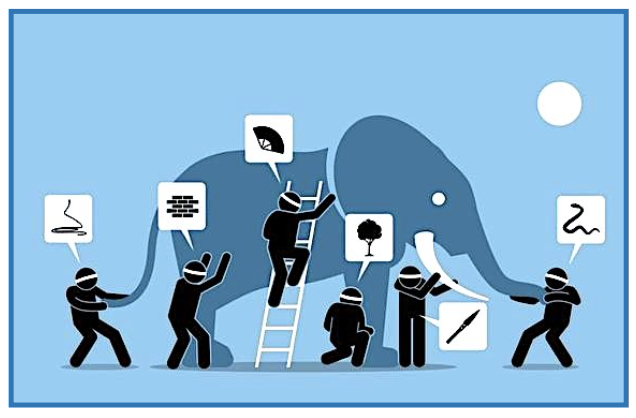
It’s best to NOT view a situation or a person using the lens of our past. Proper perspective provides an understanding of what’s happening in the moment, seeing clearly the answer in any situation & the correct next step toward our vision of success. ( re. elephant Parable)
EXP:
• bring our attention completely into the moment  • don’t get caught up in details (forest vs trees) • keep the important things in mind  • step back from a difficult situation to see the bigger picture  • step back and remove oneself from a problem  • take the long view

◉ RESOURCEFULNESS
The ability to quickly, often cleverly, find ways to overcome difficulties & problems, to make things happen when the chips are down & the situation looks bleak.  A unique use of available resources to achieve our goals – people, info, time, money, physical environment – to their fullest potential
quickAcknowledge but never focus on limitations or obstacles. Live in the now, with an eye on the future.  Resourcefulness is different from Creativity : it’s needed when one is already facing a difficult situation that must be resolved – now – while Creativity allows for time to ponder, dream & process.
While we cannot always be able to anticipate every situation, the more we’re prepare ahead of time for the issues we are familiar with, the more resources we’ll have to draw on when faced with a problem.
EXP:
• be able to out-think an opponent   • find practical uses for things others would overlook or discard   • make wise use of our energy, mind, talents & time   • see value in a wide variety of objects, ideas, & people

NEXT: Character – Social IQ

Positive Character: KNOWLEDGE (Part 1)

 I CAN NOTICE WHAT SUITS ME
without being judgmental

PREVIOUS: Character: Traits & Contrasts

SITE: “Brave New Kitty” blog – re FoO, Recovery….

◉ ATTENTIVENESS
 a. The trait of being cautious – appropriately alert to possible danger (not paranoia) for ourself & our loved ones
b. Staying in the ‘now’, listening to the ‘still small voice’ in ourselves & from H.P.
c. Indicates the worth of a task or situation by being alert, interested, observant & giving it undivided concentration

d.
Recognizes the value of others by giving them listening ears, respect, courtesy & focus – not just about our own needs & wants.
Paying attention to what’s really important to ourself, as well as to others, by noticing details of words & actions
EXP:
• ask questions if we don’t understand  • don’t distract from a situation by shifting attention to ourself  • don’t drift off   • look at people when they speak to us  • sit or stand upright

◉ CREATIVITY (originality, ingenuity)
Approach a need, task or idea from a new perspective. Create something new (a product, a solution, a work of art, a novel, a joke…) that has some kind of value.  A love for putting disparate things together that at first don’t seem to fit – but later the connections are obvious. Always curious about the physical world & relationships, as well as about the inner world of ideas & emotions.
creativeBeing playful, childlike & full of wonder, not rushing to solve a problem, taking time to imagine & dream. Not being run of the mill, not afraid to be different or have to play by the rules.

EXP:
• always look for alternative ways of doing things • have novel solutions to tricky problems  •  look for a better way to live
• the mind constantly challenges the status quo • see things from more than one perspective • use sound principles to solve puzzles • use ones talents for good to self & others
◉ CURIOSITY (novelty–seeking, open to experience)
A drive to know new things, finding many subjects & topics fascinating, always exploring & discovering. Having wonder & admiration for a wide range of info.  Able to access the Healthy Inner Child, who has wonder & admiration for everything – even when it doesn’t like something.

creativeCuriosity helps to shed light on personal issues & troubles by motivating us to uncover big truths & subtle nuances of our inner & outer life. It makes us want to discover things for ourself, not just take someone’s word for it. It is helped by self-control, perseverance & emotional security
EXP:
• ask more questions and trust fewer assumptions  • be open to new possibilities  • only stop asking Qs when we’ve gotten the info we need or want  • can tolerate difficulties or injuries from trying out something new

◉ DISCERNMENT / JUDGMENT (objective thinking, NOT being judgmental)
.
Able to see the deeper reasons behind situations & events. Think shrewdly, sift through conflicting or confusing facts, & choose the best alternative.
Examine things from all sides and not jump to conclusions. Able to change one’s mind in light of new & appropriate evidence, weighing all info fairly. Form the best opinion of a person or situation.

Question things that don’t make sense, ask for the source of info & explore it in more depth. Grasp & understand what is obscure. NOT be critical (discernment is noticing things, while critical is being unkind).
Moral wisdom includes the ability:evaluate
➤ to evaluate a situation or person (putting a value on it) by observing attitudes, communications, & repeated patterns

➤ to judge / choose the healthiest option available, reaching an appropriate decision about what to do or not do – given the desire for a good outcome.
EXP: • ask questions  • consider possible outcomes   • don’t judge hastily  • don’t repeat mistakes  • know what is helpful vs. harmful  • learn from experience • search for value  • trace problems to their cause.

NEXT: Character – Knowledge #2

Character TRAITS & CONTRASTS

character THE MORE I KNOW
the better I can manage my life

PREVIOUS: What is Character (#2)


See ACRONYM page for abbrev.


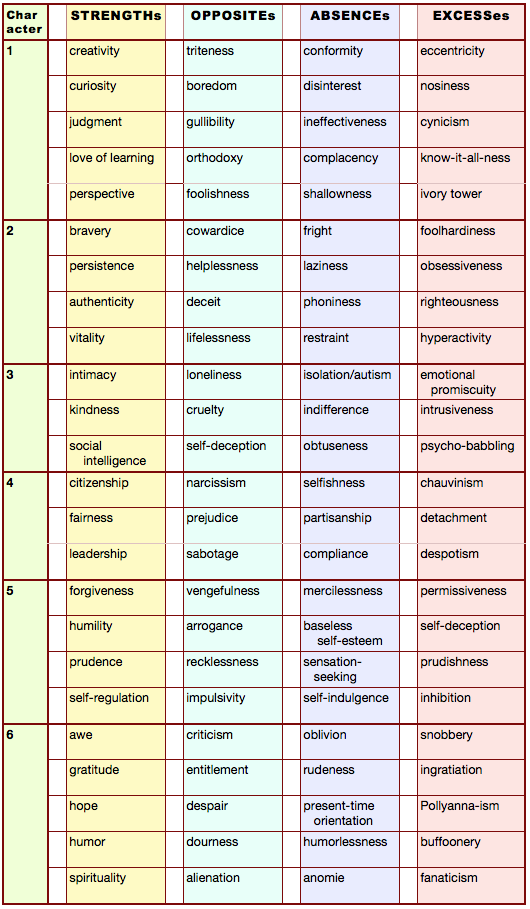
POSITIVE TRAITS + Contrasts
The book “Character Strengths and Virtues” 2004, by Christopher Peterson & Martin Seligman, provides a renewed focus on the science of character – the research community’s first attempt to identify positive human traits.  The authors defined character strengths (CS) as the pathway to virtues which are valued by moral philosophers & religious teachers.

• This CHART is for us to ponder, identify & then own all Character Strengths that fit us & that we allow ourself to acknowledge. List examples of each these positive traits that apply based on your life experience. Get suggestions from a trusted ally, if needed.

• The 1st column lists Positive Characteristics & then contrasts each with 3 variations.  If you identify mainly with columns 2, 3 or 4, you then can see what Healthy traits you can work towards, rather than just giving up as being hopeless.
You may want to print out this form & check off the traits you identify with – in the narrow white columns. Use a gradient of 1 to 5 for each, 1 being weakest, 5 the strongest.
⬇️ CATEGORIES : 1. Wisdom & Knowledge  2. Courage
3. Love  4. Justice  5. Temperance  6. Transcendence

NOTE : the next few posts are a sample list of character qualities, divided into themes. You can add to the list or change the category you think each fits into, as it makes sense to you.

NEXT: Positive Character – Knowledge, #1

Dimensions of CHARACTER (Part 2)

MY CHARACTER STRENGTHS
come from my genes & my family life

Previous: Dimension of C, Part 1

Take: ‘Big 5 Personality Test’


The “O.C.E.A.N.” scale:
These “Big 5” personality factors are broad dimensions based on research, & includes influences from both heredity (H) & environment. Studies of twins suggest the combination contributes in roughly equal proportions.

OPENNESS to experience (H = 57%) Re. Culture, Originality, Intellect
• Inventive / curious <—to—> Consistent / cautious
curiousa. high ‘O’ scorers have strong intellectual curiosity, sensitivity to beauty, a preference for novelty & variety, tolerance for & active exploration of the unfamiliar, & hold liberal or unconventional beliefs.
These people are generally more creative, more aware of their Es, open to new & different values, belief & attitudes.

b. lower scorers see themself as “down to earth”, more reserved, conventional, traditional & conforming. They prefer the plain, obvious & straightforward – rather than the complex, ambiguous or subtle. Generally more analytical & resistant to change, they view the arts & sciences with suspicion, as a waste of time or uninteresting.  At the extreme —> they’re closed-minded, provincial, dull, literal-minded, inflexible.

CONSCIENTIOUSNESS  (H = 49 – 61%) Will to Achieve
•  Efficient / organized <—to—> Easy-going / careless
a. high ‘C’ scorers are: self-disciplined, dutifully, orderly, cautious, prompt, like to be in control, regulate & direct their impulses & tend to be thought-provoking.
They’re : organized, efficient, persistent – aiming for achievement using definable measures or outside expectations. Generally regarded as responsible & reliable.serious
• At the extreme they may be stoic, methodical, cold – becoming compulsive perfectionists & workaholics.

b. lower Cs are more laid back & spontaneous, not as organized or driven to succeed & take it ‘a day at a time’.
• At the other extreme (very low C) – may be lazy, sloppy, careless & have poor impulse control (make a mess of things, shirk duties…).
Can easily be gullible, compulsive followers & put the needs of others before their own.
Very low ‘C’ is linked to antisocial & criminal behavior.
Low ‘C’ + low ‘A’  is associated with substance abuse

EXTRAVERSION (H = 54%) ‘Surgency’ (intense emotionality) : dominant, self-confident, competitive, decisive
• Outgoing / energetic <—to—> Solitary / reserved
intro-extroa.  high ‘Es’ are friendly & cheerful, easily feel pleasant Es (capacity for joy, relaxation, fun, seeing the lighter side…), energized by being with other people.
They’re action-oriented, preferring all forms of group activities, social events, lots of friends & acquaintances, loud music…

They’re assertive, likely to say “Yes!” or “Let’s go!” to opportunities for excitement as well as learning. Love to talk & get attention. Easily bored, with a need for constant stimulation, they may become followers just to have company (<——> opposite of introversion)

AGREEABLENESS  (H = 42%) Accommodation
• Friendly / compassionate <—to—> Cold / unkind
a. high ‘As’ tend to be caring, cooperative, sympathetic, with a general concern for social harmony. They’re usually considerate, friendly, generous, helpful, willing to compromise, considerate of others’ feelings, & have the ability to forgive.
extrovertAs’ are trusting, & easily form bonds with people because of an optimistic view of human nature – believing people are basically honest, decent & trustworthy. Being also pragmatic, they allow things to get done without interference

b. At the opposite extreme, Disagreeable people place self-interest above getting along. They’re not usually concerned with others’ well-being & so less likely to extend themself. Sometimes their skepticism about others’ motives make them suspicious, unfriendly & uncooperative. They can be argumentative, strong-willed, stubborn & antagonistic.

NEUROTICISM  (H = 48%) Need for Stability
• Secure / confident <—to—> Over-sensitive / nervous
a. N. measures emotional stability / instability, impulse control, & anxiety levels.
High Ns on the ‘sensitive /nervous’ end are more reactive & so likely to experience painful emotions more easily (anger, fear, sadness, embarrassment, guilt, depression)
They’re prone to unrealistic ideas, psychological distress, excessive cravings or urges, more likely to interpret ordinary situations as threatening & minor frustrations as hopelessly difficult.sensitive

• Painful emotional reactions persist much longer than for other types, so Ns are often in a bad mood. They have trouble evening out Es – which lessens the ability to think clearly, make decisions, or cope effectively with stress.  Can be self-conscious, easily vulnerable, difficult to understand & have less successful relationships.
BOOK: “The Highly Sensitive Person” ~ E. N. Aron PhD

b. At the other end, low Ns are considered well-adjusted – reserved, calm, self-confident & positive. They cope better with stress – less easily upset or reactive, free from persistent painful Es & less likely to feel tense or get rattled.
• However, low levels of emotional distress does not automatically mean being happy (a characteristic of Extroverts). For some, too low ‘N’ can mean being shallow or unemotional.

NEXT: Chart – C. Traits, Contrasts & Opposites

Dimensions of CHARACTER (Part 1)

THE MORE I OWN MY CHARACTER STRENGTHS,
the more resilient I can be in life

PREVIOUS: Principles of C

BOOK: “Born Entrepreneurs, Born Leaders: how your genes affect your work life” ~ Scott Shane

NOTE: The focus of these posts are the healthy, positive, useful character traits. Naturally we all exhibit the negative version of them as well (some listed in future post), but as we heal from our damage we can express the very best of ourself, especially the more outstanding traits.

IMP
: No one has all of these positive qualities in the same proportions or intensity. Our goal is to identify in ourself as many as we can, appreciate them, hone them – as well as accept & strengthen those we are weak in.
✶ DO NOT let Self-Hate be your guide in listing your innate ASSETS!

CHARACTER IS :
Many studies, including those from Positive Psychology, have defined & classified Character, naming it as the key to understanding what makes up a psychologically good life.

1. For RESILIENCE
Michael Baizerman, Professor of Youth Studies at the U of  MINN, writes that Personal Strengths or competencies are associated with healthy development & life success. He calls it “phenomenological resilience,” which can be observed & measured.
resiliance
• From a recent post on Control (Types of Self-Control, #3):  “Ego resiliency”  is the flexible & appropriate expression of self-control, in the face of uncertainty, change & environmental demands. Without it people tend to become over- or under-controlled.”
Baizerman says the following qualities do not cause resilience, but rather allow it to flourish:
• Autonomy : Adaptive Distancing, Humor, Initiating, Internal Locus of Control, Mastery, Mindfulness, Positive Identity, Resistance, Self-Awareness, Self-Efficacy
• Problem Solving : Critical Thinking, Flexibility, Insight, Planning, Resourcefulness

• Sense of Purpose : Achievement motivation, Creativity, Educational aspirations, Faith, Goal direction, Hope, Imagination, Optimism, Special interest, Spirituality, Sense of meaning
• Social  Competence
: Altruism, Caring, Communication, Compassion, Empathy, Forgiveness, Responsiveness

predictors2. As PREDICTORS : This list is used by KIPP NYC, a non-profit network of free, public charter schools preparing students for success in college & life.  They’re mainly focused on 7 highly predictive CS, based on Dr. Seligman’s work:
• Curiosity  : Students are eager to explore new things.  Ask & answer questions to deepen understanding.  Actively listen to others
• Grit : Finish whatever they begin. Try very hard even after experiencing failure.  Work independently with focus
• Gratitude : Recognize & show appreciation for others AND for ones own opportunities
• Optimism: Get over frustrations & setbacks quickly. Believe that effort will improve their future

• Self-Control – School work : Students come to class prepared.  They pay attention & resist distractions. Remember & follow directions. Get to work right away, rather than procrastinate
• Self-control – Interpersonal : Remain calm even when criticized or otherwise provoked.  Allow others to speak without interruption. Are polite to adults & peers. Keep temper in check

• Social Intelligence :  Able to find solutions during conflicts with others.  Demonstrate respect for the feelings of others. Know when and how to include others
• Zest : Actively participate.  Show enthusiasm.  Inspire others

3. At WORK :  Another grouping is the DISC Assessment System

D = Dominant personality, also known as type “A”. Outgoing with a strong desire to get things done. Need constant stimulation & activity, becoming easily bored. Natural strengths:
Ds are: • able to juggle priorities  • born leaders  • high achieversDISC
• clear communicators  • don’t accept rejection  •  great multi-taskers • self-motivated  • Get more accomplished than any other type

I  = Inspiring personality, also outgoing 
like the D, but more interested in fun!
Is are:  • creative thinkers   • energetic •  extroverted   • imaginative   •  optimistic  • great at persuading & motivating others  • people oriented  • relationship builders

S = Sweet personality, which says it all. These people love to help others.  Even though they are more reserved than the first two types, they still like to build relationships just like the “I” personalities.
Ss are:  • caring  •  great finishers  •  quality producers  • peace-makers  • sentimental   •  relationship builders   • team builders  •  mediators

C = Cautious personality, always thinking. They’re reserved, task oriented & perfectionists. They may not talk much, but when they do it’s important
Cs are:   • cost-conscious   •  deep thinkers  •  great researchers   •  planners   • quality-driven  •  resourceful    • systematic  •  task-oriented

NEXT: Dimension of C, Part 2

PRINCIPLES of CHARACTER

IT’S GOOD TO KNOW
what to look for

PREVIOUS: What is Character, Part 2

SITE: 7 Common Character types in Fiction

See ACRONYM Page for abbrev.


PRINCIPLES of Character (C) 

1. Character Strengths (CS) are BASIC
Neal Mayerson (founder of the VIA Institute on Character) says CS are the basic building blocks of the True Self, our essence – the core part that account for being at our best.
• The word “character” comes from a Greek noun for the stamp impressed on a coin.  From that we use the term to mean that individuals have been “stamped” by nature into a complex of mental & ethical traits.

Unfortunately, people often jump to incorrect conclusions about what C traits mean, such as – if someone is sensitive they are therefore weak; if a person is vain they must be shallow …. Groups are also rigidly stamped in a particular way, such as – because of the very real differences between men and women – one group is considered better than the other.  (‘Men are from Mars, Women are from Venus’).

2. C Strengths (CS) are stable, but can & do change
While they are fundamental parts of our personality, these strengths can change in intensity or in focus, depending on predictable life events such as starting a family, unpredictable life events such as a trauma, and deliberate changes in lifestyle.  
• ALSO, some traits may be prominent at one stage in life (being Adventurous but not Compassionate, Socially active but not Discrete…) while other traits may take prominence at other stages, as with experience & maturity (Decisiveness, Cautiousness, Self-control….)

3. CS are inter-dependent
In most situations people will express a combination of CS rather than one at a time. Interactions among strengths may enhance the expression of some but hinder the expression of others.
EXP : it’s hard to be Creativity without some level of Curiosity, or to be Kind without some amount of Bravery…..while being Discrete can limit the ability to be Persuasive, and being Truthful will modify one’s Meekness ….

4. CS can be developed
While we’re born with fundamental & personal CS, we can have them in different proportions (one person will be naturally higher on Courage, another on Cautiousness, one is higher on Ambition, another on Deference….).
Yet the strength of our characteristics can be modified or enhanced with attention, experience & training. People can learn to be more Confident, more Grateful, more Fair, more Open-minded, more Patient….
Specific interventions can have an impact on many CS, such as journaling, emulating others & goal-oriented planning. Persistent practice can break or modify old habits and form new ones

5.  CS can be overused, misused, or under-usedpower abuse
Since we are all molded by our childhood experiences, our fundamental strengths can be repressed & then quickly forgotten, or expressed in unbalanced & harmful ways.
EXP : Creativity can be misused in email spamming, overuse of Curiosity can lead to gossiping, or someone into dangerous locations, under-use of Fairness can lead to conflicted relationships.
Balance and skill are important aspects of mental health

6. CS have important consequences
The result of expressing one’s CS – at their best & from the right motives – is connected to many benefits, such as increased internal happiness & external success.  This may be especially true of our signature strengths – the more intense ones that are energizing & authentic. They’re the True Self strengths we use across many settings & are readily noticed by others.  Over time, research may also reveal that each C. has its own unique effect.
EXP : Perseverance seems to be linked with high achievement (nACH) more than most other character strengths.

7. CS are universaluniversal
Personal Character Strengths (CS) can be found in the most remote cultures & lands, shared by people with differing beliefs, religious affiliations, & political preferences. This makes applying CS more a matter of identifying & then actively using the best parts of us, instead of picking ourself apart.  (from Ryan Niemiec, Psy.D)

NEXT: Dimensions of C.

What is CHARACTER ? (Part 2)

PREVIOUS: What is CHARACTER ? (#1)

SITE: Personality Types (scroll down)


CHARACTER (cont)
a. Personality  – can be defined as a dynamic & organized set of characteristics that —> motivate us, & uniquely influence the way we think, feel & act in various circumstances.
The word “personality” originates from the Latin ‘persona’, which means mask.  Allport believed that personality develops as a function of learning to adapt to social situations, using our fundamental qualities, while trying to achieve our needs.  Interesting list:
“16 Personality Factors” ∼ psychologist Raymond Cattell.

b. Traits – In Science: Physical characteristics as an expression of a gene or many genes, such as height, eye color, the ability to roll your tongue….
In Psychology: a consistent, long-lasting tendency in behavior, as the distinguishing qualities of your personal nature, such as hostility, boldness, faith….
They are aspects of personality, background, or physique that make us better at some activities & worse at others.

TRAIT THEORY: In 1936, psychologist Gordon Allport (one of the first to focus on the study of  Personality) identified almost 18,000 words in various dictionaries that described differing personality traits, 4,000 of them in just one.

Common Traits – abstract ones used to measure one’s personality or some portion of it
Individual Traits – later renamed “dispositions”- unique characteristics which give us insight into how a person is organized – the “morphogenic study of the individual”.    (MORE…)

Allport noted that what people do is a great clue to their personality traits. If people like to run, hike, & ride bikes we can infer they are ‘Athletic’.  He grouped traits into three levels:

✤ CARDINAL :  A single characteristic that has one general focus motivating a person & guiding most of their activities. It dominates their life as their ruling passions/obsessions, such as a need for money, fame, security…. Someone can be so power-hungry that they are solely driven by that need for control.

• Some people are known specifically for such traits, so that their names become synonymous with the quality. Consider some that made these ‘names’ become household words, by their descriptive term: Christ-like, Freudian, Machiavellian, narcissistic, Don Juan(ish)…. Cardinal traits are rare (not present in all of us) & tend to show up later in life

✤ CENTRAL: these are the 5 to 10 pervasive traits found to some degree in everyone – which govern traitspeople’s day to day interactions. They’re the basic building blocks of personality that shape most of our behavior, but not as strongly as the Cardinals. They are the obvious characteristics most often used to describe someone, such as: “Sammy is intelligent, honest, shy & anxious….” (LIST of Traits)
    
✤ SECONDARY: the traits that reflect more “situational or opportunistic expressions”. They aren’t as incorporated into one’s personality as the others, the particular likes or dislikes that only a very close friend would know about. They’re attitudes or preferences that only tend to show up under specific circumstances, & must be included to provide a complete picture of human complexity. EXP:
• getting anxious when in a group, being impatient while waiting in line
• a preference for ice cream or chocolate, dislike of modern art or jazz

Traits (CT) are expressed in degrees
People express their strengths in different ways & in different amounts, depending on the event or setting. 
Social Psychology tells us that the details of the specific situation influences actual behavior. We may normally be very Responsible, but not always, like being late for an unpleasant meeting, or being flaky because of who we’re with, how much money we have at the moment, how upset or ill we are….

The degree to which a trait is expressed can also depend on the people we interact with. We may BE :
• Restrained when being with a shy person or unsafe authority figure
• Expressive with good friends or children
• Diligent at work, but Carefree on vacation
DRAW on our
• Love & Kindness when with family
• Self-regulation & Prudence when eating
• Social intelligence & Curiosity with casual friends or acquaintances
• Teamwork & Perseverance at work….

NEXT: PRINCIPLES of CHARACTER