How the BRAIN LEARNS (Part 2)

cds & the brainMY EXPECTATIONS ARE TOO HIGH
for my own good!

PREVIOUS: How the brain learns (Part 1)

BOOK : Think Better, Feel Better ∼ Carl Pacifico


OUR BRAIN – Gathering Information (cont.)
1. FIRST INFO

2. CONTRADICTIONS

3. ADDITIONS
– all new items which do fit with the majority of already accumulated info will automatically be considered as correct, whether they are or not. Finding similar elements about a topic adds to our knowledge base – which doesn’t mean it’s accurate – just reinforced!

• When we have too little info about something, any previous knowledge (no matter how flawed) will carry a lot of weight in our evaluation about a person or situation, & therefore will heavily influence our action or reaction

EXP: If our parent was an addict, & then our first lover was an alcoholic . drug user…., & we keep dating & marrying addicts, then active addicts become our ‘drug-of-choice’!

👁‍🗨 DUALITY – AND what if we encounter a situation or person that’s both a benefit AND a threat (like a parent, a spouse, a job or career, your own child)?
Because the brain is pre-programmed to label all previously gathered info as basically valid, it rejects anything that doesn’t fit — precisely to reduce the pressure of this kind of dilemma, called ‘cognitive dissonance’.frenemies
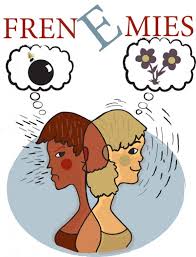
• This makes it very hard for us as adults to leave bad situations where we get or got some good stuff – emotional crumbs – along with mostly bad stuff, the same way we did as kids, like  :
needing to leave : a sibling we were once close to who is now screwing us out of our inheritance

a parent needing to oust : an adult-child still living at home, not working, drugs internet   – who was an adorable & adored favorite when little….
The ‘good stuff’ may have only been a long time ago, or it could have all been an illusion, but we’re still hanging on to memories, hopes & wishes!

4. COMPARISONS – The brain can’t measure anything directly, but rather using some pre-set standard, will compare various things, actions, people, events…  If the standard is flawed, our evaluation will be off!
EXP: Being on a ship without navigation tools & no land in sight – you can’t ‘magically’ tell where you are by just looking out of the porthole!

a. VALIDITY – For the comparison to be credible:valid
• the thing or person must be completely & correctly identified (like 2 specific books)
• the 2 things must be equal (can’t compare adult with child, a paperback to a hardcover)

• there has to be an actual way to make the measurement  (color, college degrees, education, height, weight….)
• the observer is objective (no personal stake in the conclusion)
• there should not any others factors involved – but if necessary, they also have to be of equal value (2 books in different languages, but on the same topic)

b. INTANGIBLES – What about measuring things like intelligence, honesty, love…? These are impossible to define because they’re subjective, & their meaning is embedded in one’s culture. Yet it’s constantly being attempted.

Most results of trying to pin down abstract concepts are incorrect & therefore meaningless, BUT the attempt can sometimes effect a person’s occupation/ income, social acceptance & identity.intangibles

EXPs: IQ tests only measure the ability to answers certain Qs, not the person’s actual intelligence – but can be used as a hiring tool.
EXP:
👮🏽 What cops & lawyers mean by ‘honesty‘ will be very different from what a minister believes it to be, and
👶🏼 what a kid means by “I love you” isn’t the same as when said by a lover.

c. EXPECTATIONS – a common standard for measuring performance – either our own or that imposed by some authority.
▪︎ Put on us: the results are quite arbitrary, depending on who is ‘doing’ the expecting
✓ What my high school music teaches thinks about my singing may be very, very different from how a Juilliard professor will assess it

▪︎ We put on others: Errors can easily occur when measuring others based on our expectations of them
✓ “I can’t believe she didn’t call me this week, knowing I’d been in the hospital! I would have called her right away, if she’d just had surgery!”

NEXT: How the BRAIN LEARNS (#3)

How the BRAIN LEARNS (Part 1)

trees 3WHIRR, WHIRR, WHIRR – the wheels never stop!

PREVIOUS: Undoing CDs

POST : “Retraining the Brain = Neuroplasticity”

☆ NOTE:
The following is a simplified explanation of how the brain mechanically absorbs & catalogs information, often times leading to Cognitive Distortions.
Biological information does not negate free will, Personality Type or the power to change (via Structural Neuroplasicity). But it does explain why it takes effort & time to correct damage.

➼ Think about each point listed in relation to growing up in a dangerous, terrifying, lonely environment – about how those experiences that ‘programmed’ us. Remember the military acronym G.I.G.O. = garbage in, garbage out.  Whatever our brain took in as a kid was not our fault – it’s the way humans are built.

✶ ACoAs ask: “Why do I do these things? Why can’t I get It? It’s too late, I’m too damaged…..”, which are all forms of S-H, based on CDs.
Learning the mechanical reasons why psychological change is a struggle can be encouraging. Change is hard but do-able!

• Having complete & correct info about something or someone allows us to respond to life appropriately & achieve our objectives
• The opposite is equally true – lack of, or distorted info will make us respond badly, perhaps even fatally. Any missing & incorrect facts get integrated into our thinking, like bugs in a computer program

⚑ Regardless, the brain’s main goal is to generate responses to the environment that will most likely insure our survival, including some terrible things people (abused children, battered wives, war combatants…. ) will do to cope with terrible situations!

OUR BRAIN – Gathering Information

1. FIRST INFO – The brain accepts as correct the first info it gets about any completely new topic, person, situation… without critical evaluation, whether accurate or not.  Additional info that fits with the original input is also accepted as true, regardless of validity.

Even if we suspect (intellectually) that some info might be wrong, the brain has no ‘warning signal’ to indicate what is or gathering infois not legitimate
EXP: If a new lover is charming, intelligent & seductive at first, the unconscious will label them as safe or at least acceptable, no matter what they’re really like

• Then, when the brain notices a stimulus (whatever triggers a reaction in us – like a hand wave), it goes thru all it’s stored info about:
— the origin of the stimulus (who’s waving)
— how to deal with it (wave back, ignore it, avoid it quickly…)

2. CONTRADICTIONS – Any new item that disagrees with what’s already in the memory bank is automatically rejected as wrong! This is not due to stubbornness, stupidity or a character flaw.
Rather, it’s a built-in survival mechanism, moving us toward things that seem beneficial & away from things that seem threatening

EXP: So, if the new lover at some point starts mistreating us or acting weird, we excuse it away / put up with it / ignore it completely… especially if they remind us (unconsciously) of our parents, who were our very earliest love interest!contradictions

• As more experiences are accumulate, contradictions have a less bothersome effect on our thinking, so we stay in the original groove. The brain has no built-in way of knowing what’s T or F about ‘people, places & things’ (PPT).  It just blindly relies on its backlog of stored data

• Of course, the importance (danger) of bad info is in proportion to how relevant it is to our life. Having the wrong or incomplete info about how tigers mate won’t usually effect our well-being, but bad / limited info about drugs & poisons, severe narcissists, environmental pollutants…. can be devastating or even fatal.

EXP: “First Info” is partly why battered wives keep going back. If they &/or their mother got beaten a lot when they were kids, it’s what they know & expect.  “Contradictory info” such as : “He’s no good for you, you have to leave…” has little effect, thrown out as incongruous & therefore not to be acted on.

NEXT: How the BRAIN LEARNS (#2)

CDs: CONSEQUENCES (Part 2)


HAVE TO CLEAN MY BRAIN OUT!
or I’ll never get what I need or want

PREVIOUS: CDs Consequences (Part 1)

REVIEW post:Weak decision Styles


CDs – regarding Personal Problems

a. SELF-SERVING: EXternalized dysfunctional behavior, to protect a fragile sense of self from greater harm:
• Assuming the worst, Labeling, Minimizing, Self-centeredness
USED to cover insecurities like a shabby bandage, keeping us dishonest with ourselves & separated from others

b. SELF-DEBASING INternalized expressions of self-hate:
• Catastrophizing, Disqualifying the positive, Personalizing, Over-generalization, Selective Abstraction, Shoulds ….
USED to keep us powerless & hopeless, intensifying our wounds

1.- Thinking & CDs (Part 1)

2. (E) EMOTIONS : The more CDs we absorbed & developed n childhood, & now – the longer we ‘use’ them as the basis for living, the more they increase anxiety, deepen depression, disappointment, rage…. causing relationship difficulties & potentially – auto-immune diseases.

Depression being a common ACoA state – we can identify one of several causes by carefully focusing on the connections between external events & our inner responses.
The sequence is made up of :
a. Activating event (objective Situation) that’s scary making a cold-call, asking for help, mulling over a problem, visiting family
b. Logic Errors (CDs) : Assuming the Worst, Fortune-Telling, Disqualifying the Positive,  Mind-Reading….”
CAUSING ↓
c. Automatic Thoughts = Limiting Beliefs : “They’re too busy to talk to me” , “I should’t need help” , “He won’t want to listen to me”, “They always ….. ”
d. Consequencespainful emotions & the harmful actions or non-actions that follow

EMOTIONAL (PMES) RESULTS
• they can prevent us from letting go of past hurts
• contribute to a false sense of reality, of paranoia, illusions
spiritual weakness• directly contribute to thoughts of suicide – or actual attempts
• increase frustration, depression, S-H, anxiety, irritability & helpless rage
• maintain the feeling of being a victim or scapegoat
• make it easier to feel unattractive, so not want to do regular self-care
• may distort or prevent the enjoyment of sexual activities
• reinforce our childhood abandonment, hurt & disappointment
• prevent us from seeing the bright side of life, making things less fun

➼ Put-downs from others can erode our sense of self-worth, especially when coming from our own family. Children definitely believe negative assessments of themselves given by teachers & parents, developing a damaged self-concept when criticized on a regular basis.

▶ Researchers estimate that the ratio of +positive to -negative comments needs to be at least 5+ to 1- for any relationship to be healthy and survive long-term.
THIS applies to how we talk to ourselves as well!

3. (A) ACTIONS: Another extreme —> Using CDs as a model for how to function is part of Cognitive DEFICITS. all of which prevent us from successfully handling many of life’s situations. We rely on & maintain CDs TO:
• deny responsibility for our actions & ignore the harmful results
• avoid facing painful emotions, or having to change ourself
– even though acting on them ensures that we stay deprived.

IMAGE = Stress effects —->

PHYSICAL (PMES) RESULTS
As negativity drains our energy, the body’s defenses are lowered. (See: psycho-neuro-immunology)
• they contribute to eating disorders, from extremes of over-eating to a complete lack of appetite

• cause hyper-ventilation, faster & shallower breathing, lessening oxygen delivery with less nutrients getting to the whole system
• disrupt sleep, causing constant exhaustion, since many of us obsessively worry right before dropping off
• lead to excessive sweating, which removes blood flow to hands, making them cold & clammy
ALSO:
• contribute to the cause of some illnesses (along with diet, environment, genetics…), like auto-immune diseases, colitisCD illness, ulcers…. & shorten life by damaging the immune system.

• decrease activity in the brain’s temporal lobes, slowing down our ability to think & process info, & the cerebellum, causing poor memory, moodiness, depression

• increase & flatten heart rate, so that it has to work harder, less efficiently & over time can lead to heart disease
• increase muscle tension, leading to head, back aches & overall body pain
• make the body react chemically from fear, overworking the adrenal glands, which eventually get worn out

NEXT: CONSEQUENCES of CDs (Part 3)

CDs: CONSEQUENCES (Part 1)

CDS effects - 1  

WHAT A MESS I’VE MADE
I don’t know what I was thinking!

PREVIOUS: CDs & the Unconsc. #4

REVIEW all CDs posts


OVERVIEW
Our brains are predisposed to making connections between ideas, actions & consequences, whether they’re truly connected or not.
While most people have a few CDs, ACoAs struggle with them long-term, having been formed as a way of coping with ongoing painful & traumatic life events. (Review Anxiety & T.E.A.).

1. (T) THINKING
CDs are available to the conscious mind, but are usually slanted downward, (CDs –Summary), making holes in our reasoning. 3 themes have been observed (A Beck) :
• Depressed people dislike themselves
• Current events are always interpreted negatively
• The future is also appraised negatively

CDs are like termites, damaging the whole system. Conscious (overt) abusing thoughts as self-talk reinforce themselves, creating a feedback loop of self-harm. Studies show how CDs
impact a wide variety of —
SOCIAL problems: child molestation (religious & non-church pedophilia), juvenile delinquency, chronic substance abuse….

PERSONAL issues: depression & worry, OCD, Bi-polar illness, relationship troubles, lack of college success or job searches, physical health problems… partially caused by anxiety & prolonged stress

temite CDs✶ CDs are mental signs of deeper, unconscious damage which need to be addressed. The mantra used by the Behavior Modification school of psychology “Change your thinking, & all will be well” is not the whole story, doing a great disservice to many suffering people. If we change our surface thinking but not the underlying wounds (trauma), whatever improvements that do occur are rarely permanent.

• However, there’s no doubt that identifying & replacing (not changing) CDs does have a positive effect on well-being!

MENTAL / PRACTICAL (PMES) RESULTS
a. Hamper Decision Making
• CDs act as obstacles, stopping us from being productive by creating fear & worry that hold us back from doing something that could be beneficial
• they easily discount valuable new info that disagrees with our existing beliefs
EXP: ‘Anchoring’ can throw off negotiations by getting us stuck on an arbitrary value

• they interfere with the quality of our work – concentration & productivity – by draining energy, disturbing the nervous & digestive systems
• limit or eliminate leisure, fun, & time spent with family & friends
• greatly reduce or eliminate satisfaction in our achievements
• waste time & energy obsessing, so are a wasted use of our intelligence

b. Hamper Problem Solving
• lose time, energy & $$ spent fixing problems made by following CDs which could have been avoided
• impede creativity. EXP : a ‘Framing Bias’ will make us look at a problem too narrowly, while the ‘Illusions of Control’ can make us over-estimate how much influence our actions will have in a situationdecision-making

• can interfere with the 4 skills needed in Decision-Making:
i. define & formulate a problem
— able to understand its exact nature
— understand cause-effect relationships
— identify obstacle in the way of the goal
— form realistic objectives

ii. generate alternatives — able to brainstorm a variety of solutions
iii. make decisions– able to predict possible consequences & their likelihood, & conduct cost-benefit analysis of the desired outcome
iv. implement & verify a solution — able to optimally carry out a plan, monitor its effects, troubleshoot if the solution isn’t working
and validate oneself when the outcome is successful!

c. Limit Learning
• they prevent us from going back to school to reach a goal or change careers (‘Disqualifying the Positive’, ‘Perfectionism’, Mental Filter’…)
• reduce how much we achieve (rather than what we’re actually capable of).
If we say “I can’t handle this”, “this is too hard” …. we probably won’t even try, since the subconscious believes what we say to ourselves
• short-circuit how much we can learn. The ‘Von Restorff Effect’ (also called the “isolation effect“) makes us over-emphasize some information, because it’s unusual,  over other info which may be more important. ‘Clustering Illusions’ can trick us into thinking we’ve absorbed more that we actually have.

NEXT: CD Consequences – Part 2

CDs & the Unconscious (Part 4)

cds & emotions
I CAN HAVE EMOTIONS

without having to act on them!

PREVIOUS: CDs & the Unconscious (#3)
 

1. THINKING  (cont)
a
. The UNCONSCIOUS 

bThe CONSCIOUS (cont)
Changing our thinking patterns is a continuous, sometimes frustrating process. The more we understand how our brain & the process of change works, & what to expect, the more hope & patience we can have!

RECOVERY: Correcting our thinking leads to a more peaceful inner world. As ACoAs, it’s helpful to remember that this state is something we have to get used to – most of us find it boring at first. Eventually we come to appreciate & cherish the internal quiet. This is not boredom – which is an aspect of thinking, not feeling. It’s rather a sense of well-being!

2. EMOTIONS 
In general, emotions are stored as physical memories of our experiences & can be recalled by experiencing events in the present they remind us of. These emotions may be comforting, pleasurable, relieving, exciting… OR scary, rageful, lonely…. We can’t directly choose what we feel, only what we think.

• Researchers tell us that anxiety** responses such as “fight or flight” originally had adaptive value for the human species, & are still legitimate forms of protection. Active defensive measures such as – seworriednsitivity to sound, the startle response, shallow breathing & increased heart rate – help people escape real dangers.
However, we rarely face the external dangers our ancestors did, so now we’re flooded with those same stressful chemicals from internal pressures (CDs) without enough physical outlets to burn them off.
(Post:  Anxiety & T.E.As

**Anxiety (diffuse fear) is the nervous system’s response to internal or external stressors (a painful loss, self-hate, a fight with someone….) which intensifies how we feel & then act, but needs to be triggered by CDs & negative thinking.
This has been shown on brain imaging scans. However, since CDs are conditioned over time & become unconscious habit, we simply don’t recognize the source of our fear.

• Cognitive (T) psychologists believe that some people are more biologically predisposed than others to ‘threat-sensitivity’ & the distress it causes. In such people, once anxiety (E) is triggered, it’s maintained, & increased IF negative thinking is added to the mix.

Extreme physical responses related to CDs, set off by in stressful situations, can spread to & contaminate other parts of our lives – from mildly uncomfortable to actually dangerous.
EXP: Obsessive worry (T) caused by projecting the loss of a relationship  – which is not imminent – can provoke a panic attack (E), with the same physical intensity as if you were being held at gunpoint!

• As adults, ACoAs too often make the CD mistake of ‘Emotional Reasoning’, assuming that if we feel a certain way, it must be true:  “I’m really, really scared today, so it’s not safe to leave the house”!
The WIC is having an intense feeling about something going on in our life (an exam, a new job, a break-up…) & wants to hide.
But the sense of impending doom is way out of proportion to the actual situation. “If it’s hysterical, it’s historical”. And staying home alone may make it worse!

EXP: Your father may have only beaten you Many times or only occasionally) for stealing some change or sassing mom, that pain, fear & humiliation will always be associated with thoughts like “Dad doesn’t love me”, or “Parents are so unfair!”…. So now, anytime the boss (parent figure) is annoyed with you for making a mistake, you’re terrified, convinced you’ll get fired any minute now!

EXP : EMOTIONS re. ways adults can react to the death of a parent:
💦 A symbiotically attached ACoA will be devastated, partly from the loss of hope, partly from the depth of abandonment, perhaps also feeling guilt that things were left unfinished, & anger at being left. Sometimes they try suicide.

💘 A healthier person with sufficient S & I experience will be sad, mourning the loss & be aware that a permanent piece of their life is gone, but has a sound emotional & spiritual foundation to sustain them.

REVIEW posts: Emotional Maturity, and the series on EMOTIONS

NEXT: CDs – Results (#1)

CDs & the Unconscious (Part 3)

sunrise
I CAN BRING TO LIGHT

what’s been hidden all these years!

PREVIOUS: CS & the Conscious (#2)

1. THINKING  (cont)

a. The UNCONSCIOUS (2. Emotions in Part 4)

bThe CONSCIOUS (cont)
MAKING CHANGES
• Consider the entry into the unconscious as a lens aperture.  It’s only natural that the wider the opening, the easier it is to let light in! We know that old info will try to keep out any new info that’s going to cancel it out!
So we need to use Recovery tools to become more receptive in this ‘adversarial’ situation, since too much tension closes us off to anything contradictory to our earliest training

When we begin to replace mental distortions (CDs) with positives, we may consciously say:
• “I’ve studied as much as I can & I’m not stupid.
• I’ve done well in the past, so I believe I’ll do well this time too.
• No matter what the outcome, I’ll be OK”

But because of unconscious programming,
at first we can expect :
💨 TO feel uncomfortable, because the statements don’t agree with the fear we’re experiencing at the moment
💨 TO have the PP tell us we’re ridiculous “Who do you think you are?”
💨 THE WIC to absolutely not believe you. Only the PP’s voice carries weight – until the UNIT is strong enough to takes over

• When we think: ”Oh no, what if I fail this test / I’ll never remember everything I read / I’m such a flake….” — we will feel anxious. This causes various physical reactions (tight stomach, heart pounding, headache….), which can add to the fear.

This is to be expected!  Remember from INFO & the Brain: introducing new facts – contrary to what’s stored about a topic – will automatically be discounted. The unconscious is very good at maintaining the status quo.  As a built-in skill of the brain, it’s not a bad thing, as it helps retain consistency

• We can see how important it is for our minds to be stable & predictable when considering how crazy-making double-messages are! ACoAs got so many conflicting & confusing messages growing up that we end up convinced we’re crazy! But it’s not us.

add a positive ✓ One way to have access to the unconscious is to be physically & mentally relaxed. Also – liking something makes it more accessible.
Some ACoAs think it’s deceptive or arrogant to tell ourselves before an exam or interview: “….no matter what the outcome, I’m OK”.

So, instead, try : “I LIKE the idea of being ok, no matter what the outcome is…”,  which will dilate the aperture of the unconscious enough to slip in the rest: “… and I know that tomorrow I’ll remember what I read!”

• We don’t have to replace old beliefs – just add positive, healthy ones, creating different chemical pathways, which then take precedence as new mental habits.
The old routes will be less used, get weaker, & so not as easily fallen back into (regression). They’ll become a little like abandoned buildings – still there, but no longer lived in. This is good news for ACoAs who assume we have to get rid of all bad ideas before we’re ‘better’.

✓ The best time to substitute a subconscious thought pattern is when it’s currently playing in the mind, causing us anxiety.  Even though that’s when we “feel” least like doing it – replacing the thought right then will be most effective.

EXP: Picture being in a dive with a jukebox – if we push D4 (an event), a specific record will play (a CD) but this one is scratchy & annoying (painful emotions). That’s when it’s the exact time to put a new record on, to get rid of the grating noise!
But it doesn’t FEEL right (we refuse, as if it were illegal, and Mac-the-Knife is glowering at us — so it seems impossible.)

Yet, if we push thru the lead curtain of resistance, & “Rinse & Repeat” each time the old messages surface, it WILL get easier. Eventually we won’t have to work so hard to step on that old 45 & see it crack apart.
TIP: decide on a phrase or two that counters the Bad Voice (PP), & then practice them until they become automatic.

NEXT:   CDs & the Unconscious (#4)

CDs & the Unconscious (Part 2)


THAT PESKY UNCONSCIOUS –
it’s been running my life & I didn’t even know it!

PREVIOUS: INFO & the BRAIN (#1)


1. THINKING  (cont)
a
. The UNCONSCIOUS (2. Emotions in Part 4)

bThe CONSCIOUS mind is abstract, creative & aware, about such things as —
— thinking about what we’ve heard, seen or written
— what is intelligent & purposeful (having choices)

It doesn’t know what’s in the unconscious & doesn’t even want to acknowledge it, because it considers it too ‘simple & concrete’.  In spite of that ‘prejudice’, our conscious part only has about 15% control over forming experiences, while the subconscious is in charge of the other 85%, as the result of conditioning!

In general, Thoughts are latent but measurable forms of electro-magnetic energy, an important natural activity we produce!  Changes in thoughts change our biochemistry, hormones & brainwave patterns. Thoughts vibrate at different rates of oscillation, spreading out from the body like pond ripples. The speed & distance they travel depend on the frequency that generated them, so the way we think definitely has an effect on our environment

negative thoughtsNegative Thinking (CDs) assumes only difficulties & failures. It make us feel bad & decreases brain function, creating the same physical responses that any actual physical experience which would trigger anger or fear (blood pressure rise, cold sweats, hand tremors & flushed face, light-headedness & muscle weakness, rapid heart beat, shallow breathing, stomach knots….)

Thoughts are stored:
i. EITHER by mechanical repetition (like hours of reciting multiplication tables, practicing musical scales, rote prayers….)

ii. OR by pairing a thought or experience with an intense emotion.
When emotions connected to an event are too intense (painful), the whole thing will be repressed, especially if the distress is long-term or particularly traumatic, like most of our childhood, an abusive marriage, a severe illness….
✓ Think of your very earliest memory. Whether it was a pleasant event or not, it was anchored in your mind by a strong feeling!

AUTOMATIC
• Any often-repeated thought becomes so automatic that after a while we don’t even notice it. It’s now unconscious, out of awareness, but like Google, a complete record of our life.
It includes all our experiences & emotions: disappointments, delights, habits, joys, losses, pleasures, successes, traumas….. PLUS a collection of ‘beliefs & perceptions’. It’s all there – waiting to be discovered!

EXP: Growing up you were neglected & abused at home & bullied at school, with no one to protect or defend you. Now, any time you consider attending a group – no matter how innocuous – you have palpitations.
You think it’s only because you’re an Introvert & shy, but it’s more likely to be from unconscious CDs formed by early stresses – like Over-generalizing, Disqualifying the Positive, Unrealistic Comparisons, Projection….

Hidden : even though information is out of our awareness, continual thinking is still going on. When an emotionally upset ACoAs is asked: “What are you thinking or believing about this situation?”, most will answer : “I’m not”, or “I don’t know”, insisting they’re ‘just upset’

• Strong emotional reactions are always driven by automatic thoughts. With some encouragement & digging, the harmful thinking can be uncovered:
— coming from self-hate beating us down
— repeating insensitive or cruel things others have said to us
projecting dire outcomes about something….

Automatic thinking can be either helpful or harmful:
as a +,  it makes it easier to respond to life’s many tasks & situations without having to stop each time to figure them out – whether driving a car, doing our job, or raising children

as a -, it causes problems when there’s flawed reasoning in the unconscious. Since we’re not aware of what we’re ‘saying’ to ourselves, we don’t know it is creating the emotional pain (anxiety, hopelessness, rage, unbearable loneliness….).
Instead, we blame the distress on something in our environment, which is only a trigger

EXP: 2 people are called in to see the boss. One goes in calmly, curious but confident. The other becomes more & more agitated while waiting his turn.  The difference is not the upcoming ‘talk’ but what each person is automatically, unconsciously thinking / believing about what’s going to happen.

NEXT: CDs & the UNCONSCIOUS (Part 2)

CDs & the Unconscious (Part 1)

cds & thoughts


LIKE THE BIRTH OF NEW STARS
I can give birth to new thinking

PREVIOUS: CDs & the Unconscious (#1)

AA saying: “Alcoholics dig themselves into a rut, & then decorate it!”

1. THINKING  (2. Emotions in Part 4)
a.
 The UNCONSCIOUS mind is ‘just’ the result of patterning, conditioning & habit – therefore it’s basic – very B & W, not thinking, intelligent or creative, totally literal with no sense of humor! From our birth it absorbs info & experience without insight or good judgment.  So our early years provide the basis for all future learning, as the mind filters out inconsistencies.

NOTE: ‘Unconscious’ is the part of mind holding information we’ve gathered – which isn’t available just by wanting to access it, & can only be retrieved by special techniques or triggering events.

Subconscious’ is the level where unconscious memories drive our emotional reactions & behavior, without realizing it, like:
— seeing food suddenly making us hungry
— a deep-seated but untreated childhood trauma distorting our ability to make safe, rational decisions…..

• In the Cognitive Therapy model, distorted information-processing results in anxiety symptoms, such as catastrophizing, the excessive focus on negative outcomes leading to false alarms, hyper-vigilance, loss of objectivity, no tolerance for uncertainty, & ‘lack of habituation’ (not desensitized to a stressor -air travel- even with repeated exposure).

• This is familiar to ACoAs, who grew up in emotionally tense & physically dangerous environments, at home & outside, & now react with “fight, flight, freeze or appeasing“. Originally —
Fight would have been with siblings, neighborhood kids, school peers, hurting animals or possessions, & sometimes self-harm
Flight was more common. As long as we were too young to leave home we escaped into books, friends, school work, sports & of course fantasy. And for some – attempted suicide.
Freeze was & still can be when our mind blanks out from fear, & we can’t think at all, called dissociation
Fawn / Appease was & is people-pleasing, agreeing with anyone who scared us, being over-solicitous, over-giving….. anything to ‘placate the monster’

MODIFYING the Unconscious
self Qs• While there are people & situations we DO need to get away from – it’s always good to check our point of view first. This is not a blame or a judgement. There’s a big difference between what the WIC ‘feels’ or that the PP is telling us about ourselves & others – vs – how the Healthy Adult / Loving Parent sees things.

• So in terms of CDs, if we assume our pain is ONLY caused by something outside of ourselves, we waste a lot of energy trying to change the wrong things – another person, a job, a location…. rather than our frame of reference & inner beliefs. This endless wild-goose-chase leaves us feeling frustrated, out of control & hopeless. It reinforces our Victim role, keeping us convinced we can’t take care of ourselves

• A major purpose of some therapy styles is to bring up from the unconscious as much accumulated pain & distorted thinking as possible, so we can actively process emotions (Es) & correct False beliefs (Ts), which then gradually changes our behavior! (As) When we consistently, deliberately think in new ways, we add a 10-fold power to our conscious mind

FYI: Counseling, Coaching & some Therapies focus on current actions & thinking, NOT on the past & childhood programming – when most of our ACoA damage was formed!

psychiatryPsychiatry & Psychoanalysis is deliberately structured so there’s almost NO feedback from the therapist. This has proven harmful for many ACoAs, because:
i. it’s a repeat of – no one responding to us as kids – leaving us yet again terribly alone with someone who’s supposed to be helpful!
ii. it doesn’t interfere with or correct our S-H & other distorted thinking, which we desperately need

iii. it ignores positive mirroring, also desperately needed – a healthy voice feeding back to us what we’re denying AND all of our wonderful native characteristics & accomplishments
iv. it doesn’t provide good role-model to emulate – caring, sensitivity & kindness, good boundaries, sane thinking….

✶ The most useful one-to-one therapy for most ACoAs is ‘family of origin’ work (FoO), based on a good understanding of family systems & addiction. It works best when it includes lots of well-boundaried interaction – and humor!

NEXT: CDs & The Unconscious (Part 3) Making changes

Cognitive Distortions – Intro (Part 3)

vcxcognitive distortions


NOW I’M COMPLETELY CONFUSED –
B & W thinking makes me feel safe!

PREVIOUS: CDs Intro (#2)

ARTICLE: “The NOCEBO Effect

4. Categories of INCORRECT THINKING 
There are more than 10 major kinds of Cognitive Distortions, over 40 kinds of Bias & almost 200 Fallacies. Part 4 gives a brief look at some. They’re all incorrect ‘logical’ arguments used to manipulate & control.

ACoAs are very susceptible to being conned by the WIC & PP’s use of CDs, but many people are also affected by anyone who uses twisted thinking to influence (advertisers, politicos, manipulative relationships…). This contributes to not feeling safe in the world, BUT we can protect ourselves by learning to recognize twisted thinking for what it is!

a. Cognitive DISTORTIONS (CDs): Exaggerated & irrational beliefs that contribute to & perpetuate certain psychological disorders. They can be divided into 3 groups of Negatives – re :
Views about the self (‘Mind-reading’), Views about the world, generally(‘Catastrophizing’) & Views about the future (‘Fortune Telling’).

b. Logical FALLACIES: Any part of an argument that’s flawed, making either a line of reasoning or the whole topic untrue. ALSO, when a seemingly plausible argument includes a mistaken idea (even if there are some valid parts) OR when we draw an incorrect conclusion from correct info.

ad-hoc fallacyEXP: A ‘post hoc’ fallacy insists on a direct cause and effect between 2 events, simply because one event preceded another:
i. I went to the jewelry store to look at rings
ii. While I was there, a masked man with a gun came in & robbed the store
iii. Since I was there before he came in, I must have something to do with the robbery!

Here the fallacy is the result of ignoring other relevant information around the 2 events, such as THAT:
— my being there was an unlucky coincidence
— the robber & I don’t know each other
— he’s robbed other stores I’ve never been in….

c. BIAS
• The human tendency to make systematic logic errors based on preconceived ideas, rather than evidence. They’re ‘one-sided’, favoring some outcomes over others, which interferes with the ability to be impartial & objective.  EXP of Gender Bias: ‘All boys are better at math than all girls’

• Biases can come from information-processing shortcuts, including errors in judgment, memory, or the cause of something – which drastically skew the reliability of personal accounts (experiences) or legal evidence (concrete proof). RESULT : Thinking Biases can harm our ability to make proper decisions, solve problems correctly, & limit the capacity to learn new information or ideas.

d. NOCEBO
We’ve know the term Placebo, used to identify both pleasant & harmful effects of the power of suggestion (voodoo dolls that cause pain or ‘fake’ medicines that reduce/eliminate pain).
In the 1990’s the term NOCEBO (Latin for “I will harm”) came into use in medicine. It’s anything that in itself is benign or neutral (the color of a pill or a type of plant), but which can cause symptoms of illness by the suggestion or belief that it IS harmful.  This belief can come from inside or outside of ourselves.

nocebo• ‘Nocebo’ was originally used to label the harmful, unpleasant, or undesirable reactions some test subjects actually exhibited when given an inert dummy drug.
The very real physical reactions were not created chemically, but entirely due to the subjects’ pessimistic outlook & expectations.

A psychiatrist at Boston’s Brigham & Women’s Hospital, found in a recent review of the nocebo literature that – patient expectations of possible harmful side-effects of a drug – played a significant role in the outcome of their care (Arthur Barsky, et al. 2002)
• In another study, more than 2/3 of 34 volunteering college students developed headaches when told that’s what could happen from a (non-existent) electrical current passing through their heads.

All Cognitive Distortions are mental nocebos!  Since CDs are incorrect assumptions or belief that negatively influence how we feel & act, those irrational conclusions causing untold emotional or physical injury to ourselves & others.
(From ‘Skeptic’s Diary’)

NEXT: CDs Overview

Cognitive Distortions – Intro (Part 2)

universe 2MY THINKING?
It’s just fine, thank you very much!

PREVIOUS: CDs – Intro (Part 1)

SITE : Cognitive Distortions QUIZ

QUOTE: “The most dangerous of all falsehoods is a slightly distorted truth.” – Georg Christoph Lichtenberg

3. NOTE to ACoAs
LOGICAL Argument
DEF : It consists of one or more premises (assertions, hypotheses) & one conclusion that’s offered in support of the claims being made – each being either a T or F declarative statement. If any one of these components is in error, the whole argument becomes invalid (LOGIC….)

👁‍🗨 Knowing what our CDs are & then correcting them, a day-at-a-time, is very important – even tho it’s not as ‘sexy’ as some topics – because keeping these ideas in mind will help counter our:
✓ frustration at the slowness of change in Recovery
✓ discomfort & awkwardness in trying out new thinking or activities
✓ self-hate for the way we’ve been functioning most of our life
✓ confusion & misunderstanding about the causes of our pain, now

REMINDER
CDs are part of our Wounded Inner Child (WIC) ego state, in agreement with the Bad Parent voice (PP).
When negative or harmful beliefs – hidden from ourselves in the unconscious – contradict the good things we consciously want, no matter how sincerely, which one wins?
Of course, the bad ones, because they’ve been with us the longest & they connect us to our family. (INFO & the Brain)

“The human body & mind are highly receptive to the messages & feelings put out by the thinker (YOU). How we feel about ourselves impacts how we function. When you think, “I’m ugly / I’m stupid / I’m no good / I’m fat….,” your body & mind assumes it’s true. Consciously & subconsciously, these beliefs impact & impair delicate functions of physical & mental processes — including the immune system – restricting the flow of creativity, holistic thought, self-expression & joy.” Modified from ErinJanus.com.
To heal, we have to identify & own the CDs. Then slowly, gently replace them.

CDs are profound MISUNDERSTANDINGS about:
a. Other people’s motivations (He didn’t call me again because I’m boring)
b. The meaning or importance of one particular event (I didn’t get that job so I’ll never be able to do what I love)
c. The likelihood that a similar circumstance will happen again (No one talked to me at that event so there’s no point in ever going there again)
d. The outcome or consequences of a particular situation  (Since I can’t learn a foreign language, I’m ever going to be able to travel, even though I’d love to)

WHY are CDs so ‘appealing’?
It’s not enough to say they’re a familiar & very longstanding mental habit. This is true physically (see previous post re. the brain), but the other piece is emotional  / psychological – providing Negative Benefits which keep them in play

• Some CDs reinforce our WIC’s grandiose sense of responsibility for everything that happens to us & around us
• Others provide a misguided sense of stability. Since our childhood was unpredictable & dishonest & chaotic, the rigid absoluteness of CDs makes it seem like we have something concrete to rely on for ‘guidance’

• Some keep us enslaved to our self-hate & harmful people or situations
• Others keep us so confused by their incomplete info & incorrect conclusions that we can stay in a mental fog (dissociated) without having to figure out what we truly believe or need

And ALL of them maintain a ‘black-hat / deep state’ connection to our dysfunctional past. Consistently obeying CD rules of any kind means we don’t have to think for ourselves, & so never have to S & I, or become responsible for our own freedom!

More AUTHORS
Aaron Beck first proposed the theory behind C.D.s (1967) and David Burns (1980) was responsible for popularizing it with common names and examples.
Freeman & DeWolf (1992) and Freeman & Oster (1999) added: “Externalization of self-worth; Comparison; Perfectionism”.
Gilson & Freeman (1999) identified eight other C.D.s: the Fallacies of Attachment; Being right; of Change; of Control; of Fairness; of Ignoring;  of Heaven’s Reward & of Worrying.

NEXT: CDs – Examples