Ennea – LEVELS of Development Outlined (Part 3a)

galaxy  

I WANT TO IMPROVE MY LEVEL
so I can live better

PREVIOUS: Healthy Levels (Part 2)

SITE: “Identity & Type


ANALOGY: Psychological layers (like the Ennea-levels) are like layers of apparel – how we ‘clothe’ ourselves, but are not our Essence.
Outer layer – what we present to the world – is like a man’s jacket. He can easily put it on or take it off, but it’s what he usually wears when he goes out. 3 levels
Middle layer – how we are with our family & friends – is like his pants and shirt. He can take them off, but is not likely to do so and then walk down the street in his underwear.
Inner layer – what we only show to the most intimate, or keep totally private – is like his underwear. He can easily take it off, but like most people, isn’t willing to walk naked through town. At home, he’ll first take off his jacket, later his pants and shirt, & will be naked when taking a shower. His clothes are what he uses, they’re not who he is.

MEANING of the 3 Mental Health GROUPINGS (see Part 2)
Everyone has the opportunity to go for the achievements or tackle the lessons of the various Levels, no matter which Type we are, but how we handle the tasks & demands of any given Level will depend on our Number.

Most often, people live within a certain continuum of consciousness they believe to be their ‘self’, anywhere from the clarity of ‘Presence’ (Level 1) to self-harming behaviors (9). In any given moment, we are more OR less Present, in contact with ‘Being’ (Human Being rather than a Human Do-ing). Presence distinguishes the Essential from the ego-self, the real from the illusory.

Starting in 1973, Don Riso observed that a person might be healthy (high-functioning), average (‘normal’), or unhealthy (destructive to self & others), depending on what was motivating him/her at any given time.
He also observed that while people’s basic Type tends to stay the same throughout life, the level they’re functioning from can fluctuate a great deal day-to-day, as well as over the years.

HEALTHY (1-3) – ALL Types
LEVEL 1 – Liberation level 1 optimal
External Behaviors – I’ve become compassionate, energetic, enraptured, knowing, pioneering, profound, revolutionary, visionary
Internal Attitudes – I’m awed, clear-minded, comprehending, immediately discerning, non-attached, participating, trusting

Self-Actualization – I let go of the identification with a particular self-image, & are separate from the environment (an outside observer)
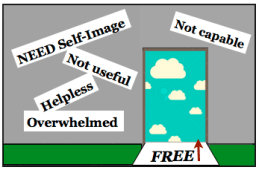
Basic Fear of this LEVEL – Being helpless, incapable, overwhelmed, useless

At our best (no matter which Type) we become extraordinarily wise and discerning. We no longer see ourselves as limited & incomplete, having integrated qualities that were rejected at Level Two, & so truly come into balance with ourselves. When living from Level 1 we realize that we in fact DO possess what we were always looking for. By accepting what is, we become transcendentally realistic, knowing the best action to take in each moment. We are connected to ‘the Truth’ – humane, hopeful & an inspiration to others
* * * * *
LEVEL 2 – Psychological Capacity
External Behaviors – I’ve become aware, curious, clever, perceptive, playful, unusual
Internal Attitudes – I’m attentive, fascinated, have sensory acuity, objective, observant, unsentimentalcompetence
Desire
is To – be capable & competent (have something to contribute)
Basic Fear of this Level – Of not being smart enough, since our intuition & perceptions aren’t strong enough to give us confidence.

At Level 2 we achieve the full potential that our ‘personality’ allows us, for the most part being very open-minded & tolerant. Although we have preferences at this level, we can act largely without bias. We recognize our gifts, talents & qualities – trusting them: we are conscientious, have strong personal convictions, an intense sense of right and wrong, with personal spiritual & moral values. Our desire is to be mature, moderate in all things rational, reasonable & self-disciplined.
* * * * *
LEVEL 3 – Social Value
External Behaviors – I’m communicative, creative, innovative, inventive, learning, original, skillful, tinkering
Internal Attitudes – I’m concentrating, exploratory, focused, independent, open-minded, patient, uncompromising, whimsicalsocial interest
Desire
is To – master something in order to gain confidence & create a niche for ourselves
Basic Fear of this Level – not having anything of valuable to contribute (unprepared)

At Level 3 we form a stronger identification with our self-image, & want to share our talents & abilities, believing that they will have a positive impact on those around us. Extremely principled, we always want to be fair, objective & ethical: truth and justice are primary values. It’s no longer enough to just hold a certain picture of ourselves in order to stave off underlying anxieties. We also want to show others who we are – with personal integrity & a sense of responsibility – which reinforces our self-image. Having a higher purpose often leads to being teachers & ‘witnesses to the truth’.

NEXT: Levels of Development – “AVERAGE”

Ennea – LEVELS of Development Outlined (Part 2)

levels THE MORE INFORMATION I HAVE
the better I can understand others

PREVIOUS: Levels of Development outline

SITE: Rob Fitzel, Canadian engineer


OUTLINE
● Our Enneagram personality Type is guided by a basic desire, the driving motivation behind most of our behavior, staying largely the same (though sometimes distorted) throughout the levels.Ennea desires
The qualities of each LEVEL apply to every TYPE – within it’s unique style, no matter how different the types are from each other.
SEE: “Freudian Enneagram”, connecting his id/ ego / superego to the EnneaTypes. (scroll down)

NOTE: The right hand column of the 3-part chart below identifies the different categories of THE JOURNEY, in relation to how much Presence or Essence we are in contact with at the various levels. Presence is: “Living in direct connection with what is fundamental and most genuine in us, freed of the social and childhood conditioning which originally caused us to abandon or hide our truest nature.”

USING the Enneagram LEVELSEnn- 1-3 LEVELS
PERSONALLY Understanding the characteristics of each Level shows us how we can move up thru them to become more balanced, open, present, relaxed & to take healthy responsibility – by being self-aware & self-honest. Most importantly we can learn about acting in line with our deepest inner truth.

● If we apply our higher qualities to dealing with stressful people & situations – using respect, compassion, gentle honesty, kindness,…. problems tend to be resolved more easily & effectively, which helps us to grow & improve, by accessing more of our natural potential.

● If we only focus on the negative, staying in the middle levels (6-9) we’re more likely to be dishonest with ourselves, beat ourselves up, blame others, complain, be easily agitated, play victim, & generally act against our inner wisdom.

● If we deal with life’s problems mainly using the lower qualities of our type – such as avoidance, being irresponsible, blaming others, being harshly critical of ourselves & others – then things are likely to stay bad or get worse.

At WORK : It’s very useful to figure out what level bosses or employees are functioning on, since it make all the difference to performance & morale.

Negatively – those factors will indicate the amount of competition, distrust, excessive conflict, individual rewards, job insecurity, lack of clear working agreements and stress/tension.

Positively – those factors include appreciation, clarity of roles and goals, collective accountability, direct communication, having the tools to do the job right, trust & an overall sense of being able to make a difference.

EXAMPLE of the levels expressed
RESPONDING to a problem: from most mature to least (1—–>9): Level 1: Be a Leader –> be a Doer –> be a Coper –> be an Opposer –> be a Manipulator (most dangerous, a con artist pretending to be a doer) –> Level 9: be a Victim

DEALING with a problem: from most mature to least (1—>9):
Type 1: See the issue as an opportunity –>
Merely cope with it –> Be antagonistic towards it –> Be angry at it –> Be Passive-aggressive –> Fear it (of the potential loss) –> Be anxious about it –> Grieve –> Level 9: Sink into apathy, or Die  (Edward E. Morler, M.B.A., Ph.D)

NEXT: Levels outlined (Part 3a)

Ennea – LEVELS of Development Outlined (Part 1)

psych levels 

I’M AFRAID TO FIND OUT
what level I’m at!

PREVIOUS: Levels of development #1

SITE: Enneagram & Addiction


Psychological LEVELS
 Each of the nine Enneagram Types contains its own 9 levels/stages of possible psychological development, (don’t confuse Types & Levels), starting at the bottom: from the most destructive (level 9) to the healthiest (level 1) – see chart above. This categorization was developed by Don Riso in 1977, added to by Russ Hudson & used by Ken Wilber in the study of personal & cultural evolution.

● The Levels are a way of picturing the “skeletal” structure of each Type,
& account for differences between people of the same Number, as well as the shifts we see in ourselves & others over time. Moving upward on the scale means we become less bound by the limiting defense mechanisms of our type, to become truer to our Real Self, to be more present in the moment. Moving downward sinks us deeper into damage, increasing our distance from objective reality.

• Unless we know each Type well there can be confusion in identifying someone. People of the same Number may seem quite different from each other when coming from differing levels of mental / emotional health. And different Types can seem deceptively similar, depending on which stage they’re in. To identifying anyone correctly, the thing to focus on is the Passion, and listenlevels of developmeting to the way each type used language helps too.

● These stages are NOT fixed. The Level we act from can change even in the course of a day, based on feeling peaceful or stressed – usually to the one above or below our ‘normal’ level. Because levels are (potentially) fluid, it’s perfectly normal to do this depending on the situation.
— Anyone working on self-improvement will be able to move up one or two on a more permanent basis, with great effort, but most commonly we migrate from lower to higher & back down again throughout our life, while the majority stay in the mid range 4 to 6

— Very few people achieve level 1, altho some do touch it from time to time, & while they’re likely to slide back down, they usually stay in the 2 to 4 range.
— And no one drops from the uppermost levels to the bottom 3, especially not all at once, unless there is severe physical trauma to the brain, or long-term exposure to severe abuse.
EXP: This is what can happen to a happy well-adjusted child who is forced to endure repeated beatings, verbal assaults &/or sexual abuse, over a long time

OVERVIEW by RANGE: At each level, we use different strategies to reinforce our sense of self / ego-identity. NOTE: ‘ego’ = the created self-image. These divisions apply to everyone, no matter which Type one is.
LEVELs 1-2-3 : Healthyhigh achivement
Anyone who in the process of Self-actualizing (not 100% or all the time): high functioning & operating successfully, who can use admire-able / balanced / consistent, reliable ways of thinking & acting. There’s a sense of flow, being fully engaged with the task at hand, moving with little or no friction against the internal & external world.

a. INSIDE: Not strongly identified with their self-image. Are free to express & reinforce their identity, by acting in a manner consistent with the ‘persona’, as well as being able to let go of it when appropriate
b. OUTSIDE: At this level of High Performance, they see other people as valuable in their own right, with unique needs & tastes, separate from themselves, & can balance their needs with those of others.
● High-functioning people have a personality – it doesn’t have them

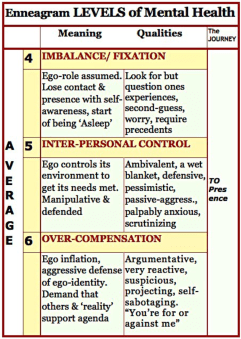
LEVELs 4, 5 & 6 : Average
Ego-driven people are neurotic but still functional, & can contribute to society, but are limited in averagesome specific way. They have a mix of productive & energy-sapping patterns.
● In this ‘normal’ range, people are generally self-centered, focused more on image – wanting to be seen in a certain way. They use social roles, manipulation & controlling others to reinforce their sense of self. They interact others mainly in terms of their own needs, with less concern for the needs of others. This can generate resistance & resentment toward them, but they don’t understand why.
● Average-range people believe they are their personality (“It’s just the way I am”)

LEVELs 7, 8 & 9 : Unhealthy
Unhealthy / Pathological people are already – or in the process of being – so out of control that they develop personality disorders such as being obsessive-compulsive, & may eventually lapse into psychosis. There is an increasing sense of ‘spinning their wheels’, heightened internal & external conflict, resistance, difficulties with the public….poor reportcard

● In this Acute/Chronic Stress range these people’s focus is so narrowed down to themselves that they can break with reality. Their self-image is completely different from how others see them, since they experience others mainly as objects rather than human beings, putting a great strain on all relationships
● For lower-functioning people, the personality has them & they just act out of it automatically.

NEXT: Levels outlined (Part 2)

What ACoAs Know & Don’t Know

SO MUCH TO KNOW –
I’ll never get it!

PREVIOUS: Ennea-Triads (3b)

SITE: Self-esteem – the problem behind the problem


ACoAs are some of the smartest, most intuitive people around.
We had to be – to survive our childhood!  But we:
a. don’t acknowledge it (taught to not trust our judgment)
b. are ashamed of it (taught to not think so highly of ourselves)
c. are missing basic, ‘normal’ info about ourselves & the world

1. LACK OF INFO
a. About Alcoholism in the family, denial. THAT:alcoholism
• they were drunk, or that their drinking effected us
• we were abused & neglected (abuse is perpetrated on one or more of the 4 levels: physical, mental, emotional, spiritual)
• we were molested, sexually or physically abused
• we carry deep pain, from all that abandonment
• their damage & our was not our fault or responsibility
• we don’t have to suffer any more
• we have a right to be here
• we can trust our intuition   -etc.

b. About Healthy Living
• what process actually is & how to use it
• what clear, sane thinking ‘sounds’ like
• that we have options & what they may be
• what we want to be / do, when we ‘grow up’ – some of us do
know, but are not allowed to go for it & we’re too scared to failno crisis
• how to live without constant crisis, abuse, anxiety
• that we don’t have to manipulate to get our needs met
• that we can take care of ourselves, if we grow a Healthy Adult
• how to be kind to our Inner Child – grow a Loving Parent!
• what mental health is  (see posts on ‘Recovery’)

c. General
• how the rest of world actually functions
• what reality is – mental, emotional, physical
• what to SAY to people when they say hurtful or outrageous things
what healthy people are like EXP: ACoAs think they don’t get angry, overwhelmed, make mistakes, love relationships…
• why other people do what they do (get away with things, are entitled, can function well…)

• what is NORMAL – which has 2 meanings:
i. the opposite of crazy.  Our S-H says we are crazy & everyone else is normal.  Yes, we do have distorted thinking, which can be corrected – but that doesn’t make us nuts.
It’s normal to: have emotions, to succeed via process, to mourn losses, to not get along with every one, all the time, to have some damage….

ii. what is average – for humans, & in your society
It’s about the behaviors & attitudes common to the majority. But in this meaning, normal is not always healthy! It’s what the norm was where you grew up, in your religion, in your neighborhood & school… 
SO – normal could have been – drinking to excess, physical danger, verbal abuse, insensitivity, lack of education…OR being up tight, having to succeed, always looking good, doing the ‘right thing’…
It’s normal to: laugh when someone gets hurt or makes a fool of themselves, to not help strangers in trouble, to stare at an accident on the street…
no happy reunion
a. Not possible or unlikely
• our parent to love us, unconditionally
• to be free of all pain & suffering
• to have relationships that never end
• to be liked & wanted by everyone, all the time
• to be a star, be famous, be adored, worshiped

b. Can be worked towards & accomplished
• diminish S-H & gain self-esteem
• be heard/ listened to/ get healthy attentionScreen Shot 2015-07-11 at 11.53.34 AM
• healthy friends & mates
• improved health & appearance
• an enjoyable career, creative outlets
• to belong & be accepted
• respected, treated well
• feel comfortable, safe, secure
• have fun, relax, enjoy life   – etc.

3. What ACoAs DO Know
• what really happened to us as kids (abuse, neglect, coercion, torture) – BUT don’t want admit or deal with
• some of the things we want in life – BUT are not allowed to have
• what we’ve learned and accomplished since we left home – BUT not allowed to admit or own it
• ALL the things we figured out on our own, as kids and as adult – BUT don’t value or validate, because of:
— S-H – we deserved anything bad that happened to us (then and now)chinese S-E
— shame – not allowed to have our need or our value our accomplishments
— lack of healthy mirroring – our real self wasn’t validated by our family, so we negate our natural abilities

SELF-ESTEEM comes from validation & unconditional regard / love.
Validation means admitting what we know & learning what we don’t. Regard is being kind, patient & respectful toward ourselves. It’s never too late to have a happy life!

NEXT: Ennea Development Levels #1

Ennea: TRIAD EMOTIONS (Part 3a)

ANGER triad
I FEEL SO MUCH ‘SAFER’
when I stay angry

PREVIOUS:

 Triad Emotions – 2b

BOOK: “Emotions and the Enneagram, Working Through Your Shadow Life Script” ~ Margaret Frings Keyes


891s – THE BODY / Instinctual Triad: Aggression and Repression
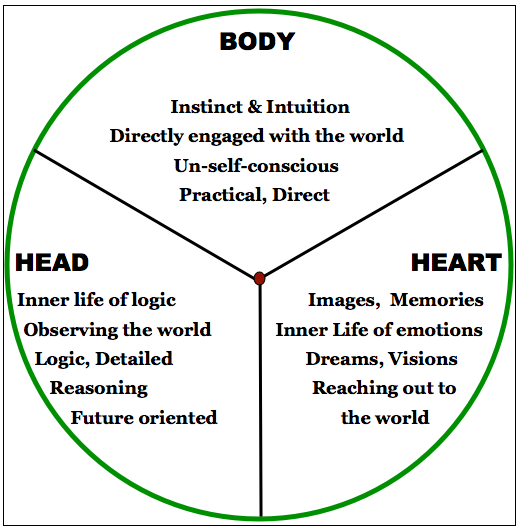
PHYSIOLOGY: this triad is associated with the brain stem (earliest developed part, also called “reptilian”), which controls motor movement, & connected with creative, sexual & bio-electric energy in the spinal column
FOCUS: this ‘Center of Intelligence” uses visceral responses to understand the world, typically responding first from the gut, a place of intuitive ‘feeling’-knowing**

ROOT Emotions
: ANGER, Aggression, Resentment
RESPONSE : tend to act without having to stop to think, are oriented to action, using body-based intuition to deal with relationship issues
891 triad Es
POWER: is in the ability to instinctively take action
TIME: mainly in the present, since actions can only be in the now
UNDERSTAND Life: best when translated into physical activity or movement

**NOTE: In this context, it’s important to not confuse Feeling / Sensing (891s) with Sentiment (234s).
Feeling – is ‘background awareness’, spontaneously coming from deep within & so is more primitive, using bodily sensations, intuition, instinct… vs
Sentiment – the copy-cat show of the ‘Feeling’ triad, which is more surface, ‘skin deep’, based on energy picked up from the environment

◆ This triad has to do with muscle movement, & therefore ‘knowing through doing’. intuition helps them make correct, concrete decisions quickly & easily. They love to face reality head on AND rebel against injustice
But when resisting reality, but assuming there’s nothing wrong with them, then the resistance is held in various physical tensions (neck, lower back…..)

When stressed, processing verbal or written information can be slow, with trouble expressing themselves verbally:
— angry 8s will think in caricatures or temporarily blank out
— compulsive 1s tends to think only in black & white
— repressed 9s tend to get mentally fuzzy, or go into long ramblings

“MANAGING” ANGER
► EIGHTS – Challengers
Root: use anger to hide a tender vulnerability & childlike innocence, from growing up abused, controlled & exploited, & with one weak parent bullied by other,
Re. not being held/ supported: try to “hold” everything & everyone by forcefully taking charge (See Enn. Emotions, Part 1)

type 8 EsExpressing anger & aggression: externalize – acting automatically. They’re aware of anger consciously to an unmet need, or to present themselves as the ‘strongest’ one around.
They tend to bulldoze through life – letting their hostility out, then leaving others to “deal with it”. It’s their main way of getting what they want, & for coping with stresses or challenges.

Acting out anger: their emotion is obvious to everyone because they feel free to express it. When their anger starts building, they show it physically – raised voice, clenched fists, moving more forcefully…. When overcome with strong ‘animal instinct’, they react blindingly fast

In relationships: 8s are comfortable with anger & are known to ‘stir the pot’ to get a reaction from others as a way of engaging, but will gladly overpower anyone who will let them. They tend to be confident, confrontational, decisive, willful.

When boundary invaded, they react directly & forcefully to push away.
Reacting to underlying fear: afraid of being vulnerable to others, they’re driven to be self-reliant & strong, so they can often be thoughtless, even heartless

With an UNHEALTHY childhood – 8s can become bullies, delinquents or gang leaders… & eventually their adult counterparts.

With a HEALTHY childhood – 8s become hard-working volunteers, protectors of the underdog, inspiring class presidents…. & eventually competent, moral, strong leaders in corporate, government or religious arenas.
• The inherent positive emotion of 8s is an enthusiasm for life, moving into action & experience with their big energy.
• Their “virtue” or higher emotional state is innocence, approaching life without cynicism or blame – the 8’s version of open heartedness – willing to be receptive to whatever comes, & therefore be vulnerable, without being weak.

QUESTIONS to ask yourself for 891s

NEXT:  Ennea GUT Emotions (3b)

Ennea: TRIAD EMOTIONS (Part 2a)

FEAR triad
I NEVER ADMIT TO ANYONE
that I’m deeply afraid inside

PREVIOUS: Triad Emotions (1b)


567s – THE HEAD / Thinking Triad: Fearful & Unsafe

PHYSIOLOGY: associated with the neo-cortex, most highly developed in humans
FOCUS: primarily use logical, left-brain intellect, tending to ignore heart & gut input
ROOT Emotions: FEAR, Anxiety, Dread

RESPONSE: from their head first, then act or not act
POWER: comes from the ability to think
TIME: mainly to the future – what they look forward to, good or bad
UNDERSTAND Life: best when translated into logic, sometimes in the form of rules & instructions

This group thinks AND creates much fear – via negative anticipation:567 triad -- fear
5s act too little, since too much time & effort is used to complete their thoughts before expressing them
6s deny the value of their thoughts & actions, flipping between extremes of too much – or – too little certainty, most out of touch with direct knowing
7s act too much and think too little or incompletely. Doesn’t stay with an idea long enough to see it through, so the Head Center’s optimal function – to completely understand – is aborted

◆ 5s & 7s (& some 6s) aren’t very focused on the outside world or on what others think – often seen to be distrustful, superficial or uninterested.  However, these surface reactions are defense mechanisms against their fear of being destroyed in some way by a frightening world.

567s look for reassurance in B & W facts. Even though this can often be a positive, it becomes a negative when ignoring intuition, emotions or actions – when dealing with problems – causing misunderstanding & conflict

◆ Their FEAR (not always experienced directly) creates a deep insecurity. Depending on the Type it’s expressed as  = ‘fear of failure’, = not doing the right thing, = missing good opportunities, & especially = not understanding what’s going on .
Since living in one’s head includes imagining, it can also include obsessive worry about what might happen.
When severely stressed, especially over a long time, fear can become panic, causing them come to a dead stop until they can get enough new info to proceed. (This is not the anxiety of the 234s, who react with impulsive activity).

“MANAGING” FEAR
► FIVES – Investigators
5s expect to run out of resources – so will hoard energy, info, money, time…. They assume they can deal with fear by constantly strategizing – as if honing skills enough will prepare them for anything scary ‘outside’

Relying on their first-rate thinking process to decipher what they consider an illogical world, ego-driven 5s can appear very cool, calm & collected – or secretive loners who focus their minds on the ‘nature of the universe’.
They hope that understanding reality in their own way will eventually allow them to rejoin the world, but they never believe they know enough to participate with total confidence. Instead, they get caught up with increasingly complex inner worlds. type 5 es

Root: 5s early violations & abandonments leads to considering the world as a scary place. Overwhelmed by emotions & life’s demands, they’re afraid of not knowing how to cope or not having enough facts to explain things

Express fear by
: live in their head, rather than connecting with others. They may take time to consider their emotions, but later & in private – so there’s a time lag between an event & their response

Deal with fear by: retreating to the safety of their private space, accumulating as much knowledge as they possibly can, & mulling everything over to make (mental) order of it all. They’re often disconnected from daily life & their emotions, assuming that figuring everything out will free them of dread, without actually facing it.\

Respond to their fear: by collecting &/or hoarding money, possessions & energy tightly. Resentful of having their ‘space’ intruded on, they retreat from anything that make them anxious, into a private universe & only rely on themselves
Alleviate fear: by using their intellect to feel omniscience, looking for answers to life’s riddles in isolation

QUESTIONS to ask yourself (for Types 567)

NEXT: Triad Emotions (#2b) Types 6 & 7

Ennea: TRIAD EMOTIONS (Part 1a)

LOVE triadI’M SO FULL OF EMOTIONS
I don’t know what to do with them!

PREVIOUS: Triad Emotions – Intro

SITE: Enneagram: Ancient knowledge, modern psychology


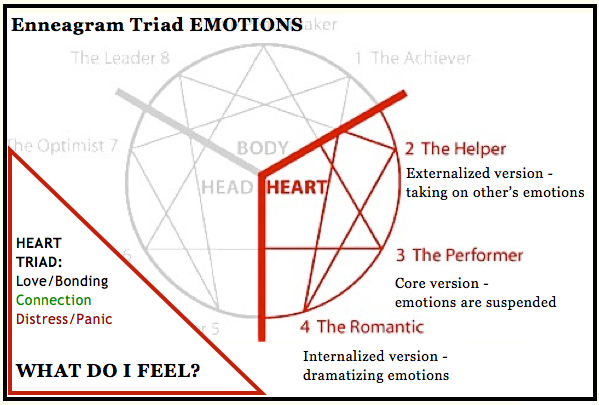
234s – HEART / Feeling Triad: Low Self-Esteem & Longing
PHYSIOLOGY: triad associated with the mammalian part of our brain
FOCUS: this ‘Center of Intelligence” uses emotions, intuition & imagery – rather than bodily senses

ROOT Emotions
: SHAME, & GRIEF/Sadness, hidden HOSTILITY
RESPONSE: from their heart first, then the head, & gut last
POWER: from their ability to instinctively feel emotions

TIME: mainly to the Past, needing to feel connected to long-term relationships & events
UNDERSTAND Life: best when info is translated into symbols of desire, through people & stories about themselves or their old experiences

❖  234s long for a sense of identity, of figuring out “Who am I?”. Instead of going inward for this information, their main attention is on getting Affirmation From Others, especially those they feel close to, to the point of side-lining their own deepest needs. Total reliance on validation from others can lead to only being able to see themselves thru others’ eyes, unreliable at best, or to low self-esteem & possibly despair. It’s also called the “image” triad, because of a concern with how they are ‘seen’triad :grief

GRIEF / Sadness comes from negating oneself by having substituted a ‘persona’ as a partial or full replacement for the True Self. As children they didn’t have accurate or adequate mirroring. Not being able to handle their pain, they chase after attention & validation. When they feel a real or imagined threat to a connection with an important ‘other’, they can get very distressed, even panicked. This motivates them to stay attached, or do whatever is necessary to re-connect.

IMMATURE: While they may seem very emotional to others, these Types are the least in touch with their primitive senses (the way 8s are). Their natural instinct is to pick up emotional energy from the environment, the same way an audience takes on the enthusiasm of a charismatic motivational speaker, & then acts it out as if it was their own, (like audiences do with Tony Robbins)

EXP: 4s can be pseudo-authentic (dramatic), who assume they must be unique to receive love…. Actually – for them true authenticity would be to include emotions they may think are too ‘ordinary’ (caring, comfortable, annoyed, disappointed….)
MATURE: When healthy, their sensitivity makes these Types admirable, being highly valued for their genuine thoughtfulness & interpersonal skills.

Hidden AGGRESSION: 234s don’t openly acknowledge their wish/need to be aggressive. Instead they use manipulation, guilt & self-pity – more passive ways of asserting themselves, which they consider safer

SHAME : In this context, it is the feeling of being “in the spotlight,” under scrutiny, rather than feeling ashamed of themselves as human beings. It grows out of the deep-seated preoccupation with the need to “See me the way I want to be seen” (rather than for who they truly are), which motivates their characteristic styles.

NEED to be SEEN
2sit shows up as wanting to be recognized for their affection & care of others, a form of “possessive affectivity” **
** Affectivity – something influenced by, sensitive to or results from emotions
3s – their own success is most important, especially in career. This kind of recognition-need can be called ‘functional affectivity’
4s – they deeply want recognition for their originality, with a need to be considered unique & special, often with ‘negative affectivity’

QUESTIONS to ask yourself – for 2, 3, 4s

NEXT: Triad Emotions (1b)

Enneagram: Triad EMOTIONS – Intro

triad emotions 

UNDERSTANDING MY EMOTIONS
helps me deal with life better

PREVIOUS: Ennea Triad Basics – #2c

SITE: “Personality tool: Understanding the Enneagram. Scroll down for info on each type’s way of expressing emotions

CORE EMOTIONAL responses of the 3 Basic Centers
An important way of using the Enneagram is to identify & properly deal with the emotional essences of each triad – developed out of biological responses to survival threats. They can be seen across ALL mammalian behavior, via modern Affective Neuroscience. The same distress-emotions are triggered when the organism’s 3 BASIC NEEDS are not met.

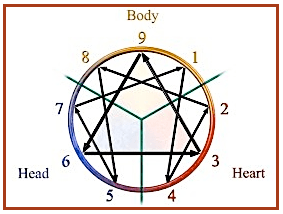
CENTERS: Feeling = Heart (234), Thinking = Head (567) and Gut (891) which includes = Instinctive (digestion, breathing, heartbeat) & Sensory aspects (running…).
Interesting: Gut acts 30,000 times faster than Heart, itself 30,000 times faster than Head. (“The Fourth Way)

◆ EVERY type is capable of experiencing ALL emotions, but each Center is driven by a main one. When things get tough, frustrating, won’t go our way….Screen Shot 2014-09-28 at 10.38.50 AM there’s an inner ‘default’ setting that gets triggered

234s = Grief, Shame
567s = Fear, Anxiety
891s = Anger, Rage
Each Type handles it’s primary emotion differently:
❖ The first # is overt “externalizes” :
2 its shame, 5 its fear, 8 its anger
◆ The second # “represses /covert” :
3 its shame, 6 its fear, 9 its anger
✦ The third # “internalizes /neutral” :
4 its shame, 7 its fear, 1 its anger

Basic FEARS – Triad emotion are our automatic ‘natural’ way of responding to the world, but most people don’t realize it’s what fuels their daily reactions.
When these emotions are cut off from our Core Self, they generate the Type’s defense mechanism, which underpin all dysfunction. While each Center has it’s preferred emotion, Riso & Hudson explained that each TYPE also has an underlying fear OF being: 
enn - Triand INFO1s – corrupt, defective, unbalanced
2s – unwanted, unworthy of love
3s – worthless
4s – without identity or personal significance
5s – helpless, incapable, useless
6s – unable to survive on their own
7s – in pain and deprivation
8s – harmed or controlled by others
9s – lost or separated from self & others

◆ Beatrice Chestnut, psychologist & teacher, condensed a human child’s early needs into 3 challenges – emotional ‘disturbances’ when not properly fulfilled:

A. Need to feel mirrored – when their caregiver makes direct, loving, face-to-face, eye-to-eye contact, so the young child feels ‘seen’ for who they are.

MISSING: Distress/Panic, from the loss of connection & bonding.
Heart types innately pursue this need, but do it incorrectly by creating a False Persona. This makes it hard to be curious about oneself, others & life.
They’re too busy watching what they do, so it will fit their created IMAGE of being:
2s – thoughtful & considerate – so others will respond favorably to ‘such a selfless person’ who only thinks of others
3s – a confident, successful person (so others will respond with respect to such a competent, achieving individual)
4s – a unique person, different from everyone else (so others will at least think they are special rather than lost or deficient).

B. Need to not feel fear – being protected from real danger, or whatever is imagined to be dangerous

MISSING: Fear/Anxiety, when experiencing ta threat, challenge, or danger to our very security
Head
types figure out what makes life certain for themselves. Some fear is necessary & useful if it’s not all-pervasive & overwhelming. When fear overwhelms, it’s very hard to be open to & curious about all the good things available to us.
It’s also imperative to separate fear that’s real from what’s self-created (S-H)

5s – move away from anything that scares them, retreating into a solitary, private world where they only rely on themselves
6s obsessively imagine future danger, &/OR act fearless, as a way of coping with their ever-present fear of life
7s try to avoid fear entirely with constant distractions, sticking to a positive attitude, always considering new possibilities, & planning escapes

C. Need to feel held & supported – seen in very young children who want to be securely wrapped & held, to not feel the threat of being dropped (injured or dead)

MISSING: Anger/Rage, when we experience not being able to depend on our caretakers to ‘back us up’ – neglected, violated & repeatedly deprived
Body Types can sense what’s wrong in their world, know what actions are needed to correct it & how to provide their needs. They want to control their experience & environment to deal with anxiety :
8s try to ‘hold’ everything & everyone by taking charge
9s ‘hold’ by repetitive activities that soothe them (narcotizing)
1s ‘hold’ by being self-controlled, trying to control or structure every aspect of life

LAYERS of the SELF enn -LAYERS of the SELF
Outer = COMPULSIVE : Behavior is automatic
Next = OBSERVING : Beginning of awareness, ability to notice & detach from compulsions
Semi-Inner = HIGHER : Increasing awareness & autonomy, the ability to access higher functions of the Centers
Inner/Center = ESSENTIAL :
Unified consciousness, not trapped in or identified with any one triad
(Chart: ‘Nine Paths’ 12/26/12)

Moving from the outer circle of Stress & Security points – towards our center – requires consistent self-observation.

NEXT: Triad Emotions (Heart)

Excellent Inner Child movie

DON’T IGNORE ME!
I’ll act out what you deny!

PREVIOUS: Enneagram Triads (#2c)


For anyone interested in better understanding the Inner Child, I highly recommend the MOVIE:

IF YOU BELIEVE, 1999

— with Ally Walker as the overworked editor who has betrayed her own instincts & needs, &
— Hayden Panettiere (long before “Hero”) as Ally’s younger inner self, prodding her to return to her truth.

Synopsis at imbd.com

MOVIE:  http://www.free-online-movies-streaming.com/if-you-believe-1999-streaming/

NEXT: Family ROLES – general

Ennea TRIAD Basics (Part 4a)


I HAVE ALL I NEED
to understand my environment

PREVIOUS: Ennea Triads, Part 2b

SITE: Discover your Enneagram TRI-Type


3rd Triad (891) : INSTINCT (Gut), Body-based character structure

#8 = Leader — Energy: Larger than life, Dominating.
#9 = Mediator Energy: Diffuse extension, Comfortable
#1= Reformer Energy: Rigid containment, Righteous

At a party: If you go right in, engaging in hearty, jovial, back-slapping greetings that may put some people off, you’re likely in the Gut triad. Or, you might offer the host a ‘helpful’ criticism about how to improve some aspect of the party.

Flow: Gut-centered people act first – think & feel later. They’re very connected to concrete reality, with a very “nuts & bolts” approach to life. Their driving ‘sin’ is anger, as their first reaction to unsafe people & physical circumstances

POSITIVE 891s : At their best, they’re grounded, with a common-sense approach to taking care of basic needs, so not much thought is required for the simple tasks of life. Their motto could be: “Just do it”, being active in the physical world, & connected to nature
When healthy, they relate to their environment & to others exceptionally well, with a deep wisdom from within. Struggling to stay in the moment, they can always call on their gut reactions to bring them back to the present.

Purpose: “We all use personal position & personal power to make life be the way we believe it “should be.” We devise strategies to assure our place in the world & to minimize discomfort.~ David Daniels, M.D

Physical Center: The Gut / Instinct is the physical link to the conscious ego & the unconscious soul. 891s value action, living life at full volume & maximum speed, doing whatever it takes to best handle physical needs.

All types depend upon the Body Center of Intelligence to be in touch with their higher qualities, including: • the right amount of energy needed for action
• how much power to use (or not use) in each situation
• the capacity to be being grounded in themselves & the world.

Priority: Instinctual needs & rhythms in daily life; issues of fairness or rightness, getting practical results.
Direction: 891 Types move in & against, are direct & straight forward, & can easily be confrontational
Key Mode: Screening & buffering (principled inattention)
Key Words: Belonging, Comfort, Congruence, Harmony, Personal power, Protection, Respect, Worth

gut reactions.pngBasic defense: A concentration of energy in the belly center enables repeated patterns to form layers of “insulation” in the mind & body.
This insulation is used to “screen out” unwanted feelings or information from the inside or outside. Personal wants and needs are controlled by super-ego “shoulds

Neurotic style
: Obsessive process – using repeating patterns of thinking and doing to capture and stabilize attention in daily life.

NEGATIVEFearing neglect or being overlooked, they seek acceptance & be respected for who they are. Acting impulsively, they resist being influenced by current reality, & try to impose their will on the environment without being affected by it – to prevent being controlled by anyone or anything. When they don’t have the experience of their positive Key Words, they react with anger / rage – the more controlled version showing up as irritation, resentment, impatience….
Main emotion :
8s
externalize & act out their anger
9s feel conflicted & disconnect with their anger
1s internalize & repress their anger

Life challenge: Struggle with being asleep to their True Self. They need to “Wake up” through self-awareness instead of falling into excessive materialism (8), low-level comfort (9) or habits (1).
Their childhood experience is of not being allowed their space, so there’s a deep hunger to carve this out for themselves in the world, with a push to distinguish between who they are vs everyone else.

INEXT: Triad EMOTIONS (Part 1)