“33 Things I’ve learned” (Part 1)

Process

PREVIOUS: Permission to Leave

IMPORTANT NOTE:
The original list is not available any more. There are 10 other sites under this title – each different.

🔺These 33 are still worth reading — they have more substance.

🔹 “Things”are listed by topic, not in numbered order.

IDENTITY
1: If you are different, you will be separated & labeled.

It ‘s ok if you’re lonely & feel different. That doesn’t mean something’s wrong with you. In fact it’s a sign you’re on the right path if you do not fit in.
People in power aren’t always the wisest ones. It’s ok to question authority.Screen Shot 2016-05-31 at 6.49.44 PM

5: Stay true to yourself, even if it upsets others & they reject you.
The person who suffers the most from being someone that others want you to be, is you. What’s in your heart is all that’s real. Embrace who you are in your heart. Show the world that person. That person is beautiful.

30: Do not believe your own thoughts sometimes, they may come from other people.
Your False Self is just that, false. Acceptance comes first. You can change yourself only after you accept yourself

RECOVERY / GROWTH
12: When you’re silent, sit still & deal with emotions, only then will the answers come.
Then can you move forward. The only way out is through. You can not escape pain, which isn’t aways a bad thing. Things that seem great at the time can end up hurting you. Withhold judgment & let things play out. You can spend your whole life running from your pain. In the end, all you get is being tired, having spent a whole life running but not living.

15: It is hard to give love when you’re in pain. But try it, & watch the miracle. If you give love away, love will come back. You will get what you need, if & when you’re prepared for it. If you start to heal yourself & be good to others, regardless of your pain, great things – even miracles – start to happen. You’ll be amazed at what the world gives you.

 16: Where youScreen Shot 2016-05-31 at 6.32.40 PM end usually depends on where you start.
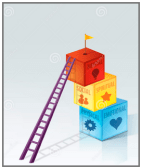
We need to equalize things for people that start off life with less opportunity. Those with privilege need to stop acting like they are on 3rd base because they hit a triple, when in fact they were born on 3rd base.

We have to stop penalizing people because they have less resources, & give everyone the same opportunity – or stop claiming we’re the land of opportunity when we’re not.

18: Living for others’ approval will kill you inside
Buying & accumulating things is not the answer. You’ll walk around depressed because you’re living someone else’s dream for you.

20: When you make someone the center of your world for the moment you’re with them, you can save their life.  You can change the world by simply being present with someone in pain.
Taking time with people. Listening to them is what ‘s important.

21: Lessons will repeat themselves until you finally learn what you’re supposed to. There are lots of ways to try escaping from yourself. Anger, alcohol, drugs, food, gambling, other people, self-harm, drugs…. How many have you tried?

29: Little things add up to big things
When trying to change things, patience is crucial. Systems don’t change fast. First, listen & observe. Pay attention to small things & details, so you gain credibility & build up through small things. You lose credibility if all you do is fight. You don’t need to fight all day, every day. Pick your battlesScreen Shot 2016-05-31 at 6.39.15 PM.png
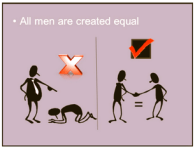
31: If you want to help people, walk with them, not above them.
Stay in the senior slow lane of life. Let people rush by you if they want. Patience & moving with people is how you help them. Even if you get in a position of power, there’s more corruption at the top.

NEXT: 33 Things I’ve learned (Part 2)

PERMISSION to LEAVE

images-1PREVIOUS:  “Kind Self-Healing” book

A NEW YEAR SUGGESTION

SITE: “Staying away
from TOXIC people

Normally I’m not fond of cutesie, ‘uplifting’ saying, but I know some of us are still struggling with the belief that it’s unkind & selfish to disengage (whatever that means for you) from unhealthy people who do not take responsibility for their damage and don’t want to /can’t yet do the hard work of Recovery.

So I’m posting a bunch of statements about permission, in the hope
that they may be of encouragement to make some changes this year.

leave toxics

LEAVING THEM

angry people

poison people

let them go

allowed to leavesoul therapy

fresher air

god says drop

god says drop

your worth it

BOOK: “Kind Self-Healing”

sick-day cat

PREVIOUS : BE KIND to YOURSELF


Hi Everyone,

I’d like to pass on info about a Recovery book for ACoAs :

 “The KIND Self-Healing Book – Raise Yourself Up with Compassion & Curiosity’ (March 2015)

by Amy Eden,  author of the ACoA blog  “Guess what Normal Is

~~~~~~~~~~~~~~~~~~~~~~~~~~~~~~~~~~~~~~~~~~~~~~~~

From the book:

5 Super-Kind Abilities You’ll Gain from Doing This Work

I honestly believe that each of these abilities is within your reach. These abilities can develop from practice and applying a compassionate approach to your personal growth–and from a decision to take the leading role in your own story every day:

1. The purpose driving your actions will become your wants, desires, and needs rather than your anxiety about other peoples’ needs or wants. Your own unique interests, goals, and personal fulfillment will become more central in guiding how you participate in life.

2. The discomfort you feel when asking for what you want and during confrontations will become a manageable discomfort (a low simmer rather than a high flame) and you’ll regard and appreciate the discomfort you feel as encouraging proof of having become daring and engaged in life.

3. Your self-confidence will become more consistent, less of a roller-coaster ride, and you’ll experience more and longer-lasting hopeful moments of self-appreciation, because you’ll have cultivated unconditional love for yourself and cease to expect perfection of your every breath.

4. You’ll be able to remain calm in situations involving criticism without losing your sense of self, your core, and your self-esteem; you’ll be able to hear and benefit from criticism without the old and unhelpful party-crashers of anger, fear, and defensiveness.

5. You’ll become comfortable expressing yourself and your needs in romantic relationships and willing to risk an ending rather than stay in a problematic situation; you will never again rationalize disrespect, criticism, or manipulation just to keep a situation going. And you won’t be tempted to try controlling the relationship because you’ll have moved from living in your head to living in the present moment.

You can have a life in which you grow, feel alive, happy, and feel like yourself (and like yourself) and live at ease. The tools in this book are meant to support you in your growing-up and healing process.

NEXT: Permission to leave

BE KIND to YOURSELF

Ann Wilson Schaef PREVIOUS: Obituary of Evil Mother


AUTHOR :
Dr. Ann Wilson Schaef
is a well-known psychologist, international speaker & writer of 13 books.

She developed her own approach to healing the whole person, which comes out of the ancient teachings of her ancestors – Cherokee Indian –  called “Living in Process“.
It is a comprehensive program of recovery —
➼ FROM addictions – both ingestive  (alcohol, food, drugs….) and process  (work, gambling, sex, relationships…. )
➼ INTO wholeness of body, mind & spirit.

SEE her Book List

perfect=abuse

OBITUARY of evil mother


PREVIOUS: 5 HARMFUL Mothers , #3


PAINFUL VALIDATION

The link below is the obit Katherine Reddick wrote about her mother, & her rebuttal regarding comments she received about it.

I pass this article on to anyone who has been tortured by a parent, & is afraid to say so, or that no one will believe you.

Be aware it may take a ‘strong stomach’, but you are not alone.

“I WROTE the “SCATHING OBITUARY ABOUT MY MOTHER, AND HERE’S WHY I DID IT and HAVE NO REGRETS.  I’m only now speaking publicly about why I wrote the vicious obituary. Even in death, this woman still gives me nightmares.”

https://www.huffpost.com/entry/marianne-theresa-johnson-reddick-obituary_n_4602902

5 HARMFUL MOTHERS (Part 3)

PREVIOUS: Harmful mothers #2

SITES: “Effects of Emotionally distant parents on the child

•‘Confusion of Living with an Emotionally Unavailable Parent

DEALING with hateful or neglectful parents, now
Many ACoAs are so symbiotically bonded to their unloving / harmful parents that it hard for us to let go – even if we’ve moved a million miles away. When they get old, sick or have some other difficulties, we feel a strong pull to step in & ‘help’. Often this is just another form of rescuing & people-pleasing.

We know that there’s an enduring bond between parent & child. BUT continued interactions with our earliest abusers (if they’re still mean, crazy, drunk….) can keep re-traumatizing us, whether we’ve been away from them for a while, OR still around them, making healing that much harder & longer.

WARNING: Unfortunately there are many people – having no understanding of how traumatic & pointless reconnecting with our family is – who will urge us to “make up with them before it’s too late / they’re the only parents you have / of course they love you even if they don’t know how to show it / just take the high road, they don’t mean anything by it….”

👎🏽 While these people may believe they’re well-intentioned, their insistence that YOU do something which is unsafe for you, is actually:
√ a projection of who they are & what they will do or have done
√ their garden-variety narcissism, not even imagining that their way would harm you, much less that it’s not what you want!
DO NOT LISTEN to THEM.

NOTE: Many ACoAs say they stay in contact &/or help out their abusers because they are / want to be ‘a good person’. In our specific circumstances (not some TV-show ideal) this idea actually means being good to the perpetrator instead of oneself. 

ALSO : There’s a confusing belief that if we’re ‘well enough’  then their craziness won’t bother us AT ALL. This is 1/2 true & 1/2 false.

TRUE: As our wounds heal, many of the buttons they installed will shrink, but not all the way, & some not at all. So YES, we become less reactive to & definitely less hurt by many of their ploys. We might even be able to just say “Ohhh, mooom!”, or “Sure dad.”
FALSE: The healthier we get the less we’ll be able or want to tolerate their addictions, abuse & unavailability. We’ll stay away more often, & not get caught up in their games.

“Dear Prudence” columnist Emily Yoffe writes:
There is no formula for defining one’s obligations to the parents who didn’t fulfill their own needs. The stories of famous people with abusive parents reveal some possible responses.

Abraham Lincoln couldn’t stand his brutish father, Thomas, who hated Abraham’s books & sent him out to be an indentured servant. As an adult, Lincoln did occasionally bail his father out financially. But during the man’s final illness, Lincoln ignored letters indicating his end was near.

Finally he wrote – not to his father, but his stepbrother – to explain his absence: “Say to him that if we could meet now, it is doubtful whether it would not be more painful than pleasant.” Lincoln didn’t attend his father’s funeral.

Warren Buffett remained distantly dutiful to his mother, who had subjected her children to endless, rabid verbal attacks. On the occasions he visited her at the end of her life, he was a “wreck” of anxiety, sitting silently while his female companions made conversation.
He was 66 when she died at 92. His tears at her death were not because he was sad or because he missed her, he said in his biography, The Snowball. “It was because of the waste.”

old houseBruce Springsteen’s frustrated, depressive father took out much of his rage on his son. In a New Yorker profile, David Remnick writes that long after Springsteen’s family had moved away, he’d obsessively drive by the old house.
A therapist told him :  “Something went wrong, & you keep going back to see if you can fix it or somehow make it right.”
Springsteen finally came to accept that he couldn’t. When he became successful he did give his parents the money to buy their dream house. But he said of this seeming reconciliation, “Of course, all the deeper things go unsaid, that it all could have been a little different.”  (MORE…. both pages 1 & 2)

child abuse

HOW COMMON IS CHILD ABUSE? perpetrators
Statistics give us many painful truths:
Neglect is by far the most common form of child abuse  reported (USA) cases in 2008 (MORE….Also Report 2008  ☁︎”America’s child death shame” BBC News Article, October 17, 2011 (scroll)

NEXT: Obituary of evil mother

5 HARMFUL MOTHERS (Part 2)

stay or leave ONE PARENT I CAN TAKE IN SMALL DOSESand the other one not at all!

PREVIOUS: Harmful Mothers (#1)

BOOK: “The Emotionally Absent Mother” ~ Jasmin Lee Cori

REMINDER: All 5 maternal styles affect both sons & daughters, but each mother treats them with differing degrees of ‘favoritism’ & abuse. ALSO – your mother may be some combo of these 5.  FROM: Characteristics of Narcissistic Mothers.  Read rest of article for ways of dealing with each type.

Harmful MOTHERS (cont)
1. Angry / 2. Controlling / 3. Emotionally Unavailable
4. ENVIOUS
Normally, parents want to see their children prosper & be happy. Instead, a child’s success & pleasure arouses hostility in the envious mother. Glowing with good news, children expect their parent’s face to show admiration. What they see instead is a frozen jaw, the corners of her mouth pulled down in contempt. ‘Who do you think you are? Someday you’ll realize you’re not as good as you think you are,’ she’ll warn. jealous mom

OR she may act pleasant at first, but later the child notices that she’s irritated by ordinary things they do : ‘Stop making such a racket / Do you have to go on and on about it? / When are you going to do the dishes?’….

• Instead of bolstering the child’s confidence & inspiring a sense of potential, an envious parent begrudges her child’s independence & appropriate self-pride. She thinks: “How dare she get all the attention! / No one is allowed to outshine me! / My ___ is better than his”
OR: Why does he have a chance to succeed when I’m always disappointed? / Look at what I’ve had to give up! / How can she be happy when I’m not…..”

Parental envy will show up even stronger when a child hits adolescence & starts to make their own way in the world. She (unconsciously) believes she’ll only feel secure & connected to her child if it’s self-worth is as low as hers. So, instead of feeling pride & delight in the child blossoming, the envious mother feels something is being taken away from her.

These children learn that the good things in their life somehow offend, even harm, the person who matters most to them, and who they long to please.
As adults they will spend years of trying to please her & other like her – in vain, making it hard to enjoy their achievements – OR they give up altogether!
Sites: Mothers Who Are Jealous of Their Daughters” 
“On being the daughter of a Jealous Mother

5. NARCISSISTIC
This mother is almost totally focus on the external – how things look – to others. Internally, she isn’t capable of the empathy so necessary & important to a healthy parent-child relationship. She craves attention & adoration for herself because of low self-worth, which is usually well hidden – even from family members.

In her self-focused mind, children are only a reflection of herself, so they have to be outstanding / perfect in absolutely every way – to make her look good. Any time thenarcissist child needs attention just for themselves & for any reason, this mother experiences it as competition, which is unacceptable to her.

If a child says they’re tired, mom will snap back: ‘Don’t talk to me about feeling tired. I’ve worked hard all day. You don’t know what being really tired is’.
If the child says “Look what I did / learned in school today!”she might say “That’s not so great / You could have done that better / I already know that / See what I’ve done” ….

These children are in a double bind – alternately praised & degraded :
• constantly pressure to be totally subservient to the mother’s ego
• AND expected to shine by their accomplishments – for her
Since they can never please her, they live under a black cloud of disdain & disapproval. The constant anxiety is that their relationship could break apart at any minute, whenever she’s inadvertently offended – which is inevitable. It’s a bewildering & volatile situation.

Narcissists have fragile relationships with others as well, since their overblown ‘ego’ causes them to take offense at the smallest imagined slight, so they will suddenly cut people out of their lives or punish them in some way for being ‘insulting’.
Sites: The Narcissistic Mother /6 Faces of Maternal Narcissism

NEXT: Part 3 – Dealing with……

5 HARMFUL MOTHERS (Part 1)

MOM WHY DID I HAVE TO end up with a mother like that???

PREVIOUS:

 4 Parenting Styles (Part 5)

SITE: 4 kinds of Angry Moms

BOOKs:Difficult Mothers: Understanding & Overcoming Their Power” ~ Terri Apter (Comments)
The Emotionally Absent Mother” ~ Jasmin Lee Cori


These classic Abandoning / Abusive
parenting styles leave big scars. If you were raised by a mother who was mainly one of these types OR some combination, it’s important to recognize where we got our dysfunctional reactions from – as a way to minimize or eliminate our Self-Hate.  (Daily Mail Reporter, U.K. 6/2012)

NOTE: Each of these types are variations of Narcissism – when it’s a severe & life-long pattern (Characteristics of Narcissistic Mothers).
❇️  Read rest of article for ways to deal with each type.

1. ANGRY
angry momAlthough no child likes it when a parent is angry, an occasional outburst does not create problems between them. What does cause harm is when a parent repeatedly uses anger to attack, shut up & control family members. When anger is always in the air, children live in a constant state of high alert, waiting for emotional explosions.

• As well as being psychologically damaging, this type of long-term stress is toxic to the young brain. Flooding it with endless anxiety limits the formation of the mental circuitry needed to regulate emotional states.
Sad irony : these are the kids who most need to learn self-soothing & to control their reaction – but are the least well equipped to do so

Continuing into adulthood, many such people say they still panic when around their angry mother, having grown up always feeling ‘wrong’. They’re most likely to become appeasers, programmed to please & placate others.
Sites: “My Mom Is Always Angry” / “My history of anger, 1-3″

2. CONTROLLING
This mother will try to run of every part of their child’s life, even to the extent of telling the child what to see, feel, think & want.

A controlling mother sees herself as custodian & shaper of her child’s mind. Day-after-day she says, acts & implies:
“I know who you are & you don’t / I need you to be X, which is more important than what you want / I know you don’t like it my way but I don’t care…..”’

Having been told repeatedly that “mother knows best”, these children learn to completely distrust their own wants, needs & opinions. Even simple independent decisions can fill them with anxiety. They also learn to lie – to say whatever the controlling mother wants to hear, just to keep her off their back

Healthy parents use control to shape general values & set specific rules – but always temper it with careful listening, & respect of the growing child’s ability to have their own personality & their ability to make age-appropriate decisions for themself.
SITEs: Signs you may have controlling parents’ +
The Psychological Effect of a Controlling Parent

3. EMOTIONALLY UNAVAILABLE
A mother’s emotional unavailability can be incredibly painful for a child, & leads to all kinds of upset & confusion. Sometimes it’s the result of depression or chemical addiction, but most often because of being a narcissist.

Long-term emotional withholding affects the physical & chemical make-up of a child’s brain. neglectful momGrowing up, such children see their role as comforter & protector, instead of being comforted & protected.

They’ll feel guilty for feeling happy, cling to the parent, avoid emotions or throw tantrums, & often take on heavy responsibility to make up for mother’s ‘absence’.

As adults, ordinary emotions such as joy & sadness may seem extreme, self-indulgent, even dangerous to these people. They may also have deep-seated toxic beliefs about their role in close relationships.  EXP:  other people’s needs are more important than their own, always have to be mature / ‘grown up’, & can’t trust anyone to be there for them.

Healthy parents provide ‘Affective sharing’ (emotional exchanges between mother & baby), which increases brain growth & cortisol receptors that absorb & buffer stress hormones. This also generates those crucial systems that help us manage our own emotions, organize our thoughts & plan our lives. Nurturing physical contact builds the brain’s ability to bounce back from disappointment & failure.

NEXT: Harmful mothers #2

4 PARENTING Styles & RESULTS (Part 5)

nationalitiesEACH CULTURE THINKS their parenting style is the correct one

PREVIOUS:
Parenting styles (#4)

SITE: “Gentle vs Mainstream’ Parenting Styles

ORIGINS : The most popular ideas about parenting styles in the West – come from the work of Diane Baumrind, who was interested in the different ways parents tried to control or socialize their kids (1960s). To compensate for overly-strict methods being implemented at the time, many parents went to the other extreme, putting very few demands on their children & avoiding any sort of parental control. Her ‘Authoritative’ style was the balancer.

Parenting in “The culture of American families”.
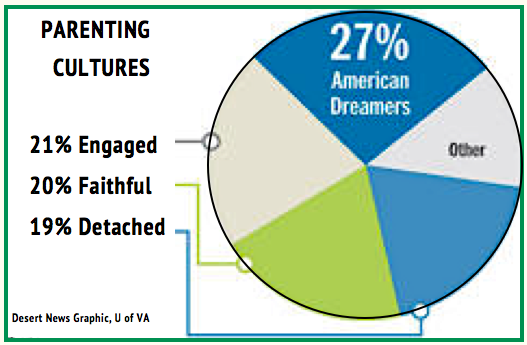
Research says families fall into 1 of 4 “cultures”, which is more important than any individual parenting style. parenting cultures
“Each type is a complex configuration of moral beliefs, values and dispositions.
They’re often implicit, rarely articulated in daily life, & largely independent of basic demographic factors such as race, ethnicity & social class.”

Never mind helicopter moms or attachment parenting. According to a U. of Virginia 3-year study of USA families (2012), the next generation is being molded by:
• the “Faithful,” 20% of parents from traditional Christianity, Judaism or Islam, who adhere to “divine, timeless morality” to give them a strong sense of right & wrong

• the “Engaged Progressives,” (21%) – the least religious. Morality is about personal freedom & responsibility, with few absolutes except the Golden Rule. They value honesty, trust what “feels right,” & allow moral latitude

• the “Detached“, (19%) let kids be kids, equally skeptical of the “old certainties” of the Faithful & the views of the Engaged Progressives.
They’re mostly white, with blue-collar jobs, no college degree, with a lower income…. are pessimistic & seem resigned about the economic future & their children’s opportunities.They say they believe in God, but don’t attend church, & religion is not an important part of their children’s lives

• the “American Dreamers,” (27%) – the most common family culture among blacks & Hispanics. They’re optimistic about their kids’ opportunities & abilities. Even with a relatively low household income and education, they “pour themselves” into raising their children, giving them material & social advantages. They try to protect their kids from negative social influences, striving for strong moral character.

The goal of this study is to distinguish the diverse moral narratives formed in daily inter-actions between parents & children.  Qs :
• What are the treasured hopes, deepest fears, & most pressing challenges of today’s parents?
• Where do they turn for support?
• What role, if any, does “character” play in the lessons children learn?
• Is contemporary life too fluid to anchor stable, shared convictions?
• What does it mean to be a “good parent” or a “good child” in an era when moral sign posts point in multiple directions?

CULTURAL DIFFERENCES
A-A shoppingDevelopmental psychologist at the U of CA at Berkeley Diana Baumrind ‘s 4 styles have been applied in places as varied as Brazil,
China & Turkey.  However they don’t always “map” onto local parenting methods – which explain why some studies report different outcomes.

African – A. families place greater importance on shared parenting responsibilities among their community, & use physical punishment more often than Euro-A.
African-American Family structure -Wikipedia)
EuropeanAuthoritative (A.) valued self-directed & tolerant children
JapaneseA. parents valued well-behaved children
hispanicHispanic parents were more authoritarian & punitive than Euro-A.

• re. Korean-American parents, over 75% of the sample didn’t fit into any of the standard parenting categories (Kim & Rohner 2002).
• re. western-Chinese parents, their style doesn’t quite fit traditional Chinese practices (Chao 1994).
• re. Spanish adolescents, studies showed that kids from permissive homes were as well-behaved & adjusted as those from authoritative ones

🌹Even so, there’s remarkable overall agreement across many cultures regarding Authoritative parenting – that it is consistently linked to the best child outcomes. (Gwen Dewar, PHD ) Scroll down

Steve Doughty (Daily Mail, UK, 2009) writes :
happy family“Taking a ‘tough love’ approach to parenting increases the chances a child will grow into a well-rounded, successful adult” a think-tank said yesterday.
Combining warmth + discipline means youngsters are more likely to develop skills such as application, self-discipline & empathy.
The Demos report (left-wing think-tank) found that “these traits were shaped during the preschool years – more often as the result of ‘tough love’ parenting – regardless of whether parents were rich or poor.” (MORE….)

NEXT: 5 harmful mothers

4 PARENTING Styles & RESULTS (Part 4)

neg introject MOMI CAN’T GET THAT WITCH VOICE
out of my head!

PREVIOUS: Parenting styles (Part 3)

SITE: COMICS (variety)


♥️ Parenting styles & SUCESS : The promise of upward mobility is a central tenet of the American Dream, one of our core civic values.

The SOCIAL GENOME Model (SGM), from the Brookings Institution in Washington, DC. ASKs :
Is the USA still an opportunity society? Can people achieve the American Dream? How can we help more people reach the middle class?
The SGM tracks the academic, social & economic experiences of individuals from birth through middle age —> in order to identify the most important paths to upward mobility.
(“The achievement gap…..” // “Social Genomics”)

Achieving the ‘dream’ depends on being born to adults who are ready to be parents, PLUS being able to succeed at each subsequent stage in life.  5 benchmarks have been identified as good predictors of eventual economic success:
• born to a non-poor, 2-parent family
• being ready for school at age 5
• mastering core academic & social skills by age 11
• graduating from HS with decent grades & avoiding risky behaviors during adolescence
• getting a post-secondary degree (PhD), or the equivalent income before age 30.

This CHART ↗️ clearly shows by % what we know intuitively & from experience:  (see also “Parenting Gap”)
• children of strong parents are the clear winners, and
• children of weak parents are consistently the least successful thru life
• children of average parents fall in between, but are closer to the ‘lucky’ ones in performance.
AND – If weak parents improve themselves to become average, their children will have an almost 10% improvement in their success rate.

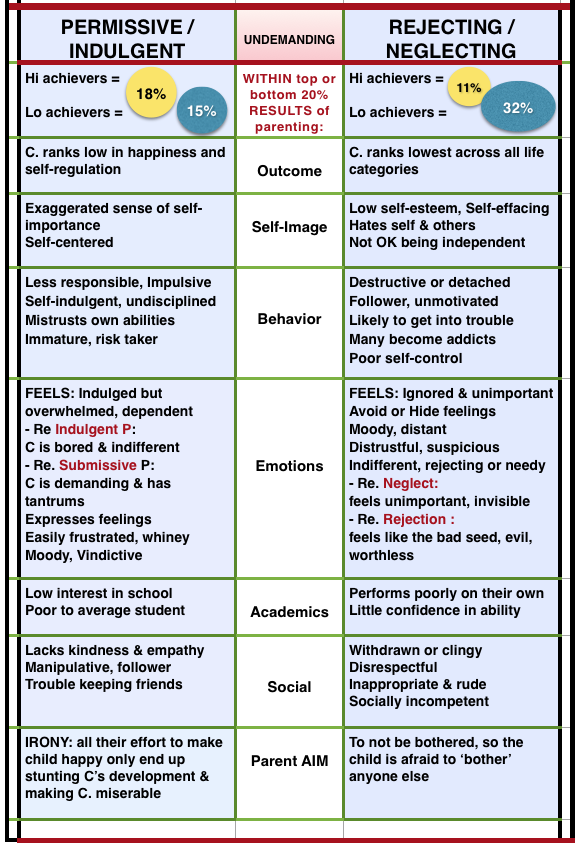
Composite RESULTS of Parenting Styles (cont)MY child -2

Parenting styles & TEEN DRINKING
Many factors contribute to teenagers’ experimentation with alcohol & drugs. Genes play a significant role, as do peer relationships. And since teens can be adversarial – it’s better to start talking to them about ‘using’ while they’re still young, as early as 4th grade.

Researchers at Brigham Young University have found that teens who grow up with parents who are either too strict or too indulgent tend to binge drink more than their peers. Stephen Bahr,  sociologist at BYU. observed  that “While parents didn’t have much of an effect on whether their teens tried alcohol or not, they can definitely have a significant impact on the more dangerous type of drinking,” Screen Shot 2015-06-15 at 8.27.29 PM

• Teens raised by indulgent parents – who tend to give their children lots of praise & warmth but do not teach them to monitor bad behavior nor about its consequences – were among the biggest abusers of alcohol (about 3x more likely than peers)

• The same was true if parents were so strict that the teens don’t learn to use their own judgment. In fact – “Kids in that environment tend not to internalize parental values nor understand why they shouldn’t drink,” says Bahr. They’re 2-3x more likely to binge drink.

• The parenting style that led to the lowest levels of problem drinking borrowed something from each of the 2 extremes:
— from the indulgent end: warmth & support, AND
— from the strict end: accountability & consequences for bad behavior
CHART from “Successful Parenting

NEXT: Parenting styles (Part 5)