QUESTIONS for Victims of Narcissists

PREVIOUS: Narcs seducing empaths #2

SITE200+ QUOTES from Survivors of N abuse


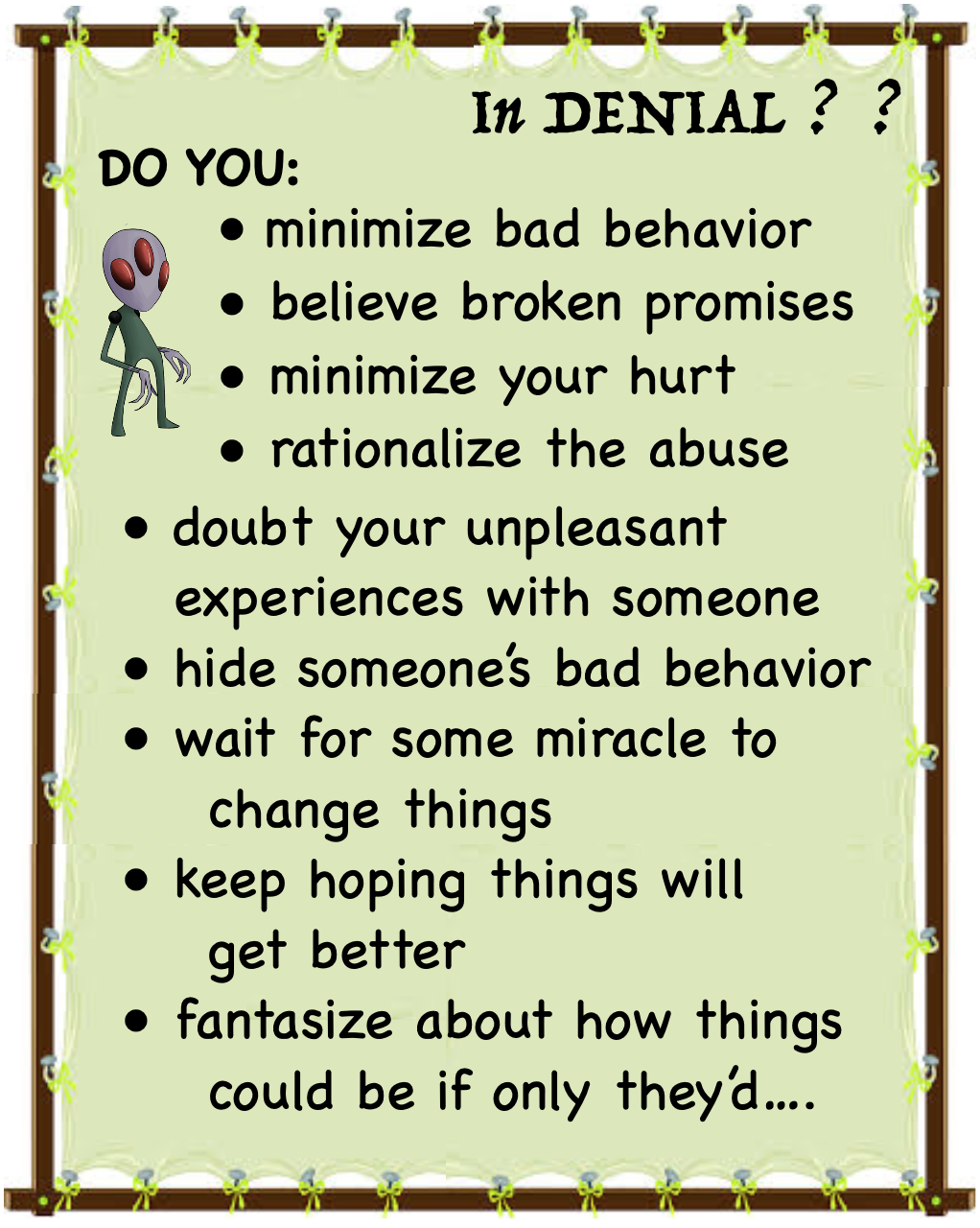
⬅️ Do any of these sound familiar?
While these apply mainly to someone married to / lives with or has an ex-spouse – who is a narc (N) –
some of these ‘issues’ will come up with family members & friends, as well.


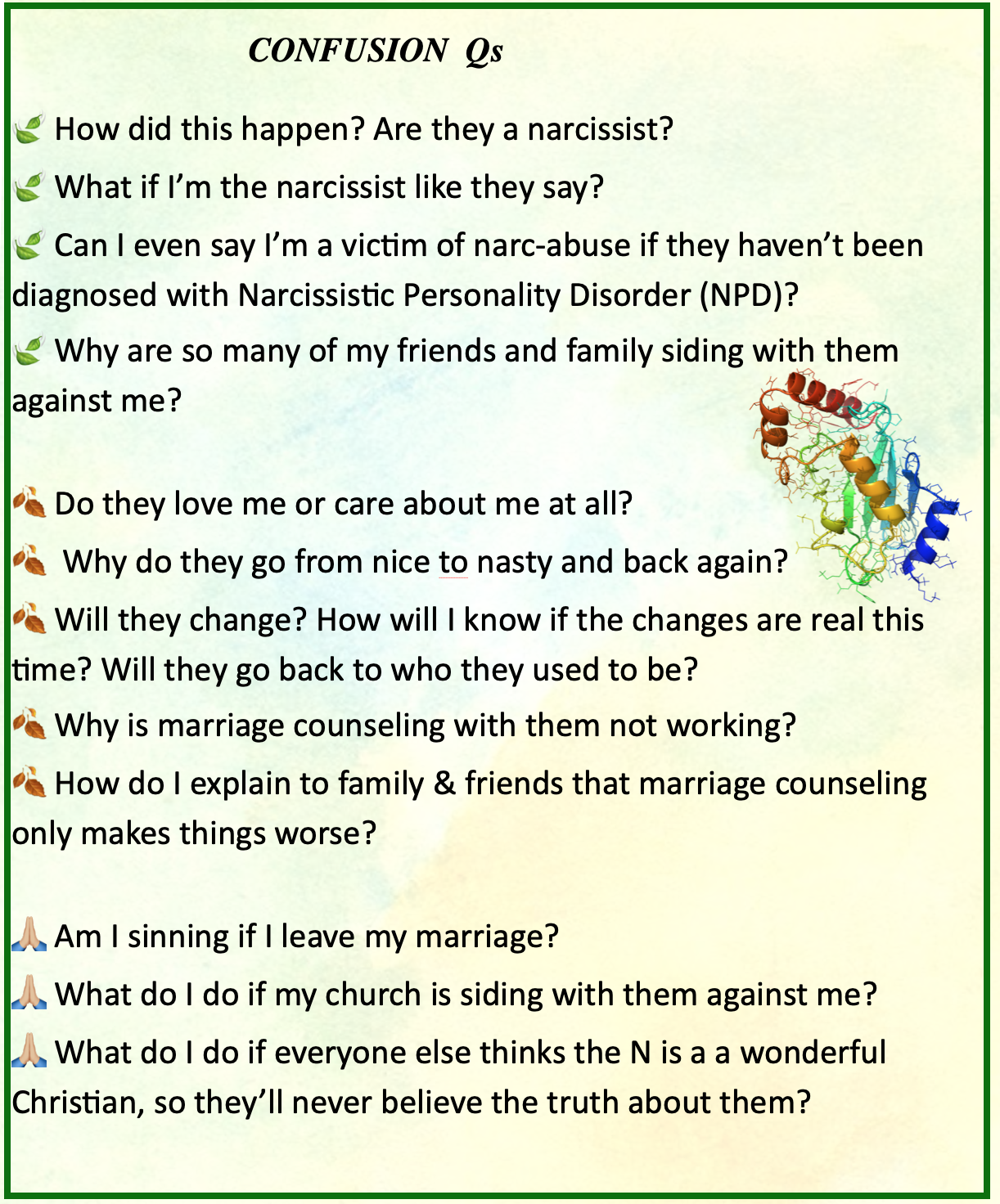
Asking Qs
WHY, WHY
 about other people’s
abusive behavior is never going to provide answers you want, nor the peace you long for, because even if you learn everything you can, it will not stop the abuser from continuing their behavior.
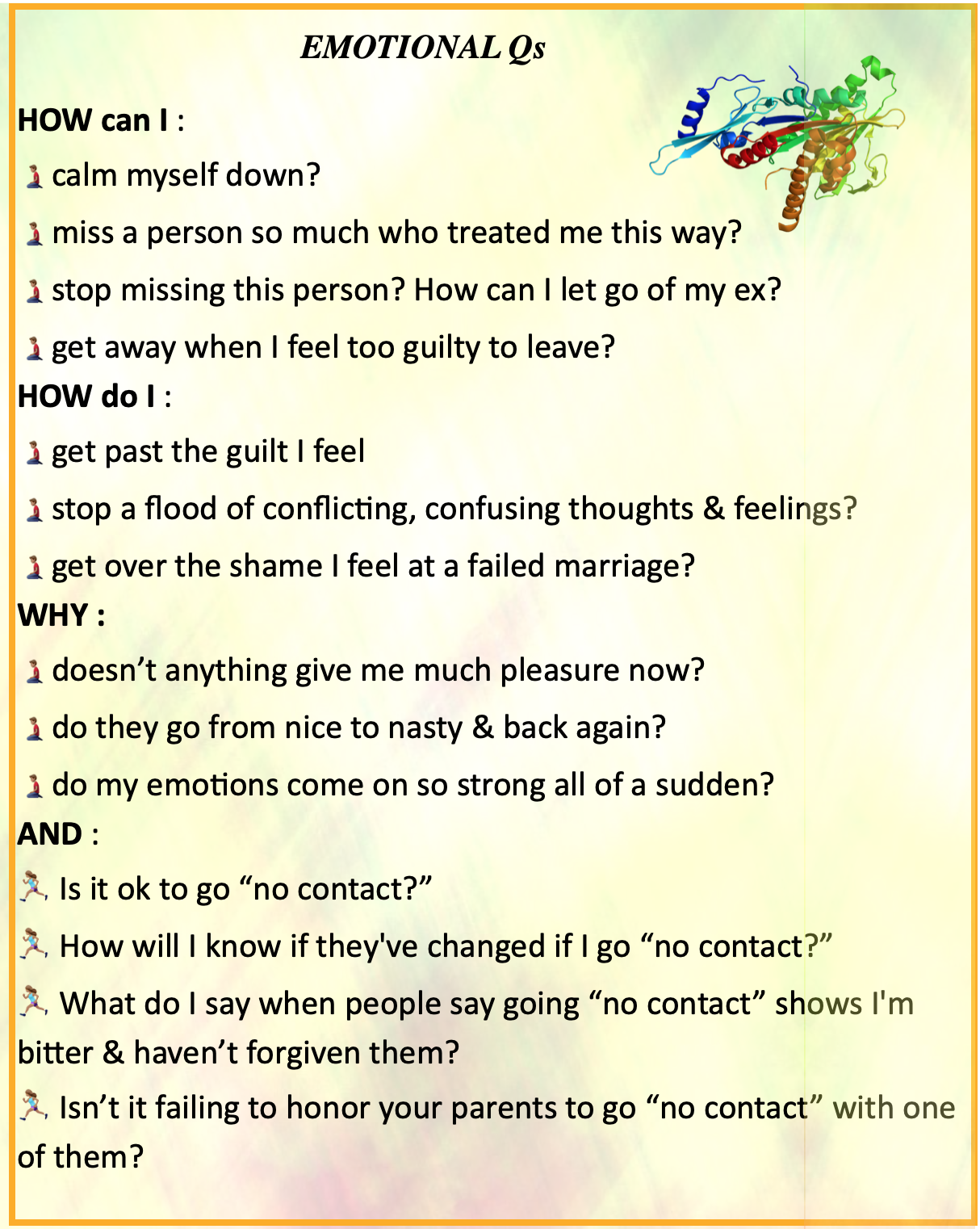
If you’re frustrated & confused, it’s normal to want to understand what’s going on. You might be asking WHY:
⁍is she like that?  can’t he just love me?
⁍does she keep cheating on me?
⁍did he say that? doesn’t he just stop & listen to me?
⁍can’t she stop triangulating, & admit she’s wrong?

INSTEAD – Since our personal power is NOT outside of ourselves – in dealing with Ns (especially the less obvious ones) – we need to ask the right Qs. It means looking inside.

Inside we hold our True Self – our knowledge, experiences and gifts. BUT it’s also where all our painful emotions & damaging beliefs are – like guilt, shame, fears, rage, self-doubt….
For some of us, going inside feels like walking into a minefield. The main reason is that without Recovery help, we don’t have the life skills or tools to know HOW to deal with intensely painful emotions when they finally surface.

Trauma specialists say that long-term psychological & physical injuries makes it hard to love ourselves, because of distorted self-images. So identifying & slowly correcting self-destructive thoughts keeping us in emotional, spiritual, cognitive, & physical chains, allow our life to expand in amazing ways!

HEALING from narcissistic abuse is an inside job, & we have to work at making it less frightening to go within. Let’s start with a bit of an inventory – in the following 3 charts – to cut through denial & notice alternatives.


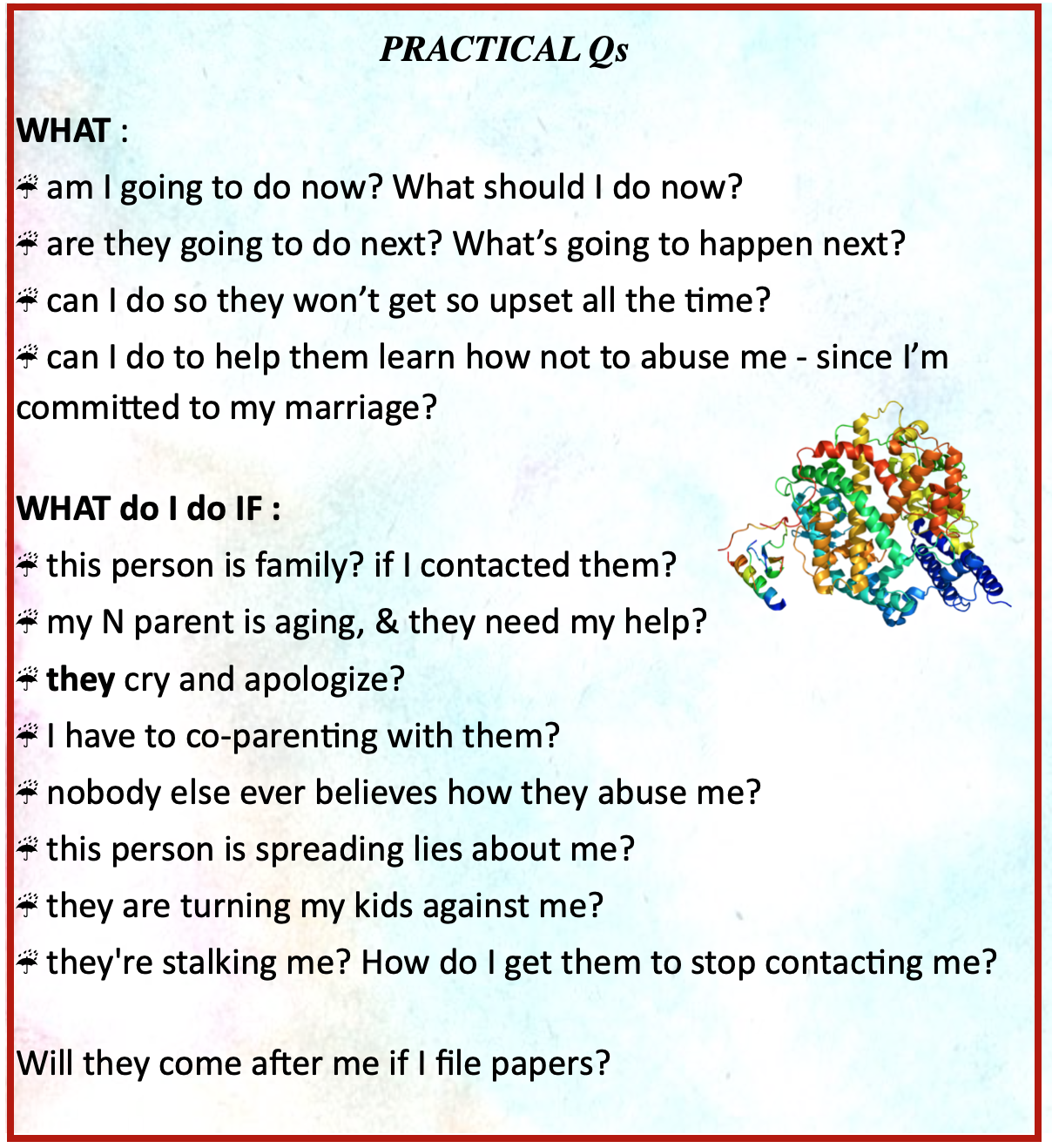
Asking the right Qs will put us on the brink of discovering where our True Power lies. The goal is to find ways to clear out old pain, negative thoughts / faulty beliefs, & create new, healthier ideas that net us the results we long for. ASK:
WHAT :
☔︎ about this person drains me?
☔︎ might be at the root of why I keep attracting abusive people?
☔︎ is keeping me locked into an unsatisfying relationship?
WHY :
💋does this person trigger me? (HINT : childhood abuse)
👅 am I in a relationship that is so frustrating? (it’s familiar)
HOW can I:
🦶🏼free myself from my dysfunction?
🕺🏼manifest the kind of healthy relationship I want & have a right to?

SITE: FAIRY TALE SHADOWS  — may articles re. N abuse & healing, including FREE eBook to download : “Taking Back your Life

COURSE : “Rewrite Your Story After Narcissistic Abuse in Relationships”

NEXT: N Helpers – Bystanders #1

NARCs seducing EMPATHs – 20 Stages (Part 2)


PREVIOUSLY: – 20 Stages (#1)

BOOK: “The Empath’s Survival Guide,” ∼ Judith Orloff, psychiatrist


REVIEW: Narcissists (Ns) & Empaths (Ems) are often drawn to each other – because Ems have a lot of compassion & understanding to give, while Ns thrive on having others worship them.
This is obviously not a healthy match, since Ems tend to forgive everything the N does, allowing themselves to be completely used & degraded, while the N creates more & more trauma. Ems work hard for harmony, whereas Ns enjoy chaos, & love knowing they can pull other people’s strings.

20 Stages (cont.)

9. The Em doesn’t get that the N’s needs / wants / desires can never be met or satisfied, no matter how hard the Em tries.
Ns can’t be happy no matter how much praise & provisions they get from others. Wanting constant attention, the N may move to other partners, open a new business, travel around the world, get involved in new creative pursuits…. but still be a bottomless well

10. If the Em ever decides to talk honestly about being hurt & disappointed in the relationship, the N will dismiss any of the Em’s efforts to work it out. They’ll be quick to say the Em’s concerns are unfounded, calling them “crazy, delusional, overly-dramatic…..”  This contemptuous attitude is a tactic used to re-gain control over the Em’s mind

11. Empaths (Em) find it impossible to ‘understand’ the narcissist’s (N) abusive behavior. In trying to making sense of it, the Em blames themself for everything that’s wrong in the relationship, since the N has convinced the Em they’re not good enough and not worthy of love – from anyone.

12. The Em doesn’t realize they’re being manipulated – again. The N has created a twisted version of reality, gaslighting the Em so they won’t believe in their experiences & sanity.
The Em has been deliberately blinded, but there are people & facts around that would be able to clearly tell them they’re quite sane, & it’s the N partner who’s wrong & wicked – if only they hadn’t been so isolated

13. Every effort the Em makes to communicate honestly with the N is pointless, who will always try to pass on the blame, to justify themselves

14. The Em needs to know that it is completely normal & legitimate to feel confused, defenseless, lost & deeply hurt.
If the Em would sit quietly – and get the right kind of help – they could finally identify their feelings about what’s been happening to them – without self-blame. Then the Recovery can start

15. Empaths are the healers of society. They have the inner strength needed for themselves to overcome any challenge that comes their way. They can also help others deal with suffering – once they’re clear about their own identity, reality & sanity 

16. Hopefully, the Em eventually comes to realize the bitter truth – that the N does not have a right to their affection, love & care.

The Em must accept that not everyone who puts on a sad face is emotionally truthful, & that not everyone who says ‘I love you’ really means it.
There are some people in the world with vile motives, using lots of manipulative games to unfairly get what they want

17. The Em needs to thoroughly understand that they are the actual victim in the relationship – not the N. They too have suffered – not just the N – but with a difference : Ems are wiling to make positive efforts to heal themselves. Ns will not

18. When the Em realizes that the N will never change – it can come as a painfully rude awakening. However, this is essential in order to move ahead – & away – to put an end to the toxic relationship

19. Once the Em stops falling for the torture of mind games, they may be surprised to find that the N will go on with their life as if nothing ‘bad’ happened, & just find a new victim.
The N won’t care that someone loved them honestly & deeply, never admitting they are the one who can’t connect internally with others

20. If the Em leaves, with time & Recovery – they become stronger & wiser.  Even though the relationship was incredibly traumatic, the Em can be seen as a lesson.
They can better identify what’s acceptable treatment & what they don’t want. This will help them choose happier, healthier relationships – not just with a mate, but also family members, friends, bosses….

NEXT: Qs for N-Abuse victims

NARCs seducing EMPATHs – 20 Stages (Part 1)

PREVIOUSLY: What Ns need you to be (#3)

BOOK: “Healing from Hidden Abuse,” ∼ Shannon Thomas, therapist


TRAUMA BOND

If you feel too tied to your N partner, unable to break away, you may use real-life reasons to excuse this reluctance, such as : concern about finding a place to live, supporting yourself & your children, or being prevented from seeing them or loved ones…. However, there’s more to it.

A too-intense emotional attachment is known as a trauma bond, developed from a repeated see-saw of neglect & insults, then switching to kindness & ‘warmth’ (positive reinforcement). This is abuse, creating a powerful connection that’s extremely confusing to the recipient (the empath) & hard to break.

Many harmful relationships begin with a shower of affection & assurances of love. It’s only natural to develop a bond with such a person.
So when the abuse starts, it a shock.
Afterward, the N may apologize, swear to change, or insist “I was just upset.” These manipulative responses often succeed, as the V remember those ‘pink cloud’ days, & mistakenly assume the N can be that person again. But it never gets better! (MORE….)

21 STAGES (by MARY WRIGHT on “The Power of Silence“)

1. The narcissist attracts the empath. They begin a relationship.
The empath’s love is deep & unconditional. They’re happy & satisfied every time they’re around the N, falsely assuming their love is being reciprocated.
However, the N has no intention of allowing themself to develop a strong emotional connection, which would be a loss of control

2. The empath (Em) starts to think they’ve finally met the love of their life.
The N reinforces this by designing an illusion to look like the 2 have a special attachment that’s impossible to break. For a while it may actually seem the N wants the relationship as much as the Em, but it’s not true. The N only wants power over another

3. As time passes, the N will work on breaking the Em’s self-esteem by making them feel weak & stupid. The N won’t usually attack openly, but say something like, “I don’t mean to hurt you but…”, then mention some “shortcoming”.  The Em will gradually start to believe they’re not able to think or do anything – for themselves, or at all – & so feel lucky to have the N making decision for them both, who is taking more & more control

4. The N will become the total center of the Em’s universe, being the one of the 2 with the capacity to love.  This is set up by the N who presents themself as the victimmanipulating the Em into giving them whatever they want,. Being natural givers, Ems keep being helpful, taking care of, cheer up & soothe their partner – always available whenever the N needs them

5. Because the Em’s intentions are pure, they can’t imagine that the N’s wounds are different from their own, and so is the healing. The N’s wounds cannot be healed with love, as the empath believes, because they’re immune to love

6. The relationship is more & more all about the N. Eventually, the Em realizes this, because now they’re afraid to verbalize or fight for their needs & wishes in the relationship.
The Em would rather die than give someone a reason to dislike them, so they’ll still try to please the N, even though they’re unhappy with what’s going on

7. The Em literally dances to the tune of the N. The more affection, devotion, effort, love & care they offer, the more control the N has.
Sadly, as long as the Em continues to put all that effort into ‘making it work’, it’s almost impossible for them to see the glaring, ugly truth. The problems starts when theEm finally ‘wakes up’ by reaching their breaking point

8. Day after day the Em’s own emotional, mental & physical needs remain unfulfilled. This happens because from the beginning they believed their partner’s emotional needs were all that mattered.

But when the Em finally understands their own well-being counts too, & that they’ve been living a delusion for a long time, they may start speaking up, not wanting to live with the N’s devaluations any more.

The N definitely does not like this, & will try to make the Em feel terribly selfish. And being brain-washed., Em can too easily agree.

NEXT: 20 Stages (Part 2)

What NARCISSISTS need YOU to BE (#3)


PREVIOUS : What Ns need YOU to BE (#2)

POST:  Emotional Maturity


Victim STRENGTHS – expanded (“Green flags”)
✥ ‘Adulting’ 
Narcissistic behavior is molded in an unhealthy childhood environment, which didn’t provide opportunities & role-modeling for self-reflection. This specific lack, a common feature of Ns, leads to an underdeveloped (immature) personality, so they subconsciously look for a “parental figure” to take care of them.

And it doesn’t have to be a person older than themselves.  It’s well known that alcoholic & other N parents keep using their children (even very young) to rescue them, by forced-listening to their adult troubles, negotiating the parent’s relationship, taking care of younger siblings…..

N. Victims : Co-Narcissists are much better at handling practical issues such as planning ahead, daily responsibilities, information gathering…. NOTE: This does not mean the Co-N have good self-esteem, just better inherent skills, along with over-responsibility

✥ Empathic
Ns will often act like a Victim around Sensitives, who are quick to comfort & embrace anyone who seems to be hurting.  It’s an easy way for Ns to get whatever they want, such as constantly being told they’re amazing, beautiful, clever….

Highly sensitive people (HSP) have nervous systems that process all experiences intensely. High sensitivity is mainly about how a person processes information, combining external input (sights & sounds) with deeply felt internal emotions. All that mental co-ordination is over-stimulating, so they can get easily overwhelmed.

N. Victims : Also, their brain regions associated with empathy are much more active than non-HSPs, making them giving, altruistic nurturers, drawn to helping & caring for others – indiscriminately

✥ Externally focused (locus of control)
N’s target people who are not ‘self-referencing’, which means they don’t look inside themselves to make decision, such as by asking “How do I feel about this?”
N. Victims: Co-Ns try to figure out how to feel or act based on what they think – or know – the N wants or will react, with no concern for their own True Self

✥ Financially responsible / dependable
Most Ns are fundamentally materialistic (non-spiritual), so it’s ‘normal’ for them to want lots of money. Attractive women Ns (men, on a lesser scale) tend to be on the lookout for someone who’s obviously wealthy.
N. Victims : Some are able & willing to pay for everything. It’s even better if they’re also ‘sensitive’ & functional!

✥ Forgiving
Narcissists only want to be with someone who overlooks their flaws & will forgive them for being hurtful. To stay in the relationship, they want to keep on comfortably abusing their mate / friend / employee.

N. Victims : They don’t hold grudges, so aren’t likely to leave the N during or because of the N’s abuse. This does mean unhealed Vs has little self-respect, but they see abuse-forgiveness as the ‘High Road’! , unaware that it allows them to be taken advantage of

✥ Idealistic
Because Ns want to be seen as superior, even god-like, they’re especially pleased with someone who only chooses to see the good in others. Co-Ns overlook the N’s immature, harmful & destructive traits, only seeing whatever positives the N may have.
EXP: If the N has a bad temper, the idealist only thinks about how good-looking he/she is. If the N drinks too much, this partner will ignore the problem & instead focus on admiring the N’s talents.
N. Victims: They dismiss all ‘the bad’ by wearing rose-colored glasses (denial)

✥ Loves unconditionally
Co-Ns are compassionate & trusting, with a big & open heart. But loving someone else comes before their own self-respect. This need to express love knows no bounds, but is a dangerous quality around Ns, because it has no realistic limits.  Ns are happy to play off of that, using & then sneering at the ‘suckers’

N. Victims : Pathologically over-giving people who are altruism & full of good deeds – regularly accept not having their caring & sacrifices reciprocated (Love vs N. love)

✥ Loyal
Ns demand one-way loyalty from others, being free to betray relationships as tit suits them. This can include setting up others (mate, child, employee) to be ridiculed, repeated infidelity, not backing up an agreed plan in a meeting, not taking a colleague’s side in a dispute, not protecting them from outside danger…. with no remorse.

N. Victims
: consider unswerving loyalty as part of their high moral standard which they’re very proud of. But it’s used to hide low self-esteem from themselves (Vulnerable Ns) with total B & W thinking, & so with no room for self-protection.

NEXT: Narcs seducing Empaths – #1

What NARCISSISTS need YOU to BE (#2)

PREVIOUS : What Ns need YOU to BE (#1)

SITE : 3 Types of Empathy

POST: ▸ Symbiosis


🎯 NOTE:  MOST competent, caring, talented, successful people are not conned by the charm & seduction of narcissists (N), whether Overt or Covert.

💘 Narcissist abuse is intentional. They know full well that what they’re doing is wrong – just don’t feel bad about it. PROOF = THEY :
▪︎ will automatically turn the abuse on or off, depending on who’s around
▪︎ definitely calculate the abuse, being both Victim- & Situation-specific
▪︎ gaslight their victims into believing the abuse never happened
▪︎ can be seen smirking with delight as they inflict harm

Victim WEAKNESSES  – expanded
✥ Compliant
Ns want to have their own way, tending to be rule-oriented & rigid. They’re only interested in partners willing to always ‘go with the flow’ & not make a big deal over anything, no matter how irresponsible, outrageous or dangerous a situation the N puts their victim in.
N. Victims : Need to be overly-flexible, willing to rarely or never get their way, & gradually compromise away desires, dreams, needs, wants, plans, schedules….

✥ Co-Dependent
“Magnet-like chemistry brings co-deps & Ns together in an enchanted fantasy that can never be sustained. It’s a complicated ‘dance’, showing what each needs the other for. Since the N hates dependence & the Co-N is terrified of independence, they’re each other’s antidote, forming an unhealthy completeness.

Given time, the co-dep’s soulmate-dream will predictably dissolve, leaving him/her with cellmate-reality.”

N. Victims: suffer from “Self-Love Deficit Disorder” (SLDD)
BOOK: “The Human Magnet Syndrome (HMS), the Codependent Narcissist Trap (More….)

✥ Depressed & Anxious
Ns need their victim (V.) to be looking for a ‘savior’, which the N is more than willing to apply for – at first, until the victim is hooked. Many externally functional people with a wounded core have ‘walking depression’, well hidden from most others. But Ns have a broken-wing detector, homing in on just the right kind of pidgin.
N. Victims : the most ‘attractive’ are untreated or unhealed walking-wounded, with a great front

✥ From Dysfunction
Ns prefer someone from an unhappy background (like ACoAs), since they’re much more willing to tolerate the N’s abuse. Ns want complete control, gradually isolating the V. from any support, which is easier with someone who may already be estranged from family.

If someone in the V’s family becomes suspicious of the N’s behavior, the abuser can launch an attack on that relative’s credibility & character, making the V doubt that person’s good intensions & warnings.

And when the V is upset about anything in the relationship, the N can say “You wouldn’t be feeling this way if you has a more stable background / Your complaint is more about them than me….”

N. Victims : need to see the N as the hero who ‘cares’ for them, unlike their own family, so they’ll do anything to avoid arguments or conflicts

✥ Overly Responsible
Ns are irresponsible emotionally, practically & relationally. So having a partner who will constantly “pick up the pieces” helps keep their game going. After all, someone has to raise the kids & pay the bills…. as long as it’s not them.

N. Victims : beside taking on the responsibilities of others, Sensitives are prone to deep introspection, but to the point of over-analysis, which allows them to rationalize the N’s behavior & pin the blame on themselves

✥ Running on Empty
Overt Ns love to be blatantly in charge, treated as if they know everything – always right & superior to the hoi-poloi. They look for mates, friends or employees who want to be guided, told what to do & even how they should feel – while expected to be highly competent & knowledgable – but only to benefit the N.

N. Victims: adults who had emotionally neglectful parents in the first 6 years or life, especially 1 co-dep & 1 N, are most vulnerable to the superficial glitter of the N’s smoke-&-mirrors initial presentation (BOOK: “Running on Emptyby Jonice Webb, PhD.

✥ Self-Sacrificing
Narcissists want partners who ‘practice’ self-deprivation, denying their needs – or at least not asking for any – since Ns aren’t interested in providing them. That way the N is always sure to be the only one getting ‘fed’.

Also, Ns mistake kindness in & caring for others as weakness, which they readily take advantage of.
N. Victims : are compulsively anorexic in many parts of their lives – especially depriving themselves of compassion, safety & respect.

NEXT: Victim STRENGTHS ( #3)

What NARCISSISTS need YOU to BE (#1)

PREVIOUS: Financial abuses

SITEs: “What is wrong with the person who is with a N

POST:  Self-esteem is not…


CORE ATTITUDE
Narcissists (Ns) don’t like to see see other people being happy. They’re jealous of your good life, so don’t want you to have it.
It’s a common misconception that abusers go for broken people. Actually – both Over & Covert Ns are attracted to the talented & competent, precisely for their strengths rather than their weaknesses.
The Overts – to break them & the Coverts – to leach off of them.

Ns are looking for the exact opposite of themselves. They’re desperate to keep their ‘supply’ coming. They can’t provide their own internal energy source, so become incredibly skilled at knowing who to go after.

Grandiose / Overt Narcissists :
☛ find it more entertaining to take down someone who’s impressive in some way, such as in their friendship circles or family
☛ only want to be with people who reflect well on themselves, because of the victim’s career, hobbies & talents

☛ thrive on the chaos they create for someone who had their life in order
☛ like to show off their partner in public, but be able to abuse them behind the scenes

☛ Ns enjoy the challenge of breaking  someone’s will. This includes destroying any strong support system (friends, family) which will threaten the Ns’ control

GREEN FLAGS – Overview of the positives Ns WANT you to BE :
❥ Compassionate = you care so much, all they have to do to hook you is spin a pitiful yarn that tunes into your empathy
❥ Competitive = you challenge their god-status, which triggers one-upmanship, so they can win at your expense

green flags❥ Eye Candy = you need to be good looking (Ns have to be with beautiful people), even if they’re not that attractive
❥ Forgiving = you can let go of others’ mistakes, which gives the N a license to keep ‘sinning’

❥ Good listener = will pay attention to all their stories, lies & BS
❥ Idealist = as a dreamer you believe there’s good in everyone – easily taken advantage of
❥ Loyal = the N will make you loyal to them & then gradually question your loyalty, using false guilt to manipulate you

❥ Responsible = letting you make personal choices, then accusing you of selfishness
❥ Sexual = they want it, & act so passionate. They make it seem safe when they say you’re special, ‘differ­ent than anyone else’ in their life

❥ Smart = you’re a cover for ‘normal’. A clever person wouldn’t be with an evil abuser, right?
❥ Spiritual = you’ll be compassionate & trusting, rising above human foibles, believing your union was ‘meant to be’

Ns also WANT you to HAVE:
❥ Assets
= a home &/or financial security is VERY appealing
❥ Children = being caring will make you a good parent – which the N doesn’t know how to be – so the N can look like a good family men / woman without doing the work
❥ Good career
= better able to provide for the N

❥ Integrity = because you have good values, you’ll stay longer to uphold them. But it also makes the N want to break you so you won’t use your principles to challenge them
❥ Money = it’s a whole lot easier to take yours than to work for their own

HOWEVER: To be attractive AND attracted to a N, someone must also have underlying weaknesses in their personality structure, not part of their True Self. This may be very hard for N-victims to admit, but their continued addictive attachment to the N is proof. It’s someone :

🔻with unhealed trauma. The N figures out your specific needs & presents themselves as the great hero who will provide them & fix the hurt

🔻lacking a clear self-identity. Many functional, talented people do express abilities, but are missing a deep inner sense of their own true value (impostor syndrome)

🔻with weak personal boundaries. allowing them to be constantly violated. You obey the Toxic Rule “Other people’s needs are more important than my own”

🔻who doesn’t have a ‘happy, productive life’, so you make the N your whole existence, the magician who will heal your wounds, & therefore you never want to let go of

🔻not on your own side – so when the N is abusive, you stay attached instead of pulling away to honor the truth & take care of yourself

🔻terrified of abandonment, who will sacrifice sanity, freedom & peace, while tolerating all the abuse, chaos, drama & loneliness, dished out. (More….)

 NEXT : Victim Characteristics – #2

Narcissists’ FINANCIAL Abuses

PREVIOUS : COVERT Ns, #2

SITEs: “Narcissistic Abuse & Financial Abuse” (extensive)

Money: They still want to make you pay. Literally” (re. Ex-spouse) Scroll down

The Narcissist & Money Control

👫 Men, Women & Money – How the Sexes Differ With Their Finances 

NARCs LOVE MONEY, of course! They love any resource that gives them power & control , & money is a major tool for that

NOTE: Most of the literature focuses on how male Ns use $$ to harm their mates & family. However, Financial Abuse covers much more ground than sexual relationships. Interestingly, there are a number of ways an N can MIS-use $$, depending on their TYPE .

There’s the N WHO
a. has accumulated or inherited money, & uses it to ‘keep’ another person (either gender)

b. has little or no money of their own, & won’t earn their own way, so they find someone else to support them

c. as a parent – will be more ‘generous’ to a favored child who knows how to stroke the N’s ego
Or who spends all their time & money on one sibling, while ignoring or actively belittling another (the scapegoat)

d. is the spouse or ex (usually male) with a good enough income they can dictate how much is spent on the family, usually to their detriment.
WHO :
e. has money but hoards or hides all of it, so they force a partner to pay more than their share of the bills.
This can also show up as the ‘friend / boyfriend’ who never seems to have their wallet with them when you’re out together

f. promises their adult-children, other relatives or long-term aids a large inheritance after their death, to keep (at least) one at their beck & call. Sadly, that victim may not get the money in the end

g. does spend money on a child, both young & later when grown, as a substitute for any form of emotional connection (paying them off)

h. throws money around in public to look grand & generous, but is stingy with their own family. This can be in the form of big donations to religious institutions or charities, OR showering it on buddies, bosses, clients, animals….
WHO :
i. acts like they care about their spouse but is constantly lying about how much money they have (sooo little) so they can’t help out right now. They promise to do better soon, but never come up with the dough they owe

j. compulsively uses their parent or spouse’s bank account, to over-spend on expensive clothes, jewelry, plastic surgery, gurus, trips…. OR drugs, without agreement or permission

k. steals their aged parent(s) SS checks
l. refuses to pay child support, ever
m. spends all their mate’s bank account – or empties it – as punishment for not getting their own way, OR possibly for truly being mistreated

n. uses every legal & illegal means to hide money & assets – before a divorce – so the spouse is left with little or nothing

NEXT : What Narcs NEED you to BE #1

COVERT Narcissism (Part 2)

PREVIOUS: COVERT Narcissism (Part 1)

Audible BOOK (11 hrs) :”Trapped in the Mirror – Adult-children of Ns….” ∼ Elan Golomb

C-Ns = covert narcs

COVERT SPECIFICS (cont) 
❥ Overts are terrified of being alone – an exaggeration of the Extrovert side of the MBTI E-I continuum.

◽️Coverts are much more comfortable being alone, a general preference for Introverts. However with C-Ns, this can be taken to an extreme. Combining self-hate (S-H), weak boundaries, fear of abandonment (FoA), fear of commitment (FoC) & fear of responsibility (FoR) make it easier for Cs to isolate – to the point of emotional & psychological starvation.

❥ Cs are more likely to suffer from depression, both from a history of being abused, & lacking even a small support system. Being less communicative than Extroverts (even secretive) many Cs lead double lives, which can turn them paranoid – having a lot to hide, like being orderly at work but messy in their home.

Their introversion can become warped by the severity of N traits, forcing them deeper into silence, & over time into abject misery – since it gets harder & harder to gather enough ‘supply’ to keep the False Self (FS) from collapsing.
In that case, the FS – which needs fuel to survive – turns in on itself, devouring whatever’s left inside. So, to survive, they use extremes of pity-ploys or people-pleasing to get the strokes that will keep them going.

The FS is one of several possible defensive identities, chosen in childhood to cope with a neglectful & abusive family life – a version of themselves they hope will be more acceptable to others – but at a great cost. As they grow up, they’ll defend the FS like it is a life-or-death issue, since It’s all they have.

They become totally invested in making sure everyone else accepts & admires the FS, taking great pains to hide the ‘Real’ one. Like Overts, they too are afraid to dig behind their defense walls to liberate the True Self, which is buried deep, along with any true empathy for others.

❥ Another version of Coverts are the Wolves in sheep’s clothing.
Many C-Ns seem gentle & humble. Some like to portray themselves as empathy itself, angels in human form – dedicated to the path of ‘enlightenment’. They can reel you in by appealing to your caring & empathy, & their lack of obvious arrogance can unfortunately numb your fears & suspicion.

These C-Ns will compulsively rescue everyone, perform many good deeds & help charity organizations…., thriving on feedback from their community that will say: “You’re such a kind person!” However, behind closed doors they can be tyrants.

Wolves disguise their true intentions. THEY:
1. live to take power, instead of empowering others
2. will charm you first, to give the impression they care
3. seem sweet on the outside, but eventually bare their teeth
4. manipulate through emotions to get what they want
5. tell ‘stories’ that are full of holes (Explanations…)


NEXT
: Ns financial abuse

COVERT Narcissism (Part 1)

PREVIOUS: Overt Ns #3

⬅️ On CHART : Letters A, B, C, D represent people with varying degrees of N damage – who are closer or further away from a Healthy Self. They function in the real world, but their behavior alternates between the extremes of Rage & Awe, creating much internal turmoil, & constant drama in their relationships & at work.

Os or O-Ns = Overts or OVERT Ns (‘narc’ = narcissist)
Cs or C-Ns = Coverts or Covert Ns //  FS = False self 

Covert Ns can be hard to identify & even harder to expose. While Overt Ns idealize themselves, Cs invest their heart & soul into idealizing something outside of themselves, hoping they’ll get warm inside by basking in reflected glory. AND, It doesn’t only have to be a person, but also religion, ideology, political movements, charity organizations….

C-Ns tend to be shy, sensitive & insecure, but Os & Cs share the same core personality traits. EXP: The difference is like listening to a song on full blast or very low. The song remains the same, only the volume changes.

IMP: Thecovert” aspect of N is not about hiding abuse or being slyly manipulative, which are common to all types of Ns.
IT IS about the fact that C-Ns are by nature more toward the Introvert end of the MBTI  E-I scale, which masks their underlying grandiosity.

If someone seems shy but still manages to suck all the air out of the room, you’re probably in the presence of an introverted N. Their partners know that there’s nothing covert about how arrogant, withholding & argumentative Cs can be.
EXP: Someone who jumps on everything you say, “What did you mean by that?”
OR who often goes into bitter rants about all the ways they’re being mistreated by everyone….

What Cs & Os have in common (intro- & extra- verts)
✴︎ They too crave importance, thirsting for admiration, but will look different to observers. They might give back-handed compliments, or purposefully minimize their accomplishments & talents so people will reassure them about how talented they are

✴︎ They cling to feeling special, but with low self-esteem the grandiosity takes a different form. Cs fantasize about their greatness more than advertise it. Some Cs imagine themselves a misunderstood or undiscovered genius, a long-suffering victim (troubled teens can raise this to high art), the most sensitive person in the room, or the biggest piece of s–t!

THEY ARE:
✴︎ hyper-sensitive: reacting to slights & criticism, apt to attack “enemies” in a flash
✴︎ manipulative : which is by definition Sneaky. Loud Os or quiet Cs, they’re equally crafty
✴︎ not self-reflective, unwilling to uncover their motivations & feelings
✴︎ very abusive – mentally, emotionally & verbally, sometimes physically
THEY:
✴︎ use narc-speak / ‘word salad’, convoluted & deliberately confusing talk
✴︎ struggle to recognize needs & feelings of others, unless those relate to themself
✴︎ lack object-constancy, seeing things in B & W
EXP: When angry at you (unaware of feeling abandoned), they forget all the good things about you, & suddenly you’re all bad

✴︎ use gaslighting, triangulation & other mind games
– Overt
s are in your face with it – they like you knowing they ‘gotch-ya’
– Coverts 
fool you by making you think they’re loyal & faithful – while sneaking around. They’re more dangerous & damaging because you don’t see them coming.

COVERT SPECIFIC
1. Overt-Ns are often ambitious, successful go-getters, full of charm & energy
‣ but many COVERTS are marked by failed ambitions, chronic feeling of emptiness, & low functioning. When supply-depleated, they can sink into hopeless apathy

2. Overts can be identified by how they tell everyone how amazing they are, bragging about abilities & achievements
‣ but COVERTS are known to present themselves as weak & needy victims, & then run that ‘game’ as bait to reel in supply

❥ They’re often referred to as ‘Vulnerable Ns”. But there’s actually nothing vulnerable about them. That’s the problem.
If they could be emotionally open & vulnerable, they would be able to form secure attachments, which is what helps prevent people from becoming NPDs in the first place.

True vulnerability means taking genuine emotional risks & openly turning to others for support – rather than endlessly complaining.

NEXT: Covert Ns – #2

OVERT NARCISSISTS – toward others (Part 2)


PREVIOUS: Overt Ns toward others – #1

SITE:  10 Signs of a toxic person


Re. Treating OTHERS cont – THEY (Ns) :
are self-righteous
N assume their point of view is inherently superior to other people’s. And what they truly value is the attention they get for their ideas.

EXP:  a N may actually believe he/she has a closer connection to God than everyone else, but what’s more important to them is that others believe the N has this ‘connection’ & admires their ‘deep’ spirituality

don’t actually listen
Ns really don’t care about what you have to say, so they don’t ask how you are or what’s going on in your life.
But even if they happen to, out of politeness-training, they don’t actually let you say more than a word or two before they just start going on about themselves again

◆ are good at stonewalling
Ns are the ‘best’ at ignoring requests that don’t fit their agenda. They’ll refuse to : compromise, collaborate, negotiate a conflict in good faith refuse to : listen to another’s point of view with an open mind, support another’s plans, nor openly discuss their own motivations.
Another version – simply ignoring a person, refusing to acknowledge their existence

don’t give compliments, unless….
Ns want to be admired. They’re not interested in making others feel good about themselves. That’s not their job in life. You’re ‘lucky’ if you do get a compliment, which should make you suspicious about their motive. Don’t assume it’s sincere. However, if a N is trying to sexually seduce someone, they’ll gush about how wonderful the potential mark is, but only until they’ve ‘won’.

◆ over-rate their attractiveness
According to one study, Ns are generally rated as more stylish & physically attractive. However, this isn’t always the case.

According to another study (2008), Ns rated themselves highly in both looks & intelligence, but their IQ tests proved to just be average. When their peers were asked to rate their N friends on looks, the results were lower than what the Ns gave themselves.

don’t pick unattractive friends (usually)
This applies mainly to Extrovert Ns, who are in business, entertainment, politics…. anywhere they’re visible. Since they only do what benefits them, picking who they surround themselves with is important. Those have to be attractive & “upper-class” people who enhance their prestige, making them feel superior & invincible.

However, there are plenty of  ‘vulnerable’ Ns who hide behind false modesty, do-gooding, caretaking…. in which case they need to be the only one who’s attractive, reenforcing their sense of superiority.

Younger N men & women have different styles. Women choose male friends with high social status so they can feel worthwhile. Guys choose bros who are willing to be their ‘wingman’ when trying to pick up girls

are serial romantics
The “seductive” Ns fall in & out of ‘love’ quickly & easily, often with someone they don’t know very well. They think their partner is absolutely perfect – a match to their own perfection. When reality sets in they realize their partner is flawed, which often ends the relationship

cheat in relationships
Psychologists’ research found that narcissists are more likely to cheat – once they think their partners are committed. They tend to use more sexually explicit language in every-day conversation, & seem to get a charge out of convincing others to engage in promiscuous sexual acts they wouldn’t normally participate in. (MORE….)

don’t incorporate security into relationships
Ns want to keep you off balance, to never feel secure in the relationship. Your anxiety & fear of losing them makes them feel important.
AND Triangulation is a favorite tactic:

1. Stirring up jealousy = constantly look at / commenting about attractive strangers, or talking about about an ex….
2. Division = talking trash about your friends, & doing the same with them about you
3. Recruitment = calling in reinforcements to be on their side when the 2 of you are fighting
4. Cruel break-up styles = such as telling others how bad you are & getting them to agree. (MORE….)

don’t stick around
If you’re staring to bore them in any relationship, expect a N to pack up & leave. They want your full attention, which includes only talking about & doing what interest them, & keeping them entertained. Otherwise – they’re on to the next person who will.

NEXT : Who Ns are attracted to (#1)