Ennea: TRIAD EMOTIONS (Part 1b)


PREVIOUS: Triad Emotions – 1a

SITE:
 
How the Enneagram can Point you to God

BOOK: The Enneagram: A Christian Perspective  – R. Rohr & A. Ebert

TWOS –  Helpers / Caretakers
Dealing with Emotions: 2s are the most externalized, focusing their grief & shame outwardly. They over-express positive aspects of their heart – at the expense of being real, so it’s an incomplete or false connection. However, they get a lot out of giving of themselves & conforming to the needs of others

Shame: 2s compensate by denying hostility, trying always to act out an idealized image (good girl/good boy). They feel shame with confronts with any form of disapproval, because they want so badly to be loved.
The try to control shame by working very hard to convince themselves & others of being totally virtuoustype 2 heart

They only allow themselves pleasant emotions & thoughts toward others, while repressing ‘ugly’ ones (anger & resentment for not being appreciated) – denying they may not be so unconditionally loving
— As long as 2s can get positive emotional responses from others, they feel acceptable, which helps control their shame

The positive emotion for 2s is a great capacity for empathy and care in relationships. Others naturally respond well to their warmth & friendliness, inviting a connection to the heart center where everyone is valued.
Their virtue is humilitynot devaluing oneself, but realizing ones true measure &  worth, without inflation or deflation – by the balance between giving & receiving

► THREES – Achievers / Performers
Dealing with Emotions: at the core of the triad, 3s are most out of touch with their heart-feelings, which are suspended so they can = make a good impression = get the job done, & = act as or become someone they believe will make the greatest impression or win the greatest accolades.
So they need to repress shame & grief, making it hard to know directly what they want or could own as theirs alone (needs, gifts, dreams, wants….)

type 3 heartShame: they deny shame by disconnecting from their heart, hiding from underlying sense of inadequacy, then trying to fill the gap by ‘being’ what they achieve.
They do feel shame (but don’t recognize it as such) with any form of rejection, because they so want to be desirable.

3s focus on accomplishing tasks & ‘managing’ shame by trying to become what they imagine a valuable, successful person is like. They learn to perform well & be acceptable, even outstanding, often driven to relentlessly pursue success as a way of staving off feelings of shame & fear of failure

NOTE: Healthy 3s – bonding with a loving mother : are the most authentic people. Self-actualized 3s attract others with a magnetic personality
Unhealthy – bonding with a narcissistic mother : become sham artists to hide an undeveloped soul. Hard-driving achievers, they claw their way to the top & crow when they get there, but their own narcissism drives others away
(ARTICLE by a Christian Type 3)

► FOURS – Individualists
Dealing with Emotions: 4s under-expressing their connecting-heart, & focus their grief & shame inward. They have an artistic temperament, a love for aesthetics & are intense about everything – absorbed in their inner life, but away from their true feelings

Shame: they try to control their shame by shoving hostility so deep – they never find it. But they do experience it when they don’t feel like belong or are criticized or nor belonging somewhere, because they’re so afraid of being defective.
Being the most likely to feel inadequate, they compensate by focusing on how unique & special their style, emotions & talents aretype 4 heart

4s also cover shame by cultivating a rich, romantic fantasy life to escape dealing with ‘reality’ – whatever seems drab or uninteresting – using dramatic emotions & imagination to soothe themselves, & fill in the Self they’re think is missing.(More….)

The positive emotion for 4s is authenticity, to feel their true feelings whatever it takes. They can empathize with other’s suffering & grief, as well as their happiness. Their virtue is equanimity – the capacity to keep the heart open, accepting all feelings while staying grounded in the goodness of life. (More…..)

 NEXT:  Ennea-EMOTIONS #2a
Ennea: TRIAD EMOTIONS (Part 1a)

LOVE triadI’M SO FULL OF EMOTIONS
I don’t know what to do with them!

PREVIOUS: Triad Emotions – Intro

SITE: Enneagram: Ancient knowledge, modern psychology


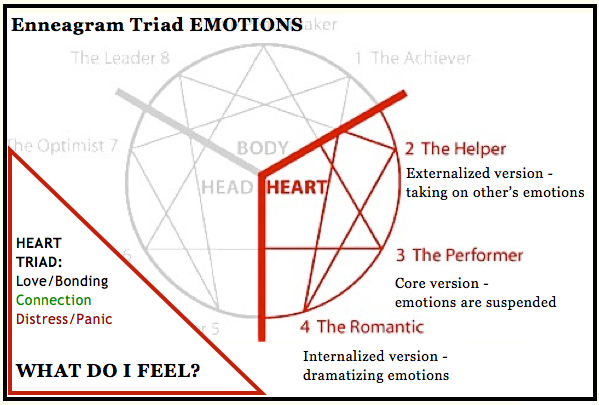
234s – HEART / Feeling Triad: Low Self-Esteem & Longing
PHYSIOLOGY: triad associated with the mammalian part of our brain
FOCUS: this ‘Center of Intelligence” uses emotions, intuition & imagery – rather than bodily senses

ROOT Emotions
: SHAME, & GRIEF/Sadness, hidden HOSTILITY
RESPONSE: from their heart first, then the head, & gut last
POWER: from their ability to instinctively feel emotions

TIME: mainly to the Past, needing to feel connected to long-term relationships & events
UNDERSTAND Life: best when info is translated into symbols of desire, through people & stories about themselves or their old experiences

❖  234s long for a sense of identity, of figuring out “Who am I?”. Instead of going inward for this information, their main attention is on getting Affirmation From Others, especially those they feel close to, to the point of side-lining their own deepest needs. Total reliance on validation from others can lead to only being able to see themselves thru others’ eyes, unreliable at best, or to low self-esteem & possibly despair. It’s also called the “image” triad, because of a concern with how they are ‘seen’triad :grief

GRIEF / Sadness comes from negating oneself by having substituted a ‘persona’ as a partial or full replacement for the True Self. As children they didn’t have accurate or adequate mirroring. Not being able to handle their pain, they chase after attention & validation. When they feel a real or imagined threat to a connection with an important ‘other’, they can get very distressed, even panicked. This motivates them to stay attached, or do whatever is necessary to re-connect.

IMMATURE: While they may seem very emotional to others, these Types are the least in touch with their primitive senses (the way 8s are). Their natural instinct is to pick up emotional energy from the environment, the same way an audience takes on the enthusiasm of a charismatic motivational speaker, & then acts it out as if it was their own, (like audiences do with Tony Robbins)

EXP: 4s can be pseudo-authentic (dramatic), who assume they must be unique to receive love…. Actually – for them true authenticity would be to include emotions they may think are too ‘ordinary’ (caring, comfortable, annoyed, disappointed….)
MATURE: When healthy, their sensitivity makes these Types admirable, being highly valued for their genuine thoughtfulness & interpersonal skills.

Hidden AGGRESSION: 234s don’t openly acknowledge their wish/need to be aggressive. Instead they use manipulation, guilt & self-pity – more passive ways of asserting themselves, which they consider safer

SHAME : In this context, it is the feeling of being “in the spotlight,” under scrutiny, rather than feeling ashamed of themselves as human beings. It grows out of the deep-seated preoccupation with the need to “See me the way I want to be seen” (rather than for who they truly are), which motivates their characteristic styles.

NEED to be SEEN
2sit shows up as wanting to be recognized for their affection & care of others, a form of “possessive affectivity” **
** Affectivity – something influenced by, sensitive to or results from emotions
3s – their own success is most important, especially in career. This kind of recognition-need can be called ‘functional affectivity’
4s – they deeply want recognition for their originality, with a need to be considered unique & special, often with ‘negative affectivity’

QUESTIONS to ask yourself – for 2, 3, 4s

NEXT: Triad Emotions (1b)

Enneagram: Triad EMOTIONS – Intro

triad emotions 

UNDERSTANDING MY EMOTIONS
helps me deal with life better

PREVIOUS: Ennea Triad Basics – #2c

SITE: “Personality tool: Understanding the Enneagram. Scroll down for info on each type’s way of expressing emotions

CORE EMOTIONAL responses of the 3 Basic Centers
An important way of using the Enneagram is to identify & properly deal with the emotional essences of each triad – developed out of biological responses to survival threats. They can be seen across ALL mammalian behavior, via modern Affective Neuroscience. The same distress-emotions are triggered when the organism’s 3 BASIC NEEDS are not met.

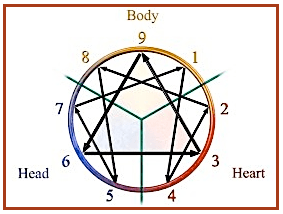
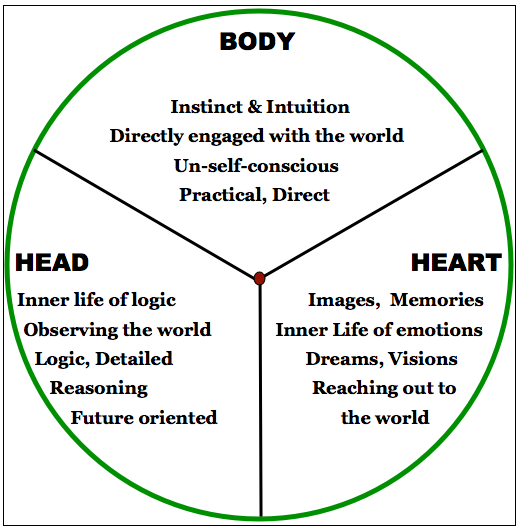
CENTERS: Feeling = Heart (234), Thinking = Head (567) and Gut (891) which includes = Instinctive (digestion, breathing, heartbeat) & Sensory aspects (running…).
Interesting: Gut acts 30,000 times faster than Heart, itself 30,000 times faster than Head. (“The Fourth Way)

◆ EVERY type is capable of experiencing ALL emotions, but each Center is driven by a main one. When things get tough, frustrating, won’t go our way….Screen Shot 2014-09-28 at 10.38.50 AM there’s an inner ‘default’ setting that gets triggered

234s = Grief, Shame
567s = Fear, Anxiety
891s = Anger, Rage
Each Type handles it’s primary emotion differently:
❖ The first # is overt “externalizes” :
2 its shame, 5 its fear, 8 its anger
◆ The second # “represses /covert” :
3 its shame, 6 its fear, 9 its anger
✦ The third # “internalizes /neutral” :
4 its shame, 7 its fear, 1 its anger

Basic FEARS – Triad emotion are our automatic ‘natural’ way of responding to the world, but most people don’t realize it’s what fuels their daily reactions.
When these emotions are cut off from our Core Self, they generate the Type’s defense mechanism, which underpin all dysfunction. While each Center has it’s preferred emotion, Riso & Hudson explained that each TYPE also has an underlying fear OF being: 
enn - Triand INFO1s – corrupt, defective, unbalanced
2s – unwanted, unworthy of love
3s – worthless
4s – without identity or personal significance
5s – helpless, incapable, useless
6s – unable to survive on their own
7s – in pain and deprivation
8s – harmed or controlled by others
9s – lost or separated from self & others

◆ Beatrice Chestnut, psychologist & teacher, condensed a human child’s early needs into 3 challenges – emotional ‘disturbances’ when not properly fulfilled:

A. Need to feel mirrored – when their caregiver makes direct, loving, face-to-face, eye-to-eye contact, so the young child feels ‘seen’ for who they are.

MISSING: Distress/Panic, from the loss of connection & bonding.
Heart types innately pursue this need, but do it incorrectly by creating a False Persona. This makes it hard to be curious about oneself, others & life.
They’re too busy watching what they do, so it will fit their created IMAGE of being:
2s – thoughtful & considerate – so others will respond favorably to ‘such a selfless person’ who only thinks of others
3s – a confident, successful person (so others will respond with respect to such a competent, achieving individual)
4s – a unique person, different from everyone else (so others will at least think they are special rather than lost or deficient).

B. Need to not feel fear – being protected from real danger, or whatever is imagined to be dangerous

MISSING: Fear/Anxiety, when experiencing ta threat, challenge, or danger to our very security
Head
types figure out what makes life certain for themselves. Some fear is necessary & useful if it’s not all-pervasive & overwhelming. When fear overwhelms, it’s very hard to be open to & curious about all the good things available to us.
It’s also imperative to separate fear that’s real from what’s self-created (S-H)

5s – move away from anything that scares them, retreating into a solitary, private world where they only rely on themselves
6s obsessively imagine future danger, &/OR act fearless, as a way of coping with their ever-present fear of life
7s try to avoid fear entirely with constant distractions, sticking to a positive attitude, always considering new possibilities, & planning escapes

C. Need to feel held & supported – seen in very young children who want to be securely wrapped & held, to not feel the threat of being dropped (injured or dead)

MISSING: Anger/Rage, when we experience not being able to depend on our caretakers to ‘back us up’ – neglected, violated & repeatedly deprived
Body Types can sense what’s wrong in their world, know what actions are needed to correct it & how to provide their needs. They want to control their experience & environment to deal with anxiety :
8s try to ‘hold’ everything & everyone by taking charge
9s ‘hold’ by repetitive activities that soothe them (narcotizing)
1s ‘hold’ by being self-controlled, trying to control or structure every aspect of life

LAYERS of the SELF enn -LAYERS of the SELF
Outer = COMPULSIVE : Behavior is automatic
Next = OBSERVING : Beginning of awareness, ability to notice & detach from compulsions
Semi-Inner = HIGHER : Increasing awareness & autonomy, the ability to access higher functions of the Centers
Inner/Center = ESSENTIAL :
Unified consciousness, not trapped in or identified with any one triad
(Chart: ‘Nine Paths’ 12/26/12)

Moving from the outer circle of Stress & Security points – towards our center – requires consistent self-observation.

NEXT: Triad Emotions (Heart)

Excellent Inner Child movie

DON’T IGNORE ME!
I’ll act out what you deny!

PREVIOUS: Enneagram Triads (#2c)


For anyone interested in better understanding the Inner Child, I highly recommend the MOVIE:

IF YOU BELIEVE, 1999

— with Ally Walker as the overworked editor who has betrayed her own instincts & needs, &
— Hayden Panettiere (long before “Hero”) as Ally’s younger inner self, prodding her to return to her truth.

Synopsis at imbd.com

MOVIE:  http://www.free-online-movies-streaming.com/if-you-believe-1999-streaming/

NEXT: Family ROLES – general

Ennea TRIAD Basics (Part 4b)


PREVIOUS: Ennea Triads, Part 4a


3rd Triad (891) : INSTINCT (Gut
), Body-based character structure (cont)
#8 = Leader — Energy: Larger than life, Dominating.
#9 = Mediator Energy: Diffuse extension, Comfortable
#1= Reformer Energy: Rigid containment, Righteous

In BIZ: They take a stand, act decisively, & take calculated yet appropriate risks. They develop alternative & solutions to problems, challenging conventional wisdom. They take ownership & demonstrate integrity.

For Inspiration: 8s use their Mental Center / 9s use their Body Center / 1s use their Heart Center (MORE….triad 891

Re. SPACE – When truly grounded (knowing exactly who & where they are in time, space & spirit), they develop healthy personal boundaries, with a clear sense of personhood & positive connections to others
EXP:
8s feel the need to conquer, to be certain of having a place for oneself, so they assert their boundaries aggressively
9s will adapt to a new environment with seeming ease, but part of them remains disengaged
1s hold back & compare situations with their sense of right/wrong, afraid that if they let go they’ll lose control & have their boundaries ‘penetrated’

► 8s Function – Leadership & Self-assertion
They express anger easily & fast. They put their guard up so that no one can get through their defenses to hurt them. Their anger will surface in situations where they or someone else experiences injustice

GOWTH: 8’s can learn.… there’s no contradiction between being sensitive to the hearts of others and having an effect in the world. In fact, the more they connect with others, the more they become a powerful force for good. Healthy 8’s can good gut instinct.pngbecome the kind of leader others will fall on their sword for
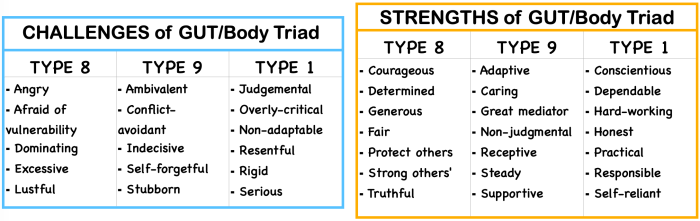
Positive potential: ability to take personal initiative, magnanimity, self-confidence, self-determination, self-reliance
Negative potential: combativeness, crude insensitivity, domination of others, ruthlessness
– They over-express their instincts, tending to dominate people & situations without pausing to think about others’ points of view

► 9s Function – Interpersonal Mediation & Receptivity
They tend to disconnect from their anger in order to build harmony & comfort, both for themselves & for others, which can be referred to as “the anger that went to sleep”. They turn a blind eye to whatever threatens their peace

GOWTH: 9’s can learn.… that staying with discomfort in the moment & being present to  engage – even if there’s confrontation, is the key to true inner peace. They don’t need to retreat from anger or other uncomfortable emotions, and with limitless patience can help others feel truly loved & accepted

Positive potential: acceptance, creating harmony with others, emotional stability & physical endurance, un-self-consciousness
Negative potential: disengaged attention & emotions, neglectfulness, mental dissociation, passivity
– They’re numb to their instincts, which makes it very hard to hold on to their own agenda as the waves of life wash over them

► 1s Function – Ethical Standards & Responsibility
They don’t like expressing their anger externally, & can be very self‐critical, working hard to hold back their unconscious impulses.  (from ‘Enneagram Singapore’)

GOWTH: 1’s can learn.… they’re not responsible for fixing everything, & accepting a situation isn’t the same as endorsing it. They can still accomplish a higher good while having patience with ‘what is.’ At their peak, they’re serene, conscientious, accepting & inspiring

Positive potential: conscience, delayed gratification, maturity, moderation, self-discipline
Negative potential: impersonal perfectionism, judgmentalism, rigid self-control, self-righteousness
– They internalize their instincts & check them repeatedly for validity, which makes them highly ethical but also a bit slow
✳️
Therapy with HORSES: Body Types 891 are taught to modulate the energy they put out through their gut centers, & allow the process to unfold naturally.

8s need to modulate their intensity
9s need to focus, & direct their intentions with clarity
1s need to relax, & let go of their need to be competent and controlling – to simply be with the horse. Easier said than done.

MEDITATIONS Thoughts’ about meditation (& some humor) Scroll to 12/3/2012

NEXT: Ennea Emotions #1

Ennea TRIAD Basics (Part 4a)


I HAVE ALL I NEED
to understand my environment

PREVIOUS: Ennea Triads, Part 2b

SITE: Discover your Enneagram TRI-Type


3rd Triad (891) : INSTINCT (Gut), Body-based character structure

#8 = Leader — Energy: Larger than life, Dominating.
#9 = Mediator Energy: Diffuse extension, Comfortable
#1= Reformer Energy: Rigid containment, Righteous

At a party: If you go right in, engaging in hearty, jovial, back-slapping greetings that may put some people off, you’re likely in the Gut triad. Or, you might offer the host a ‘helpful’ criticism about how to improve some aspect of the party.

Flow: Gut-centered people act first – think & feel later. They’re very connected to concrete reality, with a very “nuts & bolts” approach to life. Their driving ‘sin’ is anger, as their first reaction to unsafe people & physical circumstances

POSITIVE 891s : At their best, they’re grounded, with a common-sense approach to taking care of basic needs, so not much thought is required for the simple tasks of life. Their motto could be: “Just do it”, being active in the physical world, & connected to nature
When healthy, they relate to their environment & to others exceptionally well, with a deep wisdom from within. Struggling to stay in the moment, they can always call on their gut reactions to bring them back to the present.

Purpose: “We all use personal position & personal power to make life be the way we believe it “should be.” We devise strategies to assure our place in the world & to minimize discomfort.~ David Daniels, M.D

Physical Center: The Gut / Instinct is the physical link to the conscious ego & the unconscious soul. 891s value action, living life at full volume & maximum speed, doing whatever it takes to best handle physical needs.

All types depend upon the Body Center of Intelligence to be in touch with their higher qualities, including: • the right amount of energy needed for action
• how much power to use (or not use) in each situation
• the capacity to be being grounded in themselves & the world.

Priority: Instinctual needs & rhythms in daily life; issues of fairness or rightness, getting practical results.
Direction: 891 Types move in & against, are direct & straight forward, & can easily be confrontational
Key Mode: Screening & buffering (principled inattention)
Key Words: Belonging, Comfort, Congruence, Harmony, Personal power, Protection, Respect, Worth

gut reactions.pngBasic defense: A concentration of energy in the belly center enables repeated patterns to form layers of “insulation” in the mind & body.
This insulation is used to “screen out” unwanted feelings or information from the inside or outside. Personal wants and needs are controlled by super-ego “shoulds

Neurotic style
: Obsessive process – using repeating patterns of thinking and doing to capture and stabilize attention in daily life.

NEGATIVEFearing neglect or being overlooked, they seek acceptance & be respected for who they are. Acting impulsively, they resist being influenced by current reality, & try to impose their will on the environment without being affected by it – to prevent being controlled by anyone or anything. When they don’t have the experience of their positive Key Words, they react with anger / rage – the more controlled version showing up as irritation, resentment, impatience….
Main emotion :
8s
externalize & act out their anger
9s feel conflicted & disconnect with their anger
1s internalize & repress their anger

Life challenge: Struggle with being asleep to their True Self. They need to “Wake up” through self-awareness instead of falling into excessive materialism (8), low-level comfort (9) or habits (1).
Their childhood experience is of not being allowed their space, so there’s a deep hunger to carve this out for themselves in the world, with a push to distinguish between who they are vs everyone else.

INEXT: Triad EMOTIONS (Part 1)

Ennea TRIAD Basics (Part 3b)


PREVIOUS: Basic Triads, Part 2b

SITE: Triad Centers – with Id, Ego, Super-ego designations


SECOND Triad (567) : HEAD, Mental-based character structure (cont)
#5 = Observer – – Energy: ‘Invisible’ Detachment, Hoarding
#6 = Questioner Energy: Fight 6 – Jabbing Confrontation
Agreement seeking – – – –  Flight 6 – Poised-for-flight Scanning
#7 = Adventurer Energy: Airy Excitement, Re-framing

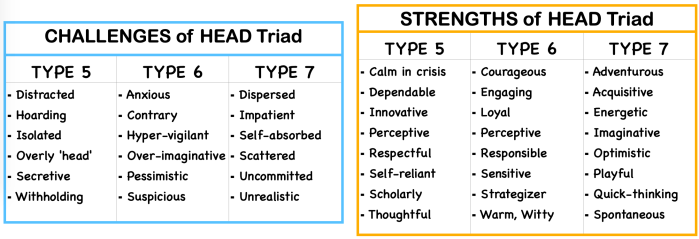
🕙 In BIZ: 567s operate from a global perspective, looking at the big picture. The use business strategies, understanding how to create value & what needs to be done to create a better future.triad 567

🤍 For Inspiration: 5s use their Heart Center / 6s use their Body Center / 7s use their Mental Center (MORE….)

5s Function – Expert Knowledge & Mental focus
Because they see the world as a scary place, preparation is the key to dealing with it. 5’s are forever in strategy mode, believing that if they could just hone their skills enough they’ll be ready for everything ‘out there.’

GROWTH: 5s can learn….. they have all the information & understanding they need to truly engage in life. With many inner resources, there’s no need to just sit by observe. When 5’s stop being the chrysalis & become the butterfly, they’re visionaries with groundbreaking insights (from PersonalityHacker)

Positive potential: acquisition of knowledge, curiosity, inventive originality, perceptiveness, technical expertise
Negative potential: eccentricity, emotional detachment, mental projections, social isolation, speculative theorizing
– Over-express thinking, mentally intense

6s Function – Perseverance & Trust
Like the 369s, they’re good at pretending there’s absolutely no reason ever to be scared. They repress an awareness of it by – being suspicious of the unfamiliar &
– surrounding themselves with safety/security systems (often in the form of people). Since they can neither trust themselves or the outside world, they can’t actually experience ‘dangers’ as fear, so they have a Janus-like quality

GROWTH: 6s can learn….. that courage is found from within, an innate capacity to trust their own judgment & take on new challenges. At their best, 6’s are what Roxanne Howe-Murphy calls “Spiritual Warriors.”

Positive potential: commitment to larger efforts, emotional bonding, group identification, industriousness, loyalty, sociability
Negative potential: ambivalence, anxiety, dependency, feelings of inferiority, rebelliousness
– Out of touch with inner Guidance

7s Function – Diverse activity & Spontaneity
The outside world is filled with fun, but inside…. there be dragons. So 7’s flee from the inner world & gorge on the outer world of pleasures and possibilities. They tend to be fun to be around – but tough to pin down. (from ‘Personality Hacker ‘)

GROWTH: 7s can learn…..that there is wonder in each moment, so no need to escape unpleasant feelings or feel trapped. Here & now is the only true freedom. Healthy 7’s inspire others with their deep gratitude & awe of the world.

Positive potential: achievement, enthusiasm, desire for change & variety, productivity, skill acquisition
Negative potential: being escapist, excessive, hyperactive, impulsive
superficial
– Under-express thinking, are impulsive without considering consequences of actions

Re. ACTIONs: The immediate response to life’s messiness is to hold back
5s physically ‘hold back’, against the far wall or in a corner, to observe the whole scene without being noticed. If they happen to be seated when something or someone new approaches, they noticeably pull back in their chair

6s
‘hold back’ by not making decisions or taking an action. When entering an unfamiliar situation – tentatively, their eyes dart around looking for someone who knows what’s going on, the “expert” who’ll show them how to act

7s
‘hold back’ in an unusual way – they run from their fear & hesitation to act by jumping into the unknown, trying to overwhelm or outmaneuver a perceived threat with charm & distraction. This buys them time to collect new info withorse therapyhout revealing anything personal that would hint at their fear

✳️
Therapy with HORSES: They have a hard time getting into their bodies in order to get what they want. It becomes obvious that they need to bring their energy & intention into their hearts & bodies, in order to make a horse move forward, draw it closer or set them a boundary. (MORE….)

MEDITATIONS ‘Thoughts’ about meditation (& some humor)
Scroll to 12/3/2012


NEXT: GUT Triads #4a

Ennea TRIAD Basics (Part 3a)

triad flowers
I NEED TO UNDERSTAND
so I can control my environment

PREVIOUS: Basic Triads, Part 2b


SECOND Triad (567) : HEAD, Mental-based character structure
#5 = Observer – – Energy: ‘Invisible’ Detachment, Hoarding
#6 = Questioner Energy: Fight 6 – Jabbing Confrontation
Agreement seeking – – – –  Flight 6 – Poised-for-flight Scanning
#7 = Adventurer Energy: Airy Excitement, Re-framing

At a party: If you stand at the door, looking around to see who’s there & what’s happening, you’re likely in the Head triad. You want to have a good idea of what to expect before going in to a new situation, approaching others cautiously.

Flow: Head-centered people think first – act and feel later. They tend to view life as outsiders looking in. Their driving ‘sin’** is fear, feeling separate from people and their environment

**”SIN” – the Enneagram comes out of a spiritual-direction tradition, so it teaches that each type has a definite sin disrupting their journey toward psychological & spiritual wholeness. In Greek it means “to miss the mark,” so it’s what makes us miss the ‘target’ in our life, which must be confronted & integrated

POSITIVE 567s notice more than other people, but don’t realize that most can’t see the same things they do, or don’t see things the same way! At their best they’re knowledgeable, intellectual & brilliant & visionary. (Bill Gates…). But caught up in the world of ideas, they can forget about the rest of the body (Shertriad 567lock Homes).

Purpose: “The goals of this center are to help us all minimize anxiety, manage potentially painful situations They want to gain a sense of certainty through the mental processes of analyzing, figuring out, envisioning, imagining & planning.

In addition, all of us depend on the HEAD Center of Intelligence to develop the higher qualities of wisdom, inner knowing & thoughtfulness.” ~ David Daniels, M.D

Physical center: Their main activity takes place in the Head, where they make decisions based either on logic on & mental processes (thinking things thru).
Also – they’re acutely aware of the environment, living very much in the present, & instinctively take everything in by physical senses (touch, taste, smell is the way to their “holy idea”) – because it gets them out of being stuck in mental loops

Priority: They want to create security by making sense of the world & other people – using ideas, concepts & rational thinking. Their most important quest is for Truth – for what’s real & what’s not.

Their implied Q is: “What does it all mean?” as they constantly try to figure out how each piece of information they’ve gathered fits in with everything else they’ve picked up. Controlling all the pieces by ‘understanding’ things makes them feel safer

Direction: 567 Types initially move away or withdraw from relationship
Key Mode: Detachment & upward displacement (away from gut)
Key Words: Assurance, Certainty, Opportunity, Predictability, Safety, Security

Basic defense: A concentration of mental energy makes it possible to detach from emotions & the body, to live in the mind. Fear of life (& death) is countered by thinking, explaining, rationalizing. Personal wants & needs are explained away or simply not felt.
Neurotic Style: Paranoid/schizoid process – distrust leads to withdrawing from contact with the world, to figure things out & feel protected.  Re. Emotion:
5s externalize their fear
6s
repress their fear, as a primary strategy
7s in
ternalize their fear inwardly

Life challenge: To integrate mind & body. They have trouble combining their inner world with the outer environment. For them – being ‘seen’ is a two-sided dilemma:
— if they get noticed, they lose their valued privacy
— if they don’t get seen they get too isolated, & feel unappreciated for all their knowledge

Much of the time they have lots of ideas & plans that never go anywhere, which tend be forgotten or go unnoticed. In business, being rigid & dogmatic in their thinking (they’re always right!) can create resentment & conflict, but they don’t know why, since they’re just being ‘reasonable’.
📌 The primary attraction / avoidance dance is trust vs. non-trust.

NEXT: Triad basics – Part 2c

Ennea TRIAD Basics (Part 2b)


PREVIOUS: Ennea TRIAD Basics (Part 2a)

SITEs: Enneagram Books & Tapes list
• Nobel books – Enneagram

QUOTE:
“Human beings are always & always will be, a frontier between what is known & what is not known.David Whyte, English poet


FIRST Triad (234): HEART, Emotion-based character structure (cont)
#2 = Sentimentalist  Energy: Aggressive Affection, Helpful
#3 = Enthusiast – – – Energy: Charismatic Producer, Successful
#4 = Romanticist – – Energy: Dramatic pull, Authentic

🕘 In BIZ: 234s are team players, communicate well with those above, below & equal to their position. They cultivate internal & external relationships, serve as role model, leading & supporting change.

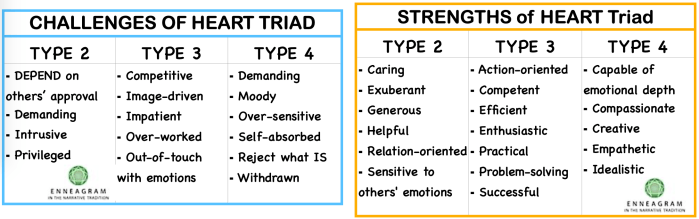
🤍 For Inspiration: 2s use their Mental Center / 3s use their Heart Center / 4s use their Body Center (MORE….)(CHART below & info From : Enneagram SingaporeScreen Shot 2016-03-13 at 10.21.04 PM

► 2s Functions – Empathy & Altruism
• Type 2s tend to be very caring for others in order to be thought well of – by everyone, so they don’t have to feel their fear of abandonment
• They create an image of being likable & needed. But they have trouble knowing their own feelings & needs. They often know or think, “There are many people that could not survive without me.”

GROWTH: 2s can learn….that getting their own needs met doesn’t mean neglecting everyone else. It is, in fact, the opposite. When the needs of the Self go unmet, the result is exhaustion & manipulation. When 2’s finally see that their own needs are neither more or less important than others, they’re sincerely generous, gracious, humble, nurturing & unconditionally loving

Positive potential: genuine self-sacrifice, generosity, other-directedness, nurturance, thoughtfulness
Negative potential – intrusiveness, possessiveness, manipulation, self-deception.

Need to do for everyone, since ‘giving of oneself’ is seen as being good
– Express & over-express only ‘positive/ happy emotions, denying or repressing the rest

3s Functions – Self-Esteem & Self-development
• Type 3s are the most out of touch with their emotions, they need positive feedback & affirmation from others.
• They find value & self-worth through accomplishment & performance. to resist feeling shame. They seek admiration of others, are very goal‐focused, tending to project an image of success

GROWTH: 3s can learn…. that they have intrinsic value. They don’t have to ‘be’ or ‘do’ anything. And since there’s already a focus on the preciousness of life, 3’s are at their best when they’re Bigger Game contributors

Positive potential: ambition, personal excellence, professional competence, self-assurance, self-improvement, social self-distinction
Negative potential: arrogant narcissism, exploitation of others, hostility, pragmatic calculation
Need for success is very strong, especially in their profession.
– Out of touch with / suppress real emotions, so they can keep functioning & to make a ‘good’ impression on others

4s Functions –  Artistic Creativity & Self-awareness
• Type 4s tend to look for reasons why they’re unique & different from others.
• They create & hold on to moods, using emotion as a way to defend against rejection. By dramatizing their losses & hurts, they avoid deeper feelings of shame, and try to draw attention & pity from others.

GROWTH: 4s can learn…. there’s richness & depth in ordinary experiences & sees beauty everywhere. They don’t have to be exotic to be unique. 4’s are at their best when moving away from emotional indulgence and toward authentically connectingto their heart (from PersonalityHacker)

Positive potential: individualism, intuition, sensitivity, self-expression, self-revelation
Negative potential: depression, self-absorption, self-consciousness, self-doubt, self-inhibition
Need / wish for recognition for their originality, & be considered special.
– Painfully self-conscious, hide true emotions by withholding direct expression

✳️
Therapy with HORSES: For HEART STYLE people, exercises done with horses usually focus on teaching them to be aware of their own emotions, to let go of their image-based defenses, & just be with the animals. 234s are usually amazed at how much awareness & control they really do have over their own responses.

MEDITATIONS for 2s, 3s & 4s (as CDs or at iTunes)
Thoughts’ about meditation (including some humor) 12/3/2012
(CHART below From : Enneagram Singapore


NEXT: HEAD Triad  #3a

Ennea TRIAD Basics (Part 2a)


ALL OF MY ENERGY
goes to looking good to others

PREVIOUS:
 Basic Triads, Part 1


FIRST Triad (234) : HEART,
Emotion-based character structure
#2 = Sentimentalist Energy: Aggressive Affection, Helpful
#3 = Enthusiast – – – Energy: Charismatic Producer, Successful
#4 = Romanticist – – Energy: Dramatic pull, Authentic

At a party: When you get to the door, what do you do?
If you walk right in, say hello & start chatting – you might belong in the Heart triad

Flow: Heart-centered people feel first – act & think later. They are very conscious of the community around them & how they’re being received.
Their driving ‘sin’ is pride – constantly engaged in image management, so they’ll be well received by others

POSITIVE 234s have flexibility & skill in relationships, achieving success by empathy – being attuned to & meeting social expectations, & sensitive to the vast potential of the human heart

Purpose: “Every Type depends on emotional intelligence to develop the higher qualities of the Heart Center, including empathy, understanding, compassion and loving-kindness.
The HEART center energy tunes us into the mood & feeling state of ourselves & others, so we can meet the vital needs for contact & approval. We can get recognition from others to help support our self-esteem, & fulfill our need for love & connection.” ~ David Daniels, M.D

Physical center is the spinal column, which allows free & comftoward othersortable movement around the outer world, to accomplish all the tasks they set for themselves. They use their energy to ‘feel’ what others want from them, so they can adapt themselves

Priority: Their relationship-needs are for recognition & approval, establishing personal identity through connecting & being seen. 234s tend to rate themselves by how others rate them – to the point of ignoring their own wishes. Their attention is so outwardly focused that it’s hard for them to access their Inner Space

CONFUSING: Actually – they’re only concerned with how they appear to themselves – keeping h image of being “good”- but it has to be through the eyes of others

Direction: 234 Types move towards others, to engage in relationship
Key Mode: Substitution of worth
Key Words: Affection, Approval, Assurance, Bonding, Certainly, Connection, Image, Love, Opportunity, Predictability

Basic defense: Their Emotional intelligence is used to form an “image self” to get recognition & approval, which helps overcome an internal sense of deficiency or emptiness. Trying to meet the expectations of others is a substitute for personal needs & wants
Neurotic Style: ‘Hysteric’ process – unconsciously building up emotional energy & then discharging it willy-nilly into the environment (over-reacting, clowning….)

Life challenge: To find the balance between Self and Other, autonomy & dependence, alots of activitycknowledging & expressing their authentic Inner state.
They tend to resist this inward turn, using many rationalizations to ‘explain’ why they can’t or don’t have time to be introspective.
Each of the 3 types will have their specific excuse, based on lack of self-esteem & emotionally hooked to the past.
Their two major themes are: Identity: “Who am I?” and
Hostility : “I hate you for not loving me in the way I want!”.

Re. Emotion 
2s externalize their shame, & create an image of good person
3s feel conflicted between feeling shame & creating an image of success
4s internalize their shame, & create an image of unique identity
“SHAME eats away at the very core of who you are, wondering if you have enough value to meet all the demands of life & love.  Without a clear answer to this question, you set out to get evidence – to prove your worth, in many unproductive & unhealthy ways. All that effort – to get something you already have.” (MORE…..)

Their Primary Instinct “To DO something” means they have a need to respond to other people or circumstances in order to stay connected.
This is true even if they’re not feeling something themselves, or don’t actually like the person or group. P.D .Ouspensky called them ‘Natural Imitators”, sometimes generating emotions they think suitable to a given situation. They create a facade for others to relate to – of like-ability (2s), success (3s) & uniqueness (4), & then become dependent on the reactions of others for their sense of value & worth.

NEXT: Heart Triad (2b)