ACoAs & TIME (Part 2)

slow timeWHY DOES EVERYTHING
take so much longer than I think??!!

PREVIOUS: ACoAs & Time (Part 1)

SITEs :  Kids, ADHD & Time
✦ Time Management Tips

Take back control of your time

QUOTEs : “Your time is limited, so don’t waste it living someone else’s life.” ~ Steve Jobs
❥ “Until you value yourself, you won’t value your time. Until you value your time, you will not do anything with it.” ~ M Scott Peck
⌛️  ⏰   🕔
1. Lost Time and 2. Wasted Time  (Part 1)

3. REQUIRED TIME
a. Much more time than something should normally take
Our damage makes any action an insurmountable project. ACoAs will put off taking actions because WE :
• are convinced it’ll take forever. Whether a task is it’s a big or small, we:
a– don’t divide it into manageable chunks, –b– don’t have an realistic time sense & –c– hate the slowness of process
WE
• have to obey the rule “No play ‘till all your work is done” which of course will never happen, so we go on strike instead, & do nothing!
• have to obey the rule “You have to struggle but never get there” so why start?stuck in time
• (think we) don’t know how, & can’t ask for help, so why bother?
AND
• we’re afraid of making the wrong choice, & the get punished or be terribly disappointed – again
• we can’t decide what to do first – everything is equally big, important, scary… because as a kid the same amount of emphasis was put on large or small events, mistakes, tasks… so we never learned to prioritize

▪️ re. ACTIONS – While these reasons are ‘hangovers’ from childhood, the root of the procrastination is our inner conflict now, between:
• what we want & what the Introject (PP) wants or won’t allow (or with others in the present)
• our damaged part (WIC) & the emerging Healthy Adult voice

These internal arguments have to be resolved by the ‘UNIT in order to proceed. The exciting thing is that when the WIC is on the same page with the Healthy Self, we find that many actions take very little time, are not a big deal AND we actually did know how. No conflict = No delay!

T.E.A. suggestions
Thoughts: write out the opposing points of view (sometimes 3 & 4 different ones) of the argument you’re having with yourself about a situation you’re stuck on
Emotions: list the emotions related to each ‘voice’- they can be different

Actions: identify the actions you want or need to take, & what you think the results will be, depending on the voice you decide to follow
✍️ Actually try out which ever side you choose (As) & then later write down the results. Evaluate (T) the outcome & see how it feels (Es).
This is “Bookending” & is very effective
✍️ You can also use the 2 forms on the post “Why Are You Stuck?

b. Much less time than is realistic
In this care we consistently underestimate how much time is needed to get something done. This can come from unreliable people we have to depend on, who give up inaccurate time-estimates,  but mostly from our own unrealistic expectations.
This relates to the ACoAs who:
♦︎ always over-book, plan things too close together, don’t allow enough time to get places or time for possible delays – and don’t allow for process…
Like: underestimate how long it takes for – a renovation, a doctor visit, to taking a trip, developing a friendship, waiting for a delivery, a check, an email or the return of a text! (it pushes our Abandonment button)
OR
♦︎ those of us who try to do several things at one time. This is not about multi-tasking, but rather expecting, magically, to be able to be in more than one place at a time
Like: attending 2 conflicting events, such as making plans to go shopping alone and having lunch with a friend – at about the same time!
—> not doing things consecutively, OR picking one & letting the other go.
It’s one of the reasons some ACoAs are habitually late (cont. in Part 3)

NEXT: ACoAs & Time (Part 3)

“FEELINGS AREN’T FACTS” (Part 2)

heart talkWHEN THE HEART TALKS….
… I should listen

PREVIOUS
: “Feelings aren’t facts” (#1)

SITEs: • How to listen to the heart
• Diff between feel, think, believe

POSTs : Use THINK instead of Feel


1. FEELINGS (Part 1)
2. ‘FACTS’:  The other problem with this platitude is that these 2 words don’t really belong together (feelings & facts).
a. Facts – are only actions, quantifiable, with measurable results. Simplified – facts come from the head.
b. Feelings – as pointed out in Part 1, has 3 different uses, 2 legit, 1 not.

For people who use this term – ‘feelings’ means Emotions (Es) and Es are never ‘facts’ – they are internal experiences – from the gut.  Yes, it’s a fact that we have emotions. Even Vulcans have those pesky things, underneath. For humans, to be cut off from them turn us into narcissists or worse – sociopaths!

• Eventually someone in Al-Anon added what they thought was a clarification: “Feelings aren’t facts, but it’s a fact that I’m having these feelings”.  OK – this does refer to Emotions. This was encouraging for many of us to hear, because as CoAs we were taught to repress some or all Es – to deny them as irrelevant or unacceptable.  So this version gave permission to FEEL emotions.
But this is not what the phrase “Feelings aren’t facts” actually means.
circular

c. Thoughts (Ts) are not technically facts either, but rather ‘constructs’ of the mind – not tangible in themselves. They are:
• the cause of emotions (in the present) :
EXP : T ⏩ “I can’t believe she never called me back. What a b— I’m so angry!” ⏪ E
Unrealistic expectations, cruel toxic rules, scary projections, unfounded assumptions & S-H … lead to distorted thinking & obsessions, which cause us great suffering, & often lead to unfair or harmful actions toward others!
OR
• the cause of actions, healthy or unhealthy, depending on the type (may not be conscious, but the real reason for behavior)
✒︎ NOTE : Watch out for people who ONLY talk about what they or other people are doing, where they’ve been, who they know, what they’ve accomplished…. Facts, facts, facts!  That tells us they’re NOT in touch with their emotions, which makes them unsafe in relationships, for anything other than giving information – if that!

CONCLUSION: Based of these distinctions, what does “Feelings are facts” really mean?
ANS: In this case ‘Feelings’ are obsessions, circular repetitive thinking built on negative, distorted beliefs, and NOT emotions at all! which are not telling us the truth (facts) about a situation.”
✒︎ In other words : “What my obsession is telling me is most likely a lie.”

And what do most ACoAs endlessly obsess about ? :
bad thoughts☁︎ EITHER Self-Hate
”I don’t know why he won’t talk to me – why is she ignoring me – was it something I said? Maybe I should have been nicer to her.  I probably sat in the wrong chair… I know he doesn’t like me… what can I do to change their mind… “  –  bla, bla, bla….
OR
👺 Rageful thoughts towards others
“How dare she treat me like that… Why didn’t he call me…. I never did anything to her… I’m going to give her a piece of my mind… I hate her, she’s a witch…. no I’d better not… what should I say… I don’t want to get fired…”  grrrrr , grrrrr

❖ Healthy THINKING is imperative for us to function well in the world & in personal relationships. This requires :
• accurate, reasonable & present-day information about how everything really work   • what our needs, goals & dreams are
• what is positive about oneself (character & abilities)
• what it means to be human (determined, imperfect) images-4
• universal spiritual truths about Higher Power.

EXRESS  thoughts
, opinions & beliefs, directly:
• “I think that the government should…”
• “That’s not my opinion”   •   “I wouldn’t say that…”
• “I suspect he’s not going to honor his agreement”
• “I’m convinced there’s a better way to do this project”

❖ Healthy EMOTIONS are NEVER good or bad, but rather range from the very painful <———–0————> to the very joyful.  ‘0’ is neutral.
✒︎ We’re most successful & comfortable when we live within a range of +5 to -5 on either side of center, most of the time, although not exclusively. Times of great stress OR great joy will push the range much higher or lower, but not get stuck at either extreme.
☆ This medium state can only happen when healing diminishes accumulated anxiety so we don’t have to alternate between the ‘outer limits’ of misery or fantasy/illusion!
(REVIEW all posts on Emotions)

NEXT: Getting to Our EMOTIONS – Under

ACoAs: Deserving vs. Rights (Part 1)

Screen Shot 2015-07-10 at 5.43.38 AM

PREVIOUS: My Rights Qs, 25-48

Posts: “Self-Hate & ACoAs
•“People should treat me better, but….”

SITE: Restructuring life in recovery


DEF. of ‘Deserving’
⚙︎ Receiving something – good or bad – which you’ve earned, based on your actions.  It always carries a sense of balance or justice.
🌹This is why we can not deserve love, because we can not earn it. It is either given freely or not.

REPEAT : “I cannot earn love!” – a hard concept for ACoAs to believe, based on our childhood – since ‘being loved / accepted / approved of’ was conditional. BAD PARENT : “Do what I want, or else.”

1. The PROBLEM of NOT deserving
a. Family
In dysfunctional families ‘deserving’ ONLY refers to earning their acceptance. The adults who raised us did not feel worthy which was rigidly held in place by their low self-esteem (S-H), depression & deprivation mentality — so could not model deserving for us
b. Spiritual
Many religions teach us to feel ashamed, guilty & unworthy. Rigid non-Biblical teachings instill guilt, & control by fear. Anyone from a fundamentalist faith was taught that because we were born in sin “we are not worthy” of God’s love, period.  We are bad, bad, bad! This dogma is used to control & discipline children, & keep the ‘faithful’ in line.

✶ What’s left out of these teaching is the KEY to the message: God has given the world many gifts, first & foremost salvation from eternal separation from Him in the afterlife, in spite of our imperfections  ( John 3:16 & commentary)

NOTE : AA Steps 2 & 3  ” Came to believe that a Power greater than ourselves could restore us to sanity. ” “Made a decision to turn our will and our lives over to the care of God as we understood Him”

The definition of ‘grace’ is unmerited favor – being given what we don’t deserve & cannot earn! (“A Bridge to Life & Bible verses)
We did not & cannot EARN grace or any of life’s benefits & beauty – they’re simply here for us to enjoy & partake of! Enjoy the lyrics to “Amazing Grace”,  a hymn universally beloved even by the non-religious.

🙆‍♀️ Too many people no longer consciously agree with the concept of original sin, BUT whatever our personal belief is now – as long as we live in deprivation – we’re agreeing with the introjected bad voice that keeps us trapped in a culture that has perverted the accurate meaning of spiritual teaching.

🙎🏽‍♀️ Some of us were not raised in any specific faith, so our sense of unworthiness would have more directly developed from unhappy & cruel interactions with parents & community.

2. ACoA DAMAGE
IMP: Parents are either capable or not capable of providing acceptance, love, compassion & validation – which has nothing to do with the personality, behavior, or gender of the child.
AGAIN: Love cannot be earned – it’s either given freely or not. And our family either did not at all – or only conditionally! We were taught by family & religion to feel UNdeserving of all kinds of good things.
Instead, we still believe that :
• asking for what we want & need is ‘selfish, sinful, arrogant, childish’…..
• other people (sometimes siblings) are definitely allowed to have good things – but not us, especially if we were scapegoated in our family
• we don’t even deserve to be alive, which we concluded —
— indirectly by being constantly ignored, put down & criticized, or
— directly from the messages about how they felt:  “You’ll be the death of me yet , Why did I have to have a kid like you , I never wanted kids anyway , You’re killing your mother/ father, You ruined my life”….

• ALSO – we’re afraid to improve ourself & our circumstances – beyond what our parents are or have accomplished, as if it would somehow diminish them (show them up).
» That would be breaking our symbiotic bond with them & no longer taking responsibility for their life-choices.
✒︎ Actually, healthy parents (& many immigrants) want the opposite – for their kids to do better than themselves & be the very best they’re capable of!

ACoAs DON’T DESERVE
 the BASICS – TO: CONTROL-ABOUT ME
• be ourself, have clear & strong opinions
• be talented, funny, creative, imaginative, intuitive
• be competent, functional, clever
• be appropriately visible, take our own center stage
• feel safe, respected as a person & for our ideas
• have all of our emotions, without judgement
• have & maintain our boundaries, & say ‘no!’ if needed
• shine, get attention, admiration, recognition, complements

NEXT: ‘Deserving’ vs. Having Rights (Part 2)

ACoAs: Healthy RULES (Part 2)

Snever give up
YEAH. I WANT TO FEEL SAFE! — Will you take care of me, Good Parent?

PREVIOUS: HEALTHY RIGHTS (#1)

SITE: How To Never Give Up On… (CHART)


HEALTHY RULES
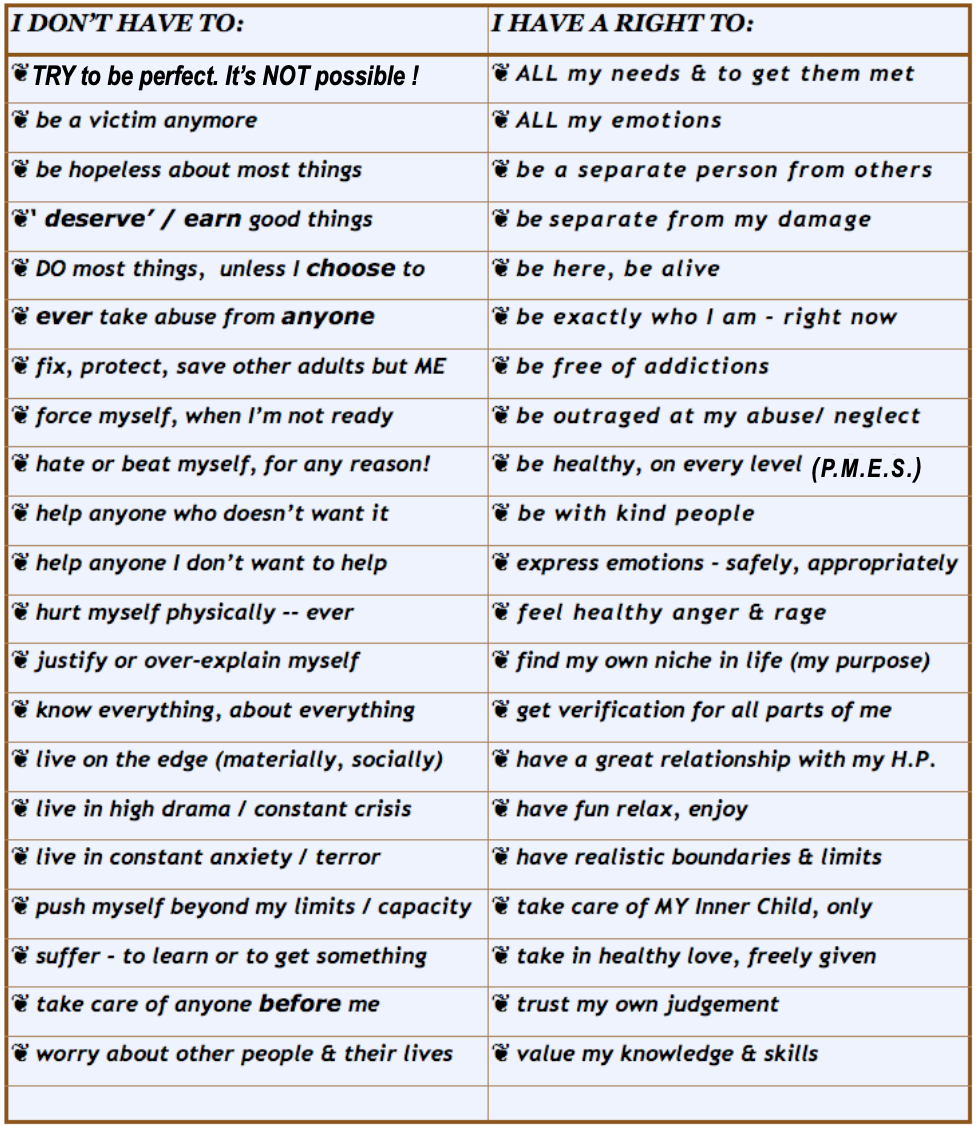
Part 2 & 3 list statement that have been accumulated from years of Recovery experience. They’re geared to the Healthy Adult / Loving Parent parts of our higher self – so we can know how to take care of our wounded and healthy Inner Children, in the best possible ways.

❀ YES, we have a broken heart!  What’s more painful to a child than not feeling loved by their parents?   BUT NOW – to be happy, we need to:
• accept who our family really was & is
• believe in every fiber that we did not cause our abuse & neglect
• accept that now we’re individually responsible for our life
• know that we have the ability to outgrow much of the damage, but not all completely
• consistently apply mental health truths to our life

❀ We all live by rules, whether we like to admit it or not.
• Some ACoAs were so neglected they think they weren’t taught any rules.  No, not good ones, but we did pick up all the Toxic Rules!
• Others of us were so constricted by rules & regulations, we nearly choked to death on them.
In either case we tend to shy away from rules, or have a raging hatred for them. And yet we are run by the bad ones, as long as they stay hidden and we don’t challenge them.

❀ So here are a few Healthy Rules to try out & apply to our every-day living.
Think about each one, carefully.
Pick one & try it out for a month. See what happens. Then try another….
«

«
NEXT : Healthy Rules & Lessons, #3

ACoAs: Healthy RULES / RIGHTS (Part 1)

JUST THINK, I COULD’A HAD A ….
no, not a V-8! …a lot of Love!

PREVIOUS: Toxic Family  Rules


Q:
What is the one & only source of self-esteem?
A:  Unconditional LOVE (acceptance, regard, respect, mirroring…)

EARLY: Heard a million times or not, it’s not trivial or a platitude
• The child’s brain develops its pathways using repeated experiences. If those experiences are disparaging, punitive, painful, limiting – then that becomes the norm for us when an adult
• Children look to their parents to tell them who they are and how they should act (guidance & mirroring). If the messages are negative, then the child’s self-image will be negative

Healthy Parental Love… (acoa website SiteMap, pgs 4, 18, 33, 62)
… does not mean giving the child everything it wants. Boundaries are imperative!
… doesn’t mean sacrificing everything for the child.  Kids need to see parents having a well-functioning life of their own which they can emulate
…. is provided by a ‘good enough’ parent, not a perfect one. Kids need to know they too don’t have to be perfect. Unconditional love is unconditional, not idealistic

NOW: Since ACoAs can’t change how we were raised –
• It’s not easy to change the old messages because we have to form new brain pathways, & the old ones are very deeply etched. That’s why repetition is so important
• We need to find all the possible ways to develop self-esteem
BOOK:Compassion & Self-Hate” ∼   Dr.T.Rubin

• The most successful way for us to change is to learn how to communicate with & comfort the WIC, becoming the Loving Parent & Healthy Adult most of us never had (the “UNIT)
BOOK: Recovery of Your Inner Child” ∼ Lucia Capacchione

 2-way conversations with the IC needs to be daily! It doesn’t have to be complicated or clever. Do you only talk to people you live with (have lived with) once every few months?
• At first you may find yourself very resistant, making excuses, think you can’t…. Yes – it’s a new language, & like learning any new language, it takes time, practice & more practice.  Don’t let the Negative Introject stop you from creating a better life

EFFECTIVE:
• The statements listed are sometimes called affirmations or mantra. ACoAs who are comfortable with the familiar ones – can use them if they resonate, since they ARE true. Whatever works to heal is valuablecomfort the kid
• However, many of us have heard platitudes from family, relative, school, religious communities, school… which didn’t mean much then because they weren’t backed up by ‘right-action’. They were substitutes for genuine communication & genuine emotional connections

• That’s why some ACoAs are frustrated with pre-packaged affirmations, since they don’t address our specific experiences & personality. We were SO unseen & unheard that now we have a desperate need for all communication to be accurate – down to the smallest word! – called “exquisite empathy”
We may prefer to create our own sayings, in exact response to the negative voice & which represent genuine caring for the WIC

• Keep in mind our IC is very smart, & won’t tolerate b.s. Don’t say: “I’ll always take care of you… be there for you… every thing’s going to be alright…” and then forget to talk to the kid for the next weeks or months, let the Bad Parent take over, not take proper care of yourself, let others walk all over you or keep on people-pleasing…. !
You must become trustworthy for the IC to listen & believe you!

EXERCISE:  Write out one of your Toxic Beliefs
• Then create as many counter statements as fit.
Put it aside, sleep on it, & go back the next day (or when you can), & see if you agree with your ideas, or have come up with others.
• If you’re completely stuck, ask someone safe for options. Sometimes watching how good parents on TV talk to their kids – can be good models.
BUT – try it out on yourself first.

EXP: Neg from WIC  – “ I can’t do anything right!”
Pos from Good Parent – “You / we can do some things very well, somethings so-so & some not at all.  If you want to know how to do X we can try to learn it. OK, Little One?”
Ask yourself & the IC:  “What would you have liked to hear back then – & now?”
«

«
NEXT:  Healthy Rules (Part 2)

ACoA : TOXIC Family RULES

Screen Shot 2015-07-09 at 12.10.53 PMTHEY DESIGNED MY STRAIGHT JACKET –
I’m gonna need some help getting it off!

PREVIOUS: Healthy Helping (Part 2)

SITE: Dysfunctional Family (Wikipedia)


RULES: No matter what our family environment looked like, all ACoAs have gathered a litany of TOXIC RULES, which we follow ‘religiously’, even well into Recovery – but hopefully less so with growth!

We absorbed these Toxic Rules from family, school, our community, religion…. They are the underlying beliefs the WIC is absolutely convinced are the absolute ‘truth’ which we are obligated to obey – on pain of death (abandonment)- even if we disagree or hate them. Notice the contradiction & conflict. No wonder we say we’re confused!

The BE and DON’T lists are the short forms, & just mirror opposites. Below are the expanded ones.  This is by no means complete. Each of us can have variations or additions.

INVENTORY: How do we know what our rules are?
a. Overview
As you read thru these lists – notice the ones that hit you the strongest. If you’re new-ish to recovery you may not recognize that you have more of them than you first think. Still confused?
✶ Ask yourself, & then siblings, mate, friends, therapist … for suggestions

✶ Do a Life Inventory, in 3-5 yr increments, listing all the major events you can remember – things that were important, relationships, when you started & stopped things, schools, moves, births, deaths …. choices made, opportunities we didn’t take…..
12065669231219144528Anonymous_work_in_progress.svg.med— Don’t go into detail. Just list things in one sentence each
— Notice the recurring themes, patterns, avoidances… What good things are missing?
— Ask : which toxic rules might your patterns represent?

b. Details
• Pick any one of the phrases that rings a bell & write what comes up.
— Where did you learn this? Who in your family exemplified it?
— How do you act it out in your life?
— How do your friends, lovers, bosses… express it?

• Take it very slow. Spread this exercise out over months & years, if needed. Maybe just write a little & go back to it when you have more info about yourself & your history
GOAL:

• See the toxic family rules you’ve been following – so clearly – that you won’t be fooled any longer into thinking they’re legitimate!
• Slowly disobey them by changing your behavior, an action at a time, a day at a time.

In the beginning – when you do some inventorying – you’re likely to feel fear & guilt. Those emotions prove you’re doing the right thing for your healing. Don’t give up!
• To orient yourself toward healthier goals –  pick out some Healthy Rules that fit your situation, & mindfully, deliberately, use one or more as often as you can (every day, a little?)

✶✶ Breaking family rules can create a lot of anxiety, as the Negative Introject will try to guilt you into returning to the fold – like good sheep.
So the work must be a slow & gentle but with steady process – with lots of support (Al-Anon as one of many resources)

If you read many other posts on this blog, you’ll see references to “Toxic Rules” over & over, so this post will give you a context for thinking about all the other topics & as you work with them. (Post: “Why Are You Stuck?“) .

«
NEXT : Healthy
Rules, #1

‘Controlling’ & Abandonment (Part 1)

baby controling I NEVER GOT WHAT I NEEDED –
so now I force it out of others!

PREVIOUS: Satir’sDISTRACTER Role


SEE
 Acronym PAGE for abbrev.


ABANDONMENT (A.) as SOURCE of Control Issues

• To understand being controlled or acting controlling, we have to know the underpinnings, which come from our original abandonment experiences.  In common usage, a person is said to be A. when someone physically leaves us – moving away, a break-up, divorce, long or repeated hospitalizations, death…..

However, based on ACoA experience we know this definition is too limited. When we observe little kids – ours or others’ – we notice how very needy they are.  This is perfectly normal, in spite of what we ACoAs were told growing up = that we were too much, too selfish, a bother, too sensitive, dramatic …. We got the clear message that at best we were being tolerated!

• A broader & more accurate definition of Abandonment (A.) is: “Not getting enough of our normal needs met in childhood”.  This includes all needs on each of the 4 levels of PMES – Physical, Mental, Emotional & Spiritual. We can also say that A. includes not being loved unconditionally, with the resulting loss of genuine connection to parents so crucial to a child’s sense of well-being & safety.sad/scared

• Picture all children as having 100 different needs in each of the PMES categories (total 400 – an arbitrary number, as example). Then consider the reality that in a severely dysfunctional family each kid only gets a small percentage of those needs met – just enough to survive. Of course some of us got more, while others didn’t even get that much & have died too young as a result!

Depending on birth order, gender & personality,  different siblings received differing amounts in each category. Certain children are favored because their ‘native’ style is similar to the parent, or rejected by the narcissists because the child was not like them!
But over all, most of us were only provided with 30 – 40% of our normal human needs – when we were the most fragile & in need of great care.

EXP: A pathological narcissist “mentally-oriented” father who incested each of his children in varying degrees, (4 boys & 1 girl) was slightly less abusive towards the one child who was also “mentally-oriented”.  This son is the only sibling who was able to forge a decent life for himself (as a doctor), but not without emotional scars. The others became addicts, severe under-achievers &/or criminals.

• With no validation & nowhere to process the emotional pain, it all goes underground & slowly eats away at us.   Toxic Beliefs then get ingrained.
As adults – these distorted rules combined with a great backlog of unmet needs –  has left us with an overwhelming desperation to be ‘fed’ by someone, anyone, along with the deep hopelessness of it ever happening. Pretending we don’t have needs, or suppressing our awareness of them does not make them go away. (Post: “Vicious cycle re needs“)

shadow sideSHADOW : To survive & not ‘go crazy”, many of those ignored childhood requirements get pushed into our ‘shadow’ – made up of every part of ourself that we were taught were so awful – so we have to deny their very existence.

In Jungian psychology the shadow aspect is a part of the unconscious mind consisting of repressed weaknesses, instincts & shortcomings…. “Everyone carries a shadow, & the less it is embodied in the individual’s conscious life, the blacker & denser it is.
It may be (in part) one’s link to more primitive animal instincts, which are superseded during early childhood by the conscious mind” (Jung-Myers Model + A Case Study & chart)

➼ Unfortunately for us, ACoAs not only relegate our ‘unpleasant’ aspects (such as the ‘7 Deadly Sins’) to Shadow, but also many of our good qualities – anything that was not allowed in our family!

We become so terrified of these aspects & activities, that we use a wide variety of defenses & addictions to keep them hidden.  But the more we suppress legitimate needs the more anxiety builds. Sooner or later they leak out or erupt in distorted ways, like being clingy, ‘invisible’, manipulative, irresponsible, vague, needy….. AND/ OR controlling, mean, demanding, domineering, promiscuous, pushy…
Sad IRONY: The more we suppress – the needier (& meaner) we get!

NEXT: Controlling & A. (Part 2)

ACoAs & Emotions (Part 3)

clean out old Es I JUST WANT TO BE HAPPY
but first I have to clean out the damage

PREVIOUS: ACoAs & Emotions #2

SITE: Help for Emotional Reactivity


WHY DO WE HATE having emotions so-o-o much? (cont)
b. OVER-REACTIONS 
(cont)
🦠 This is 
not self-indulgence or being manipulative, but rather:
1. Sensitivity = a person’s brain being wired to be intensely affected by  external cues, with nerve endings exposed & raw, causing out of control Es triggered by :
— the threat of or proof that a relationship is about to dissolve
— being told they can’t have something they badly want or are convinced they need
2
. Reactivity = having a reactive ‘higher baseline”, 0-20 vs a continual 80 out of 100 – so sadness is experienced as overwhelming despair, anger becomes rage….. and behavior is also intense & doesn’t fit the actual present situation
3. SLOW return to baseline = having a hard time calming down & staying upset longer than someone with a safer upbringing (an
emotion fires in the brain for around 12 sec. vs 20% longer)

EXP: You’re in the middle of working on a project & someone keeps trying to control how you’re doing it. You get angrier & angrier**, since you interpret their ‘directions’ as proof you’re not doing it right & so aren’t good enough – not just your work but as a person!
✶ This anger is caused by S-H.

ASK : “What does this reaction tell me about my damage?” – instead of just raging at the other person (in your head) & wanting to smash their face in
Ans: Some deep part still believes I’m so bad that I have to be perfect, to compensate, BUT since I can’t be, I hate you for exposing me, & it means I’ll never be loved!
not me• Yes, we are responsible for our behavior & attitudes.  But we also need to remember that HOW people treat us ALWAYS tells us about them. When their treatment is insensitive or mean it’s coming from their inner PP &/or WIC . Very few have a L.P. even when they have a functioning H.A. in the UNIT)

Their behavior tells us about their inner world, even if we made a mistake. So we don’t have to take responsibility for or try to fix our personality, only our actions – IF appropriate or possible!
In any case – OUR WIC desperately needs a hug & a mental course correction – modifying the CD of Perfectionism. If we do that every time – much of the anger will dissipate, even if the other person is still being a big pain!

CHECKLIST
ACoAs are often CONFUSED, because
• we combine Es with thoughts/ beliefs, usually Toxic one, because we use the word “feel” to mean both (“Use THINK instead of FEEL posts)

• of our conflicting Es: old vs. current, WIC vs Adult, PP vs Adult…
• mix up Es with normal human needs, which we’re deeply ashamed of
• don’t know our RIGHTS or what ‘normal’ is, much less have permission to act on them

1. Which Toxic Rule is in play? (all have turned into self-destructive toxic rules
behavior patterns, also called character defects)
Exp: “If I don’t like it, I have to stay” becomes passivity
2. Which of my WIC’s unmet needs am I re-experiencing?
Exp: Constantly ignored or punished for trying to get attention

3. What am I thinking about this situation?
Exp: “They’re never going to call / write back / I’m unlovable…..”
4. Which of my old buttons is getting activated? — an emotional sore spot from things your family & others consistently did to you &/or to each other – that hurt you  Exp: Being accused wrongly / being shushed

5. Which ego state is likely in charge at the moment (WIC or PP) ?
6. If I’m acting out, which parent am I copying & how?
7. What am I most afraid of in this situation? (FoA, punishment, isolation, not being heard…)
➼ Use the info in other posts to help you answer.

NEXT: ACoAs &  Emotions #4

ACoA EMOTIONS re. Painful Events (Part 1)

  notice feelingsI DON’T WANNA FEEL!
besides, I’m not supposed to

PREVIOUS: CONCLUSIONS re. painful Events (2c)


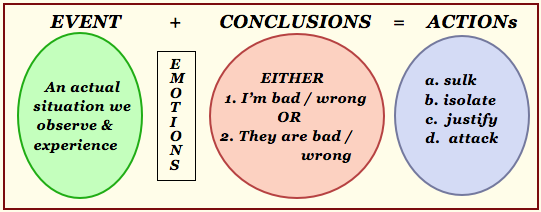
Q: So – what’s being ignored in this CHART’s equation ⬇️ ? (E + C = A):  ANS: our EMOTIONS! 


Each EVENT (green oval) that upsets us generates several emotions. We can
• be very upset (anxiety or rage) without ‘hearing’ the thoughts behind it (pink circle), OR
• only have ‘squirl-in-a-cage’ mentality (pink) without connecting it to emotions underneath (blank), and
• often not even connect our reaction to an Event (green) that set off the obsession!

Even though something or someone has hurt us, we minimize or deny it. We may not be clear what emotions come up because of a stressful Event, but we certainly don’t want to focus on them. Think T.Cause & EffectE.A. Without doing FoO & emotion-release work, we act out** those Es by:
🌀 constantly complaining, dissociating, districting ourselves, endless worry, (T), forgetting an important appointment (A), getting sick, verbally attacking someone / anyone (T), or just being paralyzed

** ACTing OUT : compulsive behavior (A) (action or non-action) which expresses emotions not consciously experienced at the time

ACoAs were taught from infancy to negate or suppress our Es, especially any that weren’t acceptable in our original home.
⚒ for some – anger/ rage was the norm
⚒ for others – only being emotionally UP was allowed! And,
⚒ for many – having no emotions was the absolute rule – “DON’T FEEL”

So, what Emotions should we be aware of, when something affects us?
If the WIC is the one reacting to an Event, we’re likely to feel the same ones we had as kids – only more intensely, because of accumulation. That’s ok – it gives us important info about our past

What’s important is allowing ourselves to have the feeling, understand what button is being triggered, comfort the WIC, AND practice healthier ways to behave that will benefit us

Re. NEGATIVE THINKING (Parts 1a-b and 2 a-c)
ACoAs are not usually in touch with what’s hiding behind the screen of negative self-talk (pink circle). These underlying emotions (Es) fit into the space between ‘Event’ & ‘Conclusion’ on the chart.

They remain invisible to the person in the grip of a regression – which is when we’re automatically thrown back into our traumatic past, as if we’re still a powerless child in a scary family

Being regressed in the present means the Event touched a hot button of damage that’s still raw.  So when anything or anyone bumps up against a particular wound formed back then, we react with intense anxiety or rage, such as when we’re being:
• ignored, not responded to right away, waiting too long
• accused wrongly – of anything
• stood up, or being let down (we take people too literally!)
• controlled (told what to do)….

EXP: If you’re walking around with a physical sore that’s very painful but not visible, and someone accidentally pushes hard against you in rush hour, aggravating the ache, how do you react?
ACoAs will typically – go into a rage at the person and the whole world, OR apologize to them, OR feel sorry for ourselves, sulk & wonder why this is happening to me!

• The same kind of intensity to certain Events are emotional over-reactions (“If it’s hysterical, it’s historical”). We really hate to be told this, because it sounds like our experience & pain is being negated – just like at home!  This is NOT what is meant.
❥ We can tell the difference by checking our level of awareness when an unwounded part of us is bumped into – we barely notice, or we don’t mind, or just don’t care

• Yes, unpleasant encounters do cause us pain, but it’s often out of proportion to the situation. Any intense reaction to normal, imperfect human situations (not pleasant BUT not really awful) comes from our Wounded Inner Child —
who is not actually living in ‘present time’, has unhealed emotional wounds, is still taking things personally, feels unloved & unprotected – at least about that particular issue.

NEXT: ‘ReACTing Negatively to Events’

ACoA CONCLUSIONS re. Painful Events (Part 1a)

Screen Shot 2015-06-20 at 6.14.39 PM
I’M SUCH A FAILURE!
I can’t get anything right

PREVIOUSNoticing Painful Events  (Part 2)

REVIEW posts : “What just happened

REMINDER: See ACRONYM page for abbrev.


1. EVENTS – the Stimulus

2. CONCLUSIONS (our THINKING)
Here is another use of T.E.A. (Thought, Emotions & Actions ). The middle circle (in pink) is about how we mentally (Ts) assess or try to explain any event that’s upsetting.
🙄 A common reaction is to ‘be in our head“, endlessly obsessing, without ever understanding the situation (T) or resolving it appropriately (A).
REMEMBER – “crazy” is mental (what we think / believe), not emotional

Most ACoAs grow up convinced we’re crazy!  We say we feel crazy, or that we’re going crazy, or we afraid of being crazy.
Well, most ACoAs are NOT, but we came to believe it because – while our emotions & observations told us that a lot was seriously wrong with family, school, church….
the grown-ups kept telling us our opinions were way off base, & anyway we were the problemCause & Effect

Reminder: ‘Painful events’ may be situations that :
a. are accidental, because people are just busy or preoccupied
b. we run into in the course of everyday living (rudeness, ignorance, delays…)
c. are genuinely insulting, shaming or otherwise abusive

We can instantly react (As), out of our conscious control  = yelling, sulking, blaming….. or just spend all our time worrying.
If we pay attention, those reactions will give us an idea of what we’re actually thinking.
HINT – that the painful event is :
💦ONLY /all about ME, & we’re the Victim (V), creating FEAR , OR
🔩ONLY /all about the OTHER person, as Perpetrator (P), creating our ANGER

💦 IT’S ALL ME – It’s my fault, I’m bad, dumb, weak, lazy….
• Whenever ACoAs experience a painful event or loss we try to make sense of it. The WIC always thinks they’re the source or cause – that we should have been able to prevent it.
The Adult in us may know this is not true. Others are also not in control of every outcome, but they are responsible for their beliefs, decisions & actions (not us), whether they acknowledge it or not

EXP:  It’s sad to think of JFK Jr. – his very bad decision to fly with a broken leg, without a co-pilot or auto-pilot, in predicted bad weather – ended in disaster. Accident? Yes, but his unwise choices contributed.

• ALL ACoAs start out from this premise (Self-Hate) & then layer it over with a variety of defenses. When something doesn’t work out, or someone hurts us / ignores us / leaves us…. we try to analyze what we did wrong & how we can fix it. We obsess for days, sometimes years about a painful situation, always from self-blame.

➼ Unhealed ACoAs have a wide streak of narcissism – mainly in the form of: EVERYTHING IS ABOUT ME!  but you may be saying “What, it’s not??”
It’s our default position, & continues as long as the WIC is in charge of our life.

EXP:  Extrovert Maria is in a night-school computer class with 6 other adults, 5 men & one other woman. Maria glances at her several times, hoping to connect, but the woman blatantly ignores her. Maria’s not just disappointed, she’s hurt. There’s a pain in her gut: “Nobody likes me!”

EXP:  Felicia was in great distress. She’d invited her family to visit her at college, so they drove down to see her. On their way another car plowed into them, causing a huge accident & her brother was killed. That was enough of a heart breaker – but her CD added to it. She kept saying: ”If only I hadn’t asked them to visit, he’d still be alive!” – tortured by thinking she has that kind of power

REALITY: There are times when we have made a wrong choice, but self-abuse does not help us learn from the error or improve our options in the future. S-H is a lie & therefore SELF-DEFEATING. It’s based on a false sense of power, but it’s still false.

Once the UNIT kicks in, that perspective greatly diminishes. There’s a big difference between believing we’re responsible for everything (grandiosity) vs being appropriately responsible for our T.E.A.s

NEXT: CONCLUSIONS  (Part 1b)