What Others Think of Me is None of My Business (#1)

LONELY CREATURES
We’re all social animals, but also need privacy

PREVIOUS: Safe & Unsafe People

REMINDER: See ACRONYM page for abbrev.

NOTE: Many people in the mental health field, spiritual practices & new-age wisdom say we shouldn’t worry about what others think of us. Yes, OK, but it’s not that simple! What they don’t tell you is that there’s 2 different aspects, the negative & the positive.

1. DAMAGE (ACoA version) – for anyone with limited self-esteem / S-H, there’s always the assumption that other people don’t like us – it’s our default position & hard to let go of.  And that has 2 parts too! Doesn’t everything?  AH, Dualism!  I can’t help it – I’m a 22/4 with an 8 Destiny. I see both sides – ‘now’. 🙂 Anyway…

a. Awkward (lame, a “drip”? —>)akward
• If we’re obnoxious, angry, childish, clingy, lazy, needy, selfish, un-groomed, or say lots of dumb things – OR just full of negativity & self-doubt, then most people will not like us!

• If we care, these problems can be worked on – if we have the courage, right kind of help & willingness to deal with the pain, sadness & fear that’s at the root all our ‘shortcomings’

• If we don’t care, or the resistance is too great to get past, the external signs & internal causes never get corrected. A great loss for us as individual & to society, but each has their own path.

b. Isolators: Some ACoAs (not about Extroverts / Introverts)
isolate• hide out because of some physical or mental disorder
• but mostly it’s from — Fear, Lack of good Boundaries & Self-hate : wounded souls who need lots of love but aren’t allowed to let it in, even when it’s available. They blame themself for everything that goes wrong. They ‘don’t belong’

• At the other extreme are those wounded ACoAs who are always angry,  complaining, dissatisfied & think they’re superior. They push others away & lose out. They have S-H too, but their whole focus is outside of themself, blaming everyone else for their troubles

c. Acceptable:  Most of us are not social misfits –
• we have an education, jobs, mates, maybe children & some outside interest. YET we think everyone is going to judge us harshly, find out we’re frauds, see  all our flaws… later if not sooner, especially if they get to know usbeing udged

• that’s straightforward Projection onto others of – how our parents treated us & now, our self-judgement

also, it’s Mind-reading (a CD). We’re sure we know what others are thinking – especially about us, & it’s always negative. That’s ACoA grandiosity.  Stay out of other people’s heads!
• Sadly, even when others like us, love, admire & laud us – we have a hard time believing it, don’t trust it, get embarrassed, tell them why it’s not true. Yuck!

2. Mental HEALTH  — All humans NEED connections, but in differing amounts.
a. Normal:
Extroverts. (They are 75-80% of the population, at least in the West)
They thrive on the energy absorbed by being around a lot of activity – choices, options, people, events….. even if not interacting with them directly.  (PS – not referring to the energy vampires).
Think: a walk in the park on a great spring day alone, when intro/extroeveryone’s out,  or an evening with a bunch of friends, just ‘messing around’. Doesn’t have to be heavy or deep, although that’s good too. Just being ‘part of’ feels great

Introverts need activity too with others, just in much smaller doses. They’re mostly comfortable one-on-one & in small groups, for short periods. They derive their energy internally, & are overwhelmed by too much external input.

NEXT: What others think…. #2

CDs: CONSEQUENCES (Part 1)

CDS effects - 1  

WHAT A MESS I’VE MADE
I don’t know what I was thinking!

PREVIOUS: CDs & the Unconsc. #4

REVIEW all CDs posts


OVERVIEW
Our brains are predisposed to making connections between ideas, actions & consequences, whether they’re truly connected or not.
While most people have a few CDs, ACoAs struggle with them long-term, having been formed as a way of coping with ongoing painful & traumatic life events. (Review Anxiety & T.E.A.).

1. (T) THINKING
CDs are available to the conscious mind, but are usually slanted downward, (CDs –Summary), making holes in our reasoning. 3 themes have been observed (A Beck) :
• Depressed people dislike themselves
• Current events are always interpreted negatively
• The future is also appraised negatively

CDs are like termites, damaging the whole system. Conscious (overt) abusing thoughts as self-talk reinforce themselves, creating a feedback loop of self-harm. Studies show how CDs
impact a wide variety of —
SOCIAL problems: child molestation (religious & non-church pedophilia), juvenile delinquency, chronic substance abuse….

PERSONAL issues: depression & worry, OCD, Bi-polar illness, relationship troubles, lack of college success or job searches, physical health problems… partially caused by anxiety & prolonged stress

temite CDs✶ CDs are mental signs of deeper, unconscious damage which need to be addressed. The mantra used by the Behavior Modification school of psychology “Change your thinking, & all will be well” is not the whole story, doing a great disservice to many suffering people. If we change our surface thinking but not the underlying wounds (trauma), whatever improvements that do occur are rarely permanent.

• However, there’s no doubt that identifying & replacing (not changing) CDs does have a positive effect on well-being!

MENTAL / PRACTICAL (PMES) RESULTS
a. Hamper Decision Making
• CDs act as obstacles, stopping us from being productive by creating fear & worry that hold us back from doing something that could be beneficial
• they easily discount valuable new info that disagrees with our existing beliefs
EXP: ‘Anchoring’ can throw off negotiations by getting us stuck on an arbitrary value

• they interfere with the quality of our work – concentration & productivity – by draining energy, disturbing the nervous & digestive systems
• limit or eliminate leisure, fun, & time spent with family & friends
• greatly reduce or eliminate satisfaction in our achievements
• waste time & energy obsessing, so are a wasted use of our intelligence

b. Hamper Problem Solving
• lose time, energy & $$ spent fixing problems made by following CDs which could have been avoided
• impede creativity. EXP : a ‘Framing Bias’ will make us look at a problem too narrowly, while the ‘Illusions of Control’ can make us over-estimate how much influence our actions will have in a situationdecision-making

• can interfere with the 4 skills needed in Decision-Making:
i. define & formulate a problem
— able to understand its exact nature
— understand cause-effect relationships
— identify obstacle in the way of the goal
— form realistic objectives

ii. generate alternatives — able to brainstorm a variety of solutions
iii. make decisions– able to predict possible consequences & their likelihood, & conduct cost-benefit analysis of the desired outcome
iv. implement & verify a solution — able to optimally carry out a plan, monitor its effects, troubleshoot if the solution isn’t working
and validate oneself when the outcome is successful!

c. Limit Learning
• they prevent us from going back to school to reach a goal or change careers (‘Disqualifying the Positive’, ‘Perfectionism’, Mental Filter’…)
• reduce how much we achieve (rather than what we’re actually capable of).
If we say “I can’t handle this”, “this is too hard” …. we probably won’t even try, since the subconscious believes what we say to ourselves
• short-circuit how much we can learn. The ‘Von Restorff Effect’ (also called the “isolation effect“) makes us over-emphasize some information, because it’s unusual,  over other info which may be more important. ‘Clustering Illusions’ can trick us into thinking we’ve absorbed more that we actually have.

NEXT: CD Consequences – Part 2

ACoA CONCLUSIONS re. Painful Events (Part 1a)

Screen Shot 2015-06-20 at 6.14.39 PM
I’M SUCH A FAILURE!
I can’t get anything right

PREVIOUSNoticing Painful Events  (Part 2)

REVIEW posts : “What just happened

REMINDER: See ACRONYM page for abbrev.


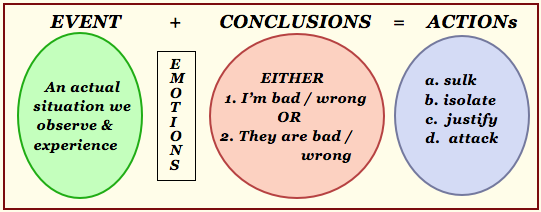
1. EVENTS – the Stimulus

2. CONCLUSIONS (our THINKING)
Here is another use of T.E.A. (Thought, Emotions & Actions ). The middle circle (in pink) is about how we mentally (Ts) assess or try to explain any event that’s upsetting.
🙄 A common reaction is to ‘be in our head“, endlessly obsessing, without ever understanding the situation (T) or resolving it appropriately (A).
REMEMBER – “crazy” is mental (what we think / believe), not emotional

Most ACoAs grow up convinced we’re crazy!  We say we feel crazy, or that we’re going crazy, or we afraid of being crazy.
Well, most ACoAs are NOT, but we came to believe it because – while our emotions & observations told us that a lot was seriously wrong with family, school, church….
the grown-ups kept telling us our opinions were way off base, & anyway we were the problemCause & Effect

Reminder: ‘Painful events’ may be situations that :
a. are accidental, because people are just busy or preoccupied
b. we run into in the course of everyday living (rudeness, ignorance, delays…)
c. are genuinely insulting, shaming or otherwise abusive

We can instantly react (As), out of our conscious control  = yelling, sulking, blaming….. or just spend all our time worrying.
If we pay attention, those reactions will give us an idea of what we’re actually thinking.
HINT – that the painful event is :
💦ONLY /all about ME, & we’re the Victim (V), creating FEAR , OR
🔩ONLY /all about the OTHER person, as Perpetrator (P), creating our ANGER

💦 IT’S ALL ME – It’s my fault, I’m bad, dumb, weak, lazy….
• Whenever ACoAs experience a painful event or loss we try to make sense of it. The WIC always thinks they’re the source or cause – that we should have been able to prevent it.
The Adult in us may know this is not true. Others are also not in control of every outcome, but they are responsible for their beliefs, decisions & actions (not us), whether they acknowledge it or not

EXP:  It’s sad to think of JFK Jr. – his very bad decision to fly with a broken leg, without a co-pilot or auto-pilot, in predicted bad weather – ended in disaster. Accident? Yes, but his unwise choices contributed.

• ALL ACoAs start out from this premise (Self-Hate) & then layer it over with a variety of defenses. When something doesn’t work out, or someone hurts us / ignores us / leaves us…. we try to analyze what we did wrong & how we can fix it. We obsess for days, sometimes years about a painful situation, always from self-blame.

➼ Unhealed ACoAs have a wide streak of narcissism – mainly in the form of: EVERYTHING IS ABOUT ME!  but you may be saying “What, it’s not??”
It’s our default position, & continues as long as the WIC is in charge of our life.

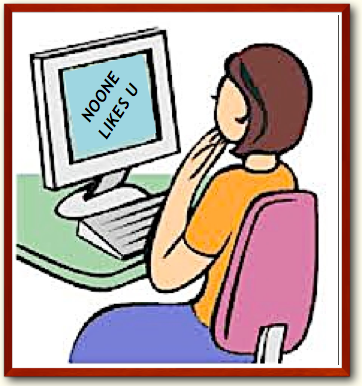
EXP:  Extrovert Maria is in a night-school computer class with 6 other adults, 5 men & one other woman. Maria glances at her several times, hoping to connect, but the woman blatantly ignores her. Maria’s not just disappointed, she’s hurt. There’s a pain in her gut: “Nobody likes me!”

EXP:  Felicia was in great distress. She’d invited her family to visit her at college, so they drove down to see her. On their way another car plowed into them, causing a huge accident & her brother was killed. That was enough of a heart breaker – but her CD added to it. She kept saying: ”If only I hadn’t asked them to visit, he’d still be alive!” – tortured by thinking she has that kind of power

REALITY: There are times when we have made a wrong choice, but self-abuse does not help us learn from the error or improve our options in the future. S-H is a lie & therefore SELF-DEFEATING. It’s based on a false sense of power, but it’s still false.

Once the UNIT kicks in, that perspective greatly diminishes. There’s a big difference between believing we’re responsible for everything (grandiosity) vs being appropriately responsible for our T.E.A.s

NEXT: CONCLUSIONS  (Part 1b)

WHAT is GUILT? (Part 1)

Man with tamI PLEAD GUILTY !
Since everything is about ME (isn’t it?)- it must be me, I’m always wrong

PREVIOUS: ACoA SiteMap

SITEs:  How to deal with Guilt Trippers
3 Types of Guilt & How to Let Them Go

NOTE: See ACRONYM page for abbrev.

POINT 1. Guilt (G) is a normal EMOTION, but not a primary one like fear, joy, sadness, love….
Since it helps preserve social bonds, a moderate amount of guilt is adaptive. Too much is crippling, repeatedly telling lies trains the brain to ignore feeling bad about it, & not having any remorse is psychopathic.
ACoA focus on guilt explained in Part 2

POINT 2. Guilt is the emotion mainly related to ACTIONS or NON-actions, but also to ‘unacceptable’ thoughts & wishes

POINT 3. General USES of guilt are for:
a.
 exerting influence – G is used by some people in close relationships to control another’s behavior (MORE….)
— the one with less power can get their way by guilting the one with more
EXP: “If you loved me, you wouldn’t do that / would do that for me”
— The one with more power can shame & punish the one with less
EXP: “I guess you mean I shouldn’t have been a mother” when told of old hurts

b. spreading out emotional stress – negative & positive sides of a ‘bad’ situation – acknowledging you’ve messed up, AND showing you care about that person or event
EXP: “If you (person A) feel guilty over not taking out the garbage, chances are your spouse (person B)–who wanted it taken out–will feel better knowing that. In this way, emotional equity is restored, because bad feelings in A are restored to B, who caused them,” (psychologist Roy F. Baumeister, CWRU of OH) Abstract Article

c. maintaining relationships – G depends on inter-personal context, a two-person experience, which can help make people pay attention to others
EXP: feeling bad about not keeping a promise, not spending enough time with loved ones, not responding to texts….
Given how uncomfortable guilt can feel, it can provide a strong motive to apologize, correct or make up for a wrong, & be more responsibly in future- BUT only if the mis-behavior is legitimate

‘Normal’ TYPES of G – in relation to actions, cause by:
a
. something you did — wrong : that harmed another person, that violated your own ethical or moral code, or something you swore you’d never do again. In these cases, there’s no doubt it happened

b. something you didn’t do, but want to — thinking a lot about an action that’s against your own principles, or is dishonest, unfaithful, or illegal.

This kind of G can be confusing, with conscience poking a finger at you.
Since you didn’t actually commit the act (yet), & no one know what you’re thinking – you’re still on moral high ground. But obsessing about wanting to do something you know is wrong (for yourself or toward others) can make you very uncomfortable

c. something you think you did — A lot of present-day unhappiness comes from our own irrational thoughts about situations we’re in. Some people will be wracked with G if they’re convinced they did something wrong, even if there’s no objective evidence of that.

EXP: The magical belief you can jinx people by just wishing them ill, without acting on it. If something bad actually happens to them later, you’ll secretly think it was because you were that powerful!  At some level you ‘know’ that’s illogical, but it’s hard to give up the belief altogether

d. that you didn’t do enough to help someone — who you know is having a hard time or is sick, but you don’t call to check on them or help in some practical way.
OR – you’re already doing too much for someone, & you take a break or just stop, because you’re burned out (compassion fatigue). Continuing to act out of guilt will only drain you further & end up making you a less effective helper

e. that you’re doing better than someone else. It can be:
— adult children doing much better in life than their alcoholic / narcissistic family, or poorly-adapted immigrant parents, such as going to college, making more money….. even if they say they want their children to succeed

— the only person left in the family after some natural (fire) or social (war) disaster, often will feel survivor guilt, even though the event was totally out of their control. This can have Spiritual implications – they were meant to survive for a reason. 😢

NEXT: What is Guilt (#2)

ACoAs – ABANDONING OTHERS (Part 3a)


YOU’RE THE BEST!
Even if I have to make you up

PREVIOUS: ACoAs abandoning OTHERS (3b)


See ACRONYM page for abbrev.


6. IDEALIZING
DEF:
• Another dysfunctional way to cope with the painful fact that our parents were not safe (nurturing, emotionally honest, mentally clear…)
• A way to survive back then. Some part of our child-mind had to make them perfect, without flaws – to deny how angry & scared we were at them, & still are
• A form of splitting off the good parts of ourselves & the bad parts of them – an overt or covert toxic agreement in childhood, with the family, that we were the bad ones & they the good ones.

All small children idealize their parents, which helps them feel safe. If they grow up in a healthy family this safety allows them to cope with reality, gradually able see the adults more realistically, with both weakness & strengths.

But for us – from the very beginning our parents disappointed us when we most needed them to be our ‘gods’ so we’d feel protected. Not only did they not help us deal with the outside world, but were the ‘enemy within’.  (➡️ IMAGE from “See Mom for who she is, not who you want her to be

To compensate now, some ACoAs idealize others, even strangers, as a way to shut out the WIC’s earliest terror still lurking in the bushes of our unconscious, BY:
a. Putting anyone – who we feel is important – on a pedestal (parent, teacher, lover, friend, boss…), not able or willing to acknowledge their real personality, including human limitations & damage (character defects) – UNTIL that person does something that pushes a big button in us, & then we feel rage at them. The illusion we created is shattered & we can’t tolerate it. So we punish them &/or cut them off.

EXP: Carol started a new class & was immediately in awe of the professor.  She began staying after class, asking all sorts of questions, unconsciously flirting a little. The teacher became less & less responsive or available.  Carol kept trying to hold his attention, but finally felt the rejection, became very angry & stormed off, telling everyone else what a jerk he was.

b. VARIATION: Making a new lover the “Answer to all my prayers!” Screen Shot 2016-06-11 at 6.51.05 PMBelieving ‘This is the one!” OR immediately making a new friend into a BFF, without taking the time to find out :
• are they actually who they seem to be?
• who this person really is (character & type)

• how you’ll feel about them, in a year or less
• what personal problems they may have
• how their ‘issues’ are going to affect you
• how will your issues impact them?
• AND, if we’re fundamentally compatible!

➼ To know that, we need to have a clear sense of ourselves, good boundaries, reasonable self-esteem, not too much anxiety about abandonment, tolerate imperfections & have the ability to ‘go slow’. PHEUW!
BTW, we may find someone willing to play out the fantasy with us (some for a while, some much longer), because they too need to be symbiotic, feel needed, overly-important…anything to not focus on themselves & their issues. This does not diminish our responsibility for playing our emotional games.

CAUSE:
• This kind of ‘jumping into’… comes from an intense need of the WIC to symbiotically attach, to fill the emptiness left by inadequate mothering in early life.
The human person we now choose to idealize will:Screen Shot 2016-06-11 at 6.51.46 PM
— EITHER be someone who is similar in damage to our own family – the hope being that this time we can fix them & so get their love & approval, even if we can’t get it from our family.
We only end up (unconsciously) playing out our abandonment / victim role – since we can’t fix others or con them into loving us

— OR someone who is or seems to be completely the opposite of family – stable, competent, smart, nice….so we can finally be taken care of!  Even if they do, for a while, we pay too high a price – being controlled & staying immature.
But usually such people are too healthy to rescue us at all, so we get disappointed again, but not as much.

• Either way we’re trying to get from others today what we couldn’t get originally, but no one can’t make up for our losses! We need to heal from the inside.

NEXT: ACoAs abandoning others (3b)

Our Wounded INNER CHILD (Part 1)

all alone I’M ALL ALONE
I’m desperate, but no one is safe!

POSTS: “Are you an ACoA?
•“Variation on Laundry List


See ACRONYM page for abbrev.

FIRST: The Inner Child (IC) is the repository of all our childhood experiences, from birth until we left that environment – our memories, emotions & immature thinking. It includes our True Self, which did show up in some ways, but was mostly suppressed or distorted. Our IC now holds all our own wounds PLUS the wounds of our parents.

The ACoA DIS-EASE
Our childhood damage is housed in the Adapted Child ⬇️, who is intensely loyal to family & culture. In order to know how to heal ourselves, we must first get to know our wounded part as thoroughly as possible**.
➼ Remember, we are DAMAGED, NOT Defective. Damage can be healed – ‘defect’ can not.

** Learning about & connecting with our Inner Child is not a waste of time & effort, or wallowing in the past, as some people believe. It IS a means of breaking thru our denial about how traumatic our childhood was. If there is any doubt, we simply have to look at the areas in our present life that don’t work – to tell us how our family (& other sources) damaged us.

• To heal we need to know specifically what our negative thoughts are telling us, because it is the basis of all self-defeating behavior patterns. These toxic beliefs are our version of our family & community, called the Negative Introject.
So no matter how much we may ‘know’ about our past, we need to do deep emotion release work as well as correct our beliefs.

Otherwise the old pain we’ve stored up from the past will keep driving us toward harmful ‘people, places & things’, & make us strongly react to events whenever our buttons get pushed (wounds get activated).

HOW DID WE GET LIKE THIS?
While growing up, kids are never supposed to be fully in charge of themselves or other family members. This only happens in dysfunctional families, sometimes out of necessity, but mostly because the parent(s) are not mature themselves.

• ACoAs were both criminally neglected AND forced to be hyper-functional – with is also abuse: not be allowed to just be a kid. It left us terrified & confused. There was too much we were never taught, left to figure out on our own, the best we could.  We managed to survive, but now we always feel incompetent & fraudulent – no matter how well we do!

We had to ‘raise ourselves’ because:
• being the eldest (the Hero) meant being the parent substitute –  for younger kids & sometimes for a drunk / non-functioning parent
• one parent was absent & we had to take over some or many of their ‘adult’ responsibilities
• one parent or sibling had a serious mental &/or physical disability, so our needs were neglected, & used as servants / slaves… (‘do’ for them)
• mother had 1 or more boyfriends /mates, a family member or best friend(s) who were always more important than the kids (symbiotically attached)

• parents were only interested in each other (addicted / worried) so we were mostly ignored
• parents were too overwhelmed by their own difficulties to notice us
• their focus was on drinking, fighting, chaos, rage ….
• there was only one parent & she (usually) was working, depressed….
• there was constant physical upheaval – moving, loss of jobs, trouble with the law, school, neighbors….
• we were expected to grow up very fast – ‘little adults’- so they didn’t have to deal with us.

NEXT: Our Wounded INNER CHILD (Part 2)

SELF-HATE & ACoAs (Part 3)

addictionsI CAN’T GIVE UP
the only ‘truth’ I know

PREVIOUS: ACoAs & S-H #2

QUOTEs:
🔻 “I won’t sleep if that’s what it takes to not wake up as myself”
Casey Renee Kiser, Hold Me Under: Poems to Drown to

😰”To keep my mind occupied when I can’t sleep – some people count sheep. I self-loathe.” ∼ Rainbow Rowell, Attachments

🥶 “Hostility, malice & sadism are the result of helplessness & self-loathing – all produced by adaptation to a hypercritical social reality, & are not attributable to innate aggression.” ∼ Arno Gruen, Swiss-German psychologist

FoO = Family of origin

1. DEFINITION
2. SOURCES of Self-Hate (S-H)

3. PURPOSE of S-H is TO:
• keep from risking any change via S & I (fear that letting go = being forever alone)
• keep us attached to the family (stave off deep loneliness)
• prevent us from dealing with ‘ugly emotions’ like our rage, envy, longing, hopelessness….
• protect our fantasy of having good, loving, safe parents
• protect us from feeling the reservoir of old abandonment pain
• protect us from Growing up, taking care of ourselves (we want to be taken care of! no matter the cost to ourself or others)

WHY is it SO HARD to GIVE UP S-H?
The above reasons are all part of the answer, but the MAIN one is that:
It gives us a FALSE SENSE of POWER! How?
Since every child is self-centered, which is human-normal, they think everything is about them – that whatever happens in or around them has to do with them.
The child’s logic says: “I’m in pain, & somehow I caused it. Therefore I CAN / must stop them from hurting me, if I can just figure out how!”

• Then we spend the rest of our childhood (& well into adulthood, until Recovery) trying different ways to FIX whatever the problem was & may still be – re :
US – by re-inventing ourselves (must be the origin of this USA craze), trying on different ‘personae‘ (be the perfect kid, the trouble maker, the helper, get good grades, be invisible, don’t have any needs, be funny…)
AND re :
THEM – by trying to make our parents see reason, get sober, get help, leave the marriage, get taken care of by us, cover up for them, fix their ‘craziness’, cater to their every whim….

Unfortunately NONE of our EFFORTS WORKED! In most cases ‘they’ didn’t change, didn’t listen, wouldn’t stop – drinking, raging, being unsuccessful, molesting, beating us, leaving, cheating, berating, controlling….!
But we kept trying, always asking: What’s wrong with ME?

Even if some of our parents did stop drinking,
— it was NOT because of our efforts. We assumed their ‘sobriety’ was, because we were extra good, prayed really hard or badgered them into it
— very few were willing to do the deeper work to become healthier human beings, so mostly they were just “Dry Drunks”. So their unhealed narcissism kept on hurting us.
RESULT -in us- was an intense feeling of failure!

• This is why so many ACoAs believe we’re FRAUDS – that people will eventually, inevitably FIND OUT.
Q: Find out what?
A: “Since I couldn’t make my parents/ family get well, be happy & be there for me – I’m not capable of and NEVER will be able ably to -succeed at anything else!” (WIC logic)

It’s an assumption ACoAs are not usually aware of, but glued to us by anxiety, and believed both by the less accomplished AND the most outwardly successful ACoAs, pre-FoO Recovery. Unfortunately, what we don’t realize is that the fundamental premise is false :
No child
— ever caused the adults’ messes
— was ever responsible for making them better! AND
— can fix anyone else

NEXT: ACoAs & S-H #4

SELF-HATE & ACoAs (Part 1)

self-hateI’M NO GOOD, & EVERYONE KNOWS IT – so I have to be perfect to make up for it

T.E.A. = Thoughts, Emotions, Actions

REMINDER: See ACRONYM page for abbrev.

FoA = fear of abandonment

SELF-HATE (S-H) is the #1 deterrent to growth for all ACoAs.
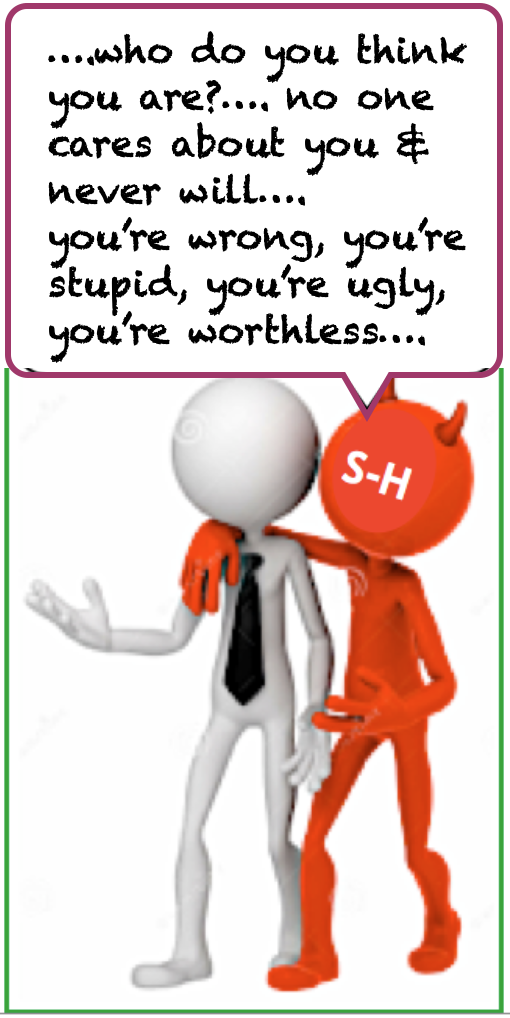
It undermines our ability to function well, to have self-esteem & to be happy. Some people call it being ‘hard on yourself”, but it’s much more than that.  It’s so pervasive in the inner world of many ACoAs, that we don’t even know we have it & if confronted, vehemently deny it.
BUT the symptoms are all there, starting with a persistent nagging anxiety.

1. DEFINITION
✶ In Childhood : being thoroughly convinced that everything bad that happen to us as kids was our fault, that we caused our own pain!
✶ In Adulthood : continuing from the past, we believe in our very cells that anytime we feel hurt, suffer a loss, get ignored, can’t get something we want, have something taken away, have to wait for something … that it’s because we are bad, don’t deserve, did something wrong , failed to do something, don’t have a right to it – anyway

REALITY
ALL self-hate is a LIE
✶  it’s a defense mechanism to deny the original abandonment – by our family & culture. This a crucial point:
✦ S-H tries to cover-up all our abandonment pain
• It’s actually a form of narcissism (ours) – making everything about US, when it rarely is.  We make other people’s bad behavior our fault & our responsibility
• It’s an attempt at feeling in control, to cover our intense sense of powerlessness & vulnerability

• S-H can be expressed in all 3 T.E.A. categories:
Ts: “I caused their accident, since I asked them to come visit me”
Es: “I feel bad & really scared they won’t like me since I said ‘No’”
As: Staying with abusive people, not taking care of ourselves, not pursuing our dreams, not speaking up….

ESSENCE
One of the characteristics on the ACoA Laundry List is being Over-Responsible, a symptom of FoA & S-H.
What make S-H different from taking healthy, balanced Responsibility?
HEALTHY R. acknowledges the reality of having our T.E.A.s – or not. It straightforwardly owns up what IS, which can sound like:
“Yes, I did that” (A), or ‘No, I can’t handle this” (A), or “No, I don’t agree with that”(T) , or “Yes, I love this” (E)….

S-H, on the other hand says : “I_______, & therefore I’m BAD”
• Ironically, it prevents us from admitting to any normal, human imperfections, from shame & for fear of abandonment, OR
•  it can make us ‘confess’ to wrongdoing, even when we are in fact blameless.

In either case, what’s underneath is an unspoken Toxic Lie tacked on to legitimate responsibility, categorically stating that:
✒︎ “I did / didn’t do_______, which proves I’m unlovable & worthless”, no matter what the topic or truth is.

This add-on is implied, but at the core of our self-image. ACoAs will take any opportunity to beat themselves up, even about good things!
🖤 All S-H comes from our wounded child (WIC) staying loyal to our wounded parents.
EXPs of S-H:
“Yes, I did forget to sent the letter out today, so therefore I’m irresponsible”
“No, I don’t how how to do that, therefore I’m incompetent”
“Yes, I went to the show without inviting you, so therefore I’m selfish”
“No, I haven’t ‘grown’ perfectly or as fast as I should, so therefore I’m unfixable”
“Yes, I talked a lot at the meeting, so I’m a limelight hog”
“No, I don’t agree with that, therefore I’m stupid” …..

This is NOT what ‘taking responsibility’ means.
Posts: ACoAs’ Fear of R // Healthy R

So – WHAT IS IT? 
Basically, adult Responsibility (R) is:
★ honestly admitting to ourselves what we feel, think & have done -or- not. (T.E.A.), without judgment, shame or guilt.
MOST of ALL – without mental torture.

✒︎ Healthy R. includes regularly acknowledging both our limitations AND our gifts, our ignorance AND our knowledge. (POST: “The 10th Step“)

This def. applies to us now, as adults.
We are not / were NOT responsible for who our parents are or what they did!
SITE: “Great Responsibility Quotes for Kids” & the WIC

NEXT: SELF-HATE & ACoAs (#2)

Variation of ACoA Laundry List

reading blogI HATE READING THIS INFO!
Even so, it’s a relief to know

SITE: Adult Survivors of Child Abuse: Removing the Splinter

BOOK: Laundry List  Tony A & Dan F

NOTE: See Acronym page for abbrev.

• All the PMES forms of Abandonment by parents forces children to hide the parts of themself that are considered NOT OK by the family, in order to not get rejected: “DON’T make mistakes, don’t have needs, don’t contradict, or successful, or show your emotions …”
Exp: We were told that what we felt was not true or legitimate: “You don’t have anything to cry about, so stop being such a baby,  Stop crying or I’ll really give you something to cry about , That really didn’t hurt  ,  You have no right to be angry, Don’t feel that way” ….S-H

Self-Hate – As a result of being mistreated as kids, the most visible issue for ACoAs now is our intense S-H: “I’m no good, no one will ever love me, I can’t do anything, my need don’t count…..”, the defense mechanism all children develop to protect themselves from experiencing the original pain suffered throughout childhood (abandonment), and from acknowledging to themselves how hurtful their parents were.
S-H says: ‘Everything bad that happened to me  – past or present – was / is my fault.’ SO – any time I’m in pain I did something wrong, & I’m bad

• This belief gives the WIC a false sense of power – “If I caused it, I can fix it!” However, the reality is that we did not create the damage that was done to us – that is the responsibility of the adults who raised us. We were the victim of their wounds – then. NOW, we’re responsible for healing ourselves so that we can become our True Self!

Because of childhood Abuse, Neglect & Abandonment, in the present –  WE:perfectionism

YOU:
• are perfectionistic, driven, rarely satisfied – especially with ourself
• are intimidated by &/or feel enraged at controlling people
• expect others to hurt, judge or take advantage of you
• experience temporary dissociation (pg__), disconnecting from self
• feel chronically empty or numb inside, easily bored, restless
• feel like you’re always under scrutiny – even when alone
• find it hard to relax, laugh or be spontaneous
• keep yourself isolated from shame and so ‘no one can hurt or leave’ us
• frantically try to avoid real or imagined abandonment – by clinging, people-pleasing, being invisible….
• lose yourself in relationships by automatically & continually putting others’ needs before your own
• over-value & then under-value people you get too close to

You HAVE:
• a confused or distorted self-image: “Who am I really? , What do I really look like?” (feel ugly, fat, too thin, too short….)
• chronic obsessive thoughts, spinning  ‘round & ‘round without solutions
• compulsive self-damaging behaviors in 2 or more areas of life = eating disorder, addictions, fights, under-achieving….

• a harsh “inner critic” that torture you, especially after any disappointment or loss
• impulsivity – can’t control your choices & reactions
• inappropriate & intense anger, trouble controlling temper
• mood swings not caused by bipolar disease

• paranoid thinking – as a regular way of experiencing others
• recurring suicidal thoughts or actions
• trouble asserting yourself & not feeling proud of your accomplishments
• trouble finding a spiritual belief, or one that feels right

ACoAs are very intelligent and determined. With the right kind of help we can heal from these wounds and prosper.  Al-Anon, therapy, a spiritual practice, reading, & staying connected with other ACoAs in Recovery make all the difference. Don’t forget: ‘Progress, not Perfection’

ACoA WEBSITE (80+ pages) : www.acoarecovery.com

NEXT: Original LL