ACoAs: PATIENCE vs Co-dependent Waiting (Part 2)

PREVIOUS: Co-dep vs Patience #1

SITE: How to cope with waiting for news

QUOTE: “Good character is not formed in a week or a month.  It is created little by little, day by day, by protracted patience” – Heraclitus of Ephesus

PASSIVE PATIENCE (cont.)

Co-dep also shows up as IMPATIENCE, annoyance, intolerance, worry, fear & distrust
• It’s demanding what we want, right now (instant gratification), because any delay in getting a need or a desire met is taken by the WIC as a definite “NO – you can’t ever have it, so shut up & go away!” from the PP (Negative Introject)
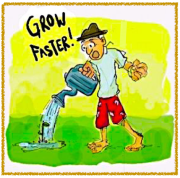
• It’s rushing relationships, to get that feeling of instant attachment, which is actually symbiosis. It’s an attempt to compensate for present-day fear of Abandonment pain, to make up for not having had that bond as an infant with mom, when it should have occurred

• It’s impulsively rushing into situations without considering whether they’re right for us, or what the consequences will be – to ourself or others
• It’s pushing our way ahead of others (selfish entitlement) – the unconscious fear of being left behind – while consciously assuming it’s ‘our right’, but is actually childish narcissism
<ADD YOUR OWN kinds of unhealthy co-dep ‘patience’ & impatience>

Fortunately, Recovery gives us an out – a way to identify our damage so we can separate & strip it away from the Real us that’s hidden under all the defenses, separating the Toxic Rules from our Rights. As adults we have very real options, if we’re willing to risk leaving our attachment to the dysfunction.
REMEMBER: We’re damaged (wounded), not defective!

🦋 🐯 🦆 🐳 🦒 🐇

HEALTHY PATIENCE
This kind is an ACTIVE response to reality (personal & environmental)
Just like ‘Acceptance‘ does NOT mean giving up or giving in, Patience does NOT mean letting the world trample us.
Nor does it mean ‘taking the moral high ground’ as some spiritual superiority, nor a punishment from the ‘universe’
• It does not imply the hopelessness of being forced to endure suffering & deprivation
• It does not mean being passive, of not taking appropriate actions when necessary to accomplish something, especially if it’s something only we can do. (Posts: Healthy Actions // What to do when confused // Why are you stuck?)

It DOES mean being emotionally mature. This allows us to tolerate delayed gratification, which can only come from lowering the WIC’s intense anxiety. Healthy patience is active in the sense that we choose to wait for a desired outcome, while at the same time actively continuing to live our life the best way we can – every day.

Real patience :
• requires knowing the difference between Rescuing & Healthy Helping, because it takes patience to sit with our own discomfort of not jumping in to someone else’s problems. Knowing the rules for Helping is important.
But we can also tell what’s healthy by feeling physically stressed or relaxed, & by our emotions: Rescuing / people-pleasing is driven by anxiety, a compulsion to compensate for something broken in us. SO —
• Before a situation (a communication, an event….)  we can obsess & worry OR – be excited about ‘doing / reacting’, which comes from a false sense of connection, & temporary relief of abandonment fear.
Afterward – we can feel drained – from overdoing, disappointed if we didn’t get what we wanted in return, & then angry. Here the actions are ALL about us, the WIC trying to cover up S.H.

True Helping is done from an inner sense of calm & confidencebefore taking action a choice that comes from the Healthy Adult’s enjoyment of sharing our personal talents, knowledge & experience. And we feel pleased, satisfied & comfortable, even uplifted – afterward. We benefit, & not just about ourself.

NEXT: Co-dep vs. Patience #3

OUTGROWING Co-Dep Niceness (Part 7b)

I WANT TO IMPROVE as many relationships as possible

PREVIOUS: Adult forgiveness (#7a)  ▲IMAGE : VeryWELL

SITEs: Healthy way to forgive yourself (and its dark side)


RECOVERY from “Too Nice Syndrome” (TNS)
cont.
TOOL 6a & b. Healing CHILDHOOD T.E.A.

TOOL 7b. FORGIVING Ourselves as ADULTS (cont.)  re. ACoA Step 4 & 5

SELF-FORGIVENESS is letting go of guilt & shame, which takes persistent time & effort, and in never complete. Letting go means accepting that we can’t change our past, but can learn from it.
At its heart, ACCEPTANCE is seeing everything as it really is, no matter how unpleasant, rather than what we want it to be. (more in Part 6b)
Acceptance eliminates illusions & CDs, & so makes letting go possible.

++ ACCEPT ourselves as valuable Children of God / HP / the Universe, which helps to stop the cruel inner rant (the WIC or PP) – a choice we can implement every day.
The benefits of self-acceptance are worth the great struggle of having to let go – of releasing the rage at ourselves & our abusers.)

++ ACCEPT that we are wounded – not defective. Letting go means stopping the cruel inner PP rant – a choice we can implement every day. Given the very hard times we’ve been thru, it means we need to be extra kind to ourselves. (Purpose of healthy parental mirroring )

 ++ ACCEPT our human limitations, which will allow us to let go of judging ourselves so harshly. That no matter how much we wish it we can’t go back & change anything. AND that we’ll never have the parents / family we legitimately wanted

LETTING GO means:
• accepting all our emotions, without reservation or judgment
• being kind to ourselves, no matter what, & staying present for whatever Es come up
• facing & dealing with our anger at our family, & other T.E.As.
• forgiving the things we didn’t do, which caused us or others harm.
• releasing any & all accusations or blame of God / the Divine for painful experiences caused by humans
• remembering painful & embarrassing situations we got ourselves into because of anxiety, FoA & dissociation (out-to-lunchness) – without S-H

EXP: In her 20’s Jenny had a little grey cat she loved a lot. As Greyling was getting older, he get thinner & thinner, but Jenny was too busy studying & writing papers for her college classes to pay much attention.

• One night Greyling flopped over on the bed, not able to stand. Jenny was worried, but thought he was just old. The next day she saw he was very weak – not moving, not eating – so she finally took him to the vet. The vet took one look at the little cat & turned angrily to Jenny. “You let this cat deteriorate to the point that he’s so dehydrated he had a stroke! There’s nothing I can do – he needs to be put down!”.

• Jenny was devastated at the loss, & deeply ashamed of her neglect. She had caused this sweet creature severe suffering because of her obliviousness. Working it thru in therapy & ACoA meetings, she understood that ignoring the signs of illness in Greyling came from her grammar school time. She spent many years seeing her father in terrible pain from a long illness, often lying in a dark room but never complaining, while mother kept telling her to be very quiet & not bother him.
Jenny loved her dad & hurt deeply for him, but was totally helpless. To protect against her overwhelming frustration & powerlessness, she became numb to physical suffering.

• Accepting the connection between past & present, & continuing to grieve Greyling, Jenny sincerely forgave herself for her inaction, without S-H, knowing where it came from. Even years later she sometimes feels sad for her dad & the cat, without judgement, & has made sure to not make that mistake again with other cats.

NEXT: ADULT self-Forgiveness (#7e)

Letting GO of ACTING Controlling (Part 3)

 THE MORE I LET GO,
the more power I have!

PREVIOUS: Letting Go of Controlling -#2

Review: “Let Go of Control…Art of Surrender


MAKING CHANGES
“What we disown – we can’t change”.
Another Inventory: Consider the following points & write out as much as you can. Do a little for each point, then go back every few days & add more.
• If needed, get trusted people to make suggestions from their experiences with you. Try not to be defensive – just write them down & look at them later.
NOTE your patterns that crop up over & over, especially if mentioned by several people

EXTERNALLY
STAY AWAKE for ways you act Controlling:
⭐︎ When it happens    ⭐︎ What sets it off
⭐︎ How it shows up in your actions
⭐︎ Who is affected   ⭐︎ How does it affect them
⭐︎ How do others react to you   ⭐︎ How does that make you feel emotionally & what is the negative self-talk

INTERNALLY
Acknowledge that you are controlling, & identify the causes  behind it
Consider which ones :   • you’ve already been working on
• others you’re willing to tackle, & how you can change your reactions
• which you have to ‘put on the shelf ‘until you’re more healed
(review ‘Controlling & Abandonment posts)
list of needsMake a list of:
• all your unmet needs & slowly work at filling them
• your talents – develop, hone & get recognized for them
• backlogged old pain that causes anxiety, & gradually feel them

• the difference between assertiveness & aggression, controlling vs in control, connection vs symbiosis, humiliation vs.humility, rage vs anger, rescuing vs helping, possible vs impossible ….

Practice asking for legitimate needs & desires from others, without demanding or having unrealistic expectations. Know who can meet specific needs & who cannot – and to what degree!

The 3 As & T.E.A.
AWARENESS: Identify your unhealthy attitudes (Ts) towards situations, unrealistic expectations of others & beliefs about how life should be.
Also, life areas that are affected (work, home…) & which are more intense than others (more with spouse, less with friends ?…)

ACCEPTANCE: Then – write about the experiences growing up that fostered the need to be Controlling, especially emotions underlying the compulsion (Es).
Identify alternative or opposite beliefs (Ts) you can use when life-stressors set off the impulse to C. (Post ; “Heathy Helping”)
✶ Allow as much time as needed to make internal shifts. Acceptance is about staying in the process & not always trying to jump into Action

ACTION: List better ways (As) to act when feeling the pull to be C. & try them out a little at a time. Learn how to communicate with your WIC & do it consistently, to comfort & protect it (Ts & Es)

Keep these new thoughts & action handy, & in a variety of locations to remind yourself (home, car, office, fridge, wallet or purse …)

TEST-CASE: Pick one thing you feel a definite need to control, then DON’T make any effort what-so-ever to exert your will over that situation the next time.  Just do it & observe how the event unfold completely on its own, without any help from you. Notice you thoughts & emotionspeaceful

• You may feel shaky at first, as it may bring up anxiety from past trauma. HOLD onto to your WIC, & let it know it’s not in danger

• Use Bookending with the WIC, to prove that most things turn out much better that we anticipate – by writing how things turn out when you don’t C.

From “Losing Control, Finding Serenity” book by Daniel A. Miller
Daily Exercise:
• About your external children, listen attentively without offering advice, especially the older ones unless they ask. Recognize that they’re different from you in how they think & process things, and accept that your way may not be right – for them
• In your love relationship, lower your expectations of your mate AND of yourself. Focus on steps you can take to improve your love-bond. Appreciate the good things you have together.

• About creativity, focus on just enjoying the process, rather than thinking too much about the outcome. Don’t worry about making “mistakes.”
Start a piece (paint, crochet, a new song…) with the intention of not completing it, & see how it goes.
>> If you’re only partly successful, do not give yourself a hard time! Keep trying, try something else or get help if needed. You’ll see that letting go of control may bring success, or at least a sense of peace!

NEXT: Types of Self-Control – #1

Letting GO of ACTING Controlling (Part 1)

I CAN GET MY NEEDS MET –
without arranging everything!

PREVIOUS: Acting Controlling (#3)

SITE: Freedom & Control

See Acronyms Page for abbrev.


STOP Controlling

To change this dysfunctional pattern takes Willingness, Perseverance & Courage!  We have to be ready to look at ourself without intense judgement & S-H, or we’re not going to own the C. behaviors.

Reminder: You are not responsible for trying to make changes or correct problems which are beyond your competency, power, authority or responsibility – OR that ARE the responsibility of someone else!

The OLD Way: Being C. is to function from the assumption that the only way to feel safe in the world is by arranging everything OUR way, all the time.
But, the very act of Controlling is a betrayal of the True Self, shutting us off from healing our wounds & making loving connections with others, because of the fear & rage we carry from the WIC & PP.

Ironically, being a control freak never seems to include changing oneself! The Negative Introject (PP) keeps trying to deceive us, saying that the only way to proceed is to completely control every tiny detail of how & when things should happen, and/or how others should act.
At the same time the PP continues to tortures us so it won’t lose power over us – by making us believe that no matter how hard we work at it, we’ll never be good enough or do things right.

progress not perfectionBOTTOM LINE – BEING C. :
• can be called a character defect, but it’s imperative we don’t use that to berate ourself (vs. Being in Control of oneself)
• is NOT the same as having strong opinions. Rather, it’s a way to ‘force solutions’ by imposing our will on others

• is a form of grandiosity, a defense mechanism to defend against re-experiencing early vulnerability, powerlessness & daily neglect. NOTICE –
our style of controlling is likely a copy of someone in our family
• provides a temporary feeling of being powerful (not at the mercy of anyone!) but like all addictions, has to be constantly repeated, since it doesn’t heal our terror
GROWTH
 As the WIC heals & we strengthen our ‘Unit’, the need for C will diminish in intensity, but may never completely go away. This has to be accepted – with healthy humility & self-respect (opposite of grandiosity)
• Lessening it requires self-esteem, boundaries, making better choices & letting love in – wherever it may come from!
• Letting go of being C. can only be done in stages, & never perfectly!

LETTING GO 
There are many wise things to be said about ‘Letting Go’, but here are 2 main ones for ACoAs. To grow we need to —

1. STOP trying to win our parents’ love. We wouldn’t need to IF they had the capacity in the first place. Stop chasing them (or substitutes) for the nurturing every child needs but was simply not available because of their damage, even if they meant well & said they loved us

2. Relinquish the fantasy / illusion that doing things perfectly will get us that love & approval. All it does is increase our self-hate & fear, since perfection is unattainable AND our family’s mental or emotional health is not – and was never was – in our power to create.
People either can love us or not. We can not earn it!

A NEW Way
Freedom from Controlling comes from giving up the internal fight, to stop trying to manage everything, to stop trying to please the PP, & by staying out of whatever is none of our business!

self-fight✶ This does NOT mean being lazy, withholding or paralyzed.
• Rather – it comes from knowing that even in times of discomfort our inner foundation is built on solid ground – a support system made up of our Loving Inner Parent, the Higher Power & respectful / kind people.

• Being comfortable in our skin includes allowing OTHERS to be themselves, & letting many circumstances be – just as they are. There’s a time to act & a time to be still. The Serenity Prayer tells us:
✳️ Change what you can right now, & Accept what you can’t change at all, what’s not yet possible, or is not yet the right time.

NEXT: Letting Go of C. –  #2

CDs & the Unconscious (Part 4)

cds & emotions
I CAN HAVE EMOTIONS

without having to act on them!

PREVIOUS: CDs & the Unconscious (#3)


1. THINKING  (cont)
a
. The UNCONSCIOUS 

bThe CONSCIOUS (cont)
Changing our thinking patterns is a continuous, sometimes frustrating process. The more we understand how our brain & the process of change works, & what to expect, the more hope & patience we can have!

RECOVERY: Correcting our thinking leads to a more peaceful inner world. As ACoAs, it’s helpful to remember that this state is something we have to get used to – most of us find it boring at first. Eventually we come to appreciate & cherish the internal quiet. This is not boredom – which is an aspect of thinking, not feeling. It’s rather a sense of well-being!

2. EMOTIONS 
In general, emotions are stored as physical memories of our experiences & can be recalled by experiencing events in the present they remind us of. These emotions may be comforting, pleasurable, relieving, exciting… OR scary, rageful, lonely…. We can’t directly choose what we feel, only what we think.

• Researchers tell us that anxiety** responses such as “fight or flight” originally had adaptive value for the human species, & are still legitimate forms of protection. Active defensive measures such as – seworriednsitivity to sound, the startle response, shallow breathing & increased heart rate – help people escape real dangers.
However, we rarely face the external dangers our ancestors did, so now we’re flooded with those same stressful chemicals from internal pressures (CDs) without enough physical outlets to burn them off.
(Post:  Anxiety & T.E.As

**Anxiety (diffuse fear) is the nervous system’s response to internal or external stressors (a painful loss, self-hate, a fight with someone….) which intensifies how we feel & then act, but needs to be triggered by CDs & negative thinking.
This has been shown on brain imaging scans. However, since CDs are conditioned over time & become unconscious habit, we simply don’t recognize the source of our fear.

• Cognitive (T) psychologists believe that some people are more biologically predisposed than others to ‘threat-sensitivity’ & the distress it causes. In such people, once anxiety (E) is triggered, it’s maintained, & increased IF negative thinking is added to the mix.

Extreme physical responses related to CDs, set off by in stressful situations, can spread to & contaminate other parts of our lives – from mildly uncomfortable to actually dangerous.
EXP: Obsessive worry (T) caused by projecting the loss of a relationship  – which is not imminent – can provoke a panic attack (E), with the same physical intensity as if you were being held at gunpoint!

• As adults, ACoAs too often make the CD mistake of ‘Emotional Reasoning’, assuming that if we feel a certain way, it must be true:  “I’m really, really scared today, so it’s not safe to leave the house”!
The WIC is having an intense feeling about something going on in our life (an exam, a new job, a break-up…) & wants to hide.
But the sense of impending doom is way out of proportion to the actual situation. “If it’s hysterical, it’s historical”. And staying home alone may make it worse!

EXP: Your father may have only beaten you Many times or only occasionally) for stealing some change or sassing mom, that pain, fear & humiliation will always be associated with thoughts like “Dad doesn’t love me”, or “Parents are so unfair!”…. So now, anytime the boss (parent figure) is annoyed with you for making a mistake, you’re terrified, convinced you’ll get fired any minute now!

EXP : EMOTIONS re. ways adults can react to the death of a parent:
💦 A symbiotically attached ACoA will be devastated, partly from the loss of hope, partly from the depth of abandonment, perhaps also feeling guilt that things were left unfinished, & anger at being left. Sometimes they try suicide.

💘 A healthier person with sufficient S & I experience will be sad, mourning the loss & be aware that a permanent piece of their life is gone, but has a sound emotional & spiritual foundation to sustain them.

REVIEW posts: Emotional Maturity, and the series on EMOTIONS

NEXT: CDs – Results (#1)

POSITIVE Responses to Painful Events (Part 2)

flowers 2 


PREVIOUS: Positive Responses – re events

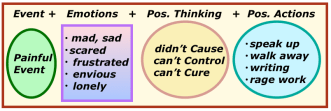
REVIEW: Part 1: Events + Large Chart

POSTS : EMOTIONS – To Motivate


2. EMOTIONS Square

Healthy ACoAs are not afraid to feel, own & deal with our emotions. Es are a vital part of our self-protection & self-correcting mechanism, built in to our brain (the limbic system).  It doesn’t matter which ego state the emotions come from – they’re all part of us. As we learn to identify ‘who’s’ saying & feeling what (Ts & Es) – we can respond to internal cues more accurately

a. From the WIC (adapted child)
• These emotions will be left-over from our difficult childhood – abandonment terror, hopelessness, profound existential loneliness, rage, self-hate, even feeling suicidal – all based on actual experiences, PLUS internalizing those of our parents

b. From the Negative Introject
It includes all the dysfunction from their background, & their feelings towards us, including:
desperation, disgust, fear of abandonment, indifference, impatience, neediness  ……  emotions we absorbed & continue to carry – until they’re cleaned out.  We have to face our pain, but the thoughts & feelings of our parents MUST be given back to them! via repeated visualizations & statements

EXPs:
• “Dad, I love you but I can’t save you from mom’s cruelty. I tried to ease your pain, even taking on your covert suicidal feelings, but never could fix you. You chose her & stayed with her – it’s your marriage. You’re not my mate, so I give you back to her!”

• “Mom, I’ve been carrying your fear, helplessness & unfelt rage all these years, thinking it would help lift your burden. I’m sad that you’ve been suffering, but I know now it was an impossible task & not mine to deal with anyway. I’ve rolled up all your pain in a big black ball & now give it back to you. I have enough of my own to Screen Shot 2016-06-22 at 9.34.34 PM.pngheal!”

c. From the Healthy Child  
• Our Natural Self, whether Introvert or Extrovert, is a combination of – amusement, amazement, anger, curiosity,  excitement, disappointment, love, joy, shyness, trust … and  envy, fear, greed, need, naiveté, selfishness, stubbornness ….  (PAC characteristics)

d. From the Loving Parent
• This is the missing ego state in all wounded ACoAs & so is the most important to develop, replacing the PP (pig parent / bad voice) : love, consistency, patience, persistence, sense of humor, tolerance, faith….. needed for positive self-care

NOTE : the Healthy Adult is basically emotion-free – primarily our computer mode, practical, rational & objective
ACCEPTANCE

i. I didn’t Cause it
Other people’s reactions to us speaks about who they are.
😻 Getting this truth into our cells is a core imperative !!! a requirement for peace of mind!  ONLY our co-dependence & narcissism says otherwise
ii. I can’t Control it
Being controlling is driven by anxiety – the fear of loss (abandonment) & the grandiose belief that we have power in powerless situations. (Serenity Prayer –  backwards). We can’t make others do or be what we want, only continue working on ourself
iii. I can’t Cure it
While some spiritual practices teach that we have all power, over everything – ultimately there are things in this lifetime we cannot cure, whether in ourselves or in others.  Focusing on the impossible is a waste of time & takes energy away from the many wonderful things we can accomplish!

Screen Shot 2016-06-22 at 9.35.19 PMOTHER PEOPLE — Their reactions to our behavior can have something to do with us, directly OR indirectly IF:
a. about Them:
• we accidentally bump against a long-standing emotional ‘hot button’ in them (we ONLY create buttons in our own physical children)
• we inadvertently remind them of someone in their own damaged past
• we don’t go along with their narcissistic needs or expectations

b. about Us:
• when our unhealed rage &/or neediness pushes others away
• we keep asking unavailable people to be there for us when they can’t
• we consistently expect too much of others, including healthy ones
• we say or do something hurtful, disloyal, selfish…. from our damageScreen Shot 2016-06-22 at 9.38.02 PM

🔸 The things WE ARE responsible for can be worked on in Recovery, especially things we do / say that hurt others.
To heal we have to own it all, objectively, without self-hate, & be willing to make changes.
Reasons that others may legitimately be uncomfortable with us (our repressed rage, neediness, unavailability…) will lessen as we develop our ‘UNIT’ & progressively interact with others in new ways.

NEXT: Positive Responses (Thinking)

SELF-HATE & ACoAs (Part 4)

Se;f=Hate


I CAN’T STAND FEELING LIKE THIS –
there has to be a better way!

PREVIOUS: ACoAs & S-H (#3)

QUOTE: “Too many people overvalue what they are not, & undervalue what they are.”∼ Malcolm S. Forbes

2. SOURCES of Self-Hate
3. PURPOSE
of S-H

4. How S-H is MAINTAINED
By following our family’s dysfunctional training, ACoAs pile on more self-hate because of our self-defeating / self-destructive actions, thoughts & feeling –  towards ourselves (T.E.A.), along with how we let others treat us, AND how we treat them BY:

Our THOUGHTS / EMOTIONS
• denying our anger at others, swallowing it & getting depressed
• C.D. = black & white thinking, all or nothing, awfulizing…
(when one of these extremes doesn’t work out, we hate ourselves even more)
• talking to ourselves in ‘shoulds’ (I should go back to school right away, although I‘m not really up to it now…..)
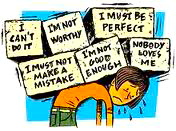
• trying to be perfect, & hating ourselves for not being able to be
• ‘yelling’ at ourselves – calling ourself stupid, crazy, weak…

ACTIONS
• active addictions & all other forms of self-denying, self-defeating, self-destructive behaviors (the big ways take big bites out of our soul, & the little ways sneakily gnaw away at us ! because it’s hard to catch the harm they do)

• being obnoxious, continual boasting, telling people off, arrogance, acting superior… (it keep us disconnected from others)
• cheat, lie, manipulate, control
• not following thru… with plans, promises, goals OR self-care
• regularly getting into verbal (&/or physical) fights, to punish & isolate
• sabotaging opportunities & preventing ourselves from going after what we want in life
• trying to do the impossible (change others, instead of ourselves)

SOCIAL
• choosing & then staying with people who continually hurt us, don’t understand or can’t listen, can’t mirror us, who use us, manipulate….
• humiliating ourselves by: telling all our faults, over-disclosing, trying desperately to convince someone (who doesn’t care) that we’re not as bad/wrong stupid as they think
• let others use us, take advantage, continually cross our boundaries
• mistrust everyone OR trust everyone, indiscriminately (copy our sick parents or play out the Scapegoat role)
• not standing up for ourselves – our rights, tastes, needs….
• trying to ‘one up’ others – to cover feeling ‘less than’

5. RESULTS of Self-Hate
a. Keeps us :
• a victim – believing we deserve whatever abuse or neglect we receive, any time, any place
• ‘anorexic’: under-earning, little or no affection, sex, love, attention, connections….
• afraid to know our ‘true self’ – which we’re sure is awful, maybe even evil
• depressed,  paranoid, hopeless, suicidal
• in an impotent rage (overt or hidden)
images-2because we still want things we think we can’t have or get
Keeps us :
• perfectionistic – expecting too much of ourself: we’re bad if we don’t have the American dream, higher education, lots of money, the right job / car / house / spouse ….
• taking everything personally!!! The wrong look, being ignored, a selfish remark… from others – can send us into a tailspin
• trapped in a constant state of FoA (fear of abandonment) – neediness, vulnerability, fear of being hurt or left alone

b. Reinforces:
• the belief that we have no rights, while thinking we can / must control everything & everyone (opposite of the Serenity Prayer)!
• the compulsion to stay symbiotically attached – to family & everyone else – because we don’t know we have a “True Self” to rely on
• letting others abuse us (we may even invite it) without stopping them or holding them accountable….
• the ‘need’ for addictions & any other forms of self-destructiveness
• staying in a rage because no one’s willing to take care of us, fix, us, magically make it all better

NEXT: S-H, #5