TYPES of Questions (Part 1c)

5 simple Qs

ASKING Qs THE RIGHT WAY
is a way of respecting someone

PREVIOUS: Types of Qs (Part 1b)

SITE: “Mutual Inquiry: 8 Steps to Deepen & Shift Thinking”

QUOTE: “Most misunderstandings in the world could be avoided if people would simply take the time to ask, “What else could this mean?”  ― Shannon L. Alder


TYPES of Questions
– Subsidiary (Qs)
LEADING
Qs that are phrased in such a way that sets up a person to answer the way the questioner wants – to agree with their point of view or pointing the listener in a certain direction. It’s not always done deliberately but is an easy trap to fall into.  EXP: “How much do you think this investment will grow?” indirectly implies it will grow, the issue is only how much. If the responder doesn’t catch the logic error, they’ll likely give a biased response.leading Qs

OPEN-ended
Qs that allow for much longer responses (than Closed ones), so are potentially more creative & informative, encouraging responders to be in control. They’re not ‘Why’ Qs, but rather ‘What or How’. They deal with unresolved issues not been finally determined, so ask the responder to reflect, give opinions & feelings. (“What are your personal strengths & weaknesses?”) (MORE…..)

ORGANIZING
Qs that group info into categories, forming logical structures. Finding patterns & relationships among & between collected fragments of info to create meaning & understanding. Whenever new valuable info surfaces, it can be added correctly to ta structure already in place. (“How can I make sense of all my confusing thoughts? // what categories do they fit into?”)

questionnaireQUESTIONNAIRE
Qs in list form, for research or survey designed to gather specific info. They have 4 basic purposes: (1)  to collect the appropriate data (2) make data compare-able & suitable for analysis (3) minimize bias in formulating & asking other Qs (4) make Qs engaging & varied (“Please fill out this Questionnaire about your dining experience”)

PLANNING
Qs that require thinking about how to structure the search for info, where to look & what resources will be needed, such as time, location, people…. It’s standing back & looking at the big picture before starting out. It also includes looking ahead to identify possible obstacles & consequences (“ Who ha written the best boo on this subject? // What clothes will I need for this trip? // MORE….)

PROVOCATIVE
Qs that are meant to challenge, push or throw conventional wisdom off-balance. They give free rein to doubt, disbelief & skepticism, often used in satire, parody or as an expose. These Qs are not always welcomed. They’re like the court jester whispering unpleasant truths in the king’s ear. The fool could often get away with Qs never allowed a legitimate member of the council, but he might also lose his head if the monarch took offense. (“Where’s the beef? // What’s you point?”)
probing QsPROBING
Qs that look below the surface to the heart of the matter, every Q answered leading to another one. Continually searching for more insight, the best results come from a convergence of 3-4 relevant elements of a subject, to get something far more pointed and powerful (“What made you want to go to the Middle East”? // MORE….)

Best used when dealing with someone who is evasive, or when trying to understand a specific issue. They’re usually CLOSED, looking for clarity about what someone’s saying, or good for getting to the root cause of a problem – by drilling down fast. Probing the cause of a problem may require going down several layers. Asking “WHY” after each answer – 5x – can be very revealing. Most people don’t consciously know they have deeper & deeper ‘reasons’ until asked.

NEXT: TYPES of Qs #1d

TYPES of Questions (Part 1b)

Qs re MEI WANT TO FIND OUT
all I can about myself!!

PREVIOUS: Types of Qs (Part 1a)

SITE: The Incredible Power Of The Right Qs


TYPES of Questions – Subsidiary (Qs)
ELABORATING
Qs that extend & stretch the meaning of info being gathered. They take the straightforward (obvious) & see where it might lead, searching below the surface to find implications in the original info (explicit –> implicit). (Reading between the lines, what does this text really mean?”)

EVALUATIVE
Qs that determine the importance, effectiveness, or worth of something or someone. Answers usually require sophisticated levels of thinking & feeling, asking the responder to make evaluations & judgements based on analyzing info at multiple levels & from different perspectives. (“What kind of a teacher was Mr Smith?”)

FACTUALfactual Qs
Qs that ask for reasonably simple, straight forward responses based on obvious facts or awareness. Usually aimed at the most basic level of thinking or feeling (“Did you go to a City College or Ivy League School”?)

FUNNELING
Qs that channel the respondent’s answers with a series of Qs that get narrower at each step, starting with open Qs, & ending with closed ones, or vice-versa:
a. From SPECIFIC to BROAD (Deductive)specifics first
Starts by asking a person to remember as many specifics of a situation as possible, & then work toward more general observations (“You saw that hit-&-run accident. What can you tell me about the man & his car?”)
b. From BROAD to SPECIFIC (Inductive)general info first
Here the responder is asked for an overview of a situation, & then using the big picture, try to remember as many specific details as they can (“If everyone has the ability to learn, then why do you think you can’t?”)

HYPOTHETICAL
Qs designed to explore possibilities & test relationships. They usually project a theory or an option out into the future, wondering what might happen if… Especially helpful when trying to decide between a number of choices, trying to solve a problem, or deciding if hunches, suppositions or hypotheses have any merit (“What do you think would happen of you let yourself be successful?”)

INFORMATIONAL
Qs designed to gather facts, searching for needed in a specific context, re some aspect, concept, issue, or problem. They ‘power’ all learning. (“How many inches in a mile?”)

INVENTIVEinventive Qs
Qs that turn findings inside out, upside down. They adjust, alter, distort, modify & rearrange bits & pieces of info – until they produce a Eureka moment – the discovery of something brand new (“If I combine these 5 yarns, I wonder if it would make a beautiful sweater?”)

IRRELEVANT
Qs that are made to distract, sidetrack or divert from the task or conversation at hand. This may be a tactic to keep others off-balance, get away from a sensitive topic or protect the speaker from being caught out. (“So, what did you say about the weather?”)
However, this type of Q can also be beneficial, since the creation of new knowledge almost always requires some wandering off course.
“The search for Truth requires the courage to venture out and away from the familiar and the known ….” From Moby Dick (”How can we understand the unconscious”?)

IRREVERENT
Qs that explore ideas or facts generally considered off-limits or over-the-top.. They challenge far more than conventional wisdom, holding no respect for authority, institutions or myths, leaping over, under or through walls, rules & regulations. They are considered disrespectful, or at the very least impolite, but are often used in comedy routines (“Why is the Emperor not wearing any clothes?”)

NEXT: Types of Qs – Part 3

TYPES of Questions (Part 1a)

Types of Qs


I NEVER KNEW HOW MANY WAYS
there were of asking questions

PREVIOUS: ACoAs & Questions (Part 3)

CHART ⬆️  based on material from http://www.edutopia.org

QUOTES: 36 Quotes from Successful People re. the Wisdom of Asking


TYPES of Questions
(Qs) – mainly from the Q Tool Kit
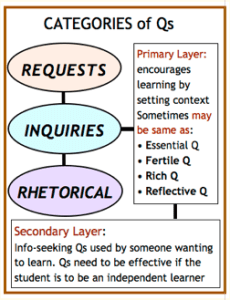
Each category gives us a wider framework & clarity for the process of finding out things.
Asking is essentially about being curious. It’s the only way of accessing knowledge from other people, so asking the right ones, in the right way, is crucial. When approached correctly, Qs can motivate & inspire people, generate new ideas & change the perception of a problem or situation.

ACoAs rightly say we don’t know what to ask, what word to us….. No matter what the circumstance – where it’s trying to find out something from a loved one, dealing with a work issue, questions a religious doctrine or trying to unravel what our politicians are saying – it’s helpful to know what we are trying to accomplish when asking a Q. It’s also important to know which kinds of Q may potentially get us the answers we’re looking for – and which kinds won’t!

While the following list is primarily focused on research in academic settings, it offers a variety of approaches when we’re trying to find answers or solve a dilemma in our daily lives. Many of these Q types are included in the skill of a good psychotherapist.

ESSENTIALpersonal needs
Qs that are at the center of info gathering. They’re at the heart of the search for truth, probing the deepest issues confronting us, those complex & baffling matters which elude simple answers (the meaning of Birth, Death, Love, Relationships…..). All other Qs, when used appropriately, enhance & illuminate the learning process. (EXP: “What does it mean to be a good friend? // MORE….)

SUBSIDIARY
Qs which combine to help build answers to the Essential Qs – which naturally spawn families of smaller ones – leading to insight. The more skillful we are at formulating & then categorizing these Qs, the more success we’ll be at constructing new knowledge.

All of the following categories are Subsidiary types

CLOSED
Qs that only require YES or NO answers, which can be a conversation stopper – but not necessarily. (“Are you cold?”). They can be having to choose from a list of possible options, to identify a piece of info, to help with a new dialogue, to encourage participation, or when fact-finding.
Since answers can be True or False, context is important. “Why” Qs are good for soliciting info, but can make people defensive, so they have to be worded carefully (“Do you want to eat right now?”, as opposed to “Why are you always hungry?”)

CONVERGENT
Qs ask for standard information, such as on multiple-choice tests for intelligence. They usually start with ‘what, where and when’ & lead to expected results. Answers looked for don’t require a great deal of creativity, but they emphasizing speed, accuracy & logic, focusing on recognizing the familiar, reapplying techniques & accumulating stored information (“What is the second largest country in the world: A– / B–/ C– or D–? diverge vs converge// What’s in that container?”)

DIVERGENT
Also called ‘lateral thinking’ are Qs that are used in the process of creating multiple, unique ideas or solutions related to a problem one is are trying to solve. They use existing knowledge as a base from which to explore territory ‘next to’ to something already known or understood, & perhaps help to avoid other people’s mistakes (“What other options do we have for saving money this month?” // How might life in the year 2100 differ from today?”)

NEXT: Types of Qs – Part 2

ACoAs & ASKING QUESTIONS (Part 4)


PREVIOUS: ACoAs & Qs #3

<— IMAGE from “Random Qs”

SITE:Asking the Right Qs
“Asking Qs is a subtle art, & everyone can benefit from improving their knowledge of Q. techniques. It’s the only way of accessing knowledge from others, so asking the right Q, in the right way, is crucially important.”


ASKING from the ADULT –
EXP:
Ina is on the bus, going home after a long painful day at the hospital. It’s crowded & she helps a lady get a seat next to her. Ina is in the mood for company, but doesn’t want to be intrusive. Intuiting that the womaking connectionman is friendly, Ina quietly says: “I feel like talking. How was your day?”

Her Q is well received, & they have a lovely, informative conversation for the next half hour. It turns out they have a lot in common, & the woman is happy to share her own difficult day with a sympathetic listener!

IDENTIFYING an ISSUE
What seems to be the trouble? // What do you make of _________?
How do you feel about __________?
What concerns you the most about _________?
What seems to be the problem? // What seems to be your main obstacle?
What is holding you back from _________________?
What do you think about doing X this way?

GET FURTHER INFO
Find out what someone has already done to resolve the problem
What do you mean by __________?
Tell me more about _______________ // What else?
What other ways did you try so far?
What will you have to do to get the job done?

so many QsOUTCOMES
Helps with negotiating a problem, or planning how to do something
How do you want ____________ to turn out?
What do you want? // What is your desired outcome?
What benefits would you like to get out of X?
What do you propose? // What is your plan?
If you do this, how will it affect ________ ?
What else do you need to consider?

TAKING ACTIONS
What will you do? // When will you do it?
How will I know you did it? // What are your next steps?
(MORE ….. Also re. Listening. ~ Irene Leonard, Coach)

🧤    🧤    🧤

ASKING for info when trying to find out something:
1. Do as much preliminary research on your own, if possible (internet….)
2. Then, ask the RIGHT people – someone or someplace what might know what you’re looking for. Also, consider the complexity of the problem & the skill level of the people you want to ask

3. Don’t ask for permission unless it’s a delicate subject, the person is very busy or they’re an authority figure. If they’re busy, ask if you can come back later. If not – find another source
4. Ask directly & clearly. If the person you’re asking doesn’t know or doesn’t have time, they may redirect you to someone who can be of more helpask a lot of people

5. Ask more than one person for the same info, such as people from different walks of life, different genders , different backgrounds….in order to get bits & pieces that may eventually lead to a whole answer, and to get a rounded perspective. It can also provide the same info from many sources, so that you can figure out what info is legitimate & what’s just someone’s point of view.

EXP
: As an adult – searching for an excellent orthodontist, at a ‘reasonable’ price – Marty interviewed 5 different doctors, & collated any info that overlapped, while checking out the location & ambiance of each dental office. Then chose the one that seemed to fit his need the best.

6. Be Patient. If you’re ‘depending’ on another person for an answer or solution, it may take longer than you’d like. Many people need time to process the Qs, figure out what they know or believe & then organize their thoughts, especially if it’s a new topic. Or they may just be busy or in a bad mood. If necessary, go away & come back later. Ask if they’re ready.  (Based on images from Deviant Art)

NEXT: TYPES OF Qs Part 1

ACoAs & ASKING QUESTIONS (Part 3)

5 easy questions I’M LEARNING THAT
I have lots of options

PREVIOUS: ACoAs & Asking Qs (Part 2)

SITE: “The Value of Questions” monograph by Professor B.F. Plybon

Importance of Asking Questions – Steve Jobs


HEALTHY:
ASKING Qs. FROM the ADULT

On the other hand, asking Qs from the Adult Ego State means we’re IN present reality, interacting with the person or situation in front of us, not someone from our past.
The Adult ES knows:
• other people are not a carbon copy of us
• we have options we didn’t have as a child
• that not everyone is as emotionally or physically
dangerous as our family
• that everyone has their own personality & experience – separate from our own
• that other adults are not responsible for taking care of us, nor are they responsible for healing our wounds – ie. not replacement parents

PURPOSE of ASKING
Asking appropriate, clear Qs is a legitimate, normal part of godifferencesod communication skills. Children ask a lot of Qs, mainly to find out about the world around them. But they also do not ask for emotional needs which healthy parents know & provide. Our didn’t, so we don’t know to ask for them now. Legitimate, healthy Qs may be a way :

• to find out about the other person – who they really are, not what we are projecting on to them from our past, or what we want them to be
• to respond to what they’re saying, not what we’re thinking or feeling
• if you don’t understand something
• to go deeper (How do feel about that”) — OR —

• to keep things LIGHT!! (“How was your vacation?”)
• to find out HOW someone thinks / feels about a current situation
• to find out what has someone already done, or what they already know about a need, a situation or experience

• of using the Socratic method, to help someone draw on their inner knowledge, to think thru a problem by figuring out who they are or what’s right for them
• to connect with a person you’ve been thrown together with for a short time. It cuts down on loneliness, makes you part of the larger world, you can learn something new & interesting, & you may even get unexpected help.

EFFECTIVE Questioning
There is no such thing as a stupid question – except if you aren’t interested in the answer. However, not all Qs are created equal. Different situations call for different types. Along with learning how to use Qs, effective questioning is also the ability to listen to the answer, & suspend judgment. Letting go of our preconceived needs & opinions make it possible to get the most info possible in a situation.

This requires being intent on understanding what the other person is really saying. What’s behind their words?
No matter how smart or experiences we may be, much of the time we’ll never guess what a person will say if we just ask “What do you mean?”

The following 2 sets of Qs can help improve communication & understanding of anyone we want to stay connected to, whether family, friends or in business. Modify the Qs according to the situation.
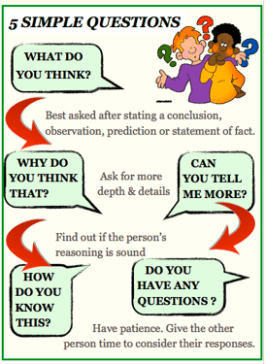
1. What do you think / feel?
This Q stopI wonders the questioner from talking too much.
2. Why do you think / feel that?
Once the person shares what they think or feel, this follow-up encourages them to provide the reasoning behind their thinking/ feeling

3. What leads you to believe this?
(How do you know this?)
This Q encourages the responder to make connections between their ideas / feelings & things they’ve experienced, read & seen.
4. Can you tell me more?
Most people always have more to say, but need encouragement to ‘spill’. This Q can extend their thinking & share added evidence for their ideas
5. Do you have any questions for me?
Use a friendly tone with ALL Qs, so the person doesn’t feel attacked or pressured to give the ‘right’ answer.  (Edutopia.org)

NEXT: ACoAs & Qs #4

ACoAs & ASKING QUESTIONS (Part 2)

defending self

PREVIOUS: ACoAs & Qs #1


AS ADULTS
(cont.)

NOTE: One of many effects of not having direct guidance, not being taught skills or appropriate socialization is a very deep belief that anything we figured out for ourselves was at best wrong, at worst absolutely worthless.

An antidote to this is to have at least one person who is knowledgeable in our area of activity & whom we respect – to review what we’ve accomplished or created on our mentoringown. They can validate it’s accuracy, skill level & value.

If that ‘mentor’ is fair & respectful, they can let us know the truth about our action or accomplishment. If the ‘verdict’ is less than stellar, we can look for ways to improve. If positive, the WIC part of us will be satisfied, & we can continue to flourish in whatever medium we’re best at.

BROAD categories of Questions (Qs)
a. Negative: to attack, to challenge, to embarrass, to stir things up
b. Positive: to connect, to encourage, get info, make you think, to teach

2 Inappropriate forms
From Narcissism
• Qs that are controlling (“Why don’t you do it THIS way?”)
• Qs from the WIC, in the victim position, if asking for info about things we DO know, as a way of feeling taken care of

• Qs coming from the assumption that others are like us
— PP: “Why would you even consider that?” or
— WIC: “Don’t you think this color is the most?”
symbiotic• Asking (insisting) others to go with you or do something that only you like, or that you know they dislike

• Qs that are rude &/or insensitive, because we don’t think about other people’s feelings – just impulsively ask whatever comes to mind without considering the consequences. This is a copy of our parents, who never acknowledged our emotions, so we act the same way

EXP: At a church dinner, teenage Jane notices that Sarah (in her 30s) is not wearing her engagement ring. Across the table, in a rather loud voice she asks about it but Sarah doesn’t answer, so Jane asks again – twice more before giving up. She doesn’t get the hint that her Q is not well received, although it’s obvious to everyone else.
Some know that Sarah’s engagement has been called off, so the Q is painful. Jane hasn’t gotten the 411 yet, but that’s not the point. Her Q is insensitive & intrusive – especially in such a public way – being in total immature mode, oblivious to another person’s reaction, especially after the initial rebuff.

With Anger
Qs with an attitude, which puts people off. Ironically, it’s always because the Abandonment angry QWound got bumped. We feel disconnected, which scares the WIC, which makes him/her angry. If we lash out we create more distance, which is the opposite of what we want.

Anger Qs are:
• in the form of accusing, blaming, shaming (“Who took my pen?”)
• an attack on an authority figure (“Why don’t you do something about this problem?”)
• challenging someone’s belief system (“How can you believe in that mythology?”)
• showing someone up (“You didn’t know that?”)

UNHEALTHY: ASKING Qs from the WIC – in the present
• whining, begging, bugging, not taking no for an answer
• talking from emotions: “I feel like I can’t trust her”, instead of: “ I can’t trust her”. The former implies you have a feeling, but aren’t sure – even tho you do actually know that person is not trustworthy – from experience
• talking around an important subject, rather than ask a direct Q

• not using “I” statements, when trying to get info. EXP: “Why can’t you be more attentive?”, instead of: “I’d like you to pay attention when I’m talking. Would you be willing to do that?”
• asking for what you need from the wrong person or venue, specially when you already know they’re not able or willing (like: going to an unavailable parent for comfort // trying to get emotional support in a school or business setting…..)

NEXT: ACoAs & Qs Part 3

ACoAs & ASKING QUESTIONS (Part 1)

asking QsIT NEVER DAWNS ON ME
to ask about the other person

PREVIOUS: Reverse Laundry List


PROBLEM
Another indicator of ACoA damage is the fear of asking questions or worse – not even realizing it is necessary, appropriate, even imperative.
At the core of this issue is the unconscious but ingrained perspective that we should not hold other people responsible for their words & actions. As emotionally immature adults, we are still going on the assumption that everything is our fault (narcissistic S-H), & therefore it’s all up to us to correct misunderstandings & fix whatever is causing us pain (narcissistic grandiosity).

In CHILDHOOD
Most ACoAs stopped asking Qs because of the messages & reactions we got from our dysfunctional family as well as from outside sources such as school & religious institutions. “Children should be seen & not heard”. They :
• didn’t want their authority questioned
• didn’t want their bad behavior pointed out or abuse objected to
• didn’t want their hypocrisy & neglect uncovered….not allowed to ask
AND they
• couldn’t be bothered to listen or explain things
• didn’t have the patience to show us what they knew how to do
• made it sound like we’re dumb for not knowing things they knew
• told us we were disrespectful for questioning their authority
• punished us with a smack or with guilt for wanting to know what’s going on around us • made fun of us for exploring & being curious ……

NOTE: Curious & clever children may seem to be ‘challenging’ the adults “WHY … WHY…” But if we got a bad reaction (“you’re arrogant, you’re being difficult, you’re disrespectful”) it’s almost always because the person did NOT know the answer & was ashamed to admit it

No matter what Toxic family Role were fell in to as kids (Hero, Scapegoat, Lost Child, Mascot), ultimately we were on our own, because our wounded parents we unable to connect with us in healthy loving ways. We got the message that we were a burden to them – or worse – hated (“You’ll be the death of me yet!”). We understood that if we were to figure things out it would have to be from other sources, like school & our peers, but mainly by just watching other people & events. Quietly, secretly observing the world around us helped, but it didn’t encourage asking questions.

As ADULTS
Our early trauma, distorted mirroring & lack of good role models has left holes in our ability to think of what to say. This is because of missing information, rather thanbeing mute stupidity. It literally means not having the vocabulary for legitimate questioning – what words to use, what point of view we need to come from, or what to expect.
BUT this can be learned from books such as “The Gentle Art of Verbal Self-Defense”, & from others who have already know how.

Many of us believe that any form of Qs is impertinent, boundary invasive, & just plain rude – which is not true when Qs come from our Adult ES.
And when someone says or does something unkind, inappropriate, narcissistic or flat-out mean – we justify, over-explain, excuse ourselves (Sorry, Sorry), instead of lobbing the ball back at the other person by saying something like:“What did you mean? // Why did you say it that way? // Is that what you would do – want?… (See “Useful Responses”).

ACoAs were not allowed to defend, protect or stand up for ourselves, to not have the right to object to abuse, & to never know what our true needs are. So we continue to live in a quasi-world of not really belonging, not having rights, not being heard, not having access to our personal power, & most of all – never truly feeling safe.  Others of us will bite back when we feel neglected, dismissed or accused, a version of the PP &/or WIC trying to protect ourselves, but this is simply ineffective & can serve to escalate a bad situation.

NEXT: ACoAs & Asking Qs – Part 2

REVERSE Laundry List & Healthy Version

drunk narcissists I HATE KNOWING
how much I’ve copied them!

PREVIOUS:

 LL (#1)

SITE: ACoAs – Qualities & Traits

REVIEW:Variation of ACoA Laundry List” post

NOTE: Reprinted from the ACoA World Service Org.

REVERSE Laundry List – acting out the Introject (the PP)
1. To cover our fear of people and our dread of isolation we tragically become the very authority figures who frighten others and cause them to withdraw.
2. To avoid becoming enmeshed and entangled with other people and losing ourselves in the process, we become rigidly self-sufficient. We disdain the approval of others.
3. We frighten people with our anger and threat of belittling criticism.
4. We dominate others and abandon them before they can abandon us or we avoid relationships with dependent people altogether. To avoid being hurt, we isolate and dissociate and thereby abandon ourselves.

5. We live life from the standpoint of a victimizer, and are attracted to people we can bad attitudemanipulate and control in our important relationships.
6. We are irresponsible and self-centered. Our inflated sense of self-worth and self-importance prevents us from seeing our deficiencies and shortcomings.
7. We make others feel guilty when they attempt to assert themselves.
8. We inhibit our fear by staying deadened and numb.
9. We hate people who “play” the victim and beg to be rescued.
10. We deny that we’ve been hurt and are suppressing our emotions by the dramatic expression of “pseudo” feelings.

11. To protect ourselves from self punishment for failing to “save” the family we project our self-hate onto others and punish them instead.
12. We “manage” the massive amount of deprivation we feel, coming from abandonment within the home, by quickly letting go of relationships that threaten our “independence” (never get too close).
13. We refuse to admit we’ve been affected by family dysfunction or that there was dysfunction in the home or that we have internalized any of the family’s destructive attitudes and behaviors.
14. We act as if we are nothing like the dependent people who raised us.

OPPOSITE of Reverse Laundry List
1. We face and resolve our fear of people and our dread of isolation and stop intimidating others with our power and position.
2. We realize the sanctuary we have built to protect the frightened and injured child within has become a prison and we become willing to risk moving out of isolation.
3. With our renewed sense of self-worth and self-esteem we realize it is no longer necessary to protect ourselves by intimidating others with contempt, ridicule and anger.
4. We accept and comfort the isolated and hurt inner child we have abandoned and disavowed and thereby end the need to act out our fears of enmeshment and abandonment with other people.

5. Because we are whole and complete we no longer try to control others through manipulation and force and bind them to us with fear in order to avoid feeling isolated and alone.
6. Through our in-depth inventory we discover our true identity as capable, worthwhile people. By asking to have our shortcomings removed we are freed from the burden of inferiority and grandiosity.healing heart
7. We support and encourage others in their efforts to be assertive.
8.We uncover, acknowledge and express our childhood fears and withdraw from emotional intoxication.

9. We have compassion for anyone who is trapped in the “drama triangle” and is desperately searching for a way out of insanity.
10. We accept we were traumatized in childhood and lost the ability to feel. Using the 12 Steps as a program of recovery we regain the ability to feel and remember and become whole human beings who are happy, joyous and free.
11. In accepting we were powerless as children to “save” our family we are able to release our self-hate and to stop punishing ourselves and others for not being enough.
12. By accepting and reuniting with the inner child we are no longer threatened by intimacy, by the fear of being engulfed or made invisible.
13. By acknowledging the reality of family dysfunction we no longer have to act as if nothing were wrong or keep denying that we are still unconsciously reacting to childhood harm and injury.
14. We stop denying and do something about our post-traumatic dependency on substances, people, places and things to distort and avoid reality.

NEXT:

ORIGINAL Laundry List + Healthy Version

bad family IT’S GOOD TO HAVE CLARITY
about the source of our damage

PREVIOUS:


SITEPsychological Characteristics of ACoAs – article

NOTE
: Part 1 & 2 Reprinted from the ACoA World Service Org.
— The Laundry List serves as the basis for ‘The Problem’ statement – the intro read at every ACA meeting

BASIC LAUNDRY LIST – acting out the Wounded Child
1. We became isolated and afraid of people and authority figures.
2. We became approval seekers and lost our identity in the process.
3. We are frightened by angry people and any personal criticism.
4. We either become alcoholics, marry them or both, or find another compulsive personality such as a workaholic to fulfill our sick abandonment needs.
5. We live life from the viewpoint of victims and we are attracted by that weakness in our love and friendship relationships.

6. We have an overdeveloped sense of responsibility and it is easier for us to be concerned with others rather than ourselves; this enables us not to look too closely at our own faults, etc.broken heart
7. We get guilt feelings when we stand up for ourselves instead of giving in to others.
8. We became addicted to excitement.
9. We confuse love and pity and tend to “love” people we can “pity” and “rescue.”
10. We have “stuffed” our feelings from our traumatic childhoods and have lost the ability to feel or express our feelings because it hurts so much (Denial).

11. We judge ourselves harshly and have a very low sense of self-esteem.
12. We are dependent personalities who are terrified of abandonment and will do anything to hold on to a relationship in order not to experience painful abandonment feelings, which we received from living with sick people who were never there emotionally for us.
13. Alcoholism is a family disease; and we became para-alcoholics and took on the characteristics of that disease even though we did not pick up the drink.
14.Para-alcoholics are reactors rather than actors.
Tony A., 1978

OPPOSITE of the LAUNDRY LIST – healthy version
1. We move out of isolation and are not unrealistically afraid of other people, even authority figures.
2. We do not depend on others to tell us who we are.
3. We are not automatically frightened by angry people and no longer regard personal criticism as a threat.
4. We do not have a compulsive need to recreate abandonment.
5. We stop living life from the standpoint of victims and are not attracted by this trait in our important relationships.

6. We do not use enabling as a way to avoid looking at our own shortcomings.
7. We do not feel guilty when we stand up for ourselves.repaied heart
8. We avoid emotional intoxication and choose workable relationships instead of constant upset.
9. We are able to distinguish love from pity, and do not think “rescuing” people we “pity” is an act of love.

10. We come out of denial about our traumatic childhoods and regain the ability to feel and express our emotions.
11. We stop judging and condemning ourselves and discover a sense of self-worth.
12. We grow in independence and are no longer terrified of abandonment. We have interdependent relationships with healthy people, not dependent relationships with people who are emotionally unavailable.
13.The characteristics of alcoholism and para-alcoholism we have internalized are identified, acknowledged, and removed.
14.We are actors, not reactors.

NEXT: REVERSE L.L. (Part 2)

OUR SENSES & Learning – Combos (#6)

PREVIOUS: Taste #3b


SITEs: Learning Styles Affects How You Play GOLF

• 3 Reasons to Use Multi-sensory Teaching Techniques

‘LEARNING STYLES’ myth // MODALITIES – & theory  // Links to OTHER QUESTIONNAIRES

MULTI-SENSORY Learning
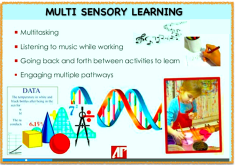
Multi-modal absorption is the ability of the nervous system to combine the input from all our senses, making it easier to detect & identify available information. This happens when multi-modal brain cells receive stimuli that overlap the different modalities, & it kicks in when no one particular sense responds to an event.

Most people – about 60% – use a combinations of the 3 main modalities (sight, hearing, body movement). While some may have 1 or 2 strong preferences, it’s normal for all the other senses to be used as well. Because it involves more Brain areas, multi-sensing allows for more mental connections & associations when learning any new concept. This makes it more efficient & effective, providing redundancy & enhancing reinforcement.

Combining all the senses becomes a powerful tool for encouraging Language Arts learning, in important ways. Key Benefits:
Much more knowledge is transferred, with the possibility of more being absorbed. Student engagement is more likely, which can improve attitudes towards learning, & therefore higher student achievement. (MORE….Research study).

Multi-sensory learning is particularly helpful for kids with learning & attention issues, such as having trouble with visual or auditory processing. It helps kids tap into learning strengths & form memories. And it allows them to use a wider range of ways to show what they’ve learned.

It gives them more ways to connect with what they’re learning & lets them use many ways to show what they’ve absorbed. It helps students:
• Collect information & make connections between new info & what they already know
• Understand & work through problems, using nonverbal problem-solving skills. Providing multiple ways to learn gives every kid a chance to succeed

Audio-Visual-Kinesthetic: A-V-K students learn best by doing, experiencing, being personally involved. They definitely need a combination of stimuli. Handling material along with seeing & hearing words and numbers make a big difference to them. Otherwise they may not seem to be able to grasp or retain info unless they’re totally involved. They want to touch & handle whatever they’re learning. Sometimes just writing or a symbolic wiggling of the finger is a symptom of the A-V-K learner.

TECH Learners (visual-haptic-kinesthetic)
• want to learn everything via the computer
• enjoy & utechnical typese the video camera
• are mechanically oriented
• like integrated learning activities
• understand technology tools without formal instruction
• can read technical manuals without intensive training
• spend excessive time on computer and/or video games
• know how to work with and use hardware and software
• communicate with others via text, e-mail & Internet
• understand how to integrate various technologies

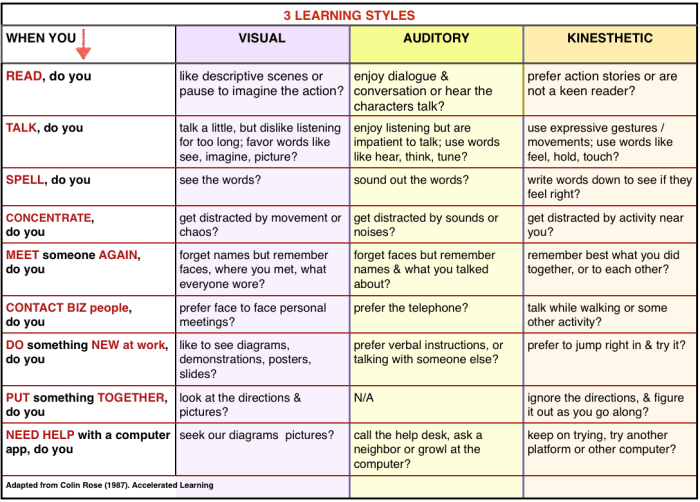
LEARNING STYLES info & Qs
CHART: See which column fits you the best. OR – some of each?

Qs re Learning Tpes

INTERESTING:
In terms of MBTI – there’s a wide gap between Sensate & Intuitive Learners.

INTUITIVE (iN) vs. SENSORY (S) Learning
Intuitives – 30% of the population, important as TRAIL BLAZERS
INFO: They prefer speed & depth of insight. They learn to trust pattern recognition to help them understand info quickly & see things that aren’t ‘there’. Can extrapolate from large amounts of facts & experiences with only a few data points

TIME: iNs are already comfortable seeing what ‘isn’t there’, theorizing or speculating on what could be in both the here-and-now & in the future. The past is only useful as a reference for future predictions
VALUES: They’re focused more on possibilities, memes, paradigms, perspectives & concepts. Conversation generally revolves around these things, with little interest in small talk.

Sensory – from MBTI : 70%, important for “HOLDING DOWN the FORT”
INFO: Sensors need it to be reliable – using the 5 senses to learn things. They have the same intuitive ability as iNs, but don’t trust it, so they ignore it. Instead, they look for anything that can be verified in the Real World, becoming masters of historical facts & fantastic at manipulating objects in real time. If it’s right in front of you, it’s reliable. Speculation is not.

TIME: Sensors can’t count on something that hasn’t happened yet, so the future is not interesting
VALUES: are about things like family, tradition, actions, old friends..… trustworthy because they’re all rooted in the known & knowable.
(MORE…..in POST: S vs N)

NEXT: Laundry list