Anger & the BRAIN (Part 3)

brain chemicals

DON’T KNOW WHAT’S WRONG
must be those pesky chemicals!

PREVIOUS: Anger & the Brain (Part 2)

SITE: “Helping children with anger


2. EMOTIONAL REACTIONS (cont)
a. The ‘Reptilian’

b. The LIMBIC SYSTEM (cont.)
iii. The Amygdala (cont)
While there are successful action-tools to manage hostile responses to life’s difficulties, chronically angry people may have trouble using them if their brain isn’t producing enough acetyl-choline, the hormone which tempers the more severe effects of adrenaline & helps to schedule REM sleep.

BTW: Introverts generally have higher level of this calming neuro-transmitter, so they’re more comfortable being alone, not needing a lot of stimulation in order to burn off excess adrenaline.(More...)
AND – they’re highly sensitive to Dopamine, so – too much will over-stimulate them.

✤ Under sudden stress, the brain is wired to make us react before we can properly consider the consequences. While the amygdala is very efficient at warning us about a threat –
it can only react from previously stored action-patterns, so it’s not good at judging or evaluating what to do about it.

When flooded with emotions, it hijacksthe rest of the brain, so the prefrontal cortex (PFC) gets temporarily cut off, without the thinking-option of checking if our behavior is reasonable, appropriate or safe.

EXP: When anger takes over, a person will tend to ‘shoot from the hip’ instead of from the head. However, resilient people (emotionally & chemically balanced) are able to make a faster recovery from stress, allowing them to BrainCoherenceEmotionuse the thinking brain more easily to calm emotional intensity.

✤ Emotional flooding does not excuse bad behavior, but it does mean that managing anger properly is a skill that has to be learned, NOT something we’re born able to do instinctively.

NOTE to ACoAs: This is another reason there are times when we can’t seem to respond successfully or at all – until well past the event. It’s when we’re shocked by someone saying or doing something that scares our WIC, whether outrageous, actually harmful, or just because it reminds us of our family.

For many us, it’s only later – sometimes much later – that the cortex is finally able to kick in & lets us think of all the ‘right’ or clever things we could / wish we could have said. Very annoying, especially in the modern world where words are more often needed than fists!
(See ‘Communication discrepancies in “D.M., #5”)

Re. the Amygdala in Animals
Overactive – When their brains were stressed by electronic stimulation, they became aggressive. As the irritation continued (just as ACoAs suffered as kids), the amygdala became overactive, dramatically increasing the subjects’ agitation & short temper
Missing – When the 2 structures were removed, the animals became very tame, no longer responding to things that previously would have caused rage, fear or sexual interest….
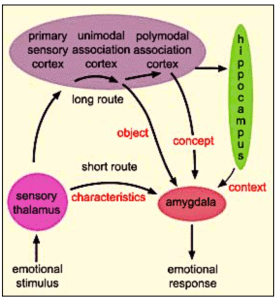
FEAR PATHS:
Information (stimuli) first goes to the thalamus & then to 2 parallel pathways:
√ The ‘low road’/ short route (12 milli-sec.) provides a fast, rough impression of the situation, bypassing the ‘thinking’ brain. This creates an emotional response before all the facts are in

√ The ‘high road’ / long route (24 milli-sec.) – goes from emotional input, thru the cortex to the amygdala – allowing the brain to determine if an event is truly life threatening.
If the frontal cortex rationally decides that it’s not, it dampens the intensity of the amygdala’s quick reaction, via the unconscious. (MORE…. birth – age 7) (Circuitry & Sense of SELF)
In Humans
:
When the amygdala is damaged, experiences which should cause alarm don’t get to the cortex for processing (high road), so that person will compulsively go toward dangerous things, even when repeatedly warned against doing so – because the fear response is missing (low road).
too much risk
EXP:  When one woman had her amygdala removed to stop her seizures, those were eliminated.
But also – she was no longer able to recognize fear or anger in herself, or in other people’s voices.
However, she could still identify & understand expressions of sadness, disgust, happiness, & surprise.
◆ In the case of PTSD, the input / event route through the cortex isn’t able to dampen enough of the fear response that has already taken place previously & repeatedly in the low road.

NEXT: Anger & the Brain (Part 4)

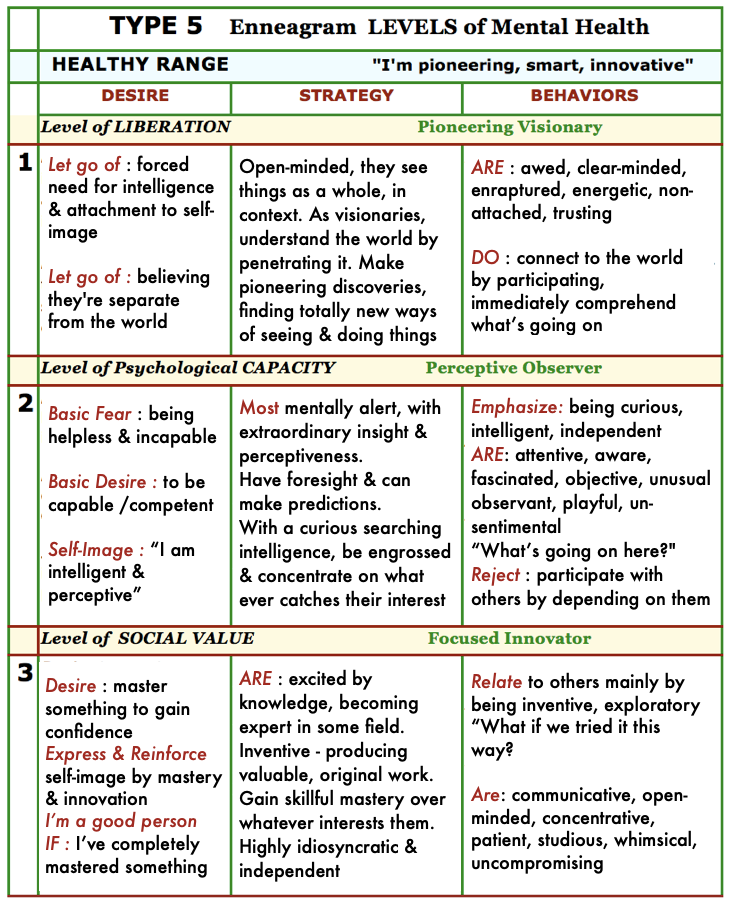
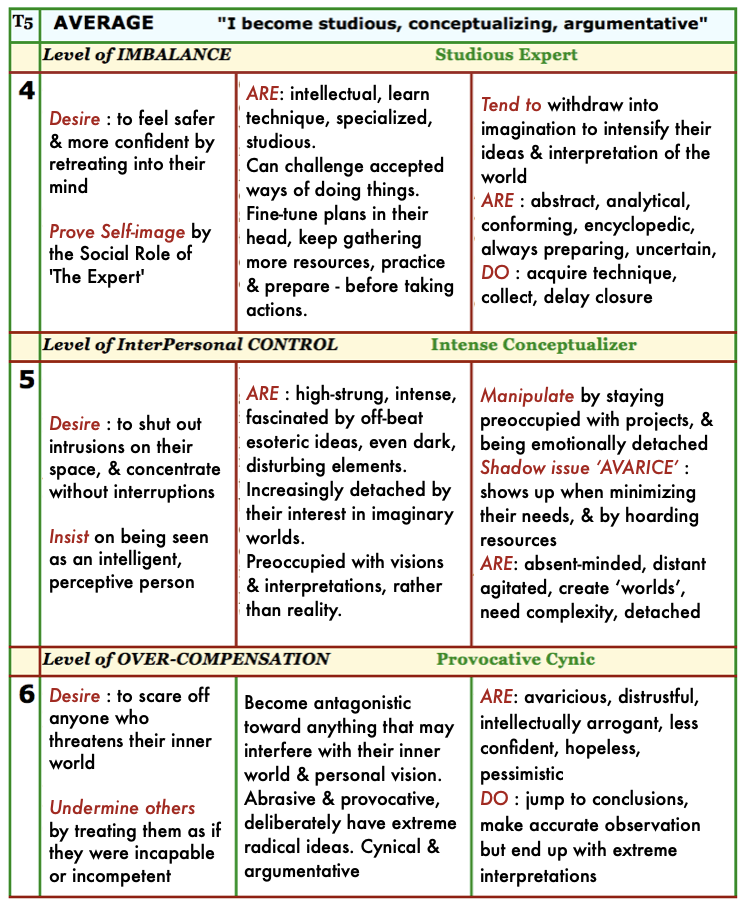
Enneagram – 9 LEVELS for TYPE 5

k13563297THE MORE I KNOW
the safer I feel

PREVIOUS: Type 4 Levels

SITEs: Type 5 overview
Enneagram Levels & ADDICTION Recovery


LEVELS by TYPE (cont.)
TYPE 5 – Investigators/Observers
Healthy Levels – Clarity: Esoteric knowledge. Able to demonstrate visionary intellect and inventiveness.
Unhealthy levels – Psychotic states: Annihilating behavior. Becomes increasingly eccentric and isolated.

HEALTHY 5s: I like to master knowledge and share it with the world.
The Innovator: They’re visionary & participatory. Discover/develop new technologies or systems of thought which are useful to others
● Detachment overcomes the vice of Avarice (the illusion of retention). As they become more confident in their knowledge, they can be bolder & more assertive, like an 8 (one of their Arrows). Intense and intellectual, they’re analytic, insightful, inventive & extremely perceptive. Deeply curious about the world, they find their own answers & explore uncharted territory. They make remarkable mental leaps & connections, valued as sources of considerable wisdom.

AVERAGE 5s: I find analytical living rewarding.
The Intellectual: They enjoy philosophical discussion/debate, endlessly curious, love to learn, thoughtful
● They’ve lost the original knowledge of omniscience (unified, limitless knowledge). This has been corrupted into the belief that the self must divide from the world to acquire this knowledge so they won’t “lose themselves” existentially. This leads to holding back, disliking intrusions on their time and space

UNHEALTHY 5s: I struggle with the meaningless of existence.
The Nihilist: They’re cold, devoid of feelings, detached, hermetic, struggle with the meaninglessness of existence
● They become arrogant, detached, eccentric. preoccupied, reclusive.

INTEGRATION
Type 5 LEVELSHealthy loop: Run by the Basic Desire of ‘Needing to understand the world’, making 5s observe and analyze the world. When they’ve reached that understanding their need is satisfied & balance is reached.
Average state: When 5s do less of observing and analyzing the world, they have trouble understanding it. This increases their need & may push to study more, creating a balance.
Unhealthy loop is run by the Basic Fear of ‘being overwhelmed by the world’, causing 5s to become detached from the people & world around them, as a defense. This leads to understanding the world even less, increasing the basic fear & prevents balance.

LENS you see the world thru: “I’m detached from the situation, & I step back to analyze and understand it.”
GROWTH: Breaking control of the basic fear comes from not detaching and start to actively observe and analyze the real world more.
~~~~~~~~~~~~~~~~~~~~~~~~~~
LEVEL 5 in BIZ (Mid-Average)
AS LEADERS
5s like to be in charge, & at this level can be ambitious, restless & intimidating in the pursuit of control & rewards. The best 5 leaders make you feel ‘inside’ a group of special initiates who have access to special knowledge which you’re responsible for nurturing & refining.
'average' levelsTHEY:
— are capable of high-level abstract thinking, easily reducing a great deal of info into a core proposition
— can wait patiently for results, not panicking as long as the basic necessities are on hand
— attract followers because of their knowledge worth having – the most sophisticated, profound or cutting edge, & they know how to use it

SUPERVISING Type 5 WORKERS
Remember that THEY:
— love inside information, looking for that specialized knowledge to give them an edge or provide a useful insight
— love details – what might be too trivial to others may be a central fact for the 5
— like to think about info which has been requested or a problem posed to them, so they can be sure to give the right answer
— like their privacy, generally avoid conflict & value un-emotional decision-making
— usually see thru flattery or charismatic leadership (manipulations)
— respond well to being asked for help in solving problems, since it encourages their self-esteem
— may seem uninterested in their environment because of being quiet but in fact are absorbing everything
— notice all the subtle expressions & characteristics of others in meetings, even as they’re paying attention to any information being presented. This combination allows them to give a brief but accurate summary of the proceeding.   (From: Global Leadership Foundation)

NEXT: EnneaHUMOR

Unrealistic Expectations – OVER (Part 3)

PREVIOUS: Unrealistic –

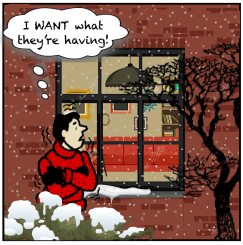
<— “OUT IN THE COLD” by DMT


What ACoAs SHOULD NOT expect…. (cont.)
B. ….of OTHERS (cont.)
1. To be Rescued
2. To be Symbiotic

3. To Mind-Read :  WE WANT / expect that people will automatically know what we need & magically come thru for us, without us having to ask! We’re not allowed to know what those needs are, & if we do, not allowed to get them met. So – we have to “depend on the kindness of strangers”.

💚 We want them to do things that we :
• never learned how, & resist doing so now, even tho there’s more help & info available in the world than ever beforemind reader
• really can do for ourselves, but it would feel too lonely & sad if we did, reminding us of the original A/A (no one to help)

• are terrified of trying / risking, believing we’re too stupid, incompetent, slow…AND what if we fail?
• know it will take a lot of time (process) & we’re impatient. As kids, having to wait usually meant it would never happen. So, don’t ask us to wait – some more!
• have trouble with (meeting our needs) because of a disability, like ADD or dyslexia, depression or other disorders, so we don’t make the effort to learn how to manage them – just keep being their victim

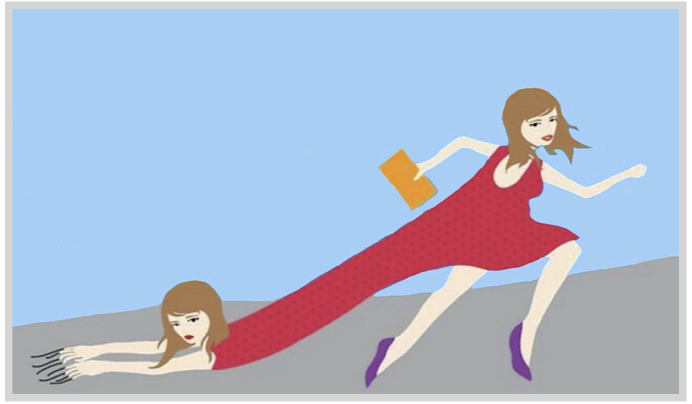
4. To be Healthy : WE WANT others to be something they aren’t or can’t be (ever – or not yet), because they’re pushing our abandonment button, activating our wounds – so we’re impatient, even desperate.  We’re afraid if they don’t change we’ll be trapped with them & continue to be hurt, OR have to leave them.

That puts us in a double bind : 💔 it’s painful to stay, it’s painful to leave. However, for most ACoAs, our FoA is greater than our tolerance for loneliness & sadness – so we stay!
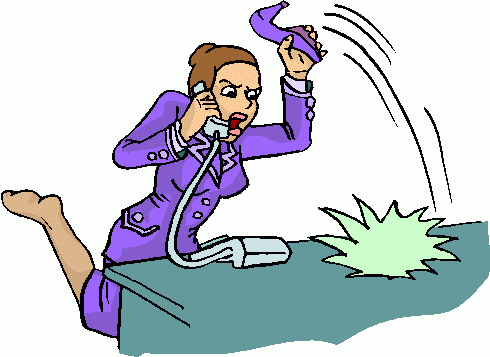
a. Maybe we keep trying to explain what we want & what they’re doing wrong – at great length, as if they’ll ‘get it’.  angry woman
When it doesn’t work!!! we act like:
• bullying control freaks – trying to make them give us what we want
• raging, abusive crazies – as if yelling would get thru to them
• sullen, complaining victims – expressing all our childhood powerless & hopeless feelings in the form of passive anger
• punishing, vengeful harpies – probably like one of our parents, to express our extreme frustration and anxiety
• people-pleasing doormats – overly helpful, solicitous, care-taking, to insure we’ll be indispensable, & then they’ll never leave …..

❎ We are NOT fundamentally any of these things, which come from the the PP or the WIC. It’s our FS damage, which is repairable.
OR:
b. We (silently or loudly) WAIT & WAIT, all the time desperate & in a panic. When others don’t take care of us, we hate them for not coming thru, BUT also blame ourselves for not being good enough to deserve it. We get depressed, ashamed, resentful & even more hopeless.
We say: “I knew it. No one can be trusted”!  or “See, the universe doesn’t want me to have anything!”  Can you hear the kid screaming?

5. To be Available (re. Relationships) : WE WANT people who we like – to like us back, regardless (is Cupid in your pocket?). We assume:
that we’ll be able to win over that one person in the room who is giving us the cold shoulder
that someone we feel deeply connected to will be our friend, mate, mentor… always & forever, as long as we’re both alive cupid

that the party, event, date, trip… with someone we care about – will turn out exactly the way we fantasize / plan it to be – usually without letting the other person know what we’re expecting/ wanting!
that if a new acquaintance is very friendly, & we spent a nice time together, once or twice, that they’ll make an effort to continue the association (It just doesn’t happen with some people – & it’s no ones fault!)

that someone will do what they said they would – for sure!, like, call us back, bring us something they promised, keep their word, help us out, give us some info we need…
A lot of people say they’ll do things & mean it at the time, but maybe they’re just people-pleasing, or they forget, or change their mind, or get too busy

C. What ACoAs SHOULD NOT expect…. re. TIME: See posts on unrealistic expectations about how long things take, both too long & not long enough –ACoAs & TIME”

NEXT: UNDER expect

Useful & Clever RESPONSES


I WISH I HAD A GOOD COME-BACK
when someone’s mean or stupid

PREVIOUS: Dealing with Toxic People

REVIEW: “Effective Responses” Heal & Grow website

SITE:” How to Craft the Perfect Comeback, According to Experts”

BOOK: “Viva la Repartee: Clever Comebacks

FRUSTRATED: ACoAs are often stumped when others say something unkind, controlling or ridiculous. No matter how smart, educated or competent, we’re often rendered mute by what we hear. First we’re shocked by the comments, not expecting such outrageous or boorish remarks. Then we can’t figure out what to say.

• So, here are some ideas that may be useful – some straightforward, some tongue-in-cheek. You may be uncomfortable with them if you think they’re rude, confrontational or hostile.  Actually, they are not – because: a. they are statements of fact
b. when said with humor, from our Adult ego state, & NOT in anger – they are very effective

TOXIC RULE: “Only other peoples’ feelings count”, which really amounts to:
• not holding others accountable for stepping all over us. Why do we let them get away with it, but condemn ourselves for being direct?
• being willing to abandon our Inner Child in favor of others, inslike ideastead of protecting it using a Loving Parent ego state?

SUGGESTION: Use these lines as is, or modify them to your personal taste. They represent setting boundary & teaching others how we want to be treated.
Pick 2-3 phrases that suit you & memorize them. Say them to yourself all day long, to get them set in your brain. Then, when you really need one – it’ll fall out of your mouth without having to think about it!
🏈 —

THEM: That was a long time ago / just get over it, let it go / stop dwelling on the past / why are dredging up old ……
YOU: 🔹That works for you, but it’s not where I’m at right now. I’d appreciate your support, but I understand if you can’t
🔹That’s exactly what I’m working on, it’s just going to take time, & I want to do it right
🔹I understand you don’t want to talk about this, so we don’t have to
🔹Getting well is the beat revenge – that’s what I’m aiming for

THEM: “That’s just a lot of psycho-babble”
YOU: “If you think that’s psycho-babble, you must not understand it.”

THEM
: You’re too sensitive // YOU: And you’re too insensitiveclever

THEM: You’re crazy! // YOU: Maybe, but I’m never boring!

THEM: You laugh a lot at everything I say
YOU: I’m easily amused!

THEM: You’re too emotional, over-reacting
YOU: You mean I’m too happy?  // Well, at least I can feel! // Maybe you could be more sensitive // You could use Compassion Lessons

THEM: Why don’t you …. / you’re just…. / if you…. //
YOU: That’s not helpful

THEM: You shouldn’t feel that way
YOU: Do you mean what I’m thinking or my emotions?

THEM: You should……
YOU: I try never to ‘should’ on myself. So please don’t ‘should’ on me either

THEM: You have to do (XXX) for me! (or else you’re bad / I’ll die…)
YOU: I’m sorry, but I can only take care of myself right now

THEM: That’s a stupid way to….. You …….
YOU: I don’t talk to myself that way

THEM: Why don’t you get (another cat) / why don’t you do…..?
YOU: Thanks, but I was talking about how I’m feeling. I wasn’t looking for advice or suggestions

THEM:  Don’t bother with that / do it this way / why can’t you…..?
YOU:  I don’t respond well to threats / being bullied / treated like a kidstop it!

THEM: —- (fill in the blank)
  //  YOU: Don’t talk to me that way

THEM: You really like that…..? / do you actually believe in that….?
YOU: Why did you ask // why say it that way?

THEM: If I were you, I’d….  //
YOU: Thank you for sharing your way of doing things!

THEM: If you don’t —– You’ll never see me again / I’ll kill myself / I’ll end up…. (& it’ll be your fault)
YOU:  I’m sorry to hear that. But do whatever makes you comfortable

THEM: I ne-e-e-ed you…. you’re the only one who can do…. who understands me….
YOU:  Well, actually, I have my hands full taking care of my own life. And there are lots of other people, groups, books… that can help you

THEM: If your mother says something provocative (or dad)
YOU: “Oh, mother!” – accent on ‘mother’, with at smile, then zip-the-lip

THEM: I’m just trying to be helpful
YOU: I’ve already tried that / I didn’t ask for help / That doesn’t work for me / Your suggestion doesn’t aideaspply to my situation / That’s not who I am / I was just expressing emotions

THEM:
 // YOU:
—> Add your own

PS: Yes, there’s a time & a place to know when to respond to insensitive comments & when not to. That takes practice, information & self-esteem based on knowing our rights.

GREY ROCKINGgrey rocking
And for those of us who are still dealing with the severe form of dysfunction – the malignant narcissists in our midst – the ONLY way to cope appropriately is to be a GRAY ROCK around them!
(
from “Psychopathfree” Forum)

NEXT: ACoAs – Dealing with Criticism (Part 1)

Our Wounded INNER CHILD (Part 3)

PREVIOUS:
Wounded IC #2

SITE: 6 Steps to Help Heal Your Inner Child


See ACRONYM page for abbrev.


Some T.E.A. ways our WIC runs the show
1. THOUGHTS (Ts)
S-H & believing what the PP voice is saying about us : thinking no one likes us, we’ll never get anywhere, we can’t get better…
• always apologizing
• awful-izing (always assuming the worst)
• devaluing anything we are, think or do
• not developing our knowledge base
• not thinking clearly (using C.D.s)
• not truthful, respectful, clear, direct – in our communications
• taking everything personally
• telling strangers too much personal info

2. EMOTIONS (Es)
• S-H : 
feel bad about ourselves
• always feeling left out, unacceptable
• being emotionally numb
• being impatient with process
• being paranoid in everyday situations
• being too easily hurt
• having any sort of tantrum, break-down
• idealizing anyone
• long-term depression, feeling suicidal, panic attacks, constant anxiety
• magical thinking, grandiosity
• not emotionally honest or open with loved ones
• raging at small or non-existent slights

3. ACTIONS (As)
S-H prevents us from taking good care of ourselves
• doing anything dangerous (fun) with little or no training or preparation
• having unprotected sex, jumping into bed too soon
PP & WCI• dating or marrying emotionally volatile &/or unavailable, actively addicted, physically dangerous people….
• making things harder than they have to be
• not doing a good job at work
• not getting help when we need it
• regularly being late
• staying too long in any inappropriate situation
• trying to ‘fix’ others

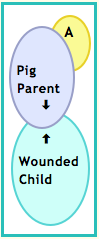
To HEAL & GROW, the WIC has to turn over it’s executive Powers to the “UNIT” (H.A. & L.P.) in order to finally get taken care of – correctly.
But the only way the WIC will let go of its role as “Little Adult” is for us to prove the Adult Self is trustworthy, dependable & loving – by showing that we’re willing to take care of ourselves by being capable & consistent.

❧ With enough healing we can be relatively free of our addiction to the harmful patterns of our upbringing, even tho it’s never going to be complete. Then we’ll have nothing to rebel against or slavishly copy. We can CHOOSE who we want to be & what we want to do!

AND – because genetics plays a part in our True Identity – along with our training – what we choose to be or do may in some ways be similar to our background BUT based on self-esteem, natural talents & fulfilling our human rights!
The KEY is to not obey the old bad rules even when we can still hear them.

HOW do we find out WHAT our damage is?
• Al-Anon & ACoA 12-Step meetings – daily on the phone & internet, in person where possible
• ACoA therapist (by phone Skype or Zoom, if distant)
book-end with the IC before & after any activity you find uncomfortable. Also re. good things you did, & sit with discomfort

• do online visualizations, inner dialogues
do family & your own time-line inventories
read any of the John Bradshaw & other recovery books (HEAL & GROW website Book List)
• learn the 2-handed IC dialogue writing. Start with Lucia Cappachione’s workbook“Recovery of your Inner Child
• list every Toxic Rule that applies to you & do as much inventory writing as you can – how was it expressed in your family? How do you act it out in your current life?

• whenever possible, talk to family & friends about what happened, but don’t push anyone who’s not ready or willing
• write down all self-hating thoughts, every day, until you can FEEL how wrong they are!

✶ STAY AWAKE for the emotional repercussions of your old behavior & choice of companions. If you’re always anxious before meeting them or when you’re together, & if it always leaves you feeling bad afterward – it’s time for a change!

NEXT: Abandonment pain, now #1

ARE YOU AN ACoA?

WHY AM I THE WAY I AM?
From being raised by alcoholics,
ACoAs & other narcissist!


50 Qs: A Self-evaluating List for Adult-Children of alcoholics, abusers, abandoners….
Answer: Y = yes, N = no, S = some, D = don’t know

DO YOU…?….
___find that you seek out tension or crisis, & then complain about it
___become anxious around angry people or authority figures
___defend or excuse people when they abuse you, implying you deserve it
___get locked into a course of action without seeing alternatives or outcomes
___react to people & situations, instead of choosing your responses
___worry that your emotions may overpower or hurt you, or others
___tend to lie or exaggerate, when it would be just as easy to tell the truth
___find the needs & wants of others more important than your own
___prevent yourself from experiencing the joy of your successes
___frequently anticipate that situations or life won’t work out for you
___isolate yourself when problems arise, or when you ‘feel bad’hiding
___find yourself in one or more survival ‘roles’ (hero, lost child…)
___mistrust your feelings, thought, perceptions
___tend to see issues in life as B & W, right or wrong
___have a fear of abandonment, especially when criticized
___strongly criticize yourself when not being perfect
___defend or excuse people when they abuse you, implying you deserve it
___get locked into a course of action without seeing alternatives or outcomes
___react to people & situations, instead of choosing your responses
___have trouble relaxing, playing, having fun
___had trouble with close, intimate relationships
___feel responsible for the feelings & actions of others, & try to fix them
___stay in relationships even tho’ you’re being constantly hurt, neglected, lied to, manipulated, hit… not getting any of your needs met
DID YOU…?….
___fight with your family members over a parent’s drinking
___your parents make promises to you & then not keep them
___lose sleep at night due to a parent’s drinking
___take on some of the jobs or responsibilities belonging to your parents
___ever get sick, or worry a lot because of their drinking
___ever do anything to prevent your parent’s drinking
___always believe that no one knew your parents were drunks, when you were growing up
ARE YOU…?…
___able to recognize situation that you have no control over
___super responsible or super irresponsible
___unable to work thru crisis & conflict, or do you aggravate it
___seeing a pattern in your relationships similar to your family of origin
___unable to enjoy your successes & accomplishments
___afraid others may ‘find out’ you’re not good, or that you’re a fraud
___afraid of your emotions, & afraid to express them   get help
___unable to complement yourself
___ashamed of or feel guilty for being who you are
___afraid of going crazy, or becoming a bag lady or bum
___uncomfortable with your life when it’s going smoothly
___unable to ask for help, or do so apologetically
___constantly seeking approval from others
___uncomfortable with being liked, admired, approved of
___always mentally looking over your shoulder to see if you’ll be punished
___out of control with: food, chemicals, work, sex, spending, exercising…
HAVE YOU…?…
___been blaming everyone else for your life’s problems
___staunchly defended your parents’ ‘innocence’ in hurting you as a kid
___had trouble following thru on projects, or never finishing
___tried to hide the fact that your parents drank a lot, beat you or others in the family, incested you or your siblings
___concerned about your mate, children, friends’…use of chemicals
___developed fantasy beliefs about how loved ones may treat you some day
___considered what ‘normal’ is, & believe you’re not
___found yourself sabotaging your success & then feeling ‘more alive’
___been loyal to others (parents, siblings, lovers, children, friends, employers) – even tho’ your loyalty was undeserved, unjustified, un-returned
___been fired more than once & never really understood why
___* learned to have dialogues with your ‘inner child’, & consistently take care of yourself in loving ways ?
♥                            ♥                            ♥
IF you’re even taking this test, it’s likely you come from a damaged, angry, abusive, traumatic, neglected, unhappy backgroundanswers
TOTALS:   ____Yes   ____ No   ____ Some  ____ Don’t Know
IF you answered YES to:
✶ 10-20, you’re either not an ACoA, in denial or in long-term recovery
✶ 20-30, you’re a co-dependent, even if there was no alcoholism in the family
✶ 30 or more, you’re definitely an ACoA (adult-child of alcoholics and other narcissists), which includes mentally ill &/or narcissistic family members

• If you said NO to Qs in the ‘DID YOU…’ section, but still scored high, there may be alcoholism/ drug addiction in some other part of your family, even if you didn’t experience it directly
• You may also be an active addict, yourself – alcohol/ drugs, food, money, sex, relationships…

Look thru this blog (2010 – 2016) and go to Heal & Grow SITE MAP – for info covering issues in this questionnaire at: http://www.acoarecovery.com

• If you are not yet in Recovery from your childhood trauma & present day difficulties, you can seek out 12-step Programs. THEY’RE BASICALLY FREE, & are available on the internet & by phone, for anyone not able to get to these meeting in person.  See pg 55 or some of the 12-step groups.

• Also, there are many recovery books, site, blogs & of course therapy, with someone very familiar with ACoA / addiction issues.
✶  If you are in Recovery, keep up the good fight. It pays off! I know because I’ve been at it for 35 yrs, & it works.

NEXT: Variations of the L.L.