BOUNDARIES – Healthy Source (Part 1)


I HAVE A RIGHT TO BE HERE –
I feel safe & loved

PREVIOUS: Bs Defined (#2)

See ACRONYM page for abbrev.

The TIES THAT BIND
• Having boundaries (Bs) is the opposite of being enmeshed (symbiotic)**. Humans are not born with Bs, & have to develop them with the guidance of healthy nurturing, so the main caregiver (usually the mother) needs to be a secure base from which the infant can safely explore its environment.

A well-grounded mother experiences the child as separate from herself, although from her body, so even if she’s anxious or sick, is able to be nurturing because she finds the helplessness & needs of the baby irresistibly appealing. She is not overwhelmed or put off by them, like in alcoholic / dysfunctional homes

• With the proper care, gradually the all-consuming ME of the child will separate from the NON-ME (all others), & personal boundaries are formed.  Being given a solid foundation is crucial before the age of 9 or 10, as by then our defense mechanisms are SET, & a bad beginning will generate a harmful crop of ‘negative protections” that are hard to change

**Symbiosis: At birth: “….is experienced by both the mother & child as a temporary merging or sharing of their needs”, an important early phase of omnipotent fusion (very deep) between the two, In a safe environment, this merging is gradually given up by the child over a long process of S & I. 

This infant’s experience is: I cried, I got fed, aren’t I great! This sense of invincibility is alternately —
— ascribed by the baby to the grandiose Self –> “I’m all-powerful”
— & about the idealized mother/caretaker –> “She’s all-powerful”
As the child separates & internalizes the parent, IF it’s a loving, healthy experience, he or she can safely become their own person, with a sturdy sense of self-hood, along with a Positive Introject

•  When this satisfying connection is not available or not adequate for the child, it spills over into adulthood, so that in unhealthy relationships: “…. symbiosis is still going on, occurring when two or more individuals behave as though between them they only have one complete personality….”, rather than being 2 separate people.
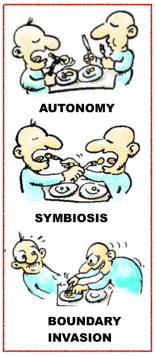
Neither have a full complement of ego states, so that one person acts from their Adult & Parent while the other only from their Child part – forming one false ‘whole’ ‘between them.
This is why it’s so hard for co-dependents to leave what others may see as destructive attachments – they would be cutting off a ‘part of themselves‘ since they haven’t yet grown their own complete identity.

1. Normal Development
• Children are highly intuitive, intelligent & curious. But at first they experience little difference between Self & others, between inner & outer, fantasy & reality.  The work of Mahler, Kernberg, Hartmann, Spitz et.al. identified 3-4 important developmental stages – not in a straight line but more like a fluctuating helix:

i. Autistic or Undifferentiated = in the first month of life, during which the infant is in its own inner world, with a minimum awareness of ‘others’, focused on reducing physical (hunger, wet diaper…. & emotional tension (fear, uncertainty, loss….)

ii. Symbiotic = for the next 4 months, the infant becomes more aware of the mother / caretaker as the source of fullness & warmth, but not as a separate person

early developmentiii. Separation-Individuation (S & I)  = made up of a series of sub-phases, thru the 3rd or 4th years of life, when the child begins to investigate the world beyond its own body through sight, locomotion, language…. & later, conflicts with mother about needing her vs. needing some independence, which requires much help in balancing

iv. Object Constancy, developed during the S & I period (if allowed!) around age 2 1/2 to 3, when the child is capable of experience both the good /providing & bad /withholding sides of the mother as one whole, as basically dependable & trustworthy, not perfect but not dangerous — assuming she’s mentally & emotionally sound! (MORE….)

NEXT: Bs – Healthy Source (Part 2)

BOUNDARIES Defined (Part 2)

gates 3IT’S UP TO ME
what I allow in, & what I don’t agree to!

PREVIOUS:
Boundaries Defined (#1)

REVIEW: My Rights – Qs. & Having Rights


Joy2MeU
: “One task in recovery is to learn to re-align our defense system with healing & Love, instead of self-destruction.”

VISUAL IMAGES of Boundaries (Bs)
a. As a ZIPPER
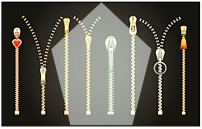
Bs can be seen as an impermeable but clear energy container completely surrounding us, with an invisible zipper down the front, from head to toe. We can see out & others can see us, but we are inside a protective shield. The zipper allows for easy access, but what’s of major importance is whether the zipper tab in on the inside or the outside!

➖ EXTERNAL: If the tab is on the outside, anyone we invade us by pulling it up or down, as they please, so we’re always at the mercy of others
➕ INTERNAL: If it’s on the inside, then WE decide when to open ourselves up – or not. ALSO, how far down we pull the tab speaks to how much of ourselves we choose to expose, depending on the situation & our current state of mind (even with the same person or environment).

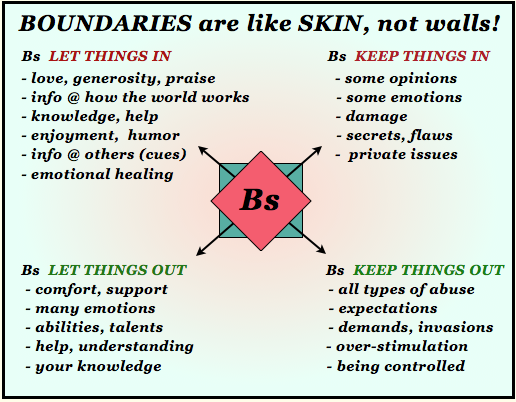
b. As our SKIN (like on our body) IT:
• breathes, so it lets toxins out and take in nutrients
• can be injured, but also repaired
• covers us completely, thus containing all our physical components
• is elastic, so can expand & contract….

Bs as skinPURPOSE of Boundaries
They are ‘Ego Barriers which are needed to guard our Inner Space, so we can:

1. Deal with the OUTSIDE WORLD positively
by Screening : protect from danger or unpleasantness, TO
— cut down intake of too much noise, info, activities, people
— eliminate toxic people, substances, locations – whenever possible
— protect from subtle manipulation, too many demands, confusing communications – anything that can inundate us

by Interpreting: understand the specific meaning of something
— TO be able to read people & situations accurately
— not assume everyone or everything is dangerous to us
— correctly assess what someone is saying or wanting from us
— think of 2-3 different causes for events – not just bad ones

2. Manage our INTERACTIONS with the world
by Modulating oneself: temper, soften, tone down, vary, TO
— not over-react to ‘normal’ situations
— choose when & where to be boisterous vs silent, angry or rageful, when to fight vs back down….
— know when to say something & when not to, and how

by Regulating oneself: adjust according to a standard in order to insure success, TO
— behave appropriately, depending on the venue & event – based on  self-respect
— pick the right time to ask questions, conduct business, communicate our upset or bad news…. with someone
— accomplish a goal : follow the rules of the relevant group we want to interact with – if not in conflict with our personal values

QUADRANTS of Interaction — dealing with struggles, using Bs
Q 1 – Open with Self : identify Bs you can practice on yourself, setting limits on self-defeating acts
Q 2 – Open with others : be available to help or participate with, as it fits who you are
Q 3 – Closed with Others : about the Takers in life, so be sure to set PMES limits with them, to protect your energy output
Q 4 – Closed with Self : TOO self-disciplined – need to release rigid Bs. Take breaks & put the joy back into your life.

NEXT: Boundaries & ACoAs (Part 1)

BOUNDARIES Defined (Part 1)

boundary gate 1
IT’S UP TO ME
what I allow & what I don’t agree to!

PREVIOUS: INFO & the Brain #4

SITE: “Vision & Self-Knowledge” – CHARTS


BOUNDARIES (Bs)
are an essential component of physical, mental, emotional & spiritual health (PMES).  They are the beneficial “rules of relationships”, representing the opposite of being manipulative.
The difference between asserting boundaries & manipulation? When we set a boundary, we let go of the result!

• Children are not born with a built-in concept of Bs, being more likely to resist any sort of limits – so it’s natural for them to test how much they can get away with.
However, because the world is a big, overwhelming, unpredictable, & therefore a scary place – they have a great need together given appropriate Bs, & will actually feel safer when those are provided. No matter how much children may struggle against Bs at first, when parents gently insist & persist, most of them learn & adapt to legitimate rules quite easily.

nourishing parentNourishing parents are both good role models & good teachers of Bs. They set limits that are — age appropriate, reasonable & consistent, in ways the child can understand. When taught to respond to healthy Bs & then incorporate them, children become well-mannered & confident adults.

Boundaries are about:
• protecting our body, our identity, our rights, our values
• expressing specific needs, wants & preferences
• making it clear what is acceptable, or not, from others
• choosing who & what we want to allow into our lives

Joy2MeU: “Learning how to set boundaries is a necessary step in learning to be a friend to ourselves.  It’s our responsibility to take care of ourselves – to protect ourselves when necessary.
– It’s impossible to learn to be Loving to ourselves (owning our rights & responsibilities) without having a Self
– It is impossible to have a healthy relationship with someone else with no boundaries, who can’t communicate directly, honestly”

a. Too MUCH – Limits that are too narrow & rigid for a child, creating a great deal of confusion them so they don’t want to venture out into the world, for fear of being constantly overwhelmed or making a fool of themselves.
Children raised with stifling Bs become afraid TO:
• think for themselves or take independent actions without being told what to do, think or feel
• take any kind of risk, even normal ones
• express their creativity, imagination, sense of possibilities
• reach their highest potential, prevent them from expressing their True Self, keep their ‘light under a bushel’

AND of course, some kids will eventually rebel by not wanting any limits! They go haywire & end up harming themselves & others

b. Too LITTLE – Too loose or non-existent Bs allow for too many options, don’t give guidelines about where to draw the line in dealing with self or others. It tells children they’re not actually cared for, not important enough to guide.
They’re ALSO afraid, but it’s hidden under blatantly angry attitude & behavior. They become adults who:
• are convinced they’re entitled to anything & everything
• are rude, disruptive & disrespectful, any time or any place limits are set for them
• don’t have empathy for other people’s needs & feelings
• don’t know how to get along with others, often getting into trouble, & are disliked by most people
• don’t consider or care about the consequences of their action
• ignore or fight against all forms of authority

💦 Both styles damage children’s self-esteem because unconditional love is missing.
Both styles indicate parental dysfunction & concern for their own needs at their children’s expense.
(POST: Good vs bad parenting . Compare w/ Healthy Parenting

🎯 PREREQUISITE for having Bs
We cannot develop Bs if we don’t know what our NEEDS are – where the line in the sand is. This means believe we have rights, since activating Bs requires expressing them.
We have to:
• know all 3 types of needs, specific to our True Self (not the ones the disease tells us to want !)
• have internal permission to acknowledge & honor those needs, in opposition to the PP voice
• actively provide those needs, both for ourselves & with the help of others, when appropriate (Fundamentals)

NEXT: Boundaries Defined (Part 2)

How the BRAIN LEARNS (Part 4)

trees 4THIS ‘PAYING ATTENTION’ THING
is a lot of work!

PREVIOUS: How the brain learns  (#3)


OUR BRAIN – Gathering Info (cont.)
6. BROAD TOPICS
7. INCOMPLETE

8. OLD is still VALID
a. EXPECTATIONS: The brain will continue to ‘understand’ & interpret the present – based on the way things were when it got the last piece of information about something familiar, no matter how long ago that was.
Therefore, it won’t know if that info is still viable, or obsolete.

✓ Think about going to a school reunion. We may unconsciously assume classmates will look the same as they did when we last saw them (10, 20 + years ago), OR to act the same, especially towards us, & may be shocked at the changes in them. Of course this isn’t logical, but….

Obsolescence has 3 main sources – THINGS :obsolete
• that often change, like prices & styles
• that change more slowly, but steadily – like aging
• learned a long time ago, as in childhood.
The further back the input, the more likely it’s not valid in the present, ✶altho’ this doesn’t apply to everything, like moral values or spiritual truths

b. ACTIONS: The mechanical brain can’t alert us to which memories (experiences) are still valid – to be used as a basis for present behavior – & which ones are out-dated. So, our current reactions to circumstances are often founded on useless, maybe even dangerous, info.

Types of Memory
a. Sensory – When our senses are triggered by a stimulus, our brain briefly stores the information for few seconds before it’s gone. It then has the option to process it through the memory banks or forget it.
When registering sensory input, it gathers info passively through visual & auditory cues – “iconic” & “echoic”.

b. Short-term – the brain temporarily stores information when it is triggered by stimuli. It can only hold a maximum of 7 items at a time, & also has a time limit for each, which is usually between 10 seconds to a minute.
“Working memory” – info stored for the purpose of using it, such as remembering a set of numbers while working on a math problem.

c. Long-term – After passing through short-term brain areas, relevant info is moved to long-term storage. Now we’re less likely to forget important details, but they can fade over time if we don’t refresh them.
When these memories form, they stay as long as they’re in use.  The hippocampus retrieves info from working memory & starts changing the brain’s physical neural wiring – between neurons & synapses.

SOURCES of distorted info
▪︎ Parents, community, school, religious leaders, who may be well-meaning & want to be helpful, but more often are damaging
▪︎ Experienced manipulators : advertisers, politicians, investment promoters, sales people….
▪︎ Popular Culture: books, TV, internet, news media ….

➼ IRONY:  Since the only criterion the brain has for identifying good or bad info is IF it’s consistent with what’s already stored, based on first impressions, then:
• for accurate input, the brain can protect us from accepting anything new that’s useless or harmful, BUT
• any bad info we started out with will stop us from believing new, correct info.
✶ That’s why we’re told that FIRST IMPRESSIONS are so important.

IN RECOVERY
a. Sometimes we hear or read something ‘healthy’ & our head says it’s true, makes sense, the speaker / writer knows what they’re talking about…  BUT we don’t feel it.  This usually means we have a layer of defense against taking it in all the way –  because the mechanical brain says it doesn’t fit,
AND the unconscious knows it’s going to be painful, & will go against the family’s messages.

b. Other times we hear or read something & it ‘rings a bell’, not just in our head but alsring a bello in our gut.  We know it’s RIGHT.  It may be quite contradictory to our earliest training, but it’s right for us – down to our toes!

This is likely because the healthy info we’re receiving now is something we (secretly) knew in our hearts a long time ago, & had to suppress but is finally being validated.
Sometimes the healthy info is so clear & relevant to our True Self that all we can do is cry in relief at finally getting what we need!

NEXT: BOUNDARIES DEFINED –  #1

How the BRAIN LEARNS (Part 3)

styled tulipsCOM’ON BRAIN –
don’t fail me now!

PREVIOUS: How the BRAIN LEARNS (#2)

See ACRONYM pg. for abbrev.

OUR BRAIN – Gathering Information (cont)
3. ADDITIONS
4. COMPARISONS

5. ALL ALIKE: The brain assumes all similar items are the same (all whites look alike to me / all rock music sounds like noise / all men are dogs!….)
• This originally had survival value so humans could respond instantly to a need or crisis, without ‘evaluating’ differences.

We still need automatic grouping – to save time, for ease of communication, to understand different things with a common meaning – like ‘scribbles’ or word-accents that represent the same word / idea….all alike

•  However, it can also lead to serious errors:
a. We can assume that all members of a particular group are alike
✓ Your mother was a nasty crazy lady, so you grow up to believing that, in spite of charming ‘disguises’, all women are nasty & crazy

b. It can be hard to notice subtle differences or gradual changes in others
✓ if you’re in Recovery – most people who’ve known you a long time will keep treating you based on how you used to be, just as some parents keep treating a grown son like a little boy

c. It can influence the way we behave / react to things around us
✓ Treating all snakes, body aches or drugs — as if they were the same — can be painful or fatal
✶ SO, one measure of intelligence is how well we can distinguish subtle variations among very similar people, things or situations.

6. BROAD TOPICS
• Focusing only on a narrow slice of life will only eliminate certain new items that are contradictory
EXP:  Women raised by a controlling parent are more likely to believe ‘The Rules’ book. So in contradiction – being told by a teacher/ preacher/  therapist… that it’s not emotionally healthy to manipulate men – will automatically be dismissed.
Exception: a woman might accept suggestions opposed to the book’s premise, if it comes from a trusted ally.

• BUT the broader the topic, the more all types of contradictory info are rejected as false.  Just the act of accumulating similar experiences will seem to confirm our original belief, right or wrong. That’s why people who are ‘trained’ in childhood to be winners tend to continue winning – or vice versa. So:
EXP: If we’re taught that our country, religion, ethnic community…. is the best, the only one to trust, is infallible… then any proof to the contrary will be ignored or make us angry!

✓ So too, if we have a bone-deep conviction that we’re worthless & unlovable, any compliment or acknowledgment is automatically rejected as b.s., even if said sincerely, & is actually true & valid about us!

7. INCOMPLETE: The brain can’t identify if it has complete info about a topic, so even when we suspect it, it can’t tell us what is missing
✓ This happed with a salesman & in college: I knew I was missing a crucial, pivotal piece of info to understand what I wanted to buy or was supposed to be learning, but I didn’t know what that was!

All I could do was ask haltingly, clumsily (sounding like an idiot!) & they’d tell me a bunch of stuff I did know. Sometimes, if I kept bugging them, eventually they’d go away in disgust OR  ‘accidentally’ spit out the missing piece.

Yeah! I was happy, but by then they were very annoyed! lazy brain
😡 When I expressed relief, they’d say “Well, I thought you already knew that!” because it was so obvious to them, they assumed I already knew it! Wrong.

Perpetuating Incomplete info:
Mental laziness: not making a consistent effort to get info on topics that have an impact on our lives & well-being
OR fear of asking, of having to take care of oneself, of no one wanting to help, of getting it wrong, of not being able to do what’s required….

• Either way, we automatically compensate by assuming we know things we don’t (Ass-u-me). Since we don’t realize we’re making assumptions, someone has to point them out.
Obviously, a lack of sufficient or accurate info will be a real road block to achieving our goals.

NEXT: How the BRAIN LEARNS (Part 4)

How the BRAIN LEARNS (Part 2)

cds & the brainMY EXPECTATIONS ARE TOO HIGH
for my own good!

PREVIOUS: How the brain learns (Part 1)

BOOK : Think Better, Feel Better ∼ Carl Pacifico


OUR BRAIN – Gathering Information (cont.)
1. FIRST INFO

2. CONTRADICTIONS

3. ADDITIONS
– all new items which do fit with the majority of already accumulated info will automatically be considered as correct, whether they are or not. Finding similar elements about a topic adds to our knowledge base – which doesn’t mean it’s accurate – just reinforced!

• When we have too little info about something, any previous knowledge (no matter how flawed) will carry a lot of weight in our evaluation about a person or situation, & therefore will heavily influence our action or reaction

EXP: If our parent was an addict, & then our first lover was an alcoholic . drug user…., & we keep dating & marrying addicts, then active addicts become our ‘drug-of-choice’!

👁‍🗨 DUALITY – AND what if we encounter a situation or person that’s both a benefit AND a threat (like a parent, a spouse, a job or career, your own child)?
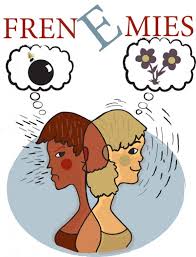
Because the brain is pre-programmed to label all previously gathered info as basically valid, it rejects anything that doesn’t fit — precisely to reduce the pressure of this kind of dilemma, called ‘cognitive dissonance’.frenemies

• This makes it very hard for us as adults to leave bad situations where we get or got some good stuff – emotional crumbs – along with mostly bad stuff, the same way we did as kids, like  :
needing to leave : a sibling we were once close to who is now screwing us out of our inheritance

a parent needing to oust : an adult-child still living at home, not working, drugs internet   – who was an adorable & adored favorite when little….
The ‘good stuff’ may have only been a long time ago, or it could have all been an illusion, but we’re still hanging on to memories, hopes & wishes!

4. COMPARISONS – The brain can’t measure anything directly, but rather using some pre-set standard, will compare various things, actions, people, events…  If the standard is flawed, our evaluation will be off!
EXP: Being on a ship without navigation tools & no land in sight – you can’t ‘magically’ tell where you are by just looking out of the porthole!

a. VALIDITY – For the comparison to be credible:valid
• the thing or person must be completely & correctly identified (like 2 specific books)
• the 2 things must be equal (can’t compare adult with child, a paperback to a hardcover)

• there has to be an actual way to make the measurement  (color, college degrees, education, height, weight….)
• the observer is objective (no personal stake in the conclusion)
• there should not any others factors involved – but if necessary, they also have to be of equal value (2 books in different languages, but on the same topic)

b. INTANGIBLES – What about measuring things like intelligence, honesty, love…? These are impossible to define because they’re subjective, & their meaning is embedded in one’s culture. Yet it’s constantly being attempted.

Most results of trying to pin down abstract concepts are incorrect & therefore meaningless, BUT the attempt can sometimes effect a person’s occupation/ income, social acceptance & identity.intangibles

EXPs: IQ tests only measure the ability to answers certain Qs, not the person’s actual intelligence – but can be used as a hiring tool.
EXP:
👮🏽 What cops & lawyers mean by ‘honesty‘ will be very different from what a minister believes it to be, and
👶🏼 what a kid means by “I love you” isn’t the same as when said by a lover.

c. EXPECTATIONS – a common standard for measuring performance – either our own or that imposed by some authority.
▪︎ Put on us: the results are quite arbitrary, depending on who is ‘doing’ the expecting
✓ What my high school music teaches thinks about my singing may be very, very different from how a Juilliard professor will assess it

▪︎ We put on others: Errors can easily occur when measuring others based on our expectations of them
✓ “I can’t believe she didn’t call me this week, knowing I’d been in the hospital! I would have called her right away, if she’d just had surgery!”

NEXT: How the BRAIN LEARNS (#3)

How the BRAIN LEARNS (Part 1)

trees 3WHIRR, WHIRR, WHIRR – the wheels never stop!

PREVIOUS: Undoing CDs

POST : “Retraining the Brain = Neuroplasticity”

☆ NOTE:
The following is a simplified explanation of how the brain mechanically absorbs & catalogs information, often times leading to Cognitive Distortions.
Biological information does not negate free will, Personality Type or the power to change (via Structural Neuroplasicity). But it does explain why it takes effort & time to correct damage.

➼ Think about each point listed in relation to growing up in a dangerous, terrifying, lonely environment – about how those experiences that ‘programmed’ us. Remember the military acronym G.I.G.O. = garbage in, garbage out.  Whatever our brain took in as a kid was not our fault – it’s the way humans are built.

✶ ACoAs ask: “Why do I do these things? Why can’t I get It? It’s too late, I’m too damaged…..”, which are all forms of S-H, based on CDs.
Learning the mechanical reasons why psychological change is a struggle can be encouraging. Change is hard but do-able!

• Having complete & correct info about something or someone allows us to respond to life appropriately & achieve our objectives
• The opposite is equally true – lack of, or distorted info will make us respond badly, perhaps even fatally. Any missing & incorrect facts get integrated into our thinking, like bugs in a computer program

⚑ Regardless, the brain’s main goal is to generate responses to the environment that will most likely insure our survival, including some terrible things people (abused children, battered wives, war combatants…. ) will do to cope with terrible situations!

OUR BRAIN – Gathering Information

1. FIRST INFO – The brain accepts as correct the first info it gets about any completely new topic, person, situation… without critical evaluation, whether accurate or not.  Additional info that fits with the original input is also accepted as true, regardless of validity.

Even if we suspect (intellectually) that some info might be wrong, the brain has no ‘warning signal’ to indicate what is or gathering infois not legitimate
EXP: If a new lover is charming, intelligent & seductive at first, the unconscious will label them as safe or at least acceptable, no matter what they’re really like

• Then, when the brain notices a stimulus (whatever triggers a reaction in us – like a hand wave), it goes thru all it’s stored info about:
— the origin of the stimulus (who’s waving)
— how to deal with it (wave back, ignore it, avoid it quickly…)

2. CONTRADICTIONS – Any new item that disagrees with what’s already in the memory bank is automatically rejected as wrong! This is not due to stubbornness, stupidity or a character flaw.
Rather, it’s a built-in survival mechanism, moving us toward things that seem beneficial & away from things that seem threatening

EXP: So, if the new lover at some point starts mistreating us or acting weird, we excuse it away / put up with it / ignore it completely… especially if they remind us (unconsciously) of our parents, who were our very earliest love interest!contradictions

• As more experiences are accumulate, contradictions have a less bothersome effect on our thinking, so we stay in the original groove. The brain has no built-in way of knowing what’s T or F about ‘people, places & things’ (PPT).  It just blindly relies on its backlog of stored data

• Of course, the importance (danger) of bad info is in proportion to how relevant it is to our life. Having the wrong or incomplete info about how tigers mate won’t usually effect our well-being, but bad / limited info about drugs & poisons, severe narcissists, environmental pollutants…. can be devastating or even fatal.

EXP: “First Info” is partly why battered wives keep going back. If they &/or their mother got beaten a lot when they were kids, it’s what they know & expect.  “Contradictory info” such as : “He’s no good for you, you have to leave…” has little effect, thrown out as incongruous & therefore not to be acted on.

NEXT: How the BRAIN LEARNS (#2)

CDs & the Unconscious (Part 4)

cds & emotions
I CAN HAVE EMOTIONS

without having to act on them!

PREVIOUS: CDs & the Unconscious (#3)


1. THINKING  (cont)
a
. The UNCONSCIOUS 

bThe CONSCIOUS (cont)
Changing our thinking patterns is a continuous, sometimes frustrating process. The more we understand how our brain & the process of change works, & what to expect, the more hope & patience we can have!

RECOVERY: Correcting our thinking leads to a more peaceful inner world. As ACoAs, it’s helpful to remember that this state is something we have to get used to – most of us find it boring at first. Eventually we come to appreciate & cherish the internal quiet. This is not boredom – which is an aspect of thinking, not feeling. It’s rather a sense of well-being!

2. EMOTIONS 
In general, emotions are stored as physical memories of our experiences & can be recalled by experiencing events in the present they remind us of. These emotions may be comforting, pleasurable, relieving, exciting… OR scary, rageful, lonely…. We can’t directly choose what we feel, only what we think.

• Researchers tell us that anxiety** responses such as “fight or flight” originally had adaptive value for the human species, & are still legitimate forms of protection. Active defensive measures such as – seworriednsitivity to sound, the startle response, shallow breathing & increased heart rate – help people escape real dangers.
However, we rarely face the external dangers our ancestors did, so now we’re flooded with those same stressful chemicals from internal pressures (CDs) without enough physical outlets to burn them off.
(Post:  Anxiety & T.E.As

**Anxiety (diffuse fear) is the nervous system’s response to internal or external stressors (a painful loss, self-hate, a fight with someone….) which intensifies how we feel & then act, but needs to be triggered by CDs & negative thinking.
This has been shown on brain imaging scans. However, since CDs are conditioned over time & become unconscious habit, we simply don’t recognize the source of our fear.

• Cognitive (T) psychologists believe that some people are more biologically predisposed than others to ‘threat-sensitivity’ & the distress it causes. In such people, once anxiety (E) is triggered, it’s maintained, & increased IF negative thinking is added to the mix.

Extreme physical responses related to CDs, set off by in stressful situations, can spread to & contaminate other parts of our lives – from mildly uncomfortable to actually dangerous.
EXP: Obsessive worry (T) caused by projecting the loss of a relationship  – which is not imminent – can provoke a panic attack (E), with the same physical intensity as if you were being held at gunpoint!

• As adults, ACoAs too often make the CD mistake of ‘Emotional Reasoning’, assuming that if we feel a certain way, it must be true:  “I’m really, really scared today, so it’s not safe to leave the house”!
The WIC is having an intense feeling about something going on in our life (an exam, a new job, a break-up…) & wants to hide.
But the sense of impending doom is way out of proportion to the actual situation. “If it’s hysterical, it’s historical”. And staying home alone may make it worse!

EXP: Your father may have only beaten you Many times or only occasionally) for stealing some change or sassing mom, that pain, fear & humiliation will always be associated with thoughts like “Dad doesn’t love me”, or “Parents are so unfair!”…. So now, anytime the boss (parent figure) is annoyed with you for making a mistake, you’re terrified, convinced you’ll get fired any minute now!

EXP : EMOTIONS re. ways adults can react to the death of a parent:
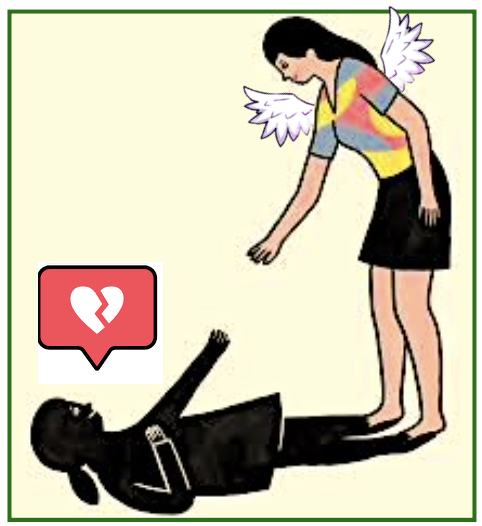
💦 A symbiotically attached ACoA will be devastated, partly from the loss of hope, partly from the depth of abandonment, perhaps also feeling guilt that things were left unfinished, & anger at being left. Sometimes they try suicide.

💘 A healthier person with sufficient S & I experience will be sad, mourning the loss & be aware that a permanent piece of their life is gone, but has a sound emotional & spiritual foundation to sustain them.

REVIEW posts: Emotional Maturity, and the series on EMOTIONS

NEXT: CDs – Results (#1)

CDs & the Unconscious (Part 3)

sunrise
I CAN BRING TO LIGHT

what’s been hidden all these years!

PREVIOUS: CS & the Conscious (#2)

1. THINKING  (cont)

a. The UNCONSCIOUS (2. Emotions in Part 4)

bThe CONSCIOUS (cont)
MAKING CHANGES
• Consider the entry into the unconscious as a lens aperture.  It’s only natural that the wider the opening, the easier it is to let light in! We know that old info will try to keep out any new info that’s going to cancel it out!
So we need to use Recovery tools to become more receptive in this ‘adversarial’ situation, since too much tension closes us off to anything contradictory to our earliest training

When we begin to replace mental distortions (CDs) with positives, we may consciously say:
• “I’ve studied as much as I can & I’m not stupid.
• I’ve done well in the past, so I believe I’ll do well this time too.
• No matter what the outcome, I’ll be OK”

But because of unconscious programming,
at first we can expect :
💨 TO feel uncomfortable, because the statements don’t agree with the fear we’re experiencing at the moment
💨 TO have the PP tell us we’re ridiculous “Who do you think you are?”
💨 THE WIC to absolutely not believe you. Only the PP’s voice carries weight – until the UNIT is strong enough to takes over

• When we think: ”Oh no, what if I fail this test / I’ll never remember everything I read / I’m such a flake….” — we will feel anxious. This causes various physical reactions (tight stomach, heart pounding, headache….), which can add to the fear.

This is to be expected!  Remember from INFO & the Brain: introducing new facts – contrary to what’s stored about a topic – will automatically be discounted. The unconscious is very good at maintaining the status quo.  As a built-in skill of the brain, it’s not a bad thing, as it helps retain consistency

• We can see how important it is for our minds to be stable & predictable when considering how crazy-making double-messages are! ACoAs got so many conflicting & confusing messages growing up that we end up convinced we’re crazy! But it’s not us.

add a positive ✓ One way to have access to the unconscious is to be physically & mentally relaxed. Also – liking something makes it more accessible.
Some ACoAs think it’s deceptive or arrogant to tell ourselves before an exam or interview: “….no matter what the outcome, I’m OK”.

So, instead, try : “I LIKE the idea of being ok, no matter what the outcome is…”,  which will dilate the aperture of the unconscious enough to slip in the rest: “… and I know that tomorrow I’ll remember what I read!”

• We don’t have to replace old beliefs – just add positive, healthy ones, creating different chemical pathways, which then take precedence as new mental habits.
The old routes will be less used, get weaker, & so not as easily fallen back into (regression). They’ll become a little like abandoned buildings – still there, but no longer lived in. This is good news for ACoAs who assume we have to get rid of all bad ideas before we’re ‘better’.

✓ The best time to substitute a subconscious thought pattern is when it’s currently playing in the mind, causing us anxiety.  Even though that’s when we “feel” least like doing it – replacing the thought right then will be most effective.

EXP: Picture being in a dive with a jukebox – if we push D4 (an event), a specific record will play (a CD) but this one is scratchy & annoying (painful emotions). That’s when it’s the exact time to put a new record on, to get rid of the grating noise!
But it doesn’t FEEL right (we refuse, as if it were illegal, and Mac-the-Knife is glowering at us — so it seems impossible.)

Yet, if we push thru the lead curtain of resistance, & “Rinse & Repeat” each time the old messages surface, it WILL get easier. Eventually we won’t have to work so hard to step on that old 45 & see it crack apart.
TIP: decide on a phrase or two that counters the Bad Voice (PP), & then practice them until they become automatic.

NEXT:   CDs & the Unconscious (#4)

CDs & the Unconscious (Part 2)


THAT PESKY UNCONSCIOUS –
it’s been running my life & I didn’t even know it!

PREVIOUS: INFO & the BRAIN (#1)


1. THINKING  (cont)
a
. The UNCONSCIOUS (2. Emotions in Part 4)

bThe CONSCIOUS mind is abstract, creative & aware, about such things as —
— thinking about what we’ve heard, seen or written
— what is intelligent & purposeful (having choices)

It doesn’t know what’s in the unconscious & doesn’t even want to acknowledge it, because it considers it too ‘simple & concrete’.  In spite of that ‘prejudice’, our conscious part only has about 15% control over forming experiences, while the subconscious is in charge of the other 85%, as the result of conditioning!

In general, Thoughts are latent but measurable forms of electro-magnetic energy, an important natural activity we produce!  Changes in thoughts change our biochemistry, hormones & brainwave patterns. Thoughts vibrate at different rates of oscillation, spreading out from the body like pond ripples. The speed & distance they travel depend on the frequency that generated them, so the way we think definitely has an effect on our environment

negative thoughtsNegative Thinking (CDs) assumes only difficulties & failures. It make us feel bad & decreases brain function, creating the same physical responses that any actual physical experience which would trigger anger or fear (blood pressure rise, cold sweats, hand tremors & flushed face, light-headedness & muscle weakness, rapid heart beat, shallow breathing, stomach knots….)

Thoughts are stored:
i. EITHER by mechanical repetition (like hours of reciting multiplication tables, practicing musical scales, rote prayers….)

ii. OR by pairing a thought or experience with an intense emotion.
When emotions connected to an event are too intense (painful), the whole thing will be repressed, especially if the distress is long-term or particularly traumatic, like most of our childhood, an abusive marriage, a severe illness….
✓ Think of your very earliest memory. Whether it was a pleasant event or not, it was anchored in your mind by a strong feeling!

AUTOMATIC
• Any often-repeated thought becomes so automatic that after a while we don’t even notice it. It’s now unconscious, out of awareness, but like Google, a complete record of our life.
It includes all our experiences & emotions: disappointments, delights, habits, joys, losses, pleasures, successes, traumas….. PLUS a collection of ‘beliefs & perceptions’. It’s all there – waiting to be discovered!

EXP: Growing up you were neglected & abused at home & bullied at school, with no one to protect or defend you. Now, any time you consider attending a group – no matter how innocuous – you have palpitations.
You think it’s only because you’re an Introvert & shy, but it’s more likely to be from unconscious CDs formed by early stresses – like Over-generalizing, Disqualifying the Positive, Unrealistic Comparisons, Projection….

Hidden : even though information is out of our awareness, continual thinking is still going on. When an emotionally upset ACoAs is asked: “What are you thinking or believing about this situation?”, most will answer : “I’m not”, or “I don’t know”, insisting they’re ‘just upset’

• Strong emotional reactions are always driven by automatic thoughts. With some encouragement & digging, the harmful thinking can be uncovered:
— coming from self-hate beating us down
— repeating insensitive or cruel things others have said to us
projecting dire outcomes about something….

Automatic thinking can be either helpful or harmful:
as a +,  it makes it easier to respond to life’s many tasks & situations without having to stop each time to figure them out – whether driving a car, doing our job, or raising children

as a -, it causes problems when there’s flawed reasoning in the unconscious. Since we’re not aware of what we’re ‘saying’ to ourselves, we don’t know it is creating the emotional pain (anxiety, hopelessness, rage, unbearable loneliness….).
Instead, we blame the distress on something in our environment, which is only a trigger

EXP: 2 people are called in to see the boss. One goes in calmly, curious but confident. The other becomes more & more agitated while waiting his turn.  The difference is not the upcoming ‘talk’ but what each person is automatically, unconsciously thinking / believing about what’s going to happen.

NEXT: CDs & the UNCONSCIOUS (Part 2)