‘Controlling’ & Abandonment (Part 1)

baby controling I NEVER GOT WHAT I NEEDED –
so now I force it out of others!

PREVIOUS: Satir’sDISTRACTER Role


SEE
 Acronym PAGE for abbrev.


ABANDONMENT (A.) as SOURCE of Control Issues

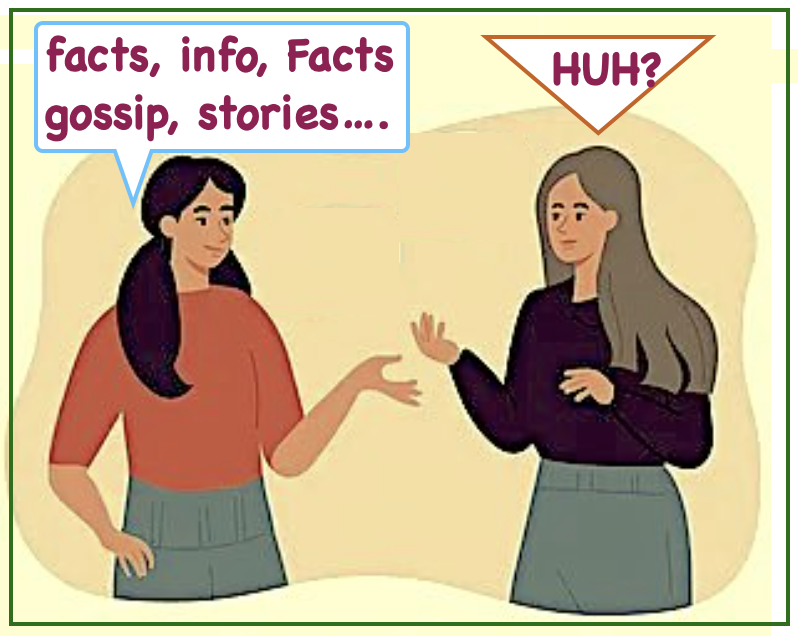
• To understand being controlled or acting controlling, we have to know the underpinnings, which come from our original abandonment experiences.  In common usage, a person is said to be A. when someone physically leaves us – moving away, a break-up, divorce, long or repeated hospitalizations, death…..

However, based on ACoA experience we know this definition is too limited. When we observe little kids – ours or others’ – we notice how very needy they are.  This is perfectly normal, in spite of what we ACoAs were told growing up = that we were too much, too selfish, a bother, too sensitive, dramatic …. We got the clear message that at best we were being tolerated!

• A broader & more accurate definition of Abandonment (A.) is: “Not getting enough of our normal needs met in childhood”.  This includes all needs on each of the 4 levels of PMES – Physical, Mental, Emotional & Spiritual. We can also say that A. includes not being loved unconditionally, with the resulting loss of genuine connection to parents so crucial to a child’s sense of well-being & safety.sad/scared

• Picture all children as having 100 different needs in each of the PMES categories (total 400 – an arbitrary number, as example). Then consider the reality that in a severely dysfunctional family each kid only gets a small percentage of those needs met – just enough to survive. Of course some of us got more, while others didn’t even get that much & have died too young as a result!

Depending on birth order, gender & personality,  different siblings received differing amounts in each category. Certain children are favored because their ‘native’ style is similar to the parent, or rejected by the narcissists because the child was not like them!
But over all, most of us were only provided with 30 – 40% of our normal human needs – when we were the most fragile & in need of great care.

EXP: A pathological narcissist “mentally-oriented” father who incested each of his children in varying degrees, (4 boys & 1 girl) was slightly less abusive towards the one child who was also “mentally-oriented”.  This son is the only sibling who was able to forge a decent life for himself (as a doctor), but not without emotional scars. The others became addicts, severe under-achievers &/or criminals.

• With no validation & nowhere to process the emotional pain, it all goes underground & slowly eats away at us.   Toxic Beliefs then get ingrained.
As adults – these distorted rules combined with a great backlog of unmet needs –  has left us with an overwhelming desperation to be ‘fed’ by someone, anyone, along with the deep hopelessness of it ever happening. Pretending we don’t have needs, or suppressing our awareness of them does not make them go away. (Post: “Vicious cycle re needs“)

shadow sideSHADOW : To survive & not ‘go crazy”, many of those ignored childhood requirements get pushed into our ‘shadow’ – made up of every part of ourself that we were taught were so awful – so we have to deny their very existence.

In Jungian psychology the shadow aspect is a part of the unconscious mind consisting of repressed weaknesses, instincts & shortcomings…. “Everyone carries a shadow, & the less it is embodied in the individual’s conscious life, the blacker & denser it is.
It may be (in part) one’s link to more primitive animal instincts, which are superseded during early childhood by the conscious mind” (Jung-Myers Model + A Case Study & chart)

➼ Unfortunately for us, ACoAs not only relegate our ‘unpleasant’ aspects (such as the ‘7 Deadly Sins’) to Shadow, but also many of our good qualities – anything that was not allowed in our family!

We become so terrified of these aspects & activities, that we use a wide variety of defenses & addictions to keep them hidden.  But the more we suppress legitimate needs the more anxiety builds. Sooner or later they leak out or erupt in distorted ways, like being clingy, ‘invisible’, manipulative, irresponsible, vague, needy….. AND/ OR controlling, mean, demanding, domineering, promiscuous, pushy…
Sad IRONY: The more we suppress – the needier (& meaner) we get!

NEXT: Controlling & A. (Part 2)

Satir’s DISTRACTER Role

distracter

I ALWAYS KEEP THINGS LIGHT
so nobody can be upset with me!

PREVIOUS: COMPUTER Role

SITE: Communication Styles & Roles


4. DISTRACTERS
 (D) – a Twisted form of Spontaneity
STYLE: 0.5% of people will typically use this defense. THEY :
• are often unfocused, what they say or do is un-related to what’s actually going on
• at first they seem like a lot of fun, but gradually one notices that everything they do is not quite relevant, not quite to the point
• become easily confused when stressed, don’t know what to do, so grasp at straws instead of doing something positive
• can come across with a ‘who cares’ attitude, are hungry for attention & deflect responsibility from themself, other people & situations
THEY
• can be silly to talk to, funny or confusing, the way young kids act or when people flirt, so are not taken seriously
confused• distract themselves & others from painful emotions & events by getting attention, being amusing &/or a pain in the butt (EXP: pick fluff off a jacket, make ‘deep’ statements, throw objects, tap pencils….)
• ignore Qs or respond by changing the subject, or ask a different Q that’s off-topic. — Others’ reaction : “What’s that got to do with what I just said?”
THEY
• react to any kind of threat by going off on a tangent, investing all their energy in side-tracking, hoping it’ll go away if they tap-dance long enough
• they cycle thru the other 3 Roles when under pressure, to look for some relief – one minute Blaming someone for being rude, next Placate, then to Computer mode & then shut off
• use a range of emotions from anger to guilt to avoid an issue OR to manipulate how others feel
• when talking – they use generalizations, leave out important facts, shift focus unpredictably from present to past, reality to fantasy, physical to mental issues

Energetic Description (by Dr. Bulbrook)
• block Self out / others & current context, so the flow of energy is irrational & the circuitry can’t get wired up properly.  Not grounded, & not connect spiritually
Potential harm to receiver: they give up trying to relate to the D, unable to have a stable or a positive exchange of energy in the relationship. OR get tapped into trying to make it ‘all better’, or trying to make the the D make sense

D’s Statements: “If I break up their concentration, I’ll be safe. If I ignore it, it’ll go away. So, how’s the weather?  Why don’t we just put that aside now & look at something else? Du-du, du-du, du-du… the Martians are coming!” (Earth to Mary?!)

D. Stance: They use kinesthetic cues
• asymmetrical position, one hand up, one down, head cocked, maybe standing on one leg or leaning against the wall
• body in motion, tilting a little to various angles, uneven ‘balance’
• smile wryly, one eyebrow raised, implying “see if you can top this!”
change direction★ takes on body posture of the other 3 Roles when switching modes

Gain Power by : successfully diverting everyone’s attention from unpleasantness
Aim: to evoke a longing in others for fun so the D. will be tolerated

Reacting to a Distracter: (via NLP) You can also use the Computer stance with them until they switch, then recalibrate to Placater or Blamer. Be careful: using the ‘super reasonable’ attitude can also trigger a stronger Distracter response in them

Reality – THEY: • are convinced that nobody really wants them
• don’t believe they would be heard or respected if they said what they really thought & felt
• just want to evade any confrontation
• think this Role is a relief from stress, but actually leaves them feeling lonely & without meaning or purpose (useless)

funNegative :  • ironically – the pattern actually serves to create conflict with others
• their actions are inappropriate for serious situations
• it makes people change the focus of their communication
• it so confuses & annoys others who can’t understand what the Distracter is getting at, that they don’t know how to respond

Positive: • great for flirting & having fun
• can be a powerful strategy in negotiations if the other party is playing hardball, and –
• the D’s stance keeps the other person off balance – their unpredictability makes them worry that the D will grab the desired ‘object’ (person, situation….) without warning.

NEXT: Controlling & Abandonment

Satir’s COMPUTER Role

isolation I’M SAFE IN MY IVORY TOWER – so you can’t touch me

PREVIOUS: BLAMER Role


3. COMPUTERS (C) – a Twisted form of Intellect
STYLE: About 15% of the population uses this defense
✶ At first glance they may seem poised & self-assured, but do not mistake them for someone who is centered, grounded & calm. If they were, Along with being fun of info, they’d also radiate presence, warmth, & compassion. Instead, Computers make others feel put off, cold & distant
THEY :
• are detached, like a machine, talk in a monotone or boring delivery
• are always thinking, evaluating, holding back, reserved, self-protective
• always very correct, very reasonable, very logical & in control – called Mr Cool or StarTrek’s Mr Spock by NPL-ers
• can sound like a dictionary, need to use the ‘right’ words as buffers to hide inner feelings
THEY :
• continually stay in teaching mode OR withdrawn into contemplation
computr type• deflect any personal responsibility, always dissociated from what’s going on around them
• deny the value of everything except ‘facts’ & logical decisions
• focus on & prefer the context of a situation, removing the human element
THEY :
• generalize, omit/ delete relevant parts of a thought, use long abstract words, speak in the 3rd person (“Someone needs to do it”)….. especially when questioned or confronted
• never let anyone know what they think or are up to, never commit to a definite position, afraid to make a mistake or not knowing something
• often make value judgments without indicating whose opinion it is, implying that = naturally everyone would agree

Unfortunately considered an ideal for men who are generally discouraged from experiencing & expressing emotions, so Computers work hard to appear super-cool on the outside, even when churning like mad on the inside.
Suitable for accountants & bureaucrats.

Energetic Description (from Dr.MJ Bulbrook)
• block out others & the situation they’re in, by creating rigid boundaries.  Personality is undeveloped & has energy holes. Spiritually Cold
Potential harm to receiver: the shielding energy of the Computer is so strong it’s likely impossible to have an even exchange. Another’s opinion is not heard, or is over-ridden without considering the value of the other’s input

Statements: “I am ultra-reasonable, calm, cool & collected. I have all the answers.  Rational thinking is superior to emotion. I say the right words, with no feeling, don’t react. Perhaps we should take a moment to step back & review the situation”

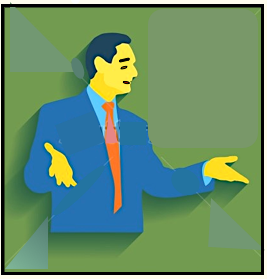
Stance: Auditory & digital cues (analytical, disconnected language)
• body is faced square on or may be tilted back a little, resting on rear leg
• head level, eyebrows slightly pulled in, arms crossed under chin to prop head up (like the‘Thinker’)
computer brain• physically separate themself from any issue there uncomfortable with
• can take on characteristics of other Roles as additional protection
• experience tension in neck & shoulders
• sit rigidly, without moving a muscle – pushing away feelings & people
• talk to themself, only learn things by making ‘sense’ of them

Gain Power: by pretending to know it all & making the audience seem dumb.  Similar to Blamers, since they both stress their superiority over others
Aim: to provoke envy & be seen as strong (hide feeling weak) so others will be drawn to ally with them

Reacting to a Computer: (via NLP) if you use a Blamer or Placating stance, they will switch to Blamer or Placater – the reverse of your strategy. Then you can recalibrate. The Distracter stance usually makes them worse

Reality: Computer types feel exposed when showing emotions, maybe because they have a hard time controlling their Es. They were probably shamed, blamed or emotionally overwhelmed as kids for having feelings
• When stressed, Computers desperately try to feel secure by intellectualizing everything, to stop from falling apart in case a real emotion ever broke through

Negative: • assumed to be cold-hearted & insensitive
• bore people to numbness by pontificating & using abstract
language or cliches
• can’t connect emotionally in any relationships
• can’t give love or provide the other’s legitimate needs – causing many problems & end up isolated
• male Computers frustrate any attempts women make to communication feelings, & just can’t understand why “she’s getting so upset when I’m being so reasonable!”

Positive: A good person to go to when needing specific, detailed info on an topic (research, medical, school work, travel…), anything not emotion-related.

NEXT: Distracter Role

Satir’s BLAMER Role

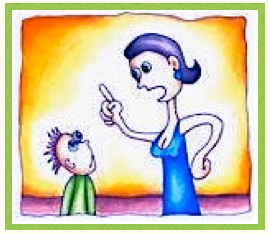
blame child IF IT WEREN’T FOR YOU….
everything would be OK!

PREVIOUS: LEVELER Role

POST: Parents blaming us

ROLES – Blamer, Computer, Placater & Distracter


2. BLAMERS (B)
 – a Twisted form of Power
STYLE :  about 30% of people use this defense. They say NO, regardless of what they really feel or want (it’s the principle of it!)
THEY
• act like they’re superior & make disparaging comparisons
• always think they’re right, & never respect others’ point of view
• are dictatorial, loud, tyrannical & expect everyone to obey them
• bully, shove their thoughts & feelings at others, are more likely to initiate conflict
THEY
• constantly find fault & point out problems or weaknesses in others (sometimes called ‘skunks’ in NLP because they ‘spray’ criticizing language)
• push responsibility for everything onto others, always looking for someone to take the blame when things go wrong, hinting that others ‘are in trouble’
mean blamer• their attitude is oppressive, which can trigger Placating in others out of fear (EXP: they’re harsh when giving a speech —-> to make firm points & elicit guilt)
THEY
• think no one will accept their view of the world unless they yell
• use authoritarian & direct language, with generalizations, to distract & assign blame
• use complex comparisons without proofs to confuse
• want to win at any cost, sometimes will “cut off their nose to spite their face” or win the battle only to lose the war

• no matter how someone replies to their accusations, Blamers will use it to make the other person even more wrong, using a double-bind with a mismatched response (EXP: if you stand up for yourself, you’re arrogant, if you back down you’re a wimp!)

Energetic Description  (by Dr. Mary Jo Bulbrook)
• blamers can operate from malicious OR unintentional intent
• as Sender – their verbal bullets attack with varying intensity at vulnerable spots in another person’s energy system, impacting their energy field, centers, tracts, head line & core
• Blaming causes terror & depression in any receiver who is in a psychologically weakened state, making them vulnerable to outside negative energies
• this receiver will experience varying amounts of pain if they can’t block or shield themself from the Blamer’s targeting, This can create holes, tears, shattering or disruptions in their energy field, blocking or shutting down the chakras & stopping energy flow in the meridians

B Statements: “It’s your fault , You can’t do anything right , I’m the boss! , If it weren’t for you everything would be all right , You never… / You always …./ Why don’t you ever….”

B’s Stance: They use visual cues with breathing, posture & gestures
• body square on, legs apart, head slightly down, tightened neck muscles, leaning forward a bit
• face is screwed up, lips curled, nostrils flared, eyebrows lowered
• one hand on hip, other hand with raised finger & palm down, pointing directly at the other for strong effect (an attack), or at the ceiling (a warning of attack).
• internal tightness of muscles & organs, with increased blood pressure (see Chart in “What about Es, #1“)

Bs Gain Power by their belittling  & guilt-producing ability, as when the Sender of blame uses force to convey a mental / psychological message, and the Receiver acknowledges & accepts the message
Aim : to never feel vulnerable, by dominating so they’ll be obeyed, & provoking fear so they’ll be ‘respected’

Reacting to a Blamer: (via NLP) If you use a Placater stance with them it can shift their attention from their own attitude & context, to your view & your context.
Be careful: it can also trigger an even stronger Blamer response from them, if they get annoyed at you for being gutless (according to them)

Reality: Blamers hide behind a tough mask of invulnerability, but actually feel powerless, uncared-for & alone in the world with no one to help.
When stressed, they compensate by taking charge, bluff their way out, attacking & controlling. This attitude temporarily makes them feel better – when people obey, they feels effective & powerful
Negative Result : they usually end up alone, since nobody wants to be at the receiving end of their blaming, harshness & over-control

 NEXT: Satir’s COMPUTER Role

Satir’s LEVELER Role

leveler I’M ON THE LEVEL –
so you can believe me

PREVIOUS: C0-dep, & the False Self vs True Self

SITE: How to be Assertive without being Arrogant


Virginia Satir’s ROLES
All roles are learned in childhood. The 4 unhealthy ones are created as defense mechanisms but end up a threat to the personality – preventing us from being loved, trusted or being able to fully grow.
Satir gives 7 reasons why we use these patterns:
• I might make a mistake     • I might impose   • They might leave me
• Someone will criticize me      • Someone might not like it
• They’ll think I am no good    • I might be thought of as imperfect

The dysfunctional roles are: Blamer, Computer, Distracter &Placater
The Leveler is the only healthy role

1. LEVELERS
a. Style: Satir suggested that 4.5% of people will typically use this style, but many psychologists think this is optimistic. THEY :
• are comfortable with their emotions & can easily discuss them when appropriate
balanced• are dependable because they are trust & honor their observations & perceptions
• are emotionally balanced, assertive (not aggressive) & can relate to many types of people
• apologize when making a mistake – without shame – & can evaluate the situation fairly, without blaming others
THEY:
• deal with a threat rather than fighting it, sweeping it under the carpet or running away
• engage in honest, direct, clear communication – in real-time whenever possible
• establish rapport before trying to influence others, so can bring people together
• experience few threats to their self-esteem, accept average stress as normal, are comfortable with ambiguous & uncertain situations
THEY:
• have easy, free & honest relationships with reasonable people
• have conscious positive intentions behind everything they do
• hold strong positive but realistic beliefs about themself & others
• look for solutions, work out problems realistically & appropriately, so their communication style helps resolve conflicts
THEY:
• may talk intellectually (like the “Computer”), as when lecturing or explaining something, but their emotions are still available
• operate from strong personal values & a store of positive images
• respond to situations in a consistent but not rigid way – conducting their life with integrity, commitment & creativity
• ‘tell it like it is’, without exaggerating or minimizing situations

b. Energy Fuel (from Mary Jo Bulbrook)
• Levelers are able to hold their ground, clearly communicate their needs, set physical & emotional energetic boundaries
• All chakras are about equal, open & flowing, allowing energy to come in & go out easily
• Potential impact on receiver : Levelers help things grow, & enhance the flow of other people’s energy

c. Statements: “I’m relaxed & comfortable because I‘ve got nothing to hide”.  “I like you”.
An important aspect of leveling is the use of “I” statements, which express what they really mean, describe their feelings & wants, while recognizing the feelings & wants of others

d. Stance – if physically healthy
• body, voice & facial expressions all give the same message
• body faces directly toward others, head vertical, relaxed face, even eyebrows, shoulders & hips level, heels directly below the shoulders so that legs are slightly apart, feet facing forward
honest, fair• both palms face down, fingers out flat, slightly wider than the body – as if trying to level the situation

NOTE : Leveling is a psychological & emotionally healthy quality. It does not depend on physical health. Therefore – mental health is not diminished in people with physical disabilities or advanced age

e. Source of Power: from deep self-esteem, finding the most effective behavior for creative problem-solving & in cooperating with others

f. Negative: they consistently state facts, are straightforward & tell the truth, according to their understanding. This makes some people uncomfortable who may feel insulted & get angry at the Leveler –  arguing & justifying themself, or avoid altogether

g. Positive:  Re. SELF –  Satir found that when people start to level (be real), they connect to their body, heart, feelings & brains, which leads to finding their souls & their humanity.
Re. OTHERS – because Levelers are fair & trustworthy, others can depend on them, so they attract people who are also interested in transparency, & no drama.

NEXT: BLAMER Role

Co-dependence & the False Self

invisible barsTHESE INVISIBLE BARS
have me trapped in the mirror

PREVIOUS: Co-dep & Roles

SITE: False Self, Real Self – the games we play with our identity”

✤ Anatomy of Emotional Warfare (key player is the False Self)

✤ 3 Reasons to Embrace Your “False” Self

BOOK: Is it Love or is it Addiction? ~ Brenda Schaeffer


CO-DEPENDENCE runs us WHEN:
We focus all our attention on the needs, feelings & problems of another person – instead of ourself – including the ones we think someone else has, in order to make that person love us AND never leave us.  So we feel guilty when we don’t tend to their wishes, needs or demands!

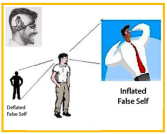
The False Self  (FS)
✶ We developed it in our dysfunctional home, where we came to believe we needed someone & something outside of ourself to be complete, to feel safe, to have any worth at all, even to give us permission to exist!

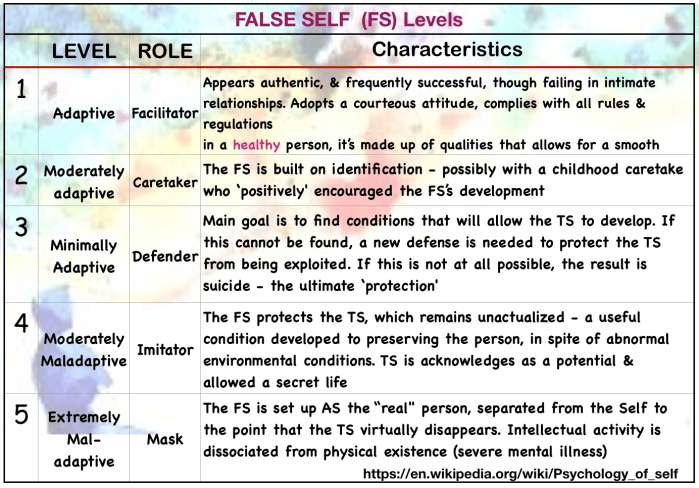
✶ Basing life on a False Self robs us of our dignity & individuality! It’s what the wounded version of the Adapted Child ego state becomes when we’re not properly nurtured in childhood, & which ends up running our life until we do FoO work in Recovery   (CHART  ➡️)

• The concept of the FS was identified in the 60s by Dr. Donald Winnicott, who specialized in Object-Relations psychology.
The FS is motivated by a basic need to survive, starting in infancy – an unconscious choice to change our behavior, repress our emotions & push aside our own needs – in order to fit in with others who cannot accept us as we really are.
It comes out of a desperate attempt to control a person or situation that is actually out of our control.

• It includes 5 USES and 5 levels ⬇️, the most extreme being when the True Self is completely hidden, while the FS appears authentic to the person & everyone else, & may be successful in the world but fails in intimate relationships  & secretly fuels anxiety
➼ In contrast, the True Self is the core of we who are, unshaped by upbringing or society, the person we were born as & still exists inside

CHILDHOOD Causes
☔︎ Attachment Trauma = a developmental shock that may become hard-wired into the child’s brain & personality structures. Desperate longing & emotion-addiction becomes a defense mechanism against the anxiety of too early or difficult separation from mother

☔︎ Toddlers = Defiant & oppositional behavior persisting beyond age 3 may indicate an attachment disorder.  Child can develop other “upper defenses” to maintain this separateness (over-independence), which support the inflated False Self.

☔︎ Co-dependent = Children create a False Self (FS) as a reaction to not having enough emotional & social support in order to become emotionally & psychologically separate from parents (grow up)
☔︎ Counter-dependent = child blocks feeling of the shame of only being ‘loved’ conditionally or not loved at all.  The FS prevents being totally traumatized by the abandonment & abuse. This defense typically shows up as the child (& later the adult) seeming to be strong & capable, while not feeling that way inside (like a fraud)

☔︎ Addictions = Later on – develop addictions in the areas associated with specific separation trauma (use ‘uppers’, work, quick sex, traveling & over-consuming…. ). These are inadequate & unsatisfying substitutes for deep union with the Divine who created the True Self, just like the unavailable emotional connection with the mother.
Unfortunately, it often takes people a long time to discover that unresolved developmental trauma is the cause of many of their adult problems.

«
CHART a
. False Self created by absorbing Negative Introject

«
CHART b.
True Self as the integrated authority of a fully developed, emotionally intelligent grownup (by Roland J. Schuster)

Also read  “What Represents True Self“?

«
NEXT: Satir’s LEVELER Role

MASCOT Family Role

IF I’M ENTERTAINING ENOUGH –
they won’t feel the pain!

PREVIOUS: Lost Child Role

SITE: Mascot: Not all Fun & Games

❧ MASCOT’s (M) GOAL
Provide diversion from family’s problems, & make everyone feel better by being funny & zany

PURPOSE
For Self: act silly to try to interrupt their own physical & emotional tension & sense of danger – from feeling scared & powerless in the middle of the family mess.  Ms are genuinely ‘immature’, & play that up to draw attention away from the scary adults

For Family: use comic relief to lighten a ‘heavy’ atmosphere for everyone, creating a diversion to diffuse volatile situations.
May perform similar tasks to Caretakers when enlisted to soothe the Dependent’s feelings & needs. And –
• like the Hero, they may be the ‘face’ of the family to the community

• take responsibility for the family’s emotional well-being & become its ‘social director’, entertaining everyone to cover the depth of the family sickness by keeping the focus on themself

• using humor to communicate awareness of the dysfunction – their antics can actually hinder Recovery. They indirectly express family’s painful emotions such as anger, grief, hostility or fear BY satire, sarcasm, teasing…. rather than addressing it head on

BIRTH ORDER :  Usually the youngest, but not always
IN SCHOOL : Class clown or cut-up, admired by classmates for making school enjoyable.
Are hyper-active, have difficulty concentrating on studies, so may already have or develop learning deficits, & conclude they’re not intelligent (which is not true)

FAMILY TREATMENT : the M is the child everybody loves & prefers. They’re assumed to be happy-go-lucky but not smart or capable. May be seen as fragile, so over-protected & shielded from life’s problems

ACTIONS /STYLE
silly child• Personal : Spend little time at home, with lots of friends, attract constant attention, are exaggerated & dramatic, disruptive, may get into trouble but not the malicious kind like the Scapegoat.
Avoid angry confrontations, go “with the flow”; ignore practical responsibility.
Have a short attention span & incongruous emotional responses (laugh when things are serious or painful).

• Social: Their humor is not always innocent. There’re known to make mean or obnoxious jokes & humorous ‘dirty laundry’ stories about the family to express their own repressed anger.
Use fun to amuse their circle of friends but are rarely taken seriously, may be subjected to criticism & rejection for being silly & flaky

DEFENSES
Act dumb, be super-cute, exaggerate their immaturity,  make fun of self, do anything to get attention – clowning, humor, becoming an actor, addictions

DEFICITS
Attention seeking, distracting to others, difficulty focusing, poor decision-making ability, superficial, ‘in the dark’.
Afraid to look inside & be honest about emotions & actions, out of touch with ‘unpleasant’ feelings & spirituality

mascot dancerChange BELIEFS
FROM: “I must never point out any problems”
“ If I make people laugh, everyone will feel better”
“ I only have value as an entertainer”

TO: “I have value for who I am, without being entertaining”
“I can be comforted & loved even when I’m not ON”
“ I’m not responsible for others’ happiness”

EMOTIONS
Anxious, deeply insecure, embarrassed, feel inadequate & unimportant, lonely, sad, self-hating, terrified. Express shame by depression & addictions

COST TO SELF
• Rarely feel loved for themself, only for playing this role to keep family distracted
• ALSO not allowed to be clever, functional, show very real & serious accomplishments
• Not allowed to have sadness or any other painful emotions, & deny the right to know their True Self.  Ignore all their own suffering, which may later show up as illnesses
• Frenetic social activity is a defense against intense inner anxiety & tension. Trouble coping with that stress can make them think they’re going crazy. If not addressed, they can slip into addiction, mental illness or committing suicide

PARENTS CAN HELP CHILD 
TO:  express humor appropriately, learn to take care of themself, modify need for attention, find ways to be competent
BY: being consistent & firm. Don’t push, only remind, & reward by using natural & logical consequences to their actions. NEVER reinforce sick, sadistic or self-deprecating humor with laughter

AS ADULTS – may already have great social skills, but trouble with addressing conflict directly, & with identifying their own emotions
• give love, but don’t know how to accept it
• 
are at risk for getting involved in abusive relationships, & try to “save” their partners by being “nice” & “upbeat.”

RECOVERY NEEDS
good hostTo take responsibility, risk being serious & be taken seriously, learn assertiveness, study something in-depth, feel all emotions

STRENGTHS
With growth – can be valued for their best qualities. They:
• are flexible, generous, helpful, independent
• are charming people, & entertaining hosts
• have a big heart, & can be good listeners
 have an easy sense of humor, know how to play & enjoy.

NEXT: Roles & Co-dependence

LOST CHILD Family Role

invisible I’M INVISIBLE TO EVERYONE,
& they like it like that!

Previous:  The Scapegoat, #2

SITE: Lost Child –> Invisible Adult


❧ LOST CHILD’s GOAL
Provide relief for the family by being invisible – sacrificing their identity & desires to give parents one less thing to worry about

PURPOSE
For Self: hide from chaos, physical & emotional abuse (under a table, in a closet, their room, after-school  activities), avoid being responsible for anyone else….  withdraw into a fantasy world, making themself very small & quiet
For Family: relieve some tension by not being another burden, provide family’s privacy by not airing ‘dirty laundry’, help family avoid facing serious problems by never mentioning alcohol, toxic roles or Recovery

BIRTH ORDER: 3rd or middle child
IN SCHOOL : Lose themself in school work, get good grades, don’t want to participate, called ‘space cadet’, geek, nerd….

FAMILY TREATMENT : Generally ignored, or considered a ‘blessing’ for not expressing needs. Last child parents will think to get help for.

ACTIONS /STYLE
• Socially Acceptable :  Pleasant when spoken to, quiet & unassuming, won’t call attention to self, have opinions but don’t express them, never make waves or demands

• Socially Awkward:  Distant, ill at ease with others, especially uncomfortable when focused on, little or no expression of emotions.  Hide out to not be a bother. Strong attachments to animals & things – instead of people, sometimes with one close friend but often none. May be confused or conflicted about their sexual identity & functioning (or anorectic)

DEFENSES
• are day-dreamers – buried in books, internet, religion / spirituality, creative mental pursuits, keep a diary, draw, listen to music, watch TV
• become addicts – use chemicals, food, porn…. to dull the pain
• can be bulimic or anorectic, or overweight
• deny getting upset, super-independent but depressed 
THEY

• may drift through life with little or no ambition, be under-employed or obsessed with one ‘big’ goal (realistic or not, productive or not)
• easily feel rejected while always staying aloof, ‘invisible’
• may try to get attention indirectly by getting sick, having asthma, allergies, or by bed-wetting in childhood

DEFICITS
• give up self-needs & the possibility of asking for help or accept any offered, have poor communication skills
• follow without questioning, easily bullied & made fun of, avoid professional help
• unable or unwilling to initiate (passive), have hard time seeing choices / options, tend to lack direction, afraid of making decisions

Change BELIEFS:  
FROM: “Why should I feel? It’s better if I don’t”
“If I don’t get emotionally involved, I won’t get hurt”
“I can’t make a difference anyway”
“Don’t draw attention to yourself”

TO
: “I have a right to positive attention”
“I do make a difference, I am worthwhile & people will value me”
“I need to get emotionally involved to have meaningful connections”
“My emotions are an important part of my True Self”

EMOTIONS : depressed, fearful, hurt, lonely, rejected, sad, with suppressed anger. Express shame by procrastination, being the victim, feeling suicidal

COST TO SELF
Always feel different, the outsider, don’t know how to get their needs / wants met – including need for personal connections, have social phobia so stay ignored & unappreciated, hard to get credit for abilities

PARENTS can HELP CHILD
TO: be more social, use its creativity & imagination, express emotions, feel important, useful & valuable
BY: giving private encouragement & praise, including child in family process, not criticizing, providing opportunities to be successful, validating anything positive
sad manAS ADULTS

❎ Unsociable: the most obvious isolators, withdrawn from life to hide from whatever will hurt or make them uncomfortable – which is almost everything.
• terrified of intimacy, they often avoid connections all together
• are attracted to any solitary work or career where they don’t have to deal with people

✅ ’Sociable’: if in a relationship they’ll be noticeably unavailable in many ways, pick controlling Heroes or unpredictable chaotic Scapegoats or Mascots
• If artistic, will be excellent actors, studying their parts carefully, glad to hide behind a facade

• Generally: when needing to make a commitment based on logical thinking, believe they have few options – because growing up they just went along with whatever was happening, instead of thinking thru possibilities or what they may actually want
• Without help: indecisive, can’t say NO, show little or no passion, fun or zest, slow to change & grow, always alone or promiscuous, die early

Adult RECOVERY NEEDS – TO
work alone• become a team player, practice flexibility, take initiative, make decisions, notice & use available options
• reach out, deal with loneliness, face emotional pain, make a few deep relationships, give up victim role
• With help: become free to express talents, creativity & imagination. Can become assertive, resourceful & independent (not isolated)

STRENGTHS
• work well alone, self-reliant, quiet (writer, researcher, artist….)
• easy-going, understanding, patient, spiritually connected
• resourceful, creative, flexible, non-conformist, good of humor
• well-read, scholarly, good observer & listener

NEXT: Mascot Role

SCAPEGOAT Family Role (Part 1)

scapegoatIF I GET INTO ENOUGH TROUBLE,
they won’t have to!

PREVIOUS: The Placater #2

SITE:  The Scapegoat Who Changed Her Family Role


NOTE: This is not the same as the being scapegoated – where parents pick out one child to blame for all the family’s troubles which they themselves are causing.
HERE, the Scapegoat role seems ‘voluntary’, in the sense that this position is being held as a self-sacrifice.

SCAPEGOAT‘s GOAL
Provide a change of focus by allowing everyone to think they are the source of the family’s problems – instead of the addict

PURPOSE
For Self: their sacrifice given as a love-offering, taking on the ‘bad-guy’ role to protect the addict or other main trouble-maker from having to face his/her pain
IMP: An in-your-face refusal to comply with a parent’s direct or unspoken demand for perfection-ism 

defiant_girl-1For Family: serve as the “pressure valve” in the family when tensions build. They misbehave to draw attention away from the ‘problem’ parent so the family’s ‘issue’ is anything other than the addiction
• also to protect the family from any outside interference (cops, social workers, shrinks, social services….) who will cause shame
• try to show family what’s really going on, hoping they’ll learn from it & change BY acting out the tension & anger in the air that everyone ignores, & doing things the ‘wrong way’

BIRTH ORDER: Usually the second child, sometimes the first boy if an older sister is the Hero
IN SCHOOL
Academically borderline or failing, they drop out, get suspended or kicked out, may not graduate (but NOT stupid)

FAMILY TREATMENT
Family makes them the ‘black sheep’ who feel ashamed of the S. Because they’re the blunt ‘truth-tellers’, one or both parents may dole out harsher & harsher punishments, trying to ‘break’ them for not going along with the program (stay in denial).

They’re compared negatively to older, well-behaved / compliant siblings or cousins, sometimes considered ‘mentally ill’, & may be taken to therapy to get ‘fixed’.
Targeted to be Scapegoats, either because they’re:
a type: hyperactive or sick, so are easily bullied, and/OR
b type: the angry, rebellious, problem child who has the guts to say or do what no one else will, & so is easily ‘set off’ / reactive

ACTIONS /STYLE
IMP : Personal- IRONY
They are the most sensitive, caring & emotionally honest family member. Scapegoats are actually the strongest ones, since they carry the “sins” for the entire family.
Their sensitivity causes them intense pain when mistreated, making them self-hating & self-destructive. They are the romantics who becomes very cynical & distrustful from being the “target” of the family’s dysfunction. Will leave home as soon as they can

Family : Rebellious (constant trouble with authority, won’t follow directions), They make a lot of noise, diverting attention from the addict & his/her need for Recovery on to themself. They won’t go along with the Hero who pretends everything’s allright. For a while will try to compete with the Hero for status, but lose & then stop trying to please
Social:                         
As the grow up = Because they have thick walls built around them from fear & outrage, their relationships will often be superficial & inauthentic – except when they can bond with another equally angry, bitter peer or group.

Often act out in front of others, putting on a tough act. In reaction to the family chaos & abuse, they become the troublemaker – argumentative, attention seekers, blaming others, disruptive, intrusive,  negative leader
AND/OR secretive, sneaky, verbally dishonest, unwilling to take any personal responsibility

DEFENSES
Defiance, withdrawal, hostility, sullenness, acting out, ‘don’t care’ facade. Strong connection to their peer group (same type) or totally isolated

DEFICITS
Inappropriate expression & use of anger, intrusive, won’t follow directions, self-destructive, defiant, irresponsible, underachiever, social & legal problems at young age (truancy, teenage pregnancy, high school dropout, addiction, suicide attempts), can lead others into trouble.

NEXT: Scapegoat, #2

PLACATER Family Role (Part 1)

PlacaterI CAN’T STAND DISCORD –
I have to make nice

PREVIOUS: Hero Role

SITE: Conflict Styles


❧ PLACATER Role  – a Twisted form of Service.  A combination of the Satir & Wegscheider versions

Placater’s GOAL
Provide soothing to make others feel better in general & specifically about themself

PURPOSE

For Self: try to not keep getting abandoned, to feel safer = not get hurt & be loved – by calming everyone, preventing conflicts or any overt expression of anger
For Family:  When parents are impaired in some way, Placater becomes a surrogate. Born negotiators, they seem to have an uncanny ability to ‘read’ what others are feeling, but at their own expense. Learn early to smooth over potentially upsetting situations & take responsibility for everyone’s pain & emotional well-being

BIRTH ORDER: can be oldest child, usually the girl
IN SCHOOL : very compliant, well-liked, so-so student – preoccupied with other students’ problems rather than studying
FAMILY TREATMENT
Used as the family social worker, inappropriately told all the adult’s problems, ‘valued’ for not being any trouble

DEFICITS
Few self-protective boundaries, don’t have a clear identity of their own, are not in touch with their own emotions & needs, so can’t get them met, are ‘lost’ without someone to please or fix

BELIEFS:
FROM: “If I’m nice, everyone will like me”
“Don’t rock the boat”
“If I focus on someone else, it won’t be on me & that’s a good thing”
“If I take care of you, you won’t reject or leave me ”
“I’ll do whatever you tell me to do. I’m here to make you happy.”

TO: “It’s ok to have a focus of my own”
“I am likable without having to take care of others”
“I don’t have the power to keep someone with me, but if they stay it’ll be because of who I am, not what I do for them”
“I can do whatever suits me best, in all situations”

Placater’s Negative DEFENSES
• Actually believe they care so much about others, but that no one cares for them. Can be great listeners
• Main concern is all about how they’ll be perceived
• Develop a high tolerance for inappropriate behavior from others, will take the blame for things not their fault (ironically), thereby protecting others from taking responsibility for their choices & actions
THEY:
• Efface & belittle themself, while inflating others, to get brownie points & stop possible aggression
• React to stress or ‘uncomfortable truths’ by trying to ignore them, sometimes going to extraordinary lengths to avoid confrontations
• May sacrifice themself – willing to lose so others can win

EMOTIONS
Frustrated rage, fear, guilt, low self-esteem,  powerlessness. Express their shame via depression, perfectionism, victimization

COST TO SELF
Deep sense of not being good enough just as they are, nor have the right to get equal attention & caring from others.  Denying personal needs, they’re unable to receive, a great fear of conflict & anger, are hyper-vigilant with high anxiety, have ‘false’ guilt – blaming themself for circumstances outside their control.

AS ADULTSover-giving
They’re often in abusive & one-sided relationships (with spouse, children, friends, bosses…), constantly giving without getting anything back.  Are overly responsible so become excellent enablers, marring addicts or other ‘broken’ people.

Often choose careers as helping professionals, which can reinforce the tendency to ignore their own needs, such as social workers, nurses, therapists…. (more likely in ‘supportive’ positions, so are not often male doctors)

PARENTS HELPING a Sensitive CHILD
TO: Allow the child to focus on themself & not others, separate their personal worth from doing / care-taking, teach them to express emotions & playing

BY: Validating Placater’s intrinsic value (being vs doing), helping them develop ability to take care of & prioritize needs for themself, so when child IS helping another – ask them what he/she is feeling at the moment
• Parents talk about & act in ways that reinforce how adults take care of themselves & other family members well, so the child can relax.

NEXT: Placater #2