Procrastinators Anon TOOLS

putting it off 

PREVIOUS: RE-ORGANIZED pages


THESE TOOLS ARE GREAT.
I’ll try them later!

PREVIOUS: ACoAS & Procrastination (#5)

POSTS“ACoAs & Procrastination” / / “Weak Decision Styles

Procrastinators-Anonymous.org – “a fellowship of men and women who share their experience, strength and hope with each other that they may solve their common problem and help others to recover from chronic procrastination.”
TOOLS for RECOVERY
1. Break It Down: Break down projects into specific action steps; include preparation tasks in the breakdown.

2. Visualize: Plan what to do, then imagine yourself doing it. The more specific and vivid your visualization, the better. See yourself doing the task, and doing it well.

3. Ask Yourself Why: While you are visualizing doing the task, see if you can detect what it is about the task that feels odious to you, what uncomfortable emotions you are avoiding. Knowing what’s behind the avoidance can help you get past it – for example, address real problems or ignore irrational fears.

4. Focus on Long-Term Consequences: Procrastinators have a tendency to focus on short-term pleasure, and shut out awareness of long-term consequences. Remind yourself how panicked and awful you’ll feel if the task isn’t done, then imagine how good it will feel when the task is finished.

5. Avoid Time Binging: One reason procrastinators dread starting is that once they start they don’t let themselves stop. Plan to work on a task for a defined period of time, then set a timer. When the timer goes off, you’re done.

6. Use Small Blocks of Time: Procrastinators often have trouble doing tasks in incremental steps, and wait for big blocks of time that never come. When you have small blocks of time, use them to work on the task at hand.

7. Avoid Perfectionism: Procrastinators have a tendency to spend more time on a task than it warrants, so tasks that should be quick to do take an agonizingly long time. Notice this tendency and stop yourself. Some things require completion, not perfection.

8. Keep a Time Log: Increase your awareness of time by logging what you are doing throughout the day. This is a great diagnostic tool for discovering where your time went, and an excellent way to become better at estimating how long tasks take.

9. Develop Routines: To help structure your day and make a habit of things you always need to do, develop routines for what you do when you wake up, regular tasks of your workday, and what you need to do before going to bed.

10. Bookend Tasks and Time: Use the Bookending board on the P.A. Web site to check in throughout the day, or at the beginning or end of specific tasks you are dreading.

Please visit Procrastinators-Anonymous.org for more info.  Details are at the top of the Bookending board.  AS A REMINDER:

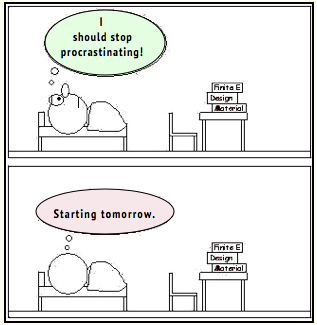
putting off cartoon
NEXT: WEAK Decision Styles, #1
ACoAs & PROCRASTINATION (Part 5)

make notes I CAN GET THINGS DONE –
& feel good about it!

PREVIOUS: Putting things off #4


SITE: Overcoming Procrastination

BOOK: “Willpower: Rediscovering the Greatest Human Strength” by John Tierney, New York Times science writer, & psychologist Roy F. Baumeister.
An unconventional “self-help” book that, much like Timothy Wilson’s ‘Redirect’, grounds its insights & advice in 30 yrs of serious academic research into willfulness & self-control. While the book is fascinating in general, its 3rd chapter “A Brief History of the To-Do List, From God to Drew Carey,” is particularly interesting.

5. BOTTOM LINE
“WHY BOTHER?” underlies all our indecision & procrastination. We don’t take genuine care of ourselves, no matter how busy or cocky we seem to others. On a deep level we’re paralyzed by:
a. Not knowing or having access to our healthy True Self, so we believe we don’t know what we want or like, nor what our rights are!

b. Not being allowed to be our own internal motivator – so our only reason to take actions has to come from outside. We have to use family, a boss, teacher, a cause, religion, a career, friends & lover relationships, AND ultimately our terror of abandonment & punishment to push ourselves. Left to our own devices, we just collapse inward

c.
Our Internal Conflicts:conflict
• losing someone, being hurt or punished vs. feeling ‘safe’ (even if that safety is an illusion or self-destructive)
• WIC & PP vs. the Healthy UNIT
• obeying vs. disobeying the Toxic Rules
• old patterns vs. new ways of doing things
• what we want vs. what we’re ‘supposed’ to be, do, think, feel

d. Double messages, originally forced on us by one or more adults, we had no choice but to internalize the resulting Double Binds* (simultaneous but opposing demands, with a penalty for whichever one we can’t fulfill).
EXP:
• As kids they expected us to do for them (which may still be going on with an elderly parent), taking advantage of us to be their parent substitute – using hints, guilt, shaming, manipulation, demands, threats…. AND were angry / abusive if we did nothing (the penalty)

• BUT THEN were totally dissatisfied with & critical of (the penalty) whatever we did do for them, no matter how much effort we put in, what it cost us, what we had to sacrifice, how clever we were at it….

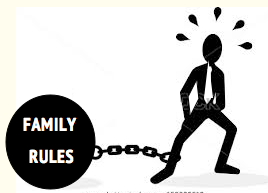
*EITHER WAY we were/are punished. If they’re still live we compulsively keep trying – to please them,chained to rules over & over. If they’re not around anymore we often find some other needy, critical person to satisfy – always with the same impossible, painful results!
YES, we’re addicted to the rejection, while maintaining the illusion that we have the power to change them, if only we try hard enough, long enough!

Ultimately, we stopped trying – but only for ourselves, because:
• we’re still waiting for them to approve of us, & give us permission to have a life of our own life (free us of their bondage because we don’t believe we can do it ourselves!)
• we’re convinced that if we failed with them (the family, also school, religion), it’s inevitably that we’ll fail with everything & everyone else, so there’s no point in trying
• we’re waiting for someone – anyone – to come & rescue us so we don’t ever have to be our own parent!

6. FACING our INNER REACTIONS
• Unfortunately, delaying inevitable responsibilities (as well as ones we’ve taken on voluntarily) creates endless obsession & self-recrimination. “”I’m just lazy by nature”, “I can’t do anything right” , “I’ll just mess it up – again” ….procratination

So why would we rather worry ourselves sick than ‘just do it’?
• we SAY it’s just a habit – but it’s really our self-hate
• we’re used to longing for things, rather than having them
• we’re waiting to be taken care of
• we think we don’t know how, even tho we actually do
• staying loyal to the family by copying how those adults ‘handled’ daily actions & problems
• we’re not allowed to do things easily because suffering is the norm (if it’s too easy it doesn’t count)

NEXT: Procrastination #6

ACoAs & PROCRASTINATION (Part 4)

self-motivationTHERE REALLY ARE THINGS
I can do to get going

PREVIOUS: Putting things off, #3

See ACRONYM page for abbrev.

SITE: ‘Beating Procrastination


2. NOW we put things off because of…. (in Part 3)
3. WHAT makes it HARD to act
a. Internal FEAR of // b. External FEAR of….

Internal & external fears can show up as: (cont.)
Putting off tasks. Many of us find that our whole life is permeated with the ‘habit’ of waiting to the last-minute to do things. It doesn’t seem to matter whether the ‘thing’ is something we would like to do or something we dread. We just put it off & off & off.

— Then comes crunch time – the deadline has caught up to us. We’re in a panic, scrambling to do the task, but now it’s going to be half-baked. We don’t have enough time to do a thorough job, don’t read the instruction correctly (or at all), leave out or miss something. And by leaving it tot he lat minute it can never be done right
— OR the deadline has past & we don’t get the benefit of a discount, miss a class or a needed product, a reunion, a party….

▶ Of course we’re painfully aware of all this, but as long as we’re stuck: worried
— we’re full of anxiety & S-H for not doing it Perfectly
— we scare ourselves with dire projections & predictions about how we’re going to get judged, punished, fired….
— hate ourselves for letting a desired or favorable opportunity pass by

But, like any good addict, we’ll do it the same way all over again, & again! WHAT? How can this be an addiction? WELL…. in this case it’s the addiction to: Fear + Adrenalin + S-H = Drama. This formula has become so much a part of our lives since childhood that we keep doing things (or not) to re-enforce the chemical surges it creates.

Yet under this self-inflicted ‘excitement’, the WIC is just trying to protect itself the only way it knows how – by NOT doing anything. Yet it’s not enough to just label it as part of our ACoA damage, which it is. We need to know how it all got started (Past) & how we perpetuate it (Present).

4. GOOD Stuff can deter us too – we often sabotage when things get too good!
• fear of success, as that would disobey basic Toxic Rules, and we’d have a lot of responsibility which the WIC believes it can not handle – even tho our adult can/could

• not allowed to be happy, based on the belief that life is hard, exclusively, AND that we aren’t worthy of having good things anyway
• stay loyal to the family by not out-doing them – we must also be a failure, don’t show them up, stay in the family mobile, don’t rock the boat…

• can’t be decisive: sometimes there are places we thinks we should go to, but really didn’t like, or we don’t feel well, or want to do something else, or do nothing at all…. even when it’s potentially pleasurable or valuable.

But we aren’t allowed to say NO to the inner Pressure-er (“what will they think if I don’t show up? / what if I miss out on something / maybe this will have the perfect answer to all my problems?….”). So instead of firmly deciding Yes or No, we dither & obsess, do nothing & then hate ourselvesindecisive

• are never supposed to say NO to what someone else suggests, offers, wants – especially if it’s good for us. Besides “Why do they want to be with me? Why are they being so nice?” So for those times we don’t rush to people-please, we make promises we eventually flake out on, make excuses or just lie, until people get angry &/or give up on us.
— That comes both as a relief – of pressure, and a big pain – of yet again feeling ‘abandoned’! Trapped in our own no-win game, we blame others AND are filled with self-abuse

NEXT: ACoAs & Procrastination #5

ACoAs & PROCRASTINATION (Part 3)

mananaMAÑANA, MAÑANA
I want to, but just can’t get going!

PREVIOUS: “Putting things off” Part 2

POST:Why are you Stuck?”


2. NOW we put things off because of: ❓Feelings  // ❓ Knowledge
✳️ ULTIMATELY – we put things off :
a. so we won’t feel so alone – that inner loneliness of not having nurturing parents growing up! Being our own caretaker, being competent – even in small things – is an emotional reminder of how terribly alone we always felt as kids – no one to guide (only bully), no one to comfort (only control), no one to encourage (only shame)…. inner aloneness

• Instead of doing something positive, all that wasted time spent worrying, obsessing about things we’re not getting done actually serves a purpose for the WIC : it fills up the emptiness inside – where a good parent should be – the Inner Supporters we never had (early abandonment).

EXP: Pre-Recovery, Tina needed to replace a knob for her radio that had fallen off & was lost. She knew she had the manufacturer’s purchase list in her files, but felt a general lethargy about taking the action = all of 5 minutes to find, make the call & order the tiny part. It was several months before she did this simple task.

• In the mean time Tina had to turn the radio on & off by awkwardly using 2 fingers on the sound stub. When the part arrived, in a little pouch, it sat on her night table several more weeks. Eventually she ‘faced’ the great task of taking the knob out of the package & clicking it into place = all of 1 minute!

b. because we have a deep (usually unacknowledged) feeling of hopelessness. After all – the WIC believes that our actions are supposed to get us the love & attention we’re always craved, specifically from our parents (dead or alive!). The Child’s logic says – “since they hurt me & hated me, it has to be my fault, so I have to find a way to fix it.”

But no matter how hard we work at being the perfect son or daughter, we rarely achieve this wish. So eventually drowningtaking actions gets harder & harder. Scapegoat & Lost Child ACoAs give up trying a lot sooner than Heroes & Mascots, but they never give up wanting to be loved & accepted! They just pretend they don’t care!

c. we feel powerless to have any effect on our environment (being efficacious). We could never get our parents (& sometimes siblings) to notice us, listen to us, take us seriously, consider or feelings & needs. So why would we be able to influence anyone else in the world? If we have no ability to influence, then why even try to DO anything?

3. WHAT makes it HARD to act
a. Internal FEAR of —
• not doing everything Perfectly (a form of S-H)
• not knowing how to do something (even tho we’re actually very
smart, clever, creative, knowledgeable)
• not knowing what to say when challenged or attacked
• looking weak, needy, incompetent, lazy, stupid…..
• having to stand up for ourselvesstandup
• making the ‘wrong’ choice, when having several options, or many demands on us at the same time
• having to feel the loneliness & pain of our original abandonment

b. External FEAR of —
• getting disappointing, hurting or angering someone
• being judged harshly (the way we do to ourselves)
• asking for help when we really need it
• having to deal with difficult people
• being interrupted & lose our train of thought /activity
• having to make everyone else happy (not be in pain) but resenting it

These can show up as:
• Not being able to decide what to do first, when we have several options, or what to do at all (like with free time)
Starting things (refinishing a pc. of furniture, art work, a book, even relationships…) but never / rarely finishing anything – IF for ourselves
• Can’t motivate ourselves – to have a life of our own, as in following our dreams, leaving bad relationships, moving to a better location….!

NEXT: Procrastination  Part 4

WHY ARE YOU STUCK?

unstuck LITTLE BY LITTLE
dismantle your prison

PREVIOUS: What to do when Confused – #7

See ACRONYM page for abbrev.


WHY
we’re stuck
There may be several reasons. Here we’re concerned with the many Toxic Beliefs* we carry with us from our childhood experiences.

✶ Our fear is strong & pervasive, but the main cause for that in the present is what we are THINKING! Change that & we’re free!
NOT being able to pursue & reach our needs & desires is caused by intense inner conflict between what we consciously desire VS the family rules coming from the Introject (PP = bad parent voice), whispering or screaming at the WIC, causing in S-H

• OBEYING the Toxic Beliefs guarantees that we stay trapped, continually failing, feeling more & more hopeless, even suicidal. BUT, they’re so much a part of us, we may not even know we’re being coerced by ideas that were created for us (deliberately or not, it doesn’t matter).

To get UNSTUCK – we need to know & own these self-destructive Rules, counter them & then slowly change our actions, ie. Only follow the New Rules!

IRONICALLY, these old beliefs are very hard to give up, because:
• the Inner Child actually believes them!pain
• following them represents loyalty to our family

GIVING them up would mean:

• getting in touch with the PAIN of our damage
• seeing what we missed out on (a loving, healthy family)
• having to give up what we thought was our ‘identity’ (our False Self
& one or more Roles)
• having to become our own person (S & I), grow up emotionally, make our own choices, be responsible for ourselves & our actions  – stop waiting to be rescued.

BELOW is one FORM to use whenever you want to know what’s going on in your head – what toxic beliefs are keeping you from getting what you want in life (use it separately for each topic or issue that’s bothering or confusing you), AND another FORM to make your corrections

➼ Please DON’T just say “I don’t understand this”, or “I don’t know how to do it” & give up.  That’s mainly resistance, even if you’ve never done this particular exercise before.  Anyone who has read self-help books & done therapy will definitely be able to fill these out, given some thought, but even if you never have, you can always ask for help from someone who knows you well.  Don’t worry if your answers are similar each time you use the forms. That’s to be expected.

resistSTART by identifying a problem you want to correct OR a goal you want to achieve, but haven’t been able to, so far. Suggested ‘Issues’What‘s stopping me from:
• starting a new career?  • looking for a new job ?  • leaving a harmful relationship?  • standing up for myself?  • letting go of my damage?  • cleaning up my apartment?  • studying  my artistic passion? ….”

1. FORM A – What’s familiar: using T.E.A. (Thoughts, Emotions & Actions), to ‘hear’ the damaged part of our thinking
•  Column 1. “Emotions” can be filled in right away if you’re very upset & know what you are feeling, otherwise —

— go to Column 2, filling in as many negative thoughts as you can (one for each category is ok if that’s all you can think of). Make sure you separate out what you’re thinking about yourself VS what you’re assuming about others (projecting)

•  If you left the first column empty, now add any emotions you’ve become aware of relating to the beliefs
• Then list the ways you ACT in response to those beliefs

2. FORM B – What is possible: Reversing patterns of thoughts & behavior will modify fear & greatly improve your experiences in life.
Use the same procedure as in Form A. but change the harmful beliefs to HEALTHY, positive & hopeful ones, & then keep the list with you at all times so you can review & internalize them

• Based on that –  you can practice changing you ACTIONS, starting in small ways, whenever you can. Plan ahead how you’re gong to change an old pattern & try it out.

• In this case the Emotions column is last because you may not know how you feel until you try our new behaviors & get some positive results. Don’t be surprised if you have uncomfortable emotions (as well as pleasant ones), which come from your WIC and/or PP.  Just let them be. Comfort your kid, tell the PP (Introject) to leave your kid alone, & focus on enjoying the relief & pleasure of living well (the best revenge!).

Sample PROBLEM :
“Why can’t I make & keep friends / lovers / bosses who are healthier, compatible & supportive??”

You may need help from a therapist, friend, sponsor or healer – to IDENTIFY the NEGATIVE and POSITIVE beliefs. Don’t be ashamed to ask!


MAKE several BLANK copies of these 2 FORMS,  and try it out on one of YOUR issues

NEXT : ACoAs & PROCRASTINATION (Part 1)

What to DO when CONFUSED (Part 5)

WHEN I’M CONFUSED
it’s OK to ask for help

PREVIOUS: ACoAs & Confusion (#4)


💠 ACTIONS: UNRAVELING CONFUSION (cont)
2. SIMPLIFY // 3. PRIORITIZE

4. OPTIONS (cont)
THE “LAW”: Being trapped as kids in endlessly dire situations without any possible ‘out’ left ACoAs with the Toxic Rule: “If you don’t like it you have to stay”. Controlling parents also taught us: “It’s MY way or the highway”  & “Who do you think you are?”.  Not only were we not allowed to leave bad situations, but we shouldn’t think for ourselves or disobey the ruling demigods – lest we be destroyed!

• That is how the WIC actually experienced our parent(s): as ‘gods’, and so disobedience = our death. If that seems extreme, imagine the terror in a small child trying to defy the angry, abusive authoriparents as godty.

OR, remember the intensity of your anxiety, as an adult, when you’ve said NO to a parent or mate, or tied something totally our of your comfort zone. Haven’t yet?  As long as we still hold these crippling beliefs we have little or no wiggle room, making it hard >to >impossible to take effective actions

EXP: Shona’s father had given her a few of his extra tools to use in her first apartment after college. 20 yrs later she was still struggling to making do with them for every repair job, no matter how unsuited they were for a particular task!

Eventually Shona realized this was a metaphor for the way she lived the rest of her life, & decided to work on expanding her sense of possibilities – starting at the most practical, undramatic level. Occasionally she’ll stop in a hardware store & just LOOK at the huge variety of items – each made for a specific operation!
Imagine making life easier by having the right tool!

APPLY this to all areas of life – & start by finding out what’s available – what are your options in a given situation. While there are realistic limits to our capacities & to what we can afford, they’re NOT nearly as narrow as we believe.  Of course with Amazon, eBay, Google…. – just about anything can be delivered!😀 Anyway – in T.E.A. terms, Emotions also come in a wide range, many ways to Think about something & a variety of ways to DO things.

The latter can certainly apply to small daily choices like what to wear or eat —> all the way to big ones like where to live, which job & relationship to pick or stay in…. One teacher repeats month after month: “Don’t be negative, just be open!” – a new rule to live by.

5. INVENTORIES
a. Venn Diagram Inventory
PURPOSE: to get an overview of where you stand on any aspect of your life right now
USE:
You can make the chart into a collage, use the computer or just free-hand it on a large sheet of paper

The biggest circle (Spirituality) is the background to our whole life.

EACH person’s Diagram will look different.
If you’re ambitious or curious, you can make one for where you were 10 or 20 yrs ago, as a comparison.

• Think about all the areas of your life, & decide their relevant importance to you at present. Change or add any not listed.
Draw / cut the size circle for each topic as it relates to their current importance

• Play with the positions of circles…. change them around until the chart feels right. Place them close to, overlapping or far away from each other, depending on how they connect in real life

• Label circles, & draw lines to form pie wedges in each one.
— You decide how many lines (slices) based on how many problems & victories for each – you’ll probably have to guess-timate
IMP: each slice represents an issue related to the circle’s topic

a. Fill in a slice for any aspect of that topic you’re confident you have a good handle on(never perfectly)
EXP:
No longer use drugs & alcohol

b. Zig-zag or cross hatch slices that are aspects you’re still working on but making progress. The degree of progress in one may be different than in another slice. Make zig-zag density accordingly
EXP: Get to places on time more often

AND THEN: Most likely there will always be one or more empty slices – representing:
c. Grey– things about a topic you know need correcting / a change but are not ready / willing to tackle

d. Blank– problems / challenges about that topic you simply don’t know you need to work on – yet

NEXT: What to do…. #6

What to DO when CONFUSED (Part 1)

PREVIOUS : Recovery Confusion (#5c)

SITE: Confusing communicators

REVIEW – See posts: “ACoAs & Confusion” —  not due to mental or physical diseases (brain damage, Alzheimers, psychosis, depression…..)


DEF
: Any time we have trouble sorting out 2 or more conflicting / opposing : points of view, rules, options, desires, experiences, needs.
Being torn between the facts as we know them AND a resolution we can’t see or find, (being sure about the facts) because we don’t understand our environment.

Can be caused by:

• getting too much information at the same time
• learninScreen Shot 2015-07-20 at 4.54.04 PMg something new, & not knowing how yet (this or that?)
• absolutely not understanding some info, communication, instruction, expectation
• not knowing what to do because of —
– having too many desirable options, but can’t do them all
– not allowed (internally) to admit what you really want to do
– not knowing yourself well enough, & so – afraid to make the wrong choice & then have regrets

EMOTIONS (Es)
You’re confused about how you feel – emotionally. You wonder :
= “Am I angry or scared? I shouldn’t be upset about the way that clerk talked to me, like I was dumb, but I am upset about having such a strong reaction…..

= I’m feeling sad & relieved at the same time about the breakup. Am I crazy?”…..
NO – not crazy, it’s just normal human complexity. Having a variety, even simultaneous contradictory Es is common, especially when considering that each Ego State has it’s own & they often disagree

EXP: Carla came to the party on her own, & wondering who all these people were. After a while she found herself talking with 2 older out-of-town business men, obviously colleagues & obviously married. They were charming, friendly & amusing – telling funny ‘war stories’  & how they’ve helped each other at work. Carla was having a good time laughing with them, genuinely enjoying their company.

At the same time,
she felt sad inside, & checking with her inner child, “Little C” said she was sad because then the party was over she’d be going home alone & missing the fun!”

COMMUNICATION
WORST
– severe Narcissists are dangerously confusing. They’ll crush any attempt you (target/victim) may make to figure out their agenda – to keep you constantly walking on eggshells, emotionally off balance & mentally confused (feeling crazy). Narcissists always need to be in control of every situation, & react accordingly to keep you in line

SECOND: those who knowingly leave out important info about themselves – that you need to know (married man, ex-con, addict….), or crucial info about a situation they’re in

OTHES Confusers – so you never know where they stand, where you stand with them, what they want….. They’re the ones who:
– talk a lot, but never say anything of substance (shallow)
– sound like they’re trying to tell you something – especially when upset – but just beat around the bush & never get to their point
– only respond in non-sequiturs that have nothing to do with what you’re saying
– lecture, pontificate…with no emotional content
(11 Posts: ‘ACoAs & Confusion‘)

LANGUAGE (T)
Most people are sloppy in their use of words & phrases, causing much confusion. (See post “Sayings that Misrepresent“)

❎ The most common is the word -FEEL- to mean 3 different states – physical, emotional & mental .(See post “Feelings aren’t facts
• Repeating words they don’t know the actual meaning of (co-dependent, introvert – when they mean shy…. )
• Using a word that sounds like another but with totally different meaning (flamingo instead of flamenco)

• Misusing words (that’s schizophrenic, your crazy, pathological… ) when we’re angry at someone
• Vague words, usually about some emotional state, but unspecified (upset, triggered, off, out of it, acting weird, not themselves…. ).
Is the person unusually angry, sad, scared, nervous, withdrawn, unusually angry, cranky… ?

• Using this word as a pejorative, “Don’t be so emotional, women are too emotional…” by which someone means they’re angry or crying.
BUT emotions come in a wide range of colors.
Why can’t “they’re being emotional” also mean “they’re so excited, thrilled, happy-shocked….!” ??
 And yes, maybe even crying a little!

NEXT: What to do …#2

ACoAs & CONFUSION – Growth (Part 5b)

PREVIOUS: Recovery Confusion (#5a)

SITE: 🔺 “Overcoming Anxiety & Confusion
🔺 Uncertainty and Cognitive Control

🔺 8 Ways to Eliminate Brain Fog Once & For All

QUOTE:”Good communication is the bridge between confusion & clarity” ∼ Nat Turner (slave rebel leader)

A Zen Buddhism story
Two monks were walking along the banks of a river. They saw a young woman who was afraid to cross. Although the monks had taken vows never to touch a woman, the older monk picked her up and carried her to the other side of the river. The younger monk was angry about it all day.
The two didn’t speak until sunset, when they were allowed to break their vow of silence.
Then the angry younger monk accused the older monk of polluting not only himself but also the whole order. The older monk simply answered, “I put the woman down on the other side of the river early this morning. It is only you who have been carrying her around throughout the day.”

REVERSING life-long Confusion (cont)
1. Learn to apply Logic // 2. Get more info

3. Get VALIDATION
Because our parents provided no mirroring or very distorted feedback about who we are, we think we’re invisible – both internally toconflicted ourselves (“I don’t know who I am”), & externally to others (“No one gets me”).
As adults we can reverse this training by risking what we fear the most – any form of abandonment.

4. Grow the ADULT/PARENT ego states
Since our internal confusion comes mainly from the PP & WIC, we need to form & strengthen the UNIT so that it can be the decision-making voice.

Posts: Book-ending // Problem-solving // My rights // Why are you stuck?
USE: relevant books, YouTube, 12-step Programs, spiritual groups, therapy …. to learn what’s normal & healthy.

5. RESOLVE internal CONFLICTS
‘Being stuck’ always includes intense internal conflicts we don’t know how to resolve, or are unwilling to do the Recovery work it would take. They are mainly in the form of frustrating disagreements – between the WIC (obeying the PP) & the UNIT, or the Unit fighting against the PP’s injunctions – between old damage & new Mental Health

The goal of Recovery is to get the PP completely separated from the WIC, so that both Healthy & Wounded parts of the Inner Child can align themselves with our healthy Adult/Parent.
STEPS
a. List real Needs (Parts 1 & 2) of each ego state – not the WIC’s outrageous demands (Part 3). ‘Normal’ childhood needs: acceptance, approval, attention, emotional comfort, physical contact, security & stimulation

b. Write down conflicts between the various opposing ego states
c. Inner Selves must agree to help each other get those needs met, brainstorming as many ideas as possible

• When Loving Parent & Inner Child are on the same page about any given subject (shutting out the PP) – the conflict melts away & useful choices seem self-evident. Whatever actions we’ve been dragging our feet about suddenly are easy to do, & usually don’t take much time. But when we’re deep in our damage, all our time is spent obsessing, worrying, planning, complaining… but NOT acting

6. Take SOME Action
Once we’re ready to focus on taking some kind of appropriate action, we can consider the next part of the process.
It may be something we’ve been thinking about for a long time but couldn’t move on, or something shifted in us so we formed a new way of thinking about the problem, which quickly translates into a new way of functioning.
*️⃣You don’t have to know if the action will lead you where you want to end up. But it can tell you if you’re on the right track or not

• Break down potential tasks into bite-size pieces – called process
• Identify the ones you know how to do, & the ones you don’t – & get the missing info
• Choose the simplest action you can & take it – one phone call, one evening class, one hour of internet searches….
• Don’t give up. It’s OK to take breaks but then start again & keep trying new things. It can eliminate some confusion & you’ve possibly learned something along the way (More….)

NEXT: Confusion – Growth #5c

ACoAs & LISTENING (Part 3)

listening to herYOU MEAN I HAVE TO
be happy for someone else?

PREVIOUS:  ACoAs & Listening (#2)

SITE: The SKILL of LISTENING  ** w/ EXP (Center for Parenting Education)

REVIEW posts : “Healthy Helping

See ACRONYM page for abbrev.

QUOTE: “We have two ears and one mouth so that we can listen”~ Epictetus 

REMINDER: Accurate & compassionate listening means we don’t try to make the other person a carbon copy of us. Even if we strongly identify, listening is about THEM – where they’re at, what they’re feeling & thinking. Don’t talk about yourself too much. You are the listen-er, they are the listen-ee.

3. (AWhen someone wants you to listen to them AND it’s a practical issue (lack of funds, health or relationship problems…..) (in Part 2)

#3 VARIATION (re. actions)
(A) When someone wants you to listen to them AND asks you directly to tell them what to do
a. Naturally if you are sought out as a professional (doctor, decorator, coach, teacher, lawyer…) you’re paid to give your expert opinion & advice.
— However, for psychologists, psychotherapists…  the rules are different. The goal is more about mirroring, giving feedback (true listening), providing the client with options & helping them find what’s right for themselves.

b.
For the rest of us who are not being paid, teach or heal, there are options.
• ASK if they want ‘advice’ OR information – not the same thing!

Advice is telling someone what you think they should do, be, feel, think based on yourself, not who they are! No matter how right or helpful the info is, it’s not listening.

Information is giving knowledge they may not have, including options, without an emotional valence attached. They can use it or not, as they wish We often tell people to DO things they’re already tried. Don’t waste their time or yours! Good listening is hard for ACoAs, but worth the effort!

i. When you know the listen-ee well, you probably know —
if they already know what to do – but in this case refuse. Don’t push
that they may know, but really do need some help implementing a solution.
Suggest someone else who is qualifies & willing, or if it doesn’t harm you, you can offer, but think twice before you do

— that they really don’t know. Then you can decide IF you want to give them info, or suggest where they can get it (on Google, from Al-Anon or AA,  some books you recommend….)

ii. If it’s someone you just met or don’t know well, start by asking some pertinent questions —
— What do they WANT from you? What are they really asking for & how much? See posts “Healthy Helping”. If you can get that far with them, the conversation may take a different turn than how it started

— What have they done about their problem / situation so far? & how have those things turned out? This saves time & energy suggesting things they’ve already covered.
• If they’ve tried a number of things which have all been disappointing, there may be absolutely nothing you can contribute. OR they didn’t try something useful because they didn’t know about it – so you can offer it

• IF their response to any suggestions is always a version of “Yes but… that won’t work / I can’t because….” then either you’re asking the wrong questions or they’re playing the “Yes, But” game from Games People Play, by Eric Berne.

In the latter case they don’t actually want an answer, they want to be parented AND be contrary, which is a child’s way of saying “You can’t control me.” It may be a version of “Come here-Go away“(posts).

With such a person, only try 2-3 times, then shut up. 😑

NEXT: What just Happened? – #1

ACoAs & LISTENING (Part 2)

Screen Shot 2016-06-19 at 5.12.58 AMI FEEL SO POWERLESS
if I don’t DO something to help!

PREVIOUS: ACoAs & Listening (#1)

POSTS: Anxiety & T.E.A

Turkish
proverb: “If Speaking is Silver, then LISTENING is GOLD”


LISTENING ‘situations’
(cont)
1. (E) When someone wants you to listen to them AND….

2. (E) When someone wants you to listen to them AND they’re expressing intense emotions (sadness, anger, fear…) 

BUT their emotional state sounds ‘crazy, irrational, ‘out of proportion’ to the current situation, remember: “If it’s Hysterical, it’s Historical”. It usually means their WIC is in the foreground, who is expressing intense old pain – accumulated from childhood trauma.

It’s not your job to parent them & you’re not their therapist. Here too – trying to make them feel better can be heard by them as denying their experience!
CAVEAT:  If you’re listening to someone deep into the emotion of self-hate, there’s very little you can do to make a difference in that moment.

DO NOT try to talk someone out of Self-Hate. It’s futile. Their WIC has completely regressed into a familiar childhood state & locked in for the time being.
Because S-H is about denying the pain of abandonment & trying to avoid feeling vulnerable, while having a little control over their sense of hopelessness (S-H gives a false sense of power) – they’re not going to come out of it right away.

OPTIONS
◆ You could say: “Wow,_____, I hear that you’re really beating yourself up mercilessly. Why is that?”
◆ You can also ask: “What’s happened recently that hurt you or disappointed you so much?”
If you think they’ll understand, you can gently suggest they’re feeling some deep childhood abandonment
◆ If appropriate, you could add your own reaction: “Your self-hate is really painful for me to hear. It’s like watching someone I care about cut themselves or shoot heroin!”
Yes, that’s how devastating S-H is!
💝   💘   💔
3. (AWhen someone wants you to listen to them AND it’s a practical issue (lack of funds, health or relationship problems…..)

AND you insist on offering a way for them to solve their problem (actions)
you’ve actually failed them, strange as it may seem, because…..
….. when you do for them what they can AND need to do for themselves, you contribute to their sense of inadequacy & fear of taking appropriate risks.
And they can do things for themselves. As adults, they’re not helpless. Maybe discouraged & faltering, but not helpless. Maybe all they need is information – but it has to be something they can apply for themselves.
(Review posts: “Rescuing – False helping” and “Healthy Helping“)

HARMFUL
• ACoAs would rather do for others that themselves. It’s our training & a great distraction from taking care of ourselves- which we don’t want to do.Screen Shot 2016-06-19 at 5.18.42 AM

• IRONY: we use a great deal of intelligence, creativity, money, time – even wisdom – on someone else, BUT genuinely believe we don’t know how to handle our own problems! How is that possible, when we just used all those skills for others?

• REALITY: We use up a lot of energy trying to save someone else, while silently expecting, even demanding, that someone else do the same for us! WE too want to be taken care of, even though we too have the ability to care for ourselves.

HELPFUL
• Rule #1, again – zip the lip!
• Often people just need a non-judgmental sounding board – to hear themselves think.  By running it past a good listener, they can hear the problem for what it is, maybe even find their own answersScreen Shot 2016-06-19 at 5.14.43 AM

• You can ASK if they need practical suggestions, but only give it IF….
…. they say yes & they seem willing to do for themselves (not just trying to be taken care of, or need to be oppositional)
…. you actually know, maybe from experience, what you’re talking about
• You need to CHECK what they….
…. want to do, in the near future
…. have already done, but for some reason didn’t work or didn’t help!

NEXT: ACoAs & Listening (Part 3)