Family INVENTORIES – Purpose (Part 2)

fam inventory 

LOOKING AT OUR DAMAGE –
ignorance is NOT bliss

PREVIOUS: Family Inventory (Part 1)

See ACRONYM page for abbrev.


2. LEGITIMATE EXCEPTIONS (Part 1)

3. PURPOSE
• Being trapped in unhealthy emotional/mental states (listed in 2b.) keeps us choosing or being chosen by people who are abusive or unavailable, and then staying with them because we compulsively blame ourselves for any pain they cause by their damage.

This happens because we keep using Self-Hate (S-H) to explain away someone else’s bad behavior (“It’s my fault / I should have / If only I had”… ), no matter how obvious it may be to others that we’re allowing ourselves to be victimized.

It’s useful to remember that all S-H is a defense mechanism. Its purpose is to ‘protect’ us from being fully aware of our childhood traumas & other abandoning experiences, but all it really does is add more pain to the original pile, by believing we caused our suffering

Of course it’s very important to do our own personal inventories (next post), but without a clear picture of our early life, much of what we end up writing is steeped in S-H & hopelessness. Therefore it’s imperative to first have an accurate understanding of all the relevant people we s-h alonegrew up with, because we absorbed their words, actions & emotions into ourselves. This absorption became our Introject.
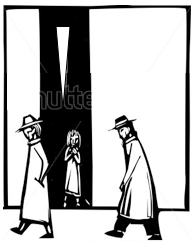
Every person has one, but not everyone’s Introject is a PP (pig parent / accusatory voice) – only those of us who come from damaging families. Without enough healing (deep FoO work), this Harsh Voice is the only one the WIC takes as absolute gospel, the cruel guide we use to identify who we are, even tho’ it’s not our original voice AND is a complete liar!

• Proverbs 22:6 says: “Train up a child in the way he should go, & even when he is old he will not depart from it”.
Unfortunately, those of us from unhealthy backgrounds have absorbed a distorted, self-defeating programming – most obvious in our CDs, which include S-H.

This brain-wiring is so strong that it takes much effort & repetition to change – mainly because it’s kept locked in place by a great deal of emotional pain, which needs to be cleaned out. Most people don’t have the guts & patience to revisit & process old beliefs & emotions, even if that refusal causes havoc to themself & others.

• But for those of us with the willingness & proper support – we greatly benefit form carefully identifying what originally happened to us & around us. It allows us to understand – & accept – that our childhood suffering was caused by the damage already present in our caretakers, and therefore could not have possibly been our responsibility, nor our fault!

It bears repeating: This awareness (The 3 C’s: “I didn’t cause it, I can’t control it, I can’t cure it” – re. problems in OTHERS) will gradually lessen our need for S-H, as we stop denying the width & breadth of our own original loss in all 4 layers of PMES. This becomes a great victory over our dis-ease!

• All of our struggles to heal & flourish are contingent on outgrowing the toxic family training (via S & I), but before we can do it thoroughly we have to SEE what that training entails. We have to know which city we’re traveling from -and to- before we can book a ticket, yet ACoAs have a built-in denial system that makes it hard to know what state we’re in much less what city! We need a map & some guide books to our destination. Inventories help.

• Psychologists, Sociologists & Spiritual teachers tell us how important it to know ‘where we come from’, what our cultural & spiritual history is & how all of humanity is ONE.
Yet ACoAs have a painful sense of not belonging anywhere – no matter what environment we’re in. This is because our parents’ narcissism made it very hard to feel wanted & loved, only getting judgement & impossible demands. And we figure that if they didn’t take care of us properly nor want us exactly the way we were – then why would anyone else?

NEXT: INVENTOTY #3

Family INVENTORIES – Purpose (Part 1)

LOOKING AT HOW IT ALL STARTED is not always easy!

PREVIOUS: Personal Responsibility-#1

See ACRONYM page for abbrev.

QUOTE re. the need for S & I
“It is not possible to live too long amid infantile surroundings, or in the bosom of the family = without endangering one’s psychic health. Life calls us forth to independence, & anyone who does not heed this call because of childish laziness or timidity is threatened with neurosis.” Carl Jung
🎯
DEF: INVENTORY – To evaluate & make an itemized report of abilities, assets, or resources. To take stock of one’s life and accomplishments.

1. IN 12-Step TERMS
a. Doing our 4th Step – to write out as many of our qualities as we can – both positive (gifts) & negative (defects), as well as a list of all actions throughout life (to identify our Being and our Doing)

b. Taking someone else’s inventorya big no-no, & for good reason, when understood correctly, is an unhealthy defense mechanism. This can mean recounting someone’s faults to all who will listen, or using a sharp tongue to tell someone off who we’re angry at.

NOT doing this is a valid rule in general for everyone, & specifically – geared toward addicts & co-dependents, because:
• we copy our parents’ habit of always finding fault with everyone & everything else, instead of owning our own thought & emotions (likes & dislikes….)
• of the compulsion to blame others for all our woes, instead of taking responsibility for our part in any situation (but not in the form of S-H)
AND
•  our character defect of using any upset as an excuse to gossip
•  our fearful avoidance of dealing clearly & honestly with anyone we’re currently having a problem with, using the Adult ego state
• the fear-driven habit of avoiding very hard decisions, making small or major changes, leaving toxic people, standing up for ourselves …..

2. LEGITIMATE EXCEPTIONS to this rule :
a. Re. Safe People: To identify the healthy characteristics we find in positive role models, which we then can look for in everyone we associate with, so we can ‘Go where it’s warm’ – toward people who are reasonable (T), kind (E) & functional (A)

b. Re. Unsafe People: to break thru our denial.
ignoringACoAs deal with abusers – either :
• by having thick blinders on, denying the character defects & emotional damage of unhealthy people, while only see our own flaws – even where they don’t exist. OR
• by being terribly judgmental & critical of everyone – including ourselves (S-H), while not trusting anyone with genuinely good qualities. BOTH types tend to shy away from healthy people!

That way we can be angry at anyone for not giving us what we want & need, just like our parents, but stay with them so we don’t have to notice of the many ways they abandon us, & then face having to do something about it (leave?)
AND we can stay loyal to the dysfunction, continuing to long for but never receive the love & acceptance we believe we’re not allowed.

✳️ As we know, people tell us something about themselves all the time – their pluses & minuses – which we miss all together & could see if we paid attention, knew what to look for, & be willing to respond appropriately
OR we do notice but ignore or excuse. Then it bites us in the butt later!

Sadly, as kids ACoAs were brainwashed to deny much or all of our experiences, intuition & perceptions, so it’s particularly necessary to do this type of inventory for all of us who:
• are genuinely ignorant of, or in deep denial about, the harmful effects that addicts & other damaging people we spend time with (family, lovers, bosses, friends…) have / have had on us

• are surrounded by unhealthy communities (family, religious, social, work….) where everyone is continually bombarding us with a distorted reality about us, themselves & the ‘right way’ to do things

• are by nature so idealistic that we only want to see the good in others, as a defense against the dangers of life, to our great detriment
• know there’s something wrong with certain people & situations in our life, but are not allowed to believe our intuition & knowledge.

NEXT:  Family Inventory – Purpose

S & I needs a Heathy EGO (Part 2)

strong identity 

THE STRONGER MY EGO –
the healthier I am

Previous: S & I – EGO (Part 1)

SITE:  “Defense of the Ego


From EGO PSYCHOLOGY –
Throughout childhood, Ego develops in sequence, from a combination of :
• our innate & inherited qualities  flowers
• having our basic needs met
• identifying with others (copying admired adults)
• interpersonal relationships
• studying & learning
• mastering development tasks
• effectively solving problems
• successfully coping with life’s challenges

✶ The healthy ego exists for a legitimate purpose, an integral part of spirituality & totality of Being. Removing the ego is like removing your right hand & only keeping the left one

BASIC COMPONENTS of the Healthy Ego
For ACoAs & all other wounded people, the following qualities are what we can strive for as we heal. The stronger these are, the better our self-esteem. ‘Ego functions’ are the means by which people successfully adapt to the world:

🍂 Affect Regulation – The ability to maintain or increase positive emotions & a sense of well-being, while minimizing or regulating stress feelings & defensive states.  Able to manage all types & intensity of Es, without being overwhelmed by them.  It’s the result of the growth, development & links to our emotional brain (limbic system), based on early experiences with parents

🍂 Defensive Functioning  – Automatic psychological processes that make us aware of internal or external dangers & stressors.  It appropriate use of our defense mechanisms, those developed in childhood & more mature ones (projection, intellectualization, rationalization…), which guard against powerful identity-threatening feelings (panic, hate, rage…) that get stirred up

🍂 Impulse control – (opposite of impulsive or compulsive acting out)
The ability to choose when & how to act – for short or long-term gains when moving toward a specific goal – allowing us to wait to get something we want.  Helps prevent immediately acting on aggressive &/or sexual wishes, & not developing physical symptoms from repressing those desires (actual ailments, obsessions, hypochondria….)

🍂 Good Judgment –  (NOT being judgmental). Forming the best opinions & decisions, by objectively considering, comparing & evaluating known info —> while resisting peer pressure & our own emotions. Allows us to act responsibly, which includes identifying our options, anticipating & evaluating likely consequences, & choosing appropriate actions in each circumstance

🍂 Object Relations  – how the The Self relates to other people (Subject to Objects) in the unconscious, based on internalized images of our actual parents (or parts – like mother’s breast), as well as images we create about others (ogre, angel…).
When emotionally healthy, we have the capacity for mutually satisfying relationship – seeing ourselves & others as whole three-dimensional ‘objects’. We can form emotional bonds with others, instead of only focusing on ourself

🍂 Reality Testing The ability to distinguish between what’s going on in our own mind of thoughts, feelings, fantasy & distortions from objective facts AND the external world – in order to act in a way that shows an awareness of accepted social norms & customs. By imaging, labeling & organizing our observations, we can make sense of them & put into mental files so we can make decisions about their “value,” as potential threat or benefit….
A reality test uses ‘reality-indicators’, that help us come to grips with practical, in-the-present facts. A way for the mind can determine whether an experience is happening now, or is remembering a previous one

🍂 Synthesis – (opposite of Splitting), the most basic ego function : stringsynthesising together succeeding moments of experience into a single preserved ‘event’, allowing all ego functions to be used. It means to be internally congruent – without different parts of ourself being in conflict (‘UNIT’ = PP vs HA, LP vs WIC…)

This organization & unification allows us to think, feel & act in a consistent way. Meshing (not enmeshment) a healthy ego identity with personal & group identity gives us a framework for successfully operating in the world

🍂 Thought Processes – 2 states of the thinking mind (vs. emotional):
a. Primary – ‘primitive’, imaginative style, during altered states of consciousness, not in the Ego’s control, from wishing, day-dreaming, night-dreaming, fugue states —> all the way to psychosis, & may include some loss of motor function

b. Secondary – normal waking consciousness of adult humans – the stable Ego’s work to minimize free-floating mental energy. It’s been called ‘inhibited’ or ‘bound’ because it is guided by the ‘Reality Principle’ (delayed gratification). This gives the ability to develop & hold logical, coherent, abstract thought. Also, to make appropriate decisions, use cause-&-effect thinking & be goal-directed.  (MORE...)

NEXT: Negative Benefits – #1

S & I needs a Heathy EGO (Part 1)

confidence 

A HEALTHY EGO –
allows me to flourish

PREVIOUS: Healthy S & I – #2

SITES : “Ego Psychology”  / / Trans4mind

See ACRONYM page for abbrev

EGO: The way Spirit has of expressing its uniqueness, so without Ego you as an individual would not exist. Therefore they go hand in hand. It’s “the Individuated consciousness of Infinite Being…. and a distinct personality apart from universal consciousness”, says Enoch Tan, in Dream Manifesto

To successfully S & I we need a HEALTHY EGO.  It’s the source of our overall physical, emotional & mental health, in relationship with ourselves & to others. Modern psychologists often replace EGO with “confidence, self-esteem, self-awareness”.

➼ It’s unfortunate that most people misuse Ego to mean ‘arrogant, self-centered, conceited, limiting’…. & therefore a bad thing! Since it’s almost always incorrectly equated with the real problem of adult narcissism, its original meaning has been forgotten. We hear this in 12-Step programs, therapy, ‘spiritual’ literature, even famous people – talking about the pitfalls of ego, such as ‘Oprah’s Lifeclass: The False Power of Ego’

These labels are not correct. The ‘character defects’ being referred to come from our PP or WIC aspects. Neither of those internal ego-states have healthy egos!  Wounded people are said to have damaged egos, split-personalities have multiple egos & psychopaths have fractured egos. NOT having a strong, clear ego causes us to be victims or absers!

NOTE: AA’s 3rd Step says: “Made a decision to turn our will & our lives over to the care of God, as we understood Him”.
In this context, the focus is on the word will. What will? Who’s will? ACoAs are afraid of this Step because it feels like volunteering for slavery to yet another authority figure – in this case the “ultimate” one.
It’s one reason why so many of us reject all religious or spiritual connection, or are drawn to paths that don’t include a specific God-person. The WIC is still functioning from the feeling that “God is an alcoholic parent” & therefore unsafe

• Before Recovery (& even during) ACoAs don’t have actual free will – no matter how headstrong, arrogant or genuinely accomplished. As long as we’re still run by the Toxic Rules, our will is not our own, controlled by the Negative Introject, which the WIC is passionately devoted th-1to.
So, the point of S & I is to find & express our True Self, by no longer obeying the PP.

A NORMAL (healthy) EGO is the ‘eyes’ we use to see the world.  IT IS the :
🌱 aspect that lets us become strong, loving, valuable, contributing members of society, both at work & in relationships – the foundation for “emotional intelligence”
🌱 adult / reality part of ourselves, the “I” that chooses what to think, feel & act
🌱 part that’s separate from our own thoughts, & from the Self of others
🌱 natural capacity for attention, concentration, memory, motor coordination, language & perception.  It is NOT something to get rid of!

• According to Freud, EGO functions on the Reality Principle, ‘sitting’ mainly in the pre-conscious & conscious, but its strong ties to the id means it also interacts with the unconscious. (id = socially or spiritually unacceptable desires)

Ego is the part of the ‘psychic apparatus’ that works to achieve a balance between the id’s anti-social wishes & our personal standards, via the superego.  It prevents us from automatically acting on id-urges, while working to satisfy them in realistic & appropriate ways. This is done through a variety of defense mechanisms, in 4 levels, from worst to best: —-> Pathological, Immature, Neurotic, Mature.  (MORE…. )

Healthy Ego mediates conflicts between the demands of the:
id – the chaotic, impulsive, unconscious part of us, which is instinctive & totally unreasonable (young narcissistic child)
superego – the incorporated values of family & society which become our own Conscience & Ideal Self (Loving OR Bad Internal Parent)
reality – the current social & physical environment

EXP: If someone cuts you off in traffic, the Healthy Ego :
✨ prevents you from chasing down the car & physically attacking the offender (altruism)
✨ tells you that reaction would harm you & the other person, which is unacceptable (identification), that —
✨ there are other more appropriate ways of venting frustration, & is in control of your choices (sublimation)

Psychologist Kit Yarrow says: “A person with a healthy ego is able to see their flaws, learn from their mistakes and forgive themself. They allow others to know them, rather than only see their surface. Because they do – they feel loved. They act purposefully rather than react emotionally to stressful people & situations.”

NEXT: S & I – Ego, (Part 2)

S & I : Healthy Individuation (Part 2)

freedomSELF-AWARENESS IS GRADUAL
and worth every step

PREVIOUS: Healthy I. (#1)

SITE: “The Way of Individuation”, by Jolande Jacobi, in article by Martha Blake

Review: Autonomy & Attachment

See ACRONYM Page for abbrev.

Field-INDEPENDENT (F-I) – having a reasonable amount of S & I  (opposite of Field-dependent = F-D)

HEALTHY / normal : Individuation is inner-directed, mainly providing a sense of identity & value from our own unique nature, not just from heredity & social training, nor from how others see us.   People become F-I gradually, finding out what they think & how to act, based on rigorous honesty, staying awake (mindfulness) & self-evaluation

• Being internally motivated gives overall psychological & physical health : (T.E.A.)
T: improved conceptual & creative thinking, superior memory recall
E: pleasant emotions (& ability to handle painful ones)
A: enhanced performance & willingness to engage in a wide variety of tasks.

There’s a significant correlation between F-I and IQ. The most original, creative & outstanding people ‘march to their own drummer’, but expressing one’s highest potential isn’t limited to an elite group – it’s available to all humans with the courage of their convictions

CHARACTERISTICS
• Our True Self is a combination of F-I & F-D, grounded in self-esteem. Introverts are more naturally inner-directed, but most do not have a healthy Self. So Introversion & being FI are not synonymous

• While Extroverts are naturally outer-directed (not other-directed like F-Ds) they need to be emotionally healthy to be F-I . Since that comes from having good boundaries & permission to have all ones needs, it doesn’t limit or undermine the degree of Individuation anyone can achieve

• F-Is have the ability to focus on details in their environment in spite of the clutter of background ‘noise’, & can extract what they need from non-relevant items within the field (as in: “pick the item in this picture that doesn’t belong”).

• They’re able to create structure even when it is not inherent in a given situation, tend to be more efficient at retrieving items from memory, framing current experiences & info in the based on prior knowledge

• They learn more effectively by screening out distracting information, focusing on a task. Often favor natural sciences, math, engineering – but not exclusively.  ALSO, they can step back to see the whole forest (background) not just the tree in front of them

• F-Is have successful relationships with others in many different settings. They don’t wait to be chosen but are pro-active about who they want to interact with, & how. They can stay or leave, depending on what’s suitable for them, or not, rather than by people-pleasing (= passive) or being controlling (= aggressive)

STAGES
Individuation is the development of the mind / spirit, which matures in much the same way as the physical bjoin oppositesody.  It unites opposites in ourselves – good & bad, light & dark, male & female. A number of Jungian psychologists list this process into 4 stages, each with its dangers to be avoided, & each with rewards:

Becoming conscious of the Shadow
Facing our ‘dark side‘ – things we’ve repressed or ignored. Just as the Persona is what we present to the world, so Shadow holds all the things we want to hide from others, but mainly from ourself

Becoming conscious of the Anima or Animus
This has to do with sexual wholeness.  Anima is the ‘inner femininity’ of men & Animus the ‘inner masculinity’ of women. Jung (1978) wrote that they represent “functions which filter the contents of the collective unconscious through to the conscious mind”, coloring the Ego’s perception of Self & others in many different ways

Becoming aware of the Archetypal spirit
This is about uniting matter & spirit, body & mind – facing both the good & evil we’re all capable of.  It’s also about liberating us from our same-sex parent.  For men the archetype is the ‘Wise old Man’, & for women the ‘Magna Mater’, the great earth mother.

Becoming conscious of the Self
Jung (1977) called this final step ‘self-realization’. Jacobi (1973) wrote: “For the conscious personality, the birth of the Self means a shift in its psychic center, and consequently an entirely different attitude toward, and view of, life”.  (MORE….)

NEXT: S & I – Healthy Individuation (Part 3)

S & I : Healthy Individuation (Part 1)

healthy S & I 

THE REAL ME –
is unique but not alone!

PREVIOUS: S & I  – Separation

SITE: “Extroverts & Introverts…”


INDIVIDUATION
• Individuation is the ‘normal’ search for our True Self – our essence & goal of life.  In the past, mystics called it : the ascent of the soul, the alchemy of the soul, or enlightenment. Carl Jung believed that the nature of humans is to constantly develop, grow & move toward a level of completeness, which can only be done from the inside (opposite of co-dependence).

It’s the progressive development of our own voice, throughout life by trial & error, involving many successes as well as failures & frustrations.
Just like Separation – Healthy Individuation includes keeping our attachment & connection to others (children & parents, mentors & protégés, friendships, mates….) without enmeshment or fusion, in a delicate balance

• Putting Self-Actualizing needs in the foreground, Individuation is to ‘own’ at least 51% of ourselves, by having combined Ego & Shadow, & therefore freeing ourself of the Superego’s tyranny (Negative Introject).
The rest – 49% – is made up of heredity + all our family & social experiences, traditions & religion.
And, because Individuation is ongoing, there’s a periodic need to return to earlier developmental stages – to heal deeper & deeper layers of unfinished business. At the same time, the truer we are to our Real Self, the more INternally motivated we become

•Successful Separation & Individuation requires an intact Ego – the center of our conscious awareness. While providing a sense of uniqueness, the Ego lets us know that we’re just like all other humans – part of a larger whole.

In Jungian terms, the Self is the main archetype in the Collective Unconscious, needed for order & organization, unifying different aspects of personality. Therefore it’s of a higher order than Ego – made up of both conscious (ego = public face) & unconscious (shadow= primitive impulses such as selfishness, greed, envy…..)

✶ Shadow :  For Jung, both constructive & destructive forces exist in the human psyche, requiring psychological integration. To become fully actualized – at the top of Maslow’s “Hierarchy of Needs”- we have to be aware of & accept all our parts.
NOTE:
Ironically, for ACoAs, much of what also gets shunted off into our Shadow are the good parts of ourselves which were not accepted or allowed in our family & society! Having normal human needs such as wanting attention, intense emotions, our own way of thinking & doing things, being heard & respected…. were punished or so controlled that we end up forgetting them OR hating ourselves when they surface

• Jung believed that we don’t suddenly make a conscious decision to free ourselves from the herd, with its well-worn paths, in order to go our own way – ie. to Individuate.
Instead, the deciding influence is an irrational factor he called “vocation – like a law of God from which there is no escape”. It’s the Ego’s response to a call from the unconscious to express our core self , whether we like it or not

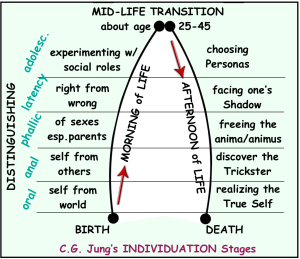
• Based on personal & professional experience, he concluded that Individuation happens in the second half of life, when people reach their goals & suddenly find themselves facing an unknown possibility or unexpected upheaval.
This turning point usually is a crisis in mid-life (not necessarily something bad), that upsets the status quo, causing a shift in perspective :
new way– a financial failure    – health problem
– broken relationship or death
– change of residence or profession
OR
– a message from powerful dreams & fantasies, creating —
– deep yearning or “call” to change direction
– profound self-doubt, loss of meaning or religious conviction
– questioning everything previously held as important, valuable or precious

• Then the essence of the personality moves from Ego toward Self, trying to form a new center. Parts that were ignored or under-developed (interests, talents, characteristics, experiences, issues…) may ‘suddenly’ want to be acknowledged
What was:
– fragmented now strives for unity  – broken now yearns for wholeness
– neglected now seeks expression   – formless now starts to take shape

While these changes can be very surprising & uncomfortable, shifting the ground under us, we intuitively recognize they fit our deeply truth

PS: Many psychologists now argue that while Individuation may be a natural outcome of age & experience, it can also be brought on sooner by deep therapy, but it’s mainly considered a life-long journey, which starts soon after birth.

MASLOW's needs

NEXT: Healthy Individuation (Part 2)

S & I : Lack of Individuation (Part 1)

taken care of  

I WANT SOMEONE TO TAKE CARE OF ME – rather that “grow up”!

PREVIOUS: Separation – #2

HEALTHY – in future posts

DEF : Individuation “is the process of self realization, the discovery & experience of meaning & purpose in life. It’s the means by which one finds oneself & becomes who one really is.
It depends upon the interplay & synthesis of opposites e.g. conscious & unconscious, personal & collective, psyche & soma, divine & human, life & death.” (Carl Jung)

INCOMPLETE / DAMAGEDshut down Es
Damaging parents interfere with the Individuation process in many ways, including preventing us from having a wide range of emotions – such as when only one or two are acceptable (only happy, only scared, only angry…) OR when any expression of E. is ignored or punished.

A study from Belgium looked at the effect of parental dysfunction on their 20-Something adult-children, studying 2 extremes – unhealthy independence or dependence. Over all, psychologically controlling parents ignore their child’s needs using manipulative tactics (guilt, shaming, love withdrawal) to pressure the child into meeting the parents’ standards – causing anxiety, depression & perfectionism

Parents who use intrusive tactics scored high on:
dependency-oriented control (DPC) to keep children physically & emotionally close, not allowing them take independent actions.
They end up feeling threatened & anxious by being on their own
AND
achievement-oriented control (APC) to make children reach the parents’ goals of individual performance, where love and acceptance are based on meeting strict rules of achievement.
These children can become self-critical perfectionists, obsessed with showing off personal ability, while ignoring the need for closeness & at expense of satisfying relationships

RESULT : We had to shut down most Es – which would normally give us subtle but definite private information about what’s right or wrong for us. Being cut off from the cues Es would provide –
— we’re deprived of the ability to reflect on our internal process
— aren’t able to trust ourself, procrastinating & confused
— & decision-making becomes very difficult or distorted

a. One extreme is when a child is forced to experience a later stage of individuation – prematurely, out of order, like ACoAs who as kids had to be ‘little adults’: a parelittle adultnt’s confidant or rescuer, or someone’s object of sexual attention).
This can turns a child INTO:
i. an arrogant ACoA adult with an over-developed, inflated False Persona, preventing or severely slowing down self-examination & emotional growth

They can function quite well as long as they’re in familiar settings, but miss genuine spontaneity, the ability to let go of control, even to the point of being unnaturally rigid, lacking zest or authenticity

Others people can be taken in by their ‘so together’ exterior. But hidden under that surface there’s a lack of personal development – a very unhealthy WIC – which mainly shows up in private, as unavailable & harmful mates & parents
OR INTO:
ii. an isolated ACoA adult, going to work every day, maybe even being in the helping professions, such as nurse, social worker…. or trapped with an addict spouse, a severely disabled child…. to take care of. They continue playing out the Hero-rescuer role, but are plagued by constantly second-guessing themself & the accompanying anxiety

like father....b. At the other end of the spectrum are the children who were bullied, browbeaten & brainwashed into buying every aspect of their family & social culture – with no room to breathe. They conformed to the dysfunction from a combination of their natural personality (more compliant OR most like the parents), and from a deep terror of being punished for disagreeing

• They too grow up without knowing who they are as individuals apart from their training, so they’re out of touch with even their most basic tendencies, dreams, wishes. Many will continually react to everything & everyone like a child, emotionally & mentally, without realizing it

However, people in this category are more likely to seek out therapy & recovery, because they know they’re incomplete, feeling lost, stuck & unhappy. Unfortunately they blame themselves (S-H) rather than correctly identifying the source of their lack!

NEXT: S & I – Individuation #1

S & I : Separation (Part 2)

PREVIOUS : S & I – Separation #1

SITE: Object Constancy


DYSFUNCTION

Symbiotic, addictive families experience S & I as a betrayal of the family unit, &/or as a threat to its stability. This forces members to choose staying attached & co-dependently loyal over personal growth, having to sacrifice their unique personality & ability to act in their own best interest.
This is always a developmental dilemma which ends badly – either capitulating to the destructive family system or having to wrench away with great anger & pain on all sides.
🔻The most common emotion for the adult-child then is guilt – for breaking several Toxic Rules
🔹And for the rest of the family – anger, & resentment, accusations, confusion (“why are you doing this?”) and often a persistent attempt at pulling the escapee back into the fold.

EXP: When teenagers try to break the bonds holding them to their parents there are often great upsets for both child & parents. When teens are not allowed to successfully complete this process, it can cause them to be disruptive (acting out) – rejecting societal & family rules, and potentially suicide.

Also, when adolescents are subjected to family stressors (drugs & alcoholism, separation, divorce, death of a parent &/or adding a step-parent….) without help to deal with them emotionally & practically, their sense of grief & loss is carried into adulthood, bteen repressionlocking the necessary process of S & I. (MORE….)

• There is growing clinical evidence that adult psycho-pathology is related to a lack of healthy Separation (staying symbiotically attached), OR from having experienced too much Separation Anxiety as a small child (caretakers un safe & undependable).

Some results:

a. Dependent Personality Disorder (DPD) – a long-standing need to be taken care of & a deep terror of being separated from important people in their life (FoA). This leads the sufferer to act clingy, needy & submissive, which is unconsciously designed to make others want to take care of them. DPDs are convinced they can’t survive without constant outside help & validation. (MORE…)

• Dependents tend to be passive & stay in relationships for a long time, no matter how bad. They can be caring & sympathetic, but their main reason for doing so is to get a return on their investment (get taken care of)

b. Borderline Personality Disorder (BPD) has its roots in faulty childhood S & I. While BPD people have many of the same terrors as the DPD – mainly fear of abandonment – the differences are marked. Borderlines are likely to have frequent, intense & volatile relationships, E damagewhile DPDs just stay.

• BPDs do a lot of come-here-go-away, idealizing people & then hating them intensely when the illusion is disappointed.  They have quick shifts in their feeling toward others, seeing their friends, lovers, even co-workers as positive supports or as cruel & punishing

c. Psychopathic Personality Disorder (PPD). NOT to be confused with the Psychotic – which is being out of touch with reality.
Psychopaths make conscious, rational choices, using premeditated strategies that effectively serve their specific goals, no matter the cost to self or others.
The ‘problem’ is their lack of internal emotional connection, so they can’t understand or empathize with other people’s emotions.

“Psychopaths are social predators who charm, manipulate & ruthlessly plow their way through life, leaving a broad trail of broken hearts, shattered expectations, & empty wallets. Completely lacking in conscience or feeling for others, they selfishly take what they want & do as they please, violating social expectations or rules, without the slightest sense of guilt or regret.” from Major Theories of Personality Disorder, M F. Lenzenweger & J.F. Clarkin.

HEALTHY SEPARATION shows when:
a. we have the right to be, & function from our True Self in all circumstances,
b. while still being able to comfortably, consistently connect with others.
In fact the latter is dependent on the former.

NEXT : Healthy Individuation – #1

S & I : Separation (Part 1)

hanging on to momSEPARATING FROM THEM
is good for me and them!

PREVIOUS: Lack of Individuation

POST:Symbiosis & ACoAs’


See ACRONYM Page for abbrev.

QUOTE: “The successful process of Separation is the source of our personal autonomy, our independence, our ability to assert ourselves and our capacity to make choices.”    From The Ties that Bind, the Ties that Strangle

A CHILD’S BRAIN
Adult life is influenced by infancy in spite of our inability to remember that far back.  In Why Love Matters: how affection shapes a baby’s brain”,  Sue Gerhardt considers how the mother-child relationship creates baby’s nervous system, with lasting consequences, affecting our future emotional well-being.

New research on early brain development showed very early signs of brain differences between low-, middle- or high-income children. For babies raised in stressed environments, the study found depressed growth in the hippocampus (memory), amygdala (involving emotion understanding), & frontal lobes (dealing with attention, language & self-control. (More…)

• “… foundations are built during pregnancy & in the first two years of life… This is when the social brain is shaped, the emotional style & emotional resources established”

• “… a poorly handled baby develops a more reactive stress response & different biochemical patterns from a well handled baby…”
• “Babies of agitated mothers may stay over-aroused & have a sense that feelings explode out of you, & that there is nothing to be done about it. CHART ⬆️ (also Teenage brain)
Well-managed babies come to expect a responsive world”

CHILDHOOD
Separation = the internal process of the child’s mental separation from the mother. Individuation = a developing Self-concept
Margaret Mahler : Her interest in the developing ego centered on its growth within the context of Object Relations, which refers to the way an individual’s interactions with another comes to be represented in the mind & then is internalized as part of the Self.

terrible 2sIn the normal Separation process – the formation of psychological limits & boundaries allow the infant to experience itself as separate from the mother.
But this is only possible if the infant is absolutely secure in its attachment to the caregiver during its first year of life, AND then begins to develop enough of a capacity for autonomy, self-reflection & self-reliance, normally by age 2.

For this to happen the mother will have to be able to accurately, consistently respond to the child’s internal emotional, mental & physical needs, at the right time & in just the right amount – using intuition & common sense. What a big job!

• This safety would allow the child to form a stable emotional core, as it recognizes & accurately interpret its mental & physical experiences (touch, talk, play….), which are then organized & grouped into loose patterns by category.
The first act of separation occurs during the ‘terrible 2s’ when children hit on the idea of “no.” They are exercising a natural instinct to be unique, but while they may be annoyingly persistent, they don’t yet have the power or autonomy to enforce it.chase 2 yr old

As children grow they can put more power behind their “NOs”, which sometimes includes doing fun things, at other times potentially dangerous ones. It’s all part of the Separation process,   but it’s even hard for heathy parents to let their children take the risks that NO imply – who love & want to protect them, having much more reality-knowledge. (MORE…. Saying YES to oneself)

▪️Providing this freedom is even harder or impossible for dysfunctional parents to provide, who have their own S & I, FoA & power/ control issues! In this case, it’s not about loving & protecting their children, but rather trying to stifle their own anxiety!

ADULTHOOD
Well-differentiated families, with good S & I & therefore are non-symbiotic, have the flexibility to balance the need for connection & stability against the need for each member to also have autonomy.
NO : Separation does not mean giving up the close attachment we have with parents or other people, nor having to be geographically separate.
YES : Separation does mean that we recognize we’re not the same as our loved significant others, that we react & think differently, AND that is OK!

NEXT: Separation #2

Separation & Individuation (Part 3)


PREVIOUS
: S & I #2


Mahler’s S & I CYCLE (cont.)

S & I (6-24 mths) is divided into overlapping minor phases:
1. HATCHING / Differentiation (6-9 mths)  Using mother as the base of operation – a point of reference or orientation, the infant is increasingly alert to & interested in events, objects & people in the outside world, beginning to ‘hatch’ from the symbiotic bond
2. PRACTICING (9-16 mths)  Baby’s developing motor skills (crawling, then walking) allows it to explore its world & move a bit away, but is still fused with mother
Emotionally – It’s about pleasure, energy & narcissism (“Aren’t I great?”), as long as baby can return to the stable caregiver for reassurance, encouragement & re-fueling

3. RAPPROCHEMENT (15 – 24 mths) (“to turn away & then come back”)
Now a toddler, the child begins to realize limitations to its sense of omnipotence, so wants to be close to mother again, aware that physical mobility creates psychic separateness, which feels scary

Yet wanting some independence leads to ‘ambi-tendency’ – a need for separation AND for support, shown as pushing away alttoddler/bearernated with whining & clinging. The child needs help resolving the conflict between autonomous functioning & frustration about parents who scale back earlier vigilance, which can feel like abandonment

Emotionally – this ambivalence can lead to tantrums, sadness & anger, as in the “terrible 2s”. The child may cling to transitional objects, like a special blanket or toy, & will use earlier defense mechanisms, such as splitting important ‘objects’ into good vs. bad, to deal with the demands of leaving babyhood

Risk : that mother will either be annoyed by this clinging & become impatient, or be over-protective, or withdraw – leaving the child feeling unsafe. Too much of any of these parental reactions creates fear of total abandonment leading to death – setting an emotional tone for life  = constant anxiety.

IMP:  Some ACoAs get stuck at this stage, afraid to stay & afraid to leave! Without Recovery, it can shows up as “Push-Pull / Come here – Go away” in adult relationships

Rapprochement sub-phases:
i. Beginning – A desire to share discoveries with the mother
ii. Crisis – Torn between staying with parent to feel emotionally close vs. being more independent, as child begins to explore on its own

iii. Solution – Crisis is resolved by the newly forming personality, from of the child’s fledgling use of language, developing superego & interactions with the personality of the ‘good-enough’ mother

iv. Open-ended – allows the child to keep growing towards ‘Object Constancy. The child carapprochementn then hold on to its own identity of being separate from everyone else, while staying mental / emotionally connected to others, whether with them or not, or no matter how it’s being treated!
IF available, it will minimize the terrible pain of anxiety, aloneness, isolation, being ‘different’ & feeling unloved

NOTE: For ACoAs to be fully ‘integrated’ (healthy adults) we need to resolve this stage – to hold on to our identity while staying connected to others!

4. CONSOLIDATION Phase (by age 3)
Object constancy is formed when he child’s split image of ‘good & bad mother’ is consolidated into a stable internal image (but only with a healthy parent), which comforts the child in her absence. D.K.Lapsley & P. Stey

Adolescence (Second half of S & I)
This is the time to shift from blindly following the internalized caretakers, to gradually form a distinct & unique sense of Self, slowly reducing the teen’s dependence on the Parental Introject for approval, self-esteem & rules. They have to learn to take over the tasks of self-regulation, self-definition & self-esteem.

Emotionally : mourning the loss of childhood dependence & safety, as the teen experiences the old ambivalence of having freedom vs a return to earlier narcissism (“I’m all-powerful”) to cope with the temporary lack of ego-strength & self-confidence.

IN ADULTHOOD (Vesna Andjelkovic)
Even though S & I continues to build on previous adult experience, it is not a copy of childhood stages. Some midlife tasks are TO gradually:
🔸build & maintain friendships
🔸maintain sexual intimacy
🔸exercise, & then relinquish power in the workplace
🔸accept the aging process in the body
🔸come to terms with time limitation & personal death
🔸change relationship with grown children by letting them go, & connect to new family members
🔸enjoy becoming grandparents
🔸care for aging & dying parents

NEXT: Lack of Individuation