HEALTHY RISK

healthy risk
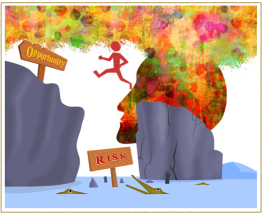
RISK IS NOT A DIRTY WORD!

as long as I’m realistic

PREVIOUS: Risk Addicted #2


COMMENTS

Risk of any kind usually entails some type of action (T.E.A). When average-functioning people are deciding what to do – ahead of time or if they only have a few seconds to consider – they use a reasonable thought process.
Thinking RISK thru :
• consider your aspirations – hopes, dreams AND level of wishing welldesire
• the short or long-term goal
• do you have the skill or knowledge to at least try
• know your expectations (to succeed or fail)
• weigh pros & cons of the situation
• consider possible consequences, both for yourself, & what’s socially acceptable
• “how important is it”! (whether to push or not)

😲 However, many ACoAs’ thinking about Risk – is either faulty or missing. Anxiety pushes some to act impulsively (R-addicted), & terror holds others back from even trying (R-averse).
❖ Which type you are now – & how you reacted to constant chaos & abuse as a kid – is based on your native personality

• ACoAs are trained to be perfectionist – only Actions counted in the family – but we could never be good enough, since nothing satisfied them.
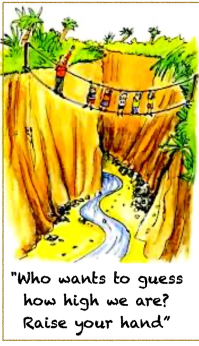
EXP: Even raising my hand in class felt like too much of a risk. What if I don’t know the answer? What if I’m made fun of?

We’re bound tofall down fall down or become paralyzed from setting the bar for every accomplishment so high we can’t possible reach it (such as trying to make everyone like us!),
Sadly, to the outside world it can look like we don’t set the bar high enough, labeled lazy, stupid or crazy. We are NOT. It’s our terror (E) & CDs that stop us, or cause mistakes & procrastination.

SCIENCE: re. taking actions, we can generally be divided into
— ‘sitters’, who observe & then act, or
— ‘rovers
’ – who act more randomly.
In our culture it’s “Just do it” (Action) vs. “Look before you leap” (Thinking).
We’re born more as one than the other, but when mixed with damage it gives us the -averse or -addict style. Each Personality Type has it’s advantages & disadvantages, & neither should look down their noses at the other!  (MORE… w/ examples)

HEALTHY RISK
Appropriate risk-taking, like all other aspects of mental health – is rooted in balance & goals. What are you specifically trying to achieve in each situation?
Finding a balance between —> considering all possible outcomes (T) vs. —-> just taking a leap of faith (A) requires knowing ourself well, & also how the real world works.planning
a. IT IS
• moving forward in any aspect of your life. Do something!
• NOT about perfectionism (a form of S-H)
• usually not something physically dangerous, AND not as emotionally dangerous as your WIC or PP think it’ll be
b. ARE
• evaluated for realistic advantages & disadvantages
• mostly small ones (sending a text, talking to a stranger at an ‘event’, asking for help)
• occasionally bigger ones (moving to a different state, changing careers, getting a divorce…)

c. EVALUATE
• which negative extreme is your False Self ‘norm‘? What would it be like to swing to the opposite unhealthy side, & what would be middle ground ?
decide what changes you can handle & what’s currently too much – based on self-knowledge about your emotional capacity

get help• who can help you over a hump (of fear) : ask a safe friend to sit with you, go with you, let you be at their place… while you try a new, scary action
• think through the consequences (outcome) of your actions, not using self-hate, co-dependence or fear of abandonment (FoA) as a guide
• consider what the result might be of not taking any action – to you or others
• try out something small & see what happens. It may turn our OK or great. If it doesn’t, figure out what the problem is & try something else.

GROWTH : One of the benefits and joys of healthy risk-taking is finding out that positive outcomes are possible, when guided by our ‘UNIT rather than by the WIC or PP.
Use Book-Ending with your Inner Child to find out what’s possible & what’s not.
MOST IMP: No matter the outcome – catch & stop any form of S-H.
ONLY : Acceptance, Acceptance, Acceptance

NEXT:  MIND-READING vs Intuition – #1
ACoAs: Risk-ADDICTED (Part 1)


DANGER IS MY MIDDLE NAME!
Don’t bore me with your caution

PREVIOUS: Risk AVERSE #2

SITE: “Risk-Taking Behaviors

ACoAs : OVER-RISKERS
ACoA risk addicts are formed by a combination of growing up in a constantly chaotic & dangerous environment – along with a personal ‘preference’ for high stimulation. People with a higher than average need for novelty, change & excitement – don’t always abuse drugs & alcohol – some become scuba or sky divers…. (Zuckerman M, 2004)

Studies look at such causes as:
Biological (hormonal effects), Cognitive (risk perception), Environmental factors / influences (parents & peer groups) & Personality (sensation seeking tendency)

PHYSICAL 
Sensation / Novelty seeking in humans is inherited, with genetics accounting for 30-50 % of the personality trait.  Risk-taking causes real changes in the brain. Major risks release adrenaline, providing a quick rush, & dopamine, giving an intense feelings of pleasure. Over time, it can function much like a drug (adrenaline junkies). Such people may need bigger ones to get the same rush, so routine daily activities will feel empty, even painful.

While these chemicals contribute to a powerful high in most people, the feelings can be especially addictive to people struggling with sadness or depression.
Interesting: This behavior has been associated with low levels MAO (monoamine oxidase), which regulates neurotransmitters like dopamine. Levels of MAO are lower in men than women, & lower in young people than older ones

Research reported in the Journal of Neuroscience indicates that daredevils’ brains are more saturated with dopamine – because of fewer inhibiting receptors – predisposing them to keep on chasing the next high, like driving too fast, drinking & drugging too much, overspending….. ” (MORE….)

Studies of risk-related poor decision making found it was related to lesions on the ventromedial prefrontal cortex. Some studies indicate that people who score high on Neuroticism – a combination of anxiety, moodiness & worry (O.C.E.A.N. types) are more likely to be risk-takers, while other studies found they actually score lower on N. than the general population.

PERSONALITY & ENVIRONMENT
Personality plays another major role in this tendency, such as the kinds of risks a person is willing to take. Some adrenaline junkies have a preferred ‘exciting’ behavior, like a dangerous profession, while those who are highly physical might choose rock climbing or mountain biking as recreation.
Ironically, the dedicated smoker might be terrified of heights, driving, or illness, without ever recognizing that smoking is a risky behavior.

Cultural influences & peer pressure also have an affect. As travel has become a part of the educational path of middle class students, more & more are willing to go to potentially risky locations, & many studies have shown that people are more likely to take risks when in a group.

EMOTIONAL 
IN GENERAL – Not everyone with higher levels of dopamine pursue danger. But those of us who do are cut off from our True Self & a wide variety of emotions, especially the ones we think make us weak – such as loneliness, sadness, vulnerability, terror….. (Review: large range of possible Es ).

Such people feel empty inside, bored & dissatisfied with themselves (S-H).  Along with a need for high stimulation – addiction to adrenal rush – they want to be different from the ‘average’ joe, whom they look down on, but secretly identify with

They love the attention they get from being daring, outspoken & flamboyant.
— When their actions are socially acceptable (bungee jumping, parkour jumping, jet plane testing, ambulance attendant, member of ‘special forces’, fire-fighter….) they bask in the awe & admiration of their peers & public

–When their choices are ‘invisible’, such as undercover agent / spy, risk-taking makes them feel in control, powerful, unique

— When their acting out is less socially acceptable (criminal), there may be few people to cheer them on. But their main ‘satisfaction’ is internal – getting away with something they’re not supposed to do, thumbing their nose at authority, a mistaken belief that they are setting a boundary, expressing contempt for rules…. ALL being run by the Introject and/or the (adapted) WIC.

NEXT: Risk-ADDICTED (Part 2)

ACoAs: RISK-AVERSE (Part 2)

attacks
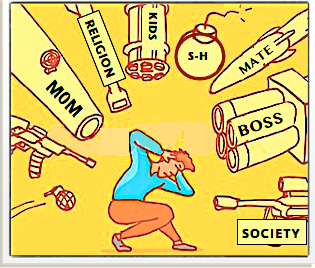
ATTACKS COME FROM EVERYWHERE!
I have to protect myself at all costs

PREVIOUS: RISK  – Intro

See ACRONYM page for abbrev.

T.E.A for ACoAs (cont)
EXP : re. Portfolio management
RISK Aversion –
a preference for safety & certainty over uncertainty, & the potential for loss or pain
vs. LOSS Aversion : 
a complex need for both risk aversion & risk seeking behavior. It’s not just the desire to reduce risk but an utter contempt for any amount of loss. These people feel the sting of loss twice as much as the joy from an equal size gain – & make financial investment decisions accordingly

Neuro-economic studies have found that when people are facing a loss, the amygdala – our brain’s fear center – begins to fire. It is the same area that reacts to being in mortal danger. No wonder many investors are influenced by loss-aversion.

So too, some ACoAs are :
a. MORE risk-averse – hardly ever taking risks of any kind, living mainly as victims, who stay in menial or unfulfilling jobs most of their work life, stay closer to home, don’t try new things, don’t reach out… And SOME are:
b. LESS averse : more adventuresome in ‘action’ ways, but afraid to risk in other important areas, most often not experiencing their emotions, & avoiding relationship intimacy

😩We learned to ignore potential options, because WE WERE:
• told anything we did was wrong, stupid or not good enough
• constantly interrupted by someone else’s needs or crises, so we couldn’t stay focused on what we needed to do for ourselves avoid risk

• punished equally for big or small infractions of ‘rules’, many of which made no sense or were unspoken! This made us put off or avoid taking normal activities, much less branching out to try things that are deeply important to us, or something more unusual to expand our world

IN the PRESENT – our reaction to childhood trauma is to avoid as much confrontation & newness as possible (co-dependence / risk-aversion).
We’re convinced that all forms of ‘taking a chance’ are bad & will guarantee a bad outcome.
We’ve been trained to assume that that’s the way life is, forever – at least for us! This is so ingrained that we don’t even know that’s what we believe. But we live it every day.
Because WE :
• copy a parent’s life-long fear of risk
obey our specific toxic rules
• rebel against family demands for success
• can’t take center stage in our own life
• don’t want to lose proof of their abuse
• not allowed to be visible, or out-shine them

also FEAR – of:
• abandonment, reprisals, punishment
• authority, not being perfect, not picking right
• being a ‘laughing stock’
• being shown as incompetent (not knowing)
• dealing with competition
• having to deal with others’ jealousy
• not getting our deepest desires, no matter how hard we try
AND / OR have to: 
• face our childhood damage AND CHANGE!
• S & I (outgrow & out do unsuccessful family)
• leave someone unsafe or incompatible (parent, friends, mate, children, job, addictions, locations….) if they prevent our growth
• deal with the discomfort of getting good things now, & being successful, which the WIC says it doesn’t know how to be
• then take riskier steps after that… maybe even scarier (like: write something, then publish, then promote, then…)

RECOVERY
In terms of positive T.E.A., while risk is primarily about Actions, there are many which fit into Emotion & Thinking, in spite of the WIC’s fear of personal growth.
WE CAN: leave home
T. – disagree with & disobey the Negative Introject, outgrowing the addiction & attachment to our family (giving up denial)

E. – tolerate the painful emotions what surface in the process of letting go, both from re-experiencing pent-up old pain, as well as facing being hurt by current family judgment & abuse for ‘leaving them’ ie. upsetting the family mobile by changing the dysfunctional dynamics.

A. …. & risk healthy actions : clearly objecting to abuse, disobeying Toxic Rules by doing positive things for our life, & sometimes having to distance ourselves from actual family members & dealing with the possible fallout.

NEXT:  Risk Addicted

ACoAs : RISK-AVERSE (Part 1)

trapping ALL I’M DOING IS BEING OBEDIENT
so what’s the problem?

PREVIOUS: ACoAs & RISK – #1

POSTS: Book-ending’ with the IC
‘What to DO when confused’

✦ ‘Weak Decision making styles
PROCESS


RISK AVERSION
is a preference for a sure outcome — over taking a gamble for an outcome with higher or equal expected value
⎖ Nobel Prize-winning psychologist Daniel Kahneman wrote, “For most people, losses loom larger than gains, so that the fear of losing $100 is more intense than the hope of gaining $150″

⎖ Columbia University’s Tory Higgins, from 20 years of research, suggests that we see goals as opportunities to provide a benefit. People are either :
⛔️ Prevention-focused, more risk-averse, to maintain the status quo & keep things running smoothly, BUT will embrace risk when it’s their only shot at returning to their status quo
OR —
💢 Promotion-focused, less risk-averse, to make progress & end up better off, with the potential for richer gains

IMP: To be able to risk – appropriately – everyone needs to have :
a. a True Self to make healthy choices, so we don’t need to keep procrastinating as a way to avoid any losses
b. a realistic ability to trust – in ourself, in process, as well as in a safe Higher Power

FAMILY TRAINING
We are all the products of our heredity & our early experiences. We interpret our upbringing thru the lens of our basic personality. But our orientation to Risk is colored by how our parents reacted to people & life events
UNDER-RISKERS
ACoAs see the world as always being dangerous – no matter the reality – IF :fearful parent
• one parent was particularly risk-averse AND we identified more with that parent
• they were depressed & not very functional
• we were constantly told not to trust ourselves AND we learned to not thrust our care-takers, with good reason!
• most adults around us were too scared to go towards new & better people/places/things
• they didn’t protect us from other crazy, abusive & dangerous adults….

EXP: One ACoA’s cold, abusive mother often told him that the world is a jungle, a survival of the fittest – the weak (him) are eaten by the strong (her) & no matter how big you think you are, there’s always someone bigger & badder who will get you! Naturally he grew up to be very timid.

For ACoAs, this style is T.E.A. resistance & withholding
MENTAL – NOT:
speaking up for ourself, asking for our needs or preferences, protecting the Inner Child
• asking for help, making calls, talking to unfamiliar people
• asking Qs when unsure or confused
• responding to a Q when we know the answer

EMOTIONAL – NOT
• being willing to feel all Es & deal with our damage (“You’re only as sick as your secrets”)
• opening up emotionally in the right way, in order to have positive intimacy in relationships

BEHAVIORAL
As all kinds of self-deprivation, not only with food but in many other areas of life ($$, love, career, self-care….). We prevent ourselves from accepting & absorbing many of the good things available to us, because of S-H, from the belief that we don’t have a right to prosperity & peacefulness.
But the deeper reason for not risking much is to keep the fantasy / demand that someone else will eventually rescue us from having to grow up & be responsible for ourselves. It includes —
NOT:
• avoiding pesilent screamople who are needy, users, leaches, abusers
• leaving a bad or outgrown relationship, OR rarely or never being in a good one
• having an adequate (or any) support system
NOT:
• having an adequate salary to live comfortably (under-earning), or not greatly increasing your income
• pursuing a career passion or vocation which has been a long-held dream, taking classes to expand your world, ‘following your bliss‘
• starting over, somewhere else that’s more suitable to you
NOT:
• trying out new foods, changing personal style of clothes or hair when appropriate (with age…), improving your living conditions
• looking for new, better or easier ways to do things ……
• learning & then doing something creative, & showing it off

NEXT: RISK AVERSE #2

ACoAs & RISK – Intro

risk 

TO RISK OR NOT TO RISK –
That is the question

PREVIOUS: Unrealistic Expect.-UNDER

See ACRONYM page for abbrev.

REVIEW posts on (not) TRUSTING


Basic MEANING of RISK

a. taking a chance on something, most often referring to the possibility of harm, misfortune or loss
b.
can also be about a positive outcome, resulting in pleasure, accomplishment & success
c.
OR a neutral / acceptable result – with no danger but no gain

STYLE “a” ⬆️ characteristics
PHYSICAL
• dealing with something or someone known as a source of danger
• a venture chosen without regard to possible loss or injury
• being exposed to the chance of damage or injury, not by choice

EMOTIONAL / PSYCHOLOGICAL
• a situation which causes suffering — being accused wrongly, manipulated & used, humiliated, misunderstood or shamed
• an element or course of action involving uncertain, unpredictable discomfort or distress
• the possibility that something unpleasant or unwelcome might happen beyond ones control

FOR ACoAsmany outcomes
Although the definitions indicate more than one possible outcome, only the a. meaning is considered an option for us – because of  Toxic family rules  such as: “Life is endless suffering’,  ‘You must always struggle but can never get ‘there’,  ‘Don’t expect anything good, ever”…..

In a ‘sane’ world, Risk is minimized or no longer a factor IF the outcome of a situation in known ahead of time based on experience, or is predictable based on dependable information
Then a person can take an action OR avoid a situation – with confidence. This is not wishful thinking, projecting or unrealistic expectations. It comes from realistic knowledge, using present-day Adult ego-state evaluation

• But that’s not how ACoAs operate. We persistently ignore info we do have from years of experience, only using the WIC’s distorted ‘glasses’.
We compulsively pursue unsafe actions, when we  —
✎ choose to return to dangerous situations, stay connected to harmful people…..
✎ & avoid beneficial opportunities, often refusing to take relatively safe actions.
Because of our very deep denial system we keep getting burned – then wonder why we don’t trust!

ANXIETY – ACoA issues around risk-taking are always about internal anxiety. One scared kidscharacteristics on the Laundry List is:
“We have become addicted to (negative) excitement after years of living in the midst of a traumatic & often dangerous family ‘soap opera’.”

ACoAs get things backwards. We keep trying to do the impossible & have trouble doing what is possible!
We’re not sufficiently afraid of some very dangerous ‘people, places & things’ while being overly scared of things that are not actually harmful (like having emotions)!

ALL ACoAs are fear-based**, the Inner Child’s terror of feeling out of control that we bring with us into adulthood, underscoring every aspect of our life. Anxiety is what drives all our character defects, our acting out, our addictions . It’s why the Serenity Prayer is so important for ACoAs!

** Fortunately, long-term recovery – if we’ve been doing emotion-release work – diminishes the intensity of our fear, so it’s not on the surface all the time.  But since our terror-base is very deep, it never dissipates completely.
So we should not be surprised when it occasionally grabs us in the gut – if or when some current event sets it off again. “If it’s hysterical, it’s historical”.

The difference is, or should be – that we’ve built a Loving Parent voice, with years of acting in healthier ways & using our tools, so we can soothe & comfort the WIC whenever we’re triggered (Use Book-ending)

CONTROLcontrolling
The counter-action defense against anxiety is to be controlling (as opposed to Having Self-Control).
It avoids any type of risk-taking that inherently implies unpredictability.
The greater the inner fear, the greater the need to control – in a futile attempt to keep anything or anyone from abandoning us – yet again.

This is why ACoAs try so hard to be mind-readers. If we can figure out what someone feels, thinks or needs – before they say anything – we assume we’ll be ‘prepared’ – for the worst, of course – to prevent being hurt, & stay connected by twisting ourselves into what we hope others will find acceptable.

NEXT: ACoAs & RISK – #2

ACoAs & Time (Part 4)

White rabbit 

I’M LATE, I’M LATE !
The Red Queen’s going to have my head!

PREVIOUS: ACoAs & Time (Part 2)


4. ON TIME?
a. Compulsively early – fear of punishment, of being left behind (abandonment), of missing out, of not being the ‘good’ one, WANTING to be special, noticed, to brown-nose, for extra attention, showing off……

b. Always Late
There are legitimate reasons for lateness – once in a while, but this is about a compulsive pattern, not always conscious, as the result of some or all of these :late, late
DAMAGE
• lack of clear identity – not knowing what ‘outfit’ to put on – who am I supposed to be in this situation / who do they expect me to be….
• being a perfectionist, or obsessive compulsive – have to do everything or finish something before leaving the house

CHAOS
• can’t find important things at home because of disorder, clutter, not paying attention, not ‘filing’ things…. so often looking for things at the last minute
• don’t plan ahead, over-book, not able to prioritize, be in IC mode (Part 1, #2.a.)
• regularly stay up too late & can’t get going in the morning

RESISTANCE
• a general rage at having to be responsible, make decisions, show up
• passive aggressive – “I don’t wanna” do something, but not allowed to admit it
• getting a secret kick out of making people wait for me – gives me a (false) sense of power out of timeto make up for never feeling important
• don’t want to deal with a particular person or event (breaking up, a stressful family event, a business meeting)

OVER-DOING
• rushing from crisis to crisis, mine or someone else’s
• co-dependence – saying yes to something I don’t want to do, but now you have to; people-pleasing – doing too much for others, staying on a phone call too long, worrying about others’ problems….
EMOTIONS
• depressed, don’t want to leave the ‘safety’ of my house
• high anxiety from intense shame – afraid to ‘be seen
• social phobia, from CDs & weak boundaries: “don’t know what to DO when I get there, afraid to talk to people, no one will like me, I don’t fit, not smart or accomplished enough”….
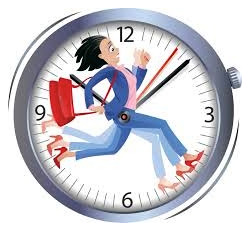
…. AND ALWAYS compulsively worrying, anxiously looking at your watch as you run to the next thing on your list

RESULTS
• stay immature, keeping us at the mercy of & vulnerable to others
• makes others frustrated & mad at usresults
• stay anxious, scared, uptight, addicted to adrenaline
• can’t relax & enjoy people, places, things
• never feel empowered, maintain S-H (feel like a f—up)
• mess up or miss out on personal, social or biz opportunities
• don’t get many of our own needs met, always behind on tasks

GROWTH
To change our ‘acting out’ around time, we need to build both aspects of the ‘UNIT’ —-> the Healthy Adult who stays in touch with reality & —> the Loving Parent to deal with the WIC’s need for nurturing & guidance,
SO we can:wake up
• hear the toxic beliefs, excused & justifications in our head & actively counter them
stay awake for the consequences of our patterns – how does it feel? How do others react? What price do we have to pay?
• change our behavior. Eventually healthy actions will become more integrated & natural.
We will feel better & others will have respect for us as well.

Unfortunately, WE
— don’t have much control over how long it takes to become willing to change a particular pattern. Some resistance melts father than others. We just need to keep the goal of Wellness in our mind’s eye
— only have limited control over how fast or slow recovery takes – until WE feel our progress, altho others often do see it sooner

• These depend on many factors, including how strong our resistance to change is, & how consistently we’re willing to use the tools of growth (reading, journaling, therapy, 12-step meetings, sponsorship, workshops, body work, dream interpretation, talking & writing with the IC every day!….)
➼ The more often we regularly use them, the deeper our healing will go. Patience & Perseverance!

NEXT: Variations of ACoA ‘Laundry List’

ACoAs & TIME (Part 2)

slow timeWHY DOES EVERYTHING
take so much longer than I think??!!

PREVIOUS: ACoAs & Time (Part 1)

SITEs :  Kids, ADHD & Time
✦ Time Management Tips

Take back control of your time

QUOTEs : “Your time is limited, so don’t waste it living someone else’s life.” ~ Steve Jobs
❥ “Until you value yourself, you won’t value your time. Until you value your time, you will not do anything with it.” ~ M Scott Peck
⌛️  ⏰   🕔
1. Lost Time and 2. Wasted Time  (Part 1)

3. REQUIRED TIME
a. Much more time than something should normally take
Our damage makes any action an insurmountable project. ACoAs will put off taking actions because WE :
• are convinced it’ll take forever. Whether a task is it’s a big or small, we:
a– don’t divide it into manageable chunks, –b– don’t have an realistic time sense & –c– hate the slowness of process
WE
• have to obey the rule “No play ‘till all your work is done” which of course will never happen, so we go on strike instead, & do nothing!
• have to obey the rule “You have to struggle but never get there” so why start?stuck in time
• (think we) don’t know how, & can’t ask for help, so why bother?
AND
• we’re afraid of making the wrong choice, & the get punished or be terribly disappointed – again
• we can’t decide what to do first – everything is equally big, important, scary… because as a kid the same amount of emphasis was put on large or small events, mistakes, tasks… so we never learned to prioritize

▪️ re. ACTIONS – While these reasons are ‘hangovers’ from childhood, the root of the procrastination is our inner conflict now, between:
• what we want & what the Introject (PP) wants or won’t allow (or with others in the present)
• our damaged part (WIC) & the emerging Healthy Adult voice

These internal arguments have to be resolved by the ‘UNIT in order to proceed. The exciting thing is that when the WIC is on the same page with the Healthy Self, we find that many actions take very little time, are not a big deal AND we actually did know how. No conflict = No delay!

T.E.A. suggestions
Thoughts: write out the opposing points of view (sometimes 3 & 4 different ones) of the argument you’re having with yourself about a situation you’re stuck on
Emotions: list the emotions related to each ‘voice’- they can be different

Actions: identify the actions you want or need to take, & what you think the results will be, depending on the voice you decide to follow
✍️ Actually try out which ever side you choose (As) & then later write down the results. Evaluate (T) the outcome & see how it feels (Es).
This is “Bookending” & is very effective
✍️ You can also use the 2 forms on the post “Why Are You Stuck?

b. Much less time than is realistic
In this care we consistently underestimate how much time is needed to get something done. This can come from unreliable people we have to depend on, who give up inaccurate time-estimates,  but mostly from our own unrealistic expectations.
This relates to the ACoAs who:
♦︎ always over-book, plan things too close together, don’t allow enough time to get places or time for possible delays – and don’t allow for process…
Like: underestimate how long it takes for – a renovation, a doctor visit, to taking a trip, developing a friendship, waiting for a delivery, a check, an email or the return of a text! (it pushes our Abandonment button)
OR
♦︎ those of us who try to do several things at one time. This is not about multi-tasking, but rather expecting, magically, to be able to be in more than one place at a time
Like: attending 2 conflicting events, such as making plans to go shopping alone and having lunch with a friend – at about the same time!
—> not doing things consecutively, OR picking one & letting the other go.
It’s one of the reasons some ACoAs are habitually late (cont. in Part 3)

NEXT: ACoAs & Time (Part 3)

ACoAs & TIME (Part 1)

slow time
TIME IS SUCH A DRAG!
Everything takes forever

PREVIOUS: Over-Feelers (#2)


REVIEW: Pre-FoO work, ACoAs are run mainly by 2 internal ego states – the WIC, who is listening to the PP. One of the signs of this is the unrealistic way many of us deal with time, and timing.
The Inner Child:
 IS still confused by not having been taught process, nor given age-appropriate limits by neglectful parents, which resulted in not knowing how long things take.
Now, depending on the size of a project, there may be many steps between setting a goal & achieving it, yet we don’t allow for the realistic stages of the process.
OR it:
IS reacting to too many constraints imposed by controlling parents who interfered with our natural internal rhythms & time sense.
Now, we either follow the training & become rigidly time conscious, OR rebel by taking our own sweet time, OR do nothing as often as possible

1. LOST TIME
a. To our damage – years spent in S-H, with the wrong lovers, friends, jobs, apartments, the wrong neighborhood or city for us, still involved with abusive &/or uncaring family members….
In Recovery, we need to mourn the loss of time stolen by living in our False Selflosing time

b. Dissociating 
from anxiety. ACoAs are fear-based, which is backlogged from childhood. When faced with any situation that pushes a button or bumps an old wound, we may temporarily ‘go blank‘ & lose track of time, for a few minutes, or much longer.

EXP: Janie desperately wanted to study fine art, but couldn’t afford it. She had to work in an office, which didn’t suit her temperament & where she was not liked. At some point she was reprimanded for always being late. Trying to change that, the next day she got up 30 minutes earlier & started her ‘automatic’ morning routine BUT found herself standing in the middle of her room – completely blank – not knowing what to do next. Eventually she snapped out of it & finished getting ready, but by then knew she’d be late – again!  Her unconscious had sandbagged her – she clearly didn’t want to be going to that job.

lost time from ADD, dyslexia. Many ACoAs have learning disabilities. This does NOT indicate intellectual deficiency – on the contrary, it usually correlates with high intelligence, but creates varying degrees of difficulty in learning, communicating, & dealing with time accurately

• Keep in mind that many ACoA characteristics mimic ADD symptoms in adults. They’re both caused by stress & affect the brain, but ADD is genetic, so treatment is different for the 2 problems. The healthier we get emotionally, the more we can tell the difference. In recovery, the ACoA symptoms will diminish or disappear, while the ADD ones will not, which need the right medication & some behavior-mod training

2. WASTED TIME
Many ACoAs don’t know what to do with chunks of free time:wastw time
• too much anxiety – from perfectionism, toxic rules, fear of commitment & decision-making, avoiding disappointment, fear of risk…
• not self-motivated (Autonomy & Attachment, Part 2)
• wanting to do too many things at once, so don’t choose anything, puttering around, not accomplishing much
• too tired from all the daily stress we put ourselves under so need to veg out but then feel gypped, frustrated, angry at ourselves…

▪️ REQUIREMENTs for growth : a willingness to break some Toxic Rules, like the ones listed in “Part 1, 2a
• Plan ahead, write on a monthly or weekly calendar things you can schedule ahead.
Stick to your plans, whenever possible, & notice how it feels afterwards. When things don’t work out, try something different
• Make a list of activities you’d like to do or might like to try – during ‘free time’, & when the time comes (weekends?) look at it when you can’t think of anything to do OR you have too many options
• Fun time is NOT about priorities. You don’t have to know what to do FIRST! Just pick something you know you like & focus on enjoying it.

NEXT: ACoAs & TIME (Part 2)

Unrealistic Expectations – UNDER

 YOU MEAN I’M ALLOWED?
I can really ask for what I need AND get it?

PREVIOUS: Unrealistic Expectations – OVER #2

See ACRONYM page for abbrev.

IRONY (also in “Over”, Part 1)
There are many things ACoAs do not expect THAT WE SHOULD!  In reality…
… we all need images (dreams, goals) of that is possible for us, which are supposed to be formed in childhood, by watching our family accomplish their goals, & thru school, friends, books, TV…
… without those images (possibilities) – we don’t have something ‘concrete’ to work towards, using process.  Goals have to start with a mental picture of what we want to accomplish or receive, in order for us to pursue them.

⚠️Some of us don’t think we have any dreams
We’re so beaten down by childhood trauma that we don’t even dare picture what we might try for. We can’t go after anything that would be important to us, much less outstrip our family – we just drift & do whatever we fall into. We can’t imagine having any dreams come true for us.

🚫 Others have dreams, but we’re not allowed

We may know what we’d like to do, when we “grow up” – but are just too scared to go for it.  What IF : I’m not good enough, I fall flat on my face, I don’t have the talent, I can’t follow thru, or mess it up some other way… AND the PP is saying “Who do you think you are, anyway?

➼ ACoAs UNDER-EXPECT basic human rights, many if which were denied us as kids.
NOW we can / must look for appropriate treatment from everyone. We know that not everyone is capable, so it’s important to “Stick with the winners”!
We need to keep away from, or severely limit, our contact with people who are too damaged to treat us with at least a minimum of courtesy. Not everyone will like or love us. That’s normal. But we can gravitate towards those who will!
So, we have a RIGHT to EXPECTbe safe
1. FROM LIFE
a. The right to BE here
• to heal from childhood damage
• to get the help we need in any situation
• to have as full a life as possible
• to get to know ourselves, thoroughly & like who we are
• to be safe in the world & to be comfortable in our skin
• to have our own dreams, to follow them & be successful

b. The right to be WHO we are
• to be happy, feel pleasure, be drama-freehave fun
• to express our creativity, in whatever form
• to be part of a community of our peers
• to have a safe, loving Higher Power
• to have a full support system, for healing & for fun
• to be acknowledged for our innate abilities, our learned skills & our actual achievements

We have a RIGHT to EXPECT
comforting2. FROM OTHER PEOPLE, that they:
a. treat us with respect  (not use us!)
• able to listen to us, be present, be thoughtful
• are ok with all our emotions (crying, anger, joy…)
• take us seriously – not make fun of us, dismiss us in any way
• tell the truth (not lie), be forthcoming
• talk to us as adults, at the very least with civility

b. have (some) mental health
• sobriety : chemical, mental & emotional (but not perfect)
• not be physically, menchurch-familytally or emotionally abusive
• have their own money, living space, career/ work they like…
• capable of intimacy, honesty, enjoyment, peacefulness
• have a spiritual belief (if it’s important to us)
• know how to act in public, be sociable (not withdrawn)
• have decent boundaries, know how to communicate

c. have the capacity to love (already)be accepted
• be supportive, encouraging, helpful
see the real us, value who we are
• able to commit to us, & not be symbiotic
• be loyal, sexually faithful
• admire us without being jealous
• want the best for us, even if they don’t agree or understand everything

These are only SOME of the things we SHOULD EXPECT!

REMINDER: In order to believe this & go for it, ACoAs need to imperfectly have:  • greatly reduced self-hate  • developed a rapport with our wounded AND healthy child aspects  •  decent boundaries • a good support system • major detachment from the bad parent voice in our head!

NEXT: ACoAs & RISK – Intro #1

Unrealistic Expectations – OVER (Part 3)

PREVIOUS: Unrealistic –

<— “OUT IN THE COLD” by DMT


What ACoAs SHOULD NOT expect…. (cont.)
B. ….of OTHERS (cont.)
1. To be Rescued
2. To be Symbiotic

3. To Mind-Read :  WE WANT / expect that people will automatically know what we need & magically come thru for us, without us having to ask! We’re not allowed to know what those needs are, & if we do, not allowed to get them met. So – we have to “depend on the kindness of strangers”.

💚 We want them to do things that we :
• never learned how, & resist doing so now, even tho there’s more help & info available in the world than ever beforemind reader
• really can do for ourselves, but it would feel too lonely & sad if we did, reminding us of the original A/A (no one to help)

• are terrified of trying / risking, believing we’re too stupid, incompetent, slow…AND what if we fail?
• know it will take a lot of time (process) & we’re impatient. As kids, having to wait usually meant it would never happen. So, don’t ask us to wait – some more!
• have trouble with (meeting our needs) because of a disability, like ADD or dyslexia, depression or other disorders, so we don’t make the effort to learn how to manage them – just keep being their victim

4. To be Healthy : WE WANT others to be something they aren’t or can’t be (ever – or not yet), because they’re pushing our abandonment button, activating our wounds – so we’re impatient, even desperate.  We’re afraid if they don’t change we’ll be trapped with them & continue to be hurt, OR have to leave them.

That puts us in a double bind : 💔 it’s painful to stay, it’s painful to leave. However, for most ACoAs, our FoA is greater than our tolerance for loneliness & sadness – so we stay!
a. Maybe we keep trying to explain what we want & what they’re doing wrong – at great length, as if they’ll ‘get it’.  angry woman
When it doesn’t work!!! we act like:
• bullying control freaks – trying to make them give us what we want
• raging, abusive crazies – as if yelling would get thru to them
• sullen, complaining victims – expressing all our childhood powerless & hopeless feelings in the form of passive anger
• punishing, vengeful harpies – probably like one of our parents, to express our extreme frustration and anxiety
• people-pleasing doormats – overly helpful, solicitous, care-taking, to insure we’ll be indispensable, & then they’ll never leave …..

❎ We are NOT fundamentally any of these things, which come from the the PP or the WIC. It’s our FS damage, which is repairable.
OR:
b. We (silently or loudly) WAIT & WAIT, all the time desperate & in a panic. When others don’t take care of us, we hate them for not coming thru, BUT also blame ourselves for not being good enough to deserve it. We get depressed, ashamed, resentful & even more hopeless.
We say: “I knew it. No one can be trusted”!  or “See, the universe doesn’t want me to have anything!”  Can you hear the kid screaming?

5. To be Available (re. Relationships) : WE WANT people who we like – to like us back, regardless (is Cupid in your pocket?). We assume:
that we’ll be able to win over that one person in the room who is giving us the cold shoulder
that someone we feel deeply connected to will be our friend, mate, mentor… always & forever, as long as we’re both alive cupid

that the party, event, date, trip… with someone we care about – will turn out exactly the way we fantasize / plan it to be – usually without letting the other person know what we’re expecting/ wanting!
that if a new acquaintance is very friendly, & we spent a nice time together, once or twice, that they’ll make an effort to continue the association (It just doesn’t happen with some people – & it’s no ones fault!)

that someone will do what they said they would – for sure!, like, call us back, bring us something they promised, keep their word, help us out, give us some info we need…
A lot of people say they’ll do things & mean it at the time, but maybe they’re just people-pleasing, or they forget, or change their mind, or get too busy

C. What ACoAs SHOULD NOT expect…. re. TIME: See posts on unrealistic expectations about how long things take, both too long & not long enough –ACoAs & TIME”

NEXT: UNDER expect