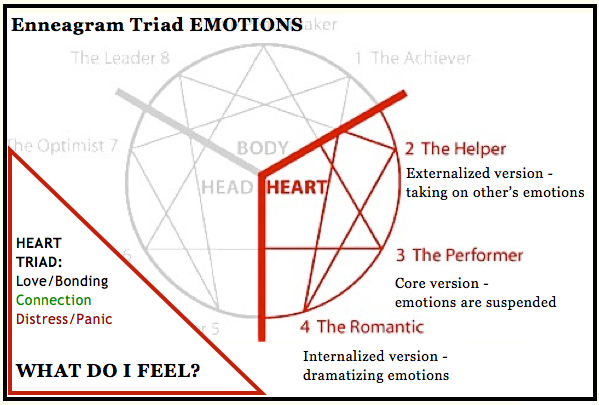
Ennea: TRIAD EMOTIONS (Part 1a)

LOVE triadI’M SO FULL OF EMOTIONS
I don’t know what to do with them!

PREVIOUS: Triad Emotions – Intro

SITE: Enneagram: Ancient knowledge, modern psychology


234s – HEART / Feeling Triad: Low Self-Esteem & Longing
PHYSIOLOGY: triad associated with the mammalian part of our brain
FOCUS: this ‘Center of Intelligence” uses emotions, intuition & imagery – rather than bodily senses

ROOT Emotions
: SHAME, & GRIEF/Sadness, hidden HOSTILITY
RESPONSE: from their heart first, then the head, & gut last
POWER: from their ability to instinctively feel emotions

TIME: mainly to the Past, needing to feel connected to long-term relationships & events
UNDERSTAND Life: best when info is translated into symbols of desire, through people & stories about themselves or their old experiences

❖  234s long for a sense of identity, of figuring out “Who am I?”. Instead of going inward for this information, their main attention is on getting Affirmation From Others, especially those they feel close to, to the point of side-lining their own deepest needs. Total reliance on validation from others can lead to only being able to see themselves thru others’ eyes, unreliable at best, or to low self-esteem & possibly despair. It’s also called the “image” triad, because of a concern with how they are ‘seen’triad :grief
GRIEF / Sadness comes from negating oneself by having substituted a ‘persona’ as a partial or full replacement for the True Self. As children they didn’t have accurate or adequate mirroring. Not being able to handle their pain, they chase after attention & validation. When they feel a real or imagined threat to a connection with an important ‘other’, they can get very distressed, even panicked. This motivates them to stay attached, or do whatever is necessary to re-connect.

IMMATURE: While they may seem very emotional to others, these Types are the least in touch with their primitive senses (the way 8s are). Their natural instinct is to pick up emotional energy from the environment, the same way an audience takes on the enthusiasm of a charismatic motivational speaker, & then acts it out as if it was their own, (like audiences do with Tony Robbins)

EXP: 4s can be pseudo-authentic (dramatic), who assume they must be unique to receive love…. Actually – for them true authenticity would be to include emotions they may think are too ‘ordinary’ (caring, comfortable, annoyed, disappointed….)
MATURE: When healthy, their sensitivity makes these Types admirable, being highly valued for their genuine thoughtfulness & interpersonal skills.

Hidden AGGRESSION: 234s don’t openly acknowledge their wish/need to be aggressive. Instead they use manipulation, guilt & self-pity – more passive ways of asserting themselves, which they consider safer

SHAME : In this context, it is the feeling of being “in the spotlight,” under scrutiny, rather than feeling ashamed of themselves as human beings. It grows out of the deep-seated preoccupation with the need to “See me the way I want to be seen” (rather than for who they truly are), which motivates their characteristic styles.

NEED to be SEEN
2sit shows up as wanting to be recognized for their affection & care of others, a form of “possessive affectivity” **
** Affectivity – something influenced by, sensitive to or results from emotions
3s – their own success is most important, especially in career. This kind of recognition-need can be called ‘functional affectivity’
4s – they deeply want recognition for their originality, with a need to be considered unique & special, often with ‘negative affectivity’

QUESTIONS to ask yourself – for 2, 3, 4s

NEXT: Triad Emotions (1b)
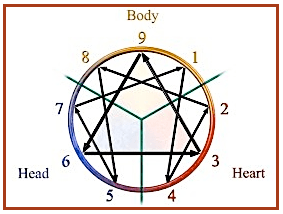
Enneagram: Triad EMOTIONS – Intro

triad emotions 

UNDERSTANDING MY EMOTIONS
helps me deal with life better

PREVIOUS: Ennea Triad Basics – #2c

SITE: “Personality tool: Understanding the Enneagram. Scroll down for info on each type’s way of expressing emotions

CORE EMOTIONAL responses of the 3 Basic Centers
An important way of using the Enneagram is to identify & properly deal with the emotional essences of each triad – developed out of biological responses to survival threats. They can be seen across ALL mammalian behavior, via modern Affective Neuroscience. The same distress-emotions are triggered when the organism’s 3 BASIC NEEDS are not met.

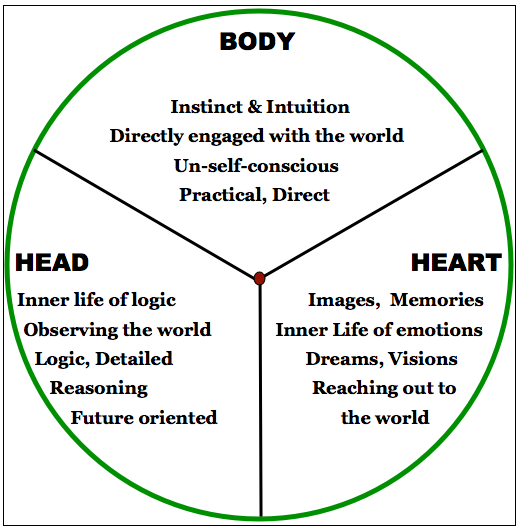
CENTERS: Feeling = Heart (234), Thinking = Head (567) and Gut (891) which includes = Instinctive (digestion, breathing, heartbeat) & Sensory aspects (running…).
Interesting: Gut acts 30,000 times faster than Heart, itself 30,000 times faster than Head. (“The Fourth Way)

◆ EVERY type is capable of experiencing ALL emotions, but each Center is driven by a main one. When things get tough, frustrating, won’t go our way….Screen Shot 2014-09-28 at 10.38.50 AM there’s an inner ‘default’ setting that gets triggered

234s = Grief, Shame
567s = Fear, Anxiety
891s = Anger, Rage
Each Type handles it’s primary emotion differently:
❖ The first # is overt “externalizes” :
2 its shame, 5 its fear, 8 its anger
◆ The second # “represses /covert” :
3 its shame, 6 its fear, 9 its anger
✦ The third # “internalizes /neutral” :
4 its shame, 7 its fear, 1 its anger

Basic FEARS – Triad emotion are our automatic ‘natural’ way of responding to the world, but most people don’t realize it’s what fuels their daily reactions.
When these emotions are cut off from our Core Self, they generate the Type’s defense mechanism, which underpin all dysfunction. While each Center has it’s preferred emotion, Riso & Hudson explained that each TYPE also has an underlying fear OF being: 
enn - Triand INFO1s – corrupt, defective, unbalanced
2s – unwanted, unworthy of love
3s – worthless
4s – without identity or personal significance
5s – helpless, incapable, useless
6s – unable to survive on their own
7s – in pain and deprivation
8s – harmed or controlled by others
9s – lost or separated from self & others

◆ Beatrice Chestnut, psychologist & teacher, condensed a human child’s early needs into 3 challenges – emotional ‘disturbances’ when not properly fulfilled:

A. Need to feel mirrored – when their caregiver makes direct, loving, face-to-face, eye-to-eye contact, so the young child feels ‘seen’ for who they are.

MISSING: Distress/Panic, from the loss of connection & bonding.
Heart types innately pursue this need, but do it incorrectly by creating a False Persona. This makes it hard to be curious about oneself, others & life.
They’re too busy watching what they do, so it will fit their created IMAGE of being:
2s – thoughtful & considerate – so others will respond favorably to ‘such a selfless person’ who only thinks of others
3s – a confident, successful person (so others will respond with respect to such a competent, achieving individual)
4s – a unique person, different from everyone else (so others will at least think they are special rather than lost or deficient).

B. Need to not feel fear – being protected from real danger, or whatever is imagined to be dangerous

MISSING: Fear/Anxiety, when experiencing ta threat, challenge, or danger to our very security
Head
types figure out what makes life certain for themselves. Some fear is necessary & useful if it’s not all-pervasive & overwhelming. When fear overwhelms, it’s very hard to be open to & curious about all the good things available to us.
It’s also imperative to separate fear that’s real from what’s self-created (S-H)

5s – move away from anything that scares them, retreating into a solitary, private world where they only rely on themselves
6s obsessively imagine future danger, &/OR act fearless, as a way of coping with their ever-present fear of life
7s try to avoid fear entirely with constant distractions, sticking to a positive attitude, always considering new possibilities, & planning escapes

C. Need to feel held & supported – seen in very young children who want to be securely wrapped & held, to not feel the threat of being dropped (injured or dead)

MISSING: Anger/Rage, when we experience not being able to depend on our caretakers to ‘back us up’ – neglected, violated & repeatedly deprived
Body Types can sense what’s wrong in their world, know what actions are needed to correct it & how to provide their needs. They want to control their experience & environment to deal with anxiety :
8s try to ‘hold’ everything & everyone by taking charge
9s ‘hold’ by repetitive activities that soothe them (narcotizing)
1s ‘hold’ by being self-controlled, trying to control or structure every aspect of life

LAYERS of the SELF enn -LAYERS of the SELF
Outer = COMPULSIVE : Behavior is automatic
Next = OBSERVING : Beginning of awareness, ability to notice & detach from compulsions
Semi-Inner = HIGHER : Increasing awareness & autonomy, the ability to access higher functions of the Centers
Inner/Center = ESSENTIAL :
Unified consciousness, not trapped in or identified with any one triad
(Chart: ‘Nine Paths’ 12/26/12)

Moving from the outer circle of Stress & Security points – towards our center – requires consistent self-observation.

NEXT: Triad Emotions (Heart)

Excellent Inner Child movie

DON’T IGNORE ME!
I’ll act out what you deny!

PREVIOUS: Enneagram Triads (#2c)


For anyone interested in better understanding the Inner Child, I highly recommend the MOVIE:

IF YOU BELIEVE, 1999

— with Ally Walker as the overworked editor who has betrayed her own instincts & needs, &
— Hayden Panettiere (long before “Hero”) as Ally’s younger inner self, prodding her to return to her truth.

Synopsis at imbd.com

MOVIE:  http://www.free-online-movies-streaming.com/if-you-believe-1999-streaming/

NEXT: Family ROLES – general

Ennea TRIAD Basics (Part 4a)


I HAVE ALL I NEED
to understand my environment

PREVIOUS: Ennea Triads, Part 2b

SITE: Discover your Enneagram TRI-Type


3rd Triad (891) : INSTINCT (Gut), Body-based character structure

#8 = Leader — Energy: Larger than life, Dominating.
#9 = Mediator Energy: Diffuse extension, Comfortable
#1= Reformer Energy: Rigid containment, Righteous

At a party: If you go right in, engaging in hearty, jovial, back-slapping greetings that may put some people off, you’re likely in the Gut triad. Or, you might offer the host a ‘helpful’ criticism about how to improve some aspect of the party.

Flow: Gut-centered people act first – think & feel later. They’re very connected to concrete reality, with a very “nuts & bolts” approach to life. Their driving ‘sin’ is anger, as their first reaction to unsafe people & physical circumstances

POSITIVE 891s : At their best, they’re grounded, with a common-sense approach to taking care of basic needs, so not much thought is required for the simple tasks of life. Their motto could be: “Just do it”, being active in the physical world, & connected to nature
When healthy, they relate to their environment & to others exceptionally well, with a deep wisdom from within. Struggling to stay in the moment, they can always call on their gut reactions to bring them back to the present.

Purpose: “We all use personal position & personal power to make life be the way we believe it “should be.” We devise strategies to assure our place in the world & to minimize discomfort.~ David Daniels, M.D

Physical Center: The Gut / Instinct is the physical link to the conscious ego & the unconscious soul. 891s value action, living life at full volume & maximum speed, doing whatever it takes to best handle physical needs.

All types depend upon the Body Center of Intelligence to be in touch with their higher qualities, including: • the right amount of energy needed for action
• how much power to use (or not use) in each situation
• the capacity to be being grounded in themselves & the world.

Priority: Instinctual needs & rhythms in daily life; issues of fairness or rightness, getting practical results.
Direction: 891 Types move in & against, are direct & straight forward, & can easily be confrontational
Key Mode: Screening & buffering (principled inattention)
Key Words: Belonging, Comfort, Congruence, Harmony, Personal power, Protection, Respect, Worth

gut reactions.pngBasic defense: A concentration of energy in the belly center enables repeated patterns to form layers of “insulation” in the mind & body.

This insulation is used to “screen out” unwanted feelings or information from the inside or outside. Personal wants and needs are controlled by super-ego “shoulds

Neurotic style
: Obsessive process – using repeating patterns of thinking and doing to capture and stabilize attention in daily life.

NEGATIVEFearing neglect or being overlooked, they seek acceptance & be respected for who they are. Acting impulsively, they resist being influenced by current reality, & try to impose their will on the environment without being affected by it – to prevent being controlled by anyone or anything. When they don’t have the experience of their positive Key Words, they react with anger / rage – the more controlled version showing up as irritation, resentment, impatience….
Main emotion :
8s
externalize & act out their anger
9s feel conflicted & disconnect with their anger
1s internalize & repress their anger

Life challenge: Struggle with being asleep to their True Self. They need to “Wake up” through self-awareness instead of falling into excessive materialism (8), low-level comfort (9) or habits (1).
Their childhood experience is of not being allowed their space, so there’s a deep hunger to carve this out for themselves in the world, with a push to distinguish between who they are vs everyone else.

INEXT: Triad EMOTIONS (Part 1)

Ennea TRIAD Basics (Part 3a)

triad flowers
I NEED TO UNDERSTAND
so I can control my environment

PREVIOUS: Basic Triads, Part 2b


SECOND Triad (567) : HEAD, Mental-based character structure
#5 = Observer – – Energy: ‘Invisible’ Detachment, Hoarding
#6 = Questioner Energy: Fight 6 – Jabbing Confrontation
Agreement seeking – – – –  Flight 6 – Poised-for-flight Scanning
#7 = Adventurer Energy: Airy Excitement, Re-framing

At a party: If you stand at the door, looking around to see who’s there & what’s happening, you’re likely in the Head triad. You want to have a good idea of what to expect before going in to a new situation, approaching others cautiously.

Flow: Head-centered people think first – act and feel later. They tend to view life as outsiders looking in. Their driving ‘sin’** is fear, feeling separate from people and their environment

**”SIN” – the Enneagram comes out of a spiritual-direction tradition, so it teaches that each type has a definite sin disrupting their journey toward psychological & spiritual wholeness. In Greek it means “to miss the mark,” so it’s what makes us miss the ‘target’ in our life, which must be confronted & integrated

POSITIVE 567s notice more than other people, but don’t realize that most can’t see the same things they do, or don’t see things the same way! At their best they’re knowledgeable, intellectual & brilliant & visionary. (Bill Gates…). But caught up in the world of ideas, they can forget about the rest of the body (Shertriad 567lock Homes).

Purpose: “The goals of this center are to help us all minimize anxiety, manage potentially painful situations They want to gain a sense of certainty through the mental processes of analyzing, figuring out, envisioning, imagining & planning.

In addition, all of us depend on the HEAD Center of Intelligence to develop the higher qualities of wisdom, inner knowing & thoughtfulness.” ~ David Daniels, M.D

Physical center: Their main activity takes place in the Head, where they make decisions based either on logic on & mental processes (thinking things thru).
Also – they’re acutely aware of the environment, living very much in the present, & instinctively take everything in by physical senses (touch, taste, smell is the way to their “holy idea”) – because it gets them out of being stuck in mental loops

Priority: They want to create security by making sense of the world & other people – using ideas, concepts & rational thinking. Their most important quest is for Truth – for what’s real & what’s not.

Their implied Q is: “What does it all mean?” as they constantly try to figure out how each piece of information they’ve gathered fits in with everything else they’ve picked up. Controlling all the pieces by ‘understanding’ things makes them feel safer

Direction: 567 Types initially move away or withdraw from relationship
Key Mode: Detachment & upward displacement (away from gut)
Key Words: Assurance, Certainty, Opportunity, Predictability, Safety, Security

Basic defense: A concentration of mental energy makes it possible to detach from emotions & the body, to live in the mind. Fear of life (& death) is countered by thinking, explaining, rationalizing. Personal wants & needs are explained away or simply not felt.
Neurotic Style: Paranoid/schizoid process – distrust leads to withdrawing from contact with the world, to figure things out & feel protected.  Re. Emotion:
5s externalize their fear
6s
repress their fear, as a primary strategy
7s in
ternalize their fear inwardly

Life challenge: To integrate mind & body. They have trouble combining their inner world with the outer environment. For them – being ‘seen’ is a two-sided dilemma:
— if they get noticed, they lose their valued privacy
— if they don’t get seen they get too isolated, & feel unappreciated for all their knowledge

Much of the time they have lots of ideas & plans that never go anywhere, which tend be forgotten or go unnoticed. In business, being rigid & dogmatic in their thinking (they’re always right!) can create resentment & conflict, but they don’t know why, since they’re just being ‘reasonable’.
📌 The primary attraction / avoidance dance is trust vs. non-trust.

NEXT: Triad basics – Part 2c

Ennea TRIAD Basics (Part 2a)


ALL OF MY ENERGY
goes to looking good to others

PREVIOUS:
 Basic Triads, Part 1


FIRST Triad (234) : HEART,
Emotion-based character structure
#2 = Sentimentalist Energy: Aggressive Affection, Helpful
#3 = Enthusiast – – – Energy: Charismatic Producer, Successful
#4 = Romanticist – – Energy: Dramatic pull, Authentic

At a party: When you get to the door, what do you do?
If you walk right in, say hello & start chatting – you might belong in the Heart triad

Flow: Heart-centered people feel first – act & think later. They are very conscious of the community around them & how they’re being received.
Their driving ‘sin’ is pride – constantly engaged in image management, so they’ll be well received by others

POSITIVE 234s have flexibility & skill in relationships, achieving success by empathy – being attuned to & meeting social expectations, & sensitive to the vast potential of the human heart

Purpose: “Every Type depends on emotional intelligence to develop the higher qualities of the Heart Center, including empathy, understanding, compassion and loving-kindness.
The HEART center energy tunes us into the mood & feeling state of ourselves & others, so we can meet the vital needs for contact & approval. We can get recognition from others to help support our self-esteem, & fulfill our need for love & connection.” ~ David Daniels, M.D

Physical center is the spinal column, which allows free & comftoward othersortable movement around the outer world, to accomplish all the tasks they set for themselves. They use their energy to ‘feel’ what others want from them, so they can adapt themselves

Priority: Their relationship-needs are for recognition & approval, establishing personal identity through connecting & being seen. 234s tend to rate themselves by how others rate them – to the point of ignoring their own wishes. Their attention is so outwardly focused that it’s hard for them to access their Inner Space

CONFUSING: Actually – they’re only concerned with how they appear to themselves – keeping h image of being “good”- but it has to be through the eyes of others

Direction: 234 Types move towards others, to engage in relationship
Key Mode: Substitution of worth
Key Words: Affection, Approval, Assurance, Bonding, Certainly, Connection, Image, Love, Opportunity, Predictability

Basic defense: Their Emotional intelligence is used to form an “image self” to get recognition & approval, which helps overcome an internal sense of deficiency or emptiness. Trying to meet the expectations of others is a substitute for personal needs & wants
Neurotic Style: ‘Hysteric’ process – unconsciously building up emotional energy & then discharging it willy-nilly into the environment (over-reacting, clowning….)

Life challenge: To find the balance between Self and Other, autonomy & dependence, alots of activitycknowledging & expressing their authentic Inner state.
They tend to resist this inward turn, using many rationalizations to ‘explain’ why they can’t or don’t have time to be introspective.
Each of the 3 types will have their specific excuse, based on lack of self-esteem & emotionally hooked to the past.
Their two major themes are: Identity: “Who am I?” and
Hostility : “I hate you for not loving me in the way I want!”.

Re. Emotion 
2s externalize their shame, & create an image of good person
3s feel conflicted between feeling shame & creating an image of success
4s internalize their shame, & create an image of unique identity
“SHAME eats away at the very core of who you are, wondering if you have enough value to meet all the demands of life & love.  Without a clear answer to this question, you set out to get evidence – to prove your worth, in many unproductive & unhealthy ways. All that effort – to get something you already have.” (MORE…..)

Their Primary Instinct “To DO something” means they have a need to respond to other people or circumstances in order to stay connected.
This is true even if they’re not feeling something themselves, or don’t actually like the person or group. P.D .Ouspensky called them ‘Natural Imitators”, sometimes generating emotions they think suitable to a given situation. They create a facade for others to relate to – of like-ability (2s), success (3s) & uniqueness (4), & then become dependent on the reactions of others for their sense of value & worth.

NEXT: Heart Triad (2b)

Ennea TRIAD Basics (Part 1)

triad proportions<—- DIAGRAM – Each Type’s proportion
of the triune brain, combining: (scroll down)
Intellect (green)
Emotions (blue)
Instinct (red)

PREVIOUS: Type Strengths (#4c)

SITEs: Ennea Triads – Centers of Intelligence


BASIC TRIADS
 As mentioned in ‘Enneagram Basics – Part 3’, there are many different ways to sub-divide the Enneagram, usually in groups of 3. Others will be addressed as well, but we start with the fundamentals, always enn triadsbeginning with TYPE 2.
The Triad that our Type falls into dictates the general way we approach life’s challenges. This gets combined with our specific VICE (character weakness) to form our Driving Need. These create all our traits & desires, fueling an automatic way of responding in the world, often cleverly disguised as defense mechanisms (Enn. Defects, Part 3a…..).

NOTE: Main approaches to categorizing the trios
a. From Helen Palmer – the most popular approach :
234= Heart-based Emotion  // 567= Head-based, Reason  // 891=Gut-based, Instinct

b. From Don Riso:  Feel / Do / Relate to environment

c. From Dick Wright, PhD, who believes his approach is truer to Gurdjieff’s original teachings:  234 = Doers // 567 = Perceivers // 891 = Feelers/ Sensers**.

◆ Each grouping is named by the function they do best, & what’s most important to each type in the sub group: (see below).
The Primary style is what is most Instinctual, the 2nd is an Auxiliary & the 3rd is Buried —->  EXP: Quality that’s buried for Type 7 is ‘Doing’ = to motivate

**In the Enneagram, Feeling or SENSING refers to basic, primitive instincts which come from deep inside & can’t be faked (891s). It does not mean Emotion or Sentiment – like the ‘show’ of 234s, which is more surface – a reaction to external ideas & events – picked up from others.

DOERS Triad (HEART #s 234) – They Motivate
Unconscious Types that deal with life experiences. Focus: emotive center
POSITIVE purpose : To achieve healthy, perfect union with others, the universe & with Spirit, to understand the stages of human development that create maturity and wholeness.
NEGATIVE use : To manipulate one’s own & others’ way of feeling, including the emotional climate within relationships

PERCEIVERS Triad (HEAD #s 567) – They Communicate
Conscious Types that define & justify emotions. Focus: theoretical center
POSITIVE Purpose: To develop creative vision & open people up to the real meaning of life, to be fully conscious of the true nature of self and others.
NEGATIVE Use: To think, plot & make intellectual decisions limited by a narrowly defined universe.

SENSERS Triad (GUT / Body #s 891) – They Translate
Subconscious Types that deal with sensations. Focus: effective center
POSITIVE Purpose: To energize & motivate people to actively live as we were intended, according to our true purpose & vision, to actively create & complete the work we are meant to do.
NEGATIVE Use: To protect & preserve our physical body & fulfill our basic needs, no matter the cost to others.
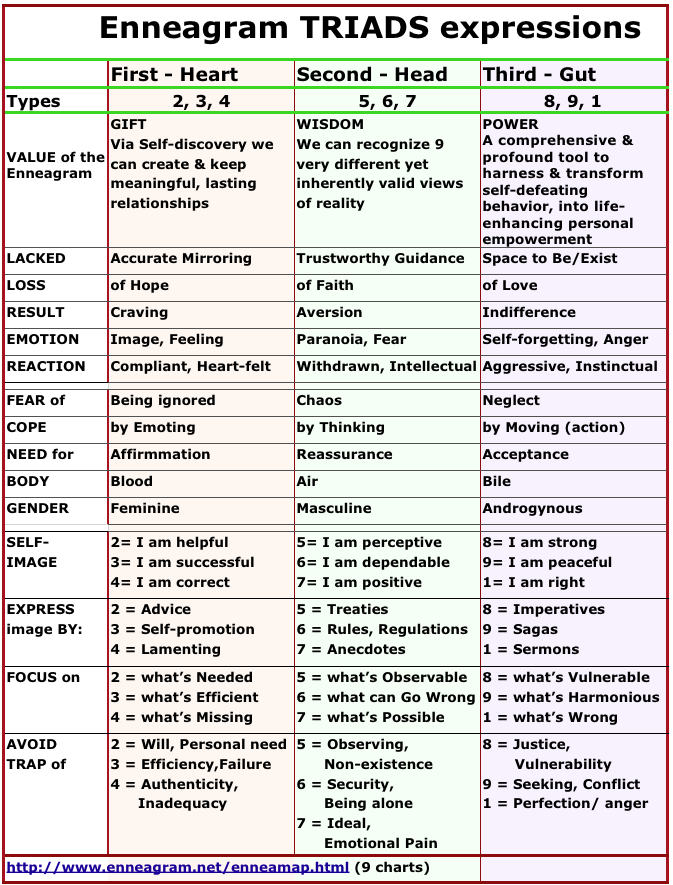
«enn TRIAD expressions

«
NEXT: Triads (Part 2a)


Enneagram – Type STRENGTHS (Part 4c)

jad0055
EACH OF US

has our own path

PREVIOUS: Type Strengths  (Part 4b)

REMINDER – Use ‘Blue’ chart in Part 4a as reference for all below


HOLY IDEAS & VIRTUES / STRENGTHS
(cont.)

#6 VIRTUE: Courage is available when negative projections are seen as Toxic Beliefs of the mind, rather than reality. Reaction against or away from fear becomes irrelevant when we see the fear is self-created

LOYALISTS are attentive to people & problems, committed, courageous, loyal, reliable, strategic thinkers, w/ shared values, solidity
— They really want to make the world a safer, more secure, reliable, trustworthy place to live in.
— They value/are attracted to Loyalty, & stand by their commitments

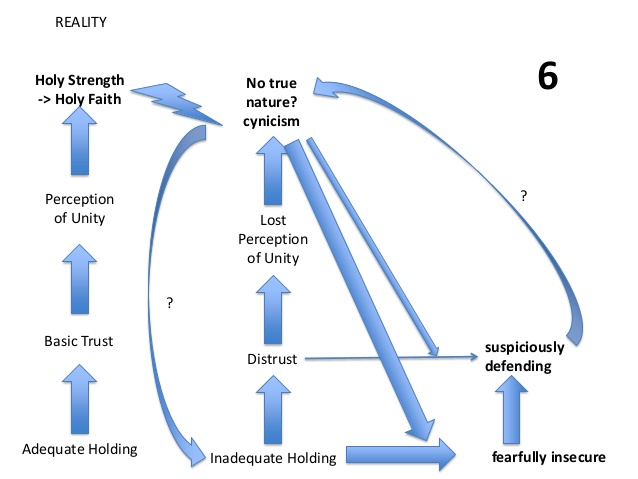
Holy FAITH provides the experience of the actual support from Presence &enn - holy-ideas 6 Being that exists right now – which is beyond the obvious. We are spiritual beings having a human experience. This Ideas infuses me with trust & the courage to respond spontaneously to what ever happens in the moment, not bound by belief, habit or doubt.

HIGHER MIND: Faith – 6s, are in the habit of doubting everything, so they can easily erase signs of success by equally ‘believable’ thoughts used to argue away positive experiences. It takes a leap of faith for 6s to keep their attention focused on genuinely positive experiences, continue their Recovery & spiritual practices, pursue projects that encourage them……
✥ ✥ ✥ ✥ ✥ ✥ ✥ ✥ ✥ ✥ ✥ ✥ ✥ ✥ ✥

#7 VIRTUE: Sobriety, ie. having a Clear Head, which comes from understanding that fulfillment ultimately develops from within & nowhere else. We learn that a more meaningful & deeper experience of life is missed when it’s sampled superficially

EPICURES are adventurous, appreciative, focus talents well, fun-loving, quick thinking, satisfied. Like adventure, excitement, variety
— They really want to enjoy life & experience all its possibilities, envision making the world a more delightful place to live in
— They value /are attracted to Joy & newness

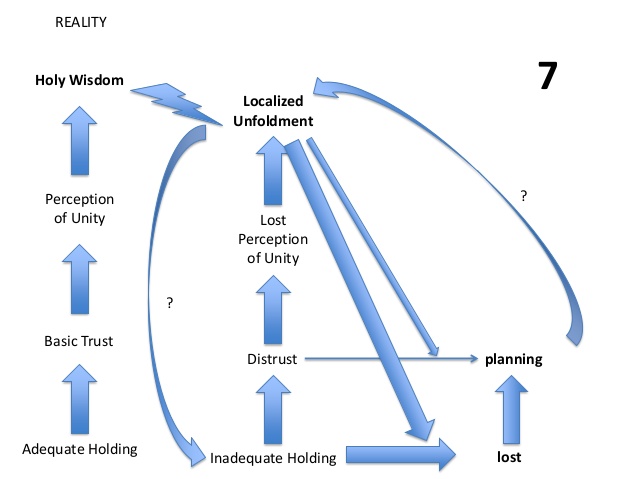
Holy PLANNING / Wisdom tells us that we are part of a Greater Plan, soenn - holy-ideas 7 we don’t have to anticipate or figure out where we’re going & are willing to take the negative with the positive. I know that in this moment I’m having the optimal experience I’m supposed to, & the pleasure is in the journey itself.

HIGHER MIND: Work implies a complete commitment to a single course of action, rather than flitting from project to project because they don’t want to miss out on something good. Setting appropriate boundaries for themselves & sticking to a good plan – even if criticized – allows them to accomplish a great deal.
✥ ✥ ✥ ✥ ✥ ✥ ✥ ✥ ✥ ✥ ✥ ✥ ✥ ✥ ✥

#8 VIRTUE: Magnanimity – the wise & balanced use of their power, knowing there’s a right and wrong time for aggression. “Liberty consists in wholesome restraint.” ~ Daniel Webster.
Mercy – not needing vengeance on or blame of – others or self – for losing the connection to the Whole (“If only I had been stronger….”)
Innocence (simplicity) from being able to feel subtle sensations & emotions, rather than go for excesses & intense experience.

BOSSES (ex-Bullies) are dependable, enthusiastic, generous, heroic, inspiring, loyalty, powerful, self-mastering, strong, improve others’ lives
— They really want to live life fully, freely – using their strength to influence others & help create a more just world where power and resources are equitably distributed
— They’re attracted to, appreciate & can effectively handle power

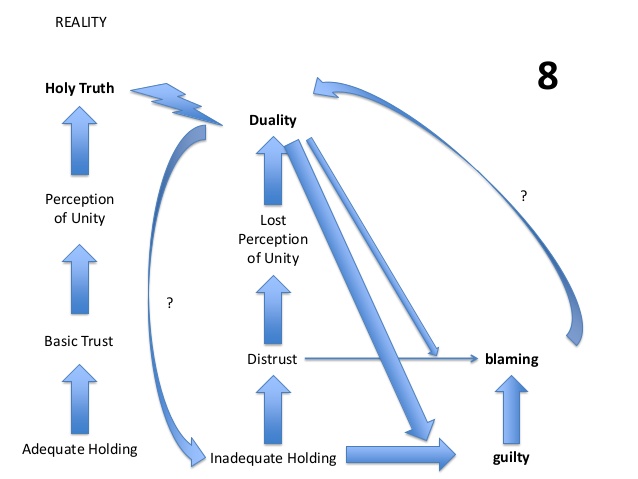
Holy TRUTH /Innocence is the understanding that “all is one”, that GodEnn - holy-ideas 8 is everywhere & omni-present. I can overcome my limited & biased perspective (trying to balance the scales of justice according to a personal sense of fairness) & recognize that all differences at all levels of existence are part of one unfathomable reality that is Truth – so I don’t have to push & control.

HIGHER MIND: Truth – In mature 8s the neurotic need to create conflict as a way to discover buried truth is a habit of the past. No longer threatened by the possibility of being unfairly controlled by others, 8s connect with a rare capacity to recognize each individual’s real needs, wishes & truth.
✥ ✥ ✥ ✥ ✥ ✥ ✥ ✥ ✥ ✥ ✥ ✥ ✥ ✥ ✥

#9 VIRTUE: Action / Participation frees up energy to pursue our goals and desires, formerly used to shut out anything felt to be disturbing. Right Action is the willingness to engage in life & stay engaged, no matter what happens, eliminating laziness or inertia which depends on using others to give us direction.

PEACEMAKERS are accepting, all-embracing, balanced, comfort-oriented, harmonizing, indomitable, peaceful, stable, heal conflicts
— They really want to feel ‘at one’ & at home – to make the world a more harmonious, ecumenical, comfortable place to live in
— They value /are attracted to Harmony, peace, unity

Holy LOVE (unconditional) holds that every being in the universe has enn - holy-ideas 9value & significance, both the world around us & our Self, which releases us from the trap of self-abasement. It has the dynamic effect of energizing the virtue of action, while cultivating compassion, nobility & unshakable inner peace.

HIGHER MIND: Love/Charity – in its higher form, love has less to do with an emotional response than 9s with being able to focus their attention on a point inside themselves, from which the loved-one can be connected with. This prevents trying to merge with others as the reason for existence – which is not Love. The goal is to be able to sense the condition of others while still being aware of the Self.

OVERVIEW: Spectrum of Personality Styles

NEXT:

Enneagram – Type STRENGTHS (Part 4b)

virtues - 2 EACH OF US
has our own talent

PREVIOUS: Type Virtues & Holy Ideas (Part 4a)

SITE: “How Each Types Sees Their Every-day Life” (scroll to page 21-22)

REMINDER – use Blue-&-White chart in part 4a as reference (by P.Ferrieux)

HOLY IDEAS & VIRTUES / STRENGTHS – Cont.
#2 Virtue: Humility overrides Pride as we come to truly see & accept that we’re not indispensable, & that everyone is equally important & needed
HELPERS are affectionate, altruistic, caring, communicators, emotionally connected, familiar, popular, unselfish, warm
— They really want to be loving, to nurture others & encourage relationships & making the world a more loving place to live in
— They value / are attracted to Love

enn - holy-ideas 2Holy WILL : I acknowledge that there is only One Will, with a Purpose beyond the self-centered motive of feeling important to & being needed by others. I am aware that Reality flows with a certain force, & the easiest way to ‘live well’ is to move with it. Freedom is the feeling of openness when I experience the unfolding of Divine Will.

HIGHER MIND: Freedom comes when 2s are able to recognizing their own needs, by not compulsively helping others & regularly paying attention to themselves. Withdrawing their focus on others interrupts a negative habit 2s usually depend on for emotional security. This frees them to provide self-care.
✥ ✥ ✥ ✥ ✥ ✥ ✥ ✥ ✥ ✥ ✥ ✥ ✥ ✥ ✥

#3 VIRTUE: Truthfulness/Integrity comes easily when our True Self is accepted. Packaging & selling of ourselves becomes unnecessary when we have no reason for a deceitful appearance (False Self).

ACHIEVERS are admirable, attractive, authentic, competent, energetic, high achievers, inspirational, self-accepting, successful
— They really want to make the world a cosmos – a more efficient, organized, productive, smooth running harmonious & orderly system
— They value/are attracted to Competence, industry, productivity

enn - holy-ideas 3Holy HARMONY corrects the false perception that the ego is the source of doing & functioning. It means the universe as a whole already functions in efficient harmony & I doesn’t need to compete with that in order to prove myself. I fully realize & surrender to the knowledge that I am not separate doer, & that all experience is part of the great Reality.

HIGHER MIND: Hope – anxiety drops away when 3s truly believe that each stage of work leads to a correct conclusion. Then they feel alive in the middle of activity, & become skilled at sensing energy requirements of different jobs. Healthy 3s say it’s like floating on a wave of inexhaustible energy
✥ ✥ ✥ ✥ ✥ ✥ ✥ ✥ ✥ ✥ ✥ ✥ ✥ ✥ ✥

#4 VIRTUE: Equanimity comes when we see our positives & negatives equally. The half-truth of envy loses its validity when we stop comparing the positives of others with what we think we don’t have.

INDIVIDUALISTS are accepting, communicators, compassionate, creative, emotionally honest & deep, idealistic, inspired, good listeners
— They aspire to be special – really wanting to be unique & to put their personal touch on everything they’re involved in, to make the world more beautiful
— They value/are attracted to originality & beauty.

enn - holy-ideas 4Holy ORIGIN tells us that ‘being’ is the source & origin of our true identity. I see that I am not separate from everything, that all parts of the universe express the Great creative intelligence. Since I am an aspect of that creative flow I cannot be otherwise. My life will unfold in unique ways, & finding my authentic self comes by being ‘in the flow’.

HIGHER MIND: Originality – 4s want to be unique so they resist being re-shaped into an ‘ordinary’ happy person. Actually, their attitude is not ‘just in their head’ but a legitimate need, and their tenacious resistance to conforming remind the rest of us to connect to our own higher awareness
✥ ✥ ✥ ✥ ✥ ✥ ✥ ✥ ✥ ✥ ✥ ✥ ✥ ✥ ✥

#5 VIRTUE: Detachment from vulnerability & over-protection comes when we no longer feel in danger of being overwhelmed by emotions, & learn that the world is better understood by participating in it. Greed for alone-time makes us less prepared to live in the world, not more.

INTELLECTUALS are intense, involved, non-intrusive, perceptive, scholarly, self-reliant, visionary pioneers, have wonder
— They really want to make the world a more enlightened place by discovering what is real & true, & making it more understandable.
— They value/are attracted to Knowledge, truth, understanding, wisdom

enn - holy-ideas 5Holy OMNISCIENCE is the direct knowing of Essence, which includes all that exists in its various manifestations, yet does not negate Unity. When I abide in my True Nature I know the Great Intelligence, & my minds is clear – I see that feeling safe in the world comes from participation & experience, rather than watching from the sidelines in the hope of understanding it before jumping in.

HIGHER MIND: All-Knowing becomes available when in a non-thinking state of mind – which is the opposite of trying to find out every tiny aspect of a given subject. Rather – it’s being able to engage the Inner Observer that allows its own awareness to merge with impressions of the past, present & future possibilities & events.

NEXT: Type VIRTUES (Part 4c)

Enneagram – Type STRENGTHS (Part 4a)

k5941299THERE ARE MANY MORE
pieces to this puzzle

PREVIOUS: Type Strengths (Part 3)

SITE: Ennea Happiness & Strengths (fun)


STRUCTURE of PERSONALITY
Claudio Naranjo has united several theories, contrasting Essence to Personality (the conditional Self/lesser mind TO the Real Being/Higher Mind). This chart shows his variation of Ichazo & Gurdjieff’s view of the human psyche, made up of five centers, with the addition of two higher centers of the ‘awakened’ individual.

● It’s based on the current view of optimal mental health that the outer expressions of Personality do not represent the True Self within, but are motivated by a sense of deficiency – the passions/drives repressing, contaminating & replacing core instincts. The Bound (lower) parts include the Enneagram’s Triad of Instincts:
— Self-Preservation, for personal survival
— Sexual, for intimate one-to-one connection
— Social, for connection to the larger world. More in future posts. (MORE…..Chart—>.)

ESSENCE:  Higher Mind drives the automatic orientation toward our specific qualities of awareness – not mediated by every-day thinking.
The Virtues are automatic bodily responses – not directed by personal likes or dislikes.

Although higher mental awareness is different from its counterparts in the Personality, it’s easy to mistakenly assume we are in our Essence when we – think humble thoughts (4s), force ourselves to be brave (6s), feel we’ve been of ‘great service’ (2s)….. These reactions are only indirectly related to being open, undefended & attuned to the environment & other people. Fortunately, each type has the unconscious drive to identify AND the conscious ability to outgrow ‘the trance of type’.

LIBERATION & Presence* (being fully awake)
2 = Humility. By Disinterestedness we can express Altruism
3 = Integrity. By Self-acceptance we gain Genuineness
4 = Equanimity. By Self-renewal we achieve Creativity

5 = Generosity. By Understanding we experience Discovery
6 = Courage. By Self-Affirmation we gain Courage
7 = Sobriety. By Assimilation we experience Gratitude

8 = Subtlety. By Self-restraint we can express Magnanimity
9 = Engagement. By Self-possession we find Fulfillment
1 = Serenity. By Discernment we gain Tolerance

*Presence – the opposite of being trapped in our Enneagram style – when we’re controlled by a younger part of ourselves, habitually acting out of the past as a reflex. When we’re not truly awake to current experiences, our judgments are flawed & our actions inappropriate. Being Present is a spiritual process, & while it’s not easy, it is a crucial requirement for a full life.

Overviews – Holy Ideas are the essential qualities of Reality.
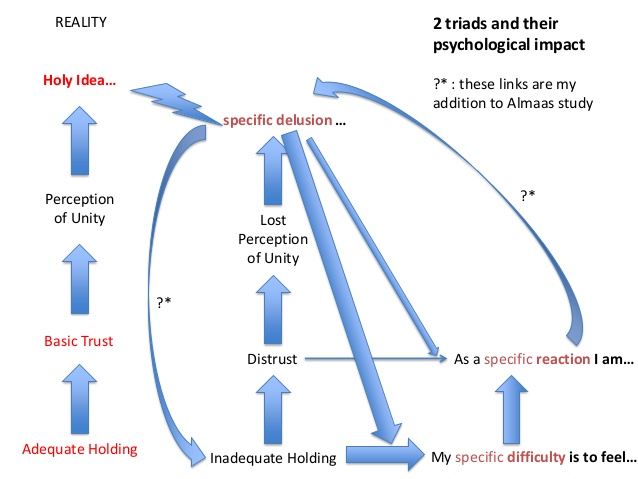
The left-hand chart shows Universal Reality coordinated with the Enneagram’s Heart, Head, Body.  enn - holy-ideas 2 TRIADS
Use the right-hand chart as the model for the #1-9  diagrams that follow. (All created by P.Ferrieux)

HOLY IDEAS & VIRTUE (STRENGTHS)
#1 VIRTUE: Serenity is the recognition that Reality is inherently perfect. As part of that reality, we are already ‘perfect’ so we can be open & accept the conditions that we are working with, trusting that whatever wisdom we may need will be available in the moment

PERFECTIONISTS are fair, honest, honorable, improvement-oriented, noble, responsible, want equality with a shared purpose and values, can be morally heroic
— They really want to be good people & make the world a better place, to realize all their potentials & help others actualize theirs
— They value/are attracted to Goodness & right-ness

Holy PERFECTION points to the more universal sense of perfection , which we can only uncover in small doses. I see that my purpose is not to achieve some transcendental level but to deal with the imperfect world with acceptance. Everything is already as it should be, so when I’m in “here and now” the moment is always perfect. I can trust the process & bring my support to every situation with compassion.

HIGHER MIND: True Perfection isenn - holy-ideas 1
a balance of positive & negative elements blending together at every moment. Any perfect relationship, event or product has to go through stages, including occasional bad risks or bad timing. So – 1s can benefit by accepting that what can seem like terrible mistakes are connected to an ultimately correct outcome. Their only responsibility is doing the best job they can at any given time

NEXT: Type VIRTUES (Part 4b)