Al-Anon STEP 10 – Comments (Part 1)

PREVIOUS : Use “THINK” instead of “feel” #2

SITE: Al-Anon Step 10  Questions (scroll down)

• MORNING MEDITATION READING = Today I will…..


AA/AL-Anon 10th Step: “Continued to take personal inventory & when we were wrong promptly admitted it.”

This Step separates into 3 distinct issues: inventory, wrongs, admitting

1. DOING a REGULAR (daily?) INVENTORY

a. STEP 10 is a general evaluation of our activities for some brief period. The actual purpose is to help us stay present for what’s going on inside of us on a continuing basis.

It’s an antidote to our compulsion to escape the WIC’s old pain that hasn’t been cleaned out yet –  by retreating into the ‘lala land’s of FB, TV, reading, over-doing…. & various addictions. It’s a way to not slide back into denial, back into just DOing instead of BEing, back into our ACA’s built-in “forgetter” state. 

b. WHEN? While it’s not stated, the assumption is that we take this step every day. In the Al-Anon book: “Paths to Recovery: Al-Anon’s Steps, Traditions and Concepts” a member writes that at first they did it once a day, then added a lunch time evaluation at work, so that anything that needed to be corrected could be done right away & then the afternoon would go more smoothly.

But each of us must find our own rhythm. The more regularly we get in the habit of checking in with ourself, the more we can connect with our True Self, & burn off bits & pieces of our damage.

c. Continuing a personal inventory does not exclusively mean listing all the flaws, mistakes, omissions… we’ve committed that day.
Yet in the literature & in meetings the focus is mainly on character defects we identified in Step 4.  About Step 10, one internet site says “Continue to watch for selfishness, dishonesty, resentment, and fear. When these crop up, we ask God at once to remove them…..”

d. Simply doing it this way is lopsided. To be accurate – make 2 very short lists of both plusses & minuses we observes in ourself. If we’re doing this during the day, they can be 2-5 for each side.

If it’s at the end of the day, we will benefit by only doing a positive inventory, as shown in the column —->. This is particularly important for ACAs because our focus is always on what we did wrong, which keeps us stuck in narcissistic S-H. (More on ‘wrongs’ in Part 2)

And, to be ‘rigorously honest’ – we need to include all T.E.A.s (thoughts, emotions & actions) – without self-judgement – BRIEFLY.  —> SO:

✔︎ What were my actions today?  This is what most of us focus on. It includes things like co-dependent people-pleasing or passive-aggressive reactions – which mostly hurts ourselves, but also hurts others by not being present with them (psychological dishonesty) – & some ways we abandon others.
ASK: Did I “Correct, Complain, Criticize?”
POSITIVE: Identify any & all actions, even if they’re easy, short, simple or repeated every day

✔︎ What were my emotions (Es) today?  annoyed, anticipating, anxious, bored, excited, grateful, pleased, relieved…?
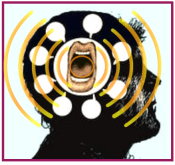
Since ACAs have trouble identifying our Es, start by briefly listing any events of the day which might have bothered you but which you brushed aside at the time – when someone ignored you, your ex called, you got a compliment, you forgot something…..

Then ask yourself:  “IF I had had an E for each event, what might it have been? Sad, hurt, angry, relieved, pleased….

This inventory is particularly important if you feel drained, upset, antsy, obsessing…. at the end of the day but don’t know why.  Notice how unrecognized Es add up & may contribute to your unease. Just because we don’t FEEL them, doesn’t mean they’re not there!

NOW: You can acknowledge some of these Es you’ve learned to suppress (denial), & can talk about them in meetings, therapy & with sponsors – to bring them into consciousness.
IMP: This will prevent having to act them out.

POSITIVE: Include a list of comfortable Es you experienced – no matter how subtle or brief. It’s important to reinforce all positives (peaceful, happy, relieved, relaxed, amused, excited ….)

NEXT : Step 10 – #2 (re. Thoughts)
Passive Aggressives – Review for ACoAs (Part 2)


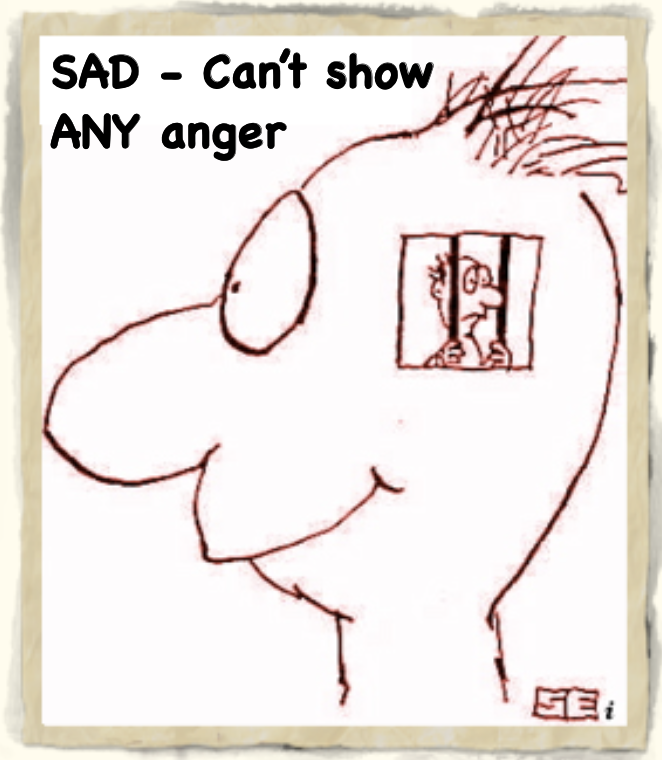
I’M NOT ALLOWED TO BE ANGRY
– but you are (lucky you)!

PREVIOUS: Passive-Aggressive ACoAs (#1)

SITE:When your Defenses lead you into trouble

REMINDER: See ACRONYM page for abbrev.


REVIEW –
(cont)
1.The GAME

2. WHO plays the game (Chart – slide #7)
a. P-As always look for & often find another person who is overtly angry / volatile* (V.) to play the game with – no fun being stuck with all that UN-expressed rage alone! (See: Inter-personal games, Eric Berne).

As adults, they desperately need to maintain their illusions of being perfect, in the faint hope of getting or keeping their parents’ approval, being taught that strong emotions are considered dirty, messy, dangerous – even murderous! Being P-A is another unsuccessful way of denying intense fear of abandonment

b. ✶ Volatiles need P-As (for their part, or the game wouldn’t work) :
• it gives them an excuse for letting out some of their rage ‘legitimately’
• it’s much safer than aiming the rage at the real target – their family
• the rage makes them feel powerful, to cover vulnerability & emptiness
• both Vs & P-As are addicted to finding someone they can act out their childhood ‘story’ with. Vs are used to being disappointed, too, & P-As do continually disappoint! It’s their trade-mark, & it can be used to identify them.
• sooner or later, usually later, it’s inevitable that Vs get angry, raging, even nasty at P-As – out of legitimate, intense, longstanding frustration at the P-As’ tactics!  Of course: Vs have to stick around for this! They’re part of the game.

DIRTY POOL – P-As unconsciously, sometimes knowingly, will find & use ‘available’ Volatiles as their own personal pressure valve – as if getting the V. to explode with rage would relieve their own pent-up hostility. When Vs get angry, P-As get very self-righteous. They feel victimized & cry: “I haven’t DONE anything!  Why are you attacking me?
SO THEY CAN
• Accuse Vs of being controlling, even though they set the V. up TO:
— take care of them emotionally & practically
— vent their anger/rage for them
— make all the decisions in the relationship!
— use the V a substitute for the original harmful parent

• Make Vs the crazy or bad one (instead of themself), of being abusive & unfair, of reacting to ‘nothing’. That way the Vs can be ‘the monster’ for pouring out that vile stuff (anger) which P-As are terrified in themself.
They can continue to feel superior & ‘clean’, keeping their ‘good-child’ status. After all, P-As can point to being easy-going, never raising their voice or letting out that ‘nasty‘ anger – right?
➼ BUT that is exactly the point – they don’t DO many things that are their responsibility.  P-As make other people responsible for decisions they should be making themself, (even if they like the ones being made for them). They neglect to ‘show up’, hold up their end, be an equal partner or peer – ie. an adult. P-As stubbornly – yes angrily – demand to be rescued, never not expressing their needs / wants.

• THEN, if /when something goes wrong – when they don’t like the choices the V. made for them, or are disappointed with the outcome – they can blame the other person & continue to play the victim.

• AND P-As can say to the other person: “YOU’RE so controlling!” (& unspoken: “I hate you”). Wow! How dishonest.
✶ BUT if the V. stops playing the game, the P-A may finally tip their hand – if only briefly – showing the true rage behind their mask

EXP: Mark (P-A) & Sandy (V.) meet at a classical concert & become art-loving, theater-going friends. Mark regularly says self-deprecating things that are clever & funny, & Sandy obliges by laughing.
After a few months Sandy becomes increasingly uncomfortable with her complicity in Screen Shot 2016-06-15 at 12.04.49 AMMark’s self-hate. The next time he makes a crack about himself – she doesn’t laugh & is quiet. He gets annoyed & indirectly insults her for not responding ‘correctly’.
Later he buys her a B/day gift which deeply offends her artistic & Christian values – an ugly-made goddess statue – knowing her religious background! She can’t imagine his intention – but is outraged. She instantly blows up at him & gives the gift back. Naturally he’s shocked & insulted. After all – it was well-meaning. Instead he mails her a self-righteous note, asking “Is that any way for a Christian to act?”.  End of friendship! Sandy feels ashamed for blowing up but also relieved to get away.

NEXT: Passive-Aggressive ACoAs, (Part 3)

Passive Aggressives – Review for ACoAs (Part 1)


YOU’LL NEVER SEE HOW ANGRY I AM –
I barely know, myself!

PREVIOUS: P-A ‘nice’ comments

SITE: Constructive, Passive & Aggressive Leadership styles


REVIEW
1.The GAME (Post: How its played)
a. DEF : Passive-Aggressive ‘Personality Disorder’ (PAPD)
A 2-handed ‘game’ which always requires the Passive-Aggressive (P-As) person & the Volatile (Vs) one to react (in ‘Games People Play’ – audio – by Eric Berne)

✰ web-MD …. apparently compliant behavior, with intrinsic obstructive or stubborn qualities, to cover deeply felt aggressive feelings that cannot be more directly expressed….

✰ Wikipedia ….. a personality trait marked by a pervasive pattern of negative attitudes & passive, usually disavowed resistance … expressed as learned helplessness, procrastination, resentment, stubbornness, sullenness, or deliberate/repeated failure to accomplish requested tasks for which one is (often explicitly) responsible….

✰ DSM VI …. the behavior often reflects an unexpressed hostility or resentment stemming from a frustrating interpersonal or institutional relationship on which an individual is overly dependent

✰ The Straight Dope …. people who suffer from PAPD expect disappointment, and gain a sense of control over their lives by bringing it about.Screen Shot 2016-06-14 at 11.09.50 PM.png

b. ACoAs: MANY of us grew up in one of 2 emotional climates :
emotionally volatile – being around loud, hyper, dramatic, raging parents / relatives – which has made some ACoAs emotionally gun-shy. We had to sit on our own anger – there was so much flying around, and we didn’t want to be like them, so we shoved our rage into a huge locked room & tried to throw away the key. But now it comes out sideways!

Screen Shot 2016-06-14 at 11.00.40 PMemotionally repressed – the other extreme found some of us in a family of uptight, buttoned down, emotionally cut-off, perhaps P-A types, who made a point of suppressing any intense emotion in their children. They may have believed it was ‘spiritually correct’, or they just didn’t want their own repressed pain to get triggered, &y didn’t have the skill/ tools to deal with ‘big feelings’ from their kids. We either copied their style or became ‘dramatic’ & over-reactive to everything.

• Both styles have deeply effected our relationship to anger & rage.
IMP: These are normal human EMOTIONS (Es), which are just forms of energy & by themselves are not dangerous or bad.
✶✶ What to watch out for are the ACTIONS we take to express these Es! If we express them safely, we don’t hurt anyone & in fact feel lighter & can function better. If they’re expressed badly we can cause pain to others, while adding to our shame, guilt & S-H.

c. Briefly:  P-As ACoAs have a huge amount of accumulated anger & rage (from childhood, as well as in adulthood), which we’re not allowed to feel, much less admit to – in order to be the ‘good’ one. We have cultivated such a facade of ‘niceness’ we’ve fooled ourself (but not everyone).  We may be the Hero or Lost Child from any dysfunctional family –  the Rescuers, the People-pleasers, or the Invisibles. (Toxic Roles”)


no, noP-As compulsively resent, oppose & thwart – indirectly – what we see as demands to function at a level others expect of us. We’re convinced that we’re still not allowed to have real power for  ourself,  afraid to admit our anger at being neglected & unloved.
We end up saying NO to our own needs & wants – and to many things that would be good for us.

So we live in a state of deprivation, expecting others to read our mind & provide what we won’t give ourself . P-As are rarely if ever able to state outright what they want & don’t want, or distinguish between actual bullying & appropriate requests.

hidden handsSuppressing our anger is a form of negative self-control, then put all the rest of our effort into trying to control other people’s actions & emotions..  In light of our self-imposed limitation, P-As are inwardly driven to push others toward our secret goals: to prove we can’t be pushed around, and to get back at anyone who’s hurt us OR their substitutes) – while seeming to not push at all. (re. controlling). It’s a way  to get our agenda across without risking negative consequences.

NEXT: P-A ACoAs – Review (Part 2)

Passive-Aggressive ‘Nice’ COMMENTS

I HAVE LOTS OF WAYS
of being covertly angry
PREVIOUS: P-A #1

SITEs27 Most Passive-Aggressive Things That Ever Happened
P-A Commuter Types – (London)

** Southern P-A veiled insults 


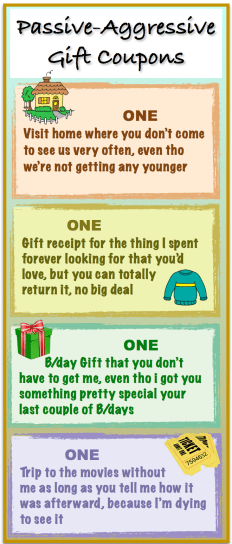
Somethings Passive-Aggressives SAY :

Using their cherished bag-of-tricks to combat insecurity, especially if they feel pushed outside their comfort zone, P-As silently hope for attention & approval, trying to prevent loss of connection by avoiding confrontation.

The following statements are meant to express disappointment, hurt & hostility, but are coded in the form of underhanded insults instead of respectful honesty. Totally confusing most people, this style insures P-As do not get their needs met, while feeling ONE UP.
When they give those little looks, roll their eyes, or throw out subtly sweetly nasty comments, they’re cresting brain fog, so most ‘recipients’ don’t catch on that they’re being messed with. 

NOTE: Emotionally healthy people are self-reflective, so not only do they have decent self-esteem, but aren’t afraid to own their ‘stuff’.  So they rarely point a finger at others,, keep the focus on themself, not ashamed of their emotions, & can communicate directly with ‘I‘ statements.
EXP: “I won’t be able to help you with that // This is who I am, please accept me as is….”

BUT dyed-in-the-wool P-As have none of those characteristics. Almost all the following statements are ‘you’ types (some implied), and none of the “I” statements are kind or supportive, nor admit personal responsibility for their feelings / opinions

THIS often leaves someone wondering:
“Did I hear right? / / Did they mean to be mean? / / If I catch them or say ‘this hurt’ – will they deny or attack?……”  What the P-A wants is for others to always be off-balance.

This list includes things said/written by any adult in any setting
Aren’t we pretty today? = Who do you think you are? / / Is that what you’re going to wear? // What you’re wearing is ugly
Don’t bother! = means I really want you to do _____, & angry that you won’t
• Don’t take it so personally = means that it was a very personal barb
Fine. Whatever = sulking, they want you to stop bugging them
• How is your therapy progressing? =You don’t seem to be getting any better (maybe worse!) // you’re still such a mess, I don’t think even this will help
I’m coming! = foot-dragging, putting off doing something they want // I’m busy!

I didn’t know you meant now = means I won’t let you control when I do what you want, which I don’t want to do anyway
If you really want to = means I don’t really want to, but won’t say so
• It’s nice that you’ve found a friend = finally, since you’re not very desirable
If you insist! = means I don’t agree //  I don’t want you to, but won’t ask you to stop
It’s fine if you’re late, again = they feel disrespected but think it’s too petty to object directly (don’t have a right to be considered)
I didn’t do anything (wrong) = complete denial of their abuse or neglect
• I didn’t mean anything by it = means ‘pretend you didn’t get it’
I h0pe it’s worth it = they’re “worried” about a choice or decision you’re making, think it’s wrong and hope you fail
I thought you knew/ are in the loop = 
they had no intention of including you
• I was curious about / surprised / confused by…  =
a disguised criticism
I was only joking = sarcasm meant to stab at you. It’s not funny

• Oh my dear, you’re looking so much better today = boy have you been looking like something the cat dragged in lately (although you have not been sick)
No worries = short for Screw You
So… (by itself) = another form of Screw you, or what’s your point? — If in a sentence : So….When are we going? / have you called them back yet?…..  = the P-A is clearly agitated, worried…. but won’t admit it
Sure, I’d be happy to = they don’t want to & have no intention of doing it
• This is far too complicated for you to understand = dumb, dumb, dumb
Thanks in advance = you’re will do what they want, without your input or consent

• You’re asking too much / just wanted everything to be perfect = they don’t want to do what you asked for, but can’t get away with putting it off, so do it badly or half-assed, then are defensive when you rightly object to a sloppy execution
• You’ve done so well for someone with your limitations / with what you had to work with = means the P-A is jealous, but patting you on the head like a child. OR are very displeased & disappointed in you, & blames you

You decide / whatever you want = (as a pattern) never taking responsibility for what they want & then objects or criticized your choices
You’re imagining things = means that if you’re ‘crazy’, they’re home free – got away with abuse

You’re so intense / too emotional = P-As are hiding their own anger & pain, so don’t want your strong emotions to stir up their suppressed ones
You’re too sensitive = P-As don’t want you to object to their hostility, judgement or insult
Why are you getting so upset? = means “Ha, I got you!”
• We’re watching your progress & hoping the best for you = we don’t have a lot of hope or confidence in you, but want to sound supportive!.

NEXT: P-A ACoAs (Part 1)

Secretly Angry “Nice” People (Intro-b)

I CAN NEVER LET GO 
no matter how bad it is!

PREVIOUS: Intro-a

SITE:You’re Not Allowed To Have Feelings” (in our culture)


UNHEALTHY ‘Nice’ People have low self-esteem. They are: EITHER co-dependent (Co-dep): over-doing for everyone else, rescuing, self-sacrificing, the ‘good’ one, always ‘up’
OR passive-aggressive (P-A): resistant, obstructive, deliberately forgetful, plotting, ‘innocent’, pretend-incompetent

When we go thru something difficult or painful, and haven’t learned appropriate ways to cope with the Es that come up (usually fear, &/or anger), we’re either not aware of them at all, or dismiss what we’re feeling & find ways to distract ourself. This stifling is a continuation of how we tried to protect ourself as kids because we kept being punished for expressing those Es. Now it just keeps us stuck in our own emotional mud.

Aggressive Anger is obvious – shown as verbal threats, screaming, physical blows, breaking / destroying objects or property…. The consequences are usually harmful to someone or something.

Hidden Anger, on the other hand, is subtle & manipulative (Co-dep or P-A), but also comes with its own risks & negative outcomes. Behaviors can be so indirect, often not related to anything that’s currently happening, that others either can’t easily catch on, or will be puzzled by it. Angry-nice people may seem like victims but are actually perpetrators, acting out their hidden rage in ways that insure they can keep denying it, keeping their ‘good-guy’ status.

🔸 If the anger is so deeply suppressed that it’s now unconscious, the person will not be able to acknowledge that certain actions or non-actions are a sign of being ‘triggered’ (hurt, scared, frustrated)
🔹 If the anger is conscious but concealed, then the unhealthy patterns are deliberate, & may be vindictive : planned to sneakily annoy, hurt or destroy someone they blame for their own shame or guilt.

Either way, ignoring our anger cuts us off from a vitality that could give us the power to forge ahead on our own behalf, leavings us feeling powerless.
Yet many ‘nice’ people are so dedicated to their carefully constructed facade of ‘OK-ness’, they refuse to feel their anger directly & deal with situations that caused it. This prevents any resolution or growth.

ACoAs

For those of us who suffered a great deal of PMES abuse by our family, it’s only natural to have built up a backlog of anger towards drunk, raging, selfish parents, abusive siblings & unsupportive relatives.  As kids we gradually suppressed some or all of that anger (A.) & rage (as well as other painful Es), for 3 major reasons:
1. We were humiliated & abused if we had the nerve to get visibly angry at adults
2. It was (& may still be) too overwhelming to consciously face that our parents truly were/are unsafe, cruel, crazy, addicted, neglectful….
3. We were afraid that our anger would literally harm them – because  children think their emotions have magical powers to injure or kill others
(BOOK:So the Witch Won’t Eat Me“, Dorothy Block. Intro explains it)

Shutting down on painful Es was self-protection.
If we had to severely stifle our anger, it was because our parents (see ‘ACoAs & Anger‘ post) :
— believed it was disrespectful or a ‘sin’ to be A.
— didn’t know how to deal with strong Es
— didn’t want us A. at them (their Co-dep & FoA)
— only they were allowed to be A.
— refused to be held accountable for what was hurting & therefore making us A.
— wanted to look ‘good’ to everyone else
— they were too weak, sick, ‘delicate’ to bear having us challenge / disobey them
— they weren’t allowed to feel their own A.

Sadly, most of us were taught to not have any Emotions. For some of us – being sad / crying was punished, made fun of, ignored, while for others – & our anger was the biggest no-no. So now many of us either refuse to acknowledge that we do indeed get angry, or are so shut down that we actually believe we never are.
 Instead, we may recognize experiencing some of the following, which are all versions of ANGER:
annoyed, blaming, cranky, impatient, irritated, jealous, ‘justified’, outraged, resentful, self-blaming, over-reaction to being treated unjustly / unfairly, ‘touchy’, vindictive…

NEXT: Intro-c

Secretly Angry “Nice” People (Intro-a)

secretly nice -1I ALWAYS HAVE TO ACT NICE
to hide how angry I really am

PREVIOUS: Multiple Intelligences #3e

POST: What about Anger?”


REVIEW
Our culture does not support, tolerate or excuse expressing anger in obvious ways – except when participating in or watching sports, or being drunk! Oh right, the BIRDS can be angry – but not humans! One reason is that most people assume there’s only one way to let it out – explosively, dangerously – which of course scares other people, since it can be physically & emotionally unsafe.
But it’s not the only way (“Ways to react” posts).

Since everyone was born with the ability to feel anger (A.), just as we have the natural capacity to experience all the other Es – in varying degrees – each of us figures out how to deal with it, based on our personal tendencies & what we copied or learned as kids.

BTW : The Enneagram triad GUT numbers▼ related to Anger are #8, 9 & 1, Each expresses anger & aggression in a nuanced way :
#8 – it’s externalized, acting automatically, & when pushed – reacts blindingly fast
— angry 8s will think in caricatures or temporarily blank out (9 levels)
#9 – repress A., processing it unconsciously, ignore it by idealizing everything
— repressed 9s tend to get mentally fuzzy, or go into long ramblings (9 levels)
#1- use the superego to represses it, then it comes out as being righteous
— compulsive 1s tends to think only in black & white (9 levels)

In our society, A. is usually called a ‘negative’* emotion – even by the best regarded teachers, writers & therapists. This is wrong!
This misnomer comes from NOT separating the TEA components:
❤️ The Emotion itself (physical energy & information about our environment), vs.
💀 the way we frame it in our Thinking (acceptable or unacceptable), vs.
✍🏽 how we Act on it – Positively or Negatively.

*The EMOTION of Anger itself should never be designated as a negative! It is not only blatantly inaccurate to do so, but does it a great injustice – because A. gives vital information about bad things happening to us or around us. NO emotion is negative, only harmful thoughts & actions are! Anger is a necessary & appropriate reaction to 3 main things:
✔︎ being scared, being frustrated & being hurt (such as threatened, ignored, disrespected….). (see T.E.A. // ‘Feelings aren’t facts’ )

★ And anger is a healthy response to any abuse & deprivation of very real needs (attention, safety, respect, love, freedom, encouragement, comfort….)

Normally, Anger can be:
• an immediate response to a particular situation, or
• gradually built up from a series of real or perceived injustices or threats, or
• a slow escalation from long-term abuse, neglect, or being treated unfairly

Emotionally HEALTHY Nice People have good self-esteem. They are:
• direct, clear & positive in communication & behavior
• happy, self-assured, assertive, confident, relaxed, easy
• well-behaved, socially appropriate, well-mannered, generous
• thoughtful, helpful, kind, loyal, respectful, sensitive to others

But when someone doesn’t have any safe outlet for their anger, it will go underground. It becomes a part of our ‘Shadow“,  (aspects of ourselves we find unacceptable) so we reject & push the anger into the unconscious.
However, the emotion never goes away on its own – until it’s expressed in safe ways and by fixing the causes, if possible. Instead, it stays locked in our muscles, ligaments, organs & auras. (See ‘Symptoms)
Over time, this trapped energy will become too big to be contained & will end up coming out sideways!

Freud once likened anger to the smoke in an old-fashioned wood-burning stove: Normally, the smoke goes up the chimney, safely away. But if this is blocked up, the smoke will leak out – thru the grate, under the door, thru the vents…. choking everyone in the house. It needs to be cleaned out. But if all avenues of escape stay blocked, the fire will eventually go out, making the stove useless.

In the same way, blocking up the natural flow of our anger-energy becomes harmful to self and others. If we shut it down for too long, it puts out our internal fire, & makes us ineffective. We need a safe outlet for all emotions.

NEXT: Secretly angry nice people (Intro-b)

ACoAs & CONFUSION – as Kids (Part 2c)

teaching congusionWHICH WAY DO I TURN?
They’re mixing me up! (# 4)

PREVIOUS: ACoAs & Confusion (#2b)

 
🖌️ Childhood CONFUSION : PARENTAL sources (2b)

📕🖌️
Childhood CONFUSION
(cont) OTHER sources
1. Being LIED to
a. about US
EXP: Sick little boy is dressed up, & some of this things put in a suitcase.
TOLD: “You’re going to a party & staying over for a while”.
REALITY: Child is taken to the hospital for procedure, dropped off & just left!

COMMON LIES parent lying
• You killed your mother (at birth)
• Your bad behavior caused your father’s drinking
• You can go play later – when all your work is done
• That therapist is bad for you / confusing you (tells you I hurt you)
• You’re a ‘bad seed’
• You’re father didn’t meant to hurt you/ he really loves you but doesn’t know how to show it….

EXP
:
4 yr. child bumps her head while playing under the dining table. She’s bleeding & goes crying to her mother. Mom (also a drunk) yells at her: “You’re not really hurt!. Go to your room.”

b. about THEM
EXP: A boy’s mother spent most of 20 yrs holed up in her bedroom.
TOLD: Mom is suffering from menopause. (She was in her early 30‘s).
TRUTH: She was either drunk, sleeping it off or hung over!
It was only many years later, as a young man, he learned that menopause usually comes much later in life & doesn’t last 20 yrs!

COMMON LIES
• I’ve never said that! / I didn’t mean the way that sounded (Yes you did!)
• I’m never wrong / I’m perfect
• We’ll go to a movie / beach…..this weekend (not)
• I’ve never done anything wrong to you
• I’ll pick you up after school – but never shows up, or always very late
• I’ll come to see you at the game / in the play…. (not)

EXP: Severe alcoholic father TOLD the same story for years – that he was in WW II, on the front lines, & participated in terrible events.
TRUTH: For the whole war he was a supply clerk, & was never in combat.

EXP: Mom pushed to stay with daughter Marcia on a visit for a week in another city. Marcia kept saying “Come, but you can’t stay here”.lying mother
TOLD: “But I’m coming to see you, I’m just low on money, I won’t get in your way….”.

Marcia felt bad for mom’s ‘poverty’ but couldn’t put her up in the tiny apartment. In spite of Marcia’s explanations, mom decided to spent the last night of her trip at daughter’s place, and then announced this ‘favor’ at the last minute without asking if it was OK.  Marcia felt she could handle that much, so agreed.

TRUTH: Mom brought along a BFF, stayed in a fancy hotel for the week AND between lunch visits with Marcia, went shopping – buying many expensive clothes & shoes – & then showing them off on that last evening! Poor????

c. about OTHERS in the family
EXP: Early Saturday a.m. child looks out front window & sees dad face down on the lawn. Terrified, child rushes to wake mom, screaming “Dad’s dead, dad’s dead!” Mom reluctantly comes down to see, looks out & says: “Oh, your dad just went camping last night”. REALLY??
TRUTH: Dad was out drinking – again – & passed out before he could get in the house. Child is confused. If this is camping, where’s the tent?

EXP: Family myth – Grandpa was a traveling salesman & died tragically in a train derailment
TRUTH: He was on a train, but merchandise wasn’t the only thing he was carrying. He was with one of many ‘girlfriends’, got into a drunken fight with her husbandeath bed lied & was killed. Not a good guy, & not tragic!

EXP: Selena is an only child of 2 severely alcoholic parents – who fought like 2 wet cats for 40 yrs. Dad dies of cirrhosis. A few years later, on her deathbed, Selena’s mom tells her: “Your dad was not your biological father”, & before she’s willing to say more, mom dies.
🔹There are no other relative to get info from, so to this day Selena still doesn’t know if her mom was lying or not!

NEXT: ACoAs & Confusion (#3a)