ACoAs: RESPONSIBILITY (Part 2b)

I GIVE IT ALL AWAY & have nothing left for myself

PREVIOUS: Fear of Responsibility (FoR)  #2a


🧍🏽‍♀️🧍🏽 AS ADULTS (cont)
1. UNDER-RESPONSIBLE – as “Leavers” (cont)
a. re. OTHERS – Part 2a

b. Re. US
Being aleaver’ includes leaving ourself – not just putting ourself last, but barely enough to survive, or to make life worth living.

We do NOT:
• take care of ourself – appearance, health, living space…..
• acknowledge the damage done to us, & get the right help
• stand up for our rights, provide for our personality needs
• use our inborn talents, so don’t contribute our best to society
• prosper, perpetuate general ‘anorexia’ – such as under-earning, bad relationships, isolation, no fun ….

Most ACoAs do not show outward signs of our underlying wounds, but all of us suffer from it to some degree, even in Recovery.
• We didn’t learn self-care from our family, having been neglected & mistreated, thus given the message that we didn’t deserve any better, and
• This left us with a lack of information about self-care, so we don’t actually think in terms of what we need

At the extreme, the self-neglect of some ACoAs is more visible (deprivation / anorexia in many areas of life).
Gibbons (2006) defined it as: “The inability – intentional or not – to maintain a socially & culturally accepted standard of self-care, with the potential for serious consequences to the health & well-being of the self-deprivers, perhaps even to their community.” (Wikipedia) (MORE….)

Some overt symptoms of personal deprivation include hoarding items & pets, a compulsive need to isolate, living in a dirty  environment, poor personal hygiene, neglecting household maintenance, unwillingness to take needed meds, unkempt / sloppy appearance, eccentric behaviors……

🍎🔥
2. OVER-RESPONSIBLE = the “Stayers”

Being ‘over-responsible’ toward others includes our children & grandchildren (small or grown),
BY: • doing too much for them
• people-pleasing & not setting boundaries
• letting them get away with unhealthy behavior, spoiling them
• giving in to unhealthy requests or demands
• not holding them responsible for bad behavior
• not teaching them the best ways to live in the world

ACoAs as ‘STAYERS’
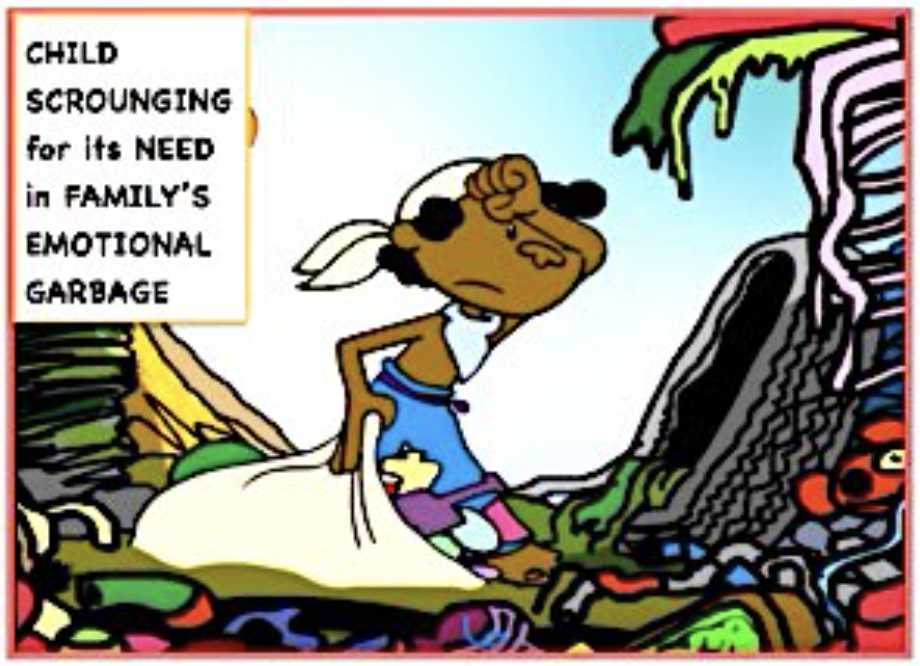
As long as the WIC is still running our life, we focus all our attention outside of ourself. We’re looking for someone to take care of us – to give us permission to even be alive, much less be our True Self

• We do too much for others, & most of the PPT we pick to ‘help’ are just are incapable of being there for us as our family was, with a few exceptions.
Also –
• Because our parents were so angry, depressed & unhappy, ACoAs are convinced (unconsciously) that everyone else is the same.  We project how our family treated us onto every situation we encounter in our daily lives, whether it’s similar or not.

That means we react & behave in the same way we did as kids = that we have to be responsible (R) for others’ feelings & needs, to ‘help’ / fix everyone we deal with, whether important to us or not (lover, parent, sibling, OR “butcher, baker, candle-stick maker”…..) & suppress our own emotions, hopes & dreams.

We BELIEVE that:
• without our intervention – others we meet will also fall apart or put out firesgo crazy, which would be our fault, so we rush in to put out other people’s fires
• if we don’t take care of them they won’t have any need for us, & ‘leave’ us
• by rescuing / saving…. others we will finally become worthy of getting our needs met (‘earning’ love)

⚡️ For prolonged rescuing, we stay with those:
• who are more wounded than we are (assuming we’re not), so we can feel useful, appreciated, even superior
• who don’t want to take care of themselves & could, but live in Victim mode – so would rather we do it for them, since we’re so good at it (& desperate to please)
• who are intensely narcissistic, using us to feed off of, which we agree to, at least for a time, because it makes us feel needed & important

AND, we automatically stay away from anyone who is reasonably healthy – competent, self-directed, doesn’t need or want rescuing…. because they don’t ne-e-ed us & we wouldn’t know how to interact with them as equals!

NEXT:
 Fear of Responsibility – #2c

Anger TYPES (Part 2)

PREVIOUS: Anger TYPES (Part 1)

SITEs: The Primacy of Anger Problems
Anger Problems: A Smokescreen for Fear-Shame Phobia
• 5-min. stress release exercise (Green : Anger —-> Compassion, Love)

⬆️ HAND : Emotions for each finger (painful & pleasant forms), with  senses & body areas, & how they’re connected to the Spinal Column 

🌐
DEGREES of FEAR & ANGER
We can use the temperature chart below to stay aware of what we’re T.E.A. chartfeeling, mainly driven by what we’re thinking, since the combination directly effects how we act (TEAs)

• Whenever possible, especially around people we don’t know, are not close to, or who are unhealthy (active addicts & other narcissists), it’s self-protective & appropriate to only show how we feel on the outside of the Emotion Circle 🔽, because those reactions are milder.Screen Shot 2014-12-26 at 10.41.37 PM
In most social situations, people will be more comfortable around us if we’re ‘tentative’ or ‘pleasant’ — > rather than ‘hysterical’, ‘aggravated’ or ‘enraged’…. making us more likable, which we all want, whether we admit it to ourselves or not. ( 2 CHARTS )

ALSO, if we do let out how we actually feel – from the center of the circle (intense) – it can influence others to become reactive too, as a result of echoing our feelings (via mirror neurons), so that when we:
• get enraged, others may also get angry
• feel depressed, others can get ‘down’,
JUST AS when we:
• get exited, others tend to also feel happy
• feel calm, others can feel more relaxed

REMINDER: This in not to deny our emotions, nor to be co-dependent – worrying about how others feel. Always distinguish between having an emotion & expressing it. It is a reminder :
➼ to stay awake for what’s going on inside, & work on letting the Adult ego state be more in charge, rather than the WIC
AND
➼ that we do have an effect on others – surprise, surprise! which many of us don’t realize – or believe – since our family never saw or responded to the REAL us.

For many of us, we were treated only as a burden, a nuisance or as a useful ‘tool’. 
So now we need to become visible to ourself & choose healthy people to correctly mirror us (validate) – people who have good boundaries & a clear sense of their own True Self.  (MORE…..The Anger Thermostat)

Anger as predictive SYMPTOM of Psychological Disorders

Intermittent Explosive Disorder (IED)emotional illness
Periodic eruptions of anger & rage, which are not in proportion to circumstances, most commonly seen in impulsive young men – but also for some ACoAs.
In this state they may threaten, assault others, harm themself, &/or destroy property. Such eruptions come after a period of heightened internal tension, followed by a feeling of emotional release, & then immediate regret

Depressive Disorders
Diminished self-esteem, heightened self-pity, irritability, low mood, low frustration tolerance – can create anger-control problems. Men are less likely to report depression & anxiety, with ego-shame an underlying cause. For women it’s more likely fear-of-abandonment, loss & rejection.

Anxiety Disorders
Sufferers of Depression & Anxiety are often in a continual state of tension. Their overworked nervous system alternates between hyper-arousal & exhaustion, priming the brain for an anger or rage reaction.

This group includes those with Generalized Anxiety, Panic attacks, PTSD, & Phobias. Also, OCD (mainly physical), setting the stage for resentments, because the person is more likely to hang on to envy / jealousy, fear of abandonment, & fantasies of being disrespected, harmed or victimized – in the present.

Personality Disorders are characterized by overall rigidity & denial.
Obsessive Compulsives : OCPD – mainly psychological, and OCD -mainly chemical – sufferers act as if their life depends on reaching a particular goal or having their demands met. Anger rises when those are frustrated. They are demanding, judgmental & perfectionistic.

Narcissists (NPD) are subject to rage reactions when their desperate need for attention or admiration is frustrated
• Histrionics (HPD) are vulnerable to angry outbursts when emotionally flooded
• Borderlines (BPD) are exceptionally vulnerable to anger because of weak or nonexistent sense of belonging & self-worth. This causes a roller-coaster emotionality, with rage reactions & unstable relationships.  (See all Psych Disorder posts w/ extended info).

CONSTRUCTIVE ANGER
In contrast, for healthy people, anger comes from their Adult ego state, in response to a specific present-day issue, prompting us to act in a positive way to protect against danger, to remove an obstacle in our path, or to right an injustice. (More in other posts).

NEXT: ANGER – ways to react (Part 1)

Why RESIST talking to the Inner Child? (Part 1)

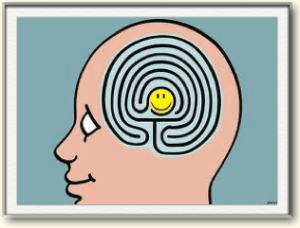
many voicesI CONFUSE MYSELF WITH
many conflicting points of viewHealthy Adult & Healthy Adult &

PREVIOUS: Resist dialoguing, #2

SITE : “Importance Of Internal Dialogue In Leading A Happy & Successful Life

POST:“Ego States – Basics” (Adult, Parent, Child)

TOPIC: TOOL for Recovery / healing IS
Healthy Adult & Loving Parent <–> Inner Child dialoguing

For ACoAs, the GOAL of this process is to shift the WIC’s focus away from believing all the harmful, distorted & untrue things it hears from the Introject – to stop the Child from relying on that voice for it’s identity & way of functioning in the world.
We need to woo the WIC away from the PigP & redirect it’s attention to our Healthy Adult & the newly developed Loving PARENT. To do that we use written & verbal dialogues, gradually replacing the harsh voice which originally created our self-hate

EVERYONE has inner dialogues all the time – called self-talk. We argue pros & cons, debating: “Should I or shouldn’t I?”, we obsessively argue with a ‘real’ person about something that bothers us – but only in our head, we hear the ‘voice’ of our parents or a religious figure scolding or lecturing…. AND no one thinks that’s crazy. SO – why not conversations with our younger self??

A common Q about talking with the Inner Child: “Is it supposed to grow up, go away or what?”
ANS: We want to heal the wounded child & bring forward the Natural one, which is our essence. Then they interact with the other 2 E.S. to make a whole person. (Review ADULT #2)

 🗣FORMS of SELF-TALK
a. Most of the time we think in the ‘I’ form, which is either the Adult, Part or the Inner Child, positively or negatively.
➕ If the statements are positive “I’d rather not do that – thanks all the same, I need more sleep, I’ll study for that exam today…” that’s the Healthy Adult
OR
“I want to see that movie, I looove my cat, give me some more ice cream, I don’t want to be around that —, it doesn’t feel good….” you’re hearing the healthy Child

➖ If the statements in the “I” form are negative, harsh, painful…. then we know it’s the Wounded Inner Child (WIC) who is in self-hate or hopeless mode: “I can’t do anything right, no one likes me, I can’t stand being ignored!, I’ll never get anywhere – I might as well give up….”TAs P:A:C

b. However, when we talk to ourselves in the “You” form, our Inner Parent is talking to the Inner Child, probably without realizing it.
➕ If the statements are positive, then our Loving / Nurturing Parent may say: “You can do it, you’re so smart – I’m proud of you, I know you’re in pain & I’m here with you, you’ll do better next time….”

➖ If the ‘You’ statements are mean, discouraging, judgmental… we know it’s the Introject (PigP / Bad Parent) talking to the Child part of us:
”You should have known better than to —, You could have done that if you’d tried harder, You blew it, you — !, You’re in trouble now! You’re so stupid, No one’s ever going to like you” ….

ACoAs: Notice that our self-talk is rarely if ever positive**, supportive, congratulatory…. Instead, we have perpetual toxic internal voices, with either the PigP haranguing the WIC or the WIC attacking itself, in agreement with the PigP

Some of us have a fairly well-developed Adult (from life experience & native intelligence) but only use it at work &/or to benefit others. Most of us are skating by on the WIC’s version of an Adult – which is very limited & full of CDs (cognitive distortions).
Even when we have a competent Adult ego state, we’re still missing the Good Parent – the main thing we’re trying to create with this tool.

**POSITIVE: Emotions are NEVER negative or positive – are just to be acknowledged, not changed or eliminated.
Only thoughts or actions (T.E.A.) can be helpful or harmful, encouraging or discouraging, useful or wasteful, valuable or worthless, producing growth or stagnation…. SO they can be corrected when they’re self-defeating.
(POST: Being Negative means….)

NEXT: Resist Talking to the IC (#2)

What is Self-Control ? (Part 5)

Screen Shot 2016-01-15 at 7.44.34 AMIT’S MUCH BETTER FOR ME – to be in control, than to be controlling

PREVIOUS: What is Self-Control ? (Part 4)

SEE post: ACoAs Acting controlling’

QUOTE: “To enjoy freedom we have to control ourselves” ~ Virginia Woolf

SELF-CONTROL  and PRESSURE
1. Neutral: No Pressure – a free environment with no competition, where you can do whatever you want. Self-control is based on however you feel at the moment. With no one else to compare to, people will be more -or- less motivated, depending on the urgency of whatever they’re doing, or their ability to self-motivate

ACoAs – re.‘ Neutral’, children left too much on their own, without guidance or boundaries, can end up floundering, lacking self-motivation. Notice : now with open chunks of time we say “I don’t know what to do”,  OR “I have so many things I could do / should be doing – I don’t know which one to pick”.
So we end up wasting the opportunity by doing nothing or just puttering around. Then we feel frustrated & upset with ourself.

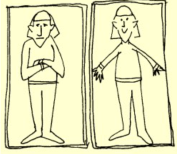
2. Negative: Bad Pressure – In a judgmental & prejudicial environment with no competition, people can get depressed, unmotivated & lose self-control.ocer-control
REVIEW: Emotional Power over others and
Emotional over-Control of oneself are similar because they :
• both try to unfairly influence inner feelings, beliefs, attitudes, values
• are inappropriate internal strategies for dealing with issues, conflicts or mistakes
• are less obvious than physical methods, being manipulative, sneaky, dishonest
• produce subtle results (harder to catch), BUT ↓
• can be identified by resulting signs — depression, discouragement, emotional suppression, insecurity, low self-esteem, negativity & pessimism

3. Positive: Good Pressure – Being in a competitive but non-judgmental, non-prejudicial environment which helps people become motivated, inspired & gain self-control, making them want to be like others around them

STUDY from Humboldt University, Germany:
Broad styles of emotional control can be identified early in life.  This study followed children for 19 years, starting at age 4, then divided them into young people who were –
a. Under-controlled:  disagreeable & lacked self-control. “When feeling frustrated they acted aggressively towards others, n spite of the negative consequences.”
who's in chargeb. Over-controlled: emotionally brittle, introverted, tense, quiet, self-conscious & uncomfortable around strangers. Who “… control their emotions too much, so are less ‘natural’ & spontaneous. Being slow to warm up, they are seen by others as shy.”

c. Resilient (balanced): self-confident, emotionally stable, with a positive orientation toward others. These were “good at modulating their emotions, interacting with others & bouncing back from adversity”

✳️ One observation from the study was that – “compared to the resilient children, the other 2 types took longer to move into adult roles, such as leaving home, starting a romantic relationship or finding a career. Accomplishing these milestones requires social adeptness that the over- & under-controllers take longer to develop….”

COMMENTS : Types a & b are likely the result of unsafe childhood experiences combined with each child’s native style of emotional reactivity. This affects brain chemistry, & therefore how we react to life as adults. Regardless of which underlying personality type we’re born as , pre-Recovery ACoAs are rarely Resilient, but more likely over- or under-controlled, from childhood trauma.

⚡︎ ⚡︎ SO : coming from a turbulent, dysfunctional home, the Impulsive child can easily turn out to be the trouble-maker or drama-queen, AND the Shy one ends up isolated, depressed & marginalized (Scapegoat or Lost Child)

Resilience : b
y comparison, coming from a safe family, Extroverts can grow up to be dynamic go-getters AND Introvert become the quieter ones who successfully use their influence & skills in-the-background.

STUDY – by Jerome Kagan, from Harvard U,  His team used MRI scans to show that the brains of young adults – who were identified as being shy when toddlers – worked differently than the more Extroverted ones when they were small.  Of course, there are many other factors, including class, that make a difference in how children mature.

Ultimately, healthy Self-control is a combination of:
• being in charge of your WIC – by forming a relationship with him/her, so your UNIT is the stronger voice – reasonable, trustworthy & KIND
• AND stopping the PP from bullying the Inner Child into staying hooked by the family disease, who will either rebel or fold in reaction.

NEXT: What is S-C ?  (Part 6)

RESPONDING to Controllers (Part 3)

 Screen Shot 2015-07-06 at 7.55.09 AM
PREVIOUS : Responding to Controllers (#2)

SITE: “21 Common Mistakes to Avoid When Responding to Conflict


WHY ‘Control’ Responses to Controllers (Cs)?
Because it’s Empowering, to not be or stay a victim.
THE GOAL is to heal enough so we can speak up from the Adult ego state right away, but only if it’s safe & appropriate to insure not hurting ourself. That way our frustration, hurt & anger won’t build up – providing short & long-term benefits.
✳️ This ability comes with lowered WIC anxiety (Es) & practicing things to say (Ts)

Being KIND to ourselves
When we react impulsively or fight back we may temporarily feel powerful, but it doesn’t help self-esteem & personal growth. Even so, sometimes it’s the only way to get thru to a C. & stop them from seeing us as weak & vulnerable. Many Cs only understand ‘tit-for-tabe coolt’! even tough it doesn’t usually resolve conflict or protect us from further attacks

• It’s best when we can mentally take a step back (T), to breathe, process how we feel (Es) & check which of our buttons got pushed. If we can address the problem in a positive way in the moment, great. If not, consider what’s best for yourself & maybe deal with the offender later. In any case, the less we RE-act the more self-empowering & peaceful we’ll feel

Freedom of Speech
Other people seem to think it’s OK to say whatever they want, but we are afraid to do the same. We need to give ourself permission to know & express our point of view as well. But over-reacting to volatile or oppositional opinions has to do with our childhood wounds, & not just to what’s being said in the present. Be truthful, but don’t get into a pissing match. Al-Anon : “Say what you mean but don’t say it mean.”

Minimize Negativity
Nurturing all-consuming anger at someone for their comments or actions only hurts us, carrying painful energy into other parts of our life.  Malachy McCourt (actor, writer & participant in Occupy Wall Street, 10/2011) once quipped: “Holding a grudge against someone is like drinking poison and expecting the other person to die.

purpose For ACoAs, obsessions come from our damaged past. We can privately do rage-work, & process our wounds in Program & therapy, so we don’t keep reacting in ways that make us feel bad about ourself afterward.

What’s our Purpose?
To get the most our of life we have to be clear about our goal in each situation & act accordingly.  What our Adult self wants to accomplish & what the WIC wants are often 2 very different things. Any time we get riled up about something, remember it’s the WIC or PP, but how we respond will depend on whether the ‘Unit’ is in charge or not.

EXP: One week-day evening Ally was in a church auditorium waiting to hear a concert. In the back vestibule a maintenance man was polishing the floor with the door open to the lower level, & the machine was very noisy!
Ally went all the way down to the man, asking him to close the door adjoining the sanctuary, but he refused, so she went back & sat down. Immediately a man waiting in the audience also went down to the worker, & lo-&-behold — the door was closed! Ally smiled.
She knew that many years ago she would have taken offense & been very angry that the worker ignored her (a woman) yet ‘listened’ to a man. BUT now she was not upset at all – her only GOAL was to shut out some of the irritating noise – rather than being respected or validated, which was not the workers job !

Where’s the Focus?
The hardest thing for ACoAs is to not take things personally. Whether someone is mean or just tactless – they’re telling us about themselves – NOT US!
It’s most useful to mirror back to them what we’ve heard: ‘Why did you say that?”, or ‘What did you mean by that?”…. Where attention goes, energy flows. We can only focus fully on one things at a time. The sooner we clear up an obsession, the faster we get our life back. Often speaking up for ourself will rebalance our energy.


NEXT: Self-Care around Controllers – #1