Their ATTITUDE Inventory (#1 of 5)

writng inventory 

TAKING THEIR INVENTORY
helps me know what I absorbed!

PREVIOUS: 2011 Blog Stats

See ACRONYM Page for abbrev.


FYI: This INTRO will be repeated for all 5 posts in the series, but with additional topics
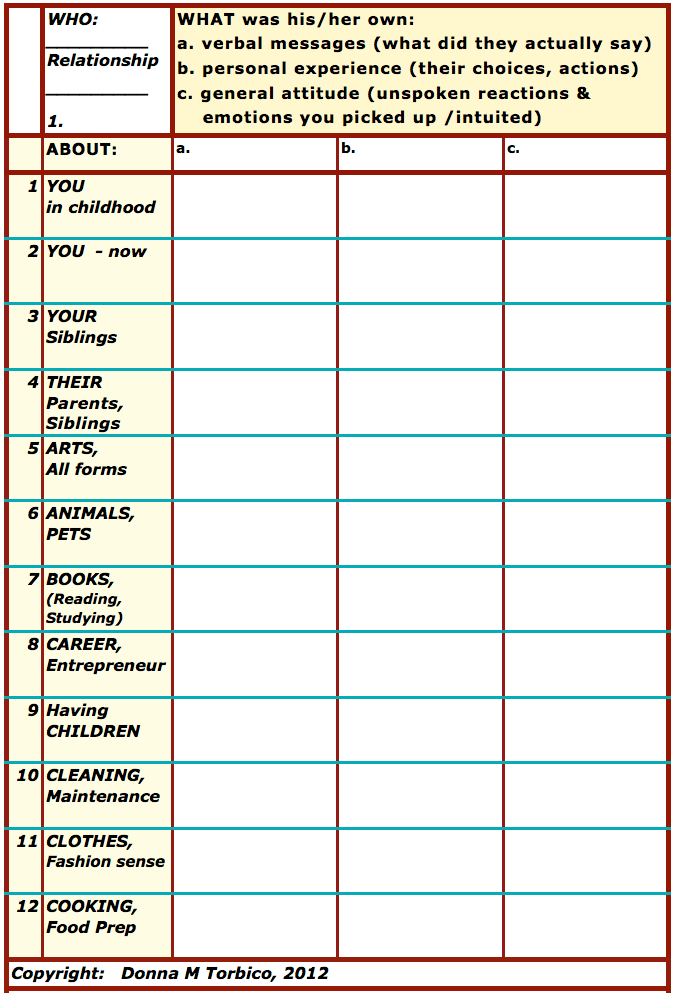
THIS CHART is much more specific & includes listing many of the statements family & others made to us (or we overheard, often) that have become our Toxic Beliefs. More issues in the next 4 posts.
List the people you want to ‘learn’ about.  To start, you can pick ONE you think you know more about & see how far you get.  Of course you can use this chart any way that suits the way YOU process info, so experiment.

* TAKE YOUR TIME. You may feel even more overwhelmed than with the previous chart (there are 62 possible topics altogether). There’s no rush – if you push it you’ll be more likely to give up or to miss important details.

** Naturally you won’t be able to fill in every category for every person. but if you make a separate page for each topic, you can play around by filling in anything that comes to you right away. If you can only write one line per category, start there. Fill in more info at any time later. That can encourage you to work on the rest.  PROGRESS not PERFECTION!

REMINDER: Not surprisingly, many of us don’t remember whatchildhood memories

we heard, felt or experienced as kids – mainly we blanked out from fear, but our unconscious remembers.
As you proceed you might be surprised at how much you DO know, and at what will ‘be revealed’ about yourself as you go thru this exercise.  Siblings, other family members & friends or old notebook/ diaries / photo albums – may be helpful.

NOTICE that for each topic you’re asked to consider 3 aspects:
a. Verbal messages: What did this person actually say about the issue? If we pay attention to the way we talk to ourselves – & others – especially when we’re frustrated or angry – we can hear ‘them’ coming out of our mouth.
Also, if someone you’re inventorying is still alive, you can get it from the ‘horse’s mouth’. Without being confrontational or angry, just slip some questions into your conversation & you may get lots of material for your writing. Even what they leave out is very informative!

b. Personal experiences: this is usually the easier one to remember – what  actions did they take about each issue – what did they go thru? Lots of jobs, kinds of relationships, the many ways they did something stupid / abusive / self-destructive / OR helpful / kind / amusing ….. especially any repeated patterns

c. General Attitudes: This may be the hardest because you are the repository of their unspoken, disowned parts! But there are things you’ve always known about them (or at least suspected) that you may not want to admit. Remind yourself – “I know what I know”. You’re NOT crazy – kids are very intuitive & absorb everything!

Suggested PROCEDURE:
More than likely you’ll be doing this on some kind of device.  Make a separate page for each topic & perhaps each subheading
• OR you can use a loose-leaf notebook, & maybe 3 different color pens
• Take as much room for each a. b. & c. as needed, filling in first the things you’re sure or have an idea about – in NO particular order!

• Include all positive & negative points, to get a rounded picture
• Skip any topics that don’t apply to a specific person or that you simply don’t know about, & include more later
• Add any topics not listed which applies to a specific person
PS: If a topic specifically impacted you – growing up – you can make a separate column / page to comment

NEXT: Attitude Inv. (2 of 5)
THEM Inv 1

Family INVENTORY – Looks

looks inv.
OH NO, THE OLDER I GET  –
the more I look like him / her! EEK!

PREVIOUS: Family Inventory – Overview

See ACRONYM Page for abbrev.

This series of Inventory Qs (© Donna M Torbico, 1995) is specific to the topic of LOOKS, but can be modified to cover almost any other topic you want to evaluate: Food, Money, Sex, Work, House, Religion, Personal & family name, Ethnic / cultural / country background…..

APPEARANCE
Every aspect of our family made a deep impact on us, consciously or not. Since everyone is affected by & often judged by our appearance, we want to look at this aspect first.  It has a direct bearing on how we feel about our own looks – did we grow up proud or ashamed of it?

EXP: A very well known passionate Bible teacher who speaks in public all over the world – is not what most people would call ‘pretty’. She mentioned once that someone unkindly told her she had a “great face for radio”!

At the other extreme, millions of people follow, even adore, famous people who are gorgeous, & imagine / assume they’re also wonderful people. Not so! Many are addicts, cheaters, batters, sexual predators….
OR: Think “Father Knows Best”‘s Robert Young who presented as squeaky clean (in the days before the net & social media) but in real life was an active alcoholic…..

Describe each Q** in as much detail as you can remember, as if telling someone who has never seen them.  If you can’t think of much, start anywhere & then go on to the next point. Leave room for adding to it as memories come up.
If you need help, ASK anyone who also was part of OR knew your family members – what they can contribute
**DO a separate list for each parent & sibling, & any other relative who had an influence on you

1. In your opinion:
• what did each of them look like?
• how have they changed over the years?
• do you/ did you like their looks or not?
• how did their looks affect you?
• did other people have reactions to their looks or to any changes in them – from age, sickness, accidents….?
• who do you most look like & how do you feel about that?

2. What was their opinion:
• of their looks?
• of your? (list their comments)
• how did you feel about that?
— did anyone in the family favor your looks or someone else’s?
— what about others in the family?

3. Is there a pattern to the physical type they preferred or disliked? (gender, color, size…) – even if it now seems shallow or cruel
• What did you think of that?
• Did it affect you in any way?
• Did it have anything to do with ethnic background?

4. How did they dress?
• has it changed over the year? How?
• what aspect of grooming was most important to them?
• if it has changed, what life situations might have contributed to it?
• what was the difference in their choice of clothes at home vs going out?
• did they ever embarrass you by the way they dressed? When & how often? (Drunk?)Screen Shot 2015-08-10 at 3.07.52 AM

5.  How would you describe their style (if not already done so above)?
• frumpy, elegant, sloppy, careful, conservative, hippy, modern…..
• did other people (neighbors, school, church…) comment on their way of dressing?
• how did you feel about their style?
• what other people said?

6. Who chose your clothes & accessories?
• how did you feel about their choices?
• OR did you have to do it alone – when you were way too young?
• what emotions & thoughts did that cause?
• if an adult chose, at what age did that change?
• were your clothes hand-me-downs?
• what effect did that have on your self-esteem & social acceptability?

7. What was their attitude about personal hygiene?
• about themselves?
• about you?
• what effect did this have on you?shows

8. What were their favorite OR hated scent, color, fabric, era…. ?
• were any of these imposed on you?
• how did that affect you?

Add other thoughts relevant to your experience on this topic.

NEXT: OUR Time-Line Inventory

ACoAs – EDUCATION Inventory (Part 1)

school, schmoolSCHOOL, SCHMOOL!
What was it all for??

PREVIOUS: Time-Line Inventory

REVIEW post : “Family Inventory – Overview


TRAUMATIC EXPERIENCE in SCHOOL?
Whether because of moving, bullying, learning disabilities….  it can be cathartic to do this writing, surprising you about how much pain is still hiding under your mental carpet. This is one way to start cleaning out more of the sludge clogging our mental & emotional arteries – that keep up stuck.

IMP: Moving often meant new schools, which meant being the ‘new’ kid each time. In most cases this was a cause for peer-abuse. The more schools – the more pain! 

EXPERIENCE
a. Some ACoAs only went to 2-3 schools throughout our educational life
b. Others of us moved a great deal & so changed schools often
c. Some have had little formal education, but have learned a great deal on our own, by life experience, reading, unofficial classes….
SITUATIONS
✒︎ some of us did very well & gained a measure of self-esteem & positive feedback away from home
BUT we were abused / ostracized by other students for being smarter, favored by a teacher, getting awards, the child of someone ‘Special’, of a different religion….

✒︎ for some it was a relief to away from the chaos & neglect of the home, but for
others it was more of the same – being teased, ignored, deliberately abused….the scream

✒︎for some, we didn’t do so well, not because we were stupid (mentally limited) but because:
✐ it was too hard to concentrate, worrying about the bad things that did happen or could happen at home while we were away
✐ of having to hide physical &/or sexual abuse from everyone
✐ of ADD, illness or other personal difficulties
✐ bullied, made fun of… for being different in some way
✐ we didn’t fit in to the social setting of the school
✐ missed school because of illness – ours or family member
✐ moved often & got out of synch with class level….

The QUESTIONS — Use this as a FACTUAL inventory, at first, so you don’t get too overwhelmed. You can add emotions later, or on a separate sheet

SCHOOLS: • how were they paid for?
• every school you went to (Kindergarten thru college)
• dates, location, names — if possible, or approximately
• was there tuition & other costs?

To be more specific: use a separate page for each of your school years & at the top include the year, your age, the grade & school location.  It’s ok if you don’t know or remember – you may eventually, someone else may give you some info or you’ll leave it blank.  Fill in as much of the following as you can for each year.

FAMILY:last-minute
• what was each parent’s attitude toward school & education?
• what messages did they give you about it?
• how did your home life affect your homework?
• did your parents help with or hinder your schoolwork?
• did you get the clothes, books & other equipment you needed? If not, what happened?
• were they proud of your progress & achievements? Indifferent? Disappointed? How did that feel?

YOU:
For the grammar school years, do the best you can & ask others for info :  • which subjects did you take?
• did you like or dislike these classes? Why? The subjects you remember most easily tell you how you felt about them

• were there special assignments you did better in? worse? What were the teachers’ reactions?school bag
• were you in any clubs, special groups, cliques?
• were you a loner, disliked, ignored, teased, tortured OR liked, popular…

• were you alert, falling asleep, sick, out a lot? visible or invisible in class?
• did you play sports (group or individual)? Was it a positive or negative experience?

NEXT: School Inventory (Part 2)

ACoAs: Our TIME-LINE Inventory

inventory


IT’S INTERESTING TO SEE
my life all laid out so clearly

PREVIOUS: Family Inventory – General

See ACRONYM Page for abbrev.


CHOICES:

Family Inventory charts are next. If you want to start with a Personal Inventory (or have already done one, try c.), here are a few options:

Al-anon “ 12 STEP Workbook ” (as an adult) and12 Steps of Adult Children” (about you & family in childhood)

These 2 books can be done together – one Step at a time – of course! & share each one with a sponsor or therapist. You may need some suggestions on how to answer the various ones, since it’s hard to see oneself. Do not rush, but do it.

If you just want to do a character Self-Evaluation, you can do:
a. the 4th Step of the 12 Step Program: “Made a fearless moral inventory of ourselves”. Most newcomers just write everything they think is wrong with them (personality defects) & all the wrong things they’ve done (bad actions). Actually it’s supposed to include our strengths, skills & gifts, but ACoAs rarely think to do that.
• This can be done with an outline such as the AA version at “Step12.com
• or done ‘freehand’, as things come to you. Then later you can categorize them for clarity.

b. AL-ANON‘sThe Blueprint for Progress” booklet & online

c.  The TIME LINE Inventory (DMT 1986)
This chart may seem sketchy, but can be quite powerful. Because it’s so visual & simple it’s hard to miss the obvious – trauma & repetitions of trauma. You may:
•  find yourself reluctant to start , OR you may fill in some & then drop it. This is most likely because it’s painful & you’re shying away from facing the pain – doing it alone can be hard
•  If you do continue, be sure you have a good support system in place ahead of time when you need encouragement if the emotions that surface come up too strongly. Don’t give up!
WHAT TO DO
•   Tape together as many sheets of paper as needed (20-30…)
•   OR use a roll of sturdy white paper
•   OR a loose leaf notebook with unlined paper
❇️ Doing this online is not as effective, since you can’t see it all at one time. Plus – the physical act of writing is good for stimulating the brain

Draw a horizontal line about 2/3 of the way down, all the way across. At far left put the year of your birth & then mark off every 2 or 3 years with the date and your age, all the way to the present. Leave more space between later 2/3-yr. periods than early ones

Above the horizontal line add slanted lines as they fit your life experiences & briefly write on each one a major event: illness, moves, school, graduations, special events, travel, hospitalizations, awards, relationships, work, physical abuse…. It’s OK if you don’t know the exact date or yr, especially from your early life. Put in everything you can think of, even if dates are approximate. ASK the Inner Child for memories (or reliable relatives)
(USE PENCIL to make changes or corrections)

Below the line write in any event that happened to another person close to you which had an impact on your life: birth of siblings, divorces, illness, deaths, their loss of jobs….

Start anywhere in your lifetime, filling in the things you remember most easily, & then go back & fill in earlier events as you think of them. Ask siblings, aunts…. or anyone who knew you then, who can give you some history you forgot or difind the patterndn’t know. Do the best you can.

👀 When you’ve filled in as much as you can (you can add things at any time) you’re going to be looking for :
•   the recurring pattern of your early experiences
•   how you’ve copied them as an adult
•   what had the most impact on you
•   what did you just realize for the first time now
•   what are you clearer about, that you sort of knew, but hadn’t solidified

IMP: Take your time. Allow yourself to feel all your emotions – sadness, anger, frustration, loss…. Bookend this exercise with someone your trust, & review it with a therapist, sponsor or sibling, if possible.

NEXT: OUR Education Inventory – #1

Inventories – In the Beginning (Part 3)

  birth treeI NEVER REALIZED
how much my infancy shaped me!

PREVIOUS: Inventories – In the Beginning-#2

See ACRONYM Page for abbrev.


2. NURTURE  (cont)

a. Wounded mother
All children are vulnerable to the feelings & expressions of their first caretakers, and will be severely affected by a Wounded Mother. Even if she tries to hide it, every day the infant absorbs her fears, worries, anger, overwhelm – as well as joys, interests, attitudes & reactions she may feel.
For many ACoAs, she was one or more of the following:
Presenting : –– demanding, ruthless, controlling
— self-hating, overwhelmed, with severe abandonment issues
— drunk, self-absorbed & narcissistic
— generally anxious, especially of parenting responsibility, often having to do it alone
OR:
bad moms— distant, emotionally cold, perfectionistic
— passive, flaky, irresponsible
rageful, verbally, physical & emotionally abusive
— un-nurturing, unsympathetic, judgmental, cruel
Unhealthy Expectations:
use child to make up for her own lack of love
— demand child be perfect, self-sufficient & NOT need much

b. Developing Child : At birth, the nerve cells in a child’s brain are not fully developed, growing & expanding continuously until about age 25.
The brain grows in complexity & therefore ‘intelligence’ – according to how much stimulation it receives. This includes a colorful & interesting environment, being talked, read & sung to, and any kind of beneficial movement – touched, held, massaged, played with….

• Because babies imprint (like ducklings) onto caretakers via emotions & the 5 senses, all helpful and hurtful events stay with us forever, some even after much ‘work’, in modified form.
For ACoAs, the wounding experiences need to be inventoried & slowly detached from as much as possible, but it’s not fair or realistic to expect them to all disappear, if only we “did it right”!brain2

PS: We know now that we never have to stop learning & growing – that brain plasticity is possible even into old age, if a person practices new & difficult tasks. In childhood it’s called Developmental Plasticity, which depends more on the effect of the environment.

🔸Early impressions – Infants don’t have verbal language, only emotional & physical signals for communication. They’re highly impressionable – hungrily absorbing all the sights, sounds & touch they’re exposed to.
Each child also has its own maximum threshold for how much activity it needs or can tolerate. Dysfunctional homes force on us too little or too much

🔹Not enough stimulus (of the right kind), so that some areas of the brain don’t form certain necessary pathways, leaving it deficient in whatever type of reasoning or understanding that were affected. This can cause the child to be sluggish in body & mind, always anxious, &/or lacking** fundamental info that will be needed later on to live a ‘normal’ life as an adult.
(**Some antidepressants, as well as Recovery activities, can build missing areas of the brain which were deprived in childhood)neglect

• Being neglected is as deadly as being over-controlled – such as being left alone too much, not nurtured, attended to, guided & included, OR allowed to do whatever the child want. We never get to learn boundaries, options & discipline.

It’s not unusual for ACoAs to have chunks of basic life know-how actually missing (lack of software), to the point of not having a clue about things other people take for granted – common sense, quick responses to crazy situations, the right things to say when confronted, making small talk….

🔶 This is different from info we do have but are not allowed to acknowledge and use. And neither of these states implies being stupid (faulty hardware), but only suppressed & can be reclaimed, or missing & can be filled in. REMINDER : child in orphanage
NO under-functioning ACoA is lazy or stupid, just TERRIFIED.

Some causes creating this debilitating fear :
• isolated, neglected & abused
• not being nurtured, taken care of & validated
• not provided with healthy role models to copy
• being given incorrect & insufficient information about how to function well in the world
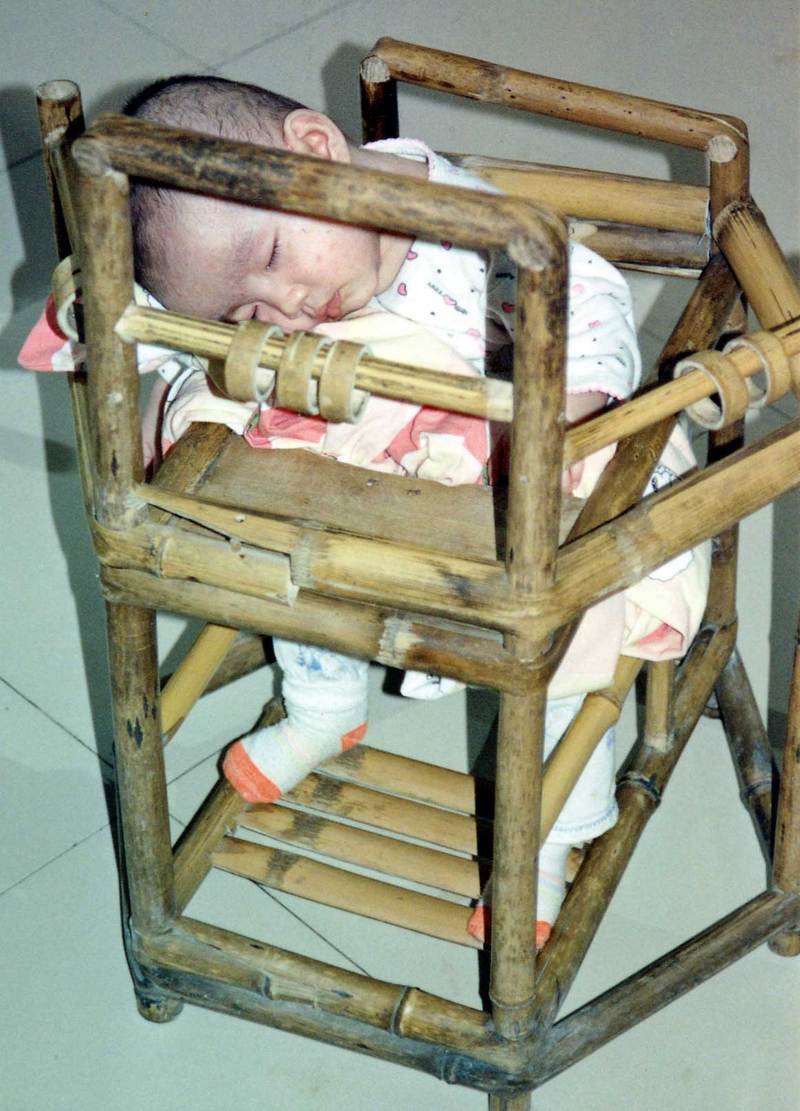
PICTURE: “This child was left unattended for a whole day at a Chinese state orphanage. The makeshift play chair was more like a prison.” ~  Paul Myhill

NEXT: Inventory  – Beginning #4

Inventories – In the Beginning (Part 1)

family portrait 

IT’S IMPORTANT TO KNOW –
where I come from, the pluses & the minuses!


REGARDING Family Inventories: We need to start at the beginning of our life – what was happening inside & outside that effected us.

Our CHILDHOOD
Doing inventories (charts in near-future posts) helps to become familiar with the patterns of thought & action burned into us as kids, so we can start to see why we think & act as we do in the present. Until this is clear we stay confused & full of self-hate, always asking “What’s wrong with me? Why can’t I get anything right?”

We are damaged, not defective, so we can heal
Our early experiences do not have to condemn us to a permanent state of ‘dis-ease’. Under all the defensive layers every person has their own fundamental personality, housed in the Natural Child, who in ACoAs has mostly been ignored.

• Accurate inventories take into account that we’re the product of combined forces:
Nature: our genetics, & who we are natively, with a specific set of characteristics – mostly suppressed, but never destroyed
Nurture: how we were raised – the specific culture, language, religion & parenting style of our home & community (in Part 2)

EARLY EXPERIENCES
• Most people don’t remember their first few years of life, although a few do. In any case, all our early experiences, even those we lived through before we could talk, are still in our unconscious & in our physical body

If those circumstances were stressful or harmful – we need to clean them out by accessing them (as well as later-life trauma) in order to heal.
All the fear, anger, loneliness & desperation of our infant & toddler self may seem ‘forgotten’, which makes it hard for most people to acknowledge that such emotions ever existed. But they do remain locked in our nervous system, & affect us in subtle ways our whole life

• All our pre-verbal energy impressions (Es) are harder to access – but not impossible. The way to get at them needs to be visual & experiential, which includes dreams, drawings, visualizations & experiential therapies such as Gestalt, Primal & Core work Brain Gym….. Using these techniques helps us re-experience those sounds & physical sensations, even without having a complete ‘explanation’ for them

EXP: When one client was asked to picture her conception, at first she was resistant – how could she possibly know what happened? But with some deep breathing & quiet, she gradually formed an image of her parents lying side by side on a bed, as a small spark of light floated towards them – her life-force arriving!

Pre-Birth: All humanpregnancy stresss are affected, long-term, by positive or distressing events a mother experiences while pregnant. For ACoAs, our mother may have suffered one or more of these while carrying us:
• a major illness, accident or crime
• alcohol &/or drug abuse, food allergies, medications
• death of a loved-one, lengthy separations, divorce
• long-term fighting, or physical & emotional battering
• living thru a big move, natural disaster, war….

Birth: this is traumatic at best, but some of us also had:
• an especially difficult birth, causing us injury in some form, almost dying (breach, cord around the neck, not enough oxygen….)
• and/or our mother was given birthing drugs, which got passed on to the us directly, made us sluggish, prone to illness, chemically depressed, immune deficient …..

A possible result: If a temporarily drugged infant is at first unable to respond to the mother in its first few hours or days of life, an unhealthy parent will take it personally & reject her child at the crucial time they should be bonding. She will consciously or unconsciously blame the baby for the lack of connection & love she wants, which will create a life-long wound between them & often results in ongoing child abuse

NEXT: Inventories – Beginning #2

Family INVENTORIES – Purpose (Part 1)

LOOKING AT HOW IT ALL STARTED is not always easy!

PREVIOUS: Personal Responsibility-#1

See ACRONYM page for abbrev.

QUOTE re. the need for S & I
“It is not possible to live too long amid infantile surroundings, or in the bosom of the family = without endangering one’s psychic health. Life calls us forth to independence, & anyone who does not heed this call because of childish laziness or timidity is threatened with neurosis.” Carl Jung
🎯
DEF: INVENTORY – To evaluate & make an itemized report of abilities, assets, or resources. To take stock of one’s life and accomplishments.

1. IN 12-Step TERMS
a. Doing our 4th Step – to write out as many of our qualities as we can – both positive (gifts) & negative (defects), as well as a list of all actions throughout life (to identify our Being and our Doing)

b. Taking someone else’s inventorya big no-no, & for good reason, when understood correctly, is an unhealthy defense mechanism. This can mean recounting someone’s faults to all who will listen, or using a sharp tongue to tell someone off who we’re angry at.

NOT doing this is a valid rule in general for everyone, & specifically – geared toward addicts & co-dependents, because:
• we copy our parents’ habit of always finding fault with everyone & everything else, instead of owning our own thought & emotions (likes & dislikes….)
• of the compulsion to blame others for all our woes, instead of taking responsibility for our part in any situation (but not in the form of S-H)
AND
•  our character defect of using any upset as an excuse to gossip
•  our fearful avoidance of dealing clearly & honestly with anyone we’re currently having a problem with, using the Adult ego state
• the fear-driven habit of avoiding very hard decisions, making small or major changes, leaving toxic people, standing up for ourselves …..

2. LEGITIMATE EXCEPTIONS to this rule :
a. Re. Safe People: To identify the healthy characteristics we find in positive role models, which we then can look for in everyone we associate with, so we can ‘Go where it’s warm’ – toward people who are reasonable (T), kind (E) & functional (A)

b. Re. Unsafe People: to break thru our denial.
ignoringACoAs deal with abusers – either :
• by having thick blinders on, denying the character defects & emotional damage of unhealthy people, while only see our own flaws – even where they don’t exist. OR
• by being terribly judgmental & critical of everyone – including ourselves (S-H), while not trusting anyone with genuinely good qualities. BOTH types tend to shy away from healthy people!

That way we can be angry at anyone for not giving us what we want & need, just like our parents, but stay with them so we don’t have to notice of the many ways they abandon us, & then face having to do something about it (leave?)
AND we can stay loyal to the dysfunction, continuing to long for but never receive the love & acceptance we believe we’re not allowed.

✳️ As we know, people tell us something about themselves all the time – their pluses & minuses – which we miss all together & could see if we paid attention, knew what to look for, & be willing to respond appropriately
OR we do notice but ignore or excuse. Then it bites us in the butt later!

Sadly, as kids ACoAs were brainwashed to deny much or all of our experiences, intuition & perceptions, so it’s particularly necessary to do this type of inventory for all of us who:
• are genuinely ignorant of, or in deep denial about, the harmful effects that addicts & other damaging people we spend time with (family, lovers, bosses, friends…) have / have had on us

• are surrounded by unhealthy communities (family, religious, social, work….) where everyone is continually bombarding us with a distorted reality about us, themselves & the ‘right way’ to do things

• are by nature so idealistic that we only want to see the good in others, as a defense against the dangers of life, to our great detriment
• know there’s something wrong with certain people & situations in our life, but are not allowed to believe our intuition & knowledge.

NEXT:  Family Inventory – Purpose

S & I needs a Heathy EGO (Part 1)

confidence 

A HEALTHY EGO –
allows me to flourish

PREVIOUS: Healthy S & I – #2

SITES : “Ego Psychology”  / / Trans4mind

See ACRONYM page for abbrev

EGO: The way Spirit has of expressing its uniqueness, so without Ego you as an individual would not exist. Therefore they go hand in hand. It’s “the Individuated consciousness of Infinite Being…. and a distinct personality apart from universal consciousness”, says Enoch Tan, in Dream Manifesto

To successfully S & I we need a HEALTHY EGO.  It’s the source of our overall physical, emotional & mental health, in relationship with ourselves & to others. Modern psychologists often replace EGO with “confidence, self-esteem, self-awareness”.

➼ It’s unfortunate that most people misuse Ego to mean ‘arrogant, self-centered, conceited, limiting’…. & therefore a bad thing! Since it’s almost always incorrectly equated with the real problem of adult narcissism, its original meaning has been forgotten. We hear this in 12-Step programs, therapy, ‘spiritual’ literature, even famous people – talking about the pitfalls of ego, such as ‘Oprah’s Lifeclass: The False Power of Ego’

These labels are not correct. The ‘character defects’ being referred to come from our PP or WIC aspects. Neither of those internal ego-states have healthy egos!  Wounded people are said to have damaged egos, split-personalities have multiple egos & psychopaths have fractured egos. NOT having a strong, clear ego causes us to be victims or absers!

NOTE: AA’s 3rd Step says: “Made a decision to turn our will & our lives over to the care of God, as we understood Him”.
In this context, the focus is on the word will. What will? Who’s will? ACoAs are afraid of this Step because it feels like volunteering for slavery to yet another authority figure – in this case the “ultimate” one.
It’s one reason why so many of us reject all religious or spiritual connection, or are drawn to paths that don’t include a specific God-person. The WIC is still functioning from the feeling that “God is an alcoholic parent” & therefore unsafe

• Before Recovery (& even during) ACoAs don’t have actual free will – no matter how headstrong, arrogant or genuinely accomplished. As long as we’re still run by the Toxic Rules, our will is not our own, controlled by the Negative Introject, which the WIC is passionately devoted th-1to.
So, the point of S & I is to find & express our True Self, by no longer obeying the PP.

A NORMAL (healthy) EGO is the ‘eyes’ we use to see the world.  IT IS the :
🌱 aspect that lets us become strong, loving, valuable, contributing members of society, both at work & in relationships – the foundation for “emotional intelligence”
🌱 adult / reality part of ourselves, the “I” that chooses what to think, feel & act
🌱 part that’s separate from our own thoughts, & from the Self of others
🌱 natural capacity for attention, concentration, memory, motor coordination, language & perception.  It is NOT something to get rid of!

• According to Freud, EGO functions on the Reality Principle, ‘sitting’ mainly in the pre-conscious & conscious, but its strong ties to the id means it also interacts with the unconscious. (id = socially or spiritually unacceptable desires)

Ego is the part of the ‘psychic apparatus’ that works to achieve a balance between the id’s anti-social wishes & our personal standards, via the superego.  It prevents us from automatically acting on id-urges, while working to satisfy them in realistic & appropriate ways. This is done through a variety of defense mechanisms, in 4 levels, from worst to best: —-> Pathological, Immature, Neurotic, Mature.  (MORE…. )

Healthy Ego mediates conflicts between the demands of the:
id – the chaotic, impulsive, unconscious part of us, which is instinctive & totally unreasonable (young narcissistic child)
superego – the incorporated values of family & society which become our own Conscience & Ideal Self (Loving OR Bad Internal Parent)
reality – the current social & physical environment

EXP: If someone cuts you off in traffic, the Healthy Ego :
✨ prevents you from chasing down the car & physically attacking the offender (altruism)
✨ tells you that reaction would harm you & the other person, which is unacceptable (identification), that —
✨ there are other more appropriate ways of venting frustration, & is in control of your choices (sublimation)

Psychologist Kit Yarrow says: “A person with a healthy ego is able to see their flaws, learn from their mistakes and forgive themself. They allow others to know them, rather than only see their surface. Because they do – they feel loved. They act purposefully rather than react emotionally to stressful people & situations.”

NEXT: S & I – Ego, (Part 2)

S & I : Healthy Individuation (Part 1)

healthy S & I 

THE REAL ME –
is unique but not alone!

PREVIOUS: S & I  – Separation

SITE: “Extroverts & Introverts…”


INDIVIDUATION
• Individuation is the ‘normal’ search for our True Self – our essence & goal of life.  In the past, mystics called it : the ascent of the soul, the alchemy of the soul, or enlightenment. Carl Jung believed that the nature of humans is to constantly develop, grow & move toward a level of completeness, which can only be done from the inside (opposite of co-dependence).

It’s the progressive development of our own voice, throughout life by trial & error, involving many successes as well as failures & frustrations.
Just like Separation – Healthy Individuation includes keeping our attachment & connection to others (children & parents, mentors & protégés, friendships, mates….) without enmeshment or fusion, in a delicate balance

• Putting Self-Actualizing needs in the foreground, Individuation is to ‘own’ at least 51% of ourselves, by having combined Ego & Shadow, & therefore freeing ourself of the Superego’s tyranny (Negative Introject).
The rest – 49% – is made up of heredity + all our family & social experiences, traditions & religion.
And, because Individuation is ongoing, there’s a periodic need to return to earlier developmental stages – to heal deeper & deeper layers of unfinished business. At the same time, the truer we are to our Real Self, the more INternally motivated we become

•Successful Separation & Individuation requires an intact Ego – the center of our conscious awareness. While providing a sense of uniqueness, the Ego lets us know that we’re just like all other humans – part of a larger whole.

In Jungian terms, the Self is the main archetype in the Collective Unconscious, needed for order & organization, unifying different aspects of personality. Therefore it’s of a higher order than Ego – made up of both conscious (ego = public face) & unconscious (shadow= primitive impulses such as selfishness, greed, envy…..)

✶ Shadow :  For Jung, both constructive & destructive forces exist in the human psyche, requiring psychological integration. To become fully actualized – at the top of Maslow’s “Hierarchy of Needs”- we have to be aware of & accept all our parts.
NOTE:
Ironically, for ACoAs, much of what also gets shunted off into our Shadow are the good parts of ourselves which were not accepted or allowed in our family & society! Having normal human needs such as wanting attention, intense emotions, our own way of thinking & doing things, being heard & respected…. were punished or so controlled that we end up forgetting them OR hating ourselves when they surface

• Jung believed that we don’t suddenly make a conscious decision to free ourselves from the herd, with its well-worn paths, in order to go our own way – ie. to Individuate.
Instead, the deciding influence is an irrational factor he called “vocation – like a law of God from which there is no escape”. It’s the Ego’s response to a call from the unconscious to express our core self , whether we like it or not

• Based on personal & professional experience, he concluded that Individuation happens in the second half of life, when people reach their goals & suddenly find themselves facing an unknown possibility or unexpected upheaval.
This turning point usually is a crisis in mid-life (not necessarily something bad), that upsets the status quo, causing a shift in perspective :
new way– a financial failure    – health problem
– broken relationship or death
– change of residence or profession
OR
– a message from powerful dreams & fantasies, creating —
– deep yearning or “call” to change direction
– profound self-doubt, loss of meaning or religious conviction
– questioning everything previously held as important, valuable or precious

• Then the essence of the personality moves from Ego toward Self, trying to form a new center. Parts that were ignored or under-developed (interests, talents, characteristics, experiences, issues…) may ‘suddenly’ want to be acknowledged
What was:
– fragmented now strives for unity  – broken now yearns for wholeness
– neglected now seeks expression   – formless now starts to take shape

While these changes can be very surprising & uncomfortable, shifting the ground under us, we intuitively recognize they fit our deeply truth

PS: Many psychologists now argue that while Individuation may be a natural outcome of age & experience, it can also be brought on sooner by deep therapy, but it’s mainly considered a life-long journey, which starts soon after birth.

MASLOW's needs

NEXT: Healthy Individuation (Part 2)

Separation & Individuation (Part 2)

TO BE MYSELF –
 I need to let go of them

PREVIOUS: S & I – Intro, Part 1

SITES: Lack of Object Constancy (causes Narcissism & other Personality Disorders)

Hole in my heart   re. BOOK about how Kathy Brous ” ….. accidentally regressed myself back to infancy and healed it all.” Includes interview with Goldie Hawn & Dr. Dan Siegel, about the brain & Attachment Disorder, from lack of Object Constancy in childhood.

S & I DILEMA – every child’s internal conflict between wanting to crawl around to explore their world, & needing to know they can always stay close to mom. This continues – as adults – wanting our needs to be met (by someone else) AND wanting to have personal freedom (autonomy). This dilemma is intensified for anyone deprived of original symbiotic safety.

If we only think in terms of either being dependent or being independent  – we put ourselves in a bind. It’s:
EITHER
• staying emotionally dependent, leading to the fear that if we speak up for ourselves or express our True Self we risk hurting the other person or making them mad – so, losing the connection with them (A.)
-OR-
• we the assumption that being independent means always being serious, being alone, not having fun, taking on responsibilities that we don’t feel ready for, being burdened or trapped …..

✶ However, genuine maturity (inter-dependence) includes a balance of these two needs. How much of each category will vary from person to person, & can vary from day-to-day!

🚴🏻‍♂️ SEPARATION – for ACoAs in the present: It’s about unhooking ourselves from the addictive symbiotic attachment to our dysfunctional family. This separation is not primarily physical, although sometimes that too is necessary, but rather needs to happen inside of us.

🚀 INDIVIDUATION
– the transition from our family’s ways of viewing the world & defining us as a person, to become fully ourselves – the True Self we were born as, but didn’t originally get to know or weren’t allowed to develop

S & I  – Growing up really means shifting away :
FROM– the FS which is controlled by our inner parental sub-self (Introject)
TO– our True Self. This gradually happens as the WIC realizes that it can rely on the ever-present Healthy Core which has actually gained a great deal of knowledge & wisdom over the years.

Our developing ‘UNIT’ (Healthy Adult & Loving Parent) is quite capable of being an effective internal leader & caretaker of the Child in a wide variety of situations, once we access all that accumulated experience.
Keep saying: “I know what I know”! Book-ending helps to make this shift.

DEVELOPMENTAL TASKS Theory (Robert Havighurst)
Development is continuous throughout a person’s entire life, in stages. Moving from one stage to the next comes by successfully solving a problem or accomplishing certain age-related tasks, common to the majority of people in a culture.

Tasks at each stage are influenced by
• biology (physical maturation, genetic makeup)
• psychology (personal values, goals)  • sociology (child’s specific culture) CHART

ORIGINS of S & I Theory describes how people develop an identity – pushed by biological urges & pulled by socio-cultural forces.
🚦🚥 Repeated disruptions in this all-important process usually results in great difficulty creating & maintaining a reliable sense of Self in adulthood.(Margaret Mahler (1897 – 1985)

The S & I  CYCLE – phases
Normal Autistic: (first month) Mahler eventually abandoning this phase, based on later infant research, leading her to believe it doesn’t actually exist – but is still included in many books
Normal Symbiotic : (0-5 mths) when the child is fused with the mother, & together they’re separate from the rest of the world. The infant is aware of its mother, but has no sense of individuality, with a barrier between the two of them & the rest of the world

S & I (6-24 mths), the infant begins to break out of the ‘autistic shell’ of self-absorption, into the world of human connections
Separation is the start of breaking the fusion with mother, developing limits, & the infant’s sense that there’s a difference between the mind of the mother & its own
Individuation is the development of the infant’s ego with a sense of identity & cognitive abilities (thinking), leading eventually to the formation of it’s own unique character – if allowed!

NEXT: S & I (#3)