Enneagram Humor (Part 3)

Croatia girlPREVIOUS: Ennea Humor (#3)

SITE: EnneaType foolishness at work

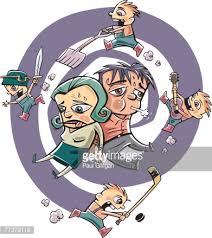
(⬅️ World Costumes by Phillip Martin)


Top Ten Signs You’re a TYPE 5 by Dave
10. You call your plants by their Latin names
9. The more excited people around you get, the more drained you feel
8. You spend time at a party reading the books in the host’s library
7. You communicate almost exclusively by text
6. Most of your friends are on social media, & you haven’t met any of them face to face
5. You consider it a good vacation if you can stay at home with your computer, books, videos, & garden for a week

4. You would like to do point 5 for a living (or already are)
3. You’ve actually read Darwin’s “Origin of the Species” & think it would make an interesting movie
2. Someone asks you how you feel about someone/ thing, & you say you’ll let them know next week after you’ve had time to think about it

1. You bite into a Snickers bar, immediately seeing the correlation between the dissolving chocolate/peanut mixture
AND:
◆ quantum electrodynamics & the potential existence of dark matter in the universe
◆ the association of Mozart’s unfinished symphony & the cryptographic origins of ancient Sumerian linguistics
◆ how the right-handed Cartesian orthogonal system of coordinates aligns with mitochondrial cellular respiration, giving you a new understanding of the role of derivatives in modern financial portfolio analysis
◆ the ennea-grammatic functions inherent in Microsoft’s Windows 98. AND when you try to explain this simple relationship, people have no clue what the H– you’re talking about.

CARTOON TYPES
The PERFORMER
Stype 3 cartoon
Some famous 3s : Truman Capote, Tom Cruise, Cindy Crawford, Anne Coulter, Johnny Cochran, Demi Moore, many CEOs, Oliver North, Oprah Winfrey, Tiger Woods.
EXP:
Sara’s #3 mother’s only response to her #4 daughter – who was in extreme fear over money worries – was: “Your hair is a mess. Why don’t you fix it?”

Twisted Affirmation
To have a successful relationship, I must learn to make it look like I’m giving as much as I’m getting

Fun Quote: Anonymous
You can’t leave footprints in the sands of time if you’re sitting on your butt. And who wants to leave butt prints in the sands of time?

Walking in to a party: Makes sure everyone knows where they went to college, & that they made a million dollars last month

The TRAGIC ROMANTIC
Some famous 4s:  Marlon Brando, Nicholas Cage, Eric Clapton, Ann Rice & her Vampires, Michael Jackson,
Vincent van Gogh, Dennis Rodman, Thomas Merton, Shakespeare, Allen Watts.
EXP:type 4 cartoon
Mitzu’s #4 girlfriend often rants about how women go out in public without putting their face on! “Don’t they know they’d look so much better with makeup?!!”

Twisted Affirmation
I can change any thought that hurts into a reality that hurts even more.

Fun Quote: Kigichi Ishiritari
If life gives you lemons – make grape juice. Then sit back & let people wonder how you did it.

Walking in to a party: Sit by themselves somewhere, & look mysterious.

The OBSERVER
Some famous 5s: Buddha, Dick Cheney, Rene Descartes, Joe DiMaggio, Albert Einstein, T. S. Eliot,
Bill Gates, Lenin, Timothy McVeigh, Jackie O., Sartre, Scrooge
Stype 5 cartoonEXP:
Even tho’ Benny knew his #5 father loved his family, dad spent most of his time locked away in his little office writing & studying, rather than talking to or doing things with the kids – or protecting them.

Twisted Affirmation
I have the power to channel my imagination into ever-soaring levels of suspicion & paranoia

Fun Quote: Garrison Keillor
Intelligence is like four-wheel drive. It allows you to get stuck in more remote places.
Walking in to a party: Look for the exit!

NEXT: HUMOR #4

Enneagram Humor (Part 2)

S.America manPREVIOUS: Ennea Humor #1

SITEs : Obnoxious questions to ask EnneaTypes
• MORE cartoons
Smiley/Emoticons for Type WINGs (12/2/11)

⬅️World costumes : Phillip Martin


MORE TYPE JOKES

Top 10 Signs that You’re a TYPE 1 (Geenius at Wrok)
10. You consider the word “that” in the above title to be crucially important, so it’s not ok to be left out
9. You’ve forever felt yourself “burning with the fires of righteousness”
8. All your life, you’ve dreamed of being a building inspector

7. All the cereal boxes on your shelf are turned so when you grab one, the opened end of the inner bag will be opposite your hand for easy pouring
6. You express brand loyalty when buying reference books
5. You can’t understand why the deli-man keeps putting the onion on top of the cheese, when putting it between the meat and the bread would keep it from sliding out all the time

4. You actually take your sandwich apart to fix it
3. The Scout Law seems, well, kind of OBVIOUS
2. You read “Walden Two” & thought Skinner was really onto something
1. You actually wrote 57 entries for this list, but the other 47 just weren’t good enough

🕶 A 2, a 5 and a 9 go to play golf & end up queuing behind three men who can’t play well – at all. After 30 minutes they’re so annoyed they decide to complain to the golf course manager, who explains :
“These men are blind but they donated so much money to charity that the city decided to reward them by allowing them to play free occasionally”.

The 9 & the 2 are both emotionally moved: “Sorry, we didn’t know & now we feel bad for getting mad a them”.  The 5, however, gets even more upset: “Then why the hell don’t they play at night ??”

😇 How many feeling types (#2, 3, 4) does it take to change a light bulb?
Five: One to turn on the bulb (#3), while the 2s & 4s to relate to the experience.

CARTOON TYPES  

The PERFECTIONIST
type 1 cartoon
Some famous 1s: Hilary Clinton, Tom Brokaw, Harrison Ford, Judge Judy, Martin Luther, Barack Obama, St Paul, The Lone Ranger, Pope John Paul II, Martha Stewart
EXP:
Zina’s #1 mother often said “Of course I’m perfect!” about herself, AND “Look ashamed!” to her little girl when she wasn’t  (just being a normal kid)

Twisted Affirmation
I am grateful that I am not as judgmental as all those censorious, self-righteous people around me.

Fun Quote: Franklin P. Jones
“The trouble with being punctual is that nobody’s there to appreciate it”

Walking in to a party: Point out to the host that they shouldn’t have put the food so close to the door – it’ll get cold
💠
The GIVER
Some famous 2s : Alan Alda, Barbara Bush, Monica Lewinsky, Madonna, Mr. Rogers, Nancy Reagan, John Travolta
Screen Shot 2015-05-17 at 6.47.25 PMEXP:
In her 20’s & 30s Zina (a #8) distanced herself from her unhealthy #2 sister, who would complain to their mother: “Why won’t Zina talk to me? Why doesn’t she love me?”. Now in their 40’s they’re finally good friends.

Twisted Affirmation
As I learn the innermost secrets of the people around me, they reward me in many ways so I’ll keep quiet

Fun Quote: Gordon R. Dickson
Some people like my advice so much that they frame it on the wall instead of using it.

Walking in to a party: Suss out who’s the most influential person in the room & offer to get them a drink

NEXT: HUMOR #3

Enneagram (serious?) Humor

enn humorNEXT:
More humor

3 Cartoons:
Enneagram &
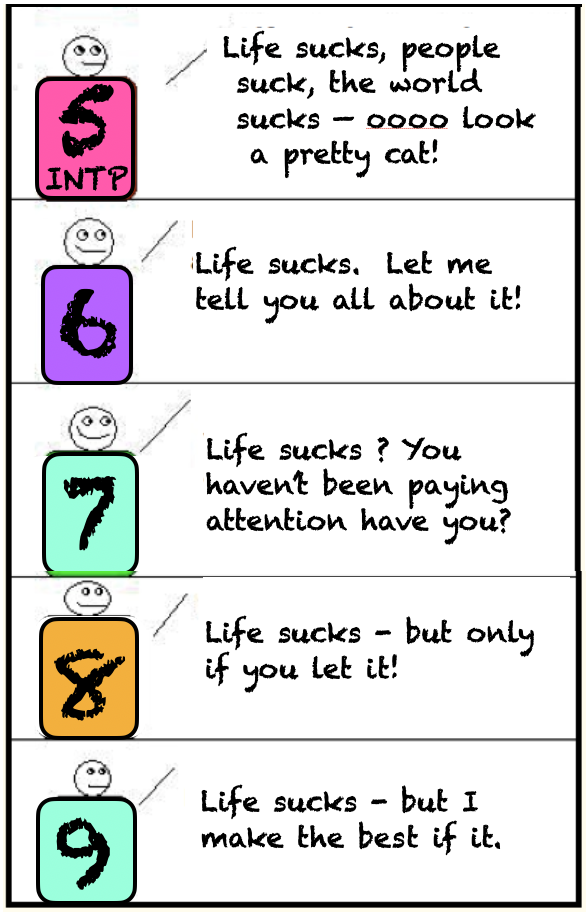
Life Sucks
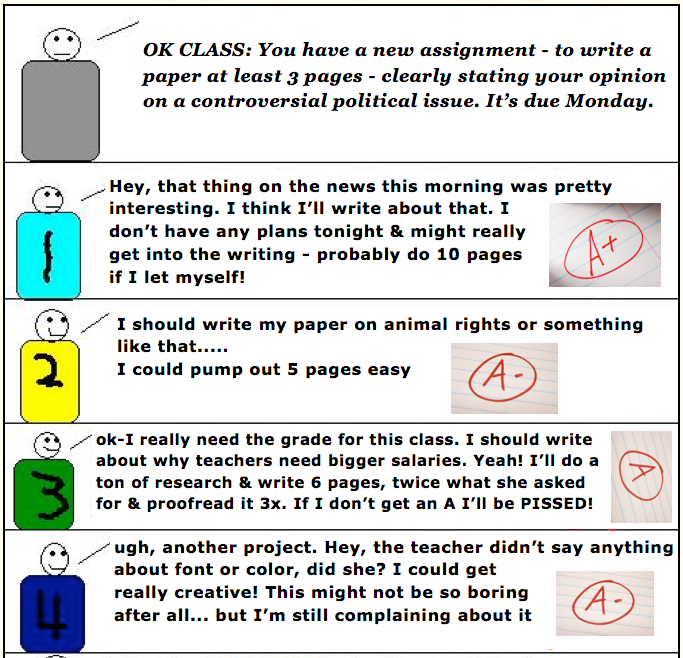
• Enneagram at School

• Enneagram &
Leadership
COMPLAINERS
Enneagram in BIZ  


Enn - school humor 1

Enn school humor 2


ennea group LEADERS

ACoAs & BLAME (Part 1)

the BLAME GAMETAKING RESPONSIBILITY
is a healthier way to live

PREVIOUS: Revenge #2

SITE: “Blame – What’s the Use?” Psych & religious

PostSatir’s BLAMER Role


BLAME as a ‘social disease’
– by Carl Alasko
“Deeply embedded throughout our society is the destructive psychology of blame. We tend to view it as a necessary behavior, a way to seek justice, a synonym for accountability or responsibility. It is none of these.
In fact, blame is a four-headed beast that attacks our very spirit.

We can launch these behaviors separately or fuse them into an assault that can annihilate the intended target. Painful emotions can & do kill. Consider those who commit suicide when battered by just one of these toxic tactics – that of humiliation. Indeed, blame is so unrelentingly harmful exactly because its primary function is to injure.

• There’s also an unacknowledged psychological paradox embedded in blame that preserves its vampire-like longevity : Screen Shot 2016-06-01 at 4.04.05 PM.pngHuman beings are hard-wired to dump their uncomfortable emotions on to others. So blame helps reduce our anxieties by externalizing our fears & stresses.

Naturally this does not excuse or condone it, since humans are also capable of learning how to accept & deal with our inner ‘demons’.

We see how political candidates temporarily surge in popularity when attacking an opponent, which reinforces the ‘value’ of the tactic. Then the opponents responds in kind, & the cycle continues. This dynamic is also at the root of bullying, whether in school or on the street. The bully’s internal anxieties are relieved by debasing another person or group. Thus blame feeds the roots of every form of bigotry, sexism and racism.”

🌀 🌀 🌀

ABUSE / cruelty : ‘Blaming the victim’ is holding someone responsible for pain they have or are suffering, especially when they did not cause it & had no way of preventing it
EXP: Born with some defect, illness, deficiency…..

Adult Blamers, in the present : the mental decision (conscious or not) to accuse someone of causing our suffering (even if accurate), WITHOUT acknowledging any possible part we may have in the source of our pain (sticking around for it, misunderstandings….)

Damaged parents often blame their children & the whole world for their own short coimages-2mings & life stressors (“Your made me hit you! If it weren’t for you I could have…..”). Then it’s only natural that as children we take on the blame. So we learned to:
• hold ourselves accountable for what was not our responsibility, AND
not hold others accountable for their bad behavior, and/OR
• blame others for our troubles, the way our parents did

SELF-HATE is the result – incorrectly blaming ourselves when anyone hurts us, even though we have nothing to do with causing it.
ACoAs IRONY:
While easily pointing out other people’s shortcomings (as it affect us, of course), <—-> being hurt by them triggers our S-H, to deny feeling vulnerable.
Actually, we have it backwards – we blame ourselves for the source of our pain to avoid holding our parents accountable for those original wounds.

Reality : We did not deserve being blamed as kids, & we don’t deserve our S-H now, which is simply agreeing with the Perpetrators. In many alcoholic & other unhealthy families, no one recognized or took responsibility for their abusive or neglectful ways, & certainly never for their twisted thoughts & disowned emotions.

• It’s imperative for ACoAs to identify when or if someone is actually doing something harmful, neglectful, abandoning – to us or to others. If we are not sure, we can start by making a list of all the ways & times various people have hurt us or our loved ones, & look for common threads. (22 POSTs : “What just happened?” re. Noticing Painful Events)

This inventory is a sincere effort to clarity what we’ve experienced, especially when at the hands of someone who is taking out their damage on us.
The legitimate motivation for this kind of writing has to be the desire to identify & distinguish between:
• when we’re angry because of unrealistic expectations & assumptions, vs.
• breaking denial about harmful relationships we hang on to, so we can outgrow the addiction to abuse

NEXT: Blame #2

REBELLION vs Compliance (Part 1)

 YOU CAN’T MAKE ME! (OR)
I’ll do whatever you want, so you won’t leave me

PREVIOUS: Wanting Revenge #2


REBELLION

1. HEALTHY

• This is normal for the teen years, when you’re trying to figure out who you are, what you want to do ‘when you grow up’, so you’re not a carbon copy of your parents (yuck), wanting to be part of your peer group….

• In a reasonably healthy family you’re given a certain amount of leeway in this, to grow & stretch. Healthy parents are not threatened by this stage – even if it makes them uncomfortable & a little nuts. They know you’re a separate person & will find out for yourself
• It does not mean they neglect you, ignore what you’re doing or just can’t be bothered. It means they’re watching & waiting, and caring, not overly imposing themselves – but also not OK letting you get into trouble!Screen Shot 2016-06-12 at 5.16.58 AM

• When you’re allowed to be different from your folks, can disagree with their politics, religion, philosophy of life, or just plain – what to wear – eventually you get to find out what you really like & don’t like, who the real you is!

• Kids with this kind of freedom eventually (usually by their 20’s) find they do in fact agree with much of what they grew up with – the values, tastes, lifestyle… even if expressed in their own personal way.
AND ways they are different from family is accepted & maybe even admired – or at least respected.

2. UNHEALTHY
However – if you’re reading this, you probably didn’t grow up in that kind of family!  As ACoAs:
a. Neglected : if we were ignored, unguided, un-nurtured – we would, of course, be left with a lot of anger, sadness, loneliness & a deep sense of hopelessness. As kids, we would Screen Shot 2016-06-12 at 5.16.16 AMconclude that we didn’t matter, were invisible, had no reason to do anything for ourselves, & are incompetent anyway.

• Maybe a relative, a neighbor or teacher took an interest in us & helped some – but it’s not the same as having our parents explain things, show us by example & help us try out things. Everything from personal hygiene, cooking, house repairs, arts & recreation, social skills – to homework, relationships, spiritual practice….

Our Reaction
THEN
: We spent a lot of time alone, daydreaming, hiding out, reading, studying, maybe hanging out in the library, with a friend – but not likely.
NOW: ACoAs in this group don’t accomplish as much as they could, have trouble pursue dreams, goals, talents, interests … in spite of being just as talented, intelligent & capable as any other human being.
After all, if our parents couldn’t be bothered to teach us how to do all the things kids need to know, so how can we possibly manage anything ourself ? !

• This may not seem like rebellion – but it is.  It’s passive resistance: “If they didn’t take care of me, I’m not going to take care of me!”.  True, there’s fear, a deep sense of not knowing how, but the refusal to try comes from rage, which underpins the passivity.

Even so, some of us were told that they love us – even though they rarely or never acted like it. In stead, WE are the ones who love them – desperately, no matter how cruel & neglectful. We’re the ones who don’t want to let go!

b. Over-Coerced : At the other extreme, many of us were bullied, over-controlled, Screen Shot 2016-06-12 at 5.15.41 AMmanipulated – forced to do & be whatever one or both parents (& other caretakers) wanted, with little or no regard to our individual personality.

• As kids we were considered ‘tabula raza’ – that’s Latin for blank slate. Parents of the baby boomer generation (& before) were taught that children come into this world with no identity or personality OR that they’re born bad, & it’s up to the parents to form them according the what’s ‘right’ – to write on the slate as they wished.

• Alcoholic & other narcissistic parents, who by definition had low self-esteem & fear of abandonment (FoA) themselves, could not tolerate any sign of individuality in their children, ⚡️which they stubbornly assumed to be disobedience, deliberate disrespect, even perversion!
☀️Such parents / family ruthlessly suppressed the reality that every child is born with their own specific personality type, & genetic makeup (even twins) which needs to be acknowledged & nurtured.

NEXT: Rebellion vs COMPLIANCE (Part 2)

PARENTS BLAMING US (Part 1) 

being blamedWHY IS IT ALWAYS MY FAULT?
No matter what I do, it’s wrong!

PREVIOUS: Rebellion vs Compliance #2

SEE posts : What is Guilt?
What is Shame?
• ACoAs’ Need for Revenge


INTRO

There is a lot of talk in the ‘spiritual’ community about forgiveness, ie – that we should not be blamers.
Not blaming ourself (S-H) or others (attacks) is a good rule for us in the present – now that we’re adults. And that’s a discussion for another post.

However, those same teachers & preachers never talk about what was done to us as kids – that among many other types of harm, our parents unfairly, inappropriately blamed us for all kinds of things – and what that did to our tender & vulnerable developing sense of identity!

This post is about what happened TO US as children. A hallmark of alcoholic & other emotionally unhealthy families is the mistreatment of their children in all 4 of life’s aspects: Spiritual, Emotional, Mental, Physical (PMES).

😿 Parents blaming their children for ANYTHING is ABUSIVE. Blaming us is the same as holding us responsible for their deficiencies & unhappiness.

Remember – abuse is not just Physical, in its various forms. Abuse encompasses all the ways people harm others – especially their children – by injuring another’s rights, self-esteem, mental clarity, sense of safety, emotional equilibrium & boundaries. So Blame fits into the other 3 categories – M, E & S..

👥 A variation on parental Blame is a constant and negative COMPARISON of a living child to a dead or other living sibling, another relative, a famous person….  “Why can’t you be more like ____”

1. IN OUR CHILDHOOD
✅ Damaged parents blamed YOU for things WHICH :
a. were NOT your fault
• your difficulties because of a learning disability, like dyslexia or ADD
• the illness or death of a parent; a parent being left by a lover or spouse..

b. was a projection
of what the parents were guilty of being (fearful, irresponsible, lazy, feeling unlovable, risk-averse….)

c. you were not doing
what you were accused of
• being a ‘whore’ when you were too young to have had sex at all OR
• of seducing a parent’s lover/ spouse, when that adult was actually sexually abusing the child
• of using drugs when you never did – at least not at the point…) Screen Shot 2016-06-12 at 5.07.37 AM

d. you could not do, especially without any instruction, & then accused of being stupid
• when you legitimately couldn’t know something (fixing a car or other machinery, shopping by yourself, def. of a big word…)
• ‘getting’ a hard school subject
• expected to know how to fix a parent’s personal, sexual & financial problems
• forced to take care of a drunk or crazy parent, alone…
WHICH
e. were truly no one’s fault. EXP :  • an act of God
• being born with a physical or mental limitation
•  getting severely ill or having an accident…

f. you were held responsible for –
 something one of your siblings or other child did, especially if you were the Hero or Scapegoat (start a fight; steal or break something; get into trouble at school…)

g. your parents were jealous of, because they couldn’t do something you could, even as a youngster (a natural skill or gift), so they made that ability stupid or a bad thing

h. was mostly not true
always lying (“Kids always lie so we can’t believe anything they say”)
always being stubborn, selfish, too sensitive, difficult, disobedient, stupid….

➼ This last category are a group of normal childhood characteristics which:
√ sick parent cannot tolerate because of their own issues
√ occur sometimes as a defense in the child because of family abuse & neglect…
√ happens occasionally because kids are human ie. imperfect.
Those behaviors & attitudes then get demonized – which make them a ‘sin’ and more likely to continue, causing the child to TRY becoming perfect’. We CAN’T WIN in a sick environment.

NEXT: ACoAs’ need for revenge

ACoAs – “Being Negative” (Part 5)

positive thinking

 EVERY DAY I REMEMBER TO FOCUS
my thinking on the good things I already have!

PREVIOUS: Being Negative (Part 4)

SITE: The science of Happiness (“Happify” Website)


TROUBLE letting go
of negative thinking /talking – WHY?
• it’s strongly imprinted in our brain from years of ‘practice’
• it would require S & I from the family, which is never easy
• denial: we have a hard time noticing how often we think / talk that way

• it gives us a sense of false ‘control’
• no one would know how bad we had it growing up
• we get something out of it (Post: Negative Benefits)

• we don’t see the value in thinking/speaking positively, believing it’s for wimps, pollyannas or dummies (who don’t know what’s real!)
• we think it would be denying / our pain & suffering
• we use it to punish ourselves for being imperfect

CONSEQUENCES of Negative Thinking (NT
a. MENTAL: • it leads us to assume that any mistake is a failure, which will expose us to criticism/ judgment, like in our family
• tells us we should be able to make big strides quickly & easily, & that since we can’t – we lazy, stupid or hopelessly stuck
• it prevents being able to think of alternative solutions to problems
• when the brain tries to deal with a complex task, being inundated with NT slows down its capacity to process information & think clearly – by as much as 50%  (More…)

b. EMOTIONAL• can easily lead to depression, assuming we have to be perfect, & to being trapped by our own unrealistic standards
• can cause anxiety, leading to unhealthy coping mechanisms

c. PHYSICAL: • it’s harmful to the body, since negativity lowers its defenses & subtracts from our energy
• because NTs are so painful we can easily turn to addictions to escape (food, money, sex, alcohol/chemicals, relationships….)

d. PSYCHOLOGICAL: • is an obstacle to personal growth, making any change feel too overwhelming & painful
• it makes it hard to see & acknowledge the small steps in progress we DO make
• it denies or ignores possibilities that would improve life, & prevents receiving abundance
• it wastes time & energy, which could be used to heal old wounds & pursue healthy goals
• it convinces us that any form of risk is ‘life-threatening’

e. SOCIAL: • causes many personal, social & work problems
• has a downer effect on others we’re regularly around
• prevents us from relaxing & let our guard down, always second guessing ourselves  (Cognitive Therapy Guide

OUTGROWING NTs – change/modify things that contribute to it:change to positive
• start with AWARENESS of what you’re saying to yourself, what’s causing the ‘stinking thinking’, & the harmful effects it has on your life (& on others)

• slowly clear up practical problems which you have some control over (changing college course, job, spouse…., pay off debts, go to 12-Step meetings, do something creative/artistic….)

• try not to actually speak any negative thought out loud (develop personal boundaries instead of giving in to S-H).
If you feel the urge to criticize or get angry about something, shift to another topic if you NEED to talk

• accept/believe that positive thinking/speaking is a big plus, personally & socially. It does NOT mean being mushy, drippy, girly, sacrificing your opinions/ tastes/ values, or never objecting to something ‘wrong’
•  if you’re depressed, get the help you need to deal with it

• become acutely sensitive to the fact that some topics you’re interested in are intensely emotional (illness, jail, abuse, death, loss, war, politics, putting anything or anyone down….)

By your logic, these topics may be ‘perfectly normal’, interesting, current…. .
But when they’re inherently unpleasant, it is not respectful to foist them on others. It can easily sour the mood of a group, bring up old pain for someone or hurt someone’s feelings.

Naturally, such topics are appropriate in a group specifically designated for that (therapy group, 12-Step programs….)

• Notice how you feel when around another person who’s always a ‘downer’. Be willing to admit you may sound like that, & work on changing your own pattern – from the inside out.

NEXT: Being Negative #6

ACoAs – “Being Negative” (Part 3)

EVERYTHING & EVERYONE sucks up my air!!

PREVIOUS: Negative Thinking (#2)

SITE: ▪︎ Complaining Rewires Brain for Negativity.… 


YOU’re thinking is too negative IF YOU :
• are always complaining about things, even when it’s in a rational, logical-sounding way, “This —- is an interesting tidbit to mull over”
• constantly notice the flaws in things (people, activities, ideas)
• have a tough time seeing the bigger, overall positive picture
IF YOU
• get a secret pleasure being negative along with someone else, or tearing something down
• see a flaw in something & just have to let everyone know, getting a little rush from being ‘right’ & superior
• think positive people are naive or fake, have low standards, easily impressed

YOU’re too negative WHEN:
• even a trivial flaw in something (good) will ruin it for you
• someone suggests an activity or product, & you’re quick to point out why it won’t work or why it’s a bad idea
• things get under your skin &you  ‘have to’ rant about them to anyone who will tolerate listening
negativityWHEN :
• others talk about the positive aspects of something – you just have to say, “Yeah, but…” pointing out its limitations or weaknesses
• something’s realistically going well, but you’ve got plenty reasons why it’s dumb, no good, won’t turn our well, is impractical ….
(from SuceedSocailly.com)

NEGATIVE thinking can come from copying our family, a personality trait that gets over-expressed, or seen as a ‘useful’ trait.  YOU:
• picked up a negative style from people we grew up with or around
• rely on negativity as a crutch in conversations. You wouldn’t know what to say if you weren’t complaining about or trashing something
YOU
• romanticize negativity, thinking it represents being a deep, complicated, tortured soul
• often get worked up about things & then vent, because it feels great
 –OR-
• are a little too rational. Not in touch with your own emotions, & don’t realize negative comments are harmful to others
YOU
• think that getting others caught up in your personal troubles is a reliable way to ‘stay connected’
• think you’re being ‘intellectual’ – as if pointing out flaws in everything (unsolicited, unprovoked) is proves analytical ability & honed critical thinking skills
YOU
• associate negativity with having refined tastes, as if putting down ‘mediocre’ things would show how discerning you are
• connect being cynical & overly skeptical about life with being ‘in the know’ or aware of how the world really works
• may think it’s just your style of humor – a way to be a clever, observational comedian or commentator. NOT!

Negative Thinking (NT)
1. re. OURSELVES
• Anyone reading this blog & other self-growth material, going to 12-step meetings & therapy – knows this category of NT is a core issue for ACoAs. It’s called self-hate (S-H) – powerful, deadly & tenacious! If our parents were unable to love us unconditionally OR not at all (no matter that they said), we concluded it was because we weren’t worth it

✶ So, our WIC is still sure that if the family didn’t make us feel wanted, safe & accepted, why would anyone else?
We think cruel things about ourself & even say them to others, while secretly being smug about being victimized by the whole universe!
Playing the role of the victim -now- allows us to not be responsible for our own life, while protecting the illusion of coming from a loving (or at least an ok) family.

2. re. Personal RELATIONSHIPS
NT (S-H) tells us we’ll NEVER:
• deserve love, validation, respect, peace, joy, success….
• even know what love is, even though we have indeed loved (children, animals, mates, activities, careers, locations, certain foods / arts …)
• be liked (much less valued) by healthy ‘normal’ people
• be able to leave bad relationships because it would condemn us to being completely alone (forever)
NEVER
• have the right to healthy, loving connections (family, friends, lovers…)
• have anything positive to offer others (personality, skills, experience..)
• have the right to look for & interact with accomplished people & other peers who we could enjoy & benefit from
SEE “The 12 Worst Relationship Mindsets (based on CDs)

NEXT: “Being Negative (#4)

ACoAs – Dealing with CRITICISM (Part 3)

PREVIOUS:
 Criticism (#2)

SITE:  “How to give Constructive Criticism


Getting VALUE out of Criticism

Whatever style of communication being ‘sent’, remember you’re not responsible for what others say, but only for how you react.
Using our Adult ego state, we can have our internal feelings of hurt, anger, disappointment, confusion…. but it’s more self-esteeming if we don’t justify, over-explain, attack, or cause a scene. If we challenge the other person, it may escalate into an unnecessary & possibly damaging argument

Ultimately, if the constant criticisms are in fact judgmental, controlling, manipulative, attacking our character…. then it’s wisest to walk away, or be very brief in our response (See “Effective Responses” & “Useful, Clever responses”)

😣 Suggestion : No matter what – it’s not empowering to be defensive or try to ‘make them see’ – which comes from the WIC. (see ‘ACoAs & Anger’ post). This is especially important when dealing with family, a mate, friend or boss – IF those people are in the habit of being emotionally abusive.

However, if the person offering criticism is reasonably fair-minded & genuinely wants to be helpful, you can :
1. Think of the criticism as a ‘suggestion’ rather than a condemnation or a command. Consider what you’ve been told carefully, thinking it over & looking at it from different angles.
KEEP in MIND: If you’re having a rage or S-H reaction then it’s an old wound, so it’s best to process that first (in 2-handed writing, therapy, Program….).
ASK yourself:Self diagnosos
• is the criticism accurate & I’m ashamed of being exposed?
• is it similar to what I heard a lot growing up?
• is the ‘thing’ being criticized related to a deep need or longing in me?
• is my criticized behavior the result of my damage, or a disability (ADD, dyslexia), because of a recent trauma, a change in meds?…..

OR are you actually being misjudged & you just want to kill?  ACoAs :
• get enraged when accused wrongly –  growing up there was no justice, no one took our side or wanted to hear an explanation of our reality…. AND
• feel terrified when accuse rightly! – as kids we got severely punished, often unfairly, leaving us feeling deeply alone. Nor did we get the right info to learn what we did wrong & how to correct it!

2. With due consideration, decide what you think of the criticism
a. If you do not agree, either wholly or in part, take the time to form your reasons, based on intuition, experience & positive information. You may or may not choose to express this to your critic, depending on how important it is to your well-being or to your work, & depending on whether the person is dangerous or not – to your livelihood or health

CONSTRUCTIVE CRITICISMb. If you do agree, hopefully you’ll have dealt first with any negative fallout from you WIC or PigP.
No one can be perfect – it’s not human! Agreeing with the other person is not an admission of failure or worthlessness!

Double check:
• ASK yourself if there’s any reality to what I’m being told
is the Sender simply telling me about themselves – nothing to do with me? Or are they seeing me clearer than I can see myself?
• Did the ‘sender’ provide any alternatives? Were they useful?
If you’re not sure, ask someone else – who is safe & trustworthy.

•  if there is some truth in it, am I interested in making a change?
• if they may have a point, do I have the courage to ask for more information & suggestions?
• if I don’t agree with the criticism, can I keep my ‘center’ & either not evaluatingsay anything, or just say Thanks & drop it?

IMP:  Consider how you can apply the offered suggestion to your actions or way of communicating.  Whatever you choose to change must be suited to your personality, abilities & current circumstances.
• Once you’ve made a change, note how it has helped or hindered you. Was it a good, neutral or bad outcome? How does it feel?
• If one revision didn’t work very well, don’t give up. Try others

ACoAs have a hard time knowing the difference between the + & – types. In either scenario always try to remember that you can use criticism to your advantage.

REVIEW posts:‘What to do when confused” // “Victims or not?
What just happened?” // “Noticing Painful Events” //
Positive Responses to Painful Events 1-5” // “Actions – Healthy opposites

NEXT: ACoAs Being Negative #1

ACoAs – Dealing with CRITICISM (Part 2)

being criticized

PREVIOUS:
 Criticism (#1)

SITE:  “Varieties of criticism”(Aesthetic, Moral, Practical….)


Managing CRITICISM
Any form of criticism challenges our thinking, behavior or skill, so it’s normal to feel uncomfortable.
When we are dealing with actual criticism we need to understand what we’re hearing : not just when feeling judged, nor when our essence is being attacked, even just a comment about / disagreement with our ideas or actions.
Is it legitimate vs. negative ‘feedback’? Are the comments constructive or destructive?

1. Are we receiving
Hurtful criticism? This is most likely a form of thoughtlessness, not consciously meant to injure, but can nevertheless be insulting or just insensitive. It’s usually ‘perpetrated’ by garden-variety narcissists who are simply expressing their point of view, as if it’s a given that others will see the world the same way. (“That’s a stupid thing to say” // “I can’t believe you didn’t know that”…..).
They’re generally unaware of their effect on the listner’s emotions & sensitivities, since only their own feelings & ideas are real to them

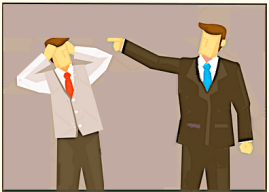
Destructive criticism? This type is a direct attack on someone, generally given with the intention to harm, belittle & destroy the other’s creationcriticism, prestige, reputation &/or self-esteem.
It’s malicious & harmful, meant to show that the person or object being attacked has no worth or validity, so no practical advice or suggestions for growth are included.
Naturally, this can do a lot of damage, & in some cases trigger verbal or physical retaliation.

While anyone is capable of this kind of attack – occasionally, & under great stress – here we’re talking about people who use this style as their main way of communicating about anything they don’t like or don’t approve of.

Generally, they’re the angry, controlling narcissists, who may or may not even notice other person’s feelings, and don’t care. They want everyone to be like them & can’t stand anything that isn’t.
Under the facade of superiority they’re deeply insecure, so bringing others down boosts their False Self, & temporarily satisfies their ego.
EXP: “You’re wrong. You’re always wrong! // You shouldn’t dance – you’ll just embarrass yourself // You have lousy taste”……

2. OR are we being offered:
• Constructive criticism? The Sender also points out ‘issues’, but without attacking the Receiver’s identity, AND may include practical advice on how something can be corrected.
That way the Receiver can choose to improve – but only if they agree with the solution AND if it suits their personality.

When using gentler language, constructive criticism aims to help the Receiver function better in the future, by kindly suggesting what to work on, & without arrogance (as in “do it my way or you’re stupid”). Therefore, it allows the Receiver to consider.

EXP: “I like your painting. Would you consider adding brighter colors?” // Your Math grades would improve if you let a tutor help // Practice keeping your back straight so you’ll feel stronger & more confident….”

HOW something is said is just as important as what. Suggestions & alternatives are offered without the Sender being manipulative, insistent, or superior – as if only they have ‘the answer’.  This usually makes it easier to accept, even if it may still hurt a little.
As a Sender:
📌 FIRST, be sure it’s appropriate to put your 2 cents in
◆ if you feel the need to tell someone a harsh truth, be sure it’s not offensive
◆ make it clear it’s your personal taste, & just your opinion – even if it’s based on first-hand knowledge or hard-won experience
◆ if you’ve tried your best to be respectful, but it’s still taken badly, then it’s not your responsibility to fix their hurt feelings or pride

As a Receiver:
a. If you get negative criticism you can say :
• “Thank you for sharing”
• “Ouch, that hurt, now say it nicely”
•  OR – just shake your head, change the subject or walk away.
Do NOT try to convince them they’re wrong, or get into a fight. It never works.  If the comment is simply not relevant to who you are – just say “Thanks for the info” or “That’s not helpful” & move on

b. If you get helpful / constructive criticism:
❥ always take it positively. Think about it, & if it applies, use it to grow. Remember that anyone willing to be careful in how they talk to you is reasonably healthy, & likely care about you as well, so take it as a sign of love or at least of goodwill .

NEXT: Criticism (Part 3)